

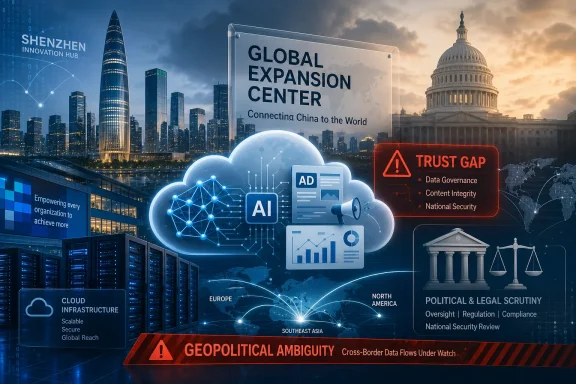
Microsoft and eclicktech launched the Shenzhen Global Expansion Center in China in May 2026, with local Shenzhen and Luohu officials supporting a platform meant to help Chinese companies expand overseas using marketing, compliance, cloud, and AI-related services. That would be an ordinary globalization story if the partner were almost any company other than Microsoft. But Microsoft is not merely a software vendor with a China business; it is a pillar of U.S. government computing, a frontier AI player, and a company still recovering from a national-security trust deficit of its own making.
The controversy is not that Microsoft opened a lab and handed over a model checkpoint. The company says this is not a research or development center, does not conduct AI research, and is more properly understood as a marketing and advertising training initiative. The problem is that Washington’s argument about AI competition has moved beyond export-control paperwork and into a broader question: should the same firms selling secure infrastructure to the Pentagon be helping Chinese technology companies internationalize with American platforms, AI tooling, and ecosystem access?
The Shenzhen Global Expansion Center was unveiled into a political environment that has lost patience for nuance around U.S.-China technology ties. In April, the House Select Committee on the Chinese Communist Party held a hearing explicitly framed around China’s campaign to acquire America’s AI edge. By May, Microsoft was appearing in Chinese-language promotional material as part of a center designed to connect local companies with global AI resources and overseas business opportunities.
That timing matters because Microsoft’s public story in Washington is increasingly patriotic. It talks about American AI leadership, secure government cloud, cyber resilience, and the need for trusted technology infrastructure. In China, the new center is being marketed around helping Chinese enterprises “go global,” with Microsoft contributing AI technologies, platform capabilities, and access to its ecosystem network.
Those phrases may mean relatively mundane things in practice: Microsoft Advertising, Azure business support, cloud onboarding, partner introductions, compliance briefings, and marketing know-how. Yet in Washington, language like “AI technologies” and “global ecosystem” does not sound mundane when attached to Chinese startups, Shenzhen government support, and a company deeply embedded in U.S. defense and civilian infrastructure.
Microsoft’s defense is carefully drawn. It says it does not operate the center directly, that the project receives no government funding, and that it is not an AI research facility. That may all be true, but it does not resolve the strategic ambiguity. The line between marketing enablement and technology enablement is getting thinner in the AI economy, especially when global expansion now depends on cloud infrastructure, data pipelines, automated customer acquisition, localization, and AI-assisted product operations.
The awkwardness is that Microsoft wants policymakers to judge it by the narrowest technical definition of what the center does. Critics want to judge it by the broader geopolitical function it serves. Both are looking at the same project and seeing different risk surfaces.
That description does not sound like Skynet in Mandarin. It sounds like a chamber-of-commerce machine attached to Microsoft’s global advertising and cloud ecosystem. Shenzhen has spent years cultivating exactly this kind of export infrastructure, because China’s next phase of technology competition depends not only on making products but on selling them abroad.
That is precisely why the center has become politically radioactive. The United States is trying to slow the diffusion of frontier AI capabilities to China while China is trying to scale its domestic firms into global competitors. A center that helps Chinese companies become more internationally competitive sits in the middle of that collision, even if the day-to-day work involves ad optimization, compliance checklists, and partner briefings.
Microsoft’s critics argue that the company is making a category error. They do not need to prove that the center is secretly training frontier models to claim it is strategically unwise. If Microsoft gives Chinese startups better access to global customers, better cloud deployment pathways, better AI-assisted marketing, or better internationalization playbooks, then it is contributing to the commercial reach of firms operating under China’s political and legal system.
That does not automatically make the project illegal. It does make it politically expensive.
The bargain always had a tension at its center. Microsoft could be a trusted American infrastructure provider and a deeply invested China operator because the global technology order allowed both identities to coexist. The commercial internet, enterprise software, and academic AI research all operated under assumptions that are now collapsing.
AI has changed the risk calculus. The old Microsoft China story was about Windows, Office, developer ecosystems, and cloud services. The new one is about models, agents, chips, data, cyber operations, and dual-use systems whose commercial and military value are difficult to separate. A marketing tool that helps a startup optimize overseas growth may look harmless until that startup sells autonomous systems, surveillance analytics, robotics software, or AI infrastructure into contested markets.
Microsoft has tried to reassure U.S. officials that sensitive research is walled off and that it maintains guardrails around areas such as facial recognition and quantum computing. The company has also said source-code inspections in China occur in controlled environments where code cannot be recorded or extracted. Those assurances may satisfy lawyers and compliance teams, but they do not erase the larger concern that technical ecosystems transfer knowledge through people, partnerships, workflows, and institutional habits.
The talent issue is especially uncomfortable. Microsoft Research Asia has been a prestigious training ground for engineers who later populate Chinese startups and labs. That is how research hubs work: they produce people, not just papers. In a less adversarial era, that was a triumph of global science. In 2026, it looks to many lawmakers like a pipeline.
That episode did lasting reputational damage because it hit Microsoft where it is supposed to be strongest: trust. Government customers do not buy cloud infrastructure the way consumers buy apps. They buy confidence in access controls, personnel controls, incident response, supply-chain integrity, and the vendor’s institutional judgment.
The digital escort controversy suggested that Microsoft’s internal risk model and Washington’s political risk model had diverged badly. Microsoft may have believed supervision by cleared U.S. personnel satisfied the required controls. Critics saw a structure in which foreign engineers in China could participate in maintenance affecting sensitive defense cloud environments, while the American intermediaries might not always have had enough technical expertise to evaluate the work.
Whether the worst fears were realized is not the only point. In security, the design of a process can be damning even before a breach is proven. If the customer believes the vendor normalized a risky workaround, the vendor has a trust problem.
That is why Microsoft’s current distinction between a research center and a marketing initiative may not land with its harshest critics. Once a company is perceived as having underestimated China-related risk in one domain, every China-linked initiative gets interpreted through that failure. The Shenzhen center is being read not as an isolated partner program but as another exhibit in a pattern.
China’s technology policy has long pushed domestic firms to move up the value chain and expand internationally. Shenzhen, in particular, is a hardware, software, e-commerce, and manufacturing powerhouse whose companies are built for export. A platform that helps those firms understand overseas compliance, acquire customers, use global cloud services, and market products abroad fits neatly into that policy direction.
That does not mean Microsoft is taking orders from the Chinese Communist Party. It means Microsoft’s commercial incentives may align with Chinese local-government priorities in ways that look alarming from Washington. The center’s public framing emphasizes precisely the things Chinese officials want: international business expansion, access to global resources, and support for emerging industries including AI, smart hardware, healthcare, and advanced services.
The strategic value may be indirect. Better overseas go-to-market support can help Chinese companies gain revenue, data, customers, distribution, and legitimacy. Those advantages can then strengthen firms that compete with U.S. and allied companies. In the AI era, commercial scale is not separate from capability development; it is one of the inputs.
Microsoft’s position is that the initiative is narrow and operational rather than technical and strategic. The counterargument is that operational advantage is strategic advantage when the companies involved are in sectors Washington increasingly treats as national-security terrain.
That makes its China posture harder to compartmentalize. A consumer electronics company can argue that selling devices in China is one business line among many. A cloud and AI platform company cannot so easily separate market access from capability transfer, because its products are enabling layers for everyone else.
The phrase “AI technologies” is doing a lot of work in this controversy. Microsoft may mean tools for advertising workflows, customer engagement, localization, analytics, or productivity. Critics hear a company with frontier AI ambitions offering American AI capability to Chinese startups. In a calmer policy environment, Microsoft could clarify the product list and perhaps quiet the room. In today’s environment, ambiguity itself is treated as evidence of poor judgment.
The company also faces a messaging conflict of its own creation. In Washington, Microsoft and its peers often argue that American AI companies need scale, investment, and supportive policy to beat China. That argument depends on policymakers believing these firms are aligned with U.S. strategic interests. When the same companies pursue projects that help Chinese firms expand, critics see not complexity but hypocrisy.
The harshest version of the critique is that Microsoft wraps itself in the flag when seeking favorable treatment at home and wraps itself in globalization when chasing growth abroad. That may be unfair as a description of every Microsoft decision, but it captures the political vulnerability the company now faces.
But national-security politics often punishes conduct that is legal but embarrassing. The question for Microsoft is not only whether the Shenzhen center complies with U.S. rules. It is whether the company can credibly explain why this project is consistent with the trust it asks from federal customers.
There is also a policy gap here. Washington has spent years building controls around hardware exports, semiconductor tools, and certain advanced AI capabilities. It has been less clear about what to do with ecosystem services: cloud credits, advertising networks, consulting, developer support, marketplace access, localization help, startup mentoring, and partner introductions. Those services are the connective tissue of modern technology growth.
If Congress decides that such support materially helps Chinese AI firms, Microsoft could find itself at the leading edge of a new regulatory fight. The company may insist that the center is benign, but policymakers may respond by asking why benign support should be available to companies in strategic sectors tied to China’s industrial ambitions.
That is where the story becomes bigger than one center in Shenzhen. The U.S. has not settled on a coherent doctrine for how American platform companies should behave in China. Until it does, every high-profile partnership becomes a proxy battle.
There is truth in that. Total technological separation is neither realistic nor obviously beneficial in every domain. Microsoft can argue that providing standardized, compliant, commercially available services is better than pushing Chinese firms into opaque ecosystems outside U.S. visibility.
But that argument requires confidence in Microsoft’s judgment, and that confidence has been weakened. The digital escort episode gave critics a concrete example to cite when they argue that Microsoft’s internal controls are too permissive or too clever by half. The Chinese hacking campaigns that exploited Microsoft systems, including the 2023 email compromise affecting senior U.S. officials, added to the perception that the company is both indispensable and fallible.
Microsoft’s indispensability is a double-edged sword. Because Windows, Azure, Microsoft 365, Entra, and related services are so deeply embedded in government and enterprise environments, Microsoft’s decisions carry public consequences. The company cannot behave like a normal multinational while asking to be treated like a national strategic asset.
That is the core tension. Microsoft wants the commercial flexibility of a global platform and the political trust granted to a domestic champion. The Shenzhen controversy shows how hard it is becoming to have both.
A decade ago, a story like this might have been filed under corporate globalization. A U.S. company helps Chinese firms sell abroad; perhaps there is some grumbling, but the basic frame is market expansion. In 2026, the same conduct is read through AI competition, cyber risk, supply-chain dependence, and military-civil fusion.
That reflects a broader recognition that technology power is cumulative. A startup does not become globally competitive because of a single algorithm. It becomes competitive because it can recruit talent, run workloads, reach customers, process payments, comply with local laws, optimize ads, localize products, and integrate with enterprise buyers. Platform companies like Microsoft sit across many of those layers.
For WindowsForum readers, this matters because Microsoft’s geopolitical choices eventually become enterprise risk. Admins are already being asked to understand tenant boundaries, data residency, sovereign cloud, conditional access, supply-chain exposure, and vendor personnel controls. The politics around Microsoft China is not an abstraction if your organization depends on Microsoft as an identity provider, endpoint manager, productivity suite, cloud host, and security vendor.
The likely future is more disclosure, more segmentation, and more pressure on Microsoft to prove that its China-facing operations cannot affect U.S. government and critical-infrastructure customers. That may mean stricter personnel rules, clearer product boundaries, more third-party audits, and more detailed reporting to federal customers. It may also mean Microsoft has to walk away from some projects that are legal but politically indefensible.
But the broader facts are harder for Microsoft. The center is supported by Chinese local-government entities. It is intended to help Chinese companies expand globally. It includes AI-adjacent language and sectors. It arrives after a Pentagon cloud controversy involving China-based engineers. And it lands amid a bipartisan U.S. push to prevent China from acquiring AI advantages through both legal and illegal channels.
That combination makes the “nothing to see here” defense insufficient. Microsoft does not need to be accused of violating export controls for the project to be politically damaging. It only needs to appear careless about the strategic meaning of its partnerships.
This is why the phrase “cozy Beijing ties” resonates, even if it oversimplifies the mechanics. The accusation is not merely that Microsoft works in China. It is that Microsoft still seems to believe it can manage China as a normal market while Washington increasingly sees China as the central technology competitor of the age.
The controversy is not that Microsoft opened a lab and handed over a model checkpoint. The company says this is not a research or development center, does not conduct AI research, and is more properly understood as a marketing and advertising training initiative. The problem is that Washington’s argument about AI competition has moved beyond export-control paperwork and into a broader question: should the same firms selling secure infrastructure to the Pentagon be helping Chinese technology companies internationalize with American platforms, AI tooling, and ecosystem access?
 Microsoft Chose the Worst Possible Moment to Look Ambiguous
The Shenzhen Global Expansion Center was unveiled into a political environment that has lost patience for nuance around U.S.-China technology ties. In April, the House Select Committee on the Chinese Communist Party held a hearing explicitly framed around China’s campaign to acquire America’s AI edge. By May, Microsoft was appearing in Chinese-language promotional material as part of a center designed to connect local companies with global AI resources and overseas business opportunities.That timing matters because Microsoft’s public story in Washington is increasingly patriotic. It talks about American AI leadership, secure government cloud, cyber resilience, and the need for trusted technology infrastructure. In China, the new center is being marketed around helping Chinese enterprises “go global,” with Microsoft contributing AI technologies, platform capabilities, and access to its ecosystem network.
Those phrases may mean relatively mundane things in practice: Microsoft Advertising, Azure business support, cloud onboarding, partner introductions, compliance briefings, and marketing know-how. Yet in Washington, language like “AI technologies” and “global ecosystem” does not sound mundane when attached to Chinese startups, Shenzhen government support, and a company deeply embedded in U.S. defense and civilian infrastructure.
Microsoft’s defense is carefully drawn. It says it does not operate the center directly, that the project receives no government funding, and that it is not an AI research facility. That may all be true, but it does not resolve the strategic ambiguity. The line between marketing enablement and technology enablement is getting thinner in the AI economy, especially when global expansion now depends on cloud infrastructure, data pipelines, automated customer acquisition, localization, and AI-assisted product operations.
The awkwardness is that Microsoft wants policymakers to judge it by the narrowest technical definition of what the center does. Critics want to judge it by the broader geopolitical function it serves. Both are looking at the same project and seeing different risk surfaces.
The Center Is Not the Scandal, but It Is a Symbol
On paper, the Shenzhen project looks like a business-development hub. It is meant to help companies in the Guangdong-Hong Kong-Macao Greater Bay Area with market readiness, compliance consulting, overseas growth, cloud services, localization, finance, taxation, auditing, logistics, and brand development. Eclicktech, a Chinese advertising and marketing technology company, is the operational partner. Local government bodies supply policy support.That description does not sound like Skynet in Mandarin. It sounds like a chamber-of-commerce machine attached to Microsoft’s global advertising and cloud ecosystem. Shenzhen has spent years cultivating exactly this kind of export infrastructure, because China’s next phase of technology competition depends not only on making products but on selling them abroad.
That is precisely why the center has become politically radioactive. The United States is trying to slow the diffusion of frontier AI capabilities to China while China is trying to scale its domestic firms into global competitors. A center that helps Chinese companies become more internationally competitive sits in the middle of that collision, even if the day-to-day work involves ad optimization, compliance checklists, and partner briefings.
Microsoft’s critics argue that the company is making a category error. They do not need to prove that the center is secretly training frontier models to claim it is strategically unwise. If Microsoft gives Chinese startups better access to global customers, better cloud deployment pathways, better AI-assisted marketing, or better internationalization playbooks, then it is contributing to the commercial reach of firms operating under China’s political and legal system.
That does not automatically make the project illegal. It does make it politically expensive.
Redmond’s China Problem Was Built Over Decades
Microsoft’s exposure to China is not a sudden discovery. The company has operated in the country for decades, built Microsoft Research Asia into one of the most consequential computer-science institutions in the region, and maintained a large local workforce. For years, that presence was treated as an asset: a way to recruit talent, serve a massive market, influence standards, and keep Windows and Office relevant in a country where piracy and domestic alternatives were constant problems.The bargain always had a tension at its center. Microsoft could be a trusted American infrastructure provider and a deeply invested China operator because the global technology order allowed both identities to coexist. The commercial internet, enterprise software, and academic AI research all operated under assumptions that are now collapsing.
AI has changed the risk calculus. The old Microsoft China story was about Windows, Office, developer ecosystems, and cloud services. The new one is about models, agents, chips, data, cyber operations, and dual-use systems whose commercial and military value are difficult to separate. A marketing tool that helps a startup optimize overseas growth may look harmless until that startup sells autonomous systems, surveillance analytics, robotics software, or AI infrastructure into contested markets.
Microsoft has tried to reassure U.S. officials that sensitive research is walled off and that it maintains guardrails around areas such as facial recognition and quantum computing. The company has also said source-code inspections in China occur in controlled environments where code cannot be recorded or extracted. Those assurances may satisfy lawyers and compliance teams, but they do not erase the larger concern that technical ecosystems transfer knowledge through people, partnerships, workflows, and institutional habits.
The talent issue is especially uncomfortable. Microsoft Research Asia has been a prestigious training ground for engineers who later populate Chinese startups and labs. That is how research hubs work: they produce people, not just papers. In a less adversarial era, that was a triumph of global science. In 2026, it looks to many lawmakers like a pipeline.
The Pentagon Cloud Episode Made Trust the Real Product
The Shenzhen center would have drawn attention under any circumstances. It is drawing sharper criticism because Microsoft recently endured a separate controversy over China-based engineers supporting U.S. Defense Department cloud systems under a “digital escort” model. The Pentagon later moved to halt that arrangement and ordered scrutiny of how the program worked.That episode did lasting reputational damage because it hit Microsoft where it is supposed to be strongest: trust. Government customers do not buy cloud infrastructure the way consumers buy apps. They buy confidence in access controls, personnel controls, incident response, supply-chain integrity, and the vendor’s institutional judgment.
The digital escort controversy suggested that Microsoft’s internal risk model and Washington’s political risk model had diverged badly. Microsoft may have believed supervision by cleared U.S. personnel satisfied the required controls. Critics saw a structure in which foreign engineers in China could participate in maintenance affecting sensitive defense cloud environments, while the American intermediaries might not always have had enough technical expertise to evaluate the work.
Whether the worst fears were realized is not the only point. In security, the design of a process can be damning even before a breach is proven. If the customer believes the vendor normalized a risky workaround, the vendor has a trust problem.
That is why Microsoft’s current distinction between a research center and a marketing initiative may not land with its harshest critics. Once a company is perceived as having underestimated China-related risk in one domain, every China-linked initiative gets interpreted through that failure. The Shenzhen center is being read not as an isolated partner program but as another exhibit in a pattern.
Beijing Does Not Need a Backdoor to Benefit
The public debate often gets trapped in the wrong mental model. People imagine a binary choice between harmless business development and espionage. Real technology competition is messier. A project can be commercially ordinary, contractually compliant, and still strategically useful to Beijing’s industrial goals.China’s technology policy has long pushed domestic firms to move up the value chain and expand internationally. Shenzhen, in particular, is a hardware, software, e-commerce, and manufacturing powerhouse whose companies are built for export. A platform that helps those firms understand overseas compliance, acquire customers, use global cloud services, and market products abroad fits neatly into that policy direction.
That does not mean Microsoft is taking orders from the Chinese Communist Party. It means Microsoft’s commercial incentives may align with Chinese local-government priorities in ways that look alarming from Washington. The center’s public framing emphasizes precisely the things Chinese officials want: international business expansion, access to global resources, and support for emerging industries including AI, smart hardware, healthcare, and advanced services.
The strategic value may be indirect. Better overseas go-to-market support can help Chinese companies gain revenue, data, customers, distribution, and legitimacy. Those advantages can then strengthen firms that compete with U.S. and allied companies. In the AI era, commercial scale is not separate from capability development; it is one of the inputs.
Microsoft’s position is that the initiative is narrow and operational rather than technical and strategic. The counterargument is that operational advantage is strategic advantage when the companies involved are in sectors Washington increasingly treats as national-security terrain.
The AI Race Has Made Ordinary Cloud Business Political
Microsoft is not the only American company trying to preserve business in China while navigating Washington’s hawkish turn. But Microsoft occupies a special role because it sits at the intersection of three sensitive markets: productivity software, cloud infrastructure, and artificial intelligence. It is also one of the most important vendors to the U.S. government.That makes its China posture harder to compartmentalize. A consumer electronics company can argue that selling devices in China is one business line among many. A cloud and AI platform company cannot so easily separate market access from capability transfer, because its products are enabling layers for everyone else.
The phrase “AI technologies” is doing a lot of work in this controversy. Microsoft may mean tools for advertising workflows, customer engagement, localization, analytics, or productivity. Critics hear a company with frontier AI ambitions offering American AI capability to Chinese startups. In a calmer policy environment, Microsoft could clarify the product list and perhaps quiet the room. In today’s environment, ambiguity itself is treated as evidence of poor judgment.
The company also faces a messaging conflict of its own creation. In Washington, Microsoft and its peers often argue that American AI companies need scale, investment, and supportive policy to beat China. That argument depends on policymakers believing these firms are aligned with U.S. strategic interests. When the same companies pursue projects that help Chinese firms expand, critics see not complexity but hypocrisy.
The harshest version of the critique is that Microsoft wraps itself in the flag when seeking favorable treatment at home and wraps itself in globalization when chasing growth abroad. That may be unfair as a description of every Microsoft decision, but it captures the political vulnerability the company now faces.
The Legal Line Is Not the Only Line That Matters
One reason this story is difficult is that Microsoft may be operating well within the law. Export controls are specific. Sanctions lists are specific. Contractual obligations are specific. A partner center that provides marketing and business-expansion services may not trigger the mechanisms designed to stop advanced chips, model weights, or controlled technical data from reaching restricted entities.But national-security politics often punishes conduct that is legal but embarrassing. The question for Microsoft is not only whether the Shenzhen center complies with U.S. rules. It is whether the company can credibly explain why this project is consistent with the trust it asks from federal customers.
There is also a policy gap here. Washington has spent years building controls around hardware exports, semiconductor tools, and certain advanced AI capabilities. It has been less clear about what to do with ecosystem services: cloud credits, advertising networks, consulting, developer support, marketplace access, localization help, startup mentoring, and partner introductions. Those services are the connective tissue of modern technology growth.
If Congress decides that such support materially helps Chinese AI firms, Microsoft could find itself at the leading edge of a new regulatory fight. The company may insist that the center is benign, but policymakers may respond by asking why benign support should be available to companies in strategic sectors tied to China’s industrial ambitions.
That is where the story becomes bigger than one center in Shenzhen. The U.S. has not settled on a coherent doctrine for how American platform companies should behave in China. Until it does, every high-profile partnership becomes a proxy battle.
Microsoft’s Best Defense Is Also Its Weakness
Microsoft’s strongest argument is that engagement gives it visibility, influence, and commercial relevance in a crucial market. If American firms retreat completely, Chinese alternatives will fill the vacuum. Chinese startups will still internationalize, still buy cloud services, still use AI tools, and still learn how to compete globally — just with fewer American touchpoints and perhaps more dependence on domestic platforms.There is truth in that. Total technological separation is neither realistic nor obviously beneficial in every domain. Microsoft can argue that providing standardized, compliant, commercially available services is better than pushing Chinese firms into opaque ecosystems outside U.S. visibility.
But that argument requires confidence in Microsoft’s judgment, and that confidence has been weakened. The digital escort episode gave critics a concrete example to cite when they argue that Microsoft’s internal controls are too permissive or too clever by half. The Chinese hacking campaigns that exploited Microsoft systems, including the 2023 email compromise affecting senior U.S. officials, added to the perception that the company is both indispensable and fallible.
Microsoft’s indispensability is a double-edged sword. Because Windows, Azure, Microsoft 365, Entra, and related services are so deeply embedded in government and enterprise environments, Microsoft’s decisions carry public consequences. The company cannot behave like a normal multinational while asking to be treated like a national strategic asset.
That is the core tension. Microsoft wants the commercial flexibility of a global platform and the political trust granted to a domestic champion. The Shenzhen controversy shows how hard it is becoming to have both.
Washington Is Learning to Scrutinize the Middle Layer
The most important policy shift is not that lawmakers are angry. Lawmakers are often angry. The shift is that the object of concern has moved from obvious transfers of controlled technology to the less visible infrastructure of competitiveness.A decade ago, a story like this might have been filed under corporate globalization. A U.S. company helps Chinese firms sell abroad; perhaps there is some grumbling, but the basic frame is market expansion. In 2026, the same conduct is read through AI competition, cyber risk, supply-chain dependence, and military-civil fusion.
That reflects a broader recognition that technology power is cumulative. A startup does not become globally competitive because of a single algorithm. It becomes competitive because it can recruit talent, run workloads, reach customers, process payments, comply with local laws, optimize ads, localize products, and integrate with enterprise buyers. Platform companies like Microsoft sit across many of those layers.
For WindowsForum readers, this matters because Microsoft’s geopolitical choices eventually become enterprise risk. Admins are already being asked to understand tenant boundaries, data residency, sovereign cloud, conditional access, supply-chain exposure, and vendor personnel controls. The politics around Microsoft China is not an abstraction if your organization depends on Microsoft as an identity provider, endpoint manager, productivity suite, cloud host, and security vendor.
The likely future is more disclosure, more segmentation, and more pressure on Microsoft to prove that its China-facing operations cannot affect U.S. government and critical-infrastructure customers. That may mean stricter personnel rules, clearer product boundaries, more third-party audits, and more detailed reporting to federal customers. It may also mean Microsoft has to walk away from some projects that are legal but politically indefensible.
The Shenzhen Bet Leaves Microsoft With Less Room to Maneuver
The narrow facts are less explosive than the rhetoric. The Shenzhen Global Expansion Center is not, based on available information, a secret AI weapons lab. Microsoft says it is not a research center, does not develop technology, and is not directly operated by the company. The project appears to sit closer to advertising, cloud ecosystem support, and international business enablement than to frontier model development.But the broader facts are harder for Microsoft. The center is supported by Chinese local-government entities. It is intended to help Chinese companies expand globally. It includes AI-adjacent language and sectors. It arrives after a Pentagon cloud controversy involving China-based engineers. And it lands amid a bipartisan U.S. push to prevent China from acquiring AI advantages through both legal and illegal channels.
That combination makes the “nothing to see here” defense insufficient. Microsoft does not need to be accused of violating export controls for the project to be politically damaging. It only needs to appear careless about the strategic meaning of its partnerships.
This is why the phrase “cozy Beijing ties” resonates, even if it oversimplifies the mechanics. The accusation is not merely that Microsoft works in China. It is that Microsoft still seems to believe it can manage China as a normal market while Washington increasingly sees China as the central technology competitor of the age.
The Signal Redmond Just Sent, Whether It Meant To or Not
The practical lessons from the Shenzhen episode are concrete, and they reach beyond one Microsoft partner launch. The center may be modest in operational terms, but it has become a test of whether American platform companies understand the politics of AI-era globalization.- Microsoft helped launch a Shenzhen-based expansion platform in May 2026 with eclicktech and support from local government bodies, aimed at helping Chinese enterprises grow overseas.
- Microsoft says the center is a marketing and advertising training initiative, not a research or development center, and says it does not operate the center directly.
- The public launch language around AI technologies, platform capabilities, and global ecosystem access gives critics an opening to argue that the project supports Chinese competitiveness in sensitive sectors.
- The backlash is intensified by Microsoft’s earlier Pentagon cloud controversy involving China-based engineers and the now-halted digital escort model.
- The central risk for Microsoft is reputational and strategic as much as legal, because federal customers buy trust in the company’s judgment as well as its software.
- The episode shows that Washington is beginning to scrutinize not just chips and model weights, but also the business infrastructure that helps AI-era companies scale globally.
References
- Primary source: aol.com
Published: 2026-06-10T23:30:07.420726
Microsoft launches incubator for Chinese tech startups — reigniting fears about cozy Beijing ties: ‘Makes no sense’ - AOL
Local Chinese Communist Party officials stood side-by-side with Microsoft executives when the “Shenzhen Global Expansion Center” was unveiled on May 8th.www.aol.com - Related coverage: defense.gov
Pentagon Halts Chinese Coders Affecting DOD Cloud Systems > U.S. Department of War > Defense Department News | U.S. Department of War
Defense Secretary Pete Hegseth said the Pentagon has halted a decade-old Microsoft program that has allowed Chinese coders, remotely supervised by U.S. contractors, to work on sensitive DOD cloud systems.,www.defense.gov - Related coverage: investing.com

Hegseth says Chinese nationals no longer service Pentagon cloud By Reuters
Hegseth says Chinese nationals no longer service Pentagon cloudwww.investing.com - Related coverage: brookings.edu
Competing AI strategies for the US and China | Brookings
The U.S.-China AI race is a competition across multiple dimensions: compute, models, adoption, integration, and deployment.www.brookings.edu - Related coverage: scworld.com
Microsoft program tapping Chinese engineers halted by Pentagon | brief | SC Media
DefenseScoop reports the U.S. Department of Defense was noted by Secretary Pete Hegseth to have terminated the usage of a Microsoft program that was previously reported by ProPublica to have enabled Chinese engineers to help maintain the cloud systems of the department.www.scworld.com - Related coverage: defensescoop.com
Pentagon terminates use of China-based engineers to support cloud systems | DefenseScoop
Secretary of Defense Pete Hegseth announced Wednesday that the Pentagon has ended all programs that allowed Chinese engineers to maintain the department's sensitive cloud systems.defensescoop.com
- Related coverage: techradar.com
Chinese nationals will no longer be allowed to manage Pentagon cloud services | TechRadar
Secretary of Defense Pete Hegseth orders urgent reviewwww.techradar.com - Related coverage: windowscentral.com
Microsoft ends use of China-based engineers on DoD systems | Windows Central
"Digital escorts\u201d with limited expertise oversaw China-based staff working on systems containing critical U.S. defense data.www.windowscentral.com - Related coverage: tomshardware.com
Microsoft to stop using engineers in China to work on U.S. Defense computer systems in wake of investigative report — fears of exploitation by foreign intelligence services spurs immediate change | Tom's Hardware
Does Microsoft lack the skilled personnel with the proper security clearances?www.tomshardware.com - Related coverage: techxplore.com
- Related coverage: prnewswire.com

eclicktech and Microsoft Launch Shenzhen Global Expansion Center to Support Chinese Enterprises Going Global
/PRNewswire/ -- Supported by the Shenzhen and Luohu district governments, Microsoft, eclicktech, and multiple ecosystem partners have officially launched the...
www.prnewswire.com
- Related coverage: metodoviral.com
