

Microsoft’s standing as the safer AI play on Wall Street isn’t academic—several well‑known analysts now say Azure’s scale and product distribution materially lower Microsoft’s risk profile compared with Alphabet’s Google, whose core ad‑driven search model faces the structural threat of zero‑click generative answers. This framing—pushed into the headlines by a Benzinga piece that relayed comments from Ravenswood Partners’ John Freeman and Epistrophy Capital’s Corey Johnson—captures a live investment debate: Microsoft’s Azure and Microsoft 365 bundle offer diversified, seat‑based monetization that can absorb AI disruption, while Google’s search‑for‑clicks business is more exposed to AI agents that deliver answers rather than links.
Analysts quoted in the Benzinga coverage argued two related points: first, Azure is the leading enterprise AI cloud substrate because of scale, enterprise trust and strong developer reach; second, Google’s search advertising model is vulnerable when conversational AIs (from ChatGPT to Google’s own Gemini) route user intent to answers rather than link clicks, potentially shrinking the referral and ad impression pool that funds much of Alphabet’s profit engine. Those concerns were voiced directly by John Freeman and echoed by Corey Johnson in the same interview recap.
These are not just surface‑level talking points. They speak to long‑term structural levers in how each company monetizes AI:
Yet the debate remains open and empirical. Google has technical advantages, developer mindshare in many ML workflows, and a clear path to re‑monetize AI within search experiences; Microsoft has balance‑sheet optionality, distribution and an enterprise moat. Investors and IT leaders should stop treating this as a simple “winner takes all” question and instead track the operational metrics that will decide the outcome: Copilot adoption and ARPU, Azure AI utilization and margins, Google’s ability to create AI‑native ad experiences that preserve or grow revenue, and supply‑chain/chip developments that alter cost curves.
The most prudent stance is a measured, evidence‑driven one: monitor verified, repeatable signals and treat unverifiable claims (GPT‑6 release dates, single‑day attribution of stock moves, headline dollar losses to publishers) as conditional until corroborated by primary filings or multiple credible independent analyses.
Microsoft’s AI narrative is compelling—but not bulletproof. Google’s search franchise is under pressure from the rise of generative AI, but it is far from dead. The coming quarters will be defined less by model announcements and more by monetization conversion, capacity utilization, and the regulatory and product innovations each company deploys to preserve or expand its economic model. Investors who want to place a high‑conviction bet should prefer one anchored in measurable operational progress, not slogans; those who prefer lower downside should appreciate why analysts see Microsoft today as the more defensible AI stake.
Source: Benzinga Why This Analyst Prefers Microsoft Over Google In The AI Race— 'You Don't Have The Downside Risk Of...' - Alphabet (NASDAQ:GOOGL), Microsoft (NASDAQ:MSFT)
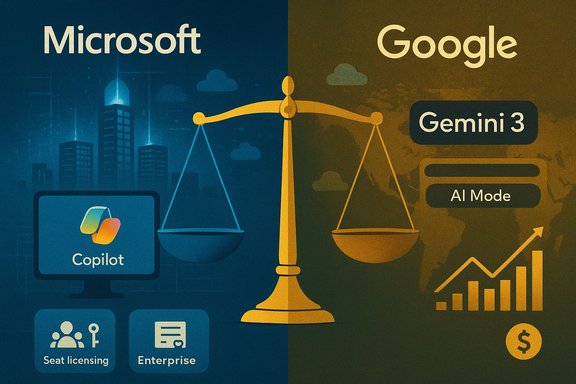 Background: what analysts actually said and why it matters
Analysts quoted in the Benzinga coverage argued two related points: first, Azure is the leading enterprise AI cloud substrate because of scale, enterprise trust and strong developer reach; second, Google’s search advertising model is vulnerable when conversational AIs (from ChatGPT to Google’s own Gemini) route user intent to answers rather than link clicks, potentially shrinking the referral and ad impression pool that funds much of Alphabet’s profit engine. Those concerns were voiced directly by John Freeman and echoed by Corey Johnson in the same interview recap.These are not just surface‑level talking points. They speak to long‑term structural levers in how each company monetizes AI:
- Microsoft can monetize AI through seat licensing (Copilot for Microsoft 365), Azure consumption (GPU hours and managed AI services), and cross‑sell across enterprise contracts.
- Google historically monetizes by capturing intent in Search and selling click inventory; if answers replace clicks, the economics change materially.
Overview: where the market stands (facts you can verify)
Gemini 3, GPT‑5.1 and the current model landscape
Google publicly launched Gemini 3 in November 2025, positioning it as a major step forward in reasoning, multimodality and agentic tooling for developers and enterprise customers. Gemini 3 has been rolled into the Gemini app, Google Search (AI Mode), Vertex AI and third‑party integrations. OpenAI’s most recent public upgrade was GPT‑5.1 (released November 12, 2025), not a GPT‑6 product. GPT‑5.1 introduced "Instant" and "Thinking" variants and continued OpenAI’s cadence of improving conversational quality and adaptive reasoning. As of late 2025 there is no public, verifiable release of "ChatGPT 6" or GPT‑6; any reference to GPT‑6 remains speculative and should be flagged accordingly.Hyperscaler cloud shares and the AI build‑out
Hyperscaler cloud infrastructure remains concentrated: Synergy Research Group’s Q3 2025 snapshot shows AWS, Microsoft Azure and Google Cloud together holding roughly 62–63% of the global enterprise cloud infrastructure market, with AWS ~29%, Azure ~20% and Google Cloud ~13% in that quarter. These shares underline that while AWS leads overall, Microsoft and Google are the primary rivals in enterprise cloud and AI hosting.Microsoft’s capital commitments
Microsoft has publicly announced massive, multi‑year infrastructure commitments tied to AI adoption. A concrete example: Microsoft pledged C$19 billion (CAD) in Canada between 2023 and 2027 to expand cloud and AI infrastructure, a signal of the firm’s balance‑sheet ability to underwrite regional datacenters for AI workloads. Similar large regional investments and global capacity buildouts have been a recurring theme in Microsoft’s disclosures and industry reporting.Market pricing snapshots
Stock‑market movements around these narratives are measurable: Microsoft closed the last trading day of 2025 near $483.62, while Alphabet (GOOG/GOOGL) closed around $313.80—numbers that reflect investors’ differing views and the large rally Alphabet experienced through 2025. These are end‑of‑year price facts that anchor the valuation debate.Why some analysts prefer Microsoft: the bull case deconstructed
1) Distribution and seat economics are durable
Microsoft’s ecosystem—Windows, Microsoft 365, Teams, GitHub and enterprise contracts—creates numerous pathways to sell AI as a productivity upgrade via seat licensing, not just as raw compute. Seat economics (e.g., Copilot add‑ons) turn AI into subscription revenue, which is stickier and less exposed to commodity inference pricing than pure GPU‑hour billing. This is the core of the “no downside” argument: even if raw AI compute commoditizes, Microsoft can still grow revenue by increasing ARPU per seat.2) Balance‑sheet optionality and multi‑year capex
Microsoft’s cash flow lets it fund multi‑year data‑center programs that absorb the high front‑loaded capital intensity of GPU‑heavy AI infrastructure. That optionality reduces insolvency risk for aggressive capacity expansion and gives Microsoft time to convert bookings and RPO into recognized revenue—assuming the utilization curve follows. Analysts argue this is a durable competitive advantage versus smaller neocloud providers.3) Partner access and multi‑model flexibility
Microsoft’s commercial ties (including its multi‑billion dollar partnership and product integrations with OpenAI) give it privileged model access and co‑engineering advantages. A multi‑model orchestration posture (running in‑house, partner and third‑party models) reduces lock‑in risk and offers customers flexibility—an enterprise sales argument that resonates in regulated industries.4) Enterprise trust and compliance posture
For highly regulated industries—healthcare, financial services, government—enterprise adoption depends on certifications, data residency and governance. Microsoft’s existing compliance ecosystem (Azure sovereign regions, contractual SLAs) lowers friction for enterprise AI adoption relative to newer providers lacking that pedigree. That practical advantage matters when CIOs decide between solutions.Why Alphabet’s search franchise is considered “at risk” (and counter‑arguments)
The risk: zero‑click answers and ad cannibalization
Generative AI experiences that resolve queries without sending users to publisher pages threaten the ad impression and referral economics that underpin Google’s search advertising business. Independent analyses and court filings have acknowledged that AI Overviews and similar features change user behavior and can reduce clicks to source pages—this is the technical mechanism behind the “search ad at risk” thesis. Several private and public studies show that when an AI summary appears, click‑through rates fall substantially in affected verticals. That drop has direct revenue implications for Google and for the open web’s monetization model (publishers, affiliate conversions, etc.. The threat is real in certain content categories—medical, legal, product comparison—where direct answers replace destination clicks.The counter‑case: Google can—and is—monetizing AI
Alphabet’s response is not passive. Google integrated Gemini into Search (AI Mode) and launched monetization experiments that preserve ad formats and embed new interactive ad experiences. Some prominent analysts and buy‑side firms view Google’s AI investments as an opportunity to increase engagement and premiumize search, not simply destroy the ad base—especially if Google can re‑engineer ad units to work inside AI responses. Recent analyst upgrades and bullish takes argue Wall Street may be underweighting Google’s ability to convert AI into new ad formats and commerce experiences.The operational and economic reality: where the debate is most fruitful
1) Conversion, not mere capability, matters
Both Microsoft and Google can build capable foundation models. The decisive variable is monetization conversion: can the company turn capabilities into predictable, recurring revenue without destroying margins? For Microsoft, that means Copilot seat conversion and Azure consumption; for Google, it means preserving ad economics inside an AI‑first search flow. Public filings, bookings, RPO and Copilot adoption metrics are the primary indicators to watch.2) CapEx timing and utilization are lumpy and visible
Large data‑center commitments are lumpy. Ramping GPUs and bringing regions online takes quarters or years; if utilization lags, margins suffer. That timing risk is the core bear case for Microsoft and explains why some Wall Street investors are cautious despite the distribution thesis. The same dynamic applies to any hyperscaler aggressively building GPU capacity.3) Model economics, chips and the supply chain matter
NVIDIA and other accelerator suppliers remain choke points. A sudden supply shock or pricing surge would raise costs for all providers. Conversely, breakthroughs in model efficiency, custom silicon, or open‑source alternatives could compress the incumbents’ price advantage and reframe the economics. Pay attention to silicon supply trajectories and custom chip roadmaps.Practical implications for Windows users, IT leaders and investors
For Windows users and corporate IT
- Treat Copilot rollouts as software changes: version, test, monitor and gate wide releases like any production feature.
- Insist on portability and multi‑cloud escape routes for critical AI workloads to avoid lock‑in risk as models and vendors evolve.
- Negotiate SLAs and sovereign options—data residency matters for regulated workloads and may drive vendor selection.
For investors and portfolio managers
- Look beyond headline multiples. Normalize valuations to account for capex intensity and expected conversion rates from pilot → paid seats.
- Watch the five operational signals that indicate durable monetization:
- Copilot seat adoption and ARPU.
- Azure AI gross margin trajectory and utilization rates.
- Large enterprise bookings and RPO conversion timelines.
- Pricing pressure or margin improvements in inference (per‑token / per‑hour economics).
- Supply chain resilience for GPUs and custom silicon.
- Beware of narrative‑driven short‑term positioning: Microsoft’s “safety” is conditional on execution; Google’s “threat” is conditional on cannibalization persisting and not being recaptured via new ad formats.
Risks, unknowns and verifiability
- ChatGPT 6 / GPT‑6: public releases as of late 2025 do not include GPT‑6. Claims about a near‑term GPT‑6 release are speculative unless confirmed by OpenAI. Treat such timeline claims with caution.
- Precise dollar impacts on Google ad revenue from AI overviews vary substantially by vertical and geography; while multiple independent analyses show meaningful CTR declines in certain categories, the aggregated, company‑level revenue impact is complex and sensitive to Google’s countermeasures. Court filings and third‑party traffic studies provide evidence of change, but not a single consensus estimate that pins a dollar figure to lost revenue. Flag macro revenue numbers as estimates unless sourced directly from audited disclosures.
- Microsoft’s long‑term AI margin profile depends on whether it can drive seat economics to scale faster than raw compute cost declines. This is an operational hypothesis that must be tested against sequential quarter metrics: Copilot conversion rates, Azure AI consumption growth and capex depreciation schedules. Those are measurable and verifiable in company filings.
Conclusion: balancing the tradeoffs
The analyst preference for Microsoft over Google in the AI race is not a binary claim that Microsoft will always outperform. It is a risk‑profile judgement: Microsoft’s distribution, enterprise trust and seat‑based monetization give it a structural cushion against a scenario where generative AI commoditizes raw compute. Google, by contrast, faces a unique exposure—its historic ad‑monetization model relies on users clicking through to publisher pages, a pattern that generative, zero‑click answers can disrupt.Yet the debate remains open and empirical. Google has technical advantages, developer mindshare in many ML workflows, and a clear path to re‑monetize AI within search experiences; Microsoft has balance‑sheet optionality, distribution and an enterprise moat. Investors and IT leaders should stop treating this as a simple “winner takes all” question and instead track the operational metrics that will decide the outcome: Copilot adoption and ARPU, Azure AI utilization and margins, Google’s ability to create AI‑native ad experiences that preserve or grow revenue, and supply‑chain/chip developments that alter cost curves.
The most prudent stance is a measured, evidence‑driven one: monitor verified, repeatable signals and treat unverifiable claims (GPT‑6 release dates, single‑day attribution of stock moves, headline dollar losses to publishers) as conditional until corroborated by primary filings or multiple credible independent analyses.
Microsoft’s AI narrative is compelling—but not bulletproof. Google’s search franchise is under pressure from the rise of generative AI, but it is far from dead. The coming quarters will be defined less by model announcements and more by monetization conversion, capacity utilization, and the regulatory and product innovations each company deploys to preserve or expand its economic model. Investors who want to place a high‑conviction bet should prefer one anchored in measurable operational progress, not slogans; those who prefer lower downside should appreciate why analysts see Microsoft today as the more defensible AI stake.
Source: Benzinga Why This Analyst Prefers Microsoft Over Google In The AI Race— 'You Don't Have The Downside Risk Of...' - Alphabet (NASDAQ:GOOGL), Microsoft (NASDAQ:MSFT)
