

Microsoft’s latest Microsoft Sentinel update delivers a clear shift: the SIEM is being retooled to make AI-generated activity and broader third‑party telemetry first‑class inputs for SOC workflows, while adding scale features MSSPs and large enterprises have long asked for. The February 2026 drop bundles new out‑of‑the‑box connectors, a Copilot activity ingestion path, multi‑tenant content distribution, a refreshed UEBA Essentials pack, partner Security Copilot agents, and deeper Purview‑to‑Sentinel integrations — changes that are practical, powerful, and also worth a careful risk assessment before rolling them into production. osoft.com]
Microsoft Sentinel has steadily evolved from a cloud‑native SIEM into a broader XDR and investigation platform that tightly integrates Defender, Purview, Microsoft 365, and Security Copilot. Over the past two years Microsoft has focused on pushing data into a single investigative plane (the Sentinel workspace and the Sentinel data lake), adding AI‑assisted investigation tools, and enabling managed, codeless ingestion patterns for third‑party telemetry. The February 2026 updates continue that trend by increasing the telemetry surface and by giving SOC teams new primitives for handling AI agents, tenant sprawl, and sensitive‑data investigations.
Thesese enterprises are adopting agentic automation and Copilot‑style assistants at scale. When agents can read, write, schedule tasks, or deploy plugins, those actions become meaningful security signals — and until now they have been fragmented across audit logs and admin consoles. The new connector set and integration patterns aim to collapse that friction so analysts can hunt, detect, and automate against AI‑related events inside their existing Sentinel workflows.
That said, these capabilities increase the platform’s complexity. Organizations that treat new telemetry as a “turn it on and forget it” feature risk analyst fatigue and automation‑driven mishaps. Responsible adoption means staged pilots, robust governance, and close attention to licensing and regional availability. Use the extra migration runway Microsoft provided to align people, processes, and tooling with Sentinel’s new capabilities and to ensure your SOC extracts the signal from the growing telemetry volume.
Microsoft’s roadmap for Sentinel is moving in the right direction: unify visibility, surfacing AI activity, and operational scale. But the last mile — governance, validation, and tuning — remains the SOC team’s responsibility. For teams that invest in that work, these updates are likely to pay dividends in detection speed and investigative clarity.
In short: enable with caution, prioritize pilots, and treat Copilot telemetry and third‑party agents as new, high‑value signals that must be governed and tuned — not as automatic sources of remediation. The platform now gives SOCs the technical primitives to make AI‑aware security practical; success will depend on disciplined operationalization.
Source: Petri IT Knowledgebase Microsoft Sentinel Gets New Visibility Capabilities
 Background / Overview
Microsoft Sentinel has steadily evolved from a cloud‑native SIEM into a broader XDR and investigation platform that tightly integrates Defender, Purview, Microsoft 365, and Security Copilot. Over the past two years Microsoft has focused on pushing data into a single investigative plane (the Sentinel workspace and the Sentinel data lake), adding AI‑assisted investigation tools, and enabling managed, codeless ingestion patterns for third‑party telemetry. The February 2026 updates continue that trend by increasing the telemetry surface and by giving SOC teams new primitives for handling AI agents, tenant sprawl, and sensitive‑data investigations.Thesese enterprises are adopting agentic automation and Copilot‑style assistants at scale. When agents can read, write, schedule tasks, or deploy plugins, those actions become meaningful security signals — and until now they have been fragmented across audit logs and admin consoles. The new connector set and integration patterns aim to collapse that friction so analysts can hunt, detect, and automate against AI‑related events inside their existing Sentinel workflows.
What’s included in the February 2026 release
Key highlights (summary)
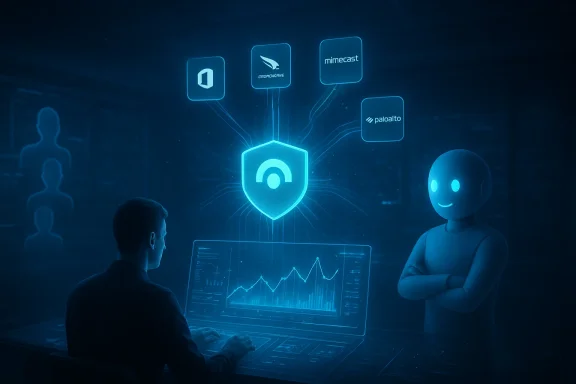
- Expanded out‑of‑the‑box connectors for major SaaS, endpoint, and network vendors (Mimecast, CrowdStrike Falcon, Vectra XDR, Palo Alto Networks Cloud NGFW, Proofpoint on Demand, Pathlock, M and more).
- Microsoft 365 Copilot data connector (public preview) that ingests Copilot audit and activity records into Sentinel’s CopilotActivity table and optionally into the Sentinel data lake.
- Multi‑tenant content distribution for pushing analytics, workbooks, and rules across tenants — targeted at MSSPs and distributed enterprise estates.
- Enhanced UEBA Essentials solution with faster detections, prebuilt UEBA queries (more than 30), and content hub delivery.
- General availability for partner‑built Security Copilot agents in the Microsoft Security Store; these agents bring domain expertise into SOC workflows.
- Threat Intelligence Briefing Agent improvements using a structured knowledge graph for industry‑ and region‑specific briefings.
- Integration of Purview Data Security Investigations (DSI) with the Sentinel graph to map sensitive‑data access and exposures using AI and graph‑based activity mapping.
- Extension of the Sentinel Azure‑to‑Defender portal migration deadline to March 31, 2027 (moved from an earlier July 2026 target).
Expanded connector ecosystem: why it matters
What changed
Microsoft shipped a broad set of ready‑made connectors designed to simplify onboarding across cloud, SaaS, endpoint, email, and network sources. Organizations can now more rapidly ingest logs from vendors such as Mimecast, CrowdStrike Falcon, Vectra XDR, Palo Alto Networks Cloud NGFW, Proofpoint on Demand, Pathlockst ADR. These connectors are delivered via the Sentinel content hub and increasingly rely on the Codeless Connector Frametyle ingestion.Verification and corroboration
Microsoft’s official “What’s New in Microsoft Sentinel — February 2026” post lists the connectors and describes the pushh replaces older Azure Function connector patterns. Independent coverage from industry outlets confirms the same connector additions and the CCF migrhcommunity.microsoft.com] (msftnewsnow.com)Practical impact for SOCs
- Faster onboarding reduces blind spots: analysts can correlate email, endpoint, network, and identity signals earlier in investigations.
- Standardized schema: CCF‑driven connectors encourage consistent field mappings and built‑in health telemetry.
- Migration tasks: teams should inventory current Azure Function or custom ingestion flows because Microsoft is signaling deprecation timelines for older collection APIs — migration planning is requis.
Deep dive: Microsoft 365 Copilo What the connector does
The Copilot data connector (public preview) ingests Microsoft 365 Copilot audit events and activity telemetry that originate in the Purview Unified Audit Log into a new Sentinel table named CopilotActivity. Tenants can also forward that data to the Sentinel data lake foention and for integration with Sentinel Graph and Model Context Protocol (MCP) scenarios. The connector is published as a Content Hub solution and is installed from the Sentinel configuration area in the Defender portal.Technical specifics verified
- Destination table: CopilotActivity in Log Analytics workspaces.
- Supported record types: includes CopilotInteraction, plugin and workspace lifecycle events (Create/Update/Delete CopilotPlugin, CreateCopilotWorkspace), CopilotPromptBook operations, CopilotForSecurityTrigger, and CopilotAgentManagement types. This taxonomy gives SOCs actionable records for both configuration and runtime activity monitoring.
- Single‑tenant scope: the connector ingests Copilot events only for the tenant in which it is deployed (not a cross‑tenant ingestion mechanism).
- Eligibility caveat: telemetry is only produced for environments where Microsoft 365 Copilot licenses and the relevant Security Compute Units (SCUs) are active; licensing and tenant feature flags therefore influence what events are available.
SOC use cases and detection scenarios
- Detect unauthorized plugin lifecycle activity: unexpected Create/Enable plugin events paired with lateral movement or privilege escalation can indicate attacker misuse of agent capabilities.
- Monitor scheduled prompts and promptbook deployments: scheduled prompts that access sensitive documents or credentials are high‑value detection targets.
- Build AI‑aware correlation rules: combine CopilotActivity with endpoint and identity signals to create detections that surdriven actions.
Implementation considerations
- Verify licensing and Purview audit log availability before enabling ingestion.
- Start in a controlled pilot workspace: ingest to a sandbox Log Analytics workspace and forward to the Sentinel data lake only after you have validated schemas and noise levels.
- Tune analytic rules and create Fusion correlation pipelines that treat Copilot events as first‑class enrichment signals — not just noise.
Multi‑tenant content distribution: scaling content across estates
What it is
The new multi‑tenant content distribution feature lets an operator (for example an MSSP or a central security practice within an enterprise) push analytics rules, workbooks, playbooks, and other Sentinel content across multiple customer or organizational tenants. The feature is explicitly positioned to reduce duplication of effort and to standardize detection coverage at scale.Why this is important
Managing detection content across dozens or hundreds of tenants is operationally expensive and error‑prone. A controlled distribution mechanism:- Ensures consistent analytic baselines across tenants.
- Simplifies updates (one push rather than manual deployments).
- Enables faster rollouts of critical detections for new threats.
Risks and governance
- Don’t push sensitive automation blindly: playbooks with destructive remediation steps must include tenant‑level safety checks and require explicit approval.
- Versioning and rollback: distributors must maintain robust version control and rollback plans to avoid breaking customer monitoring.
- Tenant scoping: ensure RBAC and separation of duties so that tenant operators retain the ability to opt‑out or customize content safely.
UEBA Essentials: faster detection of risky behavior
What UEBA Essentials brings
The refresh of the User and Entity Behavior Analytics (UEBA) Essentials solution focuses on accelerating detection of high‑risk activity across cloud and identity systems. The solution is delivered via the Sentinel content hub and includes more than 30 prebuilt UEBA queries designed to highlight anomalous user or entity patterns.How UEBA fits into investigations
UEBA augments rule‑based detection by surfacing behavior changes that may not trigger single‑event signatures. Examples include unusual service‑account access patterns, identity pivoting, or data exfiltration patterns that, combined with Copilot or endpoint telemetry, give analysts faster, higher‑confidence leads.Implementation tip
Deploy UEBA Essentials alongside identity protection tooling and tune its baselines over a 30–90 day learning window to reduce false positives. Treat UEBA hits as enrichment for triage rather than automatic block actions until the team has validated reduction thresholds.Partner‑built Security Copilot agents and the Security Store
What changed
Microsoft has moved partner‑built Security Copilot agents into general availability in the Microsoft Security Store inside the Defender experience. These agents are domain‑specific AI assistants that can run as part of investigation workflows, automate enrichment, or provide analyst‑facing reports. Examples called out in coverage include agents that review configurations, map attacks, or focus on data‑leak scenarios. (theverge.com)Strengths
- Speed: agents can perform repetitive triage tasks, freeing analysts for higher‑value work.
- Domain specialization: partner agents can embed vendor or vertical expertise into the SOC.
- No‑code creation: Microsoft’s tooling enables SOC teams to create custom agents for internal processes.
Operational cautions
- Validation is essential: agent outputs should be validated and subject to human approval for high‑risk decisions to avoid automation‑driven missteps.
- Supply‑chain risk: vet partner agents for se and data handling policies; treat agents like any other third‑party software.
Purview Data Security Investigations (DSI) + Sentinel Graph
What’s new
Purview’s Data Security Investigations capability is integrated with the Sentinel graph, allowing teams to map how sensitive data was accessed or exposed, who interacted with it, and the broader activity chain — using AI‑assisted analysis and graph mapping to speed root‑cause and impact analysis. This tightens the link between data discovery/DSPM signals and incident triage.Why it matters
Sensitive data investigations are often slow because data and security telemetry live in different places. Bringing DSI insights into Sentinel lets analysts:- See who and how sensitive content was touched
- Prioritize investigations based on sensitivity impact.
- Create targeted remediation playbooks that include data governance steps.
Caveat
Some DSI capabilities are preview or phased features; organizations should verify feature availability for their region and tenant licensing before depending on it for compliance workflows.Migration timing: Azure portal → Defender portal extension
Microsoft previously signaled a move to make the Defender portal the primary Sentinel experience. Following customer feedback, Microsoft extended the migration deadline for managing Sentinel from the Azure portal to **March 31, 2 gives larger customers and MSSPs more runway to move content, connectors, and automation safely. Plan migration projects accordingly and use the additional time to validate multi‑tenant content distribution and CCF connector migration paths.Strengths, risks, and the practical tradeoffs
Strengths (what operators should be excited about)
- Unified AI‑aware telemetry: Ingesting Copilot activity into Sentinel makes AI actions first‑class telemetry for detection and investigation, closing an important visibility gap.
- Faster onboarding with CCF: The Codeless Connector Framework reduces engineer ingestion and improves operational telemetry health.
- Scale features: Multi‑tenant content distribution and Security Store agents are real operational accelerators for MSSPs and large distrinewsnow.com]
- Integrated data investigations: Purview DSI + Sentinel graph brings sensitive‑data lineage into incident response in a practical, actionable way.
Risks and limitations
- Noise and false positives: Copilot telemetry will introduce high‑volume, novel event types. Without careful tuning, this can overwhelm triage queues. Start with pilots and aggressive tuning.
- Licensing and telemetry availability: Copilot connectors only ingest events when Copilot features and SCUs are enabled; policy and licensing gating will vary across tenants. Validate tenant eligibility before relying on the data feed.
- Automation safety: Multi‑tenant distributions and agent‑driven playbooks must be governed; incorrect or poorly tested automation could cause widespread outages or data handling errors.
- Third‑party risk: Partner agents extend your attack surface. Require security reviews, SCA, and contractual assurances around data handling before installing store agents.
Recommended adoption path (practical checklist)
- Inventory and prioritize: map current connectors, custom ingestion flows, and analytic content that will be impacted by the CCF migration.
- Pilot Copilot ingestion: deploy the Copilot data connector in a non‑prod workspace; forward to the Sentinel data lake for storage‑cost trials and to validate schema.
- Tune UEBA and analytic rules: enable UEBA Essentials and tune baselines over 30–90 days; create suppression rules for known benign agent activity.
- Govern multi‑tenant distribution: draft approval workflows, versioning policies, and rollback procedures before enabling cross‑tenant content pushes.
- Vet partner agents: perform security assessments on any Security Store agents intended for production use; require human approval gates for high‑impact automation.
- Plan for the Defender portal migration: use the extended March 31, 2027 deadline to test the Defender experience and migrate critical dashboards and playbooks.
Final analysis: a meaningful evolution, but not a turnkey fix
Microsoft’s February 2026 Sentinel updates are a practical, well‑targeted set of changes that reflect how modern SOCs operate: more SaaS telemetry, AI agents in the wild, and the need to manage many tenants at scale. The Copilot data connector is especially consequential because it formalizes Copilot and agent telemetry as an investigative signal rather than an audit‑only artifact — that alone should change threat models and SOC playbooks.That said, these capabilities increase the platform’s complexity. Organizations that treat new telemetry as a “turn it on and forget it” feature risk analyst fatigue and automation‑driven mishaps. Responsible adoption means staged pilots, robust governance, and close attention to licensing and regional availability. Use the extra migration runway Microsoft provided to align people, processes, and tooling with Sentinel’s new capabilities and to ensure your SOC extracts the signal from the growing telemetry volume.
Microsoft’s roadmap for Sentinel is moving in the right direction: unify visibility, surfacing AI activity, and operational scale. But the last mile — governance, validation, and tuning — remains the SOC team’s responsibility. For teams that invest in that work, these updates are likely to pay dividends in detection speed and investigative clarity.
In short: enable with caution, prioritize pilots, and treat Copilot telemetry and third‑party agents as new, high‑value signals that must be governed and tuned — not as automatic sources of remediation. The platform now gives SOCs the technical primitives to make AI‑aware security practical; success will depend on disciplined operationalization.
Source: Petri IT Knowledgebase Microsoft Sentinel Gets New Visibility Capabilities
