

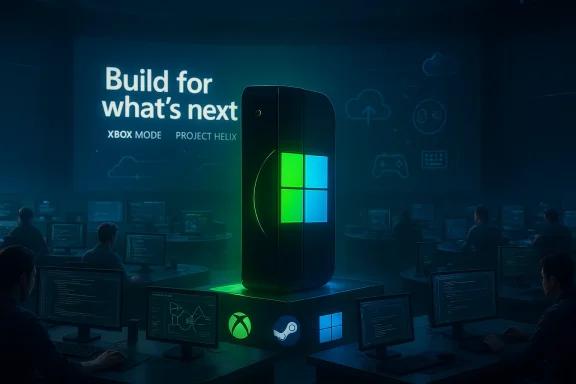
Microsoft’s marketing pivot at last week’s Game Developers Conference — a quiet but unmistakable shift from the polarizing “This Is an Xbox” campaign toward developer‑facing language like “Build for what’s next” — is more than a slogan swap; it signals a strategic reorientation that ties the Xbox brand to Windows and developer ecosystems while trying to repair a brand identity that many inside and outside Microsoft complained had become muddled. (news.xbox.com)
When Xbox launched the “This Is an Xbox” campaign in November 2024, the goal was explicit: redefine Xbox as a platform, not simply a hardware SKU. The campaign showcased Game Pass and cloud streaming, spotlighting how Xbox content could appear on TVs, phones, smart fridges, and VR headsets — a deliberate message that “Xbox” could live anywhere a player wanted it to. The initiative was rolled out with partner activations, merchandising, and a splashy Xbox Wire post that explained the idea in plain terms. (news.xbox.com)
That broad, platform‑first message landed awkwardly with a subset of Xbox’s core audience. Critics argued the campaign eroded the unique value of Xbox hardware at a time when Microsoft’s console exclusives were being released across competitors and Game Pass was deliberately cross‑platform. The predictable tension — platform ubiquity versus console prestige — turned into a public debate. Outlets and former executives called the campaign the wrong message at the wrong time, and social channels were quick to mock the idea that a smart fridge or smartphone could be labelled “an Xbox.”
Over the last several months, Microsoft has been quietly testing and expanding a controller‑first full‑screen shell inside Windows — originally known as the Full Screen Experience (FSE) and now formally rebranded as Xbox Mode — which gives PCs a console‑style front door. At GDC, Microsoft framed Xbox Mode and the next‑generation console effort as parts of the same strategy: make Windows feel like a first‑class Xbox target while designing next‑gen hardware that’s explicitly PC‑friendly. That shift in language and product focus was on display across the conference.
This divergence between headlines and reality is important to stress. Public perception of a “scrub” can move faster than corporate content management. Pages are sometimes removed and restored for technical or strategic reasons; likewise, in‑market creative rotations happen rapidly at big conferences. Multiple outlets that followed the story have reported both the apparent removal and the continued presence of campaign artifacts, leaving readers with conflicting signals about whether Microsoft intended to kill the campaign or merely move on to the next phase.
Other core claims verified across at least two independent outlets:
Additionally, internal forum threads and community repositories captured the industry reaction and timeline of messages ahead of and following GDC; these community signals echo the public narrative about a pivot from consumer slogans to developer and product messaging.
But convergence brings tension. The company must now manage two fragile expectations at once: the emotional value console buyers place on a flagship device, and the pragmatic developer desire for tools that reduce engineering friction. If Microsoft can deliver clear consumer value in Project Helix, meaningful developer productivity gains from Xbox Mode and associated tooling, and consistent messaging that respects the history of the Xbox brand, it will have successfully bent the boat toward a unified future. Fail at any of those three, and the brand will remain in a liminal space — neither a cherished console nor a fully trusted platform.
For now, the evidence suggests Microsoft is consciously choosing product credibility and developer trust over a cheeky, devices‑everywhere slogan. That’s a longer, harder path to rebuild pride in Xbox hardware, but it may be the most realistic one if Project Helix, Xbox Mode, and the promised tooling actually deliver on their technical promises. (news.xbox.com)
Source: Windows Central "This is an Xbox" campaign vanishes overnight
 Background
When Xbox launched the “This Is an Xbox” campaign in November 2024, the goal was explicit: redefine Xbox as a platform, not simply a hardware SKU. The campaign showcased Game Pass and cloud streaming, spotlighting how Xbox content could appear on TVs, phones, smart fridges, and VR headsets — a deliberate message that “Xbox” could live anywhere a player wanted it to. The initiative was rolled out with partner activations, merchandising, and a splashy Xbox Wire post that explained the idea in plain terms. (news.xbox.com)That broad, platform‑first message landed awkwardly with a subset of Xbox’s core audience. Critics argued the campaign eroded the unique value of Xbox hardware at a time when Microsoft’s console exclusives were being released across competitors and Game Pass was deliberately cross‑platform. The predictable tension — platform ubiquity versus console prestige — turned into a public debate. Outlets and former executives called the campaign the wrong message at the wrong time, and social channels were quick to mock the idea that a smart fridge or smartphone could be labelled “an Xbox.”
Over the last several months, Microsoft has been quietly testing and expanding a controller‑first full‑screen shell inside Windows — originally known as the Full Screen Experience (FSE) and now formally rebranded as Xbox Mode — which gives PCs a console‑style front door. At GDC, Microsoft framed Xbox Mode and the next‑generation console effort as parts of the same strategy: make Windows feel like a first‑class Xbox target while designing next‑gen hardware that’s explicitly PC‑friendly. That shift in language and product focus was on display across the conference.
What changed, exactly?
The marketing scrub — myth vs reality
Reports over the past 48 hours suggested Microsoft had “scrubbed” the phrase “This Is an Xbox” from its official channels, with at least one outlet claiming the original Xbox Wire launch post had been pulled. Close inspection, however, shows a more nuanced picture: the Xbox Wire post itself remains accessible and the tag pages on Xbox’s site referencing the campaign still exist, but Microsoft’s booth language and developer materials at GDC used different phrasing, and internal messaging emphasized a pivot to developer narratives. In short: the company has de‑emphasized public consumer marketing that treated every device as “an Xbox” while intensifying messaging that matters to studios and partners. (news.xbox.com)This divergence between headlines and reality is important to stress. Public perception of a “scrub” can move faster than corporate content management. Pages are sometimes removed and restored for technical or strategic reasons; likewise, in‑market creative rotations happen rapidly at big conferences. Multiple outlets that followed the story have reported both the apparent removal and the continued presence of campaign artifacts, leaving readers with conflicting signals about whether Microsoft intended to kill the campaign or merely move on to the next phase.
Product moves: Project Helix and Xbox Mode
Two product announcements crystallized Microsoft’s immediate priorities at GDC:- Project Helix: Microsoft’s new codename for its next‑generation Xbox, confirmed publicly by Microsoft Gaming CEO Asha Sharma, described as a system that will “lead in performance and play your Xbox and PC games.” The brief reveal positions the device as deliberately hybrid — a console that blurs into PC capabilities. Multiple outlets picked up the announcement from Sharma’s public post and Microsoft’s messaging around GDC.
- Xbox Mode (formerly FSE): The controller‑first full‑screen shell that debuted on the ASUS ROG Xbox Ally hardware will be rolled out more broadly to Windows 11 in April 2026, giving PCs a console‑style session posture and reducing friction for developers shipping games across Xbox and Windows. Microsoft frames Xbox Mode as an enabler for the cross‑platform vision that Project Helix embodies.
Why the pivot matters
For developers
- Unified tooling and a predictable runtime — Xbox Mode and the tooling updates Microsoft previewed at GDC promise a more uniform runtime for controller‑first games on Windows. That reduces fragmentation and the QA burden for studios shipping PC and console versions. The developer messaging at GDC was clearly prioritized over broad consumer slogans, and that’s deliberate: Microsoft needs developers to believe the platform convergence will save them time and complexity, not add to it.
- Potential platform upside — With Project Helix pitching performance parity and the ability to run PC-targeted titles, studios could reach wider audiences without doubling engineering costs. Microsoft’s narrative is that a single build can target Xbox hardware, Xbox Mode sessions on Windows, and cloud instances more easily than before. If the APIs and shader delivery tooling pan out, this could be a real efficiency win.
For consumers
- Less confusion — or more? The previous campaign’s “everything is an Xbox” line intended to highlight the convenience of Game Pass and cloud streaming, but it also introduced brand friction. Console owners felt their investments were being turned into platform features rather than cherished, unique experiences. The shift to “Build for what’s next” is an attempt to return to a product narrative that emphasizes performance and developer experience — something more tangible for the people who buy consoles. However, the risk is that casual consumers will perceive yet another rebrand as corporate hemming and hawing.
- New hardware expectations — Project Helix’s hybrid positioning raises price and value questions. Industry commentary has already floated scenarios where a high‑performance, PC‑friendly console could command a premium price. That’s a double‑edged sword: it raises the bar for fidelity but could narrow the total addressable market for day‑one adopters. Some outlets have already speculated about steep pricing pressures.
For Microsoft’s brand
- Brand repair is underway — Microsoft’s pivot is a form of brand repair: move away from a campaign perceived as flippant, emphasize technical capability and developer support, and anchor future marketing to clear product narratives. But this repair requires consistency: gamers reward clarity and penalize mixed signals.
- The risk of identity drift — The more Xbox becomes a cross‑device platform, the harder it may be to articulate what owns the Xbox identity. Is Xbox primarily a hardware experience, a subscription play, or a developer toolchain? Microsoft will need to pick primary and secondary narratives and stick with them for longer than a conference cycle.
Evidence and verification
This piece cross‑checked Microsoft’s public messaging and press reactions across the official Xbox Wire post, major gaming outlets, and community discussion. The original campaign launch post remains available on Xbox Wire and the “This Is an Xbox” tag pages still exist on Xbox’s site, which contradicts early reports that the content had been deleted outright. At the same time, Microsoft’s in‑market messaging (booth copy, session headings, and developer materials) at GDC used fresh phrasing like “Build for what’s next,” and multiple outlets reported that Microsoft is de‑emphasizing the consumer‑facing campaign in favor of product and developer narratives. That combination — persistent legacy content plus new messaging in live contexts — explains the confusion circulating online. (news.xbox.com)Other core claims verified across at least two independent outlets:
- Project Helix’s announcement via Asha Sharma and Microsoft’s GDC presence was widely reported and quoted directly from Sharma’s public post.
- Xbox Mode’s April rollout to Windows 11 was confirmed by Microsoft and covered by multiple outlets that tested the Full Screen Experience and investigated the rebrand.
- Satya Nadella’s internal reassurance that Microsoft will “always” invest in gaming was reported from a company Q&A hosted by Asha Sharma and independently echoed in coverage of Microsoft’s message to employees and partners.
Additionally, internal forum threads and community repositories captured the industry reaction and timeline of messages ahead of and following GDC; these community signals echo the public narrative about a pivot from consumer slogans to developer and product messaging.
Strengths of Microsoft’s new posture
- Developer‑first focus: Reprioritizing messaging to developers helps Microsoft shore up studio confidence and signals that tooling and technical compatibility are real priorities rather than afterthoughts. Xbox Mode reduces friction for controller‑first PC releases and could simplify certification or parity targets.
- Technical coherence: Project Helix’s hybrid focus aligns with long‑standing Microsoft bets — tight Windows integration, Game Pass delivery, cloud scalability — and the move to custom silicon (reported in several outlets) suggests Microsoft intends to own performance vectors rather than outsource them. This coherence helps create defensible differentiation.
- Ecosystem leverage: By leaning into Windows as a first‑class place to run console‑style games, Microsoft can better monetize PC gamers and create stronger ties between Xbox Game Pass and the Windows app ecosystem, which is a unique cross‑platform leverage few rivals can replicate.
Risks and weak points
- Brand confusion persists: The core problem remains — how to make Xbox feel like something worth buying in hardware while simultaneously insisting that Xbox is a cloud/service that runs on everything. If Microsoft fails to communicate a clear, consumer‑facing value proposition for Project Helix (e.g., unique features, exclusive experiences, or price), high‑end hardware that runs PC games could be perceived as an expensive niche.
- Price and accessibility: Early commentary suggests Project Helix could be expensive if Microsoft truly pursues "lead in performance." Premium hardware narrows adoption and undercuts Game Pass’ mass‑market growth strategy. Reports speculating on high price points may not be accurate, but they highlight the tension between performance and reach.
- Developer burden vs benefit: Microsoft must prove that its new tooling materially reduces development complexity. Promises of unified pipelines only matter if shader stutter, performance parity, and platform‑specific servicing are demonstrably improved in developer workflows.
- Trust deficits: Many core Xbox fans felt sidelined by previous strategy moves. Restoring trust will take more than new slogans; it requires consistent, measurable product wins and a steady cadence of console‑focused messaging that respects hardware buyers.
What Microsoft should do next — a practical checklist
- Make Project Helix messaging crisp and hardware‑centric in consumer marketing: emphasize what the box does that no other device can (e.g., unique compatibility guarantees, first‑class optimization, or exclusive platform features). Use clear, comparative examples.
- Publish a developer roadmap with tangible milestones: date the rollout of advanced shader delivery, list supported tooling versions, and provide sample studio case studies showing measurable QA and porting time reductions.
- Rip off the bandage on pricing expectations early: if Project Helix will be premium, explain the performance ROI; if Microsoft plans a competitive price, lock that in with partner OEM announcements to avoid speculation.
- Keep legacy campaign artifacts live for transparency but drive traffic to the new developer narrative pages so searchers and press see Microsoft’s forward posture first.
- Commit to console exclusivity clarity: if Microsoft intends to ship fewer exclusive titles to Xbox hardware alone, be explicit about first‑party strategies so the hardware narrative isn’t continually undermined by surprise multi‑platform releases.
Conclusion — brand strategy in an era of platform convergence
Microsoft’s shift away from the consumer‑centric, device‑agnostic chant of “This Is an Xbox” toward product, developer, and platform language is sensible — and necessary — given the company’s broader technical direction. Project Helix and Xbox Mode make the strategic thesis clear: Microsoft wants to fuse console simplicity with Windows openness and make that combination a home field advantage.But convergence brings tension. The company must now manage two fragile expectations at once: the emotional value console buyers place on a flagship device, and the pragmatic developer desire for tools that reduce engineering friction. If Microsoft can deliver clear consumer value in Project Helix, meaningful developer productivity gains from Xbox Mode and associated tooling, and consistent messaging that respects the history of the Xbox brand, it will have successfully bent the boat toward a unified future. Fail at any of those three, and the brand will remain in a liminal space — neither a cherished console nor a fully trusted platform.
For now, the evidence suggests Microsoft is consciously choosing product credibility and developer trust over a cheeky, devices‑everywhere slogan. That’s a longer, harder path to rebuild pride in Xbox hardware, but it may be the most realistic one if Project Helix, Xbox Mode, and the promised tooling actually deliver on their technical promises. (news.xbox.com)
Source: Windows Central "This is an Xbox" campaign vanishes overnight
