

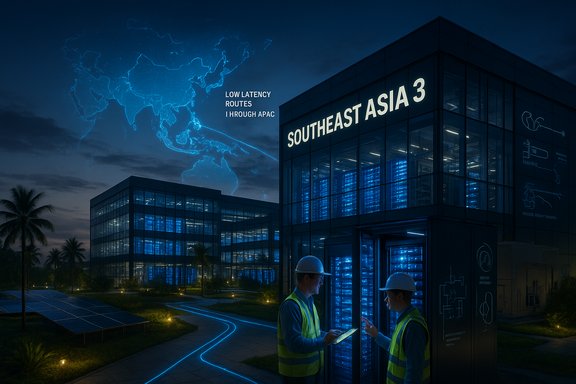
Microsoft’s decision to place a new Azure cloud region — Southeast Asia 3 — in Johor Bahru signals a deliberate push to densify AI‑ready infrastructure in Southeast Asia and to lock in lower‑latency, in‑country compute for regulated and AI‑heavy workloads.
Microsoft first announced a major multi‑year investment in Malaysia in 2024 and delivered the Malaysia West cloud region (Greater Kuala Lumpur) earlier in 2025 as its initial in‑country footprint. The new Johor Bahru region — branded Southeast Asia 3 — is presented as the next phase of that commitment and is explicitly designed to host AI‑ready services and GPU‑dense workloads while expanding regional capacity and resilience. Microsoft describes Southeast Asia 3 as a next‑generation cloud region that will deliver its “most comprehensive and strategic cloud services” for the region, complementing Malaysia West and tying into Azure’s global footprint of more than 70 announced regions. Independent reporting confirms the Johor announcement forms part of a broader Asia expansion that also included an Indonesia Central region in 2025 and planned capacity increases in India and Taiwan.
That said, headline commitments require operational follow‑through. The real test for Microsoft — and for Johor as a data centre hub — will be the pace of hardware arrival, renewable supply firming, verified environmental outcomes, and demonstrable job placement and enterprise migrations. For IT leaders, the Johor region offers an attractive, strategic option for AI workloads but one that should be approached with careful planning: pilot early, validate SKU availability, insist on private connectivity, and model sustainability and TCO under conservative assumptions.
Microsoft’s Southeast Asia 3 is a consequential step for Azure in the region — one that both accelerates Southeast Asia’s AI infrastructure and raises new operational and environmental questions that the company, regulators and customers will need to resolve together.
Source: Pokde.Net Microsoft Unveils 'Southeast Asia 3' Cloud Region Located In Johor Bahru, Malaysia - Pokde.Net
 Background / Overview
Microsoft first announced a major multi‑year investment in Malaysia in 2024 and delivered the Malaysia West cloud region (Greater Kuala Lumpur) earlier in 2025 as its initial in‑country footprint. The new Johor Bahru region — branded Southeast Asia 3 — is presented as the next phase of that commitment and is explicitly designed to host AI‑ready services and GPU‑dense workloads while expanding regional capacity and resilience. Microsoft describes Southeast Asia 3 as a next‑generation cloud region that will deliver its “most comprehensive and strategic cloud services” for the region, complementing Malaysia West and tying into Azure’s global footprint of more than 70 announced regions. Independent reporting confirms the Johor announcement forms part of a broader Asia expansion that also included an Indonesia Central region in 2025 and planned capacity increases in India and Taiwan. Why Johor Bahru? Geography, economics and strategy
Johor Bahru’s selection is logical on multiple fronts:- Proximity to Singapore — Johor sits directly across the Causeway from an APAC hub with enormous demand. Singapore’s constrained land and new limits on data centre growth have pushed demand to nearby Malaysian states. Johor offers lower land and capex costs while preserving sub‑100ms latency to Singaporean endpoints.
- Connectivity — Johor benefits from subsea cable landings and cross‑border fiber routes, enabling low‑latency paths into regional PoPs and the broader Azure backbone. Microsoft links the new region to its global network fabric.
- Land availability and cost economics — Industrial parks and designated data centre zones in Johor make campus‑style expansions possible at lower prices than Singapore while giving operators room for future growth.
- Policy and partnership — Microsoft’s announcement highlights active engagement with Malaysia’s Digital Ministry and other local partners to ensure data residency, skilling and community programmes that smooth political and operational entry.
What “AI‑ready” means here: expected technical posture
Microsoft uses the term AI‑ready to describe regions optimized for GPU‑intensive training and low‑latency inference. Based on Microsoft’s public descriptions, industry norms and reporting from Microsoft’s recent Asia rollouts, IT architects should expect the following attributes from Southeast Asia 3:- Multi‑Availability‑Zone architecture (zone‑resilient deployments) for improved SLAs and cross‑zone failover.
- GPU‑dense racks and accelerator‑optimized VM SKUs to support training and inference for large models and managed services like Azure Machine Learning and Azure OpenAI Service.
- High‑capacity private backbone and local PoPs to enable fast replication of large datasets and reduce cross‑region latency.
- Modern storage fabrics and caching layers to feed GPU nodes with high sustained I/O throughput.
- Staged service parity — Microsoft traditionally phases inventory and GPU SKUs; not all accelerators or PaaS services appear on day one. Customers should validate SKU availability before scheduling large training jobs.
Sustainability and community commitments: design choices Microsoft highlights
Microsoft has framed Southeast Asia 3 with a sustainability and local‑community lens. Public materials and reporting list multiple concrete measures:- Backup generators powered by renewable biofuel, intended to reduce net carbon emissions from backup power compared with diesel alternatives.
- Closed‑loop, chip‑level cooling systems that aim for zero‑water evaporation during normal operations, significantly reducing operational freshwater withdrawals versus evaporative tower models. Microsoft describes closed‑loop liquid cooling across the datacenter campus to improve thermal efficiency at high rack densities.
- Rainwater harvesting installations for 42 Johor schools, projected to conserve millions of liters annually and benefit local sanitation and hygiene. Microsoft cites local partners such as CLEAN International and Water Watch Penang for delivery and training.
- Ecosystem restoration projects, including mangrove restoration with environmental partners to support coastal resilience and biodiversity.
Skilling, social impact and local programs
Microsoft is coupling the Johor datacenter plans with workforce and social programmes framed under a Datacenter Community Pledge:- Skills2Work Datacenter Foundations Programme with Universiti Teknologi Malaysia (UTM) and The Asia Foundation, aiming to train 150 graduates annually for datacenter operations roles.
- Partnerships with UNDP Malaysia and BPEN Johor to support social enterprises and upskill 10,000 community members.
- AIForMYFuture — a national skilling initiative Microsoft promotes to upskill Malaysians in AI‑related competencies, targeting 800,000 people by the end of 2025 and reported to have trained over 700,000 as of late 2025.
- BINA AI Malaysia — an initiative that includes the National AI Innovation Center (NAIC) set up with EY, the National AI Office (NAIO), and the PETRONAS Leadership Centre. Projects under this umbrella include an AI‑powered financial literacy and retirement planning platform for the Employees Provident Fund (EPF).
Economic scale: investment, jobs and projections — a cautious read
Microsoft’s Malaysia program is widely reported to be part of a US$2.2 billion commitment to cloud and AI infrastructure for the country. Media reporting and Microsoft statements also cite prospective economic benefits — revenue projections and job creation estimates spanning tens of thousands — tied to the broader program. Independent outlets such as Reuters and AP covered the initial investment and rollout timetable. Caveat: vendor‑issued economic impact figures typically combine direct capital spend, projected downstream economic effects, and multi‑year modelling assumptions. Those numbers are useful for context but should be treated as projections until corroborated by independent statistical agencies or audited economic assessments. Microsoft’s infrastructure and skilling commitments are concrete; the precise long‑term GDP or job multipliers are contingent on execution, partner uptake and macro conditions.Strategic analysis — strengths and what Microsoft gains
- Platform breadth and integration: Microsoft can deliver a vertically integrated stack — Azure compute, Microsoft 365 residency options, GitHub tooling and enterprise identity — which reduces friction for customers that want a single vendor for both infrastructure and productivity tools. This is a sticky proposition for large enterprises.
- AI‑first infrastructure: Designing regions with GPU density and availability zones addresses the materially different requirements of AI workloads compared with conventional cloud compute. That creates a real product differentiation for customers running large model training and latency‑sensitive inference.
- Regional resilience and competition: Adding Johor Bahru enlarges regional capacity, improves multi‑region resilience for Malaysia, and strengthens Microsoft’s posture against other hyperscalers investing heavily in Southeast Asia. The move also leverages Johor’s comparative advantages relative to Singapore.
- Political and social capital: Skilling and community programs help Microsoft build local alliances and social license to operate — valuable when land, grid access and permitting are politically sensitive.
Risks and open questions
No hyperscaler expansion is risk‑free. Key concerns to monitor:- Energy and grid constraints: AI‑scale datacentres consume significant electricity. Even with renewable matching pledges, the operational reliability and cost of power — and the timing of grid upgrades or PPA deliveries — materially affect TCO and sustainability claims. Malaysia’s ongoing grid upgrades are promising but remain a timeline risk.
- Staged service parity and SKU availability: New regions typically reach full service parity over months. GPU SKUs and managed PaaS offerings often arrive in waves. Large model training projects should confirm specific accelerator availability and capacity timelines with Microsoft account teams.
- Supply chain and export controls: High‑end accelerators are concentrated among a few vendors and can be subject to export controls or supply constraints, which could delay full capacity ramps.
- Environmental lifecycle trade‑offs: Closed‑loop cooling reduces operational water draw but does not eliminate embodied carbon from construction or the environmental impact of backup generation during extended grid shortfalls. Independent verification of lifecycle claims is essential.
- Execution vs. announcements: Building a campus, hiring operational staff, staging services and onboarding customers takes time. Watch for milestones beyond press statements: zoning permits, construction progress, job postings, SKU availability pages and first‑party customer case studies showing production workloads.
Practical guidance for IT leaders and architects
For organizations evaluating Southeast Asia 3 as a target for pilot or production workloads, adopt a staged, risk‑aware approach:- Map workloads to residency and latency needs: identify which apps must be in‑country and which can remain multi‑region.
- Pilot first: run a non‑critical inference endpoint or analytics pipeline in the new region to validate performance and integration.
- Confirm SKU and capacity availability: obtain explicit timelines for GPU families and VM SKUs you require; assume phased arrivals.
- Use private connectivity: ExpressRoute or private peering reduces jitter and increases security for production traffic.
- Architect for multi‑zone and multi‑region failover: leverage Availability Zones for resilience and cross‑region replication for backups and DR.
- Validate sustainability and TCO assumptions: model energy tariffs, renewable procurement timing and capacity to estimate long‑term costs.
- Lock in governance and compliance: ensure encryption, keys, data access policies, and logging meet local regulatory requirements before migration.
The competitive and geopolitical context
Southeast Asia is a battleground for hyperscaler investment. Google, AWS, Alibaba and Oracle have also announced significant commitments to Malaysia and neighbouring markets, and national grid upgrades are being fast‑tracked to support the surge in demand. Microsoft’s move to Johor intensifies competition and likely accelerates reciprocal investments, which benefits customers through more local options but increases complexity when choosing vendors. From a policy perspective, governments will watch how datacentre growth affects electricity markets, land use and coastal ecosystems. That scrutiny means operators must sustain transparency, independent verification of environmental claims, and proactive community engagement to avoid local opposition that can slow projects.What to watch next — signals that matter
- Service inventory and SKU pages for Southeast Asia 3 and Malaysia West (when updated) — real evidence of capability beyond press messaging.
- Job postings and operational hires in Johor — indicators that Microsoft is moving from land and permits to staffed operations.
- First‑party production case studies and customer migrations showing enterprise workloads running at scale in the new region.
- Energy procurement transparency — PPAs, onsite renewables and grid‑firming commitments that substantiate carbon and water claims.
- Independent environmental audits or third‑party reviews of the datacentre’s water, emissions and biodiversity impacts.
Conclusion
Microsoft’s announcement of Southeast Asia 3 in Johor Bahru advances a clear strategic thesis: AI‑scale compute needs to sit closer to users and regulated datasets, and hyperscalers that provide integrated stacks with locality, skilling and sustainability commitments will capture early enterprise adoption. The technical design promises the right building blocks for GPU‑heavy workloads, and the social programs indicate a genuine desire to translate infrastructure investment into local capability.That said, headline commitments require operational follow‑through. The real test for Microsoft — and for Johor as a data centre hub — will be the pace of hardware arrival, renewable supply firming, verified environmental outcomes, and demonstrable job placement and enterprise migrations. For IT leaders, the Johor region offers an attractive, strategic option for AI workloads but one that should be approached with careful planning: pilot early, validate SKU availability, insist on private connectivity, and model sustainability and TCO under conservative assumptions.
Microsoft’s Southeast Asia 3 is a consequential step for Azure in the region — one that both accelerates Southeast Asia’s AI infrastructure and raises new operational and environmental questions that the company, regulators and customers will need to resolve together.
Source: Pokde.Net Microsoft Unveils 'Southeast Asia 3' Cloud Region Located In Johor Bahru, Malaysia - Pokde.Net
