

Microsoft’s latest push to dress the cloud in national colours is the clearest admission yet that sovereignty in the cloud is more marketing posture than legal reality — and that customers, regulators and rivals will have to work harder than ever to separate technical controls from jurisdictional risk.
The company’s recent announcements expand the EU Data Boundary, bring Microsoft 365 workloads into a new “Microsoft 365 Local” offering, supercharge Azure Local with higher scale and SAN support, and promise in‑country processing for Microsoft 365 Copilot interactions in 15 countries — with four (the United Kingdom, Australia, India and Japan) slated by the end of 2025 and eleven more rolling out across 2026. Those product moves follow a stark moment in June 2025 when Microsoft France’s legal director testified before a French Senate inquiry and conceded, under oath, that the company could not guarantee that French citizen data would never be transmitted to U.S. authorities if legally compelled under U.S. law. That legal reality — principally the U.S. CLOUD Act — remains the central constraint around which every technical sovereignty assurance must now be judged.
This is a detailed, practical, and critical look at what Microsoft has announced, what it actually secures (and doesn’t), the legal fault lines that remain, and pragmatic guidance for European organisations weighing a future where the big three hyperscalers promise “sovereignty” while remaining subject to extraterritorial U.S. law.
Cloud vendors used to sell geographic regions and the promise that “your data stays where you put it.” As geopolitical tensions and regulatory scrutiny rose in the 2020s, that promise became fragile: courts, legislators and procurement officials began probing whether a datacentre’s walls alone can keep data immune from foreign legal process.
Microsoft’s recent program of product launches is an explicit response to that pressure. The company’s public roadmap now bundles multiple tactics under the umbrella of “sovereign solutions”:
But the legal and operational context hasn’t changed: the U.S. federal statutory framework — the CLOUD Act — gives U.S. authorities the ability to compel U.S. companies to provide data, regardless of physical location. That legal fact was restated publicly during the June 10, 2025 French Senate hearing in which Microsoft France’s legal director said he could not guarantee French citizen data would never be handed to U.S. authorities.
This is the key truth: technical controls can dramatically reduce risk and improve transparency, but they cannot, by themselves, defeat extraterritorial legal powers. Any vendor claim of “sovereignty” must therefore be evaluated against both technology and law.
Yet the legal bedrock remains unchanged: a U.S.‑headquartered company cannot unilaterally neutralise U.S. extraterritorial legal powers. The admission in front of the French Senate — that Microsoft could not guarantee data would never be accessed by U.S. authorities — crystallised a reality that informed buyers have long known but that marketing often obscured.
The pragmatic path for most European organisations is therefore multi‑dimensional: adopt Microsoft’s new operational controls where they meet business needs; insist on customer key control and airtight contractual protections; maintain exit and multi‑cloud strategies; and where true legal sovereignty is non‑negotiable, consider locally owned or open alternatives that eliminate legal dependency on U.S. jurisdiction.
Sovereignty in the cloud is no longer a single checkbox you buy from a vendor. It is a program of law, technology, governance and procurement that must be assembled, audited and defended — continuously. Microsoft’s “extra sovereignty” buys more tools for that assembly. It does not, and cannot, buy immunity from law. Organizations that understand this distinction will be best placed to use these tools wisely; those who equate local processing with legal sanctuary risk being blindsided by the very vulnerability the new features are meant to mitigate.
Source: theregister.com Microsoft's data sovereignty: Now with extra sovereignty!
The company’s recent announcements expand the EU Data Boundary, bring Microsoft 365 workloads into a new “Microsoft 365 Local” offering, supercharge Azure Local with higher scale and SAN support, and promise in‑country processing for Microsoft 365 Copilot interactions in 15 countries — with four (the United Kingdom, Australia, India and Japan) slated by the end of 2025 and eleven more rolling out across 2026. Those product moves follow a stark moment in June 2025 when Microsoft France’s legal director testified before a French Senate inquiry and conceded, under oath, that the company could not guarantee that French citizen data would never be transmitted to U.S. authorities if legally compelled under U.S. law. That legal reality — principally the U.S. CLOUD Act — remains the central constraint around which every technical sovereignty assurance must now be judged.
This is a detailed, practical, and critical look at what Microsoft has announced, what it actually secures (and doesn’t), the legal fault lines that remain, and pragmatic guidance for European organisations weighing a future where the big three hyperscalers promise “sovereignty” while remaining subject to extraterritorial U.S. law.
 Background: what changed and why it matters
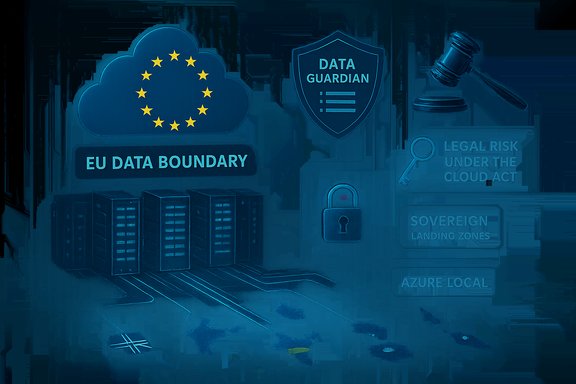
Cloud vendors used to sell geographic regions and the promise that “your data stays where you put it.” As geopolitical tensions and regulatory scrutiny rose in the 2020s, that promise became fragile: courts, legislators and procurement officials began probing whether a datacentre’s walls alone can keep data immune from foreign legal process.Microsoft’s recent program of product launches is an explicit response to that pressure. The company’s public roadmap now bundles multiple tactics under the umbrella of “sovereign solutions”:
- EU Data Boundary and end‑to‑end AI processing within the European Union.
- Data Guardian controls and organizational measures that restrict which employees can access EU systems.
- External Key Management and customer‑controlled encryption to place cryptographic keys outside Microsoft’s operational reach.
- Sovereign Landing Zones, Azure Local scale‑ups, SAN support and disconnected operations for private or air‑gapped deployments.
- Microsoft 365 Local, bringing Exchange, SharePoint and Skype for Business into Azure Local (initially in connected mode; a fully disconnected option is slated for early 2026).
- In‑country processing for Microsoft 365 Copilot in 15 named countries across 2025–2026.
- New national partner clouds (independently operated clouds using Microsoft technology) and a European board overseeing datacentre operations.
But the legal and operational context hasn’t changed: the U.S. federal statutory framework — the CLOUD Act — gives U.S. authorities the ability to compel U.S. companies to provide data, regardless of physical location. That legal fact was restated publicly during the June 10, 2025 French Senate hearing in which Microsoft France’s legal director said he could not guarantee French citizen data would never be handed to U.S. authorities.
This is the key truth: technical controls can dramatically reduce risk and improve transparency, but they cannot, by themselves, defeat extraterritorial legal powers. Any vendor claim of “sovereignty” must therefore be evaluated against both technology and law.
Overview of Microsoft’s sovereign portfolio: what’s new, briefly
EU Data Boundary and Data Guardian
Microsoft has expanded its EU Data Boundary to include end‑to‑end AI processing for EU customer data. The company also outlined operational controls — marketed as Data Guardian — that route or gate engineer access through Europe‑resident personnel and tamper‑evident logging.Microsoft 365 Local (GA)
A packaging of classic productivity server workloads for Azure Local — Exchange Server, SharePoint Server and Skype for Business Server — is now generally available for deployment on Azure Local, initially in a connected mode with a fully disconnected option promised in early 2026.Azure Local scale and SAN support
Azure Local (the evolution of Azure Stack HCI) will support far greater cluster sizes — from prior single‑cluster limits (16 physical servers) up to hundreds of servers — and will accept external Storage Area Network (SAN) attachments so customers can use existing on‑premises storage arrays.In‑country Copilot processing
Microsoft will offer in‑country processing for Microsoft 365 Copilot interactions in 15 countries: four by the end of 2025 (UK, Australia, India, Japan), and eleven more through 2026 including Canada, Germany, Italy, Malaysia, Poland, South Africa, Spain, Sweden, Switzerland, the United Arab Emirates and the United States.National partner clouds and governance changes
Microsoft is positioning operator‑run, locally controlled partner clouds (e.g., Bleu in France, Delos Cloud in Germany) and has promised a European board of directors overseeing datacentre operations in Europe under European law.What the product changes actually deliver — the strengths
Microsoft’s sovereign push contains several tangible, technically meaningful improvements that lower risk, improve control, and increase the range of compliance options for customers.- Stronger operational controls. Routing engineer access through Europe‑resident personnel, enforcing approvals and recording access in tamper‑evident logs increases transparency and makes unauthorized or secret cross‑border access harder to execute undetected.
- Customer key control and encryption. External Key Management and managed HSM options let customers retain cryptographic control over data. When keys never leave customer control, the practical ability for an operator to hand over usable plaintext is limited.
- In‑country AI processing. For AI workloads (notably Copilot prompts and responses), processing within national borders reduces latency and the surface area for data transfer. This matters for regulated sectors that must demonstrate where sensitive processing occurs.
- Air‑gapped/disconnected options. The promise of truly disconnected operation for Microsoft 365 Local (early 2026) can deliver near‑complete operational autonomy: fully offline control planes, local storage and management that reduce dependency on cross‑border communications.
- Larger on‑prem scale and SAN support. Expanding Azure Local to hundreds of nodes and supporting external SANs addresses a major practical limit for organisations that require sovereign private clouds at scale and want to reuse existing storage investments.
- Partner ecosystems and national clouds. Local operators running Microsoft technology under national ownership give procurement teams a vendor structure that aligns with sovereign procurement rules and the political preference for domestically controlled infrastructure.
Where the protections fall short — legal and structural risks
Despite meaningful engineering gains, several high‑impact risks remain. These are not bugs to be patched by a product update; they are legal and structural realities.- Jurisdictional supremacy of U.S. law. The CLOUD Act and other legal mechanisms give U.S. authorities the ability to issue valid demands that U.S. companies must obey, regardless of where the data sits. Operational controls cannot alter which legal system governs a multinational corporation.
- Gag orders and secrecy rules. Many U.S. legal processes include nondisclosure obligations, meaning even if a customer’s data is accessed, the cloud provider can be prevented from alerting the customer. Transparency reports can help, but they don’t remove the risk.
- Corporate governance and control. A European datacentre operated by a U.S. company remains subject to corporate governance that ultimately answers to a U.S. parent company and U.S. courts. Establishing a regional board or European operational guardrails improves oversight, but it is not a legal firewall.
- Sovereignty washing. The marketing term “sovereign” is now used in many ways. Running compute in a particular country is data residency, not legal sovereignty. Organisations that require the absence of foreign legal dependencies should treat vendor “sovereignty” claims with caution.
- Dependence on vendor code and closed platforms. Even with in‑country operations, reliance on proprietary closed‑source systems prevents independent audit and full confidence in controls. Open‑source alternatives can sometimes offer stronger independence and verifiability.
- Policy ambiguity in emergencies. Microsoft’s contractual commitments to contest orders and pursue legal avenues are meaningful, but they depend on time, legal jurisdictions and political contexts. In urgent national security situations, the practical effectiveness of litigation or negotiations is uncertain.
How to evaluate Microsoft’s sovereign offers: a practical checklist
For IT and procurement teams evaluating Microsoft’s sovereign stack, use a decision framework that balances business, compliance, technical and legal realities.- Map the data: classify data and workloads by sensitivity, regulatory driver and compliance needs. Treat identity, health, law‑enforcement and critical infrastructure data as high risk.
- Ask for explicit contractual terms: require commitments on data residency, access controls, employee residency for support operations, logging, and notification. Ensure indemnities or remedies are realistic.
- Key management test: insist on customer‑controlled keys (external key management) for high‑risk data. Validate how keys are stored, who has cryptographic control and what happens if Microsoft is compelled legally.
- Test disconnected scenarios: for needs requiring airtight isolation, validate the disconnected Microsoft 365 Local operations when available. Run tabletop exercises for business continuity and incident response.
- Operational transparency: demand real‑time or near‑real‑time access logs, audit trails, and a tamper‑evident logging mechanism. Validate compliance with independent audits.
- Legal risk assessment: consult counsel to model the risk of U.S. legal process and how Microsoft’s contractual commitments and dispute resolution provisions apply. Factor in the time and cost of litigation.
- Multi‑cloud and exit planning: ensure migration paths and avoid single‑point vendor lock‑in. Keep data exports, backups and alternative processing options tested.
- Consider open alternatives where appropriate: for workloads where maximum sovereignty is vital, evaluate locally owned clouds, open‑source stacks, or providers headquartered entirely outside jurisdictions of concern.
- Procurement and political alignment: involve national cyber authorities and legal teams early on for public sector or critical infrastructure procurements.
- Continuous review: treat sovereignty as an evolving program — legal opinions, geopolitical risk and product roadmaps change over time. Renew assessments annually or on material changes.
Scenarios: when Microsoft’s new tools make sense — and when they don’t
Good fit
- National agencies and regulated enterprises that need advanced AI capabilities but prefer to keep processing and logs physically in the country while retaining integrated vendor support.
- Organisations that require hybrid architectures where critical workloads run in Azure Local with customer‑held keys and can accept vendor governance subject to contractual terms.
- Enterprises needing high performance AI inference in country using NVIDIA GPUs and large local clusters that would be impractical to build themselves.
Poor fit
- Use cases demanding absolute legal non‑access by any foreign government under any conceivable legal compulsion. For those, only architectures where the vendor has zero legal jurisdiction (locally owned operators with local governance and no U.S. parent) or customer‑only encrypted systems where the vendor cannot decrypt would be acceptable.
- Organisations needing full transparency and independent audit of vendor software where closed‑source frameworks are disallowed by policy.
Market and policy implications
Microsoft’s product moves will reshape procurement conversations and competitive dynamics across Europe and other regions. Several likely outcomes deserve attention:- Rival hyperscalers will match with similar offers. The market is now in a sovereignty arms race: competing vendors are rolling out national operator models, hiring rules (e.g., EU citizen operations), and localized processing options.
- Growth of national partner clouds. Microsoft’s support for independent operators in France and Germany is a pragmatic play: offering a middle ground for governments that want Microsoft technology but prefer local operational control.
- Momentum for local cloud suppliers and open‑source stacks. The admission that U.S. law can reach EU data has given domestic providers political leverage. Expect increased public procurement bias toward local suppliers and potentially EU funding for sovereign alternatives.
- Regulatory tightening and procurement rules. EU and national authorities will likely refine procurement standards and may require more stringent contractual proof of operational controls, notification rights and legal recourse options for public sector buyers.
- Heightened scrutiny of vendor claims. “Sovereignty” will become a regulated and scrutinised term. Suppliers that over‑claim may face reputational and legal risks.
Final assessment — sober, not cynical
Microsoft’s latest sovereign cloud investments are significant: they combine real engineering upgrades, new operational controls, stronger partner options and an explicit expansion of in‑country AI processing. For many organisations the new capabilities will materially reduce risk and increase suitability of cloud AI services for regulated uses.Yet the legal bedrock remains unchanged: a U.S.‑headquartered company cannot unilaterally neutralise U.S. extraterritorial legal powers. The admission in front of the French Senate — that Microsoft could not guarantee data would never be accessed by U.S. authorities — crystallised a reality that informed buyers have long known but that marketing often obscured.
The pragmatic path for most European organisations is therefore multi‑dimensional: adopt Microsoft’s new operational controls where they meet business needs; insist on customer key control and airtight contractual protections; maintain exit and multi‑cloud strategies; and where true legal sovereignty is non‑negotiable, consider locally owned or open alternatives that eliminate legal dependency on U.S. jurisdiction.
Sovereignty in the cloud is no longer a single checkbox you buy from a vendor. It is a program of law, technology, governance and procurement that must be assembled, audited and defended — continuously. Microsoft’s “extra sovereignty” buys more tools for that assembly. It does not, and cannot, buy immunity from law. Organizations that understand this distinction will be best placed to use these tools wisely; those who equate local processing with legal sanctuary risk being blindsided by the very vulnerability the new features are meant to mitigate.
Source: theregister.com Microsoft's data sovereignty: Now with extra sovereignty!
