

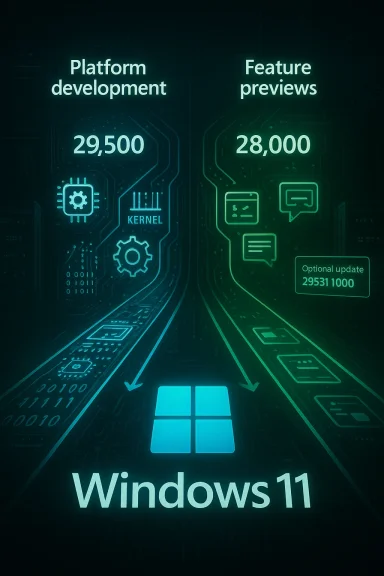
Microsoft has quietly split the Windows Insider Canary Channel into two parallel development tracks — an opt‑in 29500‑series path for deep platform work and the existing 28000‑series feature preview path — a restructuring Microsoft says is intended to let engineers validate under‑the‑hood changes earlier without blocking user‑facing feature development. ([blogs.windows.com].com/windows-insider/2026/02/18/announcing-new-optional-windows-11-insider-preview-build-for-canary-channel-29531-1000/)
Microsoft’s Windows Insider Program has long been the public testbed where experiments, feature previews, and low‑level platform plumbing are validated before they reach production Windows releases. Historically the program offered a few channels — Dev, Beta, and Canary — that prioritized different trade‑offs between novelty and stability. Over the last three years the company has used the Canary Channel for the earliest and often riskiest engineering work; now Microsoft has formalized that early experimentation by making a distinct, explicit split inside Canary itself.
This change was announced by the Windows Insider team on February 18, 2026. In practical terms, devices that remain on the 28000‑series will continue to receive feature preview builds aligned with the 26H1/26H2 feature cadence, while devices that accept the optional update to Build 29531.1000 will be migries platform development stream* focused on kernel, driver, servicing, and other foundational systems work. Microsoft calls the migration opt‑in* and stresses that the 29500 path may temporarily remove or break features while low‑level changes are validated.
Why does that matter to end users? Because the most costly class of regressions and updatmes from foundational, cross‑cutting changes — driver model shifts, update orchestration changes, kernel scheduler tweaks, and new servicing plumbing. By validating these elements on a dedicated set of devices early and widely, Microsoft aims to reduce the number of late‑stage surprises that historically have marred majo---
To be concrete and avoid ambiguity: Microsoft published the optional Canary build announcement on February 18, 2026 and explicitly framed the 29500 path as early platform development. The suggestion that the 29500 work will ultimately serve 27H2 is supported by industry reporting and the cadence signals Microsoft has historically used for major platform transitions, but the exact mapping, featureset, and ship date for 27H2 remain subject to change. Always rely on Microsoft’s official release notes and the Windows Insider Blog for authoritative timelines.
But this strategy must be balanced with excellent communication. If Insiders, OEMs, and IT professionals are not kept aligned, the very objective of better stability could be undermined by confusion, poor pilot coverage, and misinterpreted telemetry. Microsoft has taken the right technical step; the organizational and communications follow‑through will determine whether this becomes a reliable model for future Windows releases.
For Insiders and IT professionals, the guidance is clear: treat the 29500 path as a platform lab, plan for a clean reinstall if you want to revert, and use the stream for intentional testing on expendable hardware. For Microsoft, the challenge is to translate platform engineering wins into perceptible improvements for everyday users — fewer update failures, steadier performance, and more predictable servicing windows. This is the kind of engineering that rarely makes headlines, but it is the work that determines whether a major Windows release will be remembered for innovation or for disruption.
Source: thewincentral.com Windows Insider Changes Signal Windows 11 27H2 Upgrade
 Background
Microsoft’s Windows Insider Program has long been the public testbed where experiments, feature previews, and low‑level platform plumbing are validated before they reach production Windows releases. Historically the program offered a few channels — Dev, Beta, and Canary — that prioritized different trade‑offs between novelty and stability. Over the last three years the company has used the Canary Channel for the earliest and often riskiest engineering work; now Microsoft has formalized that early experimentation by making a distinct, explicit split inside Canary itself.This change was announced by the Windows Insider team on February 18, 2026. In practical terms, devices that remain on the 28000‑series will continue to receive feature preview builds aligned with the 26H1/26H2 feature cadence, while devices that accept the optional update to Build 29531.1000 will be migries platform development stream* focused on kernel, driver, servicing, and other foundational systems work. Microsoft calls the migration opt‑in* and stresses that the 29500 path may temporarily remove or break features while low‑level changes are validated.
What changed — technical details and immediate implications
Two Canary streams, one practical question: which path are you on?
- 28000‑series: the existing Canary route focused on early feature previews (the visible, user‑facing changes aligned with Windows 11 version 26H1/26H2 work).
- 29500‑series: a new, active platform development route beginning with Windows 11 Insider Preview Build 29531.1000, surfaced to Insiders as an optional update under Settings > Windows Update > Advanced options > Optional updates.
Why the split is technically meaningful
The separation lets platform engineers iterate on architectural changes — kernel improvements, update signing and compatibility, scheduling and power plumbing — without those changes colliding with the cadence used by feature teams. It creates a safer experimental sandbox for low‑level work and reduces the risk that late architectural changes will destabilize already‑mature feature work. Practically, this means:- Platform‑only churn (reboots, driver rollbacks, feature gaps) can be quarantined to devices on the 29500 path.
- Feature experimentation can continue at pace in the 28000 path without being held back by foundational changes.
- Engineers can test at scale earlier in the lifecycle, exposing regressions and driver incompatibilities before those changes are grafted onto the public servicing stream.
Why this signals a foundational phase for Windows 11 27H2
Industry coverage and Microsoft’s own language indicate the 29500 stream is intended to surface the earliest iterations of the next platform generation — the plumbing that will underpin what many are calling Windows 11 version 27H2 (a future major milestone). Windows Central, PureInfotech, and other outlets are explicitly linking the 29500 platform stream to preparatory work for 27H2, and Microsoft’s blog frames the stream as an avenue for “early access to platform changes as they take shape.” Those aligned signals make the connection clear: this split is not cosmetic — it’s a shift in testing strategy that prioritizes platform stability ahead of feature roll‑out.Why does that matter to end users? Because the most costly class of regressions and updatmes from foundational, cross‑cutting changes — driver model shifts, update orchestration changes, kernel scheduler tweaks, and new servicing plumbing. By validating these elements on a dedicated set of devices early and widely, Microsoft aims to reduce the number of late‑stage surprises that historically have marred majo---
Concrete examples of platform‑level work already visible in preview builds
Several recent Insider flights show the kind of platform plumbing Microsoft is iterating on — not just UI tweaks. Public preview notes and community analyses call out a set of plumbing changes and platform services that are representative of the 29500‑series focus:- Unified update orchestration and agent plumbing — preview builds have begun to exercise new deployment and update coordination logic (UOP‑style servlets and agent connectors), which affects how apps and system components are updated in tandem. These changes are explicitly platform‑oriented and have been surfaced in Insider notes in the past year.
- On‑device agent and Model Context Protocol (MCP) work — Microsoft has been flighting native agent and context plumbing that underpins on‑device AI scenarios, and those changes intersect with scheduling, security boundaries, and telemetry. Platform streams are a natural place to validate these components at scale.
- Kernel and driver compatibility testing at scale — the Canary split allows Microsoft to push risky driver model changes into an opt‑in population so compatibility telemetry and OEM driver feedback can be gathered without exposing the broader feature stream. Community excerpts and forum threads about the split point to driver/architecture tests being a clear motivation.
Strengths: what this change should deliver if executed well
- Fewer late‑stage regressions in public releases. By isolating risky, low‑level changes in a controlled opt‑in population, Microsoft reduces the chance that last‑minute platform adjustments break shipped features or lead to widespread update rollbacks.
- Better long‑term reliability of servicing updates. Platform first testing helps surface regression patterns that only appear when thousands of drivers and apps interact — the sort of telemetry that’s hard to gather with limited internal dogfooding.
- Faster iteration for architectural work. Platform engineers can iterate more quickly because they aren’t forced to defer or gate their work on feature delivery timelines.
- Cleaner signal for OEMs and driver authors. OEMs and ISVs can monitor the 29500 stream to get early notice of driver or firmware requirements, enabling better upstream coordination before a mass rollout.
Risks, trade‑offs, and operational pitfalls
The platform‑first testing strategy is sensible, but not withoutser experience trade‑offs:- Insider confusion and fragmentation. Splitting Canary into two one‑way paths raises the chance that Insiders will unintentionally migrate, or will not understand which set of behaviors a given device is testing. The “one‑way” clean reinstall barrier is particularly important for less technical Insiders. Microsoft acknowledged both the opt‑in nature and the rollback constraint in its announcement.
- Feature gaps on platform‑focused builds. Devices on 29500 may temporarily lose or be unable to run features that assume the current shipping platform. This will make those early builds less useful to users who care about the visible experience, and could lead to misleading impressions if those Insiders assume those feature gaps are intentional product direction rather than temporary test artifacts.
- Telemetry bias and representativeness. If the opt‑in population overindexes towards advanced or enthusiast users with specific hardware, telemetry may not accurately reflect the broader installed base. Microsoft must ensure OEM and enterprise participation to validate results across mainstream hardware. Community threads and coverage have flagged this as a monitoring concern.
- Operational cost for IT pilots and OEMs. A one‑way opt‑in path creates extra validatners and enterprise pilots need to either replicate testing across both paths or risk missing platform issues if they only watch the 28000 feature stream.
- Potential perception problem. Microsoft is prioritizing "boring but essential" platform work over headline features — the communications challenge is to make the value of these plumbing changes visible to a broad audience who typically respond to new features rather than better update reliability.
How Insiders and IT pros should respond — practical guidance
If you’re an Insider or an IT pilot, here are concrete steps to take before making any migration decision:- Back up your system image and data before opting into Build 29531.1000. Expect to need a clean reinstall to return to 28000‑series builds.
- Treat the 29500 path as a platform lab: use expendable hardware or a VM where possible; do not use your primary productivity device.
- For OEMs and driver vendors: instrument telemetry for the new stream, prioritize log collection (memory dumps, driver load traces), and plan for rapid driver patching windows. The 29500 stream is where foundational changes will surface driver compatibility issues early.
- For enterprise pilots: coordinate with Microsoft through partner channels, and stage testing across devices with diverse firmware and peripheral stacks to avoid blind spots.
- Expect more changelogs to mention platform, infrastructure, and system improvements rather than visible features; adjust test plans accordingly.
Signals about 27H2 timing and productization — what we can reasonably infer
Several outlets connecting Microsoft’s Canary split to the next major Windows platform release suggest that the 29500 stream is laying groundwork for Windows 11 version 27H2, a milestone many in the press expect to become the next major platform release. Windowsrames 29500 as preparatory work that will likely feed into the 27H2 lifecycle, potentially arriving in a later calendar year release. That linkage is widely reported but remains interpretative rather than a formal Microsoft endorsement of specific shipping dates. Treat timing and final scope as speculative until Microsoft publishes a formal roadmap.To be concrete and avoid ambiguity: Microsoft published the optional Canary build announcement on February 18, 2026 and explicitly framed the 29500 path as early platform development. The suggestion that the 29500 work will ultimately serve 27H2 is supported by industry reporting and the cadence signals Microsoft has historically used for major platform transitions, but the exact mapping, featureset, and ship date for 27H2 remain subject to change. Always rely on Microsoft’s official release notes and the Windows Insider Blog for authoritative timelines.
A deeper look: how platform testing reduces long‑tail risk
Platform regressions often emerge at the intersection of update orchestration, driver state, and third‑party software assumptions. These problems are expensive because they’re rare, hard to reproduce, and surface only in diverse field conditions. The Canary split addresses three structural problems:- Early‑stage exposure — by putting low‑level changes in front of a live population early, Microsoft can see interaction effects sooner.
- Separation of concerns — feature teams aren’t forced to accommodate last‑minute platform changes; platform teams can iterate without creating churn for feature validation.
- More deterministic servicing — new update orchestration experiments (for example, UOP‑like plumbing) can be validated independently and corrected before being used to deliver feature updates broadly.
Editorial analysis: what this says about Microsoft’s priorities
This reorganization reflects a sober, pragmatic engineering judgment: prioritize platform reliability and maintainability over continuing to surface flashy features on unstable foundations. That’s a sensible stance in an era where Windows must support an ever‑wider range of silicon (including divergent Arm platforms), broader on‑device AI scenarios, and increasingly complex update surfaces. By intentionally creating an opt‑in platform sandbox, Microsoft engineering discipline and predictable servicing.But this strategy must be balanced with excellent communication. If Insiders, OEMs, and IT professionals are not kept aligned, the very objective of better stability could be undermined by confusion, poor pilot coverage, and misinterpreted telemetry. Microsoft has taken the right technical step; the organizational and communications follow‑through will determine whether this becomes a reliable model for future Windows releases.
Summary and final thoughts
Microsoft’s Canary split — the creation of an optional Build 29531.1000 and the 29500‑series platform stream announced on February 18, 2026 — is a deliberate, technically significant shift in how Windows 11 will be validated going forward. The move creates a safer public sandbox for kernel, driver, and servicing experimentation while preserving a separate path for visible feature previews. If managed well, this approach should reduce update regressions, improve cross‑device consistency, and make future major releases such as the anticipated 27H2 more stable at launch.For Insiders and IT professionals, the guidance is clear: treat the 29500 path as a platform lab, plan for a clean reinstall if you want to revert, and use the stream for intentional testing on expendable hardware. For Microsoft, the challenge is to translate platform engineering wins into perceptible improvements for everyday users — fewer update failures, steadier performance, and more predictable servicing windows. This is the kind of engineering that rarely makes headlines, but it is the work that determines whether a major Windows release will be remembered for innovation or for disruption.
What to watch next
- Microsoft’s upcoming Canary build announcements (each Canary build will now receive its own blog post), which will reveal the concrete platform changes being validated on the 29500 stream.
- OEM and driver vendor responses to the 29500 telemetry: early advisories or updated drivers will be an early indicator of the stream’s practical value.
- Any Microsoft roadmap updates mentioning Windows 11 version 27H2 or a corresponding platform ship target; until Microsoft publishes a timetable, media reports linking 29500 to 27H2 should be treated as informed speculation.
Source: thewincentral.com Windows Insider Changes Signal Windows 11 27H2 Upgrade
