

Microsoft’s position in the software industry remains unusually strong, but the latest peer-comparison snapshot also shows why investors keep debating whether the stock is a bargain, a premium, or both at once. The company looks inexpensive on some traditional valuation measures, yet expensive on sales, while its profitability, cash generation, and growth profile continue to tower over most software peers. That mix helps explain why Microsoft still commands confidence even as its AI spending and cloud ambitions reshape the market’s expectations. The broader takeaway is simple: Microsoft is not just another software vendor; it is a platform company with multiple growth engines, and that changes how the numbers should be read.
Microsoft’s core business is still built on a remarkably durable foundation: Windows, Office, and an expanding cloud and AI stack that now stretches across productivity, infrastructure, security, data, and collaboration. In the company’s current framing, the market is no longer valuing Microsoft only as a software licensor; it is valuing it as a strategic operating layer for the enterprise. That distinction matters because it helps explain why investors tolerate high capital intensity in exchange for long-term control over workflows and workloads.
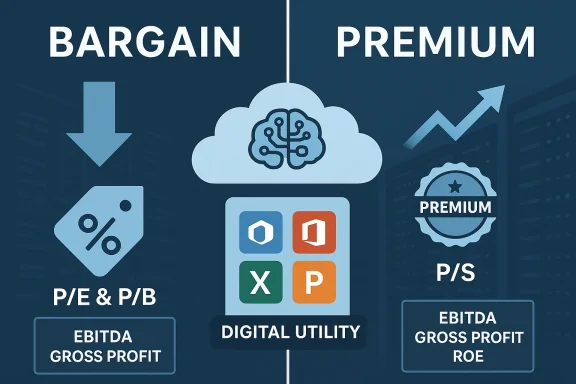
The Sahm Capital comparison article captures a classic valuation paradox. Microsoft screens as cheaper than many peers on P/E and P/B, while appearing richer on P/S, which is exactly the sort of split that often forces investors to decide whether they care more about earnings power or revenue multiples. The company’s reported EBITDA and gross profit are far above the peer averages in the table, and its revenue growth is slightly above the group average as well. That combination says more than a single ratio ever could: Microsoft is large, profitable, and still growing at a rate many software firms would envy.
What makes the story more interesting is that Microsoft’s latest growth is not being driven by one narrow product line. Instead, the company’s cloud business, AI attach rates, enterprise licensing, and platform bundling all reinforce one another. The broader ecosystem increases switching costs and supports pricing power, which is why Microsoft often looks less like a software company and more like a digital utility for modern enterprises.
By contrast, many peer companies in the comparison set are valued more like specialized growth stories than full-platform businesses. That can work very well when a company is early in its expansion phase, but it becomes harder to justify when scale and monetization slow. Microsoft’s valuation debate is therefore not about whether it is good; it is about whether it deserves to be treated like a great compounder at a still-expanding size.
The company’s ROE of 10.2%, EBITDA of $58.18 billion, and gross profit of $55.3 billion all reinforce the same point: Microsoft converts scale into cash flow very efficiently. The article also notes revenue growth of 16.72%, which edges the peer average. For a company of Microsoft’s size, that is a meaningful signal, because sustaining growth at that scale is harder, not easier.
That is why the article’s conclusion that Microsoft may be undervalued on P/E and P/B deserves careful interpretation rather than a simplistic cheer. Software investors know that high-quality franchises often deserve richer multiples, and Microsoft’s premium on sales reflects that reality. In other words, the market is not necessarily confused; it may simply be pricing in the fact that Microsoft’s revenue is more durable, more diversified, and more scalable than the peer set.
The right conclusion is not that Microsoft is a bargain in the absolute sense. It is that, relative to peers, it appears to offer a more favorable balance between price and quality. That distinction matters to institutional investors who want growth, but who also want exposure to a business with the financial depth to survive a tougher macro cycle.
That is why the comparison article’s “overvalued on sales” framing should be treated cautiously. It is technically true in a narrow ratio sense, but it ignores quality-of-revenue differences. In software, the composition of growth matters almost as much as the growth rate itself.
The article also notes that Microsoft’s ROE of 10.2% exceeds the peer average, which signals that the business is using equity capital effectively. That is especially important in software, where the best companies often produce strong returns without requiring excessive physical assets. Microsoft’s ability to combine scale with disciplined capital use gives it a flexibility most rivals simply do not have.
It is also worth remembering that Microsoft’s spending is not random. The company is investing to support future cloud demand, future model usage, and future enterprise workloads. If those bets continue to pay off, what looks like heavy spending today may look like early infrastructure positioning in hindsight.
This is also where Microsoft differs from many of its peers. A specialized vendor may grow faster in a narrow category, but Microsoft can monetize across more touchpoints. That gives it a larger surface area for cross-sell and upsell, and it helps explain why its financial quality often looks stronger even when its headline valuation appears only moderate.
The company’s AI strategy is especially compelling because it is embedded in existing workflows rather than bolted on as a separate experiment. When enterprises adopt Microsoft 365 Copilot or expand cloud usage in Azure, they are not merely trying a feature; they are deepening their dependence on the Microsoft ecosystem. That kind of attachment is much more defensible than a one-off AI novelty.
That matters because capacity constraints can be a temporary drag today and a tailwind tomorrow. If the company finishes expanding its data-center and GPU infrastructure, it could unlock even more growth from workloads that are already waiting in the queue. For investors, that creates the possibility of an earnings story that improves not just through pricing, but through volume.
The key advantage is that Copilot rides on top of software customers already use every day. That reduces adoption friction and makes the upsell story easier to explain to both IT departments and CFOs. In the software industry, ease of integration often turns out to be just as important as technical sophistication.
The article’s comparison set shows how unusual that position is. Many software peers specialize in one lane: cybersecurity, workflow automation, database software, or niche productivity. Microsoft competes across several of those lanes at once, which gives it resilience and optionality. If one category slows, another can compensate. That is a powerful trait in a volatile software market.
This kind of moat is especially valuable in an AI era. Customers want tools that plug into existing systems, manage risk, and scale across departments. Microsoft’s integrated approach makes it easier to justify enterprise-wide adoption, while smaller rivals may have to win product by product.
That breadth is why Microsoft often earns a premium in the market even when some simple ratios make it look mixed. The company is not being judged as a single-product software stock. It is being judged as a broad platform with multiple monetization routes, and that is a very different investment case.
Low leverage does not automatically make a company superior, but it does give management more room to maneuver. Microsoft can spend aggressively on infrastructure, absorb temporary margin pressure, and still maintain credibility with investors because its balance sheet is not stretched. That matters when cloud demand, AI demand, and regulatory scrutiny are all rising at the same time.
The strategic implication is simple: Microsoft can keep investing when others hesitate. That is one reason dominant software platforms often become stronger after industry downturns. They can use their balance sheets to widen the gap when capital becomes scarce.
Consumer and prosumer exposure, however, still adds strategic value. Windows, Surface, Xbox, Bing, and other more personal computing assets keep Microsoft relevant outside the enterprise world and help preserve brand reach. But the growth math is clearly dominated by business customers, especially as AI features become a budgeted line item in enterprise software stacks.
The consumer side can still be strategically useful because it keeps Microsoft’s ecosystem widely visible. Yet in investment terms, the enterprise side is where the compounding happens. That is where Microsoft can attach Copilot, security, cloud consumption, and collaboration upgrades to existing accounts.
That is why the article’s bullish conclusion should be read as a quality-relative argument rather than a pure deep-value argument. Microsoft’s valuation still leaves room for upside if AI monetization continues, but the bigger reason to own it is the durability of its growth engine. In software, durability is often worth more than the difference between two or three ratio points.
That complexity is exactly what makes Microsoft hard to compare with a single peer. Different rivals may beat it on one metric, but few can match its aggregate financial quality, breadth, and AI optionality. The market knows this, which is why Microsoft often trades like an ecosystem rather than a ticker.
Another important question is how the market will interpret Microsoft’s valuation if growth stays strong but spending remains high. If revenue acceleration continues, the stock may deserve to keep trading at a premium. If spending rises faster than monetization, the debate will shift from “undervalued” to “appropriately expensive.” That is the razor-thin line Microsoft is currently walking.
Source: Sahm Evaluating Microsoft Against Peers In Software Industry
 Overview
Microsoft’s core business is still built on a remarkably durable foundation: Windows, Office, and an expanding cloud and AI stack that now stretches across productivity, infrastructure, security, data, and collaboration. In the company’s current framing, the market is no longer valuing Microsoft only as a software licensor; it is valuing it as a strategic operating layer for the enterprise. That distinction matters because it helps explain why investors tolerate high capital intensity in exchange for long-term control over workflows and workloads.The Sahm Capital comparison article captures a classic valuation paradox. Microsoft screens as cheaper than many peers on P/E and P/B, while appearing richer on P/S, which is exactly the sort of split that often forces investors to decide whether they care more about earnings power or revenue multiples. The company’s reported EBITDA and gross profit are far above the peer averages in the table, and its revenue growth is slightly above the group average as well. That combination says more than a single ratio ever could: Microsoft is large, profitable, and still growing at a rate many software firms would envy.
What makes the story more interesting is that Microsoft’s latest growth is not being driven by one narrow product line. Instead, the company’s cloud business, AI attach rates, enterprise licensing, and platform bundling all reinforce one another. The broader ecosystem increases switching costs and supports pricing power, which is why Microsoft often looks less like a software company and more like a digital utility for modern enterprises.
Why this comparison matters now
The timing is important because the software industry has shifted from a “recurring revenue is enough” mindset to a “prove AI monetization at scale” mindset. That change favors companies with broad distribution, deep customer relationships, and large installed bases that can absorb new products quickly. Microsoft has all three. It also has the balance sheet to fund heavy AI and data-center investment without losing strategic flexibility.By contrast, many peer companies in the comparison set are valued more like specialized growth stories than full-platform businesses. That can work very well when a company is early in its expansion phase, but it becomes harder to justify when scale and monetization slow. Microsoft’s valuation debate is therefore not about whether it is good; it is about whether it deserves to be treated like a great compounder at a still-expanding size.
The key numbers in context
The Sahm Capital figures suggest that Microsoft’s P/E of 23.11 and P/B of 7.02 look attractive relative to the stated peer averages, while its P/S of 9.02 looks elevated. In practical terms, that means investors are paying a relatively reasonable price for earnings and book value, but still assigning a premium to revenue because Microsoft has stronger monetization quality than the average software company. That is not necessarily a contradiction; it is often what high-quality software franchises look like.The company’s ROE of 10.2%, EBITDA of $58.18 billion, and gross profit of $55.3 billion all reinforce the same point: Microsoft converts scale into cash flow very efficiently. The article also notes revenue growth of 16.72%, which edges the peer average. For a company of Microsoft’s size, that is a meaningful signal, because sustaining growth at that scale is harder, not easier.
Valuation Versus Quality
The most important lesson from the comparison is that valuation ratios only make sense when matched to business quality. Microsoft can look “cheap” on earnings and book value because those metrics do not fully capture the company’s platform leverage, its AI monetization potential, or the durability of its enterprise relationships. A low multiple can mean mispricing, but it can also mean the market is still digesting how much recurring value the company can extract from its ecosystem.That is why the article’s conclusion that Microsoft may be undervalued on P/E and P/B deserves careful interpretation rather than a simplistic cheer. Software investors know that high-quality franchises often deserve richer multiples, and Microsoft’s premium on sales reflects that reality. In other words, the market is not necessarily confused; it may simply be pricing in the fact that Microsoft’s revenue is more durable, more diversified, and more scalable than the peer set.
Reading the P/E and P/B signals
Microsoft’s earnings multiple is often viewed as attractive because the company produces recurring profits at a massive scale. But earnings multiples alone can understate future value when a business is still expanding into new markets such as AI infrastructure, copilots, and security. The P/B ratio can tell a similar partial story: Microsoft’s intangible asset base and platform economics make book value a blunt instrument for judging worth.The right conclusion is not that Microsoft is a bargain in the absolute sense. It is that, relative to peers, it appears to offer a more favorable balance between price and quality. That distinction matters to institutional investors who want growth, but who also want exposure to a business with the financial depth to survive a tougher macro cycle.
Why price-to-sales can mislead here
The P/S ratio of 9.02 is the number most likely to make value-oriented investors pause. Yet for Microsoft, revenue is not a neutral commodity; it is supported by a wide software stack, strong retention, and a growing cloud and AI attach layer. A revenue dollar from Microsoft is often more valuable than a revenue dollar from a smaller or more concentrated software vendor because the associated customer relationship is deeper and more expandable.That is why the comparison article’s “overvalued on sales” framing should be treated cautiously. It is technically true in a narrow ratio sense, but it ignores quality-of-revenue differences. In software, the composition of growth matters almost as much as the growth rate itself.
Profitability and Cash Generation
If valuation is the debate, profitability is the rebuttal. Microsoft’s EBITDA of $58.18 billion and gross profit of $55.3 billion are staggering relative to the peer group cited in the article, and they explain why investors are willing to fund the company’s ongoing AI and infrastructure buildout. These are not the numbers of a company struggling to prove product-market fit; they are the numbers of a mature platform with enormous operating leverage.The article also notes that Microsoft’s ROE of 10.2% exceeds the peer average, which signals that the business is using equity capital effectively. That is especially important in software, where the best companies often produce strong returns without requiring excessive physical assets. Microsoft’s ability to combine scale with disciplined capital use gives it a flexibility most rivals simply do not have.
EBITDA as a strategic indicator
EBITDA is not a perfect measure, but for Microsoft it is a useful proxy for the company’s operating strength and cash-generating ability. The key point is not just the absolute number; it is the company’s ability to keep generating substantial cash even while funding compute, data centers, and AI-related expansion. That is a major differentiator from smaller peers that may have strong growth but much thinner financial cushions.It is also worth remembering that Microsoft’s spending is not random. The company is investing to support future cloud demand, future model usage, and future enterprise workloads. If those bets continue to pay off, what looks like heavy spending today may look like early infrastructure positioning in hindsight.
Gross profit and software economics
Microsoft’s gross profit strength says something fundamental about software economics: once the platform is built, each incremental customer or workload can be highly profitable. That is especially true when products are layered together, as they are across Microsoft 365, Azure, Dynamics, Teams, and security. The more tightly these products are integrated, the more Microsoft can convert usage into margin.This is also where Microsoft differs from many of its peers. A specialized vendor may grow faster in a narrow category, but Microsoft can monetize across more touchpoints. That gives it a larger surface area for cross-sell and upsell, and it helps explain why its financial quality often looks stronger even when its headline valuation appears only moderate.
Growth Drivers
Microsoft’s growth story has become increasingly tied to Azure, Copilot, and enterprise-wide AI adoption. In the cited analysis, Azure and other cloud services grew at a very strong pace, while commercial remaining performance obligation surged sharply year over year. That combination points to both current demand and future revenue visibility, which is exactly what long-term software investors want to see.The company’s AI strategy is especially compelling because it is embedded in existing workflows rather than bolted on as a separate experiment. When enterprises adopt Microsoft 365 Copilot or expand cloud usage in Azure, they are not merely trying a feature; they are deepening their dependence on the Microsoft ecosystem. That kind of attachment is much more defensible than a one-off AI novelty.
Azure as the growth engine
Azure remains the clearest expression of Microsoft’s scale advantage. Strong cloud growth at this size implies that enterprise workloads are still migrating and that AI demand is creating new consumption patterns. The article’s emphasis on capacity constraints is especially telling, because it suggests the issue is supply, not interest. In other words, Microsoft has demand that may outstrip its current infrastructure footprint.That matters because capacity constraints can be a temporary drag today and a tailwind tomorrow. If the company finishes expanding its data-center and GPU infrastructure, it could unlock even more growth from workloads that are already waiting in the queue. For investors, that creates the possibility of an earnings story that improves not just through pricing, but through volume.
Copilot and monetization
Copilot has become one of Microsoft’s most important pricing levers. The product is no longer just a side feature; it is part of the company’s broader strategy to raise revenue per user across Microsoft 365, Teams, Dynamics 365, and Azure. That makes AI monetization more immediate and more visible than in many other software businesses.The key advantage is that Copilot rides on top of software customers already use every day. That reduces adoption friction and makes the upsell story easier to explain to both IT departments and CFOs. In the software industry, ease of integration often turns out to be just as important as technical sophistication.
Competitive Position
Microsoft’s competitive position is strengthened by breadth. It can challenge hyperscalers in cloud, productivity vendors in collaboration, security firms in identity and protection, and workflow software providers in automation. That means competitors are rarely facing only one Microsoft product; they are often facing a bundled platform with multiple integration points and a giant installed base.The article’s comparison set shows how unusual that position is. Many software peers specialize in one lane: cybersecurity, workflow automation, database software, or niche productivity. Microsoft competes across several of those lanes at once, which gives it resilience and optionality. If one category slows, another can compensate. That is a powerful trait in a volatile software market.
The moat is widening
Microsoft’s moat is not static; it expands as identity, data, governance, compliance, and AI orchestration become more interconnected. Each new layer increases the cost and complexity of replacement for customers. That is why the company often feels like a control plane for enterprise digital operations rather than just a software vendor.This kind of moat is especially valuable in an AI era. Customers want tools that plug into existing systems, manage risk, and scale across departments. Microsoft’s integrated approach makes it easier to justify enterprise-wide adoption, while smaller rivals may have to win product by product.
What peers are up against
Peers like Oracle, ServiceNow, Fortinet, Check Point, UiPath, Monday.com, and others each bring strong capabilities, but few can match Microsoft’s combination of cloud, productivity, security, and AI. Some are more specialized, some are faster growing, and some have more attractive valuations on specific metrics. But few can offer the same breadth of enterprise relevance.That breadth is why Microsoft often earns a premium in the market even when some simple ratios make it look mixed. The company is not being judged as a single-product software stock. It is being judged as a broad platform with multiple monetization routes, and that is a very different investment case.
Debt, Balance Sheet, and Financial Flexibility
The Sahm Capital article points out that Microsoft’s debt-to-equity ratio of 0.15 is lower than its top peers in the comparison set. That suggests a stronger financial position and less reliance on leverage. In a capital-intensive AI cycle, that kind of balance sheet flexibility is a real asset rather than a footnote.Low leverage does not automatically make a company superior, but it does give management more room to maneuver. Microsoft can spend aggressively on infrastructure, absorb temporary margin pressure, and still maintain credibility with investors because its balance sheet is not stretched. That matters when cloud demand, AI demand, and regulatory scrutiny are all rising at the same time.
Why leverage matters less in good times and more in bad ones
In strong markets, debt-to-equity can look like a minor metric. In tougher environments, it becomes a stress test. Microsoft’s low leverage means the company is less vulnerable to shocks and more capable of staying aggressive while weaker competitors pull back. That can create a compounding advantage over time.The strategic implication is simple: Microsoft can keep investing when others hesitate. That is one reason dominant software platforms often become stronger after industry downturns. They can use their balance sheets to widen the gap when capital becomes scarce.
Enterprise Versus Consumer Impact
Microsoft’s consumer footprint still matters, but the enterprise side is where the real financial engine sits. The company’s broad commercial ecosystem allows it to monetize productivity, infrastructure, and security in ways that feel embedded in daily business operations. That makes growth more predictable and more defensible than consumer-led demand alone.Consumer and prosumer exposure, however, still adds strategic value. Windows, Surface, Xbox, Bing, and other more personal computing assets keep Microsoft relevant outside the enterprise world and help preserve brand reach. But the growth math is clearly dominated by business customers, especially as AI features become a budgeted line item in enterprise software stacks.
Why the enterprise side wins
Enterprise buyers care about integration, governance, support, and total cost of ownership. Microsoft’s product suite is built to address those concerns at scale. That is one reason AI adoption inside the company’s ecosystem can turn into durable revenue rather than one-time experimentation.The consumer side can still be strategically useful because it keeps Microsoft’s ecosystem widely visible. Yet in investment terms, the enterprise side is where the compounding happens. That is where Microsoft can attach Copilot, security, cloud consumption, and collaboration upgrades to existing accounts.
Market Interpretation
The market is effectively telling investors two things at once. First, Microsoft is a premium business with unusually strong execution and financial quality. Second, it is no longer cheap enough to be treated like a simple bargain stock without context. The truth sits in the middle: Microsoft may be undervalued on some metrics, but it is not mispriced by accident.That is why the article’s bullish conclusion should be read as a quality-relative argument rather than a pure deep-value argument. Microsoft’s valuation still leaves room for upside if AI monetization continues, but the bigger reason to own it is the durability of its growth engine. In software, durability is often worth more than the difference between two or three ratio points.
How investors are likely to frame it
Some investors will focus on the comparatively modest P/E and P/B and call Microsoft attractive. Others will focus on the P/S premium and argue the stock is still priced for excellence. Both views have merit. The better conclusion is that Microsoft is a high-quality compounder whose price reflects its complexity, not a simple bargain or an obviously stretched story.That complexity is exactly what makes Microsoft hard to compare with a single peer. Different rivals may beat it on one metric, but few can match its aggregate financial quality, breadth, and AI optionality. The market knows this, which is why Microsoft often trades like an ecosystem rather than a ticker.
Strengths and Opportunities
Microsoft’s strengths are obvious, but the more interesting question is how those strengths translate into future opportunity. The company’s ability to monetize AI, cloud, and enterprise software simultaneously gives it several paths to sustain growth, and that makes the investment case unusually resilient. In a software market where differentiation is harder than ever, Microsoft still owns multiple levers.- Azure remains a major growth engine with strong demand visibility.
- Copilot can raise revenue per user across enterprise accounts.
- The company’s commercial backlog provides unusually strong revenue visibility.
- Microsoft’s low leverage gives it strategic flexibility.
- The platform can monetize across productivity, cloud, security, and AI at once.
- Strong gross profit supports continued investment without sacrificing resilience.
- The company’s ecosystem creates high switching costs and durable customer relationships.
Risks and Concerns
Microsoft’s upside is substantial, but the risks are equally real. The biggest one is that AI investment could continue to pressure margins before monetization fully catches up. Another is that capacity constraints, execution issues, or product friction could slow the pace at which the company turns demand into revenue.- AI capital spending may weigh on margins for longer than expected.
- Azure capacity may constrain near-term growth if supply lags demand.
- The OpenAI relationship is strategic, but it also adds dependency complexity.
- The company’s high P/S ratio can still keep valuation debate alive.
- Increased reliance on bundled AI may trigger customer scrutiny on pricing.
- Regulatory and competitive pressure could challenge the company’s platform breadth over time.
- If AI monetization slows, the market may reassess the premium it gives Microsoft for growth durability.
Looking Ahead
The next phase of Microsoft’s story will likely be defined less by whether the company is strong and more by whether it can convert strength into even more visible monetization. Investors should watch Azure growth, Copilot adoption, and the pace at which commercial customers expand spend inside the Microsoft ecosystem. Those indicators will tell us whether the current AI buildout is a temporary margin drag or the start of a deeper earnings flywheel.Another important question is how the market will interpret Microsoft’s valuation if growth stays strong but spending remains high. If revenue acceleration continues, the stock may deserve to keep trading at a premium. If spending rises faster than monetization, the debate will shift from “undervalued” to “appropriately expensive.” That is the razor-thin line Microsoft is currently walking.
What to watch next
- Azure growth trends and whether capacity constraints ease.
- Copilot monetization across Microsoft 365, Teams, and Dynamics.
- Changes in commercial backlog and enterprise spending visibility.
- Margin pressure from continued AI infrastructure investment.
- Any shift in how the market values Microsoft’s revenue quality versus pure sales multiples.
Source: Sahm Evaluating Microsoft Against Peers In Software Industry
Last edited:
