

Microsoft’s stock often gets discussed as if it were one of the market’s simplest AI beneficiaries, but the recent debate around its valuation tells a more complicated story. The Seeking Alpha piece frames the company as a high-quality platform business that has been punished alongside more speculative names, even though its fundamentals remain materially different from a company like Meta during the 2022 drawdown. That distinction matters because investors are not just asking whether Microsoft is “cheap”; they are asking whether the market has temporarily confused cyclical sentiment with structural weakness. The article’s own disclosure and positioning also underscore that this is an investment-thesis debate, not a company-existential one.
Microsoft has spent the better part of two years at the center of the market’s AI conversation, and that attention has changed how investors interpret every move the company makes. The stock’s rally and reset have been driven less by ordinary software dynamics than by questions about Azure, Copilot, OpenAI, enterprise spending, and how much of the company’s capital allocation should be redirected into AI infrastructure. That makes Microsoft unusually sensitive to sentiment swings, because the market is no longer pricing it only as a mature cash machine. It is also pricing it as a platform that may define the next computing cycle.
At the same time, Microsoft is still a very large recurring-revenue business with deeply embedded enterprise relationships, which makes it fundamentally different from a more narrative-driven platform like Meta was in 2022. The article’s central implication is that the selloff in Microsoft should not be interpreted as a simple “growth stock derating” story. Instead, it should be viewed through the lens of a premium business whose multiple has compressed while its operating franchise remains intact. That framing is important because it shapes whether investors see downside as a warning or an opportunity.
The article also points to the broader issue of how Microsoft packages AI across its ecosystem. Copilot has become a label attached to consumer chat, enterprise productivity, Windows entry points, and developer tools at once, which has made the story powerful but diffuse. Microsoft has reportedly begun drawing a line between where AI is visible and where it is monetized, especially by prioritizing future Copilot development in Microsoft 365 for commercial organizations rather than in Windows. That is not a retreat from AI; it is a sign that the company is trying to turn broad distribution into a clearer commercial thesis.
There is also a capital-allocation undercurrent here. Microsoft has been pouring money into compute capacity and data-center expansion, which has fueled investor anxiety about whether AI spending will earn back its cost fast enough. In that environment, Copilot becomes the obvious focal point because it is visible, measurable, and easy to debate. But the company’s actual revenue engine remains much broader than one product family, and that is why comparisons to a more sentiment-driven company like Meta in 2022 can be misleading.
Microsoft’s position in enterprise software gives it a much more stable base than Meta had during its own reset. The company can roll new capabilities into Microsoft 365, Windows, Azure, and adjacent tools without asking customers to adopt an entirely new relationship with the business. That matters because distribution is not merely a channel advantage; it is a mechanism for gradual monetization. If the company can improve revenue per user without disrupting workflows, the economics can compound even when sentiment looks impatient.
The article’s analysis implies that Copilot may never need to become a consumer blockbuster to justify itself. If it can improve retention, deepen Microsoft 365 usage, and increase revenue per user, then it can be strategically successful even if it never produces viral enthusiasm. That is a very Microsoft-style outcome: boring, embedded, and lucrative. Boring is not a weakness when it means dependable economics.
What stands out in the thesis is that Microsoft is still being treated as a premium business, just not an obviously euphoric one. That is a subtle but important shift. It means the market is not abandoning the stock; it is testing whether the company deserves the same valuation enthusiasm it enjoyed when AI optimism was at its peak. That is very different from a broken-balance-sheet story.
That distinction is why the company’s product choices matter so much. A consumer-facing AI assistant can build awareness, but a commercial AI layer inside Microsoft 365 is what can actually move revenue at scale. It also explains why the company has increasingly emphasized workflows rather than just features. Businesses buy outcomes, not demos.
Enterprise buyers, by contrast, are often willing to be slower if the product is safer and easier to govern. Microsoft’s own strategic signaling suggests it understands that, which is why commercial Copilot development is being centered in Microsoft 365 rather than Windows. In other words, Microsoft is trying to separate visibility from value.
In practical terms, investors are asking whether Microsoft’s AI investments are creating a more valuable platform or merely a more expensive one. The answer depends on whether the company can turn usage into monetization with enough scale to matter. That is why the article’s focus on valuation is so important: it is not really about whether Microsoft is good. It is about whether it is good at the right price.
That scale gives Microsoft a resilience that speculative AI challengers do not have. The company can experiment, adjust pricing, and reorganize product ownership without needing a one-quarter miracle to survive. It also means that even modest success in AI monetization can add up over time because the base is so large. That is one reason long-term bulls remain comfortable.
There is also execution risk in the spending itself. Heavy infrastructure investment makes strategic sense only if it generates enough usage to justify the cost. If adoption stays incremental, the market may decide that Microsoft is spending ahead of demand rather than creating it. That is the classic capex risk, and it tends to show up first in sentiment.
Ultimately, the article’s best takeaway is that Microsoft is not Meta in 2022, even if both names can be caught in a valuation downdraft. Microsoft remains a platform company with enormous distribution, recurring revenue, and a real path to AI monetization. If the company turns that path into visible earnings power, the current skepticism may look temporary rather than structural. If not, the market may keep asking for proof a little longer than bulls would like.
Source: Seeking Alpha Microsoft: Not Like Meta In 2022 (NASDAQ:MSFT)
 Background
Microsoft has spent the better part of two years at the center of the market’s AI conversation, and that attention has changed how investors interpret every move the company makes. The stock’s rally and reset have been driven less by ordinary software dynamics than by questions about Azure, Copilot, OpenAI, enterprise spending, and how much of the company’s capital allocation should be redirected into AI infrastructure. That makes Microsoft unusually sensitive to sentiment swings, because the market is no longer pricing it only as a mature cash machine. It is also pricing it as a platform that may define the next computing cycle.At the same time, Microsoft is still a very large recurring-revenue business with deeply embedded enterprise relationships, which makes it fundamentally different from a more narrative-driven platform like Meta was in 2022. The article’s central implication is that the selloff in Microsoft should not be interpreted as a simple “growth stock derating” story. Instead, it should be viewed through the lens of a premium business whose multiple has compressed while its operating franchise remains intact. That framing is important because it shapes whether investors see downside as a warning or an opportunity.
The article also points to the broader issue of how Microsoft packages AI across its ecosystem. Copilot has become a label attached to consumer chat, enterprise productivity, Windows entry points, and developer tools at once, which has made the story powerful but diffuse. Microsoft has reportedly begun drawing a line between where AI is visible and where it is monetized, especially by prioritizing future Copilot development in Microsoft 365 for commercial organizations rather than in Windows. That is not a retreat from AI; it is a sign that the company is trying to turn broad distribution into a clearer commercial thesis.
There is also a capital-allocation undercurrent here. Microsoft has been pouring money into compute capacity and data-center expansion, which has fueled investor anxiety about whether AI spending will earn back its cost fast enough. In that environment, Copilot becomes the obvious focal point because it is visible, measurable, and easy to debate. But the company’s actual revenue engine remains much broader than one product family, and that is why comparisons to a more sentiment-driven company like Meta in 2022 can be misleading.
Why the Meta Comparison Only Goes So Far
The article’s title is provocative because it invites a simple investor reflex: if Microsoft is down sharply, maybe it is just another big tech stock getting washed out like Meta in 2022. But that analogy breaks down once you examine the business mix. Meta in 2022 was dealing with a very different problem set, including ad-cycle pressure, platform risk, and a public-market reassessment of whether massive spending would ever produce durable returns. Microsoft’s issue is not the same, even if the market sometimes treats both stocks as expensive AI-adjacent names.Microsoft’s position in enterprise software gives it a much more stable base than Meta had during its own reset. The company can roll new capabilities into Microsoft 365, Windows, Azure, and adjacent tools without asking customers to adopt an entirely new relationship with the business. That matters because distribution is not merely a channel advantage; it is a mechanism for gradual monetization. If the company can improve revenue per user without disrupting workflows, the economics can compound even when sentiment looks impatient.
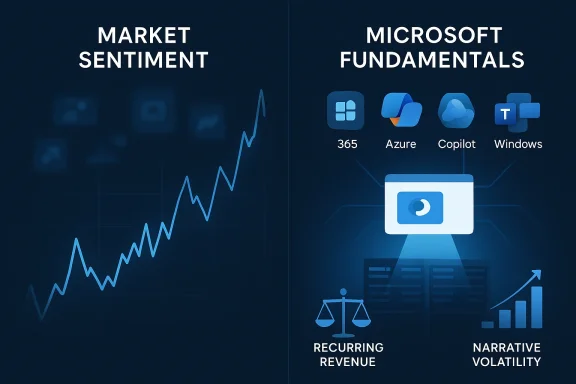
Structural Strength Versus Narrative Volatility
A useful way to think about the comparison is that Meta in 2022 was a company trying to justify a future that the market questioned, while Microsoft is a company trying to rationalize the speed of a future the market already believes in. That difference changes the burden of proof. Microsoft does not have to invent a reason to matter; it has to prove that AI integration will produce measurable returns fast enough to support its premium standing.- Microsoft’s enterprise base is sticky.
- Its revenue is more recurring than ad-dependent peer models.
- The company controls both application surfaces and cloud infrastructure.
- Investor frustration is mostly about timing, not legitimacy.
- The AI narrative is still intact even if the stock rerates.
- The market may be discounting execution speed, not strategic value.
Copilot as a Monetization Test
The strongest thread running through the broader Microsoft discussion is that Copilot is not just a feature; it is a test of whether Microsoft can turn ambient AI into a paying layer inside an already massive ecosystem. Microsoft has publicly quantified Copilot adoption and commercial seat growth, but the market keeps asking whether those numbers are enough relative to the scale of the company. That makes Copilot less of a standalone product story and more of a proof point for Microsoft’s entire AI strategy.The article’s analysis implies that Copilot may never need to become a consumer blockbuster to justify itself. If it can improve retention, deepen Microsoft 365 usage, and increase revenue per user, then it can be strategically successful even if it never produces viral enthusiasm. That is a very Microsoft-style outcome: boring, embedded, and lucrative. Boring is not a weakness when it means dependable economics.
Where the Product Story Gets Messy
The challenge is that Copilot’s branding has expanded faster than its business model has become legible. A feature that appears everywhere can feel powerful, but it can also feel blurry when customers do not understand which version they are supposed to buy or use. That is especially true when consumer and enterprise experiences diverge in practice, as Microsoft appears to be acknowledging by steering commercial customers toward Microsoft 365 rather than Windows as the main monetization center.- Copilot is visible across multiple product surfaces.
- The enterprise story is clearer than the consumer story.
- Windows is more of a visibility layer than a monetization engine.
- Product fragmentation can dilute pricing power.
- Workflow integration matters more than launch theatrics.
- The company needs habitual use, not occasional trial.
Why the Selloff Matters
Microsoft’s stock decline matters not because the company has suddenly become fragile, but because the market has started to demand more evidence that AI spending will translate into financial returns. When a premium software company rerates, investors usually want one of two things: either the growth story accelerates, or the price resets enough to compensate for the uncertainty. Microsoft is being asked to deliver a little of both.What stands out in the thesis is that Microsoft is still being treated as a premium business, just not an obviously euphoric one. That is a subtle but important shift. It means the market is not abandoning the stock; it is testing whether the company deserves the same valuation enthusiasm it enjoyed when AI optimism was at its peak. That is very different from a broken-balance-sheet story.
Timing, Expectations, and the Cost of Being Right Too Slowly
The real problem is timing. A company can be strategically correct and still disappoint if the payback arrives slower than investors expected. Microsoft’s AI spending, compute buildout, and product redesigns all make sense in isolation, but public-market valuation is a momentum game as much as a fundamentals game. The market wants a visible bridge between spending now and earnings later.- Capex growth raises the burden of proof.
- AI adoption must be visible in seat expansion or usage.
- The market is impatient for monetization milestones.
- Premium businesses can still rerate lower.
- Slow payback can hurt sentiment even when the thesis is intact.
- Microsoft must show that AI is accretive, not just additive.
Enterprise Versus Consumer Impact
One of the most useful lenses on Microsoft is the split between enterprise and consumer behavior. For consumers, Copilot and the broader AI push need to feel obvious, helpful, and not intrusive. For enterprises, the standard is harsher: the features must be secure, governable, integrated, and worth the procurement friction. Microsoft appears to know that the enterprise side is where the real monetization leverage lives.That distinction is why the company’s product choices matter so much. A consumer-facing AI assistant can build awareness, but a commercial AI layer inside Microsoft 365 is what can actually move revenue at scale. It also explains why the company has increasingly emphasized workflows rather than just features. Businesses buy outcomes, not demos.
The Consumer Story Is Still About Familiarity
For consumers, Microsoft’s advantage is distribution, but distribution alone does not guarantee delight. If the assistant feels cluttered, inconsistent, or forced, users may ignore it even when it is embedded in the apps they already use. That makes consumer AI adoption fragile and difficult to read from topline numbers alone.Enterprise buyers, by contrast, are often willing to be slower if the product is safer and easier to govern. Microsoft’s own strategic signaling suggests it understands that, which is why commercial Copilot development is being centered in Microsoft 365 rather than Windows. In other words, Microsoft is trying to separate visibility from value.
- Consumer success depends on convenience.
- Enterprise success depends on trust and control.
- Branding can create awareness, but not adoption by itself.
- Microsoft 365 is the clearer monetization path.
- Windows is important, but more as an entry point.
- The company needs both markets, but not the same pitch for both.
What the Market Is Really Pricing
The market is not just pricing Microsoft’s current earnings. It is pricing a bundle of expectations about AI leadership, cloud expansion, product coherence, and margin discipline. When those expectations rise faster than the business can digest them, even a great company can look expensive. That is the underlying tension in the Microsoft thesis.In practical terms, investors are asking whether Microsoft’s AI investments are creating a more valuable platform or merely a more expensive one. The answer depends on whether the company can turn usage into monetization with enough scale to matter. That is why the article’s focus on valuation is so important: it is not really about whether Microsoft is good. It is about whether it is good at the right price.
The Price of Greatness
A premium company can still be a bad stock if the entry price assumes too much perfection. Microsoft has spent years earning a quality multiple, but quality multiples are not permanent entitlements. They survive only if the company keeps delivering evidence that future growth is both real and durable.- Investors are paying for AI optionality.
- They are also paying for cloud durability.
- Product coherence is becoming a valuation input.
- Cost discipline still matters even in a growth narrative.
- Seat expansion is more persuasive than buzz.
- The market is rewarding proof, not promises.
Strategic Advantages Microsoft Still Has
Even after a drawdown, Microsoft retains an unusually strong strategic hand. Its software footprint, cloud infrastructure, identity layer, productivity suite, and developer ecosystem form a combination that is very hard to replicate. Few companies can distribute AI through so many surfaces while controlling so much of the backend that powers them.That scale gives Microsoft a resilience that speculative AI challengers do not have. The company can experiment, adjust pricing, and reorganize product ownership without needing a one-quarter miracle to survive. It also means that even modest success in AI monetization can add up over time because the base is so large. That is one reason long-term bulls remain comfortable.
Distribution Is Still the Hidden Superpower
Distribution is often discussed as if it were boring, but in software it is the difference between a feature and a platform. Microsoft can put AI in places where users already work, which is far more powerful than asking them to adopt a separate destination product. That is especially true in enterprise, where inertia can be an asset if the new feature lands inside an existing workflow.- Microsoft owns multiple high-traffic product surfaces.
- It can monetize through add-ons and seat upgrades.
- Its cloud and application layers reinforce each other.
- Enterprise trust lowers adoption friction.
- It can tolerate a slower ramp than smaller peers.
- The company can keep investing while the market waits.
Risks and Unintended Consequences
The biggest risk for Microsoft is that its AI strategy becomes too sprawling to explain cleanly. If Copilot remains fragmented across product surfaces, customers may struggle to understand what they are buying, and investors may struggle to understand what they are underwriting. That is a branding problem at first, but it can turn into a monetization problem later.There is also execution risk in the spending itself. Heavy infrastructure investment makes strategic sense only if it generates enough usage to justify the cost. If adoption stays incremental, the market may decide that Microsoft is spending ahead of demand rather than creating it. That is the classic capex risk, and it tends to show up first in sentiment.
Where Things Could Go Wrong
Microsoft could also face a subtler problem: the company may get the AI story broadly right but fail to make it emotionally compelling to users. If features feel forced, repetitive, or confusing, consumer goodwill can erode even when enterprise metrics improve. The company needs trust, not just reach.- Product sprawl could blur the revenue story.
- AI capex could outrun near-term monetization.
- Consumer users may resist intrusive AI surfaces.
- Enterprises may delay broader deployment.
- Valuation compression could persist despite solid fundamentals.
- Messaging drift could weaken confidence in the thesis.
- The stock can stay volatile longer than investors expect.
Strengths and Opportunities
Microsoft still has a deep moat, and the article’s setup suggests that the current reset may be more of an opportunity than a warning sign if the company executes well. The upside is not necessarily a dramatic re-rating overnight. It is the possibility that Microsoft steadily turns AI from a cost center into a deeper layer of recurring value.- Unmatched distribution through Windows, Microsoft 365, Teams, Bing, and Azure.
- Enterprise trust that supports secure deployment and compliance-heavy workflows.
- Recurring revenue that can absorb a slower AI adoption curve.
- Monetization flexibility through seats, add-ons, and cloud integration.
- Platform leverage that lets Microsoft embed AI where work already happens.
- Capital strength to keep investing through volatile AI cycles.
- Potential simplification if Copilot becomes a clearer product family.
Risks and Concerns
The downside case is less about catastrophic failure and more about disappointing execution relative to expectations. If Microsoft cannot demonstrate that Copilot and the broader AI stack are generating enough measurable return, the market may continue to treat the stock as richly priced even after a pullback. That would keep valuation pressure alive.- Execution risk if product and org changes do not improve velocity.
- Brand confusion if Copilot stays inconsistent across surfaces.
- Cost pressure from data-center and model investment.
- Adoption friction if users do not see enough daily value.
- Enterprise hesitation if roadmaps appear unstable.
- Consumer backlash if AI feels forced into core workflows.
- Multiple compression if growth fails to reaccelerate visibly.
What to Watch Next
The next phase of the Microsoft story will be judged by evidence, not rhetoric. Investors should focus on whether the company can tighten the product narrative, improve usage quality, and show that AI spending is translating into something more durable than buzz. The key is not just growth; it is efficient growth.The most important signals
- Copilot seat growth and whether it keeps accelerating in commercial accounts.
- Clearer product packaging that separates consumer convenience from enterprise monetization.
- Azure and cloud strength as AI infrastructure spending continues.
- Evidence of workflow adoption rather than just trial usage.
- Margin commentary that shows AI investment is becoming more efficient.
Ultimately, the article’s best takeaway is that Microsoft is not Meta in 2022, even if both names can be caught in a valuation downdraft. Microsoft remains a platform company with enormous distribution, recurring revenue, and a real path to AI monetization. If the company turns that path into visible earnings power, the current skepticism may look temporary rather than structural. If not, the market may keep asking for proof a little longer than bulls would like.
Source: Seeking Alpha Microsoft: Not Like Meta In 2022 (NASDAQ:MSFT)
