

Microsoft has reportedly stopped manufacturing the Surface Go and Surface Laptop Go lines as of late June 2026, leaving the Surface Go 4 and Surface Laptop Go 3 to sell through remaining stock while Microsoft concentrates its Surface portfolio on larger, pricier Pro and Laptop models. If that reporting holds, the decision closes the book on Microsoft’s last genuinely small and relatively affordable Surface PCs. It also says something larger about where the Windows hardware story is headed: less experimentation at the edges, more disciplined premium devices in the middle, and a budget market Microsoft increasingly seems content to let OEM partners fight over.
The Surface Go was never the best Surface. That was part of its appeal. It was the Surface that made the fewest grand promises and, in the right hands, solved the most specific problem: a real Windows machine small enough to disappear into a bag, sit on an airplane tray, run legacy software in a pinch, and still behave like a tablet when the keyboard came off.
That niche sounds modest until it vanishes.
The Surface Go existed because Windows never stopped needing an answer to the iPad that was not simply “buy a laptop.” Microsoft had spent years trying to prove that a tablet could also be a PC, but the mainstream Surface Pro gradually became a premium productivity machine. The Go took the same basic grammar — kickstand, detachable keyboard, pen support, Windows desktop — and shrank it into something friendlier, cheaper, and less self-serious.
That distinction mattered. The iPad won the small-tablet argument by being simple, fast, app-centric, and appliance-like. The Surface Go countered with a messier but more flexible claim: maybe what some people wanted was not a tablet that approximated a computer, but a computer that could tolerate being used like a tablet.
The Go’s compromises were obvious from the first generation. Performance was just good enough, and sometimes not even that. The Type Cover was clever but cramped. The entry configurations often felt like a decoy, because storage, RAM, and keyboard upgrades could push the real price far above the marketing price.
But the idea was coherent. A small Windows tablet with a kickstand and a real file system was useful in ways that benchmark charts never captured. It could run a niche desktop utility, connect to enterprise peripherals, join a domain, handle remote admin tools, open full Office, or become the emergency machine that saved a work trip when the main laptop failed.
That is why the reported end of the line feels less like Microsoft canceling a weak seller than Microsoft retiring a particular argument about Windows itself. The Surface Go said Windows could scale down without becoming embarrassed. Microsoft’s current Surface strategy appears to say Windows is more comfortable scaling up.
Still, “less affordable” is not the same as “premium.” The Go occupied a psychological price band Microsoft no longer seems eager to serve directly. It was expensive for a tiny computer but reachable for students, field workers, light travelers, and Surface fans who could not justify a full Pro.
The Surface Laptop Go played a similar role on the clamshell side. It was not the machine for power users, and its display resolution and component choices often drew fair criticism. Yet it put Surface industrial design, a good keyboard, and a polished Windows experience into a smaller and less expensive package than the mainstream Surface Laptop.
The problem for Microsoft is that budget hardware is unforgiving. Premium PCs can hide component inflation behind higher margins, better screens, more memory, AI branding, and enterprise manageability. Budget PCs have nowhere to hide. When RAM and storage prices rise, the entry-level device either gets worse, gets more expensive, or disappears.
Microsoft appears to have chosen the third option.
That does not mean the Surface Go failed because nobody wanted it. It means the Surface Go became hard to justify inside a company that now treats Surface less like a broad PC family and more like a curated showcase for Windows, AI, and Microsoft’s silicon partnerships. A small, low-margin Windows tablet does not fit easily into that story.
Some of those products deserved to die. The Surface Duo was fascinating but fatally compromised. The Surface Studio became difficult to recommend as its internals aged faster than its gorgeous hinge. The Surface Book was brilliant, strange, expensive, and eventually made less sense once modern ultrabooks and convertibles caught up.
But taken together, the cuts reveal a Surface organization that has become more conservative. The current message is simpler: Surface Pro, Surface Laptop, and higher-end variants around performance, AI, and business workflows. That is easier to explain, easier to supply, easier to support, and probably easier to defend in quarterly planning.
It is also less interesting.
The old Surface lineup had a certain chaotic conviction. Microsoft seemed willing to build machines that existed partly to challenge the rest of the PC industry. A detachable clipboard laptop? A desktop drafting table? A dual-screen Android device? A tiny Windows tablet that made more sense in a messenger bag than on a spec sheet? The company did not always succeed, but the ambition was visible.
The new Surface lineup feels more like a premium Windows reference design program. That is not inherently bad. Surface devices are often well-built, carefully integrated, and useful as signals to OEMs. But if the brand loses its willingness to build odd machines for specific niches, it risks becoming just another expensive laptop line with a Microsoft logo.
But replacement is not just about screen size. It is about price, posture, and purpose.
The Surface Go was a small secondary machine. The Surface Pro, even in smaller form, is positioned as a main productivity PC. That shift changes how people evaluate it. A tiny travel companion can be underpowered if it is cheap enough and convenient enough. A premium detachable has to justify itself against ultrabooks, iPads, convertibles, and larger Surface models.
The Surface Go also had a peculiar emotional advantage: users forgave it because it felt like a clever little machine. The expectations were lower, and the use cases were narrower. A more expensive 12-inch Pro enters the room with bigger promises, and bigger promises invite harsher judgment.
That distinction matters for Windows users who liked the Go precisely because it was not trying to be their only computer. It was the device you took when you did not want to bring the real laptop. It was the device you handed to a child, carried to a conference, used in a kitchen, mounted in a vehicle, or kept beside the couch for those moments when a phone was too small and a laptop was too much.
A smaller Surface Pro may be objectively better hardware. It is not necessarily the same kind of object.
Windows 11 is far better on touch than older desktop Windows releases, but it remains a desktop-first operating system with tablet accommodations. That is fine on a 13-inch detachable with a keyboard nearby. It is less graceful on a 10- or 11-inch device used primarily by hand. The Surface Go worked best when users understood that it was not an iPad clone. It was a tiny PC that occasionally pretended to be a tablet.
That nuance is hard to sell at retail. Apple can put an iPad on a table and let the device explain itself in seconds. A Surface Go requires a pitch. It asks the buyer to imagine weird edge cases: remote desktop into a server, edit a spreadsheet with a mouse in a hotel room, run a Windows-only app at a job site, annotate PDFs with a pen, switch to tablet mode on the sofa.
For WindowsForum readers, those edge cases are not weird. They are Tuesday. For the mass market, they are harder to package.
Microsoft’s challenge is that the Windows audience is not one audience. Enthusiasts and IT pros often value flexibility above elegance. Consumers often value clarity above capability. The Surface Go leaned toward the first group while trying to look friendly enough for the second. That made it lovable, but it also made it commercially awkward.
The irony is that small Windows devices may be more relevant than ever for certain professional niches. Field service, healthcare, education, logistics, point-of-sale, and remote administration all benefit from compact machines with real Windows compatibility. But those markets can be served by rugged OEM tablets, managed fleets, and vertical devices. Microsoft does not have to build the reference device itself.
That may be rational. It is still a loss for the broader Windows imagination.
A budget Surface complicates that message. Cheap devices age badly if Microsoft wants every new PC to feel like a local AI endpoint. They also create awkward comparisons when entry models ship with less memory or weaker chips while the software stack grows more demanding. If Microsoft wants Surface to embody the future of Windows, the Go may have become the wrong ambassador.
This is not only a Microsoft problem. The entire PC industry is trying to explain why buyers should care about AI PCs before the everyday use cases are fully convincing. Hardware vendors want NPUs to matter. Microsoft wants Copilot woven into the operating system. Chipmakers want a new upgrade cycle. Retailers want a story that justifies higher average selling prices.
The Surface Go never fit neatly into that upgrade narrative. Its pitch was not “the future of computing.” Its pitch was “this little thing runs Windows.” In a market obsessed with AI acceleration and premium differentiation, that sounds almost quaint.
But quaint can be valuable. The PC’s durability has always come from its refusal to be one thing. Gaming rigs, accounting desktops, rugged tablets, school laptops, developer workstations, and bargain-bin mini PCs all belong to the same messy universe. The Surface Go was one of the few first-party Microsoft devices that acknowledged the low end and the small end were still part of that universe.
That argument is true as far as it goes. It is also incomplete.
Surface has never mattered only because of unit sales. It matters because it signals what Microsoft believes a Windows PC should be. When Microsoft builds a form factor, it legitimizes that form factor. When Microsoft exits one, it tells the market that the category is peripheral to the Windows story.
OEMs can fill shelf space, but they cannot fully replace that signal. A third-party compact Windows tablet may be cheaper, faster, or more repairable, but it will not carry the same message as a Microsoft-built Surface Go. It will be a device that happens to run Windows, not a Windows device that exists to make a point.
There is also the quality question. The Surface Go was imperfect, but it usually felt like a thoughtfully made object. Budget Windows hardware often loses that sense of care. Keyboards flex, screens disappoint, trackpads feel like afterthoughts, and firmware support becomes a gamble. The Go was valuable partly because it brought premium design discipline down to a smaller machine.
If Microsoft leaves that space, buyers may still find alternatives. They may not find the same combination of size, build, Windows integration, and personality.
It also showed how hard it is for Microsoft to compete in the budget laptop market without undermining itself. The Laptop Go had to be cheaper than the Surface Laptop but nicer than commodity Windows notebooks. That left little room for error. A mediocre display, limited ports, or stingy memory configuration stood out because the Surface name created expectations.
The Windows laptop market is brutally competitive below the premium tier. OEMs can flood retailers with discounted models, regional configurations, and aggressive back-to-school pricing. Microsoft, by contrast, has to protect the Surface brand. If it cuts too deeply, Surface stops feeling premium. If it prices too high, the budget pitch collapses.
That squeeze may explain why the Laptop Go always felt slightly trapped. It was good enough to make cheap laptops look crude, but not cheap enough to make better laptops irrelevant. It was a charming compromise in a market that punishes compromise.
The Surface Go at least had a distinctive form factor to defend it. The Laptop Go had to fight on familiar laptop terrain. Its disappearance, if confirmed, is less surprising. But together, the two cancellations make the direction unmistakable: Microsoft is walking away from entry-level Surface.
Microsoft has introduced lower-RAM configurations of some newer Surface models to bring pricing down, but those machines are still not true successors to the Go family. An $849 or $949 Surface configuration may be “more affordable” compared with a $1,499 premium model. It is not affordable in the way the Surface Go or Laptop Go tried to be.
This matters because product ladders shape loyalty. A student who starts with a low-end Surface might later buy a Surface Pro. A traveler who loves a Surface Go might eventually buy a Surface Laptop. A household that buys an inexpensive Microsoft-branded PC might stay inside the ecosystem for accessories, services, and future upgrades.
Remove the entry point, and Surface becomes a brand people encounter later, if at all. That may be acceptable if Microsoft wants fewer, higher-margin customers. It is less helpful if Surface is supposed to be the public face of Windows hardware.
There is also a community cost. Enthusiast ecosystems thrive on odd devices that people can recommend for specific scenarios. The Surface Go was easy to argue about, mod around, troubleshoot, and personalize. It generated affection because it required judgment. You had to know what it was good at.
Premium laptops rarely create that kind of culture. They are better machines, but often less interesting ones.
The Go was a descendant of that optimism. It assumed there was still value in asking what happened when Windows entered a smaller, more casual shape. It did not always answer gracefully, but the question was worth asking.
The current Surface strategy looks more mature, and maturity has benefits. Fewer models can mean better support, clearer messaging, and more focused engineering. Enterprise buyers generally prefer predictable platforms over hardware experiments. Microsoft’s partners may also prefer a Surface lineup that does not compete in every price band.
But maturity can curdle into timidity. If Surface becomes only a set of polished premium machines designed to showcase Microsoft’s latest platform priorities, it loses some of the experimental pressure that made it influential. The PC industry does not need Microsoft to build another good 13-inch laptop as much as it needs Microsoft to demonstrate why Windows can still adapt to new shapes.
The Surface Go was not the future of computing. That was its strength. It was a reminder that not every useful device has to be a flagship, a workstation, or an AI showcase. Sometimes the best Windows machine is the one that barely takes up any room.
The Surface Go was never the best Surface. That was part of its appeal. It was the Surface that made the fewest grand promises and, in the right hands, solved the most specific problem: a real Windows machine small enough to disappear into a bag, sit on an airplane tray, run legacy software in a pinch, and still behave like a tablet when the keyboard came off.
That niche sounds modest until it vanishes.
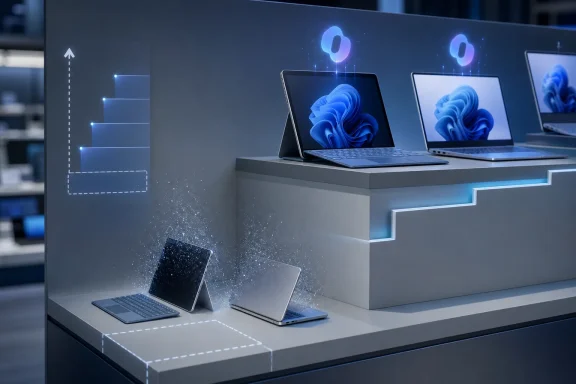 Microsoft’s Smallest Surface Was Always a Rebuttal to the iPad
The Surface Go existed because Windows never stopped needing an answer to the iPad that was not simply “buy a laptop.” Microsoft had spent years trying to prove that a tablet could also be a PC, but the mainstream Surface Pro gradually became a premium productivity machine. The Go took the same basic grammar — kickstand, detachable keyboard, pen support, Windows desktop — and shrank it into something friendlier, cheaper, and less self-serious.That distinction mattered. The iPad won the small-tablet argument by being simple, fast, app-centric, and appliance-like. The Surface Go countered with a messier but more flexible claim: maybe what some people wanted was not a tablet that approximated a computer, but a computer that could tolerate being used like a tablet.
The Go’s compromises were obvious from the first generation. Performance was just good enough, and sometimes not even that. The Type Cover was clever but cramped. The entry configurations often felt like a decoy, because storage, RAM, and keyboard upgrades could push the real price far above the marketing price.
But the idea was coherent. A small Windows tablet with a kickstand and a real file system was useful in ways that benchmark charts never captured. It could run a niche desktop utility, connect to enterprise peripherals, join a domain, handle remote admin tools, open full Office, or become the emergency machine that saved a work trip when the main laptop failed.
That is why the reported end of the line feels less like Microsoft canceling a weak seller than Microsoft retiring a particular argument about Windows itself. The Surface Go said Windows could scale down without becoming embarrassed. Microsoft’s current Surface strategy appears to say Windows is more comfortable scaling up.
The Budget Surface Was Never Actually Cheap, But It Was Reachable
The Surface Go’s pricing was always a little slippery. The Surface Go 4 started at $579, but that number did not include the keyboard most people needed to make it a credible mini-laptop. Add a Type Cover, choose a configuration that would age decently, and the affordable Surface became less affordable quickly.Still, “less affordable” is not the same as “premium.” The Go occupied a psychological price band Microsoft no longer seems eager to serve directly. It was expensive for a tiny computer but reachable for students, field workers, light travelers, and Surface fans who could not justify a full Pro.
The Surface Laptop Go played a similar role on the clamshell side. It was not the machine for power users, and its display resolution and component choices often drew fair criticism. Yet it put Surface industrial design, a good keyboard, and a polished Windows experience into a smaller and less expensive package than the mainstream Surface Laptop.
The problem for Microsoft is that budget hardware is unforgiving. Premium PCs can hide component inflation behind higher margins, better screens, more memory, AI branding, and enterprise manageability. Budget PCs have nowhere to hide. When RAM and storage prices rise, the entry-level device either gets worse, gets more expensive, or disappears.
Microsoft appears to have chosen the third option.
That does not mean the Surface Go failed because nobody wanted it. It means the Surface Go became hard to justify inside a company that now treats Surface less like a broad PC family and more like a curated showcase for Windows, AI, and Microsoft’s silicon partnerships. A small, low-margin Windows tablet does not fit easily into that story.
The New Surface Portfolio Has Less Whimsy and More Accounting
The reported cancellation of Surface Go and Surface Laptop Go follows a broader pruning of the Surface brand. Over the past several years, Microsoft has walked away from or de-emphasized multiple hardware experiments: Surface Studio, Surface Book, Surface Laptop Studio, Surface Duo, Surface Hub, Surface Headphones, and Surface Earbuds all belong to a more expansive era of the brand.Some of those products deserved to die. The Surface Duo was fascinating but fatally compromised. The Surface Studio became difficult to recommend as its internals aged faster than its gorgeous hinge. The Surface Book was brilliant, strange, expensive, and eventually made less sense once modern ultrabooks and convertibles caught up.
But taken together, the cuts reveal a Surface organization that has become more conservative. The current message is simpler: Surface Pro, Surface Laptop, and higher-end variants around performance, AI, and business workflows. That is easier to explain, easier to supply, easier to support, and probably easier to defend in quarterly planning.
It is also less interesting.
The old Surface lineup had a certain chaotic conviction. Microsoft seemed willing to build machines that existed partly to challenge the rest of the PC industry. A detachable clipboard laptop? A desktop drafting table? A dual-screen Android device? A tiny Windows tablet that made more sense in a messenger bag than on a spec sheet? The company did not always succeed, but the ambition was visible.
The new Surface lineup feels more like a premium Windows reference design program. That is not inherently bad. Surface devices are often well-built, carefully integrated, and useful as signals to OEMs. But if the brand loses its willingness to build odd machines for specific niches, it risks becoming just another expensive laptop line with a Microsoft logo.
The 12-Inch Surface Pro Is Not Really a Surface Go Replacement
It is tempting to say the 12-inch Surface Pro fills the gap. On paper, it carries some of the same DNA: a compact detachable Windows device, a kickstand, pen support, and modern internals. For many buyers, it will be faster, better built, and more future-proof than the outgoing Surface Go.But replacement is not just about screen size. It is about price, posture, and purpose.
The Surface Go was a small secondary machine. The Surface Pro, even in smaller form, is positioned as a main productivity PC. That shift changes how people evaluate it. A tiny travel companion can be underpowered if it is cheap enough and convenient enough. A premium detachable has to justify itself against ultrabooks, iPads, convertibles, and larger Surface models.
The Surface Go also had a peculiar emotional advantage: users forgave it because it felt like a clever little machine. The expectations were lower, and the use cases were narrower. A more expensive 12-inch Pro enters the room with bigger promises, and bigger promises invite harsher judgment.
That distinction matters for Windows users who liked the Go precisely because it was not trying to be their only computer. It was the device you took when you did not want to bring the real laptop. It was the device you handed to a child, carried to a conference, used in a kitchen, mounted in a vehicle, or kept beside the couch for those moments when a phone was too small and a laptop was too much.
A smaller Surface Pro may be objectively better hardware. It is not necessarily the same kind of object.
Windows Still Has a Small-Device Problem
The apparent death of the Surface Go exposes an old Windows weakness: the operating system can run on small devices, but the ecosystem rarely knows what to do with them.Windows 11 is far better on touch than older desktop Windows releases, but it remains a desktop-first operating system with tablet accommodations. That is fine on a 13-inch detachable with a keyboard nearby. It is less graceful on a 10- or 11-inch device used primarily by hand. The Surface Go worked best when users understood that it was not an iPad clone. It was a tiny PC that occasionally pretended to be a tablet.
That nuance is hard to sell at retail. Apple can put an iPad on a table and let the device explain itself in seconds. A Surface Go requires a pitch. It asks the buyer to imagine weird edge cases: remote desktop into a server, edit a spreadsheet with a mouse in a hotel room, run a Windows-only app at a job site, annotate PDFs with a pen, switch to tablet mode on the sofa.
For WindowsForum readers, those edge cases are not weird. They are Tuesday. For the mass market, they are harder to package.
Microsoft’s challenge is that the Windows audience is not one audience. Enthusiasts and IT pros often value flexibility above elegance. Consumers often value clarity above capability. The Surface Go leaned toward the first group while trying to look friendly enough for the second. That made it lovable, but it also made it commercially awkward.
The irony is that small Windows devices may be more relevant than ever for certain professional niches. Field service, healthcare, education, logistics, point-of-sale, and remote administration all benefit from compact machines with real Windows compatibility. But those markets can be served by rugged OEM tablets, managed fleets, and vertical devices. Microsoft does not have to build the reference device itself.
That may be rational. It is still a loss for the broader Windows imagination.
Surface Is Becoming a Premium AI PC Brand by Default
The Surface Go’s reported exit also lands in the middle of Microsoft’s larger AI PC push. Surface is now a stage for Copilot, neural processing units, Snapdragon and other silicon stories, battery life claims, camera improvements, and premium productivity messaging. That is where the industry money is.A budget Surface complicates that message. Cheap devices age badly if Microsoft wants every new PC to feel like a local AI endpoint. They also create awkward comparisons when entry models ship with less memory or weaker chips while the software stack grows more demanding. If Microsoft wants Surface to embody the future of Windows, the Go may have become the wrong ambassador.
This is not only a Microsoft problem. The entire PC industry is trying to explain why buyers should care about AI PCs before the everyday use cases are fully convincing. Hardware vendors want NPUs to matter. Microsoft wants Copilot woven into the operating system. Chipmakers want a new upgrade cycle. Retailers want a story that justifies higher average selling prices.
The Surface Go never fit neatly into that upgrade narrative. Its pitch was not “the future of computing.” Its pitch was “this little thing runs Windows.” In a market obsessed with AI acceleration and premium differentiation, that sounds almost quaint.
But quaint can be valuable. The PC’s durability has always come from its refusal to be one thing. Gaming rigs, accounting desktops, rugged tablets, school laptops, developer workstations, and bargain-bin mini PCs all belong to the same messy universe. The Surface Go was one of the few first-party Microsoft devices that acknowledged the low end and the small end were still part of that universe.
OEMs Will Fill the Gap, But Not the Same Way
Microsoft can reasonably argue that it does not need to make every kind of Windows PC. Dell, Lenovo, HP, Acer, Asus, and a long tail of smaller manufacturers already cover nearly every price and form factor imaginable. If someone wants a cheap Windows laptop, the market will provide one. If someone wants a compact tablet, there are industrial and consumer options.That argument is true as far as it goes. It is also incomplete.
Surface has never mattered only because of unit sales. It matters because it signals what Microsoft believes a Windows PC should be. When Microsoft builds a form factor, it legitimizes that form factor. When Microsoft exits one, it tells the market that the category is peripheral to the Windows story.
OEMs can fill shelf space, but they cannot fully replace that signal. A third-party compact Windows tablet may be cheaper, faster, or more repairable, but it will not carry the same message as a Microsoft-built Surface Go. It will be a device that happens to run Windows, not a Windows device that exists to make a point.
There is also the quality question. The Surface Go was imperfect, but it usually felt like a thoughtfully made object. Budget Windows hardware often loses that sense of care. Keyboards flex, screens disappoint, trackpads feel like afterthoughts, and firmware support becomes a gamble. The Go was valuable partly because it brought premium design discipline down to a smaller machine.
If Microsoft leaves that space, buyers may still find alternatives. They may not find the same combination of size, build, Windows integration, and personality.
The Laptop Go’s Disappearance Is Less Romantic but More Practical
The Surface Laptop Go will probably inspire fewer eulogies than the Surface Go, but its reported cancellation may matter more to ordinary buyers. The Laptop Go was Microsoft’s attempt to make a friendly, compact, lower-cost clamshell that still felt like a Surface. It was the kind of machine a student, parent, or office worker could understand instantly.It also showed how hard it is for Microsoft to compete in the budget laptop market without undermining itself. The Laptop Go had to be cheaper than the Surface Laptop but nicer than commodity Windows notebooks. That left little room for error. A mediocre display, limited ports, or stingy memory configuration stood out because the Surface name created expectations.
The Windows laptop market is brutally competitive below the premium tier. OEMs can flood retailers with discounted models, regional configurations, and aggressive back-to-school pricing. Microsoft, by contrast, has to protect the Surface brand. If it cuts too deeply, Surface stops feeling premium. If it prices too high, the budget pitch collapses.
That squeeze may explain why the Laptop Go always felt slightly trapped. It was good enough to make cheap laptops look crude, but not cheap enough to make better laptops irrelevant. It was a charming compromise in a market that punishes compromise.
The Surface Go at least had a distinctive form factor to defend it. The Laptop Go had to fight on familiar laptop terrain. Its disappearance, if confirmed, is less surprising. But together, the two cancellations make the direction unmistakable: Microsoft is walking away from entry-level Surface.
The Price Ladder Now Has a Missing First Step
The most immediate consequence for buyers is simple. The first step into Surface ownership is getting taller.Microsoft has introduced lower-RAM configurations of some newer Surface models to bring pricing down, but those machines are still not true successors to the Go family. An $849 or $949 Surface configuration may be “more affordable” compared with a $1,499 premium model. It is not affordable in the way the Surface Go or Laptop Go tried to be.
This matters because product ladders shape loyalty. A student who starts with a low-end Surface might later buy a Surface Pro. A traveler who loves a Surface Go might eventually buy a Surface Laptop. A household that buys an inexpensive Microsoft-branded PC might stay inside the ecosystem for accessories, services, and future upgrades.
Remove the entry point, and Surface becomes a brand people encounter later, if at all. That may be acceptable if Microsoft wants fewer, higher-margin customers. It is less helpful if Surface is supposed to be the public face of Windows hardware.
There is also a community cost. Enthusiast ecosystems thrive on odd devices that people can recommend for specific scenarios. The Surface Go was easy to argue about, mod around, troubleshoot, and personalize. It generated affection because it required judgment. You had to know what it was good at.
Premium laptops rarely create that kind of culture. They are better machines, but often less interesting ones.
The End of Go Is Also the End of a Certain Surface Optimism
The original Surface vision was not just about Microsoft making PCs. It was about Microsoft proving that Windows could evolve through hardware. The Surface line challenged OEM complacency, dragged attention back to materials and hinges, and made the detachable PC feel legitimate after years of awkward convertibles.The Go was a descendant of that optimism. It assumed there was still value in asking what happened when Windows entered a smaller, more casual shape. It did not always answer gracefully, but the question was worth asking.
The current Surface strategy looks more mature, and maturity has benefits. Fewer models can mean better support, clearer messaging, and more focused engineering. Enterprise buyers generally prefer predictable platforms over hardware experiments. Microsoft’s partners may also prefer a Surface lineup that does not compete in every price band.
But maturity can curdle into timidity. If Surface becomes only a set of polished premium machines designed to showcase Microsoft’s latest platform priorities, it loses some of the experimental pressure that made it influential. The PC industry does not need Microsoft to build another good 13-inch laptop as much as it needs Microsoft to demonstrate why Windows can still adapt to new shapes.
The Surface Go was not the future of computing. That was its strength. It was a reminder that not every useful device has to be a flagship, a workstation, or an AI showcase. Sometimes the best Windows machine is the one that barely takes up any room.
The Tiny Surface Leaves Behind a Very Specific Hole
The practical lesson is not that Microsoft must keep every beloved niche product alive forever. Hardware lines need volume, margins, supply chains, and strategic purpose. But the reported end of Surface Go and Surface Laptop Go leaves buyers with fewer first-party choices at exactly the moment Windows hardware is becoming more expensive and more narrowly premium.- Microsoft has reportedly stopped manufacturing Surface Go and Surface Laptop Go devices, with no successors currently planned.
- The Surface Go 4 and Surface Laptop Go 3 now appear to be sell-through products rather than active pillars of the Surface roadmap.
- The 12-inch Surface Pro may inherit some of the Go’s compact-tablet energy, but its price and positioning make it a different class of machine.
- The disappearance of the Go family pushes Surface further toward premium laptops, detachables, and AI-oriented hardware.
- Windows OEMs will continue serving cheaper and smaller PC categories, but Microsoft’s withdrawal weakens the first-party signal that compact Windows devices still matter.
- The biggest loss is not raw performance or value; it is the loss of a small, opinionated Windows PC that made the platform feel more flexible than fashionable.
References
- Primary source: Digital Trends
Published: Wed, 01 Jul 2026 11:29:11 GMT
The charm of a tiny Windows tablet is apparently at Microsoft. Long live the Surface Go! - Digital Trends
Microsoft has reportedly stopped manufacturing Surface Go and Surface Laptop Go devices, leaving Surface Pro and Surface Laptop as the company’s remaining Surface PC lineswww.digitaltrends.com - Related coverage: windowscentral.com
Microsoft finally made a more affordable Surface, but its timing was terrible | Windows Central
New 8GB configurations make the Surface Pro and Surface Laptop more affordable, but competing deals leave them looking like poor value.www.windowscentral.com - Related coverage: techradar.com
Some Microsoft Surface devices just got big price cuts — but the catch is they've had big RAM cuts, too | TechRadar
Last year's Surface Pro and Surface Laptop have new baseline models with 8GB of RAMwww.techradar.com - Related coverage: tomshardware.com
Microsoft's flagship Windows PC lineup will drop reportedly drop budget options — firm prunes Surface Go and Surface Laptop Go | Tom's Hardware
No plans for refreshes of aging, out of stock devices.www.tomshardware.com - Official source: support.microsoft.com
Surface Laptop Go update history | Microsoft Support
List of updates for the Surface Laptop Gosupport.microsoft.com - Official source: blogs.windows.com
Introducing the next Surface Pro and Surface Laptop, built for performance and flexibility
For more than 13 years, Surface has been shaped by the people who use it. Architects sketch buildings, developers train models, students build startups and field engineers solve problems that rarely make headlines. We didn't intend to design for onblogs.windows.com
- Related coverage: winbuzzer.com
Microsoft Kills Surface Hub 3, No Replacement Planned
Microsoft has discontinued its Surface Hub 3 collaborative displays with no successor planned, narrowing its Surface lineup to just the Pro and Laptop. winbuzzer.com
- Related coverage: macrumors.com
Microsoft Raises Prices for All Surface PCs, Making Them More Expensive Than Equivalent Macs
Microsoft increased prices for all of its Surface PCs this week, with most models priced hundreds of dollars higher than they were when launching. Windows Central highlighted the increases, which now see Microsoft's mid-range models priced above $1,000 and flagship models priced starting at...www.macrumors.com - Related coverage: notebookcheck.net
Microsoft Surface Go 4 now orderable from US$579.99 for consumers and businesses - Notebookcheck News
Microsoft advertises the new Surface Go 4 as being exclusively for businesses. However, the new 2-in-1 is available to order freely in multiple countries, including the US. The Surface Go 4 starts at US$579.99 with Intel Processor N200, 8 GB of RAM and 64 GB of storage. www.notebookcheck.net
- Related coverage: pcworld.com
No Windows 12 at Build, but Microsoft has something else up its sleeve | PCWorld
Microsoft's Pavan Davuluri confirmed Windows 12 won't appear at Build 2026, but the new Surface Laptop Ultra with Nvidia N1X might steal the show.www.pcworld.com - Related coverage: giga.de
Microsoft zieht bei Surface-Geräten den Stecker
In einem überraschenden Schritt zieht sich Microsoft aus dem Einsteiger-Markt für Laptops und Tablets zurück.www.giga.de - Related coverage: axios.com
Microsoft debuts Nvidia-powered Microsoft Surface Ultra laptop
Microsoft is trying again to redefine the PC for the AI era.www.axios.com