

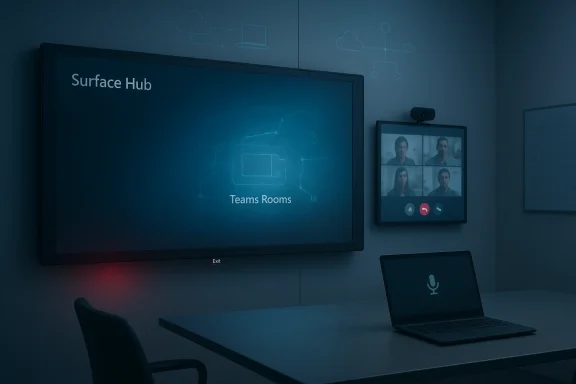
Microsoft’s Surface Hub is gone, and that makes the joke write itself. After a decade of trying to turn meeting rooms into giant touch-enabled collaboration temples, Redmond has apparently decided the future of work looks less like an 85-inch whiteboard and more like yet another Teams call where someone is muted, someone is frozen, and someone is asking if anyone can see their screen. The product did not fail in the dramatic, flaming-wreckage sense; it failed in the quieter, more Microsoft way, by becoming a large, expensive reminder that the office of the future can age very quickly.
The Surface Hub debuted in January 2015, when Microsoft was still radiating the confidence of the Windows 10 launch era. The pitch was simple and ambitious: a giant collaborative display that would make meetings less awkward, more visual, and more integrated with Microsoft’s software stack. In Microsoft’s own framing, it was the “first team device” designed to unlock group productivity, which is corporate-speak for “please stop emailing screenshots back and forth in a conference room.”
At launch, the Surface Hub arrived in 55-inch and 84/85-inch formats, depending on how much wall you were willing to sacrifice to the cause. It packed a full PC behind the glass, pen input, touch support, video conferencing, and the kind of seamless whiteboarding that made it look like Microsoft had invented the meeting room from scratch. The concept was compelling enough that the company leaned hard into the narrative of a new collaboration category rather than just a fancier display.
That category, however, was never easy to scale. Surface Hub devices were sold to commercial customers, often in bulk, and the price tag was enough to make even enthusiastic IT departments pause for one more budget meeting. The large display format also meant it was competing not just with laptops and software, but with entrenched room systems from commercial display makers and conference-room vendors that had spent years learning the less glamorous realities of corporate deployment.
Microsoft did try to keep the idea fresh. The Surface Hub line moved toward a more modular philosophy, especially with later generations that separated display and compute components. That made upgrades less punishing and kept the hardware closer to the company’s broader Surface branding strategy. But hardware refreshability is only a partial answer when the market itself shifts under your feet.
Then came the pandemic, which was almost a cruel experiment in product positioning. The Surface Hub had been built around the assumption that people would physically gather in rooms and interact around a shared screen. Instead, offices pivoted to distributed work, and the world discovered that the most important collaboration hardware was not a wall-sized touchscreen but a decent webcam, a stable headset, and a calendar app that actually worked. By the time Microsoft’s product strategy caught up, the gravitational pull had already moved toward Teams-centric, laptop-first collaboration.
What changed in 2026 is the tone. Reporting now indicates Microsoft has ended production on Surface Hub 3 and scrapped plans for a Surface Hub 4, which is what turns a support milestone into a tombstone. In plain English: this is not just maintenance mode. It is the point at which a product stops being a living category and becomes a legacy install base.
The irony is that Microsoft’s own later messaging had tried to make the device sound future-proof. The company highlighted modularity, interchangeability, and migration paths to Teams Rooms on Windows. That was a sensible engineering answer to a business problem, but it was also a tacit admission that the original dream had to be repackaged to survive.
It also matters because Surface Hub existed in a niche where replacement cycles are slow. Conference-room technology is not impulse-buy hardware. Organizations that installed these displays did so with capital budgets, facilities planning, and IT integration in mind. A product that dies before the next refresh cycle ends up making yesterday’s long-term investment look suspiciously short-term.
There was also a cultural mismatch. The Surface Hub imagined collaboration as a physical gathering around a shared digital surface. But modern work increasingly treats collaboration as asynchronous, distributed, and messy. That model favors lightweight software, not heavyweight appliances. The pandemic merely accelerated a shift that was already underway.
Then there is the economics problem. A giant collaborative display is not a small purchase, and small purchases are where office technology often wins. By comparison, a laptop license plus cloud collaboration tools can scale more cheaply, deploy faster, and fit naturally into a hybrid environment. When Microsoft Teams can cover the same workflow with a fraction of the real estate, the giant screen starts to feel like luxury infrastructure.
That shift left Surface Hub trapped between categories. It was too expensive to be a casual accessory, too room-bound to be universally useful, and too specialized to compete on volume. In technology, halfway to everything is often nowhere in particular. The Surface Hub lived that fate in real time.
The list is almost too long to read without smiling. Zune took aim at the iPod, Windows Phone tried to split the smartphone market, and Kin attempted to enter it at all. Microsoft Band came and went with the cautionary speed of a pilot program that discovered fitness users are very attached to the ecosystems they already own. Groove Music and Mixer each stood up, squared their shoulders, and eventually concluded that Spotify and Twitch had the better end of the runway.
The humor, of course, is that Microsoft often had the resources to be dangerous. It was not usually lacking for engineering talent or marketing horsepower. What it lacked, at least in these examples, was either timing, consumer momentum, or the ability to make people care before the rest of the market moved on. That is a different kind of failure from simple incompetence. It is the failure of a company that can build almost anything but cannot always persuade the world to adopt it.
Xbox is the big exception, and it matters because it proves Microsoft can win hardware when the ecosystem is right. Gaming gives the company recurring engagement, visible software advantages, and a community willing to tolerate a lot of strategic complexity. The meeting room, by contrast, is where people go when they want the technology to disappear. That is a much harder illusion to sell with a 85-inch panel.
Clippy remains the perfect mascot for this contradiction. It was earnest, intrusive, and impossible to forget. In a smaller way, it symbolized Microsoft’s recurring instinct to build a helpful layer on top of work, then discover users do not always want help that aggressively. The joke survives because the underlying lesson never really went away.
The company’s messaging stack tells a similar story. MSN Messenger gave way to Skype, and Skype slowly yielded to Teams. Each transition was supposed to be cleaner than the last, yet each left behind a sense that Microsoft keeps renovating the same house while changing the front door every few years. The furniture remains familiar; the route through the rooms does not.
That is why the Surface Hub’s ending lands with a grin and a shrug. No one is shocked. The device was bold, expensive, and distinctly Microsoft. In this company, that combination is often the opening scene of a very short sitcom. The laugh track is the market.
That is a smarter business posture for the company. Software subscriptions, device management, licensing, and room orchestration are all easier to monetize across thousands of customers than a niche display appliance with a complicated purchase cycle. Teams also benefits from network effects that no single screen can replicate.
This shift does not mean physical collaboration hardware has no future. It means the hardware must now justify itself inside a software-first environment. The winning devices are likely to be interoperable, upgradable, and boring in the best possible way. The era of the hero product sitting in the middle of the room may be ending because the room itself is no longer the center of gravity.
For IT departments, this is almost a relief. A standard platform is easier to patch, image, monitor, and replace than a bespoke category device. The real problem is not that the Surface Hub disappeared. The problem is that it may have disappeared while some customers were still paying for the dream.
The Surface Hub was different because it lived in enterprise land, where buying decisions are slower and more rational. That should have helped. Instead, it exposed the opposite problem: if the product is too specialized, enterprises may admire it without needing it. In other words, it can be strategically correct and commercially unnecessary at the same time.
That distinction matters. Consumer failures are often judged by visibility. Enterprise failures are judged by deployment pain, sunk cost, and whether the vendor still answers support calls. Microsoft’s transition guidance suggests it understands that difference, but the product’s retirement still leaves a bruise because it was never a toy. It was infrastructure with a personality.
That is why the retirement feels bittersweet rather than scandalous. Microsoft did not destroy a universally loved product. It retired a respectable idea that never escaped the premium niche. The market often rewards the boring winner, and in this story the boring winner was the laptop, the webcam, and the meeting link.
Microsoft’s best successes usually happen when the company meets users where they already are. Windows, Office, Azure, Xbox, and Teams all succeeded because they plugged into existing habits or created enormous ecosystems around them. The Surface Hub asked users to change behavior in a room that many organizations were already learning to avoid. That was always a harder sell.
The humorous lesson is that Microsoft keeps trying to build the future in shapes that are too tall, too social, or too eager to be loved. Sometimes that works. Often it produces a product story that sounds better in a keynote than it does in a procurement spreadsheet. That gap is where the graveyard grows.
In that sense, the Surface Hub is not an embarrassment. It is a reminder. Microsoft is strongest when it controls the environment around a device, not just the device. The company now appears to have decided that the environment matters more than the object mounted on the wall.
There are also practical concerns for customers who bought into the Surface Hub ecosystem late. Even with migration options and support windows, a product retirement can create uncertainty around spare parts, service continuity, and future compatibility with meeting-room workflows. Quiet exits are still exits.
The Surface Hub’s retirement also suggests that Microsoft is choosing to concentrate where it sees durable advantage. Cloud services, AI, and enterprise software are the company’s gravitational center now, and hardware will likely remain important only when it strengthens those core businesses. In that sense, the surface-level joke hides a deeper strategic truth: the company may be less interested in owning the wall and more interested in owning the workflow.
Source: Channel News Microsoft’s Graveyard Just Got A New Body – channelnews
 Background
The Surface Hub debuted in January 2015, when Microsoft was still radiating the confidence of the Windows 10 launch era. The pitch was simple and ambitious: a giant collaborative display that would make meetings less awkward, more visual, and more integrated with Microsoft’s software stack. In Microsoft’s own framing, it was the “first team device” designed to unlock group productivity, which is corporate-speak for “please stop emailing screenshots back and forth in a conference room.”At launch, the Surface Hub arrived in 55-inch and 84/85-inch formats, depending on how much wall you were willing to sacrifice to the cause. It packed a full PC behind the glass, pen input, touch support, video conferencing, and the kind of seamless whiteboarding that made it look like Microsoft had invented the meeting room from scratch. The concept was compelling enough that the company leaned hard into the narrative of a new collaboration category rather than just a fancier display.
That category, however, was never easy to scale. Surface Hub devices were sold to commercial customers, often in bulk, and the price tag was enough to make even enthusiastic IT departments pause for one more budget meeting. The large display format also meant it was competing not just with laptops and software, but with entrenched room systems from commercial display makers and conference-room vendors that had spent years learning the less glamorous realities of corporate deployment.
Microsoft did try to keep the idea fresh. The Surface Hub line moved toward a more modular philosophy, especially with later generations that separated display and compute components. That made upgrades less punishing and kept the hardware closer to the company’s broader Surface branding strategy. But hardware refreshability is only a partial answer when the market itself shifts under your feet.
Then came the pandemic, which was almost a cruel experiment in product positioning. The Surface Hub had been built around the assumption that people would physically gather in rooms and interact around a shared screen. Instead, offices pivoted to distributed work, and the world discovered that the most important collaboration hardware was not a wall-sized touchscreen but a decent webcam, a stable headset, and a calendar app that actually worked. By the time Microsoft’s product strategy caught up, the gravitational pull had already moved toward Teams-centric, laptop-first collaboration.
The Surface Hub’s Rise and Quiet Exit
The Surface Hub’s end is being described in the familiar Microsoft euphemistic register: quiet, planned, and wrapped in transition guidance. Public documentation already showed that support for Windows 10 Team edition on Surface Hub v1 and Surface Hub 2S was ending on October 14, 2025, with Microsoft urging customers to transition. That alone would not necessarily mean the line was dead, but it did signal that the old platform was on borrowed time.What changed in 2026 is the tone. Reporting now indicates Microsoft has ended production on Surface Hub 3 and scrapped plans for a Surface Hub 4, which is what turns a support milestone into a tombstone. In plain English: this is not just maintenance mode. It is the point at which a product stops being a living category and becomes a legacy install base.
The irony is that Microsoft’s own later messaging had tried to make the device sound future-proof. The company highlighted modularity, interchangeability, and migration paths to Teams Rooms on Windows. That was a sensible engineering answer to a business problem, but it was also a tacit admission that the original dream had to be repackaged to survive.
Why the timing matters
The timing of the exit matters because it arrives after Microsoft has spent years telling customers the platform could evolve. That creates a subtle trust issue for enterprise buyers, who do not just buy screens; they buy roadmaps, serviceability, and assumptions about how long a deployment will remain viable. When a product like this disappears, procurement teams remember.It also matters because Surface Hub existed in a niche where replacement cycles are slow. Conference-room technology is not impulse-buy hardware. Organizations that installed these displays did so with capital budgets, facilities planning, and IT integration in mind. A product that dies before the next refresh cycle ends up making yesterday’s long-term investment look suspiciously short-term.
- The Surface Hub was never a mass-market device.
- Its value depended on rooms, not users.
- Its demise says as much about work trends as product strategy.
- Microsoft now appears to prefer software platforms over hardware categories it must defend for years.
Why the Surface Hub Never Became the Default Meeting Room
The Surface Hub’s original pitch was elegant, but elegance is not the same as ubiquity. Meeting rooms are notoriously conservative environments. Companies often keep them running on equipment that is slightly older than the interns, because “good enough” beats “brand-new and unproven” when the room has to work before 9 a.m. every day.There was also a cultural mismatch. The Surface Hub imagined collaboration as a physical gathering around a shared digital surface. But modern work increasingly treats collaboration as asynchronous, distributed, and messy. That model favors lightweight software, not heavyweight appliances. The pandemic merely accelerated a shift that was already underway.
Then there is the economics problem. A giant collaborative display is not a small purchase, and small purchases are where office technology often wins. By comparison, a laptop license plus cloud collaboration tools can scale more cheaply, deploy faster, and fit naturally into a hybrid environment. When Microsoft Teams can cover the same workflow with a fraction of the real estate, the giant screen starts to feel like luxury infrastructure.
The office changed faster than the hardware
The broader office changed faster than the hardware could adapt. Hybrid work blurred the importance of a single fixed room, while video meetings standardized the experience across devices and locations. Once that happened, the “best collaboration device” was no longer the largest screen in the room. It was the one everybody already had with them.That shift left Surface Hub trapped between categories. It was too expensive to be a casual accessory, too room-bound to be universally useful, and too specialized to compete on volume. In technology, halfway to everything is often nowhere in particular. The Surface Hub lived that fate in real time.
- The market wanted flexibility, not monumentality.
- IT buyers wanted predictable lifecycle management.
- Hybrid work rewarded software over dedicated hardware.
- The device solved a problem that became less central over time.
The Microsoft Graveyard Is a Brand All Its Own
Microsoft’s product cemetery is so crowded that it has started to feel like a parallel business unit. The company has a long history of arriving with a credible answer to a market that has already picked its winner, then either undercutting itself or quietly retreating. The Surface Hub’s fate fits comfortably into that pattern.The list is almost too long to read without smiling. Zune took aim at the iPod, Windows Phone tried to split the smartphone market, and Kin attempted to enter it at all. Microsoft Band came and went with the cautionary speed of a pilot program that discovered fitness users are very attached to the ecosystems they already own. Groove Music and Mixer each stood up, squared their shoulders, and eventually concluded that Spotify and Twitch had the better end of the runway.
The humor, of course, is that Microsoft often had the resources to be dangerous. It was not usually lacking for engineering talent or marketing horsepower. What it lacked, at least in these examples, was either timing, consumer momentum, or the ability to make people care before the rest of the market moved on. That is a different kind of failure from simple incompetence. It is the failure of a company that can build almost anything but cannot always persuade the world to adopt it.
Hardware has been the sharpest edge
Microsoft’s hardware record is especially mixed because hardware mistakes are harder to soften with software updates. The Surface Duo vanished, Surface headphones and Surface Studio cycles changed, and the Surface line itself has had to carry the emotional burden of a company that occasionally treats categories like experiments rather than vows. That works until the experiment becomes the product.Xbox is the big exception, and it matters because it proves Microsoft can win hardware when the ecosystem is right. Gaming gives the company recurring engagement, visible software advantages, and a community willing to tolerate a lot of strategic complexity. The meeting room, by contrast, is where people go when they want the technology to disappear. That is a much harder illusion to sell with a 85-inch panel.
- Zune was late to a market already emotionally owned by Apple.
- Windows Phone faced a two-platform duopoly that hardened fast.
- Microsoft Band arrived in a wearables market with stronger incumbents.
- Mixer could not outcompete Twitch’s creator gravity.
- Surface Duo remained a curiosity rather than a category.
From Clippy to Copilot: The Microsoft Personality Problem
Microsoft’s history of product discontinuation is funny because the company has also produced some of the most durable software in enterprise computing. That creates a peculiar personality problem: the same company that powers so much of modern work is also famous for making elaborate side quests out of product strategy. The public remembers both.Clippy remains the perfect mascot for this contradiction. It was earnest, intrusive, and impossible to forget. In a smaller way, it symbolized Microsoft’s recurring instinct to build a helpful layer on top of work, then discover users do not always want help that aggressively. The joke survives because the underlying lesson never really went away.
The company’s messaging stack tells a similar story. MSN Messenger gave way to Skype, and Skype slowly yielded to Teams. Each transition was supposed to be cleaner than the last, yet each left behind a sense that Microsoft keeps renovating the same house while changing the front door every few years. The furniture remains familiar; the route through the rooms does not.
When reinvention becomes identity
At some point, repeated reinvention stops looking like strategy and starts looking like identity. Microsoft has become very good at folding one product into another, but that is not the same as building a lasting affection for any one thing. Users learn to trust the platform more than the brand of the tool sitting on it.That is why the Surface Hub’s ending lands with a grin and a shrug. No one is shocked. The device was bold, expensive, and distinctly Microsoft. In this company, that combination is often the opening scene of a very short sitcom. The laugh track is the market.
- Microsoft often invents categories in search of loyalty.
- Users usually stick with the ecosystem, not the experiment.
- The company’s own reinventions can overshadow the original product.
- Humor is part of how the public processes Microsoft’s habit of retreating.
The Teams Era Won the Office
The most telling part of the Surface Hub story is not that it failed. It is what replaced it. Microsoft’s collaboration thesis now points squarely toward Teams Rooms and the broader software-defined meeting experience. The office of the future, in Microsoft’s hands, is less a physical altar and more a managed endpoint in a cloud workflow.That is a smarter business posture for the company. Software subscriptions, device management, licensing, and room orchestration are all easier to monetize across thousands of customers than a niche display appliance with a complicated purchase cycle. Teams also benefits from network effects that no single screen can replicate.
This shift does not mean physical collaboration hardware has no future. It means the hardware must now justify itself inside a software-first environment. The winning devices are likely to be interoperable, upgradable, and boring in the best possible way. The era of the hero product sitting in the middle of the room may be ending because the room itself is no longer the center of gravity.
Enterprise buyers want less drama
Enterprise buyers are usually not looking for drama. They want dependable lifecycle support, centralized management, and a product that won’t become a weekend migration project in three years. Microsoft’s move toward Teams Rooms and migration paths for Surface Hub 2S was an acknowledgment of those priorities, even if it also marked the shrinking of the original vision.For IT departments, this is almost a relief. A standard platform is easier to patch, image, monitor, and replace than a bespoke category device. The real problem is not that the Surface Hub disappeared. The problem is that it may have disappeared while some customers were still paying for the dream.
- Teams is now the center of Microsoft collaboration strategy.
- Room management matters more than hardware spectacle.
- Upgradability beats novelty in enterprise purchasing.
- The future favors standardized endpoints over signature devices.
Consumer Futility, Enterprise Reality
One reason Microsoft’s failures become such enduring jokes is that the company often tests products in domains where consumer behavior is unforgiving. Smartphones, music players, and wearables are brutally competitive, with brand loyalty and habit acting like invisible walls. Enter too late, and the market simply ignores you.The Surface Hub was different because it lived in enterprise land, where buying decisions are slower and more rational. That should have helped. Instead, it exposed the opposite problem: if the product is too specialized, enterprises may admire it without needing it. In other words, it can be strategically correct and commercially unnecessary at the same time.
That distinction matters. Consumer failures are often judged by visibility. Enterprise failures are judged by deployment pain, sunk cost, and whether the vendor still answers support calls. Microsoft’s transition guidance suggests it understands that difference, but the product’s retirement still leaves a bruise because it was never a toy. It was infrastructure with a personality.
Why businesses still remembered it
Some companies genuinely liked the Surface Hub because it made whiteboarding and remote collaboration feel more immediate. Large-format digital canvases have a place in design, education, and executive rooms where presentation matters. The issue is that liking a product is not the same as standardizing on it.That is why the retirement feels bittersweet rather than scandalous. Microsoft did not destroy a universally loved product. It retired a respectable idea that never escaped the premium niche. The market often rewards the boring winner, and in this story the boring winner was the laptop, the webcam, and the meeting link.
- Consumer markets punish lateness quickly.
- Enterprise markets punish complexity slowly.
- The Surface Hub lived in the gap between admiration and necessity.
- A product can be technically impressive and still commercially optional.
What the Surface Hub Teaches About Microsoft
The Surface Hub is a useful case study because it shows both Microsoft’s strengths and its blind spots. The company still has the ability to imagine new workflows, to ship polished hardware, and to connect devices to a broader platform strategy. But it also has a habit of underestimating how quickly software-defined behavior can make dedicated hardware feel ornamental.Microsoft’s best successes usually happen when the company meets users where they already are. Windows, Office, Azure, Xbox, and Teams all succeeded because they plugged into existing habits or created enormous ecosystems around them. The Surface Hub asked users to change behavior in a room that many organizations were already learning to avoid. That was always a harder sell.
The humorous lesson is that Microsoft keeps trying to build the future in shapes that are too tall, too social, or too eager to be loved. Sometimes that works. Often it produces a product story that sounds better in a keynote than it does in a procurement spreadsheet. That gap is where the graveyard grows.
A few recurring patterns
The pattern is consistent enough to be predictive. Microsoft tends to launch with confidence, over-invest in category language, and then either pivot to the platform layer or quietly close the drawer. That can be frustrating for fans of the hardware itself, but it also explains why the company remains strategically formidable even while collecting product headstones.In that sense, the Surface Hub is not an embarrassment. It is a reminder. Microsoft is strongest when it controls the environment around a device, not just the device. The company now appears to have decided that the environment matters more than the object mounted on the wall.
- Microsoft is strongest when products reinforce a platform.
- Hardware works best when it deepens ecosystem lock-in.
- Category experiments are expensive, even for Microsoft.
- The company often survives by learning from what it retires.
Strengths and Opportunities
The Surface Hub story is a failure with several productive lessons attached, which is very Microsoft of it. Even as the product disappears, the company’s broader collaboration stack is arguably stronger for having tested what a premium meeting-room device could and could not do. The opportunity now is to translate that learning into lower-friction devices, better room orchestration, and simpler buying paths for customers.- Microsoft can focus on Teams Rooms and unified management instead of niche hardware.
- Customers may benefit from more standard, upgradeable endpoints.
- The company can keep the good parts of Surface Hub, like pen input and collaborative whiteboarding, without the cost of a dedicated category.
- Enterprises get clearer lifecycle expectations when product lines are simplified.
- Microsoft can channel R&D into software, AI, and cloud integration where it has stronger scale.
- The end of a hardware line can reduce support fragmentation across room systems.
- The market may still reward specialized collaboration displays, but likely only if they are less proprietary and easier to deploy.
Risks and Concerns
The biggest risk is reputational, not technical. Microsoft has done enough discontinuations that some buyers instinctively assume today’s flagship device could become tomorrow’s legacy migration project. That skepticism can slow adoption, especially in commercial hardware, where trust in long-term support matters almost as much as feature sets.There are also practical concerns for customers who bought into the Surface Hub ecosystem late. Even with migration options and support windows, a product retirement can create uncertainty around spare parts, service continuity, and future compatibility with meeting-room workflows. Quiet exits are still exits.
- Buyers may become more cautious about Microsoft hardware roadmaps.
- Legacy Surface Hub customers could face planning uncertainty.
- The transition may push some organizations toward vendor-neutral collaboration hardware.
- Microsoft risks reinforcing the idea that it abandons categories too soon.
- Product churn can increase IT administrative burden during migrations.
- The collapse of one flagship device can cast doubt on adjacent Surface-branded offerings.
- Enterprises may prefer software-only alternatives if they fear future discontinuation.
Looking Ahead
The future of Microsoft collaboration is clearly not about turning every meeting room into a giant touchscreen shrine. It is about making meetings less painful across devices, locations, and network conditions, with software doing the heavy lifting and hardware staying out of the way. That is a more mature strategy, even if it is less cinematic.The Surface Hub’s retirement also suggests that Microsoft is choosing to concentrate where it sees durable advantage. Cloud services, AI, and enterprise software are the company’s gravitational center now, and hardware will likely remain important only when it strengthens those core businesses. In that sense, the surface-level joke hides a deeper strategic truth: the company may be less interested in owning the wall and more interested in owning the workflow.
What to watch next
- Whether Microsoft expands Teams Rooms hardware partnerships rather than proprietary displays.
- How aggressively it guides customers off Surface Hub 2S and legacy Team edition.
- Whether future Surface devices lean harder toward modular enterprise longevity.
- If Microsoft ever revisits large-format collaboration hardware in a more open, software-led form.
- Whether buyers interpret this shutdown as an isolated reset or as another reason to keep one eye on the exits.
Source: Channel News Microsoft’s Graveyard Just Got A New Body – channelnews
Last edited:
