

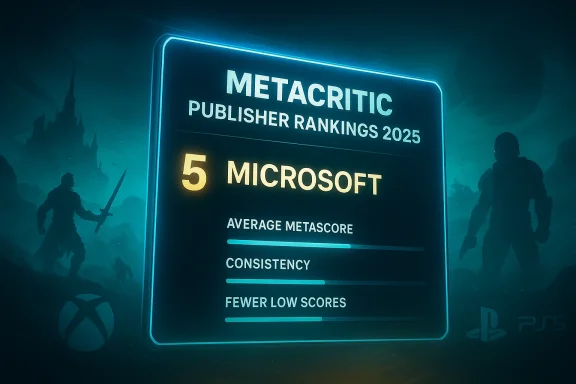
Gone are the days when Xbox can be casually dismissed as a critical also-ran. In Metacritic’s latest publisher rankings, Microsoft has landed in 5th place for 2025, edging past Nintendo and Sony on the strength of a strong slate of critically reviewed releases and a cleaner overall score profile. The headline is genuinely notable, but the more interesting story is how the ranking was earned: not by hardware dominance, but by a more consistent, higher-quality software cadence across multiple platforms. Metacritic’s system rewards breadth, stability, and standout scores, which makes this result a useful snapshot of Xbox’s present creative momentum—and a reminder that publishing performance and console market share are not the same thing.
Metacritic’s annual publisher rankings are one of the industry’s more elegant vanity metrics, and that is not a criticism. They are not a sales chart, not a revenue report, and not a measure of market power. They are a critic-weighted quality index that captures whether a publisher’s output landed with reviewers over a given year, and that makes them especially useful for identifying which companies are building durable software reputations. Microsoft’s 5th-place finish in 2025 says something important: the Xbox publishing arm is no longer living on nostalgia, brand loyalty, or one mega-launch.
The rankings are built around a 400-point system that leans heavily on average Metascore, consistency, avoidance of weak releases, and a small bonus for games scoring 90 or higher. That design matters because it does not simply reward one blockbuster and ignore everything else. It favors publishers that can repeatedly ship good games, with few misfires, across a sizable catalog. In other words, this is the kind of chart that exposes whether a publisher’s pipeline is genuinely healthy or merely lucky.
For Microsoft, the result is striking because it comes after several years of uneven public perception around Xbox hardware and ecosystem strategy. The company has faced criticism over exclusives, identity, and whether its first-party output matched its enormous corporate resources. Yet Metacritic’s 2025 list suggests something the console-war rhetoric often obscures: Xbox’s software machine has become more coherent, more varied, and more reliable than many people expected. That does not solve every Xbox problem, but it does change the conversation.
The standings also underscore a larger industry shift. The old logic of a publisher’s success being tied primarily to one platform is weaker than it used to be. Microsoft’s best-reviewed work increasingly shows up not just on Xbox consoles, but also on PC and, in some cases, PlayStation platforms. That makes the company’s Metacritic performance more representative of a modern, cross-platform publishing strategy than of a traditional closed-garden console model.
A publisher with five extremely polished releases can outperform one with a larger, messier slate. A company with one massive hit and several weak titles may look weaker than a smaller publisher with a more disciplined release calendar. That is why this kind of list is useful as an editorial lens, even if it should never be mistaken for the final word on industry health.
There is also a psychological element here. For years, Microsoft’s gaming narrative has been framed around potential: the studio acquisitions, the Game Pass ambitions, the ecosystem synergy, the promise of what should come next. Rankings like this are useful because they shift the focus from promise to execution. Execution is harder to argue with.
According to Metacritic’s own methodology notes, the company groups certain sub-brands under parent companies, and Microsoft is specifically named as a major example of that parent-company rollup. That matters because it ensures Xbox’s score reflects the broader Microsoft gaming portfolio rather than a fragmented picture of separate labels. In practical terms, this means the ranking captures the strategic shape of Microsoft Gaming, not just one studio division.
The other major constraint is that only publishers with at least five releases in the year are included. That is a significant filter because it prevents one-hit wonders from gaming the table and makes the ranking a better measure of year-long publishing health. It also means some companies with excellent but sparse releases never even appear, which is a limitation worth keeping in mind.
That last idea is more important than it sounds. In publishing, avoiding low-profile duds is often as valuable as landing a tentpole success. A company can ship a well-reviewed blockbuster and still see its ranking sink if the rest of its slate is rough. Metacritic’s formula reflects that reality better than most industry discourse does.
It also does not distinguish all forms of quality equally. A polished remaster, a mid-sized AA game, and a blockbuster first-party exclusive all contribute to the same broad statistical pool. That helps Microsoft in one sense, because its diversified publishing footprint creates more opportunities to post strong scores. But it also means the ranking cannot fully tell us whether Xbox’s biggest bets are landing in the way Microsoft wants.
What stands out is not simply the presence of familiar franchises. It is the balance between established IP and more stylistically distinct projects. Microsoft’s publishing identity used to feel overly dependent on a few tentpole brands. Now it looks more like a portfolio: action, RPG, narrative adventure, legacy revival, and multiplatform support all working in parallel.
This is a meaningful shift because it suggests the company is no longer trying to win with a single branding message. Instead, it is letting different studios play to their strengths. That tends to produce better critical results, because reviewers reward distinctiveness when it is paired with technical competence and a stable release cadence.
That matters in an age when long development cycles make every major release a risk. If one project slips, another can offset the damage. If one genre underperforms, another may rescue the average. A healthy publisher is not just one with good games; it is one with enough different kinds of good games that it can absorb the occasional miss.
This can make its success look paradoxical if you only care about console wars. But from a publishing perspective, it is rational. Wider platform distribution can increase visibility, reduce reliance on a single hardware base, and potentially improve critical and commercial reach. The downside is obvious: it also weakens the exclusivity story that once defined console identity.
There is also a tonal factor. Xbox’s recent lineup has leaned into diverse creative voices and established developers with clear identities. Reviewers tend to respond well when a game feels purposeful rather than corporate by committee. That can be especially beneficial in a year when the publisher has multiple titles competing for attention.
Sony’s ranking was dragged down despite having several strong titles, including Death Stranding 2 and Ghost of Yotei. That is a reminder that a few prestige successes do not guarantee a top publisher slot if the rest of the slate lacks comparable depth. A company can still have an excellent year creatively and look merely average in a formula that punishes inconsistency.
Nintendo’s result is perhaps the more surprising one because its brand image is usually associated with family-friendly critical reliability. Yet Metacritic noted that the company slipped to 12th place with a Metascore of 77, citing releases like the newest Donkey Kong alongside the much-maligned Nintendo Switch 2 Welcome Tour. That is exactly the kind of odd, uneven mix that can knock a publisher off balance.
It also highlights a subtle weakness of prestige publishing. If your biggest releases are so prominent that the rest of the year feels like filler by comparison, the ranking can expose that imbalance. Sony’s top titles still reinforced its brand, but the aggregate score suggests a less complete year than fans might assume at first glance.
This is where Metacritic’s emphasis on breadth becomes especially unforgiving. If a publisher spreads itself across a number of mid-tier releases, the average can slide quickly. Nintendo appears to have paid that price in 2025, even if the company’s core franchises remain immensely powerful.
This matters because identity affects how publishers are judged. When Xbox was being measured mostly against PlayStation and Nintendo on console exclusives, criticism often focused on scarcity and missed opportunities. In the current era, the conversation is broader: how well does Microsoft manage its studios, how well does it curate releases, and how effectively does it turn content into a durable platform proposition?
The line between victory and irrelevance is also different now. A publisher can ship fewer exclusive hardware sellers and still look healthy if its portfolio is strong across devices. That is not the same thing as dominating console mindshare, but it may be a more sustainable model in a world where players expect flexibility.
The downside is that fans still often interpret every success through a console-war frame. That can distort the meaning of a result like this. Microsoft did not suddenly outsell Nintendo or eclipse Sony’s installed base; it simply produced a year of games that critics generally rated more favorably.
That does not mean Metacritic scores are the same thing as subscriber retention. They are not. But a publisher with a stronger critical reputation has an easier time persuading players that its subscription library is not just large, but worth paying attention to.
That said, it is critical not to overstate the implication. Strong critical output does not automatically solve monetization, margin pressure, or the long-term economics of first-party investment. It merely shows that the software being shipped has cleared an important qualitative threshold. In the entertainment business, that is necessary, but never sufficient.
For competitors, the result is a reminder that Microsoft is still capable of turning scale into quality when the pieces align. That may matter more in the next cycle than the current one, because the industry is increasingly shaped by cross-platform availability, publisher mergers, and the search for durable franchises. A publisher with this kind of score profile has more strategic options than one that is merely big.
That tension can be productive. It can also create frustration when fans want clear, exclusive identities and instead get pragmatic, cross-platform decision-making. Microsoft may be learning that the market rewards pragmatism more than purity, at least when the games are good enough.
It also suggests that a publisher’s prestige can recover faster than many assume. Microsoft was not universally seen as a critical powerhouse at the start of this cycle. By the end of it, it had climbed into the top five. That kind of turnaround is hard to fake and hard to dismiss.
For the brand, the effect is even larger. Microsoft gets to tell a story about progress, renewal, and software excellence, which is especially valuable in a year where its hardware position may not be the primary source of excitement. A 5th-place publisher ranking is not a trophy that changes the market overnight, but it is a clean, quotable data point that supports a bigger narrative of Xbox recovery. In a business obsessed with perception, that matters.
That can influence buying habits, subscription decisions, and even the tone of online discussion. When a company is seen as “on a run,” players are more likely to take a chance on the next release. Momentum has real value.
It also helps rebalance the public image of Xbox from “promising but inconsistent” to “increasingly dependable.” That shift may be gradual, but it is the kind of change that can influence an entire generation of platform perception.
The bigger opportunity is strategic leverage. If Microsoft can combine stronger critical output with smarter platform timing and continued cross-platform reach, it may end up with a more resilient gaming business than rivals who depend on a narrower release cadence. That is the real prize, not the 5th-place badge itself.
There is also the risk of reading too much into one year. Metacritic rankings are useful, but they are snapshots. A strong year can be followed by a weaker one if the release calendar shifts or if major projects stumble. That volatility is built into the industry.
What makes the next phase interesting is that Microsoft seems positioned to compete on quality in a way that fits the modern market. It may never again be judged solely by console exclusives, and that may be fine if the broader software portfolio keeps improving. The challenge will be preserving that quality while navigating the commercial realities of an increasingly fragmented audience.
Source: Windows Central Microsoft ranks 5th in 2025 best publisher list, beating Sony and Nintendo
 Overview
Metacritic’s annual publisher rankings are one of the industry’s more elegant vanity metrics, and that is not a criticism. They are not a sales chart, not a revenue report, and not a measure of market power. They are a critic-weighted quality index that captures whether a publisher’s output landed with reviewers over a given year, and that makes them especially useful for identifying which companies are building durable software reputations. Microsoft’s 5th-place finish in 2025 says something important: the Xbox publishing arm is no longer living on nostalgia, brand loyalty, or one mega-launch.The rankings are built around a 400-point system that leans heavily on average Metascore, consistency, avoidance of weak releases, and a small bonus for games scoring 90 or higher. That design matters because it does not simply reward one blockbuster and ignore everything else. It favors publishers that can repeatedly ship good games, with few misfires, across a sizable catalog. In other words, this is the kind of chart that exposes whether a publisher’s pipeline is genuinely healthy or merely lucky.
For Microsoft, the result is striking because it comes after several years of uneven public perception around Xbox hardware and ecosystem strategy. The company has faced criticism over exclusives, identity, and whether its first-party output matched its enormous corporate resources. Yet Metacritic’s 2025 list suggests something the console-war rhetoric often obscures: Xbox’s software machine has become more coherent, more varied, and more reliable than many people expected. That does not solve every Xbox problem, but it does change the conversation.
The standings also underscore a larger industry shift. The old logic of a publisher’s success being tied primarily to one platform is weaker than it used to be. Microsoft’s best-reviewed work increasingly shows up not just on Xbox consoles, but also on PC and, in some cases, PlayStation platforms. That makes the company’s Metacritic performance more representative of a modern, cross-platform publishing strategy than of a traditional closed-garden console model.
What Metacritic is actually measuring
The most important thing to understand is that Metacritic is not judging sales, cultural impact, or player satisfaction. It is judging critic scores, then applying a scoring formula that favors publishers with strong averages, enough releases to qualify, and a low number of disappointing titles. That means the ranking can produce results that feel surprising to fans but make perfect sense from a statistical standpoint.A publisher with five extremely polished releases can outperform one with a larger, messier slate. A company with one massive hit and several weak titles may look weaker than a smaller publisher with a more disciplined release calendar. That is why this kind of list is useful as an editorial lens, even if it should never be mistaken for the final word on industry health.
- Average quality matters more than raw volume.
- Consistency is rewarded heavily.
- Bad scores can hurt a publisher faster than fans expect.
- Great scores help, but they are not enough on their own.
- The list includes only publishers with enough releases to qualify.
Why the result matters now
Microsoft’s climb is meaningful because it arrives at a time when the company’s gaming strategy is being judged on multiple fronts at once. Hardware momentum is one conversation. Subscription economics is another. Exclusivity, PC support, cloud, and multiplatform release strategy are all separate debates, and they overlap in messy ways. A 5th-place finish does not settle those debates, but it gives the company something it has lacked for long stretches: proof that the Xbox brand can still produce a high-quality critical slate.There is also a psychological element here. For years, Microsoft’s gaming narrative has been framed around potential: the studio acquisitions, the Game Pass ambitions, the ecosystem synergy, the promise of what should come next. Rankings like this are useful because they shift the focus from promise to execution. Execution is harder to argue with.
The Method Behind the Ranking
Metacritic’s methodology is the backbone of the whole story, and it is worth lingering on because the formula shapes the result as much as the games themselves. Microsoft’s 305.7-point score is not a vague consensus; it is the output of a defined scoring system that prizes critic reception across a publisher’s entire qualifying release list. That gives the ranking a kind of rough objectivity, even though it remains limited by the biases and tastes embedded in review culture.According to Metacritic’s own methodology notes, the company groups certain sub-brands under parent companies, and Microsoft is specifically named as a major example of that parent-company rollup. That matters because it ensures Xbox’s score reflects the broader Microsoft gaming portfolio rather than a fragmented picture of separate labels. In practical terms, this means the ranking captures the strategic shape of Microsoft Gaming, not just one studio division.
The other major constraint is that only publishers with at least five releases in the year are included. That is a significant filter because it prevents one-hit wonders from gaming the table and makes the ranking a better measure of year-long publishing health. It also means some companies with excellent but sparse releases never even appear, which is a limitation worth keeping in mind.
Breaking down the 400-point system
The scoring model is built to reward excellence without allowing one or two shiny outliers to dominate. The average Metascore can contribute up to 150 points, the percentage of “good” games adds up to 100, the avoidance of low scores below 50 adds another 100, and games scoring 90 or above contribute bonus points. The result is a system that looks not only for quality, but for absence of embarrassment.That last idea is more important than it sounds. In publishing, avoiding low-profile duds is often as valuable as landing a tentpole success. A company can ship a well-reviewed blockbuster and still see its ranking sink if the rest of its slate is rough. Metacritic’s formula reflects that reality better than most industry discourse does.
What the methodology misses
The system is smart, but it is not complete. It cannot measure sales, player engagement, long-tail community health, or the value of subscription launches on Game Pass. It also cannot capture whether a publisher is strategically investing in experimental projects that may be more important to long-term brand health than review scores alone. That is why the ranking should be read as one signal, not a verdict.It also does not distinguish all forms of quality equally. A polished remaster, a mid-sized AA game, and a blockbuster first-party exclusive all contribute to the same broad statistical pool. That helps Microsoft in one sense, because its diversified publishing footprint creates more opportunities to post strong scores. But it also means the ranking cannot fully tell us whether Xbox’s biggest bets are landing in the way Microsoft wants.
- The system rewards consistency over spectacle.
- Microsoft’s corporate grouping can help create a fuller score picture.
- The five-release threshold filters out thin, opportunistic publishing.
- Low-scoring titles can do disproportionate damage.
- The ranking reflects critic opinion, not player behavior.
Microsoft’s 2025 Software Lineup
The reason Microsoft did so well is not mysterious. The company’s 2025 slate was packed with games that critics generally liked, and more importantly, it avoided the kind of disastrous outliers that can drag a publisher down. Metacritic cited titles such as Avowed, Hellblade II, The Outer Worlds 2, Ninja Gaiden 4, and DOOM: The Dark Ages as part of the broader Xbox picture, and that lineup tells the story of a publisher finally operating with recognizable rhythm.What stands out is not simply the presence of familiar franchises. It is the balance between established IP and more stylistically distinct projects. Microsoft’s publishing identity used to feel overly dependent on a few tentpole brands. Now it looks more like a portfolio: action, RPG, narrative adventure, legacy revival, and multiplatform support all working in parallel.
This is a meaningful shift because it suggests the company is no longer trying to win with a single branding message. Instead, it is letting different studios play to their strengths. That tends to produce better critical results, because reviewers reward distinctiveness when it is paired with technical competence and a stable release cadence.
First-party variety as a competitive advantage
The best part of Microsoft’s score profile is the breadth of its output. A publisher can survive a weak or divisive game if the rest of the slate is broad and strong. Microsoft’s 2025 results imply that Xbox has finally reached a point where more than one studio can carry weight in the same year.That matters in an age when long development cycles make every major release a risk. If one project slips, another can offset the damage. If one genre underperforms, another may rescue the average. A healthy publisher is not just one with good games; it is one with enough different kinds of good games that it can absorb the occasional miss.
The role of platform spread
One of the most interesting footnotes in Metacritic’s coverage is that two of Microsoft’s highest-scoring games in the ranking came from PlayStation 5 releases, specifically Indiana Jones and the Great Circle and Forza Horizon 5. That illustrates the strategic complexity of Microsoft’s current model. Xbox is increasingly a brand, an ecosystem, and a publisher—not just a box under a television.This can make its success look paradoxical if you only care about console wars. But from a publishing perspective, it is rational. Wider platform distribution can increase visibility, reduce reliance on a single hardware base, and potentially improve critical and commercial reach. The downside is obvious: it also weakens the exclusivity story that once defined console identity.
Why critics may have responded well
Microsoft’s recent output has often benefited from a more polished launch experience than the company was known for in earlier eras. That matters because reviews are sensitive to technical stability, presentation, and the feeling that a game has shipped in a coherent state. A strong Metascore is often the reward for a project that feels finished, not just ambitious.There is also a tonal factor. Xbox’s recent lineup has leaned into diverse creative voices and established developers with clear identities. Reviewers tend to respond well when a game feels purposeful rather than corporate by committee. That can be especially beneficial in a year when the publisher has multiple titles competing for attention.
Why Sony and Nintendo Fell Behind
The headline comparison is irresistible because both Sony and Nintendo are industry giants with formidable reputations. Yet in Metacritic’s 2025 rankings, both landed below Microsoft, and the reasons are different. Sony’s overall average and point total were hurt by a weaker spread than expected, while Nintendo suffered from a surprisingly uneven year that included some notably underwhelming releases.Sony’s ranking was dragged down despite having several strong titles, including Death Stranding 2 and Ghost of Yotei. That is a reminder that a few prestige successes do not guarantee a top publisher slot if the rest of the slate lacks comparable depth. A company can still have an excellent year creatively and look merely average in a formula that punishes inconsistency.
Nintendo’s result is perhaps the more surprising one because its brand image is usually associated with family-friendly critical reliability. Yet Metacritic noted that the company slipped to 12th place with a Metascore of 77, citing releases like the newest Donkey Kong alongside the much-maligned Nintendo Switch 2 Welcome Tour. That is exactly the kind of odd, uneven mix that can knock a publisher off balance.
Sony’s problem was variance, not talent
Sony’s 21st-place finish may sound worse than it is. The company still landed standout hits and even some 90-plus scores, but the broader release slate evidently did not match the previous year’s critical efficiency. That is the sort of issue that matters in a formula that rewards the average and consistency as much as peak quality.It also highlights a subtle weakness of prestige publishing. If your biggest releases are so prominent that the rest of the year feels like filler by comparison, the ranking can expose that imbalance. Sony’s top titles still reinforced its brand, but the aggregate score suggests a less complete year than fans might assume at first glance.
Nintendo’s rare stumble
Nintendo’s placement outside the top 10 is notable because it is so unusual. The company’s brand is built around dependable polish and recognizable franchises, so a weaker publisher ranking reads almost like a category error. But the underlying message is simple: even the most trusted names can have off years when the release mix leans too heavily on products that critics see as minor, experimental, or underpowered.This is where Metacritic’s emphasis on breadth becomes especially unforgiving. If a publisher spreads itself across a number of mid-tier releases, the average can slide quickly. Nintendo appears to have paid that price in 2025, even if the company’s core franchises remain immensely powerful.
What the comparison really tells us
The real takeaway is not that Microsoft has permanently “beaten” Sony or Nintendo in any broad sense. It is that for one critic-defined year, Microsoft’s publishing output was more coherent. That distinction matters because it prevents people from confusing a quality index with a market hierarchy.- Sony still has elite creative studios.
- Nintendo still owns iconic franchises.
- Microsoft, in this ranking, simply shipped a more balanced year.
- The list measures publishing discipline, not brand prestige.
- One year of results should not be overread as structural destiny.
Xbox’s Changing Identity
Microsoft’s 5th-place finish sits at the center of a larger identity transition for Xbox. The brand used to be defined primarily by console competition, with software treated as ammunition in a hardware war. Now it increasingly looks like a multiplatform publishing and ecosystem business that happens to retain a console arm. That shift is easy to describe and hard to execute, but the Metacritic ranking suggests the software side of the transition is gaining momentum.This matters because identity affects how publishers are judged. When Xbox was being measured mostly against PlayStation and Nintendo on console exclusives, criticism often focused on scarcity and missed opportunities. In the current era, the conversation is broader: how well does Microsoft manage its studios, how well does it curate releases, and how effectively does it turn content into a durable platform proposition?
The line between victory and irrelevance is also different now. A publisher can ship fewer exclusive hardware sellers and still look healthy if its portfolio is strong across devices. That is not the same thing as dominating console mindshare, but it may be a more sustainable model in a world where players expect flexibility.
The end of the pure console story
Xbox is no longer easy to understand through a single lens. Console sales matter, but so do PC reach, subscriptions, cloud compatibility, and release cadence across multiple storefronts. That makes publisher rankings like Metacritic’s especially useful because they cut through some of the noise and measure the content itself.The downside is that fans still often interpret every success through a console-war frame. That can distort the meaning of a result like this. Microsoft did not suddenly outsell Nintendo or eclipse Sony’s installed base; it simply produced a year of games that critics generally rated more favorably.
Game Pass and the quality conversation
There is also a subtle Game Pass angle here. Subscription ecosystems can sometimes encourage players to focus on breadth, while critics continue to judge individual works on merit. If Microsoft wants Game Pass to be seen as premium rather than merely convenient, strong publisher rankings help reinforce the notion that the service is backed by quality software.That does not mean Metacritic scores are the same thing as subscriber retention. They are not. But a publisher with a stronger critical reputation has an easier time persuading players that its subscription library is not just large, but worth paying attention to.
The Business Signal Behind the Scores
A ranking like this is not a financial statement, but it does send business signals. A publisher that can produce consistently high-scoring games is usually doing something right in development management, creative selection, quality assurance, or all three. Microsoft’s result suggests its internal game production machine is in a better place than the old Xbox narrative would have predicted.That said, it is critical not to overstate the implication. Strong critical output does not automatically solve monetization, margin pressure, or the long-term economics of first-party investment. It merely shows that the software being shipped has cleared an important qualitative threshold. In the entertainment business, that is necessary, but never sufficient.
For competitors, the result is a reminder that Microsoft is still capable of turning scale into quality when the pieces align. That may matter more in the next cycle than the current one, because the industry is increasingly shaped by cross-platform availability, publisher mergers, and the search for durable franchises. A publisher with this kind of score profile has more strategic options than one that is merely big.
Enterprise thinking in a consumer market
Microsoft often behaves like an enterprise company inside a consumer category, and this ranking illustrates that duality well. The company appears to be optimizing portfolio performance, risk balancing, and platform reach in a way that feels almost corporate-finance driven. Yet the end product is still evaluated emotionally by players and critics.That tension can be productive. It can also create frustration when fans want clear, exclusive identities and instead get pragmatic, cross-platform decision-making. Microsoft may be learning that the market rewards pragmatism more than purity, at least when the games are good enough.
What publishers can learn from the result
The most useful lesson for other publishers is not “make more games.” It is “make a healthier mix of games.” High-quality outliers are valuable, but the ranking rewards companies that build a reliable floor. That means fewer obvious missteps, better release sequencing, and more discipline about what gets shipped.It also suggests that a publisher’s prestige can recover faster than many assume. Microsoft was not universally seen as a critical powerhouse at the start of this cycle. By the end of it, it had climbed into the top five. That kind of turnaround is hard to fake and hard to dismiss.
Consumer Impact vs. Brand Impact
For everyday players, the practical meaning of Microsoft’s ranking is straightforward: the company released a lot of games that reviewers liked, which usually increases the odds that consumers will find worthwhile purchases or Game Pass additions in the lineup. That does not mean every release is a must-play, but it does mean the brand is delivering more consistently than it used to. Quality momentum is often contagious; when a publisher strings together several good releases, it starts to feel more trustworthy.For the brand, the effect is even larger. Microsoft gets to tell a story about progress, renewal, and software excellence, which is especially valuable in a year where its hardware position may not be the primary source of excitement. A 5th-place publisher ranking is not a trophy that changes the market overnight, but it is a clean, quotable data point that supports a bigger narrative of Xbox recovery. In a business obsessed with perception, that matters.
What players actually feel
Most players will not sit around parsing Metacritic’s formula. They will notice whether the games are fun, polished, and worth their time. But rankings like this can shape perception indirectly by boosting confidence in a publisher’s output.That can influence buying habits, subscription decisions, and even the tone of online discussion. When a company is seen as “on a run,” players are more likely to take a chance on the next release. Momentum has real value.
What the brand gains
Microsoft’s brand gains reassurance more than glory. The company can point to critical strength and say that the software side of Xbox is producing meaningful results. That is especially useful when the hardware conversation gets noisy or unflattering.It also helps rebalance the public image of Xbox from “promising but inconsistent” to “increasingly dependable.” That shift may be gradual, but it is the kind of change that can influence an entire generation of platform perception.
Strengths and Opportunities
Microsoft’s result is strongest when read as a portfolio story. The company is not relying on a single runaway hit, and that creates flexibility going forward. It also suggests that the studios under the Xbox umbrella are increasingly aligned around a shared quality bar, which is a much better place to be than simply chasing headlines.The bigger opportunity is strategic leverage. If Microsoft can combine stronger critical output with smarter platform timing and continued cross-platform reach, it may end up with a more resilient gaming business than rivals who depend on a narrower release cadence. That is the real prize, not the 5th-place badge itself.
- Consistent review quality across multiple releases.
- Portfolio diversity across genres and tones.
- Better brand credibility for Xbox and Game Pass.
- Cross-platform flexibility that can widen reach.
- Reduced dependence on any single tentpole.
- Stronger studio signaling to partners and talent.
- Improved narrative momentum heading into future release windows.
Risks and Concerns
The danger in celebrating a publisher ranking is that it can create false confidence. Microsoft still has to prove that critical success translates into commercial stability, long-term platform loyalty, and sustained player engagement. Review scores do not cancel out hardware challenges, ecosystem complexity, or the fact that gaming audiences can be fickle.There is also the risk of reading too much into one year. Metacritic rankings are useful, but they are snapshots. A strong year can be followed by a weaker one if the release calendar shifts or if major projects stumble. That volatility is built into the industry.
- Scores do not equal sales or profitability.
- One strong year can mask underlying strategic issues.
- Cross-platform success may dilute exclusivity messaging.
- Hardware weakness can still drag the brand.
- Critical acclaim does not guarantee player satisfaction.
- Pipeline delays can quickly reverse momentum.
- Ranking systems can overreward small sample sizes or underrepresent niche success.
Looking Ahead
The most important question is whether Microsoft can turn a good critical year into a sustained pattern. If 2025 is the start of a multi-year trend, then this ranking will look like an early signal of a healthier Xbox era. If it is a one-off high point, it will still matter, but mostly as a reminder that the company can do it when execution lines up.What makes the next phase interesting is that Microsoft seems positioned to compete on quality in a way that fits the modern market. It may never again be judged solely by console exclusives, and that may be fine if the broader software portfolio keeps improving. The challenge will be preserving that quality while navigating the commercial realities of an increasingly fragmented audience.
- Sustaining high average Metascores across the next release cycle.
- Avoiding low-scoring outliers that could wreck the average.
- Converting critical wins into stronger consumer trust.
- Balancing platform openness with brand identity.
- Maintaining a steady studio release cadence.
- Protecting quality as the portfolio grows.
- Turning momentum into a more durable Xbox narrative.
Source: Windows Central Microsoft ranks 5th in 2025 best publisher list, beating Sony and Nintendo
Last edited:
