

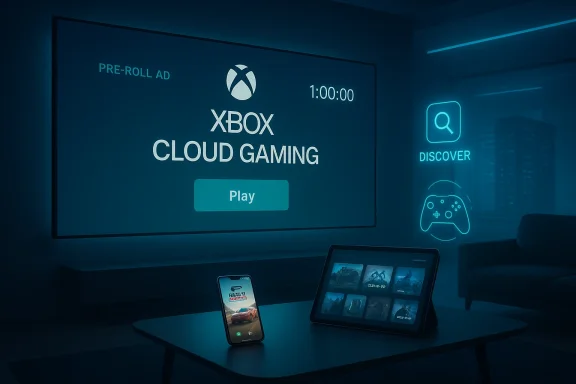
Microsoft has begun internal tests of a free, ad‑supported path into Xbox Cloud Gaming that would let non‑subscribers stream select Xbox titles for short, ad‑backed sessions — a move that could materially widen access to cloud play while forcing Microsoft and its publishing partners to reconcile streaming economics, ad policy, and user experience trade‑offs.
Background and overview
Xbox Cloud Gaming — once known as Project xCloud — matured into the streaming backbone for Xbox Game Pass, enabling console‑class experiences to run on remote Azure hardware and stream to phones, PCs, consoles, TVs and browsers. Microsoft has steadily broadened cloud capabilities in recent years, adding higher bitrates and selective 1440p streaming for qualifying content and expanding availability beyond Ultimate subscribers into additional Game Pass tiers during tests. These changes set the technical foundation for experimenting with alternate monetization models.What’s new in this wave of testing is an explicitly ad‑supported free tier that appears designed for discovery and funneling rather than to replace paid subscriptions. Early reports describe a constrained user experience: short pre‑roll advertisements unlock a time‑limited cloud session (reports name about two minutes of ads for roughly one hour of play), with additional monthly caps observed in some test builds. The curated playable library under test privileges games a user already owns, Free Play Days selections, and legacy catalog items rather than day‑one first‑party releases. Microsoft has acknowledged internal testing of ad‑supported cloud play, while several independent outlets have corroborated the same core attributes in leaked UI text and tester reports.
The experiment matters because it reframes three intertwined levers: Azure infrastructure utilization, customer acquisition for the Xbox ecosystem, and the perceived value of Game Pass. Turning otherwise idle cloud capacity into monetizable, ad‑financed sessions could improve datacenter economics; offering a free entry outlet lowers the barrier to trying cloud play; and, cruc preserve the premium reasons for users to pay for Game Pass while making a free path attractive enough to draw new players. Early analysis of the tests and their strategic intent has been captured and discussed in industry reporting and community analyses.
What the tests show (verified details)
Session mechanics and ad placement
Multiple reports and leaked in‑app strings indicate the test configuration includes:- Pre‑roll ads of roughly two minutes before a session begins.
- Session length commonly shown as around one hour per session in test builds.
- Monthly caps reported in some builds (figures circulating include around five hours per month), though Microsoft’s parameters appear provisional.
Library and entitlement scope
Early testing shows a conservative content set for the free, ad‑supported layer:- Titles a player already owns in their digital library.
- Games offered under Free Play Days or temporary promotions.
- Retro and legacy catalog selections from Xbox’s back catalog.
Platforms and availability
Testing builds suggest the ad‑supported flow will be accessible across web browsers, Windows PCs, Xbox consoles, handheld devices, and smart TVs — mirroring Xbox Cloud Gaming’s multi‑endpoint strategy. Microsoft’s use of web previews and PWA variants historically accelerates experimentation and lets the company iterate without redeploying native clients across device ecosystems.Why Microsoft is testing ad‑supported cloud gaming
The rationale behind the move is pragmatic and multi‑faceted:- Azure utilization and cost amortization. Cloud gaming consumes expensive GPU and encoding resources. Monetizing otherwise under‑utilized capacity with ad‑supported sessions improves data center economics and reduces per‑user marginal cost. This lever is frequently cited by analysts as a primary driver.
- User acquisition at scale. A free entry point dramatically lowers the barrier to trying Xbox cloud experiences, particularly in price‑sensitive regions where console ownership remains low but smartphone and smartgh. Even modest conversion rates from free to paid users can justify heavy initial investment.
- Competitive positioning and optics. After recent Game Pass price adjustments, an ad‑supported alternative provides a public relations counterbalance while offering a path for casual players to engage with Xbox content without buying hardware. It also helps Microsoft compete with other streaming or free‑to‑play ecosystems that have used ads successfully for discovery.
- Monetization diversification. Ads provide a second revenue stream alongside subscriptions, in‑game purchases, and third‑party bundling. Microsoft’s large ad sales reach and potential for targeted creative could yield decent RPMs (revenue per mille) if managed carefully, but gaming ad rates and viewer tolerance differ significantly from video streaming.
What this means for players
Upsides for consumers
- Lower friction to try cloud play. No subscription required to experience cloud streaming for short sessions, useful for players on the fence or without current hardware.
- Cross‑device reach. Players can access their owned games on devices that would otherwise require console hardware or large downloads.
- Discovery and sampling. A free tier makes it easier to sample titles before deciding to purchase or subscribe to Game Pass.
Friction and limits players should expect
- Time limits and caps. One‑hour sessions and modest monthly caps will constrain long play sessions and should tilt heavier users toward paid tiers.
- Ad interruptions (pre‑roll). Watching ads before every session adds friction; repeated short sessions could become unpleasant if ad frequency is high or poorly targeted.
- Content restrictions. Expect a curated, not comprehensive, playable set — day‑one premium launches are unlikely to be included in the free lane.
Publisher, partner, and commercial implications
Licensing and revenue share
Streaming games via an ad‑supported model raises revenue‑share questions with publishers and platform partners. Traditional retail or subscription splits may not map cleanly to ad inventory revenue. Some publishers may accept a discovery funnel that drives purchases, while others may demand direct ad revenue participation or refuse to make high‑value titles available in an ad tier. Microsoft’s negotiation leverage (first‑party IP and scale) will be tested here.Measurement and attribution
Ad monetization depends on strong measurement: viewability, conversion tracking, and cross‑device attribution. Gaming poses unique challenges (session length variability, interactive elements, and platform entitlements), and Microsoft will need robust telemetry and partner reporting to make the economics work for advertisers. Any limitations in ad measurement could materially reduce CPMs and advertiser interest.Risk of cannibalization
If the free tier offers too generous a window or too many premium titles, it could cannibalize Game Pass conversions. Conversely, if the free experience is too stingy, adoption will be low and advertiser ROI will suffer. Microsoft must find a narrow "sweet spot" where ad revenue plus downstream conversion offsets the marginal cloud costs without undermining the existing subscription ecosystem. Industry commentary emphasizes this precarious balance.Technical considerations and quality expectations
Streaming fidelity and device experience
Microsoft has progressively improved cloud fidelity — including reported selective 1440p streaming ceilings for Ultimate subscribers — but not every endpoint or title supports the highest tiers. For a free ad‑supported lane, Microsoft will likely apply conservative quality caps to protect capacity and differentiate paid tiers. Expect lower bitrates and resolution ceilings compared with the top paid offerings.Latency, control mapping and UX
Cloud gaming’s success depends on low input latency and stable bitrate. Pre‑session ads are a safer design choice because they do not inject latency mid‑game; however, queueing, session handoffs, and entitlement checks still introduce technical complexity. Microsoft’s experience operating Azure‑backed streaming gives it an advantage, but edge server allocation and geo‑latency remain constraints in some regions.Security and anti‑fraud
Ad monetization presents fraud vectors (fake impressions, automated traffic, click farms). Microsoft will need to apply ad verification and fraud detection layers to protect advertiser spend and maintain platform integrity — particularly because fraudulent impressions on a free tier could dilute value across the broader ad ecosystem. This is a standard but nontrivial requirement for any large ad‑supported product.Business model tradeoffs: will the math work?
Sh on conversion and yield.- If Microsoft can drive even a small conversion rate from free users to paid Game Pass subscriptions or in‑game purchases, the funnel economics could justify a generous ad‑supported experiment.
- If advertisers pay market CPMs and targeting is efficient across Microsoft’s ad stack, ad revenue per session might approach a meaningful fraction of Game Pass ARPU (average revenue per user) — but this requires scale and good retention.
- However, cloud gaming’s high marginal cost (GPU hours, egress bandwidth) means advertising needs to generate nontrivial yield per hour to be sustainable at scale.
Governance, privacy and regulatory cautions
Ad targeting in a gaming context raises privacy and regulatory questions. Microsoft must comply with regional data protection regimes (GDPR, CCPA/COPPA where applicable) and communicate transparently about what data is used to target ads. If Microsoft opts for interest‑based ads across devices, it will need clear user controls and opt‑outs to avoid backlash. Additionally, any ad inventory related to in‑game purchases or gambling‑adjacent content will attract heightened scrutiny.Publishers will also demand clarity on how user data and conversion signals are shared. Poorly designed data flows or opaque reporting could generate resistance to making premium games available in the free tier.
Possible product variants Microsoft could pursue
Microsoft’s intenfiguration, but there are other commercially plausible variants:- A strictly pre‑roll ad model with session caps (current test approach).
- A rewarded‑ads model where users opt into longer sessions or bonus content in exchange for watching more ads.
- Mixed ad + microtransaction funnels where ads subsidize initial hours while in‑session offers encourage purchases.
- Geographically restricted pilot programs in price‑sensitive markets to tune ad yields and conversion rates.
How Microsoft should execute to maximize chances of success
- Keep ads short, predictable and primarily pre‑session to maintain gameplay integrity.
- Maintain a clear content boundary between free/ad and paid Game Pass catalogs to avoid customer confusion and publisher pushback.
- Provide transparent metrics and revenue‑share models for publishers to opt into the program voluntarily.
- Use geographic phased testing to tune CPMs and conversion funnels before global rollout.
- Build robust fraud prevention and privacy controls to protect advertisers and user trust.
- Report early conversion and engagement metrics transparently to partners so the offering can be aligned with publisher economics.
Concise risk register
- Unit economics risk: Ad yield may be insufficient to cover GPU and egress costs at scale.
- Publisher resistance: Studios may decline ad‑supported streaming for premium titles.
- User experience degradation: Overly frequent or long ads could harm perception of Xbox services.
- Privacy/regulatory friction: Targeted ads across devices increase compliance burdens.
- Cannibalization: Poorly scoped free access could disincentivize paid subscriptions.
Final assessment: pragmatic experiment with a narrow sweet spot
Microsoft’s ad‑supported Xbox Cloud Gaming tests represent a pragmatic attempt to unlock incremental value from Azure infrastructure while lowering the barrier to cloud gaming. The current test signals — short pre‑rolls, one‑hour sessions, curated libraries, and modest monthly caps — indicate a deliberate, conservative approach: discover and funnel, not to cannibalize paid tiers.If executed well, this model could significantly broaden Xbox’s addressable market, particularly in regions where device ownership is a barrier to entry. It would give Microsoft a new monetization lever while maintaining Game Pass as the premium, ad‑free experience. The economics, however, are razor‑thin: ad yields, fraud prevention, publisher revenue participation, and conversion performance will determine whether ad‑supported cloud gaming is a long‑term growth engine or a short‑lived experiment.
For players, the promise is simple: try the cloud for free, tolerate a short ad, and get a limited window of play. For publishers and advertisers, the questions are more involved — can the ad revenue and downstream purchases meaningfully offset costs and opportunity loss? Microsoft’s next moves — public betas, partner terms, and published conversion metrics — will decide whether this test becomes a staple of the Xbox ecosystem or an instructive side experiment.
Microsoft’s tests are ongoing and parameters may change before any public launch. Early reports and Microsoft confirmations indicate the company is carefully tuning the product before wider rollout, and observers should treat current session lengths, ad lengths, and monthly caps as provisional test settings.
Source: Mix Vale Microsoft tests free Xbox Cloud Gaming access for ad-supported library games
