

A recent leak and multiple platform signals suggest Microsoft may be testing a plan to bring original Xbox and Xbox 360 titles to Windows PCs and handhelds such as ASUS’ ROG Ally by extending Xbox backwards compatibility (BC) beyond consoles — an initiative that, if real, would reshape how Xbox heritage content is accessed on Windows devices but will face material legal and technical constraints.
Microsoft has long positioned Xbox content as cross‑device intellectual property, using Game Pass, Xbox Play Anywhere, and cloud streaming to make titles available across consoles, PC and cloud. The current rumor wave (sparked by a forum insider post) asserts that Xbox engineering is working to package and validate legacy Xbox (original and Xbox 360) titles for the Windows ecosystem so they appear as native entries in the Xbox PC app and Microsoft Store. That would let Windows users — including owners of Windows handhelds such as the ROG Ally and ROG Ally X — buy and play classic Xbox catalogues with the same entitlement and front‑end UX as modern Xbox Series consoles.
This idea is technically plausible today because Microsoft has shipped two concrete building blocks that materially lower the engineering bar:
Source: DLCompare.com Rumor hints Xbox and Xbox 360 titles could soon run on ROG Ally and PC
 Background / Overview
Microsoft has long positioned Xbox content as cross‑device intellectual property, using Game Pass, Xbox Play Anywhere, and cloud streaming to make titles available across consoles, PC and cloud. The current rumor wave (sparked by a forum insider post) asserts that Xbox engineering is working to package and validate legacy Xbox (original and Xbox 360) titles for the Windows ecosystem so they appear as native entries in the Xbox PC app and Microsoft Store. That would let Windows users — including owners of Windows handhelds such as the ROG Ally and ROG Ally X — buy and play classic Xbox catalogues with the same entitlement and front‑end UX as modern Xbox Series consoles.This idea is technically plausible today because Microsoft has shipped two concrete building blocks that materially lower the engineering bar:
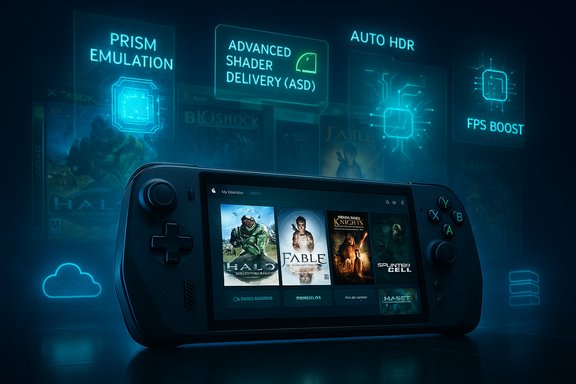
- Prism — the Windows-on‑Arm translation/emulation layer — has received updates that add emulation for advanced x86 instruction set extensions (AVX, AVX2, BMI, FMA, F16C and others), widening the set of x64 binaries that can launch on Arm devices.
- Xbox Full Screen Experience (FSE) and the evolving Xbox PC app Aggregated Library provide distribution and UX plumbing to surface multi‑storefront titles and give Windows devices a controller‑first, console‑style home. These features are already rolling into Windows Insider and Xbox Insider channels and shipped as first-class experiences on the ROG Ally line.
What the rumor actually says (and what remains unverified)
The core leak
The forum post that catalyzed coverage framed Microsoft’s work as an effort rather than a finished product: “There exists a hope to make legacy Xbox (OG and Xbox 360) games BC on ROG and Windows. Whether they succeed is the unknown; but there is an effort being made.” That language implies internal exploration, not a launch schedule or full catalog commitment. Treat the claim as plausible but unverified until Microsoft or participating publishers confirm specifics.What fans hope for (and what may realistically ship)
Enthusiasts expect:- Relisted store pages for original Xbox/Xbox 360 titles on the Microsoft Store/Xbox PC app.
- Local execution on Windows (including handhelds) with modern conveniences such as higher frame rates, Auto HDR, achievements and cloud saves.
- Use of features like FPS Boost and Auto HDR to enhance legacy titles on modern hardware.
- A selective, phased program prioritizing high‑value single‑player classics that have tractable licensing and no incompatible anti‑cheat middleware.
- The use of cloud streaming or partial feature‑releases (single‑player only, offline mode) as fallbacks for problematic titles.
- Regional gaps and missing titles where music or third‑party rights cannot be reacquired cheaply.
The technical foundations — can it actually be done?
Prism and Arm emulation: a significant enabling step
Historically, Arm Windows struggled with complex x86/x64 binaries because modern games can call into broad CPU instruction sets (AVX/AVX2) or rely on behaviors not trivially emulated. The recent Prism update expands emulation support for AVX, AVX2 and several other CPU extensions, enabling far more x64 apps and games to run on Windows‑on‑Arm devices without recompilation. Microsoft’s platform documentation and independent coverage confirm this rollout for Windows 11 24H2/25H2 devices. Why this matters:- Many Xbox era ports and their PC compatibility layers assume x86/x64 CPI features; Prism’s broader coverage reduces one of the biggest binary‑compatibility blockers.
- On Arm handhelds (ROG Ally series, Snapdragon PCs), the technical feasibility of launching legacy x64 binaries has moved from “unlikely” to “possible” — but not to “free of performance cost.” Emulation of wider‑vector instruction sets on narrower Arm SIMD incurs overhead and will produce mixed results across titles and hardware.
The Xbox PC app and storefront plumbing
Microsoft has invested in an Aggregated Library that discovers installed titles across Steam, Epic and the Microsoft Store, and in the Xbox app as the discovery and entitlement surface. That gives Microsoft a distribution vehicle to relist and deliver verified legacy packages to PC owners without forcing a re‑engineered Win32 port for every title. This is the UX-level glue a Windows BC program would use.Graphics and platform features that will matter
Microsoft has recently deployed or previewed platform features that would materially improve legacy titles on modern hardware:- Advanced Shader Delivery (ASD) — precompiles and distributes shader databases tailored to hardware so first‑run shader compilation stutter is reduced or eliminated. ASD already debuted on ROG Ally devices and is supported by DirectX tooling (Agility SDK). This directly benefits handhelds and systems that are shader‑sensitive.
- Auto HDR and FPS Boost‑style improvements already exist on Windows for many titles; Microsoft’s Auto HDR is supported in Windows 11 and can lift SDR games to HDR displays, improving visual fidelity without game rework.
The hard constraints: licensing, anti‑cheat, online services
This is where plausibility runs into reality.Licensing and rights
Many late‑1990s/2000s-era titles use licensed music, sports leagues, or third‑party IP that was only cleared for the original console marketplace. Re‑licensing these assets for a modern PC reissue can be prohibitively expensive or impossible if rights holders are unreachable or demand outsized fees. That guarantees a patchwork catalog and regional exclusions even if Microsoft elects to pursue relisting. Expect legal complexity to be the decisive filter for what returns.Anti‑cheat middleware and multiplayer
A far larger practical blocker is anti‑cheat middleware and kernel drivers. Many multiplayer titles from the Xbox 360 era used vendor middleware or required kernel‑level components that were never written for Arm or modern Windows driver models. Without vendor cooperation to reissue updated anti‑cheat drivers or to accept architecture/emulation exceptions, online and multiplayer features may remain blocked for many titles; some games could be restricted to offline single‑player modes. This is arguably the single largest technical and policy obstacle.Performance and UX variability
Emulation is not uniform. Running Xbox 360 binaries on an x86 Windows desktop will behave differently than emulation on an Arm handheld; thermal throttling, battery drain, CPU/GPU translation overhead, and per‑title shader requirements will yield a wide quality spread. Microsoft can mitigate this by prioritizing a curated list of titles, shipping per‑title optimizations, or using cloud fallback where local play is infeasible.What this would mean for Game Pass, the ROG Ally, and the PC ecosystem
For Game Pass (PC)
Expanding BC to Windows would materially increase the value proposition of Game Pass for PC subscribers by adding high‑profile legacy catalogues. That could:- Increase subscriber retention by offering nostalgia hooks.
- Enable cross‑device entitlements (buy once, play across console, PC, handheld).
- Drive additional purchases of reissued classics with modern conveniences (achievements, cloud saves).
For handhelds like the ROG Ally / Ally X
The ROG Ally family is a natural beneficiary. Handhelds that can run validated legacy Xbox titles locally (or with low‑latency cloud fallbacks) become extremely attractive to console players who want portability. Microsoft’s recent Full Screen Experience (FSE) shipping on Ally devices and expanding to more Windows 11 PCs is an explicit UX signal that Microsoft wants to make Windows handhelds feel console‑like by default. If legacy BC arrives on Windows, Ally devices would enjoy a content halo that strengthens the platform position against other handheld PCs.For PC gaming at large
A Windows BC program would blur the lines between console exclusives and PC libraries: classic Xbox franchises would be more available on PC and handhelds, but this will also stoke concerns about DRM, telemetry, and store economics if Microsoft’s Aggregated Library becomes the dominant discovery surface. Expect competitors and storefronts to push back or negotiate terms, and for developers/publishers to demand clear certification and distribution matrices.Strengths: why Microsoft could pull this off
- Stacked engineering progress: Prism’s emulation improvements + Advanced Shader Delivery + the Xbox app’s Aggregated Library reduce multiple technical barriers simultaneously. Those are concrete platform investments that can be reused to package legacy titles.
- Strategic alignment: Extending BC to Windows fits Microsoft’s long‑term vision of Xbox + PC synergy and directly increases Game Pass utility. That alignment makes internal resourcing and prioritization more likely than a one-off experiment.
- Hardware partners and reference devices: The ROG Ally family provides a vendor‑validated reference hardware and UX testbed. Having a few well‑specified devices reduces fragmentation risk for an initial rollout.
- Preservation and goodwill: Official, entitlement-backed reissues (rather than relying on community emulators) provide a supported path to replay classics and generate positive PR if executed well.
Risks and weaknesses: where the plan could fail or disappoint
- Licensing will produce a patchwork catalog. Players should not expect every classic to return. Many music‑heavy or licensed‑IP titles may be absent.
- Anti‑cheat and multiplayer limitations could make popular multiplayer titles single‑player only or cloud‑bound. That reduces commercial impact for certain franchises.
- Emulation performance will vary across devices. Arm handhelds will likely show the widest variance; desktop x86 Windows remains the safest host for native‑like behavior.
- Operational complexity and cost. Validating, packaging and maintaining legacy binaries across architectures, driver variants and storefronts will raise CI and hosting costs. Microsoft may ration resources toward flagships first.
- Expectation mismatch. Consumers may expect parity with Xbox Series X versions (FPS Boost, HDR, achievements) for all relisted titles; delivering that uniformly at scale is expensive and unlikely right away.
Signals to watch — how to tell if Microsoft is moving from experiment to product
- Official Microsoft/Xbox announcements about a formal “Classics on Windows” program or a relisting roadmap.
- Publisher confirmations via blog posts or release notes that specific original Xbox or Xbox 360 SKUs are being reissued for Windows with achievements/cloud saves.
- Microsoft documentation explaining how anti‑cheat middleware and server dependencies will be handled across architectures.
- Storefront entries that move beyond “Coming Soon” placeholders to full product pages with pricing and supported features.
- Developer documentation or DirectX/Agility SDK updates that add first‑party tooling for packaging legacy binaries (SODB/PSDB workflows, emulation packaging guidance).
Practical advice — what players, collectors and developers should do now
- For consumers who want immediate access to classics: community emulators (xenia for Xbox 360, xemu for original Xbox) remain the fastest route to play many titles today, but they lack official entitlements, achievements and guaranteed online support. Use them for preservation and hobby play, but expect technical tinkering.
- For ROG Ally or Windows handheld owners: keep Windows 11, drivers and the Xbox PC app up to date to benefit from Prism improvements, Advanced Shader Delivery, and Full Screen Experience previews as they roll out. Join Insider programs (Xbox Insider, Windows Insider) for early access to FSE and related features.
- For developers/publishers: request clarity from Microsoft on certification matrices for anti‑cheat, driver packaging and API support. Investigate DirectX Agility SDK tooling (SODB/PSDB) if you plan to support precompiled shader delivery or to reissue legacy titles.
- For preservationists and archivists: continue to document game binaries and metadata now — reissues can be selective and legal rights may shift quickly; preserve what matters to you offline while you can.
Verdict — cautious optimism
The pieces for a Windows‑side Xbox backwards compatibility program are more present today than they would have been two years ago. Microsoft’s Prism updates, the Xbox Full Screen Experience rollout, and DirectX investments such as Advanced Shader Delivery create a credible technical foundation. The ROG Ally family serves as an immediate reference device that demonstrates the UX and hardware tradeoffs Microsoft is targeting. However, the decisive obstacles are non‑technical: licensing, middleware (anti‑cheat) and operational cost. These are not minor engineering tasks; they are legal negotiations and long‑running vendor relationships that will shape catalog breadth and timeline. The forum leak at the center of this story used cautious language — “an effort being made” — and that same caution is the right posture for observers today. Expect a selective, staged rollout centered on high‑value titles first, with cloud fallbacks and reduced‑feature releases for harder cases.Conclusion
Bringing original Xbox and Xbox 360 games to Windows and handheld devices is now technically more possible than it was a year ago — thanks to Prism improvements, DirectX/Agility SDK work, Advanced Shader Delivery, and the Xbox Full Screen Experience — but turning possibility into a smooth, comprehensive consumer program requires navigating licensing, anti‑cheat and multiplayer server realities. The most likely outcome, if Microsoft follows through, is a curated Classics program that returns marquee titles first and uses cloud or reduced‑feature options where legal or technical constraints remain. For Windows handhelds such as the ROG Ally, that outcome would be a major value add; for consumers it will be a welcome expansion of Game Pass and a preservation win where it succeeds. Until Microsoft or publishers publish a confirmed roadmap, treat current storefront placeholders and forum leaks as plausible signals, not guarantees.Source: DLCompare.com Rumor hints Xbox and Xbox 360 titles could soon run on ROG Ally and PC
