

Microsoft is reportedly preparing to cut more than 5,000 jobs across sales, consulting, Xbox, and other teams in early July 2026, a reduction of under 2.5 percent of its roughly 220,000-person workforce as it redirects capital toward AI infrastructure. The number is smaller than last summer’s 9,000-person round, but the message is not softer. Microsoft is not acting like a company in crisis; it is acting like a company choosing which parts of itself deserve to grow in the AI era. That makes this round more revealing than a conventional cost-cutting story.
The easy read is that Microsoft is conducting another annual restructuring after closing its fiscal year on June 30. Big technology companies often use that moment to reset budgets, flatten teams, and clear out work that no longer maps neatly to the next year’s priorities. On paper, a sub-2.5 percent reduction is not existential for a company of Microsoft’s scale.
But the pattern matters more than the percentage. Microsoft cut around 6,000 employees in May 2025 and followed with roughly 9,000 more in July 2025, a sequence that made layoffs feel less like an emergency measure and more like a recurring operating discipline. The new round, if carried out as reported, would extend that rhythm into 2026.
That rhythm is especially jarring because Microsoft is not shrinking in the ordinary sense. Azure remains central to enterprise cloud computing, Microsoft 365 is embedded in corporate life, Windows still anchors the PC ecosystem, and the company has spent aggressively to make Copilot and AI infrastructure the connective tissue across its product line. These layoffs are happening not because Microsoft lacks money, but because it has chosen a more expensive future.
That is the heart of the story. AI is not merely another product group inside Microsoft. It is becoming the budgetary center of gravity, and everything else is being asked to justify itself against that gravitational pull.
That changes the internal politics of the company. A dollar spent on headcount in sales, consulting, or game development now competes with a dollar spent on GPUs, data-center capacity, and cloud-scale AI services. The result is a company that can be profitable, powerful, and still ruthless about labor.
This is why the phrase “AI investment” can sound bloodless. It is not just a line in a capital expenditure plan. It is a decision to privilege infrastructure that may compound for years over teams whose value is measured in more traditional ways: customer relationships, field support, creative production, and internal operational knowledge.
Microsoft will argue, as every large company does, that it is aligning resources with customer demand. There is truth in that. Enterprise customers are experimenting with AI assistants, code-generation tools, security copilots, and automation layers that promise to compress tedious work into prompts and workflows. But the brutal question for employees is whether the company sees them as builders of that transition or as costs to be reduced to pay for it.
AI, especially in large organizations, is not a magic switch. It requires data governance, security review, licensing decisions, employee training, workflow redesign, and a tolerance for uneven early results. That is exactly where sales engineers, account teams, and consultants matter. They translate product ambition into deployable systems.
If those teams are hit meaningfully, Microsoft risks weakening the very channels it needs to make AI stick. Copilot does not sell itself simply because it appears in a Microsoft 365 admin center. Azure AI does not become a production platform merely because executives say the future is agentic. Enterprises need hand-holding, and often they need blunt advice about what not to automate yet.
There is a familiar Silicon Valley assumption that AI can also replace some of that field work. In limited cases, perhaps it can. Documentation, demos, support scripts, proposal drafting, and internal analytics can all be accelerated. But enterprise trust is still built by people who understand the customer’s architecture, politics, compliance environment, and budget cycle.
That is the tension Microsoft now has to manage. The company is selling AI as a force multiplier for knowledge work while reducing knowledge workers in the parts of the business that persuade customers to adopt it. If that balance is wrong, the savings will show up quickly and the damage will surface slowly.
Xbox has already endured a bruising stretch. Microsoft’s gaming division absorbed Activision Blizzard, endured major job cuts, and faced continuing pressure to prove that its subscription, console, cloud, and cross-platform strategies can coexist. Each round of layoffs revives the same question: is Microsoft building a bigger gaming business, or is it steadily converting gaming into another content-and-services layer inside a broader AI-and-cloud empire?
That may sound dramatic, but it reflects a real strategic ambiguity. Microsoft owns some of the most valuable game properties in the world, yet Xbox hardware has struggled to define a clean identity against PlayStation, Nintendo, and the increasingly capable PC handheld market. Game Pass remains influential, but subscription growth alone has not erased the hard economics of blockbuster development.
When cuts hit Xbox, they also hit morale across an industry already conditioned to expect instability. Game development depends on long timelines, fragile creative trust, and teams that accumulate specialized knowledge over years. Layoffs may improve a quarterly cost line, but they can also damage the continuity that makes ambitious games possible.
For WindowsForum readers, the Xbox angle is not separate from the Windows story. Microsoft’s gaming strategy increasingly crosses console, PC, cloud streaming, Windows handhelds, and store policy. A leaner Xbox may still be a powerful Xbox, but it will likely be one more tightly integrated with Microsoft’s platform priorities and less tolerant of experiments that do not serve those priorities.
That creates a difficult incentive structure. Microsoft must convince Wall Street that it is spending enough to win the AI infrastructure race while also proving that spending will not swallow the profitability that made the company one of the market’s safest compounders. Layoffs become one way to tell investors that management still has cost discipline.
This is not unique to Microsoft. Alphabet, Amazon, Meta, Oracle, and other large technology firms have all been reshaping workforces while funding AI infrastructure, model development, and cloud capacity. The industry has entered a period where companies can announce enormous capital programs and layoffs in the same breath without seeing those messages as contradictory.
Employees, naturally, experience the contradiction more directly. To them, AI can look less like an exciting platform shift and more like the justification for a permanent reduction in job security. The fact that these firms remain wealthy only sharpens the resentment.
Microsoft’s challenge is that its public rhetoric still leans heavily on empowerment. Copilot is marketed as a tool that helps people do more, not as a machine for making them redundant. But when workforce reductions accompany the rollout of those tools, the distinction becomes harder to defend.
Programs based on age-plus-service thresholds can remove experienced workers without the optics of a blunt reduction in force. They also carry hidden costs. Long-tenured employees often know where the old systems are buried, which customers need special handling, and which internal processes exist because previous “simplifications” failed.
That institutional memory is easy to undervalue during a platform transition. It is especially easy to undervalue when leaders believe AI tools can capture, summarize, and operationalize organizational knowledge. The danger is that the knowledge most worth preserving is often tacit, political, and situational — precisely the kind that does not fit neatly into a document corpus.
Microsoft is not wrong to reshape itself. Every major platform transition forces companies to reallocate talent, and the AI shift is real enough to require hard choices. But buyouts and layoffs can produce an organization that is theoretically optimized and practically thinner, with fewer people capable of explaining why a customer deployment failed or why a product decision carries risk.
That matters for Windows administrators and enterprise IT teams because Microsoft’s internal continuity affects external reliability. Support quality, licensing clarity, documentation accuracy, and escalation paths are not abstract concerns. They shape whether customers feel Microsoft is a partner or simply a vendor with a chatbot.
Predictability has consequences. Employees learn to treat the end of the fiscal year as a danger zone. Managers delay decisions while waiting for headcount guidance. Teams become cautious just when the company says it needs speed.
For a company trying to win the AI transition, that is a cultural tax. Innovation rhetoric depends on employees believing that intelligent risk-taking will be rewarded. Recurring layoffs teach a different lesson: keep your work visible, align with the dominant narrative, and avoid being attached to a project that can be described as non-core.
That kind of behavior may be rational for individuals, but it is not always healthy for the company. The most valuable ideas inside Microsoft have not always looked obvious at first. Windows, Office, Azure, Xbox, GitHub, and AI all required periods of strategic patience. A company that becomes too aggressive about pruning may remove the awkward early work that later becomes essential.
Still, Microsoft’s leadership likely sees the alternative as worse. In a world where AI infrastructure requires vast upfront spending, management may believe recurring workforce discipline is the price of staying in the race. The risk is that the race becomes so capital-obsessed that the company forgets which human systems make its platforms usable.
It may show up as slower support escalation for enterprise customers. It may appear as thinner documentation, more reliance on automated help flows, or a stronger push toward self-service admin portals. It may surface in product quality when teams responsible for testing, compatibility, or customer feedback loops are asked to do more with less.
For sysadmins, the concern is not sentimental. Microsoft’s ecosystem is already complex enough: Windows 11 feature updates, Intune policy changes, Entra identity decisions, Defender integrations, Azure dependencies, Microsoft 365 licensing, and Copilot governance all collide inside real organizations. When the vendor reduces human capacity while increasing platform complexity, customers inherit some of the burden.
That does not mean every layoff damages product quality. Large companies accumulate duplication, and some reorganizations genuinely improve execution. But users should be skeptical of the idea that AI can instantly absorb the operational work removed by layoffs. Automation can accelerate support; it can also create a maze that keeps customers away from accountable humans.
The deeper issue is trust. Microsoft asks organizations to standardize on its stack not merely because the products are capable, but because the company promises continuity. Layoffs across customer-facing and product-facing teams put that promise under pressure.
That is how platform shifts work, but the social contract has changed. In earlier eras, productivity gains were sold as a way to grow the pie. In the current AI cycle, the public increasingly hears a different message: the tools will make companies more efficient, and efficiency will mean fewer workers.
Microsoft cannot fully control that narrative, but it has contributed to it. The more the company celebrates AI-assisted productivity while cutting employees, the more outsiders will assume the productivity gains are being harvested mainly as labor savings. Even if the reality is more nuanced, optics matter.
This is particularly sensitive because Microsoft sells AI into workplaces where employees are already anxious about surveillance, automation, and role compression. If the company’s own workforce becomes a case study in AI-era downsizing, customers may adopt the tools with a mixture of enthusiasm and dread.
The irony is that Microsoft’s best AI products still depend on human confidence. Copilot works best when employees trust it enough to use it, correct it, and integrate it into real workflows. Fear can drive adoption mandates, but it rarely produces thoughtful transformation.
For readers tracking the practical implications, the most important facts are concrete:
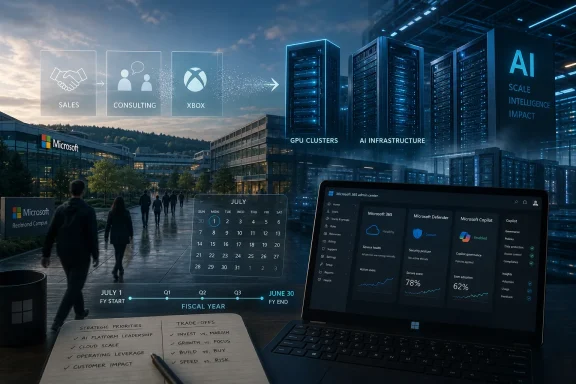 Microsoft Is No Longer Trimming Around the Edges
The easy read is that Microsoft is conducting another annual restructuring after closing its fiscal year on June 30. Big technology companies often use that moment to reset budgets, flatten teams, and clear out work that no longer maps neatly to the next year’s priorities. On paper, a sub-2.5 percent reduction is not existential for a company of Microsoft’s scale.But the pattern matters more than the percentage. Microsoft cut around 6,000 employees in May 2025 and followed with roughly 9,000 more in July 2025, a sequence that made layoffs feel less like an emergency measure and more like a recurring operating discipline. The new round, if carried out as reported, would extend that rhythm into 2026.
That rhythm is especially jarring because Microsoft is not shrinking in the ordinary sense. Azure remains central to enterprise cloud computing, Microsoft 365 is embedded in corporate life, Windows still anchors the PC ecosystem, and the company has spent aggressively to make Copilot and AI infrastructure the connective tissue across its product line. These layoffs are happening not because Microsoft lacks money, but because it has chosen a more expensive future.
That is the heart of the story. AI is not merely another product group inside Microsoft. It is becoming the budgetary center of gravity, and everything else is being asked to justify itself against that gravitational pull.
The AI Buildout Has Become the Company’s New Fixed Cost
Microsoft’s AI strategy is capital intensive in a way that classic software was not. The old Microsoft could sell Windows and Office at enormous margins because the product, once built, could be distributed endlessly. The new Microsoft must lease or build data centers, buy accelerators, secure power, optimize cooling, and keep adding capacity for workloads whose economics are still being tested in real time.That changes the internal politics of the company. A dollar spent on headcount in sales, consulting, or game development now competes with a dollar spent on GPUs, data-center capacity, and cloud-scale AI services. The result is a company that can be profitable, powerful, and still ruthless about labor.
This is why the phrase “AI investment” can sound bloodless. It is not just a line in a capital expenditure plan. It is a decision to privilege infrastructure that may compound for years over teams whose value is measured in more traditional ways: customer relationships, field support, creative production, and internal operational knowledge.
Microsoft will argue, as every large company does, that it is aligning resources with customer demand. There is truth in that. Enterprise customers are experimenting with AI assistants, code-generation tools, security copilots, and automation layers that promise to compress tedious work into prompts and workflows. But the brutal question for employees is whether the company sees them as builders of that transition or as costs to be reduced to pay for it.
Sales and Consulting Are Where Strategy Becomes Friction
Cuts in sales and consulting deserve more attention than they usually receive. These are not glamour divisions, and they rarely produce the product-launch moments that dominate tech coverage. But for Microsoft’s enterprise business, they are the connective tissue between Redmond’s strategy and the messy reality of customer adoption.AI, especially in large organizations, is not a magic switch. It requires data governance, security review, licensing decisions, employee training, workflow redesign, and a tolerance for uneven early results. That is exactly where sales engineers, account teams, and consultants matter. They translate product ambition into deployable systems.
If those teams are hit meaningfully, Microsoft risks weakening the very channels it needs to make AI stick. Copilot does not sell itself simply because it appears in a Microsoft 365 admin center. Azure AI does not become a production platform merely because executives say the future is agentic. Enterprises need hand-holding, and often they need blunt advice about what not to automate yet.
There is a familiar Silicon Valley assumption that AI can also replace some of that field work. In limited cases, perhaps it can. Documentation, demos, support scripts, proposal drafting, and internal analytics can all be accelerated. But enterprise trust is still built by people who understand the customer’s architecture, politics, compliance environment, and budget cycle.
That is the tension Microsoft now has to manage. The company is selling AI as a force multiplier for knowledge work while reducing knowledge workers in the parts of the business that persuade customers to adopt it. If that balance is wrong, the savings will show up quickly and the damage will surface slowly.
Xbox Is Again the Most Visible Casualty of Microsoft’s New Math
The reported impact on Xbox gives the layoff story a sharper public edge. Gaming is emotionally legible in a way enterprise licensing is not. Players remember canceled projects, closed studios, delayed releases, and price increases more vividly than they remember a reorganization inside consulting services.Xbox has already endured a bruising stretch. Microsoft’s gaming division absorbed Activision Blizzard, endured major job cuts, and faced continuing pressure to prove that its subscription, console, cloud, and cross-platform strategies can coexist. Each round of layoffs revives the same question: is Microsoft building a bigger gaming business, or is it steadily converting gaming into another content-and-services layer inside a broader AI-and-cloud empire?
That may sound dramatic, but it reflects a real strategic ambiguity. Microsoft owns some of the most valuable game properties in the world, yet Xbox hardware has struggled to define a clean identity against PlayStation, Nintendo, and the increasingly capable PC handheld market. Game Pass remains influential, but subscription growth alone has not erased the hard economics of blockbuster development.
When cuts hit Xbox, they also hit morale across an industry already conditioned to expect instability. Game development depends on long timelines, fragile creative trust, and teams that accumulate specialized knowledge over years. Layoffs may improve a quarterly cost line, but they can also damage the continuity that makes ambitious games possible.
For WindowsForum readers, the Xbox angle is not separate from the Windows story. Microsoft’s gaming strategy increasingly crosses console, PC, cloud streaming, Windows handhelds, and store policy. A leaner Xbox may still be a powerful Xbox, but it will likely be one more tightly integrated with Microsoft’s platform priorities and less tolerant of experiments that do not serve those priorities.
The Stock-Market Story Is Less Simple Than It Looks
The submitted report says Microsoft’s stock has fallen roughly 17 percent in the past month, a figure that should be treated carefully because market moves depend on the exact measurement window. What matters more than a single percentage is the broader investor mood: shareholders want AI growth, but they also want evidence that AI spending will produce durable margins.That creates a difficult incentive structure. Microsoft must convince Wall Street that it is spending enough to win the AI infrastructure race while also proving that spending will not swallow the profitability that made the company one of the market’s safest compounders. Layoffs become one way to tell investors that management still has cost discipline.
This is not unique to Microsoft. Alphabet, Amazon, Meta, Oracle, and other large technology firms have all been reshaping workforces while funding AI infrastructure, model development, and cloud capacity. The industry has entered a period where companies can announce enormous capital programs and layoffs in the same breath without seeing those messages as contradictory.
Employees, naturally, experience the contradiction more directly. To them, AI can look less like an exciting platform shift and more like the justification for a permanent reduction in job security. The fact that these firms remain wealthy only sharpens the resentment.
Microsoft’s challenge is that its public rhetoric still leans heavily on empowerment. Copilot is marketed as a tool that helps people do more, not as a machine for making them redundant. But when workforce reductions accompany the rollout of those tools, the distinction becomes harder to defend.
Voluntary Buyouts Were the Warning Shot
The reported earlier voluntary retirement program for certain U.S. employees now looks less like an isolated HR maneuver and more like part of a broader workforce reset. Buyouts are softer than layoffs, but they often signal the same underlying diagnosis: the company believes its current employee mix is too large, too expensive, or misaligned with future priorities.Programs based on age-plus-service thresholds can remove experienced workers without the optics of a blunt reduction in force. They also carry hidden costs. Long-tenured employees often know where the old systems are buried, which customers need special handling, and which internal processes exist because previous “simplifications” failed.
That institutional memory is easy to undervalue during a platform transition. It is especially easy to undervalue when leaders believe AI tools can capture, summarize, and operationalize organizational knowledge. The danger is that the knowledge most worth preserving is often tacit, political, and situational — precisely the kind that does not fit neatly into a document corpus.
Microsoft is not wrong to reshape itself. Every major platform transition forces companies to reallocate talent, and the AI shift is real enough to require hard choices. But buyouts and layoffs can produce an organization that is theoretically optimized and practically thinner, with fewer people capable of explaining why a customer deployment failed or why a product decision carries risk.
That matters for Windows administrators and enterprise IT teams because Microsoft’s internal continuity affects external reliability. Support quality, licensing clarity, documentation accuracy, and escalation paths are not abstract concerns. They shape whether customers feel Microsoft is a partner or simply a vendor with a chatbot.
The Layoff Calendar Has Become a Management Tool
There is a reason July keeps appearing in Microsoft layoff stories. The company’s fiscal year ends June 30, and the weeks around that boundary are a natural time for budget resets. That does not make the cuts automatic, but it does make them part of a predictable management cycle.Predictability has consequences. Employees learn to treat the end of the fiscal year as a danger zone. Managers delay decisions while waiting for headcount guidance. Teams become cautious just when the company says it needs speed.
For a company trying to win the AI transition, that is a cultural tax. Innovation rhetoric depends on employees believing that intelligent risk-taking will be rewarded. Recurring layoffs teach a different lesson: keep your work visible, align with the dominant narrative, and avoid being attached to a project that can be described as non-core.
That kind of behavior may be rational for individuals, but it is not always healthy for the company. The most valuable ideas inside Microsoft have not always looked obvious at first. Windows, Office, Azure, Xbox, GitHub, and AI all required periods of strategic patience. A company that becomes too aggressive about pruning may remove the awkward early work that later becomes essential.
Still, Microsoft’s leadership likely sees the alternative as worse. In a world where AI infrastructure requires vast upfront spending, management may believe recurring workforce discipline is the price of staying in the race. The risk is that the race becomes so capital-obsessed that the company forgets which human systems make its platforms usable.
Windows Users Will Feel This Indirectly, Then All at Once
Most Windows users will not notice a layoff announcement the day it happens. Their PCs will still boot, Microsoft 365 will still update, Defender will still scan, and Teams will still find new ways to demand attention. The impact of workforce reductions in a company this large tends to arrive indirectly.It may show up as slower support escalation for enterprise customers. It may appear as thinner documentation, more reliance on automated help flows, or a stronger push toward self-service admin portals. It may surface in product quality when teams responsible for testing, compatibility, or customer feedback loops are asked to do more with less.
For sysadmins, the concern is not sentimental. Microsoft’s ecosystem is already complex enough: Windows 11 feature updates, Intune policy changes, Entra identity decisions, Defender integrations, Azure dependencies, Microsoft 365 licensing, and Copilot governance all collide inside real organizations. When the vendor reduces human capacity while increasing platform complexity, customers inherit some of the burden.
That does not mean every layoff damages product quality. Large companies accumulate duplication, and some reorganizations genuinely improve execution. But users should be skeptical of the idea that AI can instantly absorb the operational work removed by layoffs. Automation can accelerate support; it can also create a maze that keeps customers away from accountable humans.
The deeper issue is trust. Microsoft asks organizations to standardize on its stack not merely because the products are capable, but because the company promises continuity. Layoffs across customer-facing and product-facing teams put that promise under pressure.
The AI Dividend Has Not Been Evenly Distributed
Microsoft’s AI strategy has already changed the company’s internal hierarchy. Teams tied directly to Azure capacity, AI platforms, Copilot integration, security automation, and developer tooling have strategic oxygen. Teams outside that orbit must prove they are not legacy cost centers.That is how platform shifts work, but the social contract has changed. In earlier eras, productivity gains were sold as a way to grow the pie. In the current AI cycle, the public increasingly hears a different message: the tools will make companies more efficient, and efficiency will mean fewer workers.
Microsoft cannot fully control that narrative, but it has contributed to it. The more the company celebrates AI-assisted productivity while cutting employees, the more outsiders will assume the productivity gains are being harvested mainly as labor savings. Even if the reality is more nuanced, optics matter.
This is particularly sensitive because Microsoft sells AI into workplaces where employees are already anxious about surveillance, automation, and role compression. If the company’s own workforce becomes a case study in AI-era downsizing, customers may adopt the tools with a mixture of enthusiasm and dread.
The irony is that Microsoft’s best AI products still depend on human confidence. Copilot works best when employees trust it enough to use it, correct it, and integrate it into real workflows. Fear can drive adoption mandates, but it rarely produces thoughtful transformation.
Redmond’s July Message Is Clearer Than Its Memo Will Be
Microsoft will likely describe the cuts in careful corporate language: priorities, alignment, efficiency, customer demand, investment areas, and long-term growth. Those words are not meaningless, but they are incomplete. The clearer message is that Microsoft is willing to shrink parts of its workforce while spending heavily to dominate the AI layer of computing.For readers tracking the practical implications, the most important facts are concrete:
- Microsoft is reportedly preparing to eliminate more than 5,000 roles, or less than 2.5 percent of its global workforce.
- The expected cuts are said to affect multiple groups, including sales, consulting, and Xbox.
- The move follows large 2025 reductions, including about 6,000 jobs in May and around 9,000 more in July.
- The timing aligns with Microsoft’s post-fiscal-year planning cycle, making July a recurring moment for restructuring.
- The strategic backdrop is Microsoft’s expensive AI infrastructure buildout, which is reshaping how the company allocates money and headcount.
- Windows and enterprise customers may feel the effects less through immediate product changes than through support, documentation, account coverage, and the pace of platform complexity.
References
- Primary source: Benzatine Infotech
Published: 2026-07-02T05:42:09.827483
Loading…
benzatine.com - Related coverage: pcgamer.com
Loading…
www.pcgamer.com - Related coverage: windowscentral.com
Loading…
www.windowscentral.com - Related coverage: livemint.com
Microsoft plans another round of layoffs, may cut less than 2.5% of workforce: Report | Company Business News
Microsoft is reportedly planning another round of layoffs, with less than 2.5% of its global workforce expected to be affected. According to reports, the job cuts could be announced as early as next week. www.livemint.com
- Related coverage: businesstoday.in
Loading…
www.businesstoday.in - Related coverage: winbuzzer.com
Loading…
winbuzzer.com
- Related coverage: insight.tmcnet.com
Loading…
insight.tmcnet.com - Related coverage: technologies.org
- Related coverage: investing.com
Loading…
www.investing.com - Related coverage: business-standard.com
Loading…
www.business-standard.com - Related coverage: techspot.com
Microsoft offers voluntary buyouts to thousands of US workers as AI spending takes priority
The buyout program will open to around 7% of Microsoft's US employees, according to CNBC, which cites a person familiar with the plans who can't be named. www.techspot.com
- Related coverage: techcrunch.com
Loading…
techcrunch.com - Related coverage: elpais.com
Loading…
elpais.com - Related coverage: gamesradar.com
Loading…
www.gamesradar.com - Related coverage: techradar.com
Loading…
www.techradar.com