

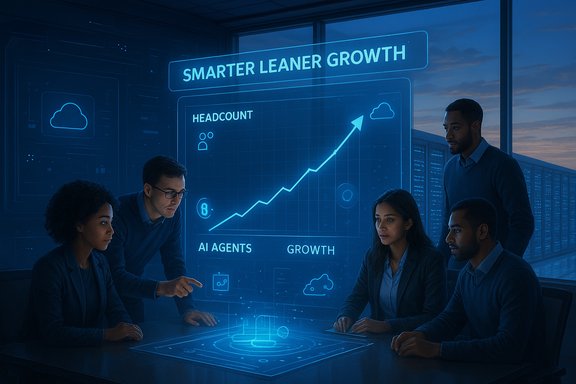
Satya Nadella told an investor podcast that Microsoft will “grow our headcount” again after a year of heavy cuts — but the next hiring wave will be smarter and more leveraged by artificial intelligence, not a return to pre‑AI scale‑ups.
Microsoft closed fiscal 2025 with a powerful set of financial results but a much thinner operational story underneath: the company reported $76.4 billion in revenue for Q4 and $281.7 billion for the fiscal year, while simultaneously executing multiple rounds of workforce reductions and organizational change. Over the past year Microsoft eliminated well into five digits of roles in several waves — including rounds reported at roughly 6,000 and later ~9,000 layoffs — a strategy the company framed as reallocation toward AI and cloud priorities. At the same time, leadership has signaled an unusually large capital push into AI infrastructure — publicly discussed plans in 2025 centered on tens of billions of dollars of data‑center and hardware investment. Taken together, this is a classic corporate pivot: preserve earnings and fund a capital‑intensive inorganic future while reshaping the recurring cost base (headcount and management layers) to match a different operating model. Internal and industry discussion of that pivot — its rationale, mechanics, and human cost — has been lively and sometimes contentious.
Execution will determine whether the plan creates a durable competitive advantage or becomes a cautionary tale of lost institutional knowledge and misjudged automation. The next 12–24 months will be the proving ground: watch the hiring patterns, the new roles that appear, the governance tooling Microsoft ships, and, most importantly, whether per‑employee productivity gains show up as measurable outcomes rather than rhetoric.
Source: Storyboard18 After layoffs, Microsoft to hire again: Satya Nadella says AI will power a 'smarter, leaner’ workforce
 Background
Microsoft closed fiscal 2025 with a powerful set of financial results but a much thinner operational story underneath: the company reported $76.4 billion in revenue for Q4 and $281.7 billion for the fiscal year, while simultaneously executing multiple rounds of workforce reductions and organizational change. Over the past year Microsoft eliminated well into five digits of roles in several waves — including rounds reported at roughly 6,000 and later ~9,000 layoffs — a strategy the company framed as reallocation toward AI and cloud priorities. At the same time, leadership has signaled an unusually large capital push into AI infrastructure — publicly discussed plans in 2025 centered on tens of billions of dollars of data‑center and hardware investment. Taken together, this is a classic corporate pivot: preserve earnings and fund a capital‑intensive inorganic future while reshaping the recurring cost base (headcount and management layers) to match a different operating model. Internal and industry discussion of that pivot — its rationale, mechanics, and human cost — has been lively and sometimes contentious.What Nadella actually said — the messaging and the nuance
The kernel: “We will grow our headcount… with a lot more leverage”
On the BG2 podcast with investor Brad Gerstner, Satya Nadella described a two‑stage transition for Microsoft’s workforce. The short form: expect headcount growth again, but only after an “unlearning and learning” period in which teams adopt AI as a multiplier for human work. “The headcount we grow will grow with a lot more leverage than the headcount we had pre‑AI,” he said. That sentence is straightforward, but the implications are layered: Nadella frames the approach as targeted scaling — hire where AI multiplies human output, not to re‑create old hierarchical machines. The company is explicitly prioritizing talent that can build, operate, and govern AI systems over broad, headcount‑heavy growth.Anecdote versus evidence
Nadella offered a concrete anecdote — an executive who managed fiber‑network operations used AI agents to automate maintenance and operations because hiring could not keep pace with demand — to illustrate how smaller teams plus AI can meet large operational requirements. That anecdote was presented as an illustration rather than audited evidence; it is useful as a signal of approach but should be treated cautiously until independently validated at scale.Why Microsoft is shifting from mass hiring to “smarter, leaner” growth
Capital intensity and margin discipline
Large AI models and the cloud infrastructure they require are extraordinarily capital‑intensive. Microsoft has signaled multi‑year investments in AI‑ready data centers and custom infrastructure that run into the tens of billions — a trade that forces choices between one‑time capital spending and recurring operating costs. Trimming recurring costs (headcount and managerial layers) becomes a lever to preserve margins while funding heavy capex.Productivity leverage and the agent thesis
The company is betting that AI will change the unit economics of work: instead of adding headcount to scale, an AI‑augmented employee or small cross‑functional squad can deliver the same or more output. That logic underpins a shift in how product teams, services, and operations will be staffed and measured.Changing composition of demand for talent
“Targeted scaling” does not mean blanket hiring freezes. It means different hires. Expect growth in:- MLOps, ModelOps and ML engineering
- Data engineering, labeling operations, and dataset governance
- Reliability engineering, power and data‑center operations
- Security, privacy, and compliance specialists for generative AI
- Product and UX roles that design AI‑first experiences
Strengths of Microsoft’s approach
- Scale advantage: Microsoft’s global cloud footprint, enterprise install base, and partnership with model builders give it an unmatched platform to amortize AI infrastructure across customers. This structural scale lowers unit economics for services and models.
- Financial firepower: Strong FY25 earnings provide the balance‑sheet capacity to fund large capital projects while returning cash to shareholders, giving Microsoft flexibility to invest aggressively in data centers and custom hardware.
- Product leverage: Embedding Copilot and agent frameworks across Windows, Microsoft 365, Teams and Azure creates cross‑sell and retention advantages that competitors without the same breadth will find hard to match.
- Targeted hiring efficiency: Hiring narrowly for AI and infrastructure roles — rather than bulk replacements of prior structures — can accelerate the company’s ability to ship AI‑native products and reduce duplication.
Risks, tradeoffs and unanswered questions
1) Culture and morale risk
Multiple layoffs, RTO (return‑to‑office) policy tightening, and repeated reorganizations have eroded trust in some quarters of Microsoft’s workforce. Rebuilding morale while expecting rapid adoption of AI — including performance expectations tied to new tooling — is a delicate people challenge. If not managed well, the company risks talent attrition and reduced discretionary effort from remaining employees.2) Institutional knowledge loss
Large cuts in management and long‑tenured technical staff can remove tacit knowledge that is essential for safe, reliable AI deployments — particularly in systems operating at cloud scale. Replacing that expertise with AI agents or new hires is not frictionless.3) Governance and compliance pressures
Embedding generative AI across enterprise software raises regulatory, auditability, and data‑protection demands. Microsoft must deliver governance tooling, explainability, and administrative controls that enterprise IT teams trust — failure here would stall wide enterprise adoption.4) Over‑reliance on capital intensity
Heavy CapEx bets accelerate potential returns but increase exposure to cyclical demand. If model economics (compute cost per query, fine‑tuning expense, energy, interconnect) shift unfavorably, Microsoft could find itself with sizable underutilized capacity. Investors have rewarded the approach so far, but the model requires strong utilization discipline.5) External competitive dynamics
Cloud rivals and specialized AI vendors are sharpening their edges — multi‑cloud deals, model specialization, or new entrants could capture workloads Microsoft expects to own. Partnership dynamics (notably the relationship and cooperation with OpenAI and others) add complexity and potential counterparty risk.How this will look in practice — operational signals to watch
- Smaller, cross‑functional squads using agents and copilots as a baseline workflow.
- Adoption of toolchains that embed model inference and prompting into product development cycles.
- Surge hiring in MLOps, data platform, and power & reliability engineering rather than in broad marketing or administrative roles.
- New job requisitions that list “Copilot”, “model ops”, or “Azure AI Foundry” as core responsibilities.
- Product‑level telemetry that ties Copilot activation or agent usage to improved per‑employee throughput.
- Public or investor disclosures linking CapEx utilization rates for data centers to hiring plans.
Recommendations and a tactical checklist for Microsoft (what must go right)
- Prioritize retraining and credible career‑pathing for affected teams — investments in reskilling reduce churn and preserve institutional memory.
- Build transparent governance and audit tools for Copilot and agents — enterprises will only scale if they can demonstrate control.
- Decouple hiring cadence from headline layoffs — publish clear metrics that justify each hiring tranche (e.g., utilization, ROI per AI‑augmented FTE).
- Protect security teams from erosion — cybersecurity and incident response are unlike cost centers that can be fully automated without risk.
- Maintain multi‑cloud flexibility in partner arrangements to avoid single‑vendor lock‑in and ensure capacity resilience.
What the rest of the industry will learn
Microsoft’s experiment is a high‑stakes demonstration of an emerging corporate playbook: heavy capital investment in AI infrastructure paired with leaner, AI‑amplified teams. Other large companies — from Amazon to traditional enterprises — will watch closely to see whether this approach yields sustained productivity gains without unacceptable human and security costs. There are signs that several large firms are pursuing parallel strategies, but each will have different mixes of capital, product breadth, and cultural readiness.The journalist’s verdict: coherent strategy, high execution bar
Satya Nadella’s message is coherent: Microsoft will hire again, but only in a world where AI changes what a headcount actually produces. That narrative aligns corporate finance (capex on infrastructure) with product strategy (Copilot and agent ecosystems) and talent planning (targeted hires for AI infrastructure and governance). It’s a defensible position given Microsoft’s scale and strengths. But it is not risk‑free. Execution must solve three hard problems simultaneously: preserve and redeploy critical human expertise, prove the economic leverage of AI hires empirically, and deliver governance controls that enterprise buyers will trust. Fail in any one of those and the “smarter, leaner” promise looks like a cost‑cutting headline without sustainable value.Quick takeaways for IT leaders and Windows users
- Expect Microsoft to keep embedding AI into Windows, Microsoft 365, and Azure products — those features will drive procurement conversations and device refresh logic for enterprise customers.
- For IT hiring and reskilling priorities, focus on MLOps, data governance, reliability engineering, and AI safety/compliance skills. These roles will be in demand regardless of headcount totals.
- Treat anecdotes of agent automation (the fiber‑network example) as signals of direction, not proof of universal applicability; test agent workflows in low‑risk environments before rolling them into mission‑critical paths.
Conclusion
Microsoft’s pivot — cut recurring people costs while sinking capital into AI infrastructure, then re‑hire selectively where AI multiplies human impact — is a plausible strategy for a company with Microsoft’s scale and balance sheet. Satya Nadella’s public framing of the next hiring phase as “smarter, leaner” and AI‑leveraged telegraphs a disciplined approach to growth that emphasizes capability over headcount.Execution will determine whether the plan creates a durable competitive advantage or becomes a cautionary tale of lost institutional knowledge and misjudged automation. The next 12–24 months will be the proving ground: watch the hiring patterns, the new roles that appear, the governance tooling Microsoft ships, and, most importantly, whether per‑employee productivity gains show up as measurable outcomes rather than rhetoric.
Source: Storyboard18 After layoffs, Microsoft to hire again: Satya Nadella says AI will power a 'smarter, leaner’ workforce
