

OpenAI and Microsoft formally loosened their exclusive cloud arrangement on April 27, 2026, clearing the way for OpenAI to serve products across non-Azure clouds just as Amazon Web Services expanded its own OpenAI partnership the next day. That is not a divorce, but it is no longer the old marriage. The most important AI alliance in enterprise software has shifted from exclusivity to leverage. For Microsoft, the risk is not losing OpenAI overnight; it is losing the ability to define OpenAI’s market on Azure’s terms.
For years, the Microsoft-OpenAI partnership was simple enough to explain in a sentence: OpenAI supplied the frontier models, Microsoft supplied the cloud, and everyone else had to route around the resulting gravitational field. That arrangement made Azure feel less like the second-place hyperscaler and more like the toll road into the generative AI economy.
The new agreement keeps Microsoft in the center of the frame, but it changes the composition of the picture. Microsoft remains OpenAI’s primary cloud partner, OpenAI products are still supposed to ship first on Azure when Azure can support them, and Microsoft retains access to OpenAI intellectual property for years. But the phrase that matters is the one Microsoft would rather not have had to say out loud: OpenAI can now serve all of its products to customers across any cloud provider.
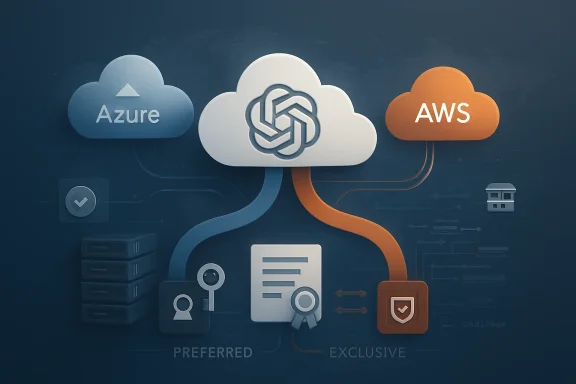
That single change turns a strategic moat into a preferred-provider relationship. Preferred providers are powerful. Exclusive providers are more powerful. The distinction is the difference between owning the channel and competing inside it.
This is why the Amazon move matters even if Microsoft continues to benefit financially and technically from OpenAI’s growth. AWS is not merely renting spare capacity to a model company with GPU hunger. Amazon is positioning itself as the enterprise distribution layer for OpenAI workloads in the same accounts where AWS already owns databases, identity patterns, networking habits, procurement muscle, and operational trust.
That bargain made extraordinary sense in 2019 and still made sense in the early ChatGPT boom. OpenAI needed cloud capacity at a scale few companies could provide. Microsoft needed a narrative that could transform Azure from a cloud competitor into the platform for the next computing paradigm. The result was a mutually reinforcing loop: OpenAI made Microsoft look indispensable to AI, and Microsoft made OpenAI look enterprise-ready.
But scarcity has a habit of changing the politics of supply. Once demand exploded, the question stopped being whether Microsoft was a good partner and became whether any single partner could satisfy OpenAI’s ambitions. Frontier model training, inference, agentic workflows, enterprise distribution, and consumer product growth each pull on different parts of the infrastructure stack. One cloud can be strategic without being sufficient.
That is the real story behind OpenAI’s drift. It is not that Azure suddenly became unfit for AI. It is that OpenAI’s needs became too large, too varied, and too commercially sensitive to be mediated through one hyperscaler’s priorities.
That created an awkward split for AI adoption. A company could run its systems on AWS while reaching into Azure or OpenAI directly for the frontier model layer. That was workable for experiments. It was less attractive for regulated, high-volume, production-grade agentic systems expected to touch business data, internal tools, and customer workflows.
Amazon’s pitch is therefore not just “we have GPUs.” It is “bring OpenAI to the cloud where your enterprise already operates.” That is a much more dangerous proposition for Microsoft because it attacks Azure’s hoped-for AI migration story at the point of adoption. If OpenAI becomes easy to consume inside AWS, then AI no longer has to be the event that pulls customers toward Azure.
The Bedrock angle is especially important. Amazon Bedrock was built as a model marketplace and managed AI platform that lets enterprises choose among providers without betting the whole architecture on a single lab. Adding OpenAI to that environment, even in limited preview or staged rollout form, changes the psychology of the platform. Bedrock no longer looks like the place you go when you cannot get OpenAI; it becomes one of the places you go to get OpenAI with AWS-native controls.
But language matters in technology partnerships because it tells customers where the leverage has moved. “Primary cloud partner” is a status. “Exclusive cloud provider” is a constraint. OpenAI has moved from one world to the other.
The practical effect is that Microsoft must now win more of OpenAI’s future on execution, not contract geometry. If Azure has the best capacity, economics, latency profile, compliance posture, and product integration for a given OpenAI workload, it will get that workload. If AWS or another provider can offer a better path for a specific product, region, enterprise segment, or agent platform, OpenAI now has room to use it.
That puts Microsoft in a familiar but uncomfortable position. It is still huge, still embedded, still technically formidable. But it is now competing for the next tranche of AI growth against the same cloud rivals it hoped OpenAI would help it outflank.
This is the normal maturation curve for a company whose product suddenly becomes strategically important to everyone. In the early stage, a dominant partner supplies credibility and resources. In the next stage, that partner becomes a bottleneck, not because it is malicious, but because its incentives are not identical. Microsoft wants OpenAI to strengthen Azure, Copilot, Windows, Microsoft 365, and its developer stack. OpenAI wants its models and agents everywhere useful enough to generate revenue, data, adoption, and political relevance.
That tension was always going to surface. The only surprise is how quickly the industry moved from whispered concerns about Microsoft’s influence to public restructuring of the relationship. OpenAI now has a cleaner answer for enterprises that do not want their AI strategy bound to Azure. It can tell them that Microsoft remains central but no longer singular.
The Amazon expansion amplifies that message. AWS gives OpenAI more than capacity; it gives OpenAI a second enterprise channel with enormous installed-base credibility. If Microsoft’s strength is bundling AI into the tools workers already use, Amazon’s strength is embedding AI into the infrastructure companies already run.
A chatbot can sit at the edge of an architecture and answer questions through an API. An agent increasingly needs permissions, memory, tool access, event triggers, audit logs, network reachability, and identity integration. The closer that agent sits to the systems it acts upon, the easier it is to govern and scale. This is where AWS has a natural wedge.
Amazon’s OpenAI partnership is explicitly framed around agentic workloads, Bedrock integration, managed agents, coding tools, and infrastructure that enterprises already trust. That is not an accident. AWS does not need to beat Microsoft at putting AI into Word to make this deal matter. It needs to make AWS the safest and most convenient place to deploy OpenAI-powered agents against AWS-hosted business systems.
Microsoft understands this, which is why the partnership revision is not merely legal housekeeping. The future of enterprise AI revenue may depend less on who has the splashiest model announcement and more on who controls the runtime environment for autonomous or semi-autonomous work. If those runtimes live in AWS accounts, Azure’s OpenAI advantage becomes less absolute.
A broader OpenAI distribution model reduces that friction. It lets enterprises ask a more practical question: where should this workload live? The answer may differ by application, compliance regime, latency requirement, data gravity, and procurement relationship. That is how cloud strategy usually works outside the artificial scarcity of a hot model.
The change also gives buyers leverage. If OpenAI models and tools become meaningfully available across multiple clouds, procurement teams can pressure providers on price, service-level commitments, data controls, and integration quality. The cloud vendor no longer gets to say, implicitly or explicitly, that the model layer is hostage to a single platform choice.
Still, enterprises should not confuse optionality with simplicity. Multi-cloud AI can quickly become a governance mess if teams treat every model endpoint and agent runtime as interchangeable. The hard work will be policy, observability, identity, cost management, and data boundary enforcement. The benefit is flexibility; the bill comes in operational discipline.
That distinction matters. Microsoft’s application-layer AI strategy remains formidable because it is tied to user habits and licensing relationships. A company does not adopt Copilot simply because OpenAI runs on Azure; it adopts Copilot because Microsoft has inserted AI into the productivity suite employees already inhabit. Amazon cannot easily replicate that.
Azure, however, faces a sharper challenge. Much of Azure’s AI halo has come from the belief that Microsoft was the privileged gateway to OpenAI at enterprise scale. If AWS can credibly host, distribute, and operationalize OpenAI-powered systems, then Azure must compete more directly on cloud fundamentals. That means capacity, regions, tooling, reliability, pricing, compliance, and developer experience.
This is not a collapse scenario for Microsoft. It is a margin-of-victory scenario. Azure can still grow rapidly in AI while losing some of the exclusivity premium investors and customers had mentally assigned to it. The market may not punish Microsoft for being less exclusive; it may punish Microsoft if it was valued as though exclusivity would last forever.
Bringing OpenAI deeper into AWS changes that perception. Amazon no longer has to argue only that a model-neutral marketplace is the right long-term architecture. It can say the model-neutral marketplace includes the model provider enterprises keep asking for.
That helps Bedrock, but it also helps AWS’s broader infrastructure narrative. The company wants the AI era to look less like a winner-take-all model race and more like the cloud era it already won: many workloads, many services, many customers, all needing scalable infrastructure. OpenAI on AWS supports that worldview.
It also hedges Amazon’s own AI dependencies. Amazon can continue backing Anthropic, building Trainium and Inferentia, offering Amazon Nova models, and supporting third-party models through Bedrock. OpenAI becomes another strategic pillar rather than the only bet. That diversified posture is very AWS: less glamorous than owning the whole stack, but often more durable.
OpenAI needs more compute than any one partner can comfortably guarantee on ideal terms. Microsoft needs OpenAI to keep making its products smarter without letting OpenAI become a platform that weakens Azure differentiation. Amazon needs a stronger claim on frontier AI adoption inside its customer base. Enterprise buyers need choice.
Those incentives were always going to collide with a rigid exclusivity model. The February statements that sought to preserve the old arrangement already hinted at strain: Microsoft and OpenAI insisted the relationship was unchanged, while acknowledging other partnerships and compute flexibility. By late April, the legal and commercial framing had caught up with the operational reality.
The most useful way to read the change is not as betrayal, but as normalization. OpenAI is becoming too important to be contained inside one cloud. Microsoft is becoming one of OpenAI’s most important partners rather than the partner that defines the perimeter. Amazon is exploiting the opening with characteristic speed.
But it does not eliminate competition concerns. The AI infrastructure market is still concentrating around a handful of companies with access to chips, energy, data centers, model talent, and enterprise distribution. If anything, OpenAI’s move toward AWS confirms how narrow the top tier has become. The company is diversifying, yes, but among giants.
That matters for customers and policymakers. Multi-cloud availability can increase competition at the point of purchase, but it can also reinforce the dominance of the largest hyperscalers by making them the only realistic homes for frontier AI. Smaller clouds may gain some specialized opportunities, yet the heavy training and production inference workloads remain brutally capital-intensive.
The OpenAI-Amazon expansion therefore should not be mistaken for decentralization. It is a redistribution of influence among incumbents. Better than a single gatekeeper, certainly, but still a game played on a field most companies cannot afford to enter.
If Amazon makes OpenAI feel native inside Bedrock and associated AWS services, developers already building on AWS will have little reason to leave their environment for many classes of applications. That is the strategic prize. Cloud platforms win not only by having the best individual service, but by reducing the number of reasons a team has to cross a boundary.
Microsoft knows the same playbook. Azure OpenAI Service succeeded because it wrapped OpenAI models in enterprise controls, regional availability, security postures, and procurement paths that large organizations understood. AWS now wants to offer the same comfort to its own base.
The result could be healthier competition in developer experience. Microsoft will have to make Azure OpenAI and Copilot Studio better. Amazon will have to prove Bedrock is not just a catalog but a serious runtime for agents. Google will press its own case through Gemini and Vertex AI. The customer may finally get more than slogans about openness.
Now the story is messier, which is to say more honest. Microsoft has distribution and deep OpenAI ties. Amazon has infrastructure gravity and a newly expanded OpenAI path. Google has models, chips, research depth, and a vertically integrated AI stack. Oracle, CoreWeave, and others have found openings because raw compute demand is so extreme that even the giants need help.
This is closer to how enterprise technology actually evolves. No single vendor gets to own every layer indefinitely. The application layer, model layer, infrastructure layer, and deployment layer pull apart and recombine as customers seek leverage and suppliers seek margin.
OpenAI’s move toward Amazon is aggressive because it accelerates that unbundling. It tells the market that the most famous AI company in the world does not want its future explained as an Azure dependency. It wants to be treated as a platform whose reach exceeds any one cloud.
Source: The Tech Buzz https://www.techbuzz.ai/articles/op...-has-become-an-aggressive-move-toward-amazon/
 Microsoft Still Has the Ring, but Not the Room
For years, the Microsoft-OpenAI partnership was simple enough to explain in a sentence: OpenAI supplied the frontier models, Microsoft supplied the cloud, and everyone else had to route around the resulting gravitational field. That arrangement made Azure feel less like the second-place hyperscaler and more like the toll road into the generative AI economy.The new agreement keeps Microsoft in the center of the frame, but it changes the composition of the picture. Microsoft remains OpenAI’s primary cloud partner, OpenAI products are still supposed to ship first on Azure when Azure can support them, and Microsoft retains access to OpenAI intellectual property for years. But the phrase that matters is the one Microsoft would rather not have had to say out loud: OpenAI can now serve all of its products to customers across any cloud provider.
That single change turns a strategic moat into a preferred-provider relationship. Preferred providers are powerful. Exclusive providers are more powerful. The distinction is the difference between owning the channel and competing inside it.
This is why the Amazon move matters even if Microsoft continues to benefit financially and technically from OpenAI’s growth. AWS is not merely renting spare capacity to a model company with GPU hunger. Amazon is positioning itself as the enterprise distribution layer for OpenAI workloads in the same accounts where AWS already owns databases, identity patterns, networking habits, procurement muscle, and operational trust.
The Azure Era Was Built on Scarcity
The first phase of the Microsoft-OpenAI alliance worked because AI compute was scarce, expensive, and hard to operate. Microsoft committed capital and infrastructure before ChatGPT turned OpenAI into a household name. In return, it got a privileged lane into the future of software.That bargain made extraordinary sense in 2019 and still made sense in the early ChatGPT boom. OpenAI needed cloud capacity at a scale few companies could provide. Microsoft needed a narrative that could transform Azure from a cloud competitor into the platform for the next computing paradigm. The result was a mutually reinforcing loop: OpenAI made Microsoft look indispensable to AI, and Microsoft made OpenAI look enterprise-ready.
But scarcity has a habit of changing the politics of supply. Once demand exploded, the question stopped being whether Microsoft was a good partner and became whether any single partner could satisfy OpenAI’s ambitions. Frontier model training, inference, agentic workflows, enterprise distribution, and consumer product growth each pull on different parts of the infrastructure stack. One cloud can be strategic without being sufficient.
That is the real story behind OpenAI’s drift. It is not that Azure suddenly became unfit for AI. It is that OpenAI’s needs became too large, too varied, and too commercially sensitive to be mediated through one hyperscaler’s priorities.
Amazon Did Not Win OpenAI by Accident
Amazon’s opportunity has always been hiding in plain sight. AWS remains the default infrastructure environment for vast swaths of the enterprise world, especially among companies that built their modern application estates before generative AI became boardroom vocabulary. Those customers may use Microsoft 365, GitHub, and Windows, but their production workloads, data lakes, governance tooling, and developer operations often live in AWS.That created an awkward split for AI adoption. A company could run its systems on AWS while reaching into Azure or OpenAI directly for the frontier model layer. That was workable for experiments. It was less attractive for regulated, high-volume, production-grade agentic systems expected to touch business data, internal tools, and customer workflows.
Amazon’s pitch is therefore not just “we have GPUs.” It is “bring OpenAI to the cloud where your enterprise already operates.” That is a much more dangerous proposition for Microsoft because it attacks Azure’s hoped-for AI migration story at the point of adoption. If OpenAI becomes easy to consume inside AWS, then AI no longer has to be the event that pulls customers toward Azure.
The Bedrock angle is especially important. Amazon Bedrock was built as a model marketplace and managed AI platform that lets enterprises choose among providers without betting the whole architecture on a single lab. Adding OpenAI to that environment, even in limited preview or staged rollout form, changes the psychology of the platform. Bedrock no longer looks like the place you go when you cannot get OpenAI; it becomes one of the places you go to get OpenAI with AWS-native controls.
The “Primary Cloud” Label Now Does Less Work
Microsoft’s defenders will correctly note that the amended agreement preserves a great deal. Microsoft still has deep product integrations, a major shareholder position, continuing revenue-share arrangements from OpenAI, and privileged access that competitors do not enjoy. Copilot is not being ripped out of Office. Azure OpenAI Service is not disappearing. GitHub is not about to swap its AI foundation on a whim.But language matters in technology partnerships because it tells customers where the leverage has moved. “Primary cloud partner” is a status. “Exclusive cloud provider” is a constraint. OpenAI has moved from one world to the other.
The practical effect is that Microsoft must now win more of OpenAI’s future on execution, not contract geometry. If Azure has the best capacity, economics, latency profile, compliance posture, and product integration for a given OpenAI workload, it will get that workload. If AWS or another provider can offer a better path for a specific product, region, enterprise segment, or agent platform, OpenAI now has room to use it.
That puts Microsoft in a familiar but uncomfortable position. It is still huge, still embedded, still technically formidable. But it is now competing for the next tranche of AI growth against the same cloud rivals it hoped OpenAI would help it outflank.
OpenAI Is Trading Dependency for Optionality
OpenAI’s motives are not mysterious. The company is trying to become infrastructure-independent without becoming infrastructure-light. It wants the bargaining power of a platform company and the capacity of a hyperscaler, without being swallowed by any one hyperscaler’s roadmap.This is the normal maturation curve for a company whose product suddenly becomes strategically important to everyone. In the early stage, a dominant partner supplies credibility and resources. In the next stage, that partner becomes a bottleneck, not because it is malicious, but because its incentives are not identical. Microsoft wants OpenAI to strengthen Azure, Copilot, Windows, Microsoft 365, and its developer stack. OpenAI wants its models and agents everywhere useful enough to generate revenue, data, adoption, and political relevance.
That tension was always going to surface. The only surprise is how quickly the industry moved from whispered concerns about Microsoft’s influence to public restructuring of the relationship. OpenAI now has a cleaner answer for enterprises that do not want their AI strategy bound to Azure. It can tell them that Microsoft remains central but no longer singular.
The Amazon expansion amplifies that message. AWS gives OpenAI more than capacity; it gives OpenAI a second enterprise channel with enormous installed-base credibility. If Microsoft’s strength is bundling AI into the tools workers already use, Amazon’s strength is embedding AI into the infrastructure companies already run.
The Agent Wars Made Exclusivity Harder to Defend
The cloud fight is not really about chatbots anymore. It is about agents that can write code, operate software, retrieve business context, perform actions, maintain state, and live inside enterprise workflows. That shift makes cloud location much more important.A chatbot can sit at the edge of an architecture and answer questions through an API. An agent increasingly needs permissions, memory, tool access, event triggers, audit logs, network reachability, and identity integration. The closer that agent sits to the systems it acts upon, the easier it is to govern and scale. This is where AWS has a natural wedge.
Amazon’s OpenAI partnership is explicitly framed around agentic workloads, Bedrock integration, managed agents, coding tools, and infrastructure that enterprises already trust. That is not an accident. AWS does not need to beat Microsoft at putting AI into Word to make this deal matter. It needs to make AWS the safest and most convenient place to deploy OpenAI-powered agents against AWS-hosted business systems.
Microsoft understands this, which is why the partnership revision is not merely legal housekeeping. The future of enterprise AI revenue may depend less on who has the splashiest model announcement and more on who controls the runtime environment for autonomous or semi-autonomous work. If those runtimes live in AWS accounts, Azure’s OpenAI advantage becomes less absolute.
The Enterprise Buyer Just Got More Powerful
For CIOs and platform teams, this shift is mostly good news. The old arrangement forced many enterprises into architectural compromises. They could standardize on AWS for infrastructure while maintaining a separate Azure path for OpenAI access, or they could embrace Microsoft’s AI stack more fully even when the rest of their cloud estate lived elsewhere. Neither approach was fatal, but both increased complexity.A broader OpenAI distribution model reduces that friction. It lets enterprises ask a more practical question: where should this workload live? The answer may differ by application, compliance regime, latency requirement, data gravity, and procurement relationship. That is how cloud strategy usually works outside the artificial scarcity of a hot model.
The change also gives buyers leverage. If OpenAI models and tools become meaningfully available across multiple clouds, procurement teams can pressure providers on price, service-level commitments, data controls, and integration quality. The cloud vendor no longer gets to say, implicitly or explicitly, that the model layer is hostage to a single platform choice.
Still, enterprises should not confuse optionality with simplicity. Multi-cloud AI can quickly become a governance mess if teams treat every model endpoint and agent runtime as interchangeable. The hard work will be policy, observability, identity, cost management, and data boundary enforcement. The benefit is flexibility; the bill comes in operational discipline.
Microsoft’s Copilot Story Is Still Strong, but Its Azure Story Is More Exposed
Microsoft’s strongest AI asset may no longer be OpenAI exclusivity. It may be distribution. Microsoft 365, Teams, Windows, GitHub, Dynamics, Power Platform, and security tooling give the company a front-row seat inside daily work. Copilot can succeed even if OpenAI workloads also run elsewhere.That distinction matters. Microsoft’s application-layer AI strategy remains formidable because it is tied to user habits and licensing relationships. A company does not adopt Copilot simply because OpenAI runs on Azure; it adopts Copilot because Microsoft has inserted AI into the productivity suite employees already inhabit. Amazon cannot easily replicate that.
Azure, however, faces a sharper challenge. Much of Azure’s AI halo has come from the belief that Microsoft was the privileged gateway to OpenAI at enterprise scale. If AWS can credibly host, distribute, and operationalize OpenAI-powered systems, then Azure must compete more directly on cloud fundamentals. That means capacity, regions, tooling, reliability, pricing, compliance, and developer experience.
This is not a collapse scenario for Microsoft. It is a margin-of-victory scenario. Azure can still grow rapidly in AI while losing some of the exclusivity premium investors and customers had mentally assigned to it. The market may not punish Microsoft for being less exclusive; it may punish Microsoft if it was valued as though exclusivity would last forever.
Amazon Finally Gets a Cleaner Frontier Model Answer
AWS spent the first wave of the generative AI boom in an odd position. It had the biggest cloud business, deep machine learning infrastructure, custom silicon ambitions, and an enormous enterprise base. Yet the public imagination of frontier AI was dominated by OpenAI and Microsoft, with Google playing the vertically integrated counterweight and Anthropic giving Amazon a serious but less culturally dominant model partner.Bringing OpenAI deeper into AWS changes that perception. Amazon no longer has to argue only that a model-neutral marketplace is the right long-term architecture. It can say the model-neutral marketplace includes the model provider enterprises keep asking for.
That helps Bedrock, but it also helps AWS’s broader infrastructure narrative. The company wants the AI era to look less like a winner-take-all model race and more like the cloud era it already won: many workloads, many services, many customers, all needing scalable infrastructure. OpenAI on AWS supports that worldview.
It also hedges Amazon’s own AI dependencies. Amazon can continue backing Anthropic, building Trainium and Inferentia, offering Amazon Nova models, and supporting third-party models through Bedrock. OpenAI becomes another strategic pillar rather than the only bet. That diversified posture is very AWS: less glamorous than owning the whole stack, but often more durable.
The Cracks Were Structural, Not Personal
Tech partnerships are often narrated as boardroom drama because personalities are easier to understand than incentive structures. OpenAI and Microsoft have supplied plenty of drama over the years, but the current shift does not require a soap opera explanation. It follows directly from scale.OpenAI needs more compute than any one partner can comfortably guarantee on ideal terms. Microsoft needs OpenAI to keep making its products smarter without letting OpenAI become a platform that weakens Azure differentiation. Amazon needs a stronger claim on frontier AI adoption inside its customer base. Enterprise buyers need choice.
Those incentives were always going to collide with a rigid exclusivity model. The February statements that sought to preserve the old arrangement already hinted at strain: Microsoft and OpenAI insisted the relationship was unchanged, while acknowledging other partnerships and compute flexibility. By late April, the legal and commercial framing had caught up with the operational reality.
The most useful way to read the change is not as betrayal, but as normalization. OpenAI is becoming too important to be contained inside one cloud. Microsoft is becoming one of OpenAI’s most important partners rather than the partner that defines the perimeter. Amazon is exploiting the opening with characteristic speed.
Regulators Will Notice the New Shape of Power
The loosening of exclusivity may also help Microsoft and OpenAI answer a political problem. Their partnership had become a magnet for regulatory scrutiny because it looked like a way for Microsoft to control a leading AI company without formally acquiring it. A more open cloud arrangement complicates that critique.But it does not eliminate competition concerns. The AI infrastructure market is still concentrating around a handful of companies with access to chips, energy, data centers, model talent, and enterprise distribution. If anything, OpenAI’s move toward AWS confirms how narrow the top tier has become. The company is diversifying, yes, but among giants.
That matters for customers and policymakers. Multi-cloud availability can increase competition at the point of purchase, but it can also reinforce the dominance of the largest hyperscalers by making them the only realistic homes for frontier AI. Smaller clouds may gain some specialized opportunities, yet the heavy training and production inference workloads remain brutally capital-intensive.
The OpenAI-Amazon expansion therefore should not be mistaken for decentralization. It is a redistribution of influence among incumbents. Better than a single gatekeeper, certainly, but still a game played on a field most companies cannot afford to enter.
Developers Will Follow the Path of Least Friction
For developers, the practical impact will depend on how deep the AWS integrations become. A model available through a console checkbox is useful. A model integrated into identity, observability, deployment pipelines, agent frameworks, vector stores, event systems, and billing controls is much more powerful.If Amazon makes OpenAI feel native inside Bedrock and associated AWS services, developers already building on AWS will have little reason to leave their environment for many classes of applications. That is the strategic prize. Cloud platforms win not only by having the best individual service, but by reducing the number of reasons a team has to cross a boundary.
Microsoft knows the same playbook. Azure OpenAI Service succeeded because it wrapped OpenAI models in enterprise controls, regional availability, security postures, and procurement paths that large organizations understood. AWS now wants to offer the same comfort to its own base.
The result could be healthier competition in developer experience. Microsoft will have to make Azure OpenAI and Copilot Studio better. Amazon will have to prove Bedrock is not just a catalog but a serious runtime for agents. Google will press its own case through Gemini and Vertex AI. The customer may finally get more than slogans about openness.
The Shift Makes the Cloud Wars More Honest
The last three years allowed every hyperscaler to claim it had the best AI strategy, but Microsoft had the cleanest story. It had OpenAI. That was enough to simplify investor decks, customer pitches, and analyst narratives.Now the story is messier, which is to say more honest. Microsoft has distribution and deep OpenAI ties. Amazon has infrastructure gravity and a newly expanded OpenAI path. Google has models, chips, research depth, and a vertically integrated AI stack. Oracle, CoreWeave, and others have found openings because raw compute demand is so extreme that even the giants need help.
This is closer to how enterprise technology actually evolves. No single vendor gets to own every layer indefinitely. The application layer, model layer, infrastructure layer, and deployment layer pull apart and recombine as customers seek leverage and suppliers seek margin.
OpenAI’s move toward Amazon is aggressive because it accelerates that unbundling. It tells the market that the most famous AI company in the world does not want its future explained as an Azure dependency. It wants to be treated as a platform whose reach exceeds any one cloud.
The New Cloud Map Leaves Fewer Excuses
The immediate lesson for WindowsForum readers is not that Microsoft has lost the AI war or that Amazon has won it. The lesson is that AI infrastructure strategy has entered its post-exclusive phase, and enterprise teams should plan accordingly.- OpenAI’s amended Microsoft deal preserves Azure as the primary cloud partner but ends the practical simplicity of Azure-only distribution.
- Amazon’s expanded OpenAI partnership gives AWS customers a more direct path to frontier models, coding agents, and managed agent infrastructure.
- Microsoft’s strongest defense is now its application distribution through Copilot, Microsoft 365, GitHub, Windows, and enterprise licensing rather than cloud exclusivity alone.
- Enterprise buyers should expect more negotiating leverage, but also more responsibility for governance across clouds and agent runtimes.
- The next phase of competition will be decided by operational integration, not press-release claims about model access.
Source: The Tech Buzz https://www.techbuzz.ai/articles/op...-has-become-an-aggressive-move-toward-amazon/
