

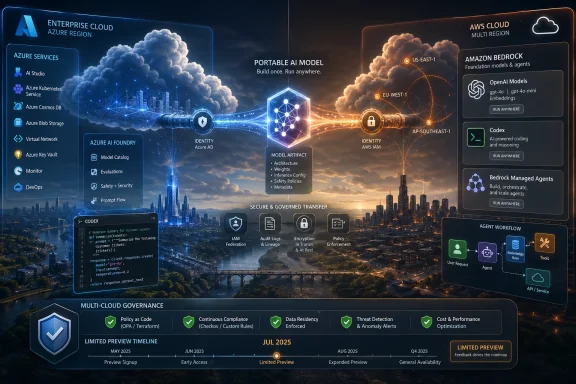
Amazon Web Services has moved from AI infrastructure contender to direct OpenAI distribution partner, giving enterprise customers a new path to use OpenAI models without shifting core workloads to Microsoft Azure. The limited-preview arrival of OpenAI models, Codex, and Bedrock Managed Agents on Amazon Bedrock follows a revised Microsoft-OpenAI agreement that loosens the exclusivity structure that shaped the first phase of the generative AI boom. For Microsoft, this is not a collapse of the partnership that made Azure synonymous with OpenAI at enterprise scale, but it is a material change in the economics and psychology of cloud AI buying. For Amazon, it is the strongest answer yet to the criticism that AWS had the infrastructure, customers, and developer gravity, but lacked direct access to the most visible AI model brand in the market.
The modern cloud AI race was shaped by a sequence of unusually concentrated bets. Microsoft invested early and heavily in OpenAI, then used Azure as the compute and enterprise distribution backbone for OpenAI’s fastest-growing products. When ChatGPT exploded into public view in late 2022, Microsoft already had the relationship, the infrastructure story, and the enterprise sales channel needed to turn excitement into Azure consumption.
Amazon’s position was more complicated. AWS remained the world’s most important cloud infrastructure business by installed base and enterprise familiarity, but the first wave of generative AI attention favored companies that could put a headline model in front of users immediately. Amazon responded by building Amazon Bedrock, a managed platform designed around model choice rather than a single proprietary AI stack.
That strategy gave AWS a credible enterprise AI story with Anthropic, Meta, Mistral, Cohere, Stability AI, Amazon’s own Nova models, and other foundation model providers. Yet OpenAI remained the missing name for many CIOs, developers, and procurement teams. In boardroom shorthand, Azure was where companies went for OpenAI, while AWS was where they went for everything else.
The revised Microsoft-OpenAI framework changes that mental map. Microsoft remains a primary partner with continuing access to OpenAI intellectual property, but OpenAI can now serve products through other cloud providers. That shift turns OpenAI from a largely Azure-centered enterprise accelerant into a more portable AI platform — and it gives Amazon a chance to convert customer demand that previously leaked toward Microsoft.
That distinction is subtle but critical. Microsoft may still receive early product advantages or retain preferred-partner status in some contexts, yet customers no longer need to treat Azure as the only serious route to OpenAI. For enterprises that run heavily on AWS, the decision becomes less about migrating workloads and more about enabling models inside the infrastructure they already operate.
Microsoft also gains something from simplification. A clearer long-term licensing structure, continuing IP access, and defined revenue-share mechanics reduce ambiguity around the relationship. In a market where AI capacity planning spans years and billions of dollars, certainty has value even when exclusivity declines.
Key implications for Microsoft include:
This is also a reputational win. For much of the generative AI cycle, Amazon faced a perception gap: it had unmatched infrastructure scale but seemed less culturally central to the AI narrative than Microsoft, OpenAI, Nvidia, or Google DeepMind. Bringing OpenAI models into Bedrock narrows that gap and gives AWS sellers a cleaner answer in competitive deals.
The limited-preview label matters. Enterprises should expect phased access, region limitations, quota management, and possible model availability differences as the rollout matures. But even a limited preview changes procurement conversations immediately because architects can now plan around a future in which OpenAI is an AWS-native option.
For AWS customers, the appeal is practical:
The OpenAI-AWS partnership appears designed to turn agent infrastructure into a managed cloud service. That gives Amazon a chance to package agent runtime, model access, identity, logging, and orchestration in a way that fits enterprise expectations. It also lets OpenAI focus on intelligence and developer experience while AWS handles much of the operational plumbing.
Codex on Bedrock is equally significant. Coding agents are among the clearest early examples of AI agents creating measurable value, because software teams can track pull requests, tests, review cycles, documentation changes, and bug fixes. If Codex becomes available through AWS-native billing and controls, it could accelerate adoption among companies that already run development environments, CI/CD systems, and internal tooling on AWS.
A likely adoption sequence looks like this:
That is especially true for regulated industries. Banks, insurers, healthcare networks, public-sector contractors, and manufacturers often have extensive cloud governance frameworks. Moving sensitive workflows to a new cloud provider just to use a model may create months of review, while using the model inside a familiar AWS environment can be much easier to justify.
This does not mean consumer users will notice no effects. Competition across clouds can improve performance, availability, and product breadth over time. But the immediate shift is enterprise-led because enterprise customers are where cloud AI revenue, capacity commitments, and long-term platform lock-in are most intense.
For businesses, the most important changes are:
Oracle’s role is different but still relevant. Oracle has become a major AI infrastructure provider through large-scale compute deals and aggressive capacity buildout. It can win workloads where raw GPU availability, pricing, or enterprise database proximity matters. Yet AWS adding OpenAI models makes Amazon more formidable in the higher-level platform layer, not merely the data center layer.
Anthropic also sits in an interesting position. Amazon’s major investment in Anthropic helped define Bedrock’s early credibility, and Claude has become a serious enterprise model family. The arrival of OpenAI on Bedrock does not erase that relationship; instead, it reinforces AWS’s model-agnostic strategy, where Anthropic and OpenAI compete inside the same customer environment.
Competitive effects to watch include:
Developers will feel the shift quickly. A company that uses Windows laptops, GitHub repositories, AWS infrastructure, and Microsoft 365 may now have more choices about where AI coding and agent workflows run. Codex on Bedrock could appeal to teams that want AI software engineering help close to AWS-hosted build systems, deployment targets, or internal developer platforms.
This is also a reminder that the AI stack is fragmenting into layers. The user interface might be Windows, the coding platform might be GitHub, the model might be OpenAI, the runtime might be AWS, and the data warehouse might be Snowflake or Databricks. The winning vendors will be those that make this complexity manageable rather than pretending customers will standardize on one company for everything.
Developer teams should evaluate:
Amazon can bring global regions, custom silicon efforts, procurement scale, and operational discipline to OpenAI’s capacity problem. But the challenge remains immense. Frontier models and agentic workloads are computationally hungry, and enterprise adoption can create unpredictable bursts of inference demand.
Microsoft faces the same reality. Azure’s OpenAI demand has been both a growth engine and a capacity challenge. The shift to multiple clouds may relieve some pressure while also reducing Microsoft’s ability to capture every incremental OpenAI workload. That tradeoff may be acceptable if it stabilizes the ecosystem and keeps OpenAI growing.
Capacity constraints will shape outcomes through:
For Amazon, OpenAI availability can increase Bedrock usage, pull through storage and networking consumption, and strengthen AWS Marketplace relationships. It can also reduce customer defection to Azure in accounts where OpenAI access was the deciding factor. That defensive value is difficult to quantify but highly important.
For OpenAI, AWS distribution expands enterprise reach. It gives customers who already trust AWS a cleaner path to adoption, which could support revenue growth at a time when model training and inference costs remain enormous. OpenAI also reduces dependency risk by avoiding overreliance on one cloud partner.
The economics are likely to be shaped by:
AWS has a strong story here because enterprises already use its IAM, CloudTrail, VPC controls, Key Management Service, and compliance frameworks. If Bedrock Managed Agents can align with those controls, security teams may be more willing to approve pilots. But approval will still require careful policy design because autonomous systems can behave unpredictably.
OpenAI also benefits from being embedded in environments that customers already govern. Enterprise customers do not want AI adoption to create shadow infrastructure. They want models and agents to inherit the same operational discipline as databases, containers, serverless functions, and internal applications.
Security questions buyers should ask include:
The more interesting question is whether this partnership accelerates the normalization of cloud-neutral model access. Customers increasingly want the freedom to run different models against different workloads without rewriting governance, procurement, and deployment systems each time. Bedrock, Azure AI Foundry, Google Vertex AI, Databricks, Snowflake, and emerging agent platforms are all competing to become the layer where that complexity is managed.
Watch the following signals over the coming months:
Source: PYMNTS.com Amazon Gains Access to OpenAI Models, Challenging Microsoft’s Cloud Lead | PYMNTS.com
 Background
The modern cloud AI race was shaped by a sequence of unusually concentrated bets. Microsoft invested early and heavily in OpenAI, then used Azure as the compute and enterprise distribution backbone for OpenAI’s fastest-growing products. When ChatGPT exploded into public view in late 2022, Microsoft already had the relationship, the infrastructure story, and the enterprise sales channel needed to turn excitement into Azure consumption.Amazon’s position was more complicated. AWS remained the world’s most important cloud infrastructure business by installed base and enterprise familiarity, but the first wave of generative AI attention favored companies that could put a headline model in front of users immediately. Amazon responded by building Amazon Bedrock, a managed platform designed around model choice rather than a single proprietary AI stack.
That strategy gave AWS a credible enterprise AI story with Anthropic, Meta, Mistral, Cohere, Stability AI, Amazon’s own Nova models, and other foundation model providers. Yet OpenAI remained the missing name for many CIOs, developers, and procurement teams. In boardroom shorthand, Azure was where companies went for OpenAI, while AWS was where they went for everything else.
The revised Microsoft-OpenAI framework changes that mental map. Microsoft remains a primary partner with continuing access to OpenAI intellectual property, but OpenAI can now serve products through other cloud providers. That shift turns OpenAI from a largely Azure-centered enterprise accelerant into a more portable AI platform — and it gives Amazon a chance to convert customer demand that previously leaked toward Microsoft.
Microsoft’s OpenAI Advantage Enters a New Phase
Microsoft’s original advantage was never just about being first. It combined investment, product integration, enterprise trust, developer tooling, and cloud capacity into a single package that competitors struggled to match. Azure OpenAI Service became a default procurement route for organizations that wanted OpenAI capabilities wrapped in familiar Microsoft compliance, identity, and support structures.From exclusivity to primacy
The new arrangement appears to preserve Microsoft’s strategic relationship while reducing its exclusivity. Microsoft can still integrate OpenAI models into Copilot, Azure services, Windows-adjacent workflows, security products, and developer tools. But the phrase that matters now is non-exclusive, because it changes how customers and rivals interpret the balance of power.That distinction is subtle but critical. Microsoft may still receive early product advantages or retain preferred-partner status in some contexts, yet customers no longer need to treat Azure as the only serious route to OpenAI. For enterprises that run heavily on AWS, the decision becomes less about migrating workloads and more about enabling models inside the infrastructure they already operate.
Microsoft also gains something from simplification. A clearer long-term licensing structure, continuing IP access, and defined revenue-share mechanics reduce ambiguity around the relationship. In a market where AI capacity planning spans years and billions of dollars, certainty has value even when exclusivity declines.
Key implications for Microsoft include:
- Azure remains strategically important for OpenAI and for Microsoft’s own Copilot ecosystem.
- OpenAI model access becomes less differentiated as a pure Azure selling point.
- Microsoft’s advantage shifts toward integration, not simple availability.
- Enterprise customers gain leverage when negotiating cloud AI commitments.
- Copilot execution becomes more important than contractual exclusivity.
AWS Gets the Model Its Customers Kept Asking For
Amazon’s message is straightforward: OpenAI is coming to where many enterprise workloads already live. That matters because infrastructure gravity is real. Databases, data lakes, IAM policies, observability systems, networking patterns, and procurement workflows are not easily moved just to reach one model family.Bedrock becomes harder to dismiss
Amazon Bedrock was designed as a model marketplace and orchestration layer for enterprises that do not want to be locked into one AI provider. The addition of OpenAI models strengthens that pitch dramatically. AWS can now argue that customers can compare leading models, build agents, manage governance, and route workloads without leaving the Bedrock control plane.This is also a reputational win. For much of the generative AI cycle, Amazon faced a perception gap: it had unmatched infrastructure scale but seemed less culturally central to the AI narrative than Microsoft, OpenAI, Nvidia, or Google DeepMind. Bringing OpenAI models into Bedrock narrows that gap and gives AWS sellers a cleaner answer in competitive deals.
The limited-preview label matters. Enterprises should expect phased access, region limitations, quota management, and possible model availability differences as the rollout matures. But even a limited preview changes procurement conversations immediately because architects can now plan around a future in which OpenAI is an AWS-native option.
For AWS customers, the appeal is practical:
- Use existing AWS accounts instead of creating separate model access paths.
- Keep data architectures close to existing workloads and storage systems.
- Apply familiar security controls through AWS identity and governance tooling.
- Compare OpenAI with other Bedrock models using a more unified platform.
- Reduce migration pressure for teams that standardized on AWS years ago.
Bedrock, Codex, and Managed Agents Signal a Broader Play
The announcement is not only about chatbot-style model access. AWS and OpenAI are pairing frontier models with Codex and a managed agent framework, which points to a deeper ambition: production AI systems that can act, remember context, interact with tools, and operate inside enterprise controls. That is a more important cloud battleground than simple prompt-and-response APIs.Agents move from demo to operations
Bedrock Managed Agents powered by OpenAI are aimed at a problem every enterprise AI team now recognizes. Prototype agents are easy to demonstrate, but production agents require state, permissions, audit trails, workflow continuity, tool integration, and failure handling. Without those layers, agentic AI remains a conference demo rather than a business system.The OpenAI-AWS partnership appears designed to turn agent infrastructure into a managed cloud service. That gives Amazon a chance to package agent runtime, model access, identity, logging, and orchestration in a way that fits enterprise expectations. It also lets OpenAI focus on intelligence and developer experience while AWS handles much of the operational plumbing.
Codex on Bedrock is equally significant. Coding agents are among the clearest early examples of AI agents creating measurable value, because software teams can track pull requests, tests, review cycles, documentation changes, and bug fixes. If Codex becomes available through AWS-native billing and controls, it could accelerate adoption among companies that already run development environments, CI/CD systems, and internal tooling on AWS.
A likely adoption sequence looks like this:
- Developers test Codex inside familiar AWS-governed environments.
- Platform teams connect Bedrock to internal repositories, ticketing systems, and observability tools.
- Security teams define permissions for agent actions and data boundaries.
- Business units pilot managed agents for repeatable workflows such as support, finance, compliance, or operations.
- Procurement consolidates usage under cloud agreements that already govern AWS consumption.
Why Enterprises Care More Than Consumers
Consumers may see this story as another cloud partnership, but enterprises will treat it as a purchasing and architecture event. Large organizations rarely choose AI systems based only on raw model benchmarks. They care about identity integration, auditability, legal terms, support channels, regional availability, data handling, and whether the service fits the infrastructure they already trust.Procurement beats novelty
For a Fortune 500 company, the ability to buy OpenAI models through AWS can be as important as the models themselves. Procurement teams prefer existing vendor relationships, negotiated discounts, committed-spend agreements, and established compliance paperwork. If OpenAI access can ride those rails, friction falls.That is especially true for regulated industries. Banks, insurers, healthcare networks, public-sector contractors, and manufacturers often have extensive cloud governance frameworks. Moving sensitive workflows to a new cloud provider just to use a model may create months of review, while using the model inside a familiar AWS environment can be much easier to justify.
This does not mean consumer users will notice no effects. Competition across clouds can improve performance, availability, and product breadth over time. But the immediate shift is enterprise-led because enterprise customers are where cloud AI revenue, capacity commitments, and long-term platform lock-in are most intense.
For businesses, the most important changes are:
- More deployment flexibility for OpenAI-powered applications.
- Less pressure to duplicate cloud architectures across Azure and AWS.
- Better negotiating leverage across cloud vendors.
- A stronger case for multi-model governance through Bedrock.
- Faster agent experimentation in production-like environments.
Competitive Pressure Spreads Beyond Microsoft
The first-order story is Amazon versus Microsoft, but the impact reaches Google Cloud, Oracle, Anthropic, Databricks, Snowflake, and every enterprise software vendor embedding AI. If OpenAI becomes more cloud-portable, cloud platforms must compete on execution rather than privileged access alone. That is healthier for customers, but tougher for vendors that hoped exclusivity would carry the sales motion.Google and Oracle face a sharper benchmark
Google Cloud has its own strengths: Gemini models, DeepMind research, TPU infrastructure, Vertex AI, and strong data analytics ties through BigQuery. But OpenAI on AWS raises the competitive bar. Google can no longer assume that Microsoft’s OpenAI relationship creates the only contrast; AWS can now pair market-leading infrastructure with OpenAI access and a broad model catalog.Oracle’s role is different but still relevant. Oracle has become a major AI infrastructure provider through large-scale compute deals and aggressive capacity buildout. It can win workloads where raw GPU availability, pricing, or enterprise database proximity matters. Yet AWS adding OpenAI models makes Amazon more formidable in the higher-level platform layer, not merely the data center layer.
Anthropic also sits in an interesting position. Amazon’s major investment in Anthropic helped define Bedrock’s early credibility, and Claude has become a serious enterprise model family. The arrival of OpenAI on Bedrock does not erase that relationship; instead, it reinforces AWS’s model-agnostic strategy, where Anthropic and OpenAI compete inside the same customer environment.
Competitive effects to watch include:
- Model providers will fight harder on latency, cost, safety, and tool use.
- Cloud vendors will emphasize orchestration rather than simple API hosting.
- Enterprise software companies may support more clouds to avoid customer friction.
- AI infrastructure deals will become more flexible and less exclusive.
- Benchmark claims will matter less than integration quality and operational reliability.
The Windows and Developer Angle
For WindowsForum readers, the Microsoft angle remains central. Microsoft’s AI strategy touches Windows, Visual Studio, GitHub, Microsoft 365, Defender, Azure, and Copilot. Losing exclusive distribution rights does not make Microsoft weaker overnight, but it raises the bar for how well those products must work together.Copilot must win on workflow
Microsoft Copilot has a built-in advantage because it lives where many workers already spend their day: Windows, Office apps, Teams, Outlook, Edge, GitHub, and enterprise identity systems. That distribution is powerful. But if OpenAI models are available through AWS, Microsoft must prove that Copilot’s integration layer is uniquely useful, not merely that it has access to the same underlying intelligence.Developers will feel the shift quickly. A company that uses Windows laptops, GitHub repositories, AWS infrastructure, and Microsoft 365 may now have more choices about where AI coding and agent workflows run. Codex on Bedrock could appeal to teams that want AI software engineering help close to AWS-hosted build systems, deployment targets, or internal developer platforms.
This is also a reminder that the AI stack is fragmenting into layers. The user interface might be Windows, the coding platform might be GitHub, the model might be OpenAI, the runtime might be AWS, and the data warehouse might be Snowflake or Databricks. The winning vendors will be those that make this complexity manageable rather than pretending customers will standardize on one company for everything.
Developer teams should evaluate:
- Where code and build systems already run before choosing AI tooling.
- How agent permissions are scoped across repositories and production systems.
- Whether logs and prompts are auditable under internal security policies.
- How model choice affects cost during automated coding and testing loops.
- Which tools improve actual delivery velocity, not just demo performance.
Infrastructure Capacity Is the Real Constraint
The OpenAI-AWS partnership lands in a market where demand for AI compute continues to exceed supply. The limiting factor is not only model availability. It is power, land, networking, memory, accelerators, cooling, supply chains, and the ability to operate gigantic distributed systems reliably.The cloud race becomes a power race
AI capacity is now a strategic asset comparable to oil fields, chip fabs, or undersea cables. The companies that can secure electricity, GPUs, custom silicon, and data center permits will decide how quickly model providers can grow. That gives AWS an enormous opportunity because infrastructure execution is its core business.Amazon can bring global regions, custom silicon efforts, procurement scale, and operational discipline to OpenAI’s capacity problem. But the challenge remains immense. Frontier models and agentic workloads are computationally hungry, and enterprise adoption can create unpredictable bursts of inference demand.
Microsoft faces the same reality. Azure’s OpenAI demand has been both a growth engine and a capacity challenge. The shift to multiple clouds may relieve some pressure while also reducing Microsoft’s ability to capture every incremental OpenAI workload. That tradeoff may be acceptable if it stabilizes the ecosystem and keeps OpenAI growing.
Capacity constraints will shape outcomes through:
- Regional availability for OpenAI models on Bedrock.
- Inference latency for enterprise-scale applications.
- Pricing pressure as demand rises.
- Custom chip adoption across AWS, Microsoft, and Google.
- Data center power negotiations with governments and utilities.
The Economics Behind the Alliance
AI partnerships increasingly look less like software licensing deals and more like industrial alliances. Model companies need capital and compute. Cloud providers need high-margin AI workloads. Enterprises need usable products that do not require rebuilding their entire technology estate.Revenue follows workload gravity
If reported spending commitments between OpenAI and AWS scale as expected, the partnership could become one of the most consequential infrastructure relationships in technology. The exact numbers matter less than the direction: OpenAI needs diversified capacity, and AWS wants more first-class AI demand flowing through its platform. Both sides have strategic reasons to make the integration work.For Amazon, OpenAI availability can increase Bedrock usage, pull through storage and networking consumption, and strengthen AWS Marketplace relationships. It can also reduce customer defection to Azure in accounts where OpenAI access was the deciding factor. That defensive value is difficult to quantify but highly important.
For OpenAI, AWS distribution expands enterprise reach. It gives customers who already trust AWS a cleaner path to adoption, which could support revenue growth at a time when model training and inference costs remain enormous. OpenAI also reduces dependency risk by avoiding overreliance on one cloud partner.
The economics are likely to be shaped by:
- Committed cloud spend across multi-year infrastructure agreements.
- Model inference margins after accelerator and energy costs.
- Marketplace and procurement fees tied to enterprise purchasing.
- Agent runtime consumption as workflows become longer and more autonomous.
- Competitive discounting among Azure, AWS, and Google Cloud.
Governance, Security, and Trust Become Differentiators
Enterprise AI buyers increasingly ask less about whether a model can answer a prompt and more about whether the surrounding system can be governed. That includes data residency, identity, encryption, logging, abuse monitoring, retention policies, and human approval workflows. The OpenAI-AWS combination will be judged by those operational controls as much as by model quality.Agentic AI raises the stakes
AI agents create a larger governance problem than chatbots. A chatbot produces text; an agent may call APIs, update records, modify code, send messages, trigger workflows, or retrieve sensitive documents. Every additional tool expands the blast radius of a mistake.AWS has a strong story here because enterprises already use its IAM, CloudTrail, VPC controls, Key Management Service, and compliance frameworks. If Bedrock Managed Agents can align with those controls, security teams may be more willing to approve pilots. But approval will still require careful policy design because autonomous systems can behave unpredictably.
OpenAI also benefits from being embedded in environments that customers already govern. Enterprise customers do not want AI adoption to create shadow infrastructure. They want models and agents to inherit the same operational discipline as databases, containers, serverless functions, and internal applications.
Security questions buyers should ask include:
- What data is sent to the model, and where is it processed?
- How are agent actions logged for audit and investigation?
- Can permissions be limited by role, workload, and environment?
- How are failed or unsafe actions stopped before they affect production?
- What retention and training policies apply to enterprise prompts and outputs?
- How are third-party tools validated before agents can use them?
Strengths and Opportunities
The AWS-OpenAI partnership is powerful because it aligns customer demand with infrastructure reality. Enterprises want OpenAI capabilities without unnecessary cloud migration, AWS wants to close a strategic model gap, and OpenAI wants broader distribution and capacity. If the execution is strong, this could become a defining example of multi-cloud AI moving from aspiration to normal enterprise practice.- AWS becomes a more complete AI platform by adding OpenAI to Bedrock’s existing model catalog.
- OpenAI gains access to AWS-heavy enterprises that resisted Azure-centered adoption paths.
- Microsoft is pushed to differentiate Copilot and Azure through integration quality rather than exclusivity.
- Developers get more deployment flexibility for Codex and agentic workflows.
- Enterprises can reduce architecture duplication across competing cloud environments.
- Competition may improve pricing and availability as cloud vendors fight for AI workloads.
- Managed agents could accelerate practical AI adoption in business operations, software engineering, and support.
Risks and Concerns
The biggest risk is that the announcement outruns the operational reality. Limited previews can generate excitement before region support, quotas, documentation, compliance assurances, pricing clarity, and production reliability are fully mature. Enterprise AI teams should treat this as a significant strategic signal, not an excuse to bypass architecture review or governance work.- Capacity shortages may limit near-term availability for OpenAI models on AWS.
- Pricing could become difficult to predict as agentic workloads run longer and call more tools.
- Multi-cloud AI architectures may increase complexity if teams lack strong governance.
- Microsoft and OpenAI relationship changes could create uncertainty around product timing and priority.
- Security teams may hesitate on autonomous agents that can act across production systems.
- Model parity across clouds may not be guaranteed during early rollout phases.
- Vendor lock-in could reappear at the orchestration layer, even if model access becomes more portable.
Looking Ahead
The next phase will be measured less by press releases and more by customer deployment patterns. If enterprises begin moving OpenAI workloads into Bedrock because their data, applications, and security controls already live on AWS, Microsoft’s cloud AI lead will face genuine pressure. If availability remains limited or pricing proves unattractive, Azure’s early-mover advantage will remain difficult to dislodge.The more interesting question is whether this partnership accelerates the normalization of cloud-neutral model access. Customers increasingly want the freedom to run different models against different workloads without rewriting governance, procurement, and deployment systems each time. Bedrock, Azure AI Foundry, Google Vertex AI, Databricks, Snowflake, and emerging agent platforms are all competing to become the layer where that complexity is managed.
Watch the following signals over the coming months:
- Which OpenAI models reach general availability on Bedrock and in which AWS regions.
- How Codex on AWS is priced and governed for enterprise developer teams.
- Whether Bedrock Managed Agents gain production references from large regulated customers.
- How Microsoft responds inside Azure, GitHub, Windows, and Microsoft 365.
- Whether Google Cloud or Oracle secure deeper OpenAI-related roles in future capacity deals.
Source: PYMNTS.com Amazon Gains Access to OpenAI Models, Challenging Microsoft’s Cloud Lead | PYMNTS.com
