

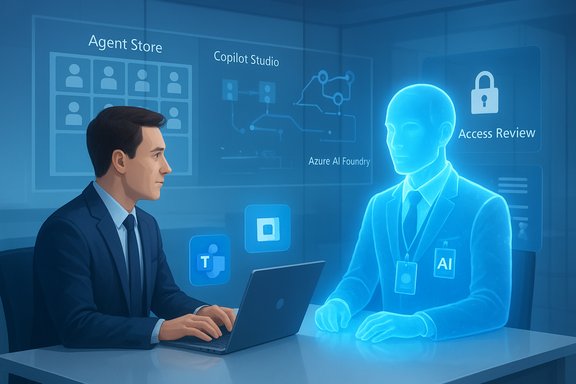
Microsoft’s plan to give AI agents full employee-like presences inside Microsoft 365 — with directory entries, email addresses, Teams accounts, and managed identities — marks a decisive shift: AI is moving from a helper tucked into a sidebar to a first-class “digital colleague” that can be discovered in an agent store, join meetings, edit documents, and be governed like any other identity in the enterprise. This isn’t hypothetical: Microsoft’s product roadmaps and Build 2025 announcements show agents becoming auditable, identity-backed entities through Copilot Studio, Azure AI Foundry, an in‑product Agent Store, and a new Entra Agent ID experience — and partners such as Workday are already wiring their systems to treat agents as workforce participants.
Microsoft’s ambitions for agentic AI grew from the same forces that pushed Copilot into Word, Excel and Teams: organizations want tools that do work on behalf of people, not merely answer questions. Over the last two years Microsoft has incrementally moved beyond one‑off chat helpers to persistent agents that maintain state, coordinate across apps, and can be composed into multi‑agent workflows. At Build 2025 the company framed that next phase as an “era of human‑agent collaboration,” complete with low-code authoring (Copilot Studio), a runtime and model marketplace (Azure AI Foundry), and management surfaces for operations teams. Copilot Studio and associated toolsets now emphasize:
Enterprises that prepare governance, update identity practices, and pilot conservatively will capture early productivity wins. Those that don’t will inherit new attack surfaces, compliance headaches, and potential reputational exposure. The future of the workplace will likely be mixed teams of humans and agentic AIs; executing well requires elevating agents from novelty to operational discipline.
Source: WebProNews Microsoft’s AI Colleagues: Virtual Agents Get Company Badges and Desks
 Background
Microsoft’s ambitions for agentic AI grew from the same forces that pushed Copilot into Word, Excel and Teams: organizations want tools that do work on behalf of people, not merely answer questions. Over the last two years Microsoft has incrementally moved beyond one‑off chat helpers to persistent agents that maintain state, coordinate across apps, and can be composed into multi‑agent workflows. At Build 2025 the company framed that next phase as an “era of human‑agent collaboration,” complete with low-code authoring (Copilot Studio), a runtime and model marketplace (Azure AI Foundry), and management surfaces for operations teams. Copilot Studio and associated toolsets now emphasize:- Multi‑agent orchestration and agent‑to‑agent protocols so agents can delegate or combine work.
- Developer tooling and SDKs for building and publishing agents to an Agent Store discoverable inside Microsoft 365.
- Identity and governance primitives — notably Entra Agent ID — to make agents visible, manageable, and auditable in enterprise directories.
What Microsoft Is Shipping (and What It Means)
Agentic Users: AI with company badges and desks
Microsoft’s roadmap term “Agentic Users” (sometimes shortened in admin docs to Agent 365 or “A365” licencing hints) describes agents that appear in tenant directories, can be assigned licenses, and may receive mailbox/Teams presence and org‑chart placement. The product documents flagged for November rollouts indicate admins will be able to approve, publish, and assign an “A365” license to an agent template — essentially provisioning a managed, auditable digital employee. Multiple independent outlets and IT blogs have reported these roadmap entries and the admin workflows that accompany them. Why this matters:- Agents become discoverable, requestable, and billable items in IT catalogs rather than one‑off experiments.
- Identity plumbing enables conditional access, access reviews, and lifecycle controls using existing Entra/Azure tooling.
- Agents attending meetings or receiving mailboxes materially change audit, compliance, and retention models.
Copilot Studio, Azure AI Foundry, Agent Store
Copilot Studio is Microsoft's low‑code maker experience for building agents; Azure AI Foundry supplies model choices and hosting; and the Agent Store is the in‑product catalog where agents are published, discovered, and managed. Together they form a pipeline from idea to deployed agent that can be integrated across Teams, SharePoint, Power Platform, and Office canvases. Microsoft’s Build messaging stressed multi‑agent orchestration, bringing-your-own-model, and governance features such as Purview protection for Dataverse‑backed agents. Practical impacts:- Business units can publish vetted agent templates into a tenant catalog for reuse.
- IT can audit agent usage and set tenant‑wide boundaries through existing Copilot control surfaces.
- Developers can create more sophisticated multi‑agent flows rather than single-turn assistants.
Agent Mode and Office Agent: agents that act inside documents
Beyond chat and meeting helpers, Microsoft has been shipping Agent Mode and Office Agent experiences that let agents act inside Word and Excel canvases. These agents can decompose a high‑level request into steps, execute them, show intermediate outputs, and iterate — a pattern Microsoft describes as vibe working. The difference is substantive: agents can now make auditable, stepwise changes in documents rather than returning opaque generative blobs.Security, Governance and Identity Management
Entra Agent ID: first‑class identities for agents
At Build 2025 Microsoft introduced Entra Agent ID, which automatically surfaces agent identities created through Copilot Studio or Azure AI Foundry inside the Entra admin center. The aim is to let identity teams treat agents like service principals or shared accounts with lifecycle, authentication, conditional access, and audit trails. The Entra tooling also underpins the Access Review Agent preview for Teams, a concrete example of agents being used in identity governance flows. Key governance capabilities announced:- Unified agent listings in Entra for visibility and lifecycle management.
- Integration with Access Reviews and conditional access to reduce runaway privileges.
- Purview-based information protection for agents using Dataverse and other sensitive stores.
Access Review Agent and AI‑assisted governance
Microsoft launched an Access Review Agent in preview that runs within Teams to analyze entitlements, score access decisions using signals (sign‑ins, group membership, employment status), and surface suggested approve/deny actions with LLM‑produced justifications. The workflow preserves the final human decision but automates the heavy lifting of synthesis and triage. Petri and Windows Forum commentary provide operational details and list the preview limitations (e.g., supported review types, review size caps). Practical caveats for IT teams:- Agents often need standing privileges to gather signals — choose the activating account carefully.
- Preview constraints (language support, type coverage, review size) mean staged pilots are essential.
- Once started, some preview agent runs cannot be paused mid‑run; procedural planning matters.
Ecosystem Moves: Workday and the Agent System of Record
Microsoft isn’t building agentic work alone. Workday’s September 2025 announcements show a first‑party integration: Workday’s Agent System of Record (ASOR) can ingest and manage identities for agents created in Microsoft’s tooling, providing HR and finance context (roles, reporting lines, budgets) for agent lifecycle governance. The Workday partnership explicitly frames agents as items that require business context and accounting — not just technical artifacts. That partnership is an early sign that vendors expect agents to appear on org charts and financial systems. Consequences for adoption:- Enterprises will be able to register agents in HR systems so access and actions can be tied to business purpose and budgets.
- The agent becomes a traceable line item for compliance, procurement, and chargebacks.
- Vendor ecosystems (Workday, partner agents) are positioning to make agents auditable and manageable at scale.
Commercial and Licensing Questions
Microsoft’s internal admin documentation and third‑party reporting point to a potential A365 / Agent 365 license family for agent provisioning and management. Early screenshots and roadmap notes suggest admins will assign an A365 license when approving an agent template — implying agents may be monetized separately from human M365 seats. Independent reports from licensing specialists and IT blogs flagged this in November 2025 product roadmap leaks. Until Microsoft publicly clarifies SKUs and pricing tiers, organizations must prepare for scenarios where agents carry their own license costs and role‑based variants. What procurement teams should anticipate:- New SKUs or metered billing options for agent usage and capabilities.
- Role‑based licensing where simple retrieval agents cost less than autonomous, multi‑tool agents.
- New chargeback and budgeting models that treat agents as consumable labor.
Benefits: Productivity and Scale
Microsoft and early adopter customer stories emphasize concrete productivity benefits:- Faster onboarding: channel agents can synthesize historic project context so new hires ramp more quickly.
- Meeting efficiency: Facilitator removes manual note taking and converts decisions into tasks that agents and humans can follow.
- Developer velocity: Copilot Studio + Agents SDKs reduce context switching and enable automation that translates ideas into code and PRs faster.
Risks and Ethical Considerations
Despite the upside, the agentic era amplifies existing risks and introduces new ones.1) Privilege creep and data exposure
Agents with directory identities and mailbox/Teams access can accumulate privileges over time. Without strict policy, they become high‑value targets for attackers and sources of accidental data leakage. Entra Agent ID and Access Review Agent mitigate this risk only if deployed with conservative defaults and active governance.2) Hallucination and operational error
When agents are allowed to act without human checkpoints, a hallucinated invoice, a misapplied policy change, or an erroneous task assignment becomes operational risk. Microsoft’s agent design emphasizes stepwise plans and intermediate approvals to reduce this danger, but organizations must still treat agent outputs as assistive, not authoritative, until proven reliable.3) Auditability and legal exposure
Agents that draft or send communications will create new records. Organizations must update retention, discovery, and legal hold policies to account for agent‑generated content and ensure agent actions are fully logged and recoverable. Workday’s ASOR integration is a step toward providing business context and audit trails, but legal, privacy, and eDiscovery teams need to be involved early.4) Governance capacity and institutional memory
Microsoft’s 2023 restructuring that reduced one responsible AI team — widely reported at the time — remains a cautionary data point: when organizations (including vendors) scale rapidly, governance functions can be deprioritized, increasing downstream risk. Independent reporting from 2023 showed Microsoft eliminating an ethics and society team that previously focused on aligning product design with AI principles; that history underscores why enterprises should not outsource governance decisions solely to vendors.5) New attack surfaces and automation abuse
Autonomous agents increase the attack surface: credential theft, permitted privileged actions, and social engineering now target both humans and agent accounts. Security teams must elevate agent accounts to the same hardening standard they apply to service accounts and critical infrastructure.Recommended Enterprise Playbook
For IT leaders preparing for agentic adoption, the pragmatic sequence is:- Start small with low‑risk agent pilots (knowledge retrieval, meeting facilitation) and conservative permissions.
- Require human‑in‑the‑loop for any agent action that impacts finance, HR, or external communications.
- Register agents in HR/Finance/ASOR systems so each has clear business justification and budget ownership.
- Harden agent identities with conditional access, MFA where possible, and least‑privilege policies mapped in Entra.
- Instrument traceability: enable Foundry Observability, Purview classification for agent data flows, and SIEM ingestion for agent actions.
- Define the agent’s scope, data sources, and acceptable failure modes.
- Create rollbacks and manual override procedures for each automated action.
- Map legal/eDiscovery implications and ensure retention and logging are in place.
- Measure outcomes: time saved, error rate, compliance incidents, and total cost of ownership (including projected A365 licensing).
Competitive and Ecosystem Landscape
Microsoft’s agent strategy is competitive and ecosystem‑driven. Startups such as Coworker.ai and Maximor (launched by former executives in finance-focused agent markets) show niche players bundling deep company context into specialized agents. Workday’s ASOR and the Agent Partner Network further indicate a market forming around controlled, auditable agent deployments. Large cloud providers (AWS, Google) and enterprise software vendors are building their own agent or agent orchestration offerings, guaranteeing this will be a multi‑vendor landscape with interoperability and lock‑in tradeoffs that buyers must evaluate.What to Watch Next
- Licensing clarity: will Microsoft ship an explicit A365/Agent 365 SKU and how will role‑based tiers be priced?
- Regulatory scrutiny: EU and global regulators are watching how identity, data portability, and interoperability rules apply to agentic capabilities.
- Security maturity: the arrival of agent identity primitives will be valuable only if tenants can enforce conditional access, monitoring, and lifecycle controls at scale.
- Interoperability standards: MCP and A2A (agent-to-agent) protocols sound promising, but the value of an open agentic web depends on third‑party support and robust standards.
Conclusion
Microsoft’s move to provision AI agents as identity‑bearing, directory‑managed “digital colleagues” is consequential. When agents can appear on org charts, be charged to budgets, and attend meetings, the line between human and machine labor blurs in ways that offer real productivity gains — and real new governance burdens. The architecture Microsoft is assembling (Copilot Studio + Azure AI Foundry + Agent Store + Entra Agent ID) gives enterprises the tools to launch agent fleets, but the upside will only be realized if organizations treat agents like any other enterprise service: governed, audited, budgeted, and monitored.Enterprises that prepare governance, update identity practices, and pilot conservatively will capture early productivity wins. Those that don’t will inherit new attack surfaces, compliance headaches, and potential reputational exposure. The future of the workplace will likely be mixed teams of humans and agentic AIs; executing well requires elevating agents from novelty to operational discipline.
Source: WebProNews Microsoft’s AI Colleagues: Virtual Agents Get Company Badges and Desks
