

Microsoft is already doing something many AI investors still struggle to identify: turning the AI boom into measurable revenue, not just promises. The company is monetizing AI through Copilot subscriptions and Azure cloud demand, and both lines are showing up in the numbers right now. That matters because the biggest question hanging over the sector is whether the enormous spending on data centers and chips will ever produce acceptable returns. In Microsoft’s case, the answer appears to be yes — at least for now.
The AI investment debate has shifted from novelty to accountability. A year or two ago, companies could talk about artificial intelligence as a strategic imperative and leave it at that. In 2026, investors want a more concrete answer: who is paying, how much, and whether the cash flow is improving or merely being consumed by infrastructure buildouts.
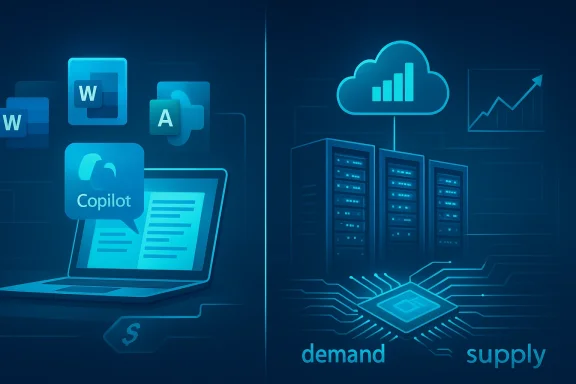
Microsoft stands out because it has a two-layer business model that helps it capture value from AI in different ways. On one side is Microsoft 365 Copilot, a paid add-on that turns AI into a recurring software subscription. On the other is Azure, which sells compute, storage, and model-running capacity to businesses that do not want to build AI infrastructure on their own. That combination means Microsoft can monetize both the application layer and the infrastructure layer of AI.
The company’s latest earnings disclosures make the model more tangible. Microsoft said Azure and other cloud services revenue grew 39% year over year in the fiscal fourth quarter, and management explicitly linked that performance to accelerated growth in its core infrastructure business and strong demand from its largest customers. Microsoft also said demand remained higher than supply even after bringing additional datacenter capacity online. That is an important signal: the constraint is not lack of customer interest, but the company’s ability to build fast enough.
This is why the AI capex debate is so nuanced. Microsoft is spending heavily on cloud and AI engineering, and those investments are pressuring margins in the near term. But the company is also reporting that customers are willing to pay for the capacity and software experiences those investments enable. The result is a rare situation in tech: rising capital intensity alongside rising demand visibility.
The strategic benefit is obvious. Microsoft already owns the workflow where employees spend their day: Word, Excel, PowerPoint, Outlook, Teams, and related Microsoft 365 services. By placing AI directly into those apps, Microsoft turns AI from a standalone product into an upgrade path inside a familiar suite. That reduces adoption friction and raises the odds that AI becomes a line item on the customer’s software budget rather than a side experiment.
This also helps explain why Copilot matters even if it is not the flashiest part of the story. Subscription revenue is sticky, and enterprise software customers dislike switching costs. Once AI becomes part of the daily workflow, the product can strengthen Microsoft’s pricing power and deepen lock-in across the broader Microsoft 365 ecosystem. In that sense, Copilot is not just an AI feature; it is a retention and expansion tool. That is the subtle part investors sometimes miss.
The current growth numbers show how powerful that dynamic is. Microsoft said Azure and other cloud services revenue grew 39% year over year in the fiscal fourth quarter, with growth driven by core infrastructure demand from its largest customers. In a separate investor materials page, Microsoft also described Azure and other cloud services revenue growth of 34%, again pointing to demand for its portfolio of services. The exact quarter-over-quarter comparison depends on the view you take, but the consistent message is clear: AI demand is feeding Azure.
Azure matters more than Copilot because it is the scale business. The AI features sold inside Microsoft 365 are valuable, but the heavier revenue engine is the cloud layer underneath them. That is where Microsoft can capture usage from customers running models, storing data, and deploying workloads across a broad set of services. Put differently, Copilot is the front door; Azure is the factory.
That matters because infrastructure-heavy businesses can look inefficient until utilization catches up. Microsoft is spending on datacenters, power, networking, and AI-ready hardware before all the revenue is visible, which depresses margins in the interim. But if customer demand is already outrunning supply, then those assets are more likely to become productive rather than stranded. That is a very different risk profile from a speculative platform launch.
A large backlog or long-term demand pipeline matters for two reasons. First, it improves visibility, which is prized by both management teams and investors. Second, it gives Microsoft an opportunity to turn capital spending into future recurring revenue rather than one-time sales. When customers queue for capacity, the company can invest with more confidence that the assets will generate returns.
That does not make the spending risk-free. It simply means Microsoft has evidence that the spending may be matched by long-lived demand. In AI, that is a meaningful advantage because the industry is still sorting out whether current usage patterns are a temporary wave or the beginning of a persistent shift in enterprise computing. Microsoft’s numbers suggest the latter is at least plausible.
That is why Copilot may look modest compared with Azure even though it is strategically important. The enterprise buyer does not need to believe in a futuristic AI revolution; they only need to believe that employees can save time, improve output, or reduce process friction. That lowers the barrier to purchase. It also creates a clearer value proposition than vague “AI transformation” language often used elsewhere in the market.
Still, Copilot’s greatest strength may be distribution, not novelty. Microsoft can place AI into tools that workers already open daily, which makes monetization easier than launching a separate AI-only app and asking users to build new habits. Convenience is a business model. In Microsoft’s case, that convenience can convert into recurring revenue with relatively little friction once organizations decide the tool is worth rolling out.
This is a familiar software tactic, but it is especially effective in AI because buyers often want to test productivity gains before committing to a broader deployment. Microsoft can let customers sample the experience while preserving a premium layer for serious usage. That helps explain why Copilot is positioned as both a growth feature and a monetization engine.
Key takeaways on Copilot:
That creates a strong economic flywheel for Microsoft. More AI demand drives more cloud consumption, which drives more revenue, which justifies more capacity investment, which enables even more demand fulfillment. If the cycle holds, the company can grow revenue while also reinforcing its strategic position in enterprise infrastructure.
The most important nuance is that Azure is not only about AI. Microsoft’s investor materials show that Azure and other cloud services revenue reflects a broad basket of cloud and AI consumption-based services. That means AI is amplifying an already large platform rather than carrying it alone. The advantage of that structure is resilience: if one AI product slows, the broader cloud base still supports growth.
Yet margin compression in a high-growth infrastructure phase is not automatically a red flag. If the company is building capacity into known demand, the spend can be viewed as an investment rather than waste. The key question is utilization over time, not just current cost intensity. That is where disciplined investors should focus.
Microsoft’s advantage is that it can extract value across multiple layers of the same customer relationship. A customer may pay for Microsoft 365, add Copilot, consume Azure, and eventually deploy custom AI workloads on the same platform. That broad monetization surface gives Microsoft a better shot at recouping its AI investments than a single-product vendor would have.
This is a meaningful edge over rivals that may have strong infrastructure but weaker software anchoring, or strong software but less cloud breadth. Microsoft can offer a path from workplace AI to heavy compute without leaving its ecosystem. That lowers friction and improves retention, both of which matter in an AI market where customers may otherwise shop around.
At the same time, rivals are not standing still. The AI infrastructure race is likely to remain capital-intensive and competitive for years. Microsoft’s current lead does not guarantee permanent dominance, but it does suggest the company is well positioned to be one of the few firms that can monetize the cycle at multiple points.
This gives Microsoft a “good enough plus convenient” strategy. In enterprise software, that often wins more deals than the flashiest product on the market. Buyers want low integration costs, familiar security controls, and a clear procurement path, all of which Microsoft can provide.
The broader market implication is that AI value may concentrate in firms that already own the customer relationship and the compute stack. If that proves true, the winners will not necessarily be the companies with the loudest AI messaging, but the ones with the most reliable distribution and infrastructure economics. Microsoft fits that description unusually well.
The quality of revenue also matters for valuation. Investors tend to reward businesses that can show a path from spending to future cash generation. Microsoft’s AI model offers exactly that narrative: spend now on capacity and software integration, collect recurring revenue through licenses and usage, and expand the installed base over time.
Still, the market will keep demanding proof. AI enthusiasm can create large expectations very quickly, and Microsoft will need to continue showing that growth in Copilot and Azure outpaces the costs of expansion. If margins deteriorate faster than revenue scales, the story becomes less compelling. Right now, though, the evidence leans in Microsoft’s favor.
The company’s operating expenses also increased as it invested in cloud and AI engineering. For long-term investors, that can be fine if those expenses help secure a larger share of the AI market. But for near-term traders, it reinforces the reality that AI leadership is expensive and will remain so for some time.
The interesting part is that Microsoft can afford this strategy because its core business still throws off substantial cash. That gives the company a funding advantage over smaller AI players and a strategic patience that the market often overlooks. In other words, Microsoft is not betting the company on AI; it is using the company to fund an AI transition.
Investors should watch not only headline growth, but also the relationship between AI demand, capacity additions, and margin trends. Microsoft’s ability to keep demand ahead of supply is positive in the near term, but the long-term prize is higher utilization, stronger recurring revenue, and a more durable AI moat. That is what would transform AI from a cost center into a compounding engine.
Things to watch next:
Source: The Motley Fool This Is How Microsoft Is Making Money from AI Right Now | The Motley Fool
 Overview
The AI investment debate has shifted from novelty to accountability. A year or two ago, companies could talk about artificial intelligence as a strategic imperative and leave it at that. In 2026, investors want a more concrete answer: who is paying, how much, and whether the cash flow is improving or merely being consumed by infrastructure buildouts.Microsoft stands out because it has a two-layer business model that helps it capture value from AI in different ways. On one side is Microsoft 365 Copilot, a paid add-on that turns AI into a recurring software subscription. On the other is Azure, which sells compute, storage, and model-running capacity to businesses that do not want to build AI infrastructure on their own. That combination means Microsoft can monetize both the application layer and the infrastructure layer of AI.
The company’s latest earnings disclosures make the model more tangible. Microsoft said Azure and other cloud services revenue grew 39% year over year in the fiscal fourth quarter, and management explicitly linked that performance to accelerated growth in its core infrastructure business and strong demand from its largest customers. Microsoft also said demand remained higher than supply even after bringing additional datacenter capacity online. That is an important signal: the constraint is not lack of customer interest, but the company’s ability to build fast enough.
This is why the AI capex debate is so nuanced. Microsoft is spending heavily on cloud and AI engineering, and those investments are pressuring margins in the near term. But the company is also reporting that customers are willing to pay for the capacity and software experiences those investments enable. The result is a rare situation in tech: rising capital intensity alongside rising demand visibility.
How Microsoft Monetizes AI
Microsoft’s AI monetization strategy is simpler than many of its rivals’ presentations make it sound. The company is not just hoping AI makes its products more attractive someday; it is charging for AI now, either directly through licenses or indirectly through usage-based cloud consumption. That distinction matters because it gives investors a current revenue stream rather than a speculative future one.The Copilot layer
The first revenue engine is Microsoft 365 Copilot, which is sold as a separate license on top of qualifying Microsoft 365 plans. Microsoft’s own pricing pages show Copilot for business and enterprise customers at roughly $30 per user per month on annual commitment plans, with Copilot Chat included at no additional cost for eligible customers and more advanced capabilities available when customers add the paid license. That structure is classic enterprise SaaS: a free or bundled entry point, then monetization through the premium tier.The strategic benefit is obvious. Microsoft already owns the workflow where employees spend their day: Word, Excel, PowerPoint, Outlook, Teams, and related Microsoft 365 services. By placing AI directly into those apps, Microsoft turns AI from a standalone product into an upgrade path inside a familiar suite. That reduces adoption friction and raises the odds that AI becomes a line item on the customer’s software budget rather than a side experiment.
This also helps explain why Copilot matters even if it is not the flashiest part of the story. Subscription revenue is sticky, and enterprise software customers dislike switching costs. Once AI becomes part of the daily workflow, the product can strengthen Microsoft’s pricing power and deepen lock-in across the broader Microsoft 365 ecosystem. In that sense, Copilot is not just an AI feature; it is a retention and expansion tool. That is the subtle part investors sometimes miss.
Azure as the larger opportunity
If Copilot is the neat story, Azure is the big one. Microsoft’s cloud platform provides the compute backbone many enterprises need for AI training, inference, storage, and related workloads. Companies that cannot or do not want to build massive AI data centers themselves can rent capacity from Microsoft instead, which turns AI demand into recurring cloud spend.The current growth numbers show how powerful that dynamic is. Microsoft said Azure and other cloud services revenue grew 39% year over year in the fiscal fourth quarter, with growth driven by core infrastructure demand from its largest customers. In a separate investor materials page, Microsoft also described Azure and other cloud services revenue growth of 34%, again pointing to demand for its portfolio of services. The exact quarter-over-quarter comparison depends on the view you take, but the consistent message is clear: AI demand is feeding Azure.
Azure matters more than Copilot because it is the scale business. The AI features sold inside Microsoft 365 are valuable, but the heavier revenue engine is the cloud layer underneath them. That is where Microsoft can capture usage from customers running models, storing data, and deploying workloads across a broad set of services. Put differently, Copilot is the front door; Azure is the factory.
Why Capacity Constraints Actually Help the Story
One of the most telling details in Microsoft’s earnings commentary is that demand remains higher than supply. In a normal business, that would be a short-term operational headache. In Microsoft’s AI business, it is also a proof point. It means the company is not struggling to find buyers for its AI capacity; it is struggling to build enough of it fast enough.That matters because infrastructure-heavy businesses can look inefficient until utilization catches up. Microsoft is spending on datacenters, power, networking, and AI-ready hardware before all the revenue is visible, which depresses margins in the interim. But if customer demand is already outrunning supply, then those assets are more likely to become productive rather than stranded. That is a very different risk profile from a speculative platform launch.
The backlog signal
The Motley Fool article cites a $625 billion backlog for AI computing, and while that figure should be read carefully without Microsoft directly breaking out all of its AI backlog in a single simple metric, the broader point is credible: the pipeline of AI demand is large enough to justify continued buildout. Microsoft’s own disclosures repeatedly emphasize that cloud and AI demand remains strong and that additional datacenter capacity is still being added.A large backlog or long-term demand pipeline matters for two reasons. First, it improves visibility, which is prized by both management teams and investors. Second, it gives Microsoft an opportunity to turn capital spending into future recurring revenue rather than one-time sales. When customers queue for capacity, the company can invest with more confidence that the assets will generate returns.
That does not make the spending risk-free. It simply means Microsoft has evidence that the spending may be matched by long-lived demand. In AI, that is a meaningful advantage because the industry is still sorting out whether current usage patterns are a temporary wave or the beginning of a persistent shift in enterprise computing. Microsoft’s numbers suggest the latter is at least plausible.
Copilot as a Commercial Product
Copilot is easy to describe as an AI assistant, but the more important detail is that Microsoft has turned it into a commercial product with enterprise controls, pricing, and integration points. That makes it less like a demo and more like an upgradeable workflow layer. The enterprise version is particularly significant because it ties AI to Microsoft’s core productivity stack, where budgets are larger and renewal rates are typically stronger.Enterprise adoption vs consumer buzz
Consumer AI interest gets the headlines, but enterprise AI is where the money tends to accumulate. Businesses pay for licenses, compliance, admin controls, analytics, and integration into existing systems. Microsoft’s pricing pages and enterprise positioning show exactly that pattern: Copilot is pitched as an assistant for work, with access to Microsoft Graph, app integration, and management tools that buyers can justify to procurement and IT.That is why Copilot may look modest compared with Azure even though it is strategically important. The enterprise buyer does not need to believe in a futuristic AI revolution; they only need to believe that employees can save time, improve output, or reduce process friction. That lowers the barrier to purchase. It also creates a clearer value proposition than vague “AI transformation” language often used elsewhere in the market.
Still, Copilot’s greatest strength may be distribution, not novelty. Microsoft can place AI into tools that workers already open daily, which makes monetization easier than launching a separate AI-only app and asking users to build new habits. Convenience is a business model. In Microsoft’s case, that convenience can convert into recurring revenue with relatively little friction once organizations decide the tool is worth rolling out.
What makes Copilot different
Microsoft is also smart about how it segments access. Some Copilot features are bundled or available in lighter-weight form at no additional cost, while the full work-grounded product requires the paid license. That creates a funnel: users experiment, teams adopt, and organizations pay for deeper functionality once the value becomes obvious.This is a familiar software tactic, but it is especially effective in AI because buyers often want to test productivity gains before committing to a broader deployment. Microsoft can let customers sample the experience while preserving a premium layer for serious usage. That helps explain why Copilot is positioned as both a growth feature and a monetization engine.
Key takeaways on Copilot:
- It is sold as a premium add-on, not just a bundled novelty.
- It sits inside Microsoft’s most deeply embedded productivity ecosystem.
- It benefits from enterprise purchasing habits and software switching costs.
- It provides an upgrade path from free or lighter-tier AI experiences.
Azure and the Economics of AI Infrastructure
Azure is where Microsoft’s AI story becomes macroeconomic rather than just product-level. AI models are computationally expensive, and most organizations would rather rent the capacity than finance and manage their own global infrastructure. Microsoft’s cloud platform turns that preference into usage-based revenue, which is exactly the sort of recurring, scalable model public-market investors understand well.Why customers rent instead of build
Building a modern AI data center requires capital, power access, specialized hardware, networking, staffing, and ongoing optimization. Many companies can’t justify that complexity, especially if AI usage is still evolving. Renting from Azure lets them avoid owning a highly specialized asset while still getting access to the compute they need.That creates a strong economic flywheel for Microsoft. More AI demand drives more cloud consumption, which drives more revenue, which justifies more capacity investment, which enables even more demand fulfillment. If the cycle holds, the company can grow revenue while also reinforcing its strategic position in enterprise infrastructure.
The most important nuance is that Azure is not only about AI. Microsoft’s investor materials show that Azure and other cloud services revenue reflects a broad basket of cloud and AI consumption-based services. That means AI is amplifying an already large platform rather than carrying it alone. The advantage of that structure is resilience: if one AI product slows, the broader cloud base still supports growth.
Margin pressure now, margin potential later
The obvious downside is that cloud and AI expansion can pressure margins before the scale benefits arrive. Microsoft has acknowledged that scaling AI infrastructure has weighed on Microsoft Cloud gross margin percentage, even as the business continues to grow. That is the trade-off investors are watching closely.Yet margin compression in a high-growth infrastructure phase is not automatically a red flag. If the company is building capacity into known demand, the spend can be viewed as an investment rather than waste. The key question is utilization over time, not just current cost intensity. That is where disciplined investors should focus.
Microsoft’s advantage is that it can extract value across multiple layers of the same customer relationship. A customer may pay for Microsoft 365, add Copilot, consume Azure, and eventually deploy custom AI workloads on the same platform. That broad monetization surface gives Microsoft a better shot at recouping its AI investments than a single-product vendor would have.
Competitive Implications
Microsoft’s AI strategy is not occurring in a vacuum. It is unfolding in competition with other hyperscalers, productivity-suite vendors, and pure-play AI providers that all want a piece of the same spend. But Microsoft has a particularly strong position because it can compete in both software and infrastructure without asking customers to stitch together a new enterprise stack from scratch.Against cloud rivals
In the cloud market, Microsoft’s advantage is not just scale; it is embedded distribution. Azure benefits when enterprise customers already use Microsoft identity, productivity, security, and collaboration tools. That makes it easier to cross-sell AI workloads into an environment where Microsoft already has administrative trust and procurement relationships.This is a meaningful edge over rivals that may have strong infrastructure but weaker software anchoring, or strong software but less cloud breadth. Microsoft can offer a path from workplace AI to heavy compute without leaving its ecosystem. That lowers friction and improves retention, both of which matter in an AI market where customers may otherwise shop around.
At the same time, rivals are not standing still. The AI infrastructure race is likely to remain capital-intensive and competitive for years. Microsoft’s current lead does not guarantee permanent dominance, but it does suggest the company is well positioned to be one of the few firms that can monetize the cycle at multiple points.
Against software competitors
On the software side, Copilot competes with a broader category of AI assistants and workflow tools. Microsoft’s advantage is that it is not forcing users to adopt a brand-new environment; it is inserting AI into tools they already know. That may make the feature less glamorous, but it can make adoption far more durable.This gives Microsoft a “good enough plus convenient” strategy. In enterprise software, that often wins more deals than the flashiest product on the market. Buyers want low integration costs, familiar security controls, and a clear procurement path, all of which Microsoft can provide.
The broader market implication is that AI value may concentrate in firms that already own the customer relationship and the compute stack. If that proves true, the winners will not necessarily be the companies with the loudest AI messaging, but the ones with the most reliable distribution and infrastructure economics. Microsoft fits that description unusually well.
Why Investors Care About the Revenue Mix
One of the recurring fears around AI is that companies are building expensive infrastructure without a clear monetization path. Microsoft reduces that fear because it can point to revenue today, not just future optionality. That makes its AI spending easier to defend, especially when compared with firms that are still in the pre-revenue or experimental stage of deployment.Revenue quality matters
Not all AI revenue is equal. Subscription revenue from Copilot is predictable and recurring, while Azure AI usage can scale with customer demand. Together, they create a mix of predictable software income and scalable infrastructure demand. That is attractive because it improves both visibility and upside.The quality of revenue also matters for valuation. Investors tend to reward businesses that can show a path from spending to future cash generation. Microsoft’s AI model offers exactly that narrative: spend now on capacity and software integration, collect recurring revenue through licenses and usage, and expand the installed base over time.
Still, the market will keep demanding proof. AI enthusiasm can create large expectations very quickly, and Microsoft will need to continue showing that growth in Copilot and Azure outpaces the costs of expansion. If margins deteriorate faster than revenue scales, the story becomes less compelling. Right now, though, the evidence leans in Microsoft’s favor.
How the AI Spend Shows Up in the Financials
Microsoft’s latest disclosures show a classic expansion phase. Revenue is still growing at healthy rates, but the company is also spending more on cloud and AI engineering, which affects margins. That is the unavoidable trade-off of building a platform that is meant to dominate the next era of enterprise computing.The margin story in plain English
Microsoft said Microsoft Cloud gross margin percentage declined because of the impact of scaling AI infrastructure, even though Azure efficiency gains helped offset some of that pressure. That means AI spending is visible in the financial statements, but so is management’s attempt to manage the cost curve. It is not a hidden issue; it is a strategic choice.The company’s operating expenses also increased as it invested in cloud and AI engineering. For long-term investors, that can be fine if those expenses help secure a larger share of the AI market. But for near-term traders, it reinforces the reality that AI leadership is expensive and will remain so for some time.
The interesting part is that Microsoft can afford this strategy because its core business still throws off substantial cash. That gives the company a funding advantage over smaller AI players and a strategic patience that the market often overlooks. In other words, Microsoft is not betting the company on AI; it is using the company to fund an AI transition.
Strengths and Opportunities
Microsoft’s AI monetization strategy has several structural advantages that should not be underestimated. The business can capture value at multiple layers, and each layer reinforces the others. That creates a feedback loop that is unusually strong for a company operating at this scale.- Recurring subscription revenue from Copilot provides a visible monetization path.
- Azure demand gives Microsoft a direct way to profit from AI compute growth.
- Enterprise distribution lowers customer acquisition friction.
- Workflow integration increases adoption and switching costs.
- Scale economics make infrastructure buildout more defensible.
- Cross-sell potential links Microsoft 365, Azure, and AI into one ecosystem.
- Strong demand visibility supports ongoing capital investment.
Risks and Concerns
The bullish case is strong, but it is not without risk. AI infrastructure is still expensive, customer adoption is still evolving, and competitive intensity is unlikely to ease. Microsoft may be better positioned than most, but that does not eliminate execution risk.- Margin pressure could persist if AI capex rises faster than monetization.
- Capacity shortages could limit near-term revenue conversion if demand outruns supply.
- Copilot adoption risk remains if customers question the return on per-user pricing.
- Competitive pricing pressure could intensify across both cloud and productivity software.
- Customer concentration in large enterprise accounts can make results lumpy.
- AI hype risk may cause investors to expect too much too soon.
- Infrastructure execution risk could leave Microsoft overbuilt if demand shifts unexpectedly.
Looking Ahead
Microsoft’s next phase will be about converting strong AI demand into cleaner economics. The company has already shown that it can sell AI through both software subscriptions and cloud usage, but the real test will be whether those revenues grow fast enough to justify the scale of the buildout. If they do, Microsoft could become the clearest proof case that the AI infrastructure boom is not just expensive, but economically rational.Investors should watch not only headline growth, but also the relationship between AI demand, capacity additions, and margin trends. Microsoft’s ability to keep demand ahead of supply is positive in the near term, but the long-term prize is higher utilization, stronger recurring revenue, and a more durable AI moat. That is what would transform AI from a cost center into a compounding engine.
Things to watch next:
- Azure revenue growth and whether it remains driven by AI workloads.
- Copilot licensing trends across business and enterprise customers.
- Margin movement as AI infrastructure spending continues.
- Data center capacity additions and whether supply constraints ease.
- Any signs that AI usage becomes embedded in more Microsoft 365 renewals.
Source: The Motley Fool This Is How Microsoft Is Making Money from AI Right Now | The Motley Fool
