

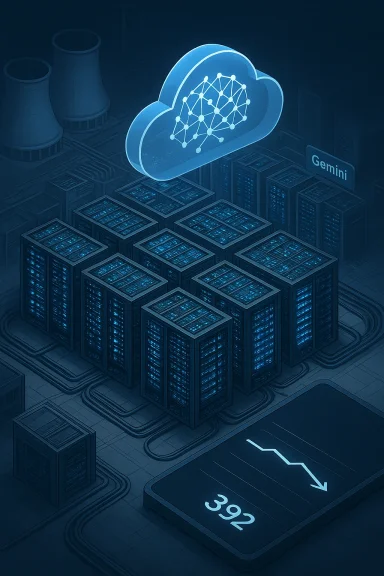
Microsoft’s stock narrative has a rare crack: Stifel downgraded the company from Buy to Hold, slashed its price target from $540 to $392 and signalled that the market’s expectation for Azure-driven revenue acceleration may be overly optimistic given capacity constraints, steep AI infrastructure spending, and intensifying competitive pressure. The move is notable not just because Stifel is a long-standing Wall Street house, but because it crystallizes investor nervousness about the trade-off Microsoft is making—aggressive capital expenditure to fund generative-AI leadership today at the cost of near-term cloud growth and margins. This article unpacks why Stifel acted, what the underlying numbers show, and what IT leaders, investors, and partners should watch next.
Microsoft reported strong headline results in its fiscal second quarter of 2026—revenue and earnings beat expectations—but the market reaction exposed a fragile equilibrium between demand and the company’s ability to deliver capacity. The company posted roughly $81.3 billion in revenue and non‑GAAP earnings per share of about $4.14 for the quarter. Azure (and other cloud services) grew roughly 39% year-over-year, an impressive rate by historical standards but short of the “perfection” benchmark Wall Street demands for hyperscalers today.
Investors focused on two threads beneath the surface numbers:
Key pressures include:
Key structural advantages that argue for patience:
Yet Microsoft’s advantages are enduring: an integrated enterprise ecosystem, massive backlog and bookings, and unmatched distribution. The investment thesis now hinges on whether Microsoft can translate its AI infrastructure spending into durable top‑line acceleration and improved unit economics before the market demands a permanent re‑rating.
For IT leaders, this moment favors cautious planning: validate critical workload portability, negotiate capacity and allocation terms, and stress‑test AI projects against multi‑cloud alternatives. For investors, patience will be tested: the prize is large but so are the near‑term execution and margin risks. The coming quarters will show whether Microsoft’s bet on owning the AI stack was visionary—or simply expensive timing.
Source: Bloomberg https://www.bloomberg.com/news/arti...re-downgrade-as-stifel-warns-on-azure-growth/
 Background: the context behind the downgrade
Microsoft reported strong headline results in its fiscal second quarter of 2026—revenue and earnings beat expectations—but the market reaction exposed a fragile equilibrium between demand and the company’s ability to deliver capacity. The company posted roughly $81.3 billion in revenue and non‑GAAP earnings per share of about $4.14 for the quarter. Azure (and other cloud services) grew roughly 39% year-over-year, an impressive rate by historical standards but short of the “perfection” benchmark Wall Street demands for hyperscalers today.Investors focused on two threads beneath the surface numbers:
- A massive step-up in capital expenditure to build GPU-heavy data centers and other specialized infrastructure—one quarter saw capex in the tens of billions (reported around $37.5 billion)—that is compressing near-term margins and will take time to earn back.
- A capacity allocation problem: Microsoft is balancing long-term strategic commitments to partners (notably major AI customers) with commercial Azure demand. That allocation leads to slower visible Azure growth even while long-run demand remains strong.
What Stifel said — the hard claims
Stifel’s research note (and the reporting that summarized it) made several specific, quantitative claims that drove the downgrade decision. The key takeaways the market digested are:- Stifel lowered Microsoft from Buy to Hold and cut its price target to $392 from $540.
- The firm increased its fiscal‑year 2027 capex estimate for Microsoft to roughly $200 billion (about +40% year/year versus management and consensus figures that were materially lower).
- Stifel trimmed its fiscal‑year 2027 gross margin assumption to around 63% (from a consensus of roughly 67%), reflecting the margin headwind from AI‑heavy investments and higher-cost compute resources.
- The note flagged Azure supply limitations as the central near‑term constraint, and it called out competitive momentum from Google Cloud (and its Gemini AI stack) and Anthropic as likely to cap Azure’s acceleration.
Why this matters now: the mechanics of the problem
Azure growth vs. capacity: the key tension
Cloud growth is not solely a demand story—it’s a supply story. Hyperscalers compete on two fronts: winning customer commitments and having the compute footprint to satisfy those commitments with acceptable latency, performance, and cost. For Microsoft today, the bottlenecks are largely physical and financial:- GPU and specialized silicon scarcity: Leading generative-AI workloads require high-end GPUs and memory. These parts are constrained globally and expensive compared to traditional cloud hardware.
- Data‑center build cycles: Bringing capacity online is multi‑quarter work—land, power, procurement, construction, and deployment. Even with accelerated timelines, it lags demand surges.
- Allocation choices: Microsoft has large strategic commitments to AI partners and internal projects that can absorb new capacity before commercial customers do. That prioritization can depress visible Azure growth even while total utilization is high.
Margin math: capex today, margins tomorrow
Stifel’s margin call is straightforward: if you spend a lot more on short-lived compute (GPUs, accelerators) and allocate a meaningful portion to non‑revenue-generating internal projects or strategic partners at discounted economics, aggregate gross margin will decline in the near term.Key pressures include:
- Higher per‑unit cost for GPU-heavy workloads versus the previous CPU‑dominated baseline.
- A shift in asset mix toward short‑lived hardware increases depreciation and replacement cycles.
- The revenue profile of AI deals can be lumpy and long‑dated—some involve upfront commitments that delay revenue recognition or have different margin profiles.
Competitive dynamics: Google and Anthropic
Stifel explicitly cited Google Cloud Platform (GCP) and Gemini and Anthropic as competitive forces that can blunt Azure momentum. That matters because:- Google has been investing heavily in Gemini and has strong cost controls across its cloud fleet, potentially offering competitive pricing for AI workloads.
- Anthropic and other AI startups are packaging models and managed services that can divert demand from Azure if they secure scale deployments with customers directly or via alternative cloud providers.
The market reaction: volatility, re‑rating, and context
The day after Microsoft’s fiscal results and the publicization of these capacity and capex concerns, the stock experienced one of its largest single‑day market value declines in years—erasing hundreds of billions in value in a sharp repricing. The market punishes uncertainty, and two uncertainties were amplified:- Will Microsoft be able to convert steep capex into sustainably higher revenue growth and margins, and on what timeline?
- How concentrated and durable are Microsoft’s AI revenue streams when a large fraction of backlog and bookings are tied to a small number of strategic AI customers?
Strengths that temper the downgrade thesis
Before concluding Microsoft is damaged, it’s important to underscore the company’s formidable advantages—factors that informed Stifel’s note and, in many cases, still favor Microsoft over the medium term:- Integrated ecosystem: Microsoft’s portfolio (Azure, Microsoft 365, Dynamics, GitHub, LinkedIn) creates cross‑sell opportunities and sticky enterprise relationships that are hard to replicate.
- Enormous backlog and bookings: Microsoft reported very large remaining performance obligations and commercial backlogs, indicating a multiyear pipeline of demand.
- Balance sheet and cash flow: Microsoft’s scale allows it to fund investments at a pace many competitors cannot match.
- Strategic AI partnerships: Early, deep investments in organizations building frontier models (and the resulting strategic ties) grant Microsoft preferential access to differential workloads and commercial arrangements.
- Enterprise trust and compliance: For many customers—particularly regulated industries—Microsoft remains a default choice for security, compliance, and enterprise feature parity.
Risks and potential blind spots in Stifel’s call
Stifel’s downgrade and assumptions are plausible, but not certain. Important counterpoints and risks to Stifel’s thesis include:- Monetization of AI workloads: If Microsoft can translate AI differentiation into higher billings per workload (through Copilot licensing, premium API pricing, or long‑term contracts), revenue could accelerate even as capex grows.
- Hardware cost deflation: If GPU supply improves or costs fall (new generations of chips, competitive supply from different foundries), the margin impact could be smaller and the payback faster.
- Operational efficiency gains: Microsoft’s scale allows optimisation—software stacks, model efficiency, and data center management improvements could improve unit economics faster than the market expects.
- Contract structure nuance: Large strategic deals may have richer economics over life than headline backlog percentages imply; early revenue concentration can mask durable monetization paths.
What enterprise customers and IT buyers should watch
For CIOs and IT procurement teams, Stifel’s downgrade and the broader debate highlight operational realities that affect vendor decisions and cloud strategy. Key considerations:- Capacity availability for AI projects: If Azure remains supply constrained for high-performance AI instances, customers will evaluate multi‑cloud or alternative providers for latency-sensitive or bursty workloads.
- Price and contract flexibility: Expect Microsoft to emphasize long‑term contracts and capacity commitments. Negotiate for transparency on allocation, priority, and escalation paths.
- Resilience and vendor diversification: For mission‑critical AI deployments, consider an architecture that decouples models from a single cloud provider or uses multiple clouds for failover and cost arbitrage.
- Evaluation of managed AI offerings: Assess how Microsoft’s managed AI services (Copilot, domain-specific AI solutions) fit business ROI compared to building on raw GPUs or third‑party model hosts.
What investors and analysts should monitor next
Stifel’s note sets a checklist for financial watchers. If Microsoft can demonstrate progress on several items, the market may re‑rate the stock; if not, the Hold rating may prove prescient. Watch for:- Capex guidance and trajectory: Is fiscal 2027 capex closer to Stifel’s ~$200B estimate or to the Street’s lower expectations? The cadence of capex and the split between short‑lived GPU investments and long‑lived facilities matter.
- Azure growth vs. capex growth: The central metric is whether Azure/Commercial Cloud revenue growth meaningfully outpaces capex growth over a reasonable time horizon.
- Gross margin trajectory: Does margin stabilize around the mid‑60s or rebound toward the high‑60s as capacity scales and utilization improves?
- Backlog composition: How much of the remaining performance obligations are exposed to a few partners? Are there signs Microsoft can broaden the revenue mix?
- Competitive pricing and feature parity: How do GCP and other clouds price comparable AI services, and what unique enterprise features does Microsoft retain?
- OpenAI and strategic partner economics: The market will demand clearer disclosure around the terms, allocations, and revenue recognition relating to major AI partners.
A pragmatic framework for assessing Microsoft from here
If you’re an investor or IT buyer deciding how to act given the downgrade and the broader debate, use this simple framework:- Clarify your horizon. Are you a long-term investor focused on franchise durability, or a near‑term trader sensitive to margin cycles? Your answer changes the weighting of capex risk.
- Map exposure. For organizations using Microsoft, quantify how much workload is dependent on Azure-specific features versus portable services.
- Demand audit. Evaluate whether current AI projects require immediate access to ultra‑low-latency GPU instances or whether they can tolerate multi‑cloud or queued execution.
- Contract leverage. Negotiate capacity guarantees, pilot allocations, and exit clauses for projects where vendor allocation risk is material.
- Scenario planning. Build a three‑scenario model: conservative (slow Azure acceleration), base (gradual catch‑up as capex comes online), and optimistic (rapid monetization and margin recovery).
Long-term perspective: why Microsoft’s strategic direction still makes sense
Stepping back from the short‑term drama, Microsoft’s strategic pivot—investing heavily to own the AI stack from silicon to services—aligns with a plausible long‑term monopolistic play. Owning the infrastructure, developer tools, enterprise integrations, and distribution channels can yield outsized returns, provided Microsoft navigates execution risks and can convert early lead into durable economics.Key structural advantages that argue for patience:
- Enterprise lock‑in: Microsoft’s productivity suite and enterprise accounts create natural touchpoints for AI productization and upsell.
- Platform effect: A single platform serving development, deployment, and enterprise integration reduces friction for customers adopting Microsoft’s AI offerings.
- Network effects with models: As Microsoft hosts larger model workloads and datasets, it benefits from feedback loops that improve services and increase switching costs.
What to expect in the near term
Realistically, the next several quarters will be noisy. Expect:- Continued capex intensity and commentary from Microsoft on prioritization and allocation strategies.
- Close tracking of Azure growth figures, including sequential changes and guidance for future quarters.
- Increased scrutiny from analysts and the market on margin metrics, backlog composition, and concentration risk.
- Potential tactical responses from Microsoft—clarifying partner allocations, offering targeted commercial concessions, or accelerating software monetization strategies (e.g., broader Copilot licensing, tiered API pricing).
Conclusion
Stifel’s rare downgrade of Microsoft is less a verdict on the company’s long‑term prospects than a warning flag about execution risk during a massive investment cycle. The firm’s concerns—Azure supply constraints, surging capex, and intensifying competition—are real and measurable. They have already driven material market volatility and forced a re‑examination of the math that made Microsoft’s valuation impervious to short‑term gyrations.Yet Microsoft’s advantages are enduring: an integrated enterprise ecosystem, massive backlog and bookings, and unmatched distribution. The investment thesis now hinges on whether Microsoft can translate its AI infrastructure spending into durable top‑line acceleration and improved unit economics before the market demands a permanent re‑rating.
For IT leaders, this moment favors cautious planning: validate critical workload portability, negotiate capacity and allocation terms, and stress‑test AI projects against multi‑cloud alternatives. For investors, patience will be tested: the prize is large but so are the near‑term execution and margin risks. The coming quarters will show whether Microsoft’s bet on owning the AI stack was visionary—or simply expensive timing.
Source: Bloomberg https://www.bloomberg.com/news/arti...re-downgrade-as-stifel-warns-on-azure-growth/
