

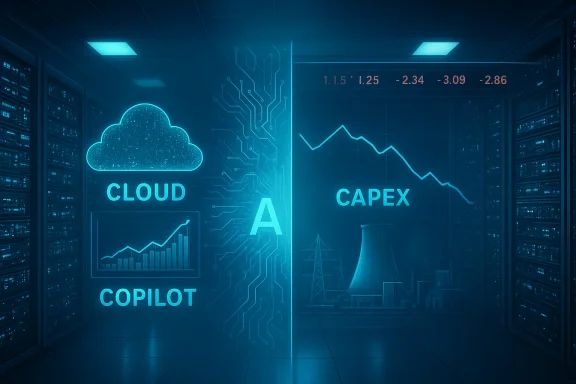
Microsoft’s stock wobble on Thursday wasn’t a single tick of bad news — it was a clear market reaction to a wedge forming between the company’s long-term AI ambitions and the near-term realities of cloud capacity, margins, and execution that prompted Stifel to cut its rating to Hold.
Microsoft’s pivot from a software‑licensing powerhouse to an AI‑first, cloud‑centric company has been dramatic and deliberate. The company now layers large‑scale model hosting, enterprise Copilot deployments, and consumption‑based pricing on top of decades of enterprise relationships and a massive cloud footprint. That strategy has produced enormous revenue and an industry‑leading position — but it also requires vast capital deployment, complex supply chains for GPUs, and steady Azure capacity growth to convert investments into durable returns.
The immediate spark for the market’s anxiety — and for Stifel’s downgrade — is twofold. First, Microsoft disclosed capital spending and operational items in recent quarters that signaled a heavy front‑loaded investment cycle to scale GPU‑dense data centers and other AI infrastructure. Second, Azure growth, while still robust, has shown signs of deceleration in sequential growth rates and faces reported supply constraints that could limit near‑term revenue acceleration. Together these factors have analysts asking whether Wall Street’s FY/CY‑2027 revenue and EPS expectations are too optimistic given Microsoft’s current pace of spending and the competition for enterprise AI workloads.
Why did the market punish Microsoft despite an earnings beat? Because the conversation shifted from “growth and AI monetization” to “how much capital must be burned, and when will utilization and monetization catch up?” Investors are particularly sensitive to capital intensity when growth slows even a few percentage points on a very large base — the math on returns changes quickly.
Because exact CapEx numbers vary by quarter and outlet, readers should note two things:
Key competitive pressures:
For WindowsForum readers, the implications are operational and tactical: plan for capacity variability, watch Microsoft’s public metrics closely, and be realistic about the difference between AI capability (which is advancing rapidly) and AI monetization (which requires capacity, pricing, and adoption to line up). Microsoft still has the resources, product portfolio, and enterprise trust to win this era — but winning it will take time, and the market is rightly pricing that timing into sentiment today.
Source: Seeking Alpha https://seekingalpha.com/news/45478...tifel-downgrades-on-ai-spending-azure-issues/
 Background / Overview
Microsoft’s pivot from a software‑licensing powerhouse to an AI‑first, cloud‑centric company has been dramatic and deliberate. The company now layers large‑scale model hosting, enterprise Copilot deployments, and consumption‑based pricing on top of decades of enterprise relationships and a massive cloud footprint. That strategy has produced enormous revenue and an industry‑leading position — but it also requires vast capital deployment, complex supply chains for GPUs, and steady Azure capacity growth to convert investments into durable returns.The immediate spark for the market’s anxiety — and for Stifel’s downgrade — is twofold. First, Microsoft disclosed capital spending and operational items in recent quarters that signaled a heavy front‑loaded investment cycle to scale GPU‑dense data centers and other AI infrastructure. Second, Azure growth, while still robust, has shown signs of deceleration in sequential growth rates and faces reported supply constraints that could limit near‑term revenue acceleration. Together these factors have analysts asking whether Wall Street’s FY/CY‑2027 revenue and EPS expectations are too optimistic given Microsoft’s current pace of spending and the competition for enterprise AI workloads.
What Stifel actually said — the numbers and the thesis
Stifel’s note is unusually blunt for a firm that has long been favorable on Microsoft. Key points from the downgrade:- Rating moved from Buy to Hold, with the price target cut sharply from $540 to $392.
- Stifel raised its estimate for Microsoft’s fiscal‑2027 capital expenditures to roughly ~$200 billion (a ~40% increase over prior expectations), a level far above the Street’s consensus figure. The implication: sustained high CapEx will weigh on near‑term margins and free cash flow.
- Gross margin assumptions were trimmed in the firm’s model to ~63% for FY‑2027 versus a Street consensus near ~67%, reflecting the company’s shift into a more capital‑intensive AI buildout.
- The analysts identified Azure supply constraints, increasing competition (notably Google Cloud’s Gemini and Anthropic’s momentum), and concentration risk from large commercial commitments as primary reasons to temper expectations for re‑rating in the short term.
Market reaction: muted beat, outsized pain
The market’s response to the mix of strong top‑line results and bruising guidance/footnotes has been severe and fast. Media outlets and market feeds reported a premarket slide of about 2% tied to the Stifel note, but the broader price action in the days after Microsoft’s quarter was much sharper: intraday moves and multi‑session selloffs removed large chunks of market capitalization as investors re‑priced near‑term returns versus long‑term optionality.Why did the market punish Microsoft despite an earnings beat? Because the conversation shifted from “growth and AI monetization” to “how much capital must be burned, and when will utilization and monetization catch up?” Investors are particularly sensitive to capital intensity when growth slows even a few percentage points on a very large base — the math on returns changes quickly.
Azure: where the story gets technical
Azure remains the growth engine for Microsoft, but the growth profile is what matters most to investors now. Recent public disclosures and reporting show:- Azure growth remains high‑teens to high‑thirties percent year‑over‑year depending on the quarter, but sequential deceleration of a few percentage points alarmed the market because it suggests consumption is uneven and may be constrained by capacity rather than demand alone.
- Management and analysts flagged Azure capacity constraints — not as a theoretical problem, but as a real limiter on how quickly Azure can expand consumption of GPU‑heavy workloads. This is relevant because AI inference and training consume outsized GPU cycles relative to traditional VM or database workloads.
- A nontrivial portion of Microsoft’s near‑term commercial backlog and contracted commitments has become concentrated with a few large partners, an arrangement that introduces execution risk if those partners shift compute sourcing or if Microsoft must prioritize internal products over third‑party hosting.
How GPU economics change the Azure game
Traditional cloud growth relied on commodity x86 compute and storage — low‑margin, high‑scale work. AI workloads shift the economics toward GPU hours, specialized accelerators, high‑density networking, and changes in cooling and facility design. That increases short‑term CapEx, raises depreciation, and introduces utilization risk: until utilization catches up, margins compress. Analysts and journalists have repeatedly highlighted that Microsoft’s AI investments are changing both the revenue model (toward consumption) and cost structure (toward capital intensity).AI spending: scale, timing, and the specter of front‑loaded CapEx
Reports and follow‑ups on Microsoft’s recent quarterly disclosure show CapEx surges that are unusual in scale for any company, even one of Microsoft’s size. Different outlets quoted different figures depending on the quarter covered — earlier reporting flagged multi‑tens‑of‑billions quarters, while other coverage noted even larger, record‑level investments in later quarters. The takeaway is consistent: CapEx is much higher and more front‑loaded than many models assumed.Because exact CapEx numbers vary by quarter and outlet, readers should note two things:
- The direction and magnitude of CapEx are beyond standard operating variability; Microsoft is intentionally building capacity to host large foundation models and enterprise Copilot workloads.
- Elevated CapEx creates pressure on gross margins and free cash flow in the near term until utilization ramps. Stifel explicitly models that consequence and reduces gross margin assumptions accordingly.
Competitive dynamics: why Google, Anthropic, and others matter
Stifel’s downgrade frames Microsoft’s problems in part through competition: Google Cloud’s Gemini push and Anthropic’s growing enterprise traction are cited as proof that share gains for Azure are not guaranteed. Microsoft’s unique relationship with OpenAI remains strategically important, but the landscape is now multi‑polar: large clouds, vertical specialists, and model vendors are all vying for the same enterprise consumption.Key competitive pressures:
- Google Cloud: heavy investment in Gemini and a compelling integrated stack for customers, combined with Google’s cost structure and datacenter planning.
- Anthropic and other model vendors: offer differentiated models and go‑to‑market strategies that can reduce the need for customers to choose Microsoft for model hosting.
- In‑house model runs and specialized providers: enterprises may select on cost, performance, or compliance, splitting spend away from hyperscalers even when those hyperscalers make aggressive offers.
What this means for Windows users, IT admins, and enterprise customers
For the WindowsForum readership — developers, sysadmins, IT decision‑makers, and enthusiasts — the macro dustup between analysts and the market translates into concrete considerations.- Capacity and performance for cloud‑connected Windows services: If Azure capacity is prioritized toward first‑party AI workloads, certain enterprise customers may experience longer lead times for large deployments or scheduled migrations. For admins, that means planning for potential staging windows or exploring multi‑cloud strategies.
- Product rollout timing: Slower Azure acceleration could shift Microsoft’s internal prioritization of features that rely on ample cloud capacity (e.g., large‑scale Windows‑hosted AI features, Intune cloud services, Azure Virtual Desktop scaling). Expect Microsoft to prioritize where capacity yields the highest strategic yield.
- Licensing and cost impacts: Enterprises may see more consumption‑based pricing offers alongside promotions aimed at retaining customers. Microsoft could also accelerate bundling of AI features into higher‑tier enterprise suites to preserve predictable revenue even as consumption models evolve.
Risk analysis: what could go wrong — and what Microsoft can do about it
Microsoft’s advantages are substantial — enterprise relationships, a massive install base, and deep pockets — but the risks are real:- Concentration risk: Heavy contractual exposure to a few large partners (including OpenAI) can distort revenue recognition and future cash flows. If large partners shift compute, switch providers, or renegotiate terms, Microsoft’s top line could feel outsized swings.
- Utilization lag: New AI capacity takes time to monetize. Underutilized GPU clusters depress margins and delay payback on CapEx. This is the central concern Stifel models into FY‑2027.
- Competitive erosion: Rapid advances from Google, Anthropic, or specialized providers could make Azure’s offerings less compelling on either price or performance. That risk is asymmetric: Microsoft loses share slowly, but when it happens it reduces the platform multiplier for its other products.
- Execution risk: Massive global buildouts are operationally complex — procurement, permitting, power negotiations, and supply chain constraints for accelerators are all friction points. Any misstep could push monetization timelines out further.
- Optimize software stack efficiency: Reducing per‑inference compute needs through model and inference engineering can materially shrink GPU demand. Microsoft has a software optimization playbook that can lower overall capital intensity if successful.
- Strategic partnerships and diversification: Expanding partnerships beyond a single large partner and offering hybrid on‑prem + cloud options will lower concentration risk and give enterprises flexibility.
- Transparent guidance and metrics: The market is hungry for leading indicators — internal Copilot adoption metrics, GPU utilization rates, and Azure AI consumption KPIs would help align expectations. Stifel’s critique is in part a demand for better forward guidance.
What to watch next — the concrete signaling events
Investors, IT leaders, and WindowsForum readers should track a short list of high‑leverage indicators:- Azure growth rates (reported and constant‑currency) — watch sequential change and whether AI consumption offsets any base workload slowdown.
- CapEx guidance and quarterly CapEx run‑rate — any sign of moderation or acceleration will materially alter models.
- GPU utilization / time‑to‑deploy metrics (if Microsoft provides them) — utilization is the bridge between CapEx and margin recovery.
- Copilot / Microsoft 365 AI adoption: seat counts, revenue per seat, and enterprise tier adoption.
- Remaining Performance Obligations (RPO) concentration metrics — is a large share tied to a single external partner?
- Competitive product milestones from Google, Anthropic, and other vendors — product parity or superiority can sway customer choices.
- Comments from management on partnerships, prioritization of third‑party hosting vs. first‑party projects, and pace of capacity buildouts.
- Any material changes in pricing or enterprise contract language that would shift consumption economics.
Balanced assessment: strengths, opportunities, and the case for patience
Despite Stifel’s downgrade and the justified market scare over capex and Azure execution, the long‑term strategic case for Microsoft is strong:- Microsoft has unparalleled enterprise relationships and distribution channels that make it a default choice for many customers considering AI upgrades. That moat isn’t trivial to erode quickly.
- The company controls a powerful product stack — Windows, Office, Azure, GitHub — that can be integrated to accelerate adoption of paid AI features. The cross‑sell opportunity is real and high‑value.
- Microsoft has the financial resources to stomach multi‑year investment cycles. The question is timing: investors want to see when and how those investments flow through to sustainable margins and cash returns.
Practical takeaways for different audiences
- For long‑term shareholders: This is a classic valuation vs. execution inflection. If you believe Microsoft’s AI investments will pay off in 3–5 years, short‑term downgrades and volatility are noise; if you need steadier near‑term cash flow, reassessing allocation size is sensible.
- For enterprise IT buyers: Don’t assume capacity will always be plentiful for large GPU workloads. Build contingency into procurement timelines and consider multi‑cloud or hybrid deployment architectures for mission‑critical projects.
- For developers and Windows admins: Expect steady feature innovation in Windows and Microsoft 365 AI, but also expect Microsoft to prioritize where it can extract the most strategic value from limited capacity. That may affect rollouts or beta programs tied to cloud capacity.
Final analysis — measured optimism with a new emphasis on timing
Stifel’s downgrade should be read as an important reality check: Microsoft’s AI future is promising, but it is now explicitly capital‑intensive and contingent on execution across supply, partnerships, and monetization. The downgrade is prudent modeling — it doesn’t negate Microsoft’s long‑term strengths, but it does force a recalibration of investor expectations about when those strengths will translate into improved free cash flow and margins.For WindowsForum readers, the implications are operational and tactical: plan for capacity variability, watch Microsoft’s public metrics closely, and be realistic about the difference between AI capability (which is advancing rapidly) and AI monetization (which requires capacity, pricing, and adoption to line up). Microsoft still has the resources, product portfolio, and enterprise trust to win this era — but winning it will take time, and the market is rightly pricing that timing into sentiment today.
Source: Seeking Alpha https://seekingalpha.com/news/45478...tifel-downgrades-on-ai-spending-azure-issues/
