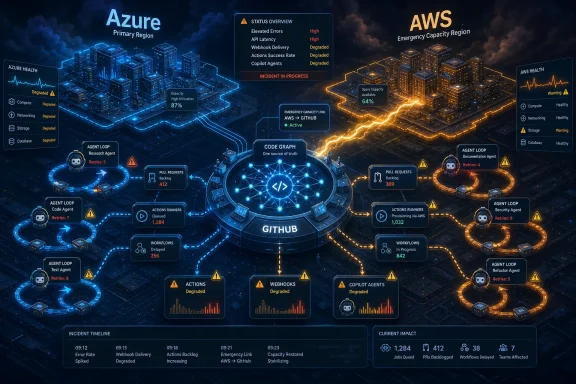
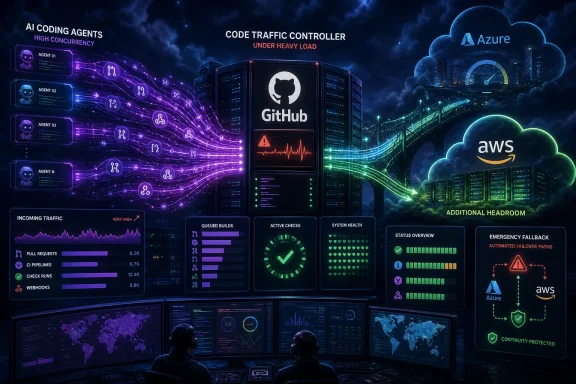
Microsoft is reportedly using Amazon Web Services to help relieve GitHub infrastructure pressure in June 2026, after AI-assisted coding and agentic development drove a surge in commits, traffic, and outages while the Microsoft-owned platform continued its long migration from legacy data centers to Azure. The striking part is not merely that GitHub needs more capacity; hyperscale platforms need more capacity every day. The striking part is that Microsoft’s developer crown jewel may be leaning on Amazon, its fiercest cloud rival, because AI has turned software development from a human-paced workflow into a machine-amplified load generator. This is what the AI boom looks like when the marketing slides reach the production database.
GitHub has spent the past few years selling the idea that AI will change how software is written. Now it is living with the consequences of being right. Tools such as GitHub Copilot, Claude Code, OpenAI Codex-style agents, Cursor, and other coding assistants do not just help developers type faster; they encourage more branches, more commits, more pull requests, more tests, more automation, and more background activity against the same platform.
That matters because GitHub is not a simple code locker anymore. It is source control, identity, issue tracking, CI/CD, package distribution, security scanning, code search, pull request review, and increasingly the control plane for AI-driven software work. When an agent edits code, opens a pull request, triggers workflows, fetches dependencies, and asks for review, it can consume platform resources in ways that look very different from a human pushing a few commits at the end of the day.
The reported numbers are staggering. GitHub COO Kyle Daigle has said commits were on pace to reach 14 billion in 2026, compared with roughly 1 billion in 2025. Even allowing for measurement nuance, that is not ordinary growth. It is a workload profile changing faster than the infrastructure beneath it.
For years, GitHub’s scale problem was mainly about serving more developers. The new scale problem is serving more development events. That distinction is crucial. A platform can add users steadily and plan capacity around human adoption curves; it is much harder to plan for software agents that multiply the number of actions each developer can generate.
That bargain came with a promise that was never written in a single press release but was obvious to every developer: GitHub had to remain boringly reliable. Developers forgive missing features. They are less forgiving when the place where their code, pipelines, reviews, secrets, and releases live becomes unpredictable.
The problem is that GitHub’s role inside Microsoft has expanded just as its operational burden has increased. It is no longer just a popular service Microsoft happens to own. It is a delivery mechanism for Copilot, a strategic wedge into enterprise development, a bridge between Microsoft 365, Azure, Visual Studio Code, and security tooling, and a defensive wall against rivals that want AI coding to happen somewhere else.
That raises the stakes of every outage. When GitHub goes down, it is not merely a social network for programmers having a bad afternoon. It can stop release trains, break automation, strand incident fixes, delay security patches, and block developers from pushing code into production. For Windows shops and enterprise IT teams, GitHub reliability is now part of the broader Microsoft platform risk calculation.
But migrations are hardest when the thing being migrated is growing explosively. Moving a large platform from bespoke infrastructure to a hyperscale cloud is not like copying a folder. It means rethinking traffic patterns, storage replication, service dependencies, internal networking, observability, failover behavior, database topology, deployment practices, and the assumptions engineers have built up over years.
GitHub’s own public availability updates this year have described a platform trying to re-architect itself while under live fire. The company has talked about designing for dramatically larger scale, using the Azure migration to stand up more compute, and moving more monolith and Git traffic into Azure. That is a reasonable engineering path, but it is also a risky one: the bridge is being rebuilt while everyone is still driving across it.
This is where the reported AWS angle becomes so revealing. If Microsoft is exploring or using Amazon capacity to help GitHub absorb demand, it suggests the immediate constraint is not ideological purity but elasticity. Azure may be the strategic destination, yet GitHub’s present-tense problem is keeping the service responsive while AI-driven activity compounds faster than the migration can comfortably absorb.
These are not ordinary times. AI has made compute capacity, network capacity, storage throughput, and power availability strategic resources. The industry’s biggest companies are signing huge infrastructure deals, renting capacity from rivals, building new data centers, negotiating power arrangements, and treating GPUs and cloud regions like scarce commodities.
That does not erase the competitive tension. If AWS is helping carry GitHub load, Amazon can fairly claim that even Microsoft sometimes needs the world’s largest cloud provider. Microsoft, for its part, can say multi-cloud pragmatism is what serious global platforms do when demand spikes beyond normal planning assumptions.
Both arguments can be true. Hyperscale cloud competition has always had a public layer and a private layer. Publicly, vendors argue that their cloud is the best strategic home for enterprise workloads; privately, sophisticated operators know that resilience often requires redundancy, capacity diversity, and a willingness to route around constraints.
The more AI turns every software platform into a high-volume automation platform, the more this kind of uncomfortable cooperation will happen. The future of cloud may not be one vendor winning every workload. It may be a world in which even the biggest vendors quietly borrow from one another because customer demand refuses to respect corporate rivalry.
An AI-assisted workflow compresses that loop. An agent can produce multiple variations, open pull requests, run jobs, respond to comments, regenerate code, and interact with repositories while the developer supervises. A team that once had ten engineers producing a manageable stream of repository events may now have ten engineers plus dozens of agent-driven tasks creating traffic throughout the day.
That changes the stress points. Git storage must handle more objects. Pull request systems must handle more diffs and comments. CI/CD systems must schedule more workflows. Security scanners must inspect more changes. Notification systems must push more events. Search and indexing must keep up with a larger and noisier code graph.
It also changes the economics. GitHub can charge for Copilot usage and enterprise seats, but not every AI-generated load comes from GitHub’s own AI products. Third-party coding agents can interact with GitHub through normal workflows and APIs. That means GitHub may absorb infrastructure costs generated by tools whose revenue accrues elsewhere.
This is one of the underappreciated platform risks of the AI era. The company that owns the workflow is not always the company that monetizes the compute-amplified behavior. GitHub is the place where much of the AI coding boom lands, regardless of which assistant caused the activity.
Recent GitHub availability concerns have already drawn attention from developers and enterprise customers. Public incident reports and status updates have described degraded services, configuration-related problems, Copilot disruptions tied to upstream dependencies, and reliability work still in progress. None of this means GitHub is collapsing; large distributed systems fail, and GitHub remains one of the most important and capable developer platforms in the world.
But reliability is judged by user experience, not architecture diagrams. If a developer cannot merge a fix, if a pipeline stalls, if a repository operation times out, or if an incident response team cannot push a hotfix, the explanation that GitHub is scaling for a 30-times future is not very comforting in the moment.
For sysadmins and IT leaders, this is where the story becomes practical. The AI coding boom is not just a developer productivity story; it is a dependency-management story. The more organizations wire GitHub into build pipelines, deployment workflows, security scans, and compliance gates, the more GitHub availability becomes part of their own operational risk surface.
That is the sensible way to describe it. Large platforms rarely run on one clean abstraction. They accumulate legacy systems, edge cases, specialized services, data locality constraints, compliance needs, and migration stages. GitHub’s infrastructure story was never going to become “flip a switch and everything is Azure.”
Still, the optics are awkward. Microsoft has spent years telling customers that Azure is a complete enterprise cloud for mission-critical workloads. If GitHub needs AWS help at the same time Microsoft is trying to move GitHub fully onto Azure, critics will read that as evidence that Azure capacity or architecture is struggling to keep pace with Microsoft’s own AI ambitions.
The fairer reading is more complicated. Azure is under extraordinary demand from Microsoft’s own AI products, OpenAI-related workloads, enterprise customers, and internal services. GitHub’s growth is arriving during the same period in which every major cloud provider is fighting for chips, power, cooling, and data center construction. Even a very large cloud can be constrained in the wrong region, at the wrong layer, or on the wrong timeline.
That is the lesson enterprise IT should take from this. Multi-cloud is not a slogan that magically prevents outages, but capacity optionality has value. If Microsoft can justify it for GitHub, customers can justify asking harder questions about their own single-provider assumptions.
This is especially true for Windows-heavy organizations that have embraced Microsoft’s developer ecosystem. Visual Studio Code, GitHub Copilot, Azure DevOps integrations, GitHub Actions, Microsoft Defender for DevOps, package feeds, and Azure deployment workflows can all orbit the same developer platform gravity well. The convenience is real, but so is the concentration.
Concentration creates leverage for Microsoft. It can sell a more integrated story than almost anyone else: write code in VS Code, get AI help from Copilot, host the repository on GitHub, deploy to Azure, secure with Microsoft tools, manage identity through Entra, and report through enterprise dashboards. That is a powerful platform loop.
But concentration also creates blast radius. When one part of the loop wobbles, the wobble can travel. The more AI agents sit inside that loop, the faster the wobble can propagate because more actions are automated, more pipelines are triggered, and more systems depend on timely repository state.
This does not mean organizations should abandon GitHub. It does mean they should stop treating hosted developer platforms as low-risk utilities. GitHub is infrastructure now, and infrastructure deserves contingency planning.
GitHub Copilot gave Microsoft an early lead in mainstream AI coding. But that lead is no longer uncontested. Anthropic’s Claude Code, OpenAI’s coding agents, Cursor, and other tools have made developers more willing to imagine a future where the code host is just one endpoint among many. If the assistant becomes the main interface, the repository platform risks becoming plumbing.
That is why GitHub’s reliability troubles are strategically dangerous. Developers tolerate plumbing until it leaks. If AI coding tools can shift work to alternative platforms, internal repositories, or competing code hosts, GitHub’s network effects remain powerful but not invincible.
Reports that OpenAI has considered or developed internal alternatives to GitHub should be read in that light. Large AI labs have unusual needs, but they are also early indicators of where software development may go. If the most AI-intensive engineering organizations find traditional developer platforms too slow, too brittle, or too constrained, their workarounds may eventually become products.
Microsoft understands this. GitHub is not merely defending against GitLab or Bitbucket anymore. It is defending against the possibility that AI-native development environments make the old repository-centered model less central.
That likely means more aggressive rate shaping, better API design, smarter agent controls, workload isolation, regional failover improvements, and clearer separation between critical Git operations and higher-level collaboration features. It may also require pricing changes so third-party agent-driven load is not treated as an externality absorbed by GitHub’s core platform.
There is a delicate balance here. If GitHub clamps down too hard, it risks annoying the very AI ecosystem that makes the platform more valuable. If it stays too open without changing the economics and architecture, it risks letting agent traffic consume reliability budgets intended for human developers and enterprise workflows.
This is why reliability has become product strategy. GitHub’s competitive advantage is not only that everyone’s code is there. It is that developers trust it to be there when needed. If that trust erodes, even slightly, customers begin building mirrors, fallback plans, secondary CI paths, or internal alternatives.
In the pre-AI era, those precautions sometimes looked excessive. In the AI era, they look increasingly prudent.
PowerShell modules, winget manifests, open-source utilities, infrastructure-as-code templates, endpoint management scripts, and vendor SDKs often flow through GitHub. Even when production systems do not depend directly on GitHub at runtime, engineering and operations teams often depend on it during maintenance, response, and release windows.
That changes how organizations should think about resilience. A GitHub outage during normal development is inconvenient. A GitHub outage during a zero-day response, a broken deployment, or a weekend migration can become a serious operational problem.
The answer is not panic. It is preparation. Critical repositories should be mirrored. Release artifacts should be stored somewhere controlled by the organization. Build pipelines should be reviewed for unnecessary external dependencies. Incident response playbooks should assume that a SaaS developer platform can be degraded when you most want it to work.
Microsoft’s own reported willingness to use multi-cloud capacity for GitHub should make this conversation easier inside enterprises. If Redmond can route around constraints, so can you.
The result is a new class of scaling problem. Code hosts, CI systems, package registries, security scanners, and collaboration tools were designed around assumptions about human productivity. AI coding assistants break those assumptions by making software activity cheaper to generate.
That does not automatically make the activity better. More commits do not necessarily mean better code. More pull requests do not necessarily mean more thoughtful engineering. More automation does not necessarily mean safer releases. The infrastructure strain is visible because the volume is visible; the quality question will take longer to answer.
Still, the direction is clear. The developer platform of the future must be built for both humans and agents. It must distinguish useful automation from noisy churn, isolate workloads by importance, and make reliability a first-class feature rather than a status page afterthought.
GitHub is one of the few companies with enough scale to learn these lessons early. Unfortunately for GitHub, learning them early means learning them in public.
 GitHub’s AI Windfall Has Become an Infrastructure Stress Test
GitHub has spent the past few years selling the idea that AI will change how software is written. Now it is living with the consequences of being right. Tools such as GitHub Copilot, Claude Code, OpenAI Codex-style agents, Cursor, and other coding assistants do not just help developers type faster; they encourage more branches, more commits, more pull requests, more tests, more automation, and more background activity against the same platform.That matters because GitHub is not a simple code locker anymore. It is source control, identity, issue tracking, CI/CD, package distribution, security scanning, code search, pull request review, and increasingly the control plane for AI-driven software work. When an agent edits code, opens a pull request, triggers workflows, fetches dependencies, and asks for review, it can consume platform resources in ways that look very different from a human pushing a few commits at the end of the day.
The reported numbers are staggering. GitHub COO Kyle Daigle has said commits were on pace to reach 14 billion in 2026, compared with roughly 1 billion in 2025. Even allowing for measurement nuance, that is not ordinary growth. It is a workload profile changing faster than the infrastructure beneath it.
For years, GitHub’s scale problem was mainly about serving more developers. The new scale problem is serving more development events. That distinction is crucial. A platform can add users steadily and plan capacity around human adoption curves; it is much harder to plan for software agents that multiply the number of actions each developer can generate.
Microsoft Bought a Developer Network and Inherited a Reliability Obligation
Microsoft’s 2018 acquisition of GitHub for $7.5 billion was one of the company’s most important strategic reversals. The old Microsoft treated open source with suspicion; the new Microsoft bought the town square. GitHub became both a business asset and a reputational asset, a symbol that Microsoft had learned to meet developers where they were.That bargain came with a promise that was never written in a single press release but was obvious to every developer: GitHub had to remain boringly reliable. Developers forgive missing features. They are less forgiving when the place where their code, pipelines, reviews, secrets, and releases live becomes unpredictable.
The problem is that GitHub’s role inside Microsoft has expanded just as its operational burden has increased. It is no longer just a popular service Microsoft happens to own. It is a delivery mechanism for Copilot, a strategic wedge into enterprise development, a bridge between Microsoft 365, Azure, Visual Studio Code, and security tooling, and a defensive wall against rivals that want AI coding to happen somewhere else.
That raises the stakes of every outage. When GitHub goes down, it is not merely a social network for programmers having a bad afternoon. It can stop release trains, break automation, strand incident fixes, delay security patches, and block developers from pushing code into production. For Windows shops and enterprise IT teams, GitHub reliability is now part of the broader Microsoft platform risk calculation.
Azure Was Supposed to Be the Answer, Not Another Constraint
GitHub historically ran much of its own infrastructure, including legacy data center operations that predated the Microsoft acquisition. Microsoft’s long-term plan has been to move GitHub fully into Azure, with reports describing an internal target around 2027. Strategically, that makes sense. Microsoft wants its developer platform on its own cloud, both for operational consistency and for obvious commercial reasons.But migrations are hardest when the thing being migrated is growing explosively. Moving a large platform from bespoke infrastructure to a hyperscale cloud is not like copying a folder. It means rethinking traffic patterns, storage replication, service dependencies, internal networking, observability, failover behavior, database topology, deployment practices, and the assumptions engineers have built up over years.
GitHub’s own public availability updates this year have described a platform trying to re-architect itself while under live fire. The company has talked about designing for dramatically larger scale, using the Azure migration to stand up more compute, and moving more monolith and Git traffic into Azure. That is a reasonable engineering path, but it is also a risky one: the bridge is being rebuilt while everyone is still driving across it.
This is where the reported AWS angle becomes so revealing. If Microsoft is exploring or using Amazon capacity to help GitHub absorb demand, it suggests the immediate constraint is not ideological purity but elasticity. Azure may be the strategic destination, yet GitHub’s present-tense problem is keeping the service responsive while AI-driven activity compounds faster than the migration can comfortably absorb.
The Cloud Rivalry Looks Smaller Than the Capacity Shortage
Microsoft and Amazon have spent years fighting for enterprise cloud workloads. Azure versus AWS is one of the defining rivalries of modern infrastructure, shaping procurement decisions, partner ecosystems, certification paths, and boardroom cloud strategies. In ordinary times, Microsoft relying on Amazon for a major Microsoft-owned platform would look like an embarrassment.These are not ordinary times. AI has made compute capacity, network capacity, storage throughput, and power availability strategic resources. The industry’s biggest companies are signing huge infrastructure deals, renting capacity from rivals, building new data centers, negotiating power arrangements, and treating GPUs and cloud regions like scarce commodities.
That does not erase the competitive tension. If AWS is helping carry GitHub load, Amazon can fairly claim that even Microsoft sometimes needs the world’s largest cloud provider. Microsoft, for its part, can say multi-cloud pragmatism is what serious global platforms do when demand spikes beyond normal planning assumptions.
Both arguments can be true. Hyperscale cloud competition has always had a public layer and a private layer. Publicly, vendors argue that their cloud is the best strategic home for enterprise workloads; privately, sophisticated operators know that resilience often requires redundancy, capacity diversity, and a willingness to route around constraints.
The more AI turns every software platform into a high-volume automation platform, the more this kind of uncomfortable cooperation will happen. The future of cloud may not be one vendor winning every workload. It may be a world in which even the biggest vendors quietly borrow from one another because customer demand refuses to respect corporate rivalry.
Agentic Development Changes the Shape of Demand
The phrase agentic development can sound like vendor fog, but the infrastructure implications are concrete. A classic developer workflow is relatively bursty but human-limited. A person writes code, runs tests, pushes a commit, waits for review, and responds to feedback.An AI-assisted workflow compresses that loop. An agent can produce multiple variations, open pull requests, run jobs, respond to comments, regenerate code, and interact with repositories while the developer supervises. A team that once had ten engineers producing a manageable stream of repository events may now have ten engineers plus dozens of agent-driven tasks creating traffic throughout the day.
That changes the stress points. Git storage must handle more objects. Pull request systems must handle more diffs and comments. CI/CD systems must schedule more workflows. Security scanners must inspect more changes. Notification systems must push more events. Search and indexing must keep up with a larger and noisier code graph.
It also changes the economics. GitHub can charge for Copilot usage and enterprise seats, but not every AI-generated load comes from GitHub’s own AI products. Third-party coding agents can interact with GitHub through normal workflows and APIs. That means GitHub may absorb infrastructure costs generated by tools whose revenue accrues elsewhere.
This is one of the underappreciated platform risks of the AI era. The company that owns the workflow is not always the company that monetizes the compute-amplified behavior. GitHub is the place where much of the AI coding boom lands, regardless of which assistant caused the activity.
Outages Turn Productivity Gains Into Organizational Risk
The pitch for AI coding tools is speed. Developers can move faster, prototype faster, fix bugs faster, and automate more of the tedious work that used to fill the day. But if that speed depends on a central platform that becomes less reliable under the load, the productivity gain starts to look fragile.Recent GitHub availability concerns have already drawn attention from developers and enterprise customers. Public incident reports and status updates have described degraded services, configuration-related problems, Copilot disruptions tied to upstream dependencies, and reliability work still in progress. None of this means GitHub is collapsing; large distributed systems fail, and GitHub remains one of the most important and capable developer platforms in the world.
But reliability is judged by user experience, not architecture diagrams. If a developer cannot merge a fix, if a pipeline stalls, if a repository operation times out, or if an incident response team cannot push a hotfix, the explanation that GitHub is scaling for a 30-times future is not very comforting in the moment.
For sysadmins and IT leaders, this is where the story becomes practical. The AI coding boom is not just a developer productivity story; it is a dependency-management story. The more organizations wire GitHub into build pipelines, deployment workflows, security scans, and compliance gates, the more GitHub availability becomes part of their own operational risk surface.
Microsoft’s Multi-Cloud Language Is a Quiet Admission of Reality
Microsoft has reportedly confirmed that GitHub uses multiple cloud service providers while declining to specify Amazon’s role. That wording is careful, but it is still meaningful. It frames multi-cloud not as a retreat from Azure but as a capacity and resilience strategy.That is the sensible way to describe it. Large platforms rarely run on one clean abstraction. They accumulate legacy systems, edge cases, specialized services, data locality constraints, compliance needs, and migration stages. GitHub’s infrastructure story was never going to become “flip a switch and everything is Azure.”
Still, the optics are awkward. Microsoft has spent years telling customers that Azure is a complete enterprise cloud for mission-critical workloads. If GitHub needs AWS help at the same time Microsoft is trying to move GitHub fully onto Azure, critics will read that as evidence that Azure capacity or architecture is struggling to keep pace with Microsoft’s own AI ambitions.
The fairer reading is more complicated. Azure is under extraordinary demand from Microsoft’s own AI products, OpenAI-related workloads, enterprise customers, and internal services. GitHub’s growth is arriving during the same period in which every major cloud provider is fighting for chips, power, cooling, and data center construction. Even a very large cloud can be constrained in the wrong region, at the wrong layer, or on the wrong timeline.
That is the lesson enterprise IT should take from this. Multi-cloud is not a slogan that magically prevents outages, but capacity optionality has value. If Microsoft can justify it for GitHub, customers can justify asking harder questions about their own single-provider assumptions.
GitHub Is Becoming Too Central to Fail Quietly
There was a time when a GitHub outage mostly meant developers complained on social media and waited. That time is over. GitHub now sits in the path of modern software delivery, and modern software delivery sits in the path of nearly every business.This is especially true for Windows-heavy organizations that have embraced Microsoft’s developer ecosystem. Visual Studio Code, GitHub Copilot, Azure DevOps integrations, GitHub Actions, Microsoft Defender for DevOps, package feeds, and Azure deployment workflows can all orbit the same developer platform gravity well. The convenience is real, but so is the concentration.
Concentration creates leverage for Microsoft. It can sell a more integrated story than almost anyone else: write code in VS Code, get AI help from Copilot, host the repository on GitHub, deploy to Azure, secure with Microsoft tools, manage identity through Entra, and report through enterprise dashboards. That is a powerful platform loop.
But concentration also creates blast radius. When one part of the loop wobbles, the wobble can travel. The more AI agents sit inside that loop, the faster the wobble can propagate because more actions are automated, more pipelines are triggered, and more systems depend on timely repository state.
This does not mean organizations should abandon GitHub. It does mean they should stop treating hosted developer platforms as low-risk utilities. GitHub is infrastructure now, and infrastructure deserves contingency planning.
The Real Competition Is Moving Up the Stack
The AWS angle is dramatic because it pits Microsoft against Amazon in cloud infrastructure. But the deeper competitive battle may be happening above the cloud layer, where AI coding tools are trying to own the developer’s daily workflow.GitHub Copilot gave Microsoft an early lead in mainstream AI coding. But that lead is no longer uncontested. Anthropic’s Claude Code, OpenAI’s coding agents, Cursor, and other tools have made developers more willing to imagine a future where the code host is just one endpoint among many. If the assistant becomes the main interface, the repository platform risks becoming plumbing.
That is why GitHub’s reliability troubles are strategically dangerous. Developers tolerate plumbing until it leaks. If AI coding tools can shift work to alternative platforms, internal repositories, or competing code hosts, GitHub’s network effects remain powerful but not invincible.
Reports that OpenAI has considered or developed internal alternatives to GitHub should be read in that light. Large AI labs have unusual needs, but they are also early indicators of where software development may go. If the most AI-intensive engineering organizations find traditional developer platforms too slow, too brittle, or too constrained, their workarounds may eventually become products.
Microsoft understands this. GitHub is not merely defending against GitLab or Bitbucket anymore. It is defending against the possibility that AI-native development environments make the old repository-centered model less central.
Reliability Engineering Becomes Product Strategy
GitHub’s answer cannot simply be “more servers.” More capacity helps, and AWS may help in the short term, but the platform’s long-term challenge is architectural. It must support machine-speed development without letting machine-speed activity degrade the human experience.That likely means more aggressive rate shaping, better API design, smarter agent controls, workload isolation, regional failover improvements, and clearer separation between critical Git operations and higher-level collaboration features. It may also require pricing changes so third-party agent-driven load is not treated as an externality absorbed by GitHub’s core platform.
There is a delicate balance here. If GitHub clamps down too hard, it risks annoying the very AI ecosystem that makes the platform more valuable. If it stays too open without changing the economics and architecture, it risks letting agent traffic consume reliability budgets intended for human developers and enterprise workflows.
This is why reliability has become product strategy. GitHub’s competitive advantage is not only that everyone’s code is there. It is that developers trust it to be there when needed. If that trust erodes, even slightly, customers begin building mirrors, fallback plans, secondary CI paths, or internal alternatives.
In the pre-AI era, those precautions sometimes looked excessive. In the AI era, they look increasingly prudent.
Windows Shops Should Read This as a Dependency Warning
For WindowsForum.com readers, the practical angle is straightforward: GitHub’s infrastructure story now intersects with everyday Microsoft operations. Windows administrators may not think of themselves as GitHub customers, but their environments often depend on software, scripts, drivers, packages, documentation, and deployment templates that live there.PowerShell modules, winget manifests, open-source utilities, infrastructure-as-code templates, endpoint management scripts, and vendor SDKs often flow through GitHub. Even when production systems do not depend directly on GitHub at runtime, engineering and operations teams often depend on it during maintenance, response, and release windows.
That changes how organizations should think about resilience. A GitHub outage during normal development is inconvenient. A GitHub outage during a zero-day response, a broken deployment, or a weekend migration can become a serious operational problem.
The answer is not panic. It is preparation. Critical repositories should be mirrored. Release artifacts should be stored somewhere controlled by the organization. Build pipelines should be reviewed for unnecessary external dependencies. Incident response playbooks should assume that a SaaS developer platform can be degraded when you most want it to work.
Microsoft’s own reported willingness to use multi-cloud capacity for GitHub should make this conversation easier inside enterprises. If Redmond can route around constraints, so can you.
The Lesson Microsoft Would Rather Customers Learn Quietly
The GitHub-AWS report is easy to turn into a tribal cloud argument, but that would miss the bigger lesson. AI is not just increasing demand for GPUs. It is increasing demand on every system that surrounds software creation.The result is a new class of scaling problem. Code hosts, CI systems, package registries, security scanners, and collaboration tools were designed around assumptions about human productivity. AI coding assistants break those assumptions by making software activity cheaper to generate.
That does not automatically make the activity better. More commits do not necessarily mean better code. More pull requests do not necessarily mean more thoughtful engineering. More automation does not necessarily mean safer releases. The infrastructure strain is visible because the volume is visible; the quality question will take longer to answer.
Still, the direction is clear. The developer platform of the future must be built for both humans and agents. It must distinguish useful automation from noisy churn, isolate workloads by importance, and make reliability a first-class feature rather than a status page afterthought.
GitHub is one of the few companies with enough scale to learn these lessons early. Unfortunately for GitHub, learning them early means learning them in public.
The New GitHub Reality Fits on One Operations Whiteboard
GitHub’s reported turn toward AWS is not a scandal so much as a signal. It shows how quickly AI-driven development is changing the infrastructure assumptions underneath modern software work, and it gives IT teams a preview of the dependency problems they will face as agents become normal parts of engineering.- Microsoft’s reported use of Amazon capacity for GitHub reflects immediate scaling pressure, not a simple failure of Azure strategy.
- AI coding tools are multiplying repository events, CI jobs, pull requests, and API activity faster than traditional developer growth models anticipated.
- GitHub’s Azure migration may be strategically necessary, but carrying it out during an AI-driven traffic surge increases operational risk.
- Enterprise customers should treat GitHub as critical infrastructure and plan mirrors, artifact backups, and fallback workflows accordingly.
- Cloud rivals will increasingly cooperate behind the scenes when AI demand outruns the neat boundaries of vendor competition.
References
- Primary source: The Hans India
Published: 2026-06-16T12:54:20.497528
Microsoft turns to Amazon as AI-driven growth at GitHub strains its infrastructure
AI-generated code growth is pushing GitHub’s infrastructure to the limit, prompting Microsoft to seek additional cloud capacity.www.thehansindia.com
- Related coverage: investing.com
Microsoft taps Amazon to ease GitHub AI-driven strains - Business Insider By Investing.com
Microsoft taps Amazon to ease GitHub AI-driven strains - Business Insiderwww.investing.com - Official source: learn.microsoft.com
Migrate your HC-series virtual machines by May 31, 2027 - Azure Virtual Machines | Microsoft Learn
Learn about the retirement of HC-series virtual machines on May 31, 2027, how it affects you, and how to migrate to recommended alternative Azure VM sizes.learn.microsoft.com - Official source: devblogs.microsoft.com
How Microsoft is migrating repositories to GitHub - Azure DevOps Blog
For the past decade, Azure DevOps has powered software development at Microsoft, supporting some of our largest repositories and most complex engineeringdevblogs.microsoft.com - Related coverage: windowscentral.com
"GitHub is failing me, every single day, and it is personal": After Xbox and Windows, now GITHUB is in crisis — Microsoft, what are you doing? | Windows Central
One of GitHub's most staple contributors announced they are abandoning ship due to constant outages. GitHub's COO responds, promising change, but is it all too little too late?www.windowscentral.com - Related coverage: techradar.com
OpenAI builds its own internal GitHub alternative after repeated outages leave engineers struggling with AI-powered development workflows | TechRadar
Azure migration troubles spark OpenAI’s secret projectwww.techradar.com
- Related coverage: theinformation.com
Microsoft’s GitHub Sees Booming Traffic—and Outages—as AI Agents Flood Platform — The Information
Software developers are using AI agents to crank out more lines of code than is humanly possible, with companies like Meta hosting “tokenmaxxing” contests to see which coders can spin the AI meter the fastest.That trend is leading to a surge in traffic at Microsoft-owned GitHub, which hosts ...www.theinformation.com - Related coverage: music.amazon.com
- Related coverage: redmondmag.com
Supply Chain Attack Hits Microsoft GitHub Repos, AI Coding Tools -- Redmondmag.com
GitHub disabled 73 Microsoft repositories on June 5 after a malicious commit landed in an Azure project, in what researchers described as a supply chain attack aimed at developer workstations and AI coding environments.redmondmag.com - Official source: github.com
GitHub - Azure/migration · GitHub
Contribute to Azure/migration development by creating an account on GitHub. github.com
- Related coverage: itpro.com
Microsoft is shaking up GitHub in preparation for a battle with AI coding rivals | IT Pro
Microsoft is reportedly reshuffling teams as part of a drive to stave off competition from up-and-coming AI coding startups and key competitors in the space.www.itpro.com - Related coverage: tomshardware.com
OpenAI building GitHub alternative after frequent platform outages and disruptions — a public OpenAI code repository would directly compete with one of its biggest investors | Tom's Hardware
The project could eventually be sold to customers and would put OpenAI in direct competition with one of its biggest investors.www.tomshardware.com - Related coverage: nerdheadz.com
GitHub Agents Future: What It Means for Builders | NerdHeadz Blog
GitHub's agent-first vision is reshaping how software gets built. Here's what every development team needs to know about AI agents, trust, and scale.www.nerdheadz.com - Related coverage: aihola.com
GitHub AI Agent Traffic Surge Causing Repeated Outages | aiHola
GitHub commits jumped 14x to 275M per week as AI agents flood the platform. Outages mount while infrastructure struggles to keep pace.aihola.com - Official source: azure.microsoft.com
- Official source: download.microsoft.com
Migrating your Windows Azure Applications between Data Centers
Considerations, approaches and risk managementdownload.microsoft.com
- Official source: info.microsoft.com
- Related coverage: github.blog
Updated GitHub status page experience - GitHub Changelog
We’ve updated the GitHub status page to make incident information easier to find and more useful during an active event. The status site now includes a 90-day historical view of availability and…github.blog
- Related coverage: devhelm.io
GitHub SLA — 99.9% Uptime Guarantee vs Actual — DevHelm
GitHub promises 99.9% uptime in their SLA. See how they actually perform: measured uptime, pricing tiers, credit policy, and incident history.devhelm.io - Related coverage: megaoneai.com
GitHub Uptime Statistics 2025-2026 Analysis
Explore GitHub's 99.9% uptime SLA and analyze incident reports for 2025-2026. Discover insights on performance and reliability.megaoneai.com - Official source: azure.status.microsoft
Azure status history | Microsoft Azure
Check the status history of Microsoft Azure services here.azure.status.microsoft
- Related coverage: opensourcebeat.com
- Related coverage: assets.ctfassets.net