
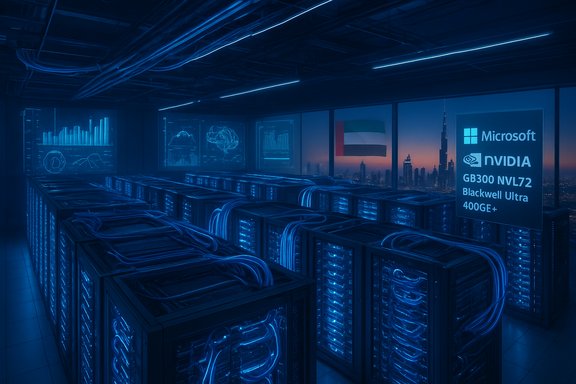
Microsoft’s announcement that it will invest roughly $15.2 billion in the United Arab Emirates and has secured U.S. export approvals to deploy advanced NVIDIA GB300-class systems in-country marks a watershed moment in the global AI infrastructure race—one that reshapes where frontier AI compute lives, how hyperscalers manage export controls and national security constraints, and what IT leaders should expect when planning for cloud-native AI deployments.
Microsoft’s investment plan is presented as a seven-year program of capital and operating expenditures concentrated on expanding AI data centers, local product processing, and regional services in the UAE. The company says $7.3 billion has already been spent between 2023 and the end of the current year, and it has allocated an additional $7.9 billion for 2026–2029—together amounting to the headline $15.2 billion figure. These outlays include a previously disclosed $1.5 billion equity stake in Abu Dhabi-based G42 and significant capital expenditures for Azure infrastructure in the region. At the same time, Microsoft confirmed it has obtained U.S. government export authorizations that enable shipments of NVIDIA’s most advanced accelerators—including GB300-based systems—that the company will operate in UAE Azure datacenters. Microsoft states these approvals build on earlier licenses that allowed it to accumulate the equivalent compute of roughly 21,500 A100-class GPUs and that the recent authorizations permit the addition of compute equivalent to approximately 60,400 more A100 GPUs using GB300 systems. Those chips, Microsoft says, will arrive and be deployed in the coming months. This package of capital, chips, and partnerships is part of a wider Gulf and global story: Gulf states are investing heavily to become AI hubs, hyperscalers are racing to localize AI services for regulatory and latency reasons, and U.S. export policy is adapting to balance national-security protections with commercial and diplomatic priorities.
This approach reflects careful balancing of three competing objectives:
This is an inflection point: the global topology of AI compute is being redrawn, and the long-term outcome—whether it becomes a transparent, auditable template for allied‑nation compute partnerships or a set of opaque bilateral deals—will depend on the depth of governance, independent verification and operational transparency that accompanies these shipments and deployments.
Source: Techzine Global Microsoft expands AI cloud with billions in Gulf region
 Background
Microsoft’s investment plan is presented as a seven-year program of capital and operating expenditures concentrated on expanding AI data centers, local product processing, and regional services in the UAE. The company says $7.3 billion has already been spent between 2023 and the end of the current year, and it has allocated an additional $7.9 billion for 2026–2029—together amounting to the headline $15.2 billion figure. These outlays include a previously disclosed $1.5 billion equity stake in Abu Dhabi-based G42 and significant capital expenditures for Azure infrastructure in the region. At the same time, Microsoft confirmed it has obtained U.S. government export authorizations that enable shipments of NVIDIA’s most advanced accelerators—including GB300-based systems—that the company will operate in UAE Azure datacenters. Microsoft states these approvals build on earlier licenses that allowed it to accumulate the equivalent compute of roughly 21,500 A100-class GPUs and that the recent authorizations permit the addition of compute equivalent to approximately 60,400 more A100 GPUs using GB300 systems. Those chips, Microsoft says, will arrive and be deployed in the coming months. This package of capital, chips, and partnerships is part of a wider Gulf and global story: Gulf states are investing heavily to become AI hubs, hyperscalers are racing to localize AI services for regulatory and latency reasons, and U.S. export policy is adapting to balance national-security protections with commercial and diplomatic priorities. What exactly was announced and why it matters
The headline figures and local footprint
- Microsoft’s total announced commitment: $15.2 billion (2023–2029), with roughly $7.3 billion already spent and $7.9 billion planned for 2026–2029.
- GPU export approvals: prior licenses equivalent to ~21,500 A100 compute; a September authorization covering an additional ~60,400 A100-equivalents using more advanced GB300 systems.
- Capacity targets: Microsoft and subsequent reporting estimate a near‑quadrupling of UAE AI capacity to an H100-equivalent of ~81,900 chips after the buildout that includes GB300 systems. This conversion to “H100 equivalents” is a common shorthand in coverage but masks how performance varies by architecture and workload.
Product-level residency and Copilot in-country processing
Microsoft has tied these infrastructure investments to product commitments: enabling in‑country processing for Microsoft 365 Copilot interactions for “qualified UAE organizations,” a product-level residency promise meant to address regulatory and procurement barriers for governments, banks and other regulated industries. Delivering Copilot processing locally is operationally non-trivial but materially reduces legal and latency friction for adoption.The hardware: what is GB300 / Blackwell Ultra and how big is the step?
Understanding the GB300 and Blackwell Ultra architecture is essential because much of the commercial value of the UAE investment hinges on these chips’ real-world performance.- GB300 systems are NVIDIA’s NB: a rack-scale “superchip” design pairing NVIDIA Grace CPUs with multiple Blackwell Ultra GPUs in high-density NVL72 (rack-level) configurations. Vendor and independent technical reporting indicate GB300 NVL72 systems deliver substantial improvements over prior generations in memory capacity, interconnect bandwidth and inference throughput.
- NVIDIA and trade coverage have described Blackwell Ultra variants as delivering approximately 50% more FP4 inference throughput than the standard Blackwell (B200) parts in dense inference scenarios, and significantly larger GPU memory per device (e.g., 288 GB HBM3e figures are commonly cited). Those technical gains translate to better handling of very large models, longer context windows, and faster inference on massive LLMs—when the software and interconnect are tuned to exploit them.
- Caveat: “X‑times faster than H100” headlines are workload-dependent. NVIDIA’s Blackwell-series announcements and industry benchmarks show dramatic improvements for specific inference and tokenization workloads, but comparative performance varies by precision format (FP4/BF16/FP16), model size, batch regime, and software stack. Independent real-world benchmarks will be needed to validate vendor claims across common enterprise LLM tasks.
Partnerships and supply-side mechanics
Two partnership threads are central to Microsoft’s announcement and its operational feasibility.- G42 and the UAE anchor: Microsoft’s earlier $1.5 billion equity investment in G42 (with a board seat) remains part of the operational and commercial fabric of the buildout. G42 is a major Abu Dhabi AI player and will be a local collaborator on infrastructure and product delivery. Past Washington scrutiny over G42’s China ties contributed to the tighter export-control scrutiny that preceded the recent export approvals—Microsoft says G42 has made progress toward compliance with U.S. governance expectations.
- Infrastructure partners: Microsoft is reportedly commissioning external AI-focused cloud providers to build and manage significant parts of the deployment. Coverage indicates a new multi‑billion‑dollar infrastructure partnership with Lambda Labs to deliver tens of thousands of GPU systems—including GB300 NVL72 appliances—alongside Microsoft‑operated capacity. Lambda, a U.S. startup backed in part by NVIDIA, reportedly already operates a large GPU fleet and will supply rack-scale GB300 builds for Microsoft’s platform needs. This mirrors other hyperscaler playbooks (e.g., CoreWeave) where hyperscalers buy capacity from specialized cloud-build partners.
Geopolitics, export controls and governance: the hard trade-offs
The shipments of GB300-equivalent systems to the UAE underline an important shift in how the U.S. government is applying export controls: rather than blanket denial, the current approach can permit exports to selected partners under “stringent safeguards.” The approvals reportedly included compliance conditions negotiated with Microsoft and the UAE government.This approach reflects careful balancing of three competing objectives:
- Protecting U.S. national-security interests by restricting uncontrolled transfers of frontier capabilities.
- Avoiding the stagnation of supply‑chains and market distortions that a total export embargo might create.
- Supporting strategic partners and commercial diplomacy by enabling allied nations to host advanced AI compute under monitored conditions.
- Operational oversight: ensuring that the chips are used only under agreed‑upon conditions requires continuous, auditable monitoring—technical and contractual controls must be robust and independently verifiable. Reliance on vendor attestations alone is fragile.
- Technology diffusion: once significant high‑end compute is available in a region, controlling derivative flows and third‑party access becomes more complex. Clear, enforceable contractual rights and technical guardrails are necessary.
- Political optics: partnerships that bypass prior restrictions will invite scrutiny domestically and from other governments, especially given prior concerns about local partners’ external ties. Microsoft’s disclosures emphasize compliance progress at G42, but independent third‑party audits and public reporting will be critical to maintain trust.
Operational realities for datacenter builds: power, cooling, interconnect
A practical note for IT and data-center professionals: GB300 NVL72 racks are extremely power- and cooling‑dense. Deploying tens of thousands of GPUs at GB300 scale is not just a matter of buying chips—data center design, electrical capacity, water or liquid-cooling, and fiber connectivity matter.- Power and facility scale: building or upgrading to support multiple GB300 NVL72 pods requires gigawatts-scale electrical planning at campus level if projects reach the largest advertised scales. The UAE’s broader AI campus and partnerships with local energy companies aim to address these constraints, but power costs and sourcing remain a long-term TCO driver.
- Cooling and rack topology: GB300 NVL72 appliances use advanced liquid cooling and optimized rack-level NVLink topologies. These designs alter O&M and failure modes compared to conventional air-cooled general-purpose servers; facilities teams should insist on maintenance, spare part, and failure-isolation plans.
- Networking: the interconnect (NVLink switches, fifth‑generation NVLink, and 400GE+/Terabit fabrics) is as important as the GPUs for multi‑rack LLM training and large-scale inference. Expect providers to require topology-aware SLAs and visibility into rack/affinity placement for performance-sensitive models.
What this means for enterprises, governments and WindowsForum readers
The Microsoft–UAE package is not just a headline—it has tangible implications for cloud customers, across three practical dimensions:- Product availability and procurement: in-country Copilot processing and increased local GPU capacity mean regulated organizations can migrate workloads that previously required complex cross-border legal frameworks. Procurement teams should get day‑one feature matrices and SKU inventories in writing.
- Contract and audit rights: insist on auditable SLAs, independent third‑party audits, and explicit contractual clauses that define data residency, subprocessors, model access, and post‑incident obligations. Relying on marketing claims alone is insufficient.
- Architecture and cost: evaluate whether new, in‑region GB300 SKUs are necessary for your workloads. Not every application benefits from the highest-end accelerators; many inference and training tasks still run more cost-effectively on lower-tier GPU families. Design multi-tiered architectures that match SKU to workload.
- Inventory your AI/ML workloads and classify them by latency, compliance sensitivity, and throughput needs.
- Confirm the exact in-region SKUs, Copilot features and availability timelines with your Microsoft account team in writing.
- Negotiate audit and portability terms—ask for testable proofs of data residency and process flows.
- Model TCO including energy and potential surcharges for GB300-class instances.
- Build fallback multi‑region DR plans to avoid single-region operational dependencies.
Strengths and opportunities
- Accelerated local AI adoption: immediate operational benefits for UAE organizations—low latency, regulatory alignment and product-level residency for Microsoft services—will reduce barriers for public‑sector and enterprise AI projects.
- Ecosystem development: the capital infusion creates demand for local talent, systems integrators and AI services companies, which can lift the broader innovation ecosystem and create jobs if paired with credible skilling programs. Microsoft has framed the buildout with workforce and skilling commitments.
- Commercial and diplomatic leverage: the model—exporting frontier chips under strict, audited frameworks to allied partners—could unlock supply‑chain flexibility while maintaining export-control objectives.
Risks and unresolved questions
- Verification and transparency: current public statements are high-level; independent, third‑party publishing of compliance attestations, SOC/Security reports and red-team results would materially improve public trust. Where transparency is limited, treat vendor claims cautiously.
- Workload portability lock‑in: extremely optimized rack-scale topologies risk entrenching vendor‑specific model packaging and placement dependencies. Customers should demand portability guarantees and exit terms.
- Geopolitical fragility: the deal depends on sustained diplomatic relationships and export‑control regimes; policy shifts or future administrations could alter the permissibility of similar exports. Contingency planning is prudent.
- Environmental and energy constraints: large-scale GPU campuses are power intensive; the sustainability profile and long-term energy cost trajectory are material to TCO and public acceptability.
Practical recommendations for WindowsForum readers and IT teams
- Demand clarity on feature parity: if you plan to use in‑country Copilot or Azure OpenAI endpoints, ask for explicit day‑one feature lists and the exact VM/GPU SKU IDs that will be available in the UAE Azure regions.
- Negotiate audit and compliance rights: include contractual rights for independent audits, published executive summaries of the audits where permissible, and KYC/identity controls for who can operate heavy‑duty model endpoints.
- Be topology-aware: for high-performance LLM inference, require placement and rack‑affinity SLAs and clarify whether you get single‑tenant or shared‑tenant access to GB300 NVL72 pods.
- Model cost scenarios: include energy and cooling pass-throughs in cost models; high-density GPU racks will influence both capital and operating costs.
- Keep portability in contracts: insist on clear model export and packaging mechanics so workloads can be migrated if political or commercial conditions change.
- Classify workloads by residency and performance needs.
- Validate vendor SKUs and feature parity claims in writing.
- Add audit and portability clauses to contracts.
- Update DR/backup plans for potential cross‑border service shifts.
- Budget for realistic OPEX modeled on high power and cooling needs.
Conclusion
Microsoft’s $15.2 billion UAE investment and the U.S. approvals to export GB300-class systems mark a structural shift in the geography of frontier AI compute. For the UAE, the buildout accelerates its ambition to be a global AI hub. For Microsoft and its hyperscaler peers, the move demonstrates a new operational model: export‑controlled, closely governed distribution of top-tier AI hardware to trusted partners outside the U.S. under audited safeguards. For enterprise IT leaders, the implications are immediate—more local capacity and product-residency options, paired with an imperative to demand auditability, contractual protections, and realistic technical architecture planning.This is an inflection point: the global topology of AI compute is being redrawn, and the long-term outcome—whether it becomes a transparent, auditable template for allied‑nation compute partnerships or a set of opaque bilateral deals—will depend on the depth of governance, independent verification and operational transparency that accompanies these shipments and deployments.
Source: Techzine Global Microsoft expands AI cloud with billions in Gulf region
