

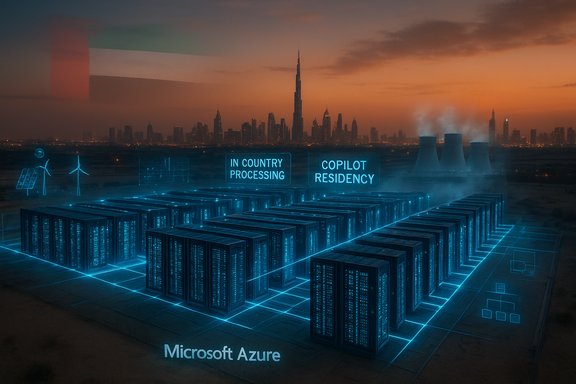
Microsoft’s latest AI push folds two big moves into one clear strategic play: a multibillion-dollar, in-region infrastructure and partnership program in the United Arab Emirates that formalizes sovereign cloud and in‑country Copilot processing, and a rapid rollout of Nvidia’s Blackwell family of AI processors across Azure to give Microsoft the rack‑scale compute needed for next‑generation generative and reasoning workloads. The headlines — tens of thousands of Blackwell‑class GPUs headed to UAE Azure datacenters, a 200 MW datacenter expansion with local partner G42 and a multi‑year $15.2 billion regional commitment — are as much about geopolitics and governance as they are about raw FLOPS.
Background / Overview
Microsoft’s announcement accelerates work the company has been doing to localize AI infrastructure for regulated customers, while simultaneously industrializing the high‑end compute stack inside Azure. The program joins several threads we’ve seen in the last two years: hyperscalers partnering with national institutions to create sovereign cloud capability; the arrival of Nvidia’s Blackwell (GB200/GB300 family) as the new top tier of training/inference hardware for very large models; and evolving U.S. export controls that make such moves politically sensitive and operationally complex. Key facts confirmed by public reporting and vendor communications:- Microsoft says it is committing roughly $15.2 billion in capital and operating expenditures to the UAE between 2023 and 2029, with about half the allocation already spent and the rest planned through 2029.
- The immediate tactical step includes a 200‑megawatt datacenter expansion in partnership with Abu Dhabi’s G42 (via Khazna Data Centres) aimed at bringing thousands of GPU racks online before the end of 2026.
- Microsoft has secured U.S. Commerce Department export licenses that permit shipments of extremely high‑end Nvidia accelerators — described in coverage as the equivalent of ~60,000 A100 GPU equivalents using Nvidia’s GB300/Blackwell Ultra systems — to Azure facilities in the UAE, subject to what Microsoft and regulators call “stringent safeguards.”
- Separately, Microsoft and Nvidia have publicly announced broad integrations to bring Blackwell‑class processors (GB200 and GB300 families) into Azure VM families and supercomputing clusters; vendor materials and Azure blog posts confirm ND/GB200‑class VMs and preview work on Blackwell Ultra‑based VMs for 2025.
What Microsoft is Building in the UAE
A regional AI hub with sovereign controls
Microsoft’s UAE package is not only a data center capacity commitment: it’s an integrated effort to deliver locally governed AI infrastructures — compute, residency guarantees, skills programs, and research partnerships — that allow governments and regulated enterprises to run advanced AI capabilities without sending sensitive data overseas.- Microsoft framed the program as enabling in‑country processing of Microsoft 365 Copilot for “qualified UAE organizations”, a product‑level residency guarantee that converts infrastructure into usable services for banks, healthcare providers and ministries. That capability is being marketed as available in phases, with early availability slated around 2026 for certain offers.
- The package includes creation of research and governance bodies — for example, a Responsible AI Future Foundation with local academic partners — meant to institutionalize safety and standards inside the region.
Power, cooling and industrial scale
A 200 MW allocation is a meaningful, real‑world constraint and capability indicator. Modern rack‑scale AI systems demand dense power and advanced cooling; 200 MW provides the headroom for many thousands of GPU‑dense racks once power distribution, substations and cooling infrastructure are in place. Microsoft and partners have publicly tied the program to renewable and energy partners to address baseload and sustainability concerns.Operational takeaway: capacity planning, power purchase agreements, cooling architecture and site permitting will determine how quickly real usable clusters appear — the headline MW number is necessary but not sufficient to indicate instant availability.
Nvidia Blackwell in Azure: The Technical Upgrade
What Blackwell brings to the table
Nvidia’s Blackwell family (GB200/GB300 and Blackwell Ultra variants) was designed as a generation optimized for the new class of reasoning‑class workloads: long contexts, multimodal inputs, agentic chains of thought, and production‑grade inference at low latency.Highlights in vendor and hyperscaler materials:
- GB200 (Grace Blackwell) and GB300 (Blackwell Ultra / NVL72 rack systems) are built for rack‑scale deployments — NVL72-style racks bundle dozens of Blackwell GPUs with Grace‑family CPUs and extremely high intra‑rack NVLink/NVSwitch bandwidth to produce large pooled memory envelopes that are useful for very large models and long‑context inference.
- Microsoft and Nvidia announced both GB200/GB300 integrations and VM families intended for training and inference workloads on Azure, and Microsoft has publicized ND GB200 v6 and ND GB300‑type offerings as part of its high‑end VM roadmap.
- Blackwell variants are claimed by vendors to improve efficiency and throughput for targeted workloads while also offering better power characteristics than previous generations — but vendor claims are workload dependent. Independent benchmarking remains essential to quantify real gains for specific enterprise models.
Rack‑first architecture: what changes for cloud architects
The fundamental shift is operational: the rack becomes the logical accelerator. That drives new considerations for cloud architects and application designers:- Topology awareness (rack affinity) matters: job schedulers and model parallelism frameworks must be rack‑friendly to extract the full benefit.
- Memory per logical accelerator increases dramatically at the rack level, enabling longer context windows and larger KV caches for Copilot‑style agents.
- Power, liquid or immersion cooling, and pod‑level networking become first‑order infrastructure concerns rather than engineering footnotes.
Geopolitical and Regulatory Context
Export controls, licenses and safeguards
Shipping frontier AI accelerators overseas is governed by U.S. export control regimes that have tightened in recent years. Microsoft says it secured Commerce Department licenses that permit shipments of advanced Nvidia GB300‑class systems to the UAE under specific safeguards and intergovernmental assurances. Public reporting and Microsoft’s own statements emphasize conditional approvals and operational controls attached to licenses. This licensing reality sits in tension with public statements from senior political figures about limiting exports of the “most advanced” chips. The Microsoft‑UAE approvals illustrate how export policy has become case‑by‑case: large, allied nations with governance agreements and negotiated technical safeguards can receive approvals even as broad rhetoric suggests restrictions.Strategic partners and scrutiny
Microsoft’s prior investments in Abu Dhabi‑based G42 (a $1.5 billion equity stake disclosed earlier) complicate the policy picture; G42’s past partnerships and global ties have attracted scrutiny in Washington, and those concerns influenced the structuring of export licenses and operational safeguards. The presence of G42 and other national partners means the project is as much a diplomatic and economic arrangement as it is a technical one.Policy implication: This model — export approvals conditioned on nation‑level assurances and auditability — may be replicated with other allied nations, but it also raises the bar for transparency and compliance auditing that enterprises must consider.
Strengths and Strategic Advantages
- Lower latency and sovereignty: In‑region Blackwell‑class racks and in‑country Copilot processing reduce latency and compliance friction for regulated customers, enabling adoption where prior architectures were a legal or operational barrier.
- Industrialized scale: Microsoft’s Azure footprint and integrations with Nvidia (and third‑party rack vendors) mean customers can consume high‑end compute as a cloud service rather than building and operating racks themselves. That shortens time‑to‑production and shifts operational risk to the cloud provider.
- Model and product enablement: Rack‑scale memory and topology advantages directly improve long‑context models and agentic systems used in Copilot, enterprise automation, and vertical AI — delivering observable UX improvements for generative assistants.
- Governance and skills investment: The Responsible AI Foundation, local AI labs and skilling commitments promise a talent pipeline and governance apparatus that regional governments can lean on to build safe deployments.
Risks, Unknowns and Caveats
1) License details and enforceability are opaque
Public reporting references “stringent safeguards” attached to Commerce Department licenses, but the operational detail — who gets access, what audit mechanisms are in place, whether remote telemetrics or cross‑border failover are permitted — is not available in public documents. That opacity creates compliance risk for customers who require ironclad assurances. Be cautious: the phrase “in‑country processing” is meaningful but rarely absolute; contractual exceptions and support mechanisms commonly allow limited cross‑border flows for debugging or emergency support.2) Performance claims are workload dependent
Vendor and press announcements tout large percentage gains versus prior generation hardware. Those gains are real for targeted workloads but vary based on precision type (FP4/BF16/FP16), model parallelism strategy, batch size and software stack maturity. Independent, third‑party benchmarks on representative enterprise workloads will be required to validate vendor claims for each use case. Headlines that say “X× faster than H100” should be treated as promotional shorthand, not universal fact.3) Energy, sustainability and site engineering
Large Blackwell clusters are power‑hungry and sensitive to cooling design. The 200 MW number is promising but not a guarantee of immediate availability; it signals the scale of the planned buildout. Achieving continuous, low‑carbon baseload for GPU farms will require PPAs, storage and renewables integration — elements that can delay commissioning or increase lifecycle cost. Enterprises must demand carbon and compute accounting to make informed TCO decisions.4) Concentration and vendor lock‑in
Relying on a hyperscaler’s integrated stack (Azure + Nvidia Blackwell + Microsoft‑hosted models) brings convenience but concentrates risk: supply chain constraints, software‑ecosystem lock‑in, and pricing shocks (e.g., hardware scarcity or support model changes) can shift cost structures rapidly. Multi‑cloud and hybrid strategies, or staged migration plans, remain prudent for mission‑critical workloads.5) Geopolitical optics and trust
Hosting frontier accelerators in foreign jurisdictions — even allied ones — invites political scrutiny and reputational risk. Organizations should expect that auditors, supply chain partners and foreign stakeholders will raise questions about governance, data access and the chain of custody for model training data. Contracts must be explicit about data flows, telemetry and audit rights.What This Means for WindowsForum Readers, IT Leaders and Architects
Practical guidance and checklist
- Confirm residency needs and eligibility: if your organization requires in‑country Copilot processing or regional model inference, verify whether you meet the “qualified organization” criteria and get written SLAs describing which features are supported locally.
- Demand technical specifics: request details on physical access controls, key management and confidential compute options, and require audit evidence of the license safeguards the hyperscaler claims.
- Re‑architect for topology: if you aim to leverage GB300/Blackwell‑class instances, instrument your model‑parallel and inference orchestration to be rack‑aware and test for rack affinity. This can materially affect latency and throughput for long‑context models.
- Model staging and benchmarking: run representative workloads on preview ND/GB200/GB300 VMs before committing production workloads; measure latency, cost per token and energy usage. Vendor numbers are a starting point, not the answer.
- Plan for energy and sustainability reporting: request provider carbon intensity and power usage effectiveness (PUE) metrics for your region; include those in TCO and sustainability models.
For developers and ISVs
- Expect new VM SKUs (ND GB200/GB300‑v6 families) to appear in private preview and then general availability; these will be the most cost‑effective route for very large model training and deployment once orchestration and licensing align.
- Update deployment scripts and ML orchestration layers to support topology preferences, NUMA awareness and accelerated fabrics. Container and orchestrator tools may need configuration changes to avoid cross‑rack synchronization penalties.
The Competitive Landscape and Strategic Implications
Microsoft’s Blackwell integration and UAE partnership tighten its position against other hyperscalers that are pursuing similar hardware and regional partnerships. AWS and Google Cloud are also working with high‑end chips, strategic partners and sovereign cloud offerings; Microsoft’s distinction is the tight integration of product residency (Copilot), local governance commitments and a large investment envelope tied to specific national partnerships. This combination — compute + product guarantees + governance scaffolding — becomes a differentiator for regulated sectors. Longer term, expect this template — large hyperscaler investments coupled with export‑conditioned hardware licenses and national governance frameworks — to be replicated with other allied countries that seek sovereign AI capacity. That will reshape the geography of frontier compute in a way that both democratizes access beyond the contiguous United States and increases the complexity of compliance and supply chain management for global enterprises.Conclusion
Microsoft’s UAE deal and the broad rollout of Nvidia Blackwell processors into Azure represent a consequential, system‑level bet: a bet that leading AI capabilities will be delivered not just by centralized exascale clusters but by globally distributed, sovereignly governed regions that host rack‑scale reasoning compute. For customers, the upside is tangible: lower latency, in‑country Copilot processing, and access to the latest hardware without operating the racks themselves. For operators, the challenge is equally real: new compliance obligations, topology‑aware engineering, energy and sustainability tradeoffs, and the need to verify vendor claims with independent benchmarks and contractual assurances.Organizations planning to use these capabilities should move deliberately: insist on contractual clarity about residency and safeguards, perform workload‑level benchmarking on preview hardware, and factor energy and governance costs into procurement decisions. The arrival of Blackwell in Azure and the UAE’s expanded compute footprint will change what’s possible with enterprise AI — but it will also demand more sophisticated operational, legal and risk management practices than previous cloud transitions required.
Source: Apple Magazine Microsoft Expands AI Ambitions With UAE Partnership - AppleMagazine
