

Microsoft appears to be taking a familiar Silicon Valley-style approach to an old problem: reduce headcount without calling it a layoff, while claiming the move will improve the business. According to reporting from The Register, the company has offered a voluntary buyout program to a slice of U.S. employees who are senior director level or below and meet an age-plus-years-of-service threshold of 70 or higher. The timing is awkward for a company that has spent months insisting it is serious about Windows quality and reliability, because buyouts of seasoned staff are precisely the kind of move that can thin out institutional memory at the wrong moment.
Microsoft is no stranger to workforce reshaping, but the current round matters because it lands in the middle of a very visible effort to restore confidence in Windows and in the broader company narrative around execution. Microsoft’s most recent annual report shows a company with 228,000 employees as of June 30, 2025, including about 125,000 in the U.S., and with product R&D still representing a huge share of the workforce. That matters because the company’s own filings make clear that product development, cloud infrastructure, and service quality are central to its business model, not peripheral concerns.
At the same time, Microsoft has been leaning hard into AI and cloud expansion, with those investments showing up in both strategy and cost structure. The FY2025 annual report notes that Microsoft Cloud gross margin was pressured by the scaling of AI infrastructure, even as the company delivered double-digit revenue and operating income growth. In other words, Microsoft is still growing, but it is also paying heavily to keep its AI and cloud ambitions moving. That combination often leads large vendors to look for operating leverage, and headcount is one of the fastest levers available.
Windows has also become a public relations and product-management pressure point. Microsoft has been telling customers that Windows 11 updates are designed to improve quality and reliability, and its support materials now repeatedly emphasize “continuous innovation” delivered through servicing technology, monthly updates, and annual feature releases. The company’s March 2026 Windows communications framed reliability as a priority and pointed to the Insider community as a feedback engine for production quality. That context makes any move that could drain experienced engineers and program managers feel especially delicate.
The broader industry pattern is hardly unique to Microsoft. Large tech firms have spent the last few years cutting, consolidating, and rebalancing teams while arguing that they are becoming more focused. The problem is that buyouts and voluntary exits often concentrate on people with tenure, domain knowledge, and the kind of “how things really work” expertise that is difficult to replace with process documents or AI assistance. That is the central tension here: Microsoft may be trying to get leaner, but it risks becoming less experienced exactly where experience matters most.
The structure is important. A voluntary buyout does not create the same immediate PR hit as a mass layoff, but it can produce similar workforce reductions if enough people accept. It also gives management a softer narrative: no one is being forced out, the company is merely “offering options.” Yet from an operational perspective, the effect can be nearly identical if the employees most inclined to take the package are also the most seasoned.
There are three practical consequences of that structure:
That sounds good on paper, but Windows is a deeply layered product. Reliability work is not just about patch cadence; it is about deep familiarity with subsystems, compatibility constraints, telemetry interpretation, and the hidden edge cases that show up only in the field. When a company trims experienced staff, it can keep the process running, but it may weaken the human judgment that makes those processes effective.
Microsoft’s March 2026 Windows messaging acknowledged the need to improve how issues are identified and prioritized before they reach production environments. That is a welcome admission, but it also implies a more labor-intensive quality discipline, not a less experienced one. The irony is hard to miss: if the company values reliability more than ever, it may now be asking some of the people best equipped to deliver it to leave.
But AI is not a substitute for product stewardship. It can help draft code, summarize data, or accelerate support workflows, yet it does not magically absorb the accumulated judgment of senior engineers, program leads, and quality specialists. If anything, the rise of AI should increase the value of experienced people who know how to validate outputs, catch regressions, and avoid shipping polished nonsense.
There is a difference between operational discipline and indiscriminate slimming. The former can improve execution; the latter can simply make mistakes more expensive. In a software company, particularly one as sprawling as Microsoft, losing seasoned troubleshooters can create savings today and complexity tomorrow.
At the same time, cost pressure from AI infrastructure is real, and Microsoft has been frank about the gross-margin drag that comes with scaling those systems. In that context, personnel reductions can look like a rational response to a broader resource reallocation. The challenge is that reducing labor costs in a software business is not the same as improving product quality, even if the spreadsheet says the initiative is “efficient.”
That perception can hurt morale in ways that are difficult to quantify. Employees do not just respond to their own severance math; they respond to what the company appears to value. If experience is treated as a cost center rather than an asset, people start planning their exits earlier than management expects.
This is where buyouts become a strategic gamble. They can reduce payroll without a public bloodbath, but they can also hollow out the exact ranks that make a large platform company resilient. That is particularly dangerous when the product in question has to serve consumers, enterprises, developers, and OEM partners all at once.
Key risks include:
This is especially relevant for Windows, where large organizations have long memories. IT departments remember the upgrades that broke compatibility, the cumulative updates that caused pain, and the months spent waiting for a reliable fix. A company that wants to win trust back cannot afford to look casual about retaining the people who know how to prevent those failures.
If buyouts hit the wrong pockets, Microsoft may see several subtle effects:
Windows has always had a large surface area, but modern Windows also has a much shorter tolerance window for mistakes. Users expect rapid fixes, but they also expect those fixes not to cause fresh problems. Maintaining that standard takes people who can think beyond the immediate ticket queue.
Consumers do not need Microsoft to be perfect. They need it to be predictably competent. That is a much more modest ask, but it is also the one most likely to be damaged by avoidable churn.
This is especially relevant for enterprise software competitors and for the broader ecosystem of managed endpoint, cloud, and collaboration platforms. Microsoft’s advantage has long been that it is everywhere, but ubiquity becomes a liability if customers start to associate the brand with churn and unreliability. The company has to defend not just market share, but the idea that it can scale without losing control.
There is also a governance question lurking beneath the HR mechanics. Microsoft wants to sell a story of disciplined investment in AI, cloud, and Windows quality, yet those goals can pull against one another if cost pressure is handled crudely. The company does not need fewer people in the abstract; it needs the right people in the right places, and that distinction will determine whether this turns into a smart reset or an expensive self-inflicted wound.
Source: theregister.com Microsoft encourages chunk of experienced US staff to leave
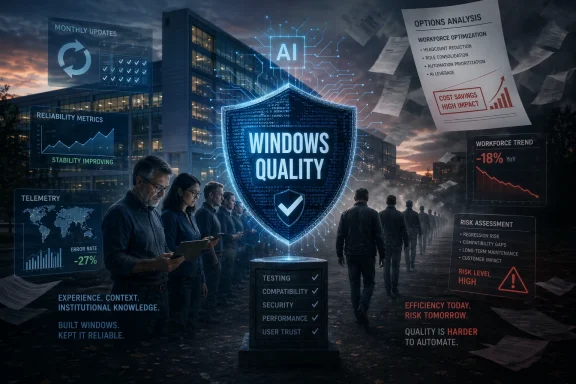 Background
Microsoft is no stranger to workforce reshaping, but the current round matters because it lands in the middle of a very visible effort to restore confidence in Windows and in the broader company narrative around execution. Microsoft’s most recent annual report shows a company with 228,000 employees as of June 30, 2025, including about 125,000 in the U.S., and with product R&D still representing a huge share of the workforce. That matters because the company’s own filings make clear that product development, cloud infrastructure, and service quality are central to its business model, not peripheral concerns.At the same time, Microsoft has been leaning hard into AI and cloud expansion, with those investments showing up in both strategy and cost structure. The FY2025 annual report notes that Microsoft Cloud gross margin was pressured by the scaling of AI infrastructure, even as the company delivered double-digit revenue and operating income growth. In other words, Microsoft is still growing, but it is also paying heavily to keep its AI and cloud ambitions moving. That combination often leads large vendors to look for operating leverage, and headcount is one of the fastest levers available.
Windows has also become a public relations and product-management pressure point. Microsoft has been telling customers that Windows 11 updates are designed to improve quality and reliability, and its support materials now repeatedly emphasize “continuous innovation” delivered through servicing technology, monthly updates, and annual feature releases. The company’s March 2026 Windows communications framed reliability as a priority and pointed to the Insider community as a feedback engine for production quality. That context makes any move that could drain experienced engineers and program managers feel especially delicate.
The broader industry pattern is hardly unique to Microsoft. Large tech firms have spent the last few years cutting, consolidating, and rebalancing teams while arguing that they are becoming more focused. The problem is that buyouts and voluntary exits often concentrate on people with tenure, domain knowledge, and the kind of “how things really work” expertise that is difficult to replace with process documents or AI assistance. That is the central tension here: Microsoft may be trying to get leaner, but it risks becoming less experienced exactly where experience matters most.
What Microsoft Is Reportedly Doing
The Register’s report describes a voluntary buyout scheme aimed at U.S. employees at the senior director level or below, with eligibility tied to an age-plus-years-of-employment rule that reaches 70 or more. The paper’s framing suggests that the pool could be roughly 7 percent of the workforce, or just under 9,000 employees, although exceptions reportedly apply, including some employees on sales incentive plans. That is a meaningful number even for a company of Microsoft’s size, and it signals something more serious than a symbolic retirement offer.The structure is important. A voluntary buyout does not create the same immediate PR hit as a mass layoff, but it can produce similar workforce reductions if enough people accept. It also gives management a softer narrative: no one is being forced out, the company is merely “offering options.” Yet from an operational perspective, the effect can be nearly identical if the employees most inclined to take the package are also the most seasoned.
Why the Eligibility Formula Matters
The age-plus-service formula is a classic way to target employees close to retirement without explicitly saying so. It is not subtle, and it tends to maximize the number of long-tenured people who see the package as a clean exit. That can reduce compensation costs quickly, but it can also remove the workers who understand legacy systems, internal dependencies, and the history behind past failures.There are three practical consequences of that structure:
- It tends to favor departures from highly experienced staff.
- It can create a sharper loss of institutional memory than a standard performance-based layoff.
- It may reduce legal and reputational friction compared with involuntary cuts, at least in the short run.
Why Timing Matters for Windows
The timing is what makes the report sting. Microsoft has been telling customers that it wants to improve Windows quality, and that messaging has grown louder in 2026 as the company has tried to reassure users that update reliability is improving. Microsoft’s own support and Windows-team communications stress that new features and fixes are being shipped with an eye toward stability, and that the Windows Insider pipeline is meant to catch problems before they hit the broad audience.That sounds good on paper, but Windows is a deeply layered product. Reliability work is not just about patch cadence; it is about deep familiarity with subsystems, compatibility constraints, telemetry interpretation, and the hidden edge cases that show up only in the field. When a company trims experienced staff, it can keep the process running, but it may weaken the human judgment that makes those processes effective.
The Quality Problem Is Not Just Technical
Windows quality issues are often discussed as if they are purely engineering defects, but they are also organizational problems. Fixing recurring regression patterns requires memory of prior incidents, knowledge of why certain fixes were chosen, and the ability to spot when a “quick change” will create a downstream mess. That kind of expertise usually lives in people, not in dashboards.Microsoft’s March 2026 Windows messaging acknowledged the need to improve how issues are identified and prioritized before they reach production environments. That is a welcome admission, but it also implies a more labor-intensive quality discipline, not a less experienced one. The irony is hard to miss: if the company values reliability more than ever, it may now be asking some of the people best equipped to deliver it to leave.
AI, Efficiency, and the Executive Narrative
The Register notes that AI was not explicitly mentioned in the reported memo, but AI hangs over almost every major Microsoft workforce discussion now. Microsoft has invested billions into AI infrastructure and product integration, and the company’s consumer and enterprise messaging increasingly positions Copilot-style assistance as a productivity layer across the stack. Microsoft’s own marketing now describes Copilot as available in more places and wrapped in improved reliability, signaling just how central the AI story has become.But AI is not a substitute for product stewardship. It can help draft code, summarize data, or accelerate support workflows, yet it does not magically absorb the accumulated judgment of senior engineers, program leads, and quality specialists. If anything, the rise of AI should increase the value of experienced people who know how to validate outputs, catch regressions, and avoid shipping polished nonsense.
The Efficiency Argument Cuts Both Ways
Microsoft’s leadership can plausibly argue that the company needs a leaner structure to stay nimble in an AI-heavy market. That is not a crazy claim, especially given the capital intensity of AI infrastructure and the pressure on margins from model training and cloud scaling. But a smarter efficiency strategy would target process duplication and organizational bloat before it targets the people who have been keeping the product stable.There is a difference between operational discipline and indiscriminate slimming. The former can improve execution; the latter can simply make mistakes more expensive. In a software company, particularly one as sprawling as Microsoft, losing seasoned troubleshooters can create savings today and complexity tomorrow.
What the Numbers Suggest
Microsoft’s recent financial results help explain why the company might feel emboldened to reshuffle the workforce. FY2025 revenue reached $281.7 billion, operating income hit $128.5 billion, and net income topped $101.8 billion. Those are not the figures of a company in distress. They are the figures of a company that can afford to make strategic cuts while still presenting itself as exceptionally healthy.At the same time, cost pressure from AI infrastructure is real, and Microsoft has been frank about the gross-margin drag that comes with scaling those systems. In that context, personnel reductions can look like a rational response to a broader resource reallocation. The challenge is that reducing labor costs in a software business is not the same as improving product quality, even if the spreadsheet says the initiative is “efficient.”
Compensation and Credibility
The optics also matter. Microsoft’s executive compensation remains enormous, and the company’s shareholder materials show that executive pay continues to be a visible topic in governance discussions. Even without getting lost in the politics of CEO pay, the contrast between richly paid leadership and buyouts for long-serving staff is hard to ignore. It feeds a familiar employee narrative: the people who built the place are asked to make room for the next strategic turn.That perception can hurt morale in ways that are difficult to quantify. Employees do not just respond to their own severance math; they respond to what the company appears to value. If experience is treated as a cost center rather than an asset, people start planning their exits earlier than management expects.
The Risks of Losing Experience
Experienced staff are not just expensive employees with long résumés. They are often the people who understand the failure modes that do not show up in hiring interviews. In Windows, where backward compatibility, security hardening, and hardware diversity all collide, that knowledge is especially valuable. If too many of those workers leave, Microsoft may find itself paying later in slower incident response, poorer triage, and more cautious shipping decisions.This is where buyouts become a strategic gamble. They can reduce payroll without a public bloodbath, but they can also hollow out the exact ranks that make a large platform company resilient. That is particularly dangerous when the product in question has to serve consumers, enterprises, developers, and OEM partners all at once.
Institutional Memory vs. AI Assistance
AI tools can help document systems, generate code, and summarize prior incidents, but they do not fully replace institutional memory. A seasoned engineer often knows which bug report is a symptom, which one is noise, and which one is the start of a widespread regression. That judgment is often built over years of accumulated pain, and it is not easily distilled into a chatbot prompt.Key risks include:
- Slower identification of recurring defects.
- Reduced ability to trace root causes across legacy components.
- Fewer mentors for junior staff.
- More dependence on documentation that may already be incomplete.
- Higher odds of repeat mistakes in release management.
- Lower team confidence during high-pressure incidents.
Enterprise Customers Will Feel This Too
Enterprise customers often care more about stability than novelty. They want predictable update behavior, fewer regressions, and support teams that understand the difference between an annoyance and a business disruption. If Microsoft’s workforce changes weaken those functions, the consequences may not show up in marketing copy, but they will show up in support tickets and rollout decisions.This is especially relevant for Windows, where large organizations have long memories. IT departments remember the upgrades that broke compatibility, the cumulative updates that caused pain, and the months spent waiting for a reliable fix. A company that wants to win trust back cannot afford to look casual about retaining the people who know how to prevent those failures.
Support, Servicing, and the Hidden Cost of Churn
Support quality is not glamorous, but it is strategically vital. It is the difference between a customer who tolerates a bad patch cycle and one who starts evaluating alternatives. Microsoft’s own recent messaging about continuous innovation and update reliability suggests that it understands this well. But support promises are only as strong as the teams behind them.If buyouts hit the wrong pockets, Microsoft may see several subtle effects:
- Longer resolution times for complex cases.
- More escalation between product teams.
- Higher dependence on contractors or temporary staff.
- Slower propagation of hard-earned lessons.
- Reduced confidence in update governance.
The Consumer Windows Story
For consumers, the issue is less about contract clauses and more about whether Windows feels dependable again. Microsoft has been trying to stabilize the user experience while also layering on AI features, richer cloud integration, and more frequent servicing. That is a difficult balancing act even when staffing is steady. If the company trims too much experienced talent, the consumer-facing result could be more of the same: promising launches followed by patch notes and apologetic follow-ups.Windows has always had a large surface area, but modern Windows also has a much shorter tolerance window for mistakes. Users expect rapid fixes, but they also expect those fixes not to cause fresh problems. Maintaining that standard takes people who can think beyond the immediate ticket queue.
The Update Quality Problem Is Social, Not Just Software
A lot of Windows frustration now comes from the feeling that users are being asked to act as unpaid testers in a never-ending release cycle. Microsoft has made real investments in the Insider program and in update telemetry, yet public confidence still depends on the everyday experience of people who are not enthusiasts. If a buyout wave removes some of the staff who know how to interpret that experience, the feedback loop can get noisier and less useful.Consumers do not need Microsoft to be perfect. They need it to be predictably competent. That is a much more modest ask, but it is also the one most likely to be damaged by avoidable churn.
How Rivals May Read the Move
Competitors do not need Microsoft to fail completely; they only need it to stumble often enough that alternatives look safer. In operating systems, cloud, productivity, and AI, the boundary between product superiority and trust is thin. If Microsoft appears to be sacrificing seasoned expertise for efficiency, rivals can frame themselves as more stable, more customer-centric, or more disciplined.This is especially relevant for enterprise software competitors and for the broader ecosystem of managed endpoint, cloud, and collaboration platforms. Microsoft’s advantage has long been that it is everywhere, but ubiquity becomes a liability if customers start to associate the brand with churn and unreliability. The company has to defend not just market share, but the idea that it can scale without losing control.
Competitive Pressure Points
The risk is not a single rival taking over Windows. It is a thousand small comparisons:- “This vendor’s support is calmer.”
- “That platform ships fewer regressions.”
- “Our users complain less after upgrades there.”
- “Their roadmap seems less chaotic.”
- “We trust that team more with critical workloads.”
Strengths and Opportunities
There is still a plausible upside if Microsoft uses the buyout program selectively and protects the right expertise. A carefully managed reduction could remove organizational drag, lower long-term costs, and free resources for the areas the company now considers strategically essential. The opportunity is not in shrinking for its own sake, but in proving that Microsoft can reallocate talent without damaging product quality. The company’s scale, cash generation, and market position mean it has options, if it chooses discipline over bluntness.- Microsoft can reduce overhead without a mass-layoff headline.
- Voluntary exits may soften short-term morale damage compared with forced cuts.
- The company can redirect resources toward AI infrastructure and cloud execution.
- A leaner org may speed decision-making if layers are genuinely redundant.
- The move could signal investor discipline during a capital-heavy AI cycle.
- If handled well, Microsoft can retain enough expertise to preserve quality.
- A focused reorganization could improve accountability across Windows and platform teams.
Where the Opportunity Is Real
The best-case version of this strategy is not simple headcount reduction. It is a deliberate reshaping that preserves the people who understand release engineering, customer pain points, and the failure patterns that matter most. If Microsoft can do that, it may actually improve execution while funding its next phase of growth.Risks and Concerns
The risks are just as clear. A program that quietly encourages older, more experienced employees to leave can create a brain drain disguised as a voluntary benefit. That might make the org chart look cleaner, but it can also leave the company with fewer people who know how to keep Windows stable under pressure. If the wrong people accept the package, Microsoft could end up paying more in rework, delay, and reputation damage than it saves in payroll.- The policy may disproportionately target employees with the deepest institutional knowledge.
- Windows quality work could suffer if experienced troubleshooters depart.
- Customer trust may weaken if service reliability worsens.
- Morale can take a hit when long-tenured staff see themselves as expendable.
- AI tools may be overestimated as replacements for human judgment.
- The company could face a second wave of cuts if buyouts fall short.
- Investor enthusiasm for efficiency may collide with product reality.
The Core Concern
The biggest concern is not that Microsoft is being cheap. It is that the company may be undervaluing the very talent it says it needs. If quality is truly the priority, then retaining expertise should be the starting point, not the casualty list.Looking Ahead
The next few months will reveal whether Microsoft is conducting a surgical reshaping or simply running another round of corporate trimming under a softer label. If enough senior staff take the package, the company may avoid more visible layoffs, but it may also have to absorb the operational cost of losing depth at a time when Windows reliability is under the microscope. That tradeoff will matter far more than the memo language.There is also a governance question lurking beneath the HR mechanics. Microsoft wants to sell a story of disciplined investment in AI, cloud, and Windows quality, yet those goals can pull against one another if cost pressure is handled crudely. The company does not need fewer people in the abstract; it needs the right people in the right places, and that distinction will determine whether this turns into a smart reset or an expensive self-inflicted wound.
- Watch whether the buyout window is extended or expanded.
- Watch for follow-on involuntary layoffs if participation is low.
- Watch how Windows engineering leadership talks about quality in the next quarter.
- Watch for morale effects in product, support, and servicing teams.
- Watch whether Microsoft reaffirms, quietly alters, or walks back staffing targets.
Source: theregister.com Microsoft encourages chunk of experienced US staff to leave
