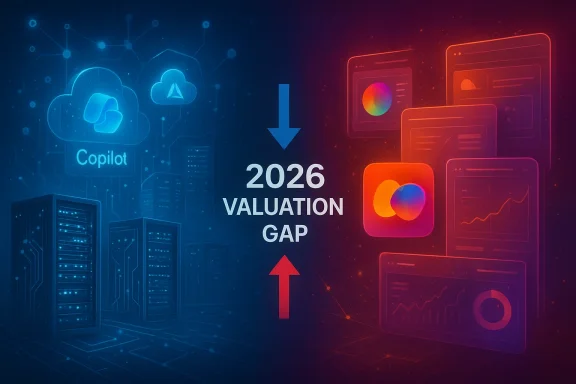
Microsoft and Adobe remain two of the most important software franchises in the market, but the investment case for each has diverged sharply as 2026 unfolds. Microsoft is leaning on its scale, cloud dominance, and rapid AI commercialization to sustain double-digit growth, while Adobe is trying to prove that its creative and marketing ecosystem can grow fast enough to offset tougher competitive and macro pressures. On the evidence currently available, Microsoft offers the stronger growth profile, but Adobe’s lower valuation gives it more leverage if execution improves. The key question is not which company is better managed; it is which one can translate AI momentum into durable, expanding revenue at scale.
Microsoft and Adobe have spent years building powerful subscription businesses, but the market now views them through very different lenses. Microsoft is increasingly treated as a broad AI and cloud platform with exposure to enterprise productivity, infrastructure, developer tools, security, and data. Adobe is more narrowly positioned around digital media and digital experience, with an installed base that is deeply entrenched but also more exposed to category-specific disruption.
That difference matters because software investors are no longer paying just for recurring revenue. They are paying for the ability to compound revenue through new workloads, higher average revenue per user, and AI-driven expansion inside existing customer relationships. Microsoft’s footprint across Azure, Microsoft 365, Copilot, and security gives it multiple shots on goal. Adobe’s opportunity is meaningful, but it is more concentrated in creative workflows, document tools, and marketing technology.
The current comparison is also shaped by the companies’ AI strategies. Microsoft has embedded generative AI across its stack and paired it with enormous infrastructure investment, long-term demand visibility, and a deep partnership with OpenAI that remains central to its ecosystem. Adobe, meanwhile, has pushed Firefly and adjacent AI workflows into creative and marketing products, aiming to defend its franchise while also opening new usage-based opportunities.
The difference in market positioning shows up in valuation and sentiment. Microsoft trades as a premium compounder because investors believe the company can keep expanding in cloud and AI despite heavy capital spending. Adobe trades at a much lower multiple because investors see slower growth, a more contested product set, and some uncertainty around leadership and the pace of AI monetization.
A fair comparison therefore has to separate brand strength from growth durability. Both companies are still highly relevant, both are still profitable, and both are still investing in AI. But their paths to growth, and the risks attached to those paths, are not the same. Microsoft is a scale-and-infrastructure story; Adobe is a product-and-transition story.
The scale of the backlog is especially important because it reduces the market’s need to guess at near-term outcomes. Microsoft can point to a long pipeline of contracted or anticipated business across cloud, productivity, and AI services. That makes the company less dependent on any single product cycle than many other software names.
AI is not just a marketing layer for Microsoft; it is becoming a monetization engine across the portfolio. Microsoft 365 Copilot is increasingly tied to revenue per user growth, and management has said the strongest commercial performance has been led by E5 and Copilot adoption. When AI becomes embedded in the seat, the economic model becomes more attractive than a standalone add-on or experimental pilot.
That matters for investors because capacity constraints are a temporary drag but also a sign of true demand. Microsoft is spending heavily to expand data center infrastructure and GPU availability, and that spending is pressuring margins. Yet the existence of the bottleneck also implies that revenue could accelerate further if supply catches up faster than expected.
That model is especially attractive in the enterprise market, where switching costs are already high. If Microsoft can make Copilot indispensable in daily work, it gains a durable revenue layer with strong retention characteristics. The company is also benefiting from a broader market shift toward agentic AI, where software is expected to complete tasks rather than merely assist users.
The importance of this relationship goes beyond headline news. It gives Microsoft a recurring advantage in product integration, infrastructure utilization, and customer perception. Even when OpenAI expands externally, Microsoft still retains a strategic position in the ecosystem that few rivals can match. That kind of embedded relevance is rare in tech and difficult for competitors to dislodge.
Key takeaways from Microsoft’s current setup:
The company’s first-quarter fiscal 2026 results showed record revenue of $6.4 billion, up 12% year over year, with subscription revenue up 13%. Adobe also reported that AI-first annualized recurring revenue had more than tripled, and monthly active users surpassed 850 million. Those are not trivial figures; they indicate meaningful product engagement and broad consumer and enterprise reach.
Still, Adobe’s growth narrative is not as clean as Microsoft’s. Adobe’s business depends heavily on maintaining relevance in creative software and marketing technology while defending against AI-native competitors. That is a harder balancing act than expanding a cloud platform already benefiting from massive enterprise adoption.
The challenge is that creative AI is becoming crowded quickly. Adobe is not only competing with traditional software vendors; it is also competing with newer tools built around speed, automation, and lower-cost experimentation. If users can generate usable content elsewhere and export it into their workflows, Adobe has to prove that its integrated stack is worth paying a premium for.
That matters because marketing teams increasingly want AI systems that are both creative and analytical. Adobe’s alliance with WPP and its broader enterprise marketing push suggest that the company understands this shift. If Adobe can become the operating layer for AI-powered marketing campaigns, it could reaccelerate the overall business.
The bigger issue is product mix. Adobe’s stock business is a relatively small but visible drag, and the company faces continued pressure from lower-cost or AI-native alternatives in some categories. The concern is not collapse; it is erosion at the edges while the core remains healthy. Over time, edge erosion can still matter if it limits pricing power.
But margins alone do not win growth comparisons. Investors want to know whether AI is creating a new runway or simply defending the old one. Adobe’s challenge is to prove that AI can be both protective and expansive.
That does not make Adobe cheap in a vacuum; it makes Adobe cheaper relative to Microsoft. For investors, the right question is whether the discount is a warning or an opportunity. Right now, the market appears to be saying that Adobe’s path to higher growth is more uncertain than Microsoft’s.
Microsoft’s premium is easier to justify because its revenue base is larger and more diversified. It has cloud infrastructure, enterprise software, security, developer tools, and AI all contributing to the story. Adobe has a strong brand and a loyal customer base, but its investment case is more concentrated and therefore more sensitive to execution.
The valuation also reflects confidence in Microsoft’s ability to keep compounding even as spending rises. AI capital expenditures are significant, but the company has the balance sheet and cash flow to absorb them. That gives Microsoft strategic flexibility that smaller or more specialized software companies simply do not have.
There is also an investor psychology issue at work. When a company has been perceived as a premium compounder for years, any slowdown in growth can compress the multiple quickly. Adobe is experiencing exactly that. The market is rewarding certainty elsewhere and demanding a discount for uncertainty here.
In practical terms, the market is making a distinction between good business and better growth story. Adobe remains a good business. Microsoft is still the better growth story.
Microsoft’s approach is broader and more defensible because it is tied to the systems companies already use to run their operations. When Azure, Microsoft 365, and security all layer together, AI adoption becomes embedded in the enterprise stack. That tends to support higher retention and more stable expansion revenue.
Adobe’s AI strategy is narrower but still potentially powerful. If Firefly becomes indispensable for creative and marketing teams, Adobe can deepen engagement and reduce churn. The company’s challenge is that creative AI features are easier for rivals to imitate than Microsoft’s integrated enterprise control plane.
Adobe has a stronger consumer and prosumer footprint, especially around creative expression and content generation. That broadens its user base, but it can also dilute pricing power if users can access similar capabilities elsewhere. The consumer side can create top-of-funnel engagement, yet the enterprise side is where long-term value is most likely to compound.
That means Microsoft has more pathways to expansion without relying on entirely new customer acquisition. Adobe can still grow through upselling and cross-selling, but its cross-sell universe is smaller. The more limited the product ecosystem, the harder it is to sustain accelerated growth over many years.
Adobe’s position is strong inside creative and digital experience workflows, but those markets are more exposed to AI substitution. The company has a powerful installed base, yet installed base alone does not guarantee expansion if new tools reshape user expectations. Adobe must convince customers that its integrated workflow remains superior even as generative AI lowers barriers to entry.
The strategic contrast is therefore stark. Microsoft is using AI to broaden its platform moat. Adobe is using AI to defend and extend its existing moat. Both strategies can work, but the first tends to produce more visible growth upside in the near term.
Adobe faces a different competitive field. It must contend with AI-native content tools, alternative design platforms, and marketing software that increasingly blends automation with analytics. The result is not that Adobe is losing relevance, but that it must work harder to preserve pricing power.
That difference matters in an AI market where users are willing to switch quickly if a tool feels faster or cheaper. Microsoft can often bundle around that risk. Adobe has less room to maneuver.
Microsoft’s AI capital expenditures are a real concern for margin watchers, but they are also a sign of ambition. The company is investing for future compute, future enterprise demand, and future AI adoption. If those investments continue to translate into Azure and Copilot growth, the spending will look prescient rather than excessive.
Adobe is in a different position. It does not need to make the same scale of infrastructure investment, which supports its margin profile. But lower capex does not automatically translate into a better growth outcome. Adobe’s issue is not financial fragility; it is whether its product mix can accelerate enough to re-rate the stock.
Adobe’s ARR is also substantial, but its growth is more modest and more vulnerable to product cycle shifts. Recurring revenue is a strength, but recurring revenue with weak expansion is less exciting than recurring revenue with strong AI attach. The market knows that distinction well.
Key financial contrasts:
The most important developments to watch are likely to come from product adoption, not just earnings calls. Microsoft needs to prove that Copilot and Azure continue to expand at scale while capacity catches up. Adobe needs to show that Firefly, marketing automation, and any Semrush integration can accelerate ARR and improve confidence in the long-term platform story.
Source: Bitget Microsoft or Adobe: Which Tech Powerhouse Offers Greater Growth Opportunities? | Bitget News
 Background
Microsoft and Adobe have spent years building powerful subscription businesses, but the market now views them through very different lenses. Microsoft is increasingly treated as a broad AI and cloud platform with exposure to enterprise productivity, infrastructure, developer tools, security, and data. Adobe is more narrowly positioned around digital media and digital experience, with an installed base that is deeply entrenched but also more exposed to category-specific disruption.That difference matters because software investors are no longer paying just for recurring revenue. They are paying for the ability to compound revenue through new workloads, higher average revenue per user, and AI-driven expansion inside existing customer relationships. Microsoft’s footprint across Azure, Microsoft 365, Copilot, and security gives it multiple shots on goal. Adobe’s opportunity is meaningful, but it is more concentrated in creative workflows, document tools, and marketing technology.
The current comparison is also shaped by the companies’ AI strategies. Microsoft has embedded generative AI across its stack and paired it with enormous infrastructure investment, long-term demand visibility, and a deep partnership with OpenAI that remains central to its ecosystem. Adobe, meanwhile, has pushed Firefly and adjacent AI workflows into creative and marketing products, aiming to defend its franchise while also opening new usage-based opportunities.
The difference in market positioning shows up in valuation and sentiment. Microsoft trades as a premium compounder because investors believe the company can keep expanding in cloud and AI despite heavy capital spending. Adobe trades at a much lower multiple because investors see slower growth, a more contested product set, and some uncertainty around leadership and the pace of AI monetization.
A fair comparison therefore has to separate brand strength from growth durability. Both companies are still highly relevant, both are still profitable, and both are still investing in AI. But their paths to growth, and the risks attached to those paths, are not the same. Microsoft is a scale-and-infrastructure story; Adobe is a product-and-transition story.
Microsoft’s Growth Engine
Microsoft’s recent momentum is built on a mix of cloud demand, AI attach rates, and broad enterprise adoption. In its fiscal 2026 second quarter, Azure and other cloud services revenue grew 39%, while commercial remaining performance obligation surged to $625 billion, up 110% year over year. That combination tells investors two important things: demand is still outpacing supply, and future revenue visibility remains exceptionally strong.The scale of the backlog is especially important because it reduces the market’s need to guess at near-term outcomes. Microsoft can point to a long pipeline of contracted or anticipated business across cloud, productivity, and AI services. That makes the company less dependent on any single product cycle than many other software names.
AI is not just a marketing layer for Microsoft; it is becoming a monetization engine across the portfolio. Microsoft 365 Copilot is increasingly tied to revenue per user growth, and management has said the strongest commercial performance has been led by E5 and Copilot adoption. When AI becomes embedded in the seat, the economic model becomes more attractive than a standalone add-on or experimental pilot.
Azure and the Capacity Constraint
The strongest evidence of Microsoft’s growth opportunity is still Azure. A 39% growth rate at this scale is not merely good execution; it indicates that enterprise workloads are continuing to migrate and that AI demand is creating entirely new categories of consumption. The company’s own commentary suggests that the bottleneck is capacity, not customer interest.That matters for investors because capacity constraints are a temporary drag but also a sign of true demand. Microsoft is spending heavily to expand data center infrastructure and GPU availability, and that spending is pressuring margins. Yet the existence of the bottleneck also implies that revenue could accelerate further if supply catches up faster than expected.
Copilot as a Pricing Lever
Copilot is now a central part of Microsoft’s growth story. Its expansion across Microsoft 365, Teams, Dynamics 365, and Azure makes it more than a single product; it is a pricing and engagement mechanism across the enterprise stack. When customers upgrade from standard productivity software to AI-enhanced workflows, Microsoft can raise revenue without necessarily relying on headcount-driven growth.That model is especially attractive in the enterprise market, where switching costs are already high. If Microsoft can make Copilot indispensable in daily work, it gains a durable revenue layer with strong retention characteristics. The company is also benefiting from a broader market shift toward agentic AI, where software is expected to complete tasks rather than merely assist users.
The Strategic Value of OpenAI
Microsoft’s relationship with OpenAI remains one of its most important competitive advantages. The companies reaffirmed their partnership in late February 2026, with Microsoft stating that the commercial and IP relationship remains unchanged and that Azure remains the exclusive cloud provider for stateless OpenAI APIs. That keeps Microsoft at the center of the modern AI supply chain, both as a platform and as a beneficiary of model demand.The importance of this relationship goes beyond headline news. It gives Microsoft a recurring advantage in product integration, infrastructure utilization, and customer perception. Even when OpenAI expands externally, Microsoft still retains a strategic position in the ecosystem that few rivals can match. That kind of embedded relevance is rare in tech and difficult for competitors to dislodge.
What the Numbers Say
Microsoft’s fiscal 2026 guidance remains strong. Management projected total revenue between $80.65 billion and $81.75 billion for the March quarter, implying continued double-digit growth. Analysts also expect fiscal 2026 earnings per share to rise meaningfully year over year, reflecting the company’s unusual mix of growth and profitability.Key takeaways from Microsoft’s current setup:
- Azure growth remains exceptional for a business already at enormous scale.
- Commercial RPO of $625 billion provides long visibility.
- Copilot adoption is lifting revenue per user across the portfolio.
- AI infrastructure spend is high, but it is funding future capacity.
- Enterprise demand remains broad rather than isolated to one vertical.
Adobe’s AI Transition
Adobe’s case is more nuanced. The company is still growing, still highly profitable, and still deeply embedded in creative and marketing workflows. But its growth rate is slower than Microsoft’s, and investors are watching closely to see whether AI can offset pressures in its stock photography and creative segments. In fiscal 2026, Adobe is trying to demonstrate that it can evolve without losing the cash-generating strength of its core franchise.The company’s first-quarter fiscal 2026 results showed record revenue of $6.4 billion, up 12% year over year, with subscription revenue up 13%. Adobe also reported that AI-first annualized recurring revenue had more than tripled, and monthly active users surpassed 850 million. Those are not trivial figures; they indicate meaningful product engagement and broad consumer and enterprise reach.
Still, Adobe’s growth narrative is not as clean as Microsoft’s. Adobe’s business depends heavily on maintaining relevance in creative software and marketing technology while defending against AI-native competitors. That is a harder balancing act than expanding a cloud platform already benefiting from massive enterprise adoption.
Firefly and the Creative Stack
Firefly is Adobe’s most important AI bet. The company has been pushing generative AI into its creative apps, marketing tools, and enterprise workflows in an effort to preserve its position as the default creative suite. Adobe’s advantage is that it controls the surface area where professionals already work, which gives it a natural distribution channel for new AI features.The challenge is that creative AI is becoming crowded quickly. Adobe is not only competing with traditional software vendors; it is also competing with newer tools built around speed, automation, and lower-cost experimentation. If users can generate usable content elsewhere and export it into their workflows, Adobe has to prove that its integrated stack is worth paying a premium for.
Marketing Cloud and the Semrush Angle
Adobe’s marketing business is another potential growth lever, especially if the company successfully integrates Semrush. The planned acquisition could strengthen Adobe’s ability to connect content creation with search visibility and competitive intelligence. In theory, that creates a stronger end-to-end marketing platform that spans discovery, creation, optimization, and measurement.That matters because marketing teams increasingly want AI systems that are both creative and analytical. Adobe’s alliance with WPP and its broader enterprise marketing push suggest that the company understands this shift. If Adobe can become the operating layer for AI-powered marketing campaigns, it could reaccelerate the overall business.
Revenue Quality and Product Mix
Adobe’s business remains highly recurring, which is one of its main strengths. The company’s total ARR reached $26.06 billion in fiscal 2026, and management continues to guide for solid growth. But ARR growth in the low double digits is simply less explosive than what Microsoft is showing through Azure and AI-linked enterprise expansion.The bigger issue is product mix. Adobe’s stock business is a relatively small but visible drag, and the company faces continued pressure from lower-cost or AI-native alternatives in some categories. The concern is not collapse; it is erosion at the edges while the core remains healthy. Over time, edge erosion can still matter if it limits pricing power.
Adobe’s Operating Discipline
One of Adobe’s best qualities is that it still runs an efficient business. For Q2 fiscal 2026, management guided for revenue between $6.43 billion and $6.48 billion and a non-GAAP operating margin near 44.5%. That is a reminder that Adobe remains a high-quality cash generator even in a more complicated growth environment.But margins alone do not win growth comparisons. Investors want to know whether AI is creating a new runway or simply defending the old one. Adobe’s challenge is to prove that AI can be both protective and expansive.
Valuation and Market Sentiment
Valuation is where the contrast becomes especially visible. Microsoft trades at a much richer forward sales multiple than Adobe, and that premium reflects a belief that the company’s growth is more durable, diversified, and scalable. Adobe’s lower valuation suggests that the market sees more risk, less upside leverage, and a slower AI transition.That does not make Adobe cheap in a vacuum; it makes Adobe cheaper relative to Microsoft. For investors, the right question is whether the discount is a warning or an opportunity. Right now, the market appears to be saying that Adobe’s path to higher growth is more uncertain than Microsoft’s.
Microsoft’s premium is easier to justify because its revenue base is larger and more diversified. It has cloud infrastructure, enterprise software, security, developer tools, and AI all contributing to the story. Adobe has a strong brand and a loyal customer base, but its investment case is more concentrated and therefore more sensitive to execution.
Why the Premium Exists
Investors typically pay up for three things: scale, scarcity, and durability. Microsoft checks all three boxes. It is one of the few companies large enough to build AI infrastructure at massive scale while also monetizing it through enterprise software subscriptions and cloud consumption.The valuation also reflects confidence in Microsoft’s ability to keep compounding even as spending rises. AI capital expenditures are significant, but the company has the balance sheet and cash flow to absorb them. That gives Microsoft strategic flexibility that smaller or more specialized software companies simply do not have.
Why Adobe Looks Cheaper
Adobe’s lower multiple reflects a different reality. Growth is still respectable, but not exceptional, and management is navigating a more crowded product landscape. The company is also facing a leadership transition, which tends to invite caution even when the underlying business remains solid.There is also an investor psychology issue at work. When a company has been perceived as a premium compounder for years, any slowdown in growth can compress the multiple quickly. Adobe is experiencing exactly that. The market is rewarding certainty elsewhere and demanding a discount for uncertainty here.
Relative Performance
Recent share performance has reflected these concerns. Microsoft has held up better than Adobe over the past six months, even though both names have lagged broader technology benchmarks. That suggests investors are still willing to favor Microsoft’s growth durability over Adobe’s turnaround potential.In practical terms, the market is making a distinction between good business and better growth story. Adobe remains a good business. Microsoft is still the better growth story.
AI Monetization Paths
The AI race is often discussed as if all software firms are pursuing the same opportunity, but that is not true. Microsoft and Adobe are monetizing AI through very different mechanisms, and those differences matter a great deal. Microsoft is monetizing through infrastructure usage, enterprise seats, copilots, and integrated agent workflows. Adobe is monetizing through content generation, workflow automation, and marketing optimization.Microsoft’s approach is broader and more defensible because it is tied to the systems companies already use to run their operations. When Azure, Microsoft 365, and security all layer together, AI adoption becomes embedded in the enterprise stack. That tends to support higher retention and more stable expansion revenue.
Adobe’s AI strategy is narrower but still potentially powerful. If Firefly becomes indispensable for creative and marketing teams, Adobe can deepen engagement and reduce churn. The company’s challenge is that creative AI features are easier for rivals to imitate than Microsoft’s integrated enterprise control plane.
Enterprise Versus Consumer Dynamics
Enterprise adoption is where Microsoft has the clear edge. Its products are already core to day-to-day business operations, and AI features can be sold as productivity enhancements that justify price increases. That makes monetization more predictable and easier to scale across departments and geographies.Adobe has a stronger consumer and prosumer footprint, especially around creative expression and content generation. That broadens its user base, but it can also dilute pricing power if users can access similar capabilities elsewhere. The consumer side can create top-of-funnel engagement, yet the enterprise side is where long-term value is most likely to compound.
Seat Expansion and Attach Rates
A crucial metric in both stories is attach rate. Microsoft can attach Copilot, security, and cloud services to existing enterprise accounts. Adobe can attach Firefly, Express, Document Cloud, and marketing tools to existing creative and business users. The difference is that Microsoft’s attach opportunity extends across a much broader enterprise surface area.That means Microsoft has more pathways to expansion without relying on entirely new customer acquisition. Adobe can still grow through upselling and cross-selling, but its cross-sell universe is smaller. The more limited the product ecosystem, the harder it is to sustain accelerated growth over many years.
Competitive Positioning
Microsoft’s competitive position is strengthened by the fact that it is not trying to win in just one category. It can compete with hyperscalers in cloud, with productivity suites in collaboration, with security vendors in identity and protection, and with enterprise software providers in workflow automation. That multiplicity gives it resilience and optionality.Adobe’s position is strong inside creative and digital experience workflows, but those markets are more exposed to AI substitution. The company has a powerful installed base, yet installed base alone does not guarantee expansion if new tools reshape user expectations. Adobe must convince customers that its integrated workflow remains superior even as generative AI lowers barriers to entry.
The strategic contrast is therefore stark. Microsoft is using AI to broaden its platform moat. Adobe is using AI to defend and extend its existing moat. Both strategies can work, but the first tends to produce more visible growth upside in the near term.
What Rivals Are Doing
In the enterprise software market, Microsoft’s main rivals are still trying to match its breadth. Few can replicate the combination of cloud, productivity, security, and AI in one ecosystem. That is one reason Microsoft often looks less like a software vendor and more like a full-stack operating layer for the digital enterprise.Adobe faces a different competitive field. It must contend with AI-native content tools, alternative design platforms, and marketing software that increasingly blends automation with analytics. The result is not that Adobe is losing relevance, but that it must work harder to preserve pricing power.
The Moat Question
Microsoft’s moat is expanding because the company keeps adding layers customers need to manage. Identity, governance, compliance, data, and AI orchestration all reinforce each other. Adobe’s moat is still strong, but it is more dependent on product quality and workflow familiarity than on platform breadth.That difference matters in an AI market where users are willing to switch quickly if a tool feels faster or cheaper. Microsoft can often bundle around that risk. Adobe has less room to maneuver.
Financial Quality
Both companies are financially strong, but they convert growth into value differently. Microsoft combines high growth with substantial cash generation, even after aggressive AI spending. Adobe combines lower but steady growth with very attractive margins and recurring revenue.Microsoft’s AI capital expenditures are a real concern for margin watchers, but they are also a sign of ambition. The company is investing for future compute, future enterprise demand, and future AI adoption. If those investments continue to translate into Azure and Copilot growth, the spending will look prescient rather than excessive.
Adobe is in a different position. It does not need to make the same scale of infrastructure investment, which supports its margin profile. But lower capex does not automatically translate into a better growth outcome. Adobe’s issue is not financial fragility; it is whether its product mix can accelerate enough to re-rate the stock.
Revenue Visibility
Microsoft has exceptional revenue visibility thanks to its massive commercial RPO balance. That backlog gives investors confidence that growth is not dependent on a few large deals closing in a single quarter. It also suggests that Microsoft can absorb short-term volatility while still maintaining a strong medium-term trajectory.Adobe’s ARR is also substantial, but its growth is more modest and more vulnerable to product cycle shifts. Recurring revenue is a strength, but recurring revenue with weak expansion is less exciting than recurring revenue with strong AI attach. The market knows that distinction well.
Margin Versus Momentum
Adobe’s margins are better than Microsoft’s in many periods, which is one reason investors continue to respect the business. But Microsoft’s momentum is stronger, and growth tends to dominate valuation debates when investors are willing to pay for expansion. In a market that rewards AI scale, momentum often wins.Key financial contrasts:
- Microsoft has faster revenue growth.
- Adobe has stronger operating margins.
- Microsoft has greater backlog visibility.
- Adobe has more concentrated product exposure.
- Microsoft has higher capital intensity but broader optionality.
Strengths and Opportunities
Both companies bring real strengths to the table, and both have credible opportunities to create value from AI. The difference is in the breadth of those opportunities and the likelihood that each company can monetize them at scale. Microsoft currently has more moving parts working in its favor, while Adobe has a more focused but more vulnerable transition.- Microsoft has a diversified AI and cloud platform that can monetize across multiple product lines.
- Azure remains a major growth driver with enormous demand visibility.
- Copilot gives Microsoft a direct way to raise revenue per user across enterprise accounts.
- Adobe retains a strong brand in creative software and digital experience.
- Firefly gives Adobe a real chance to defend and modernize its core workflow.
- Semrush, if fully integrated, could strengthen Adobe’s marketing analytics and discovery stack.
- Both companies benefit from recurring subscription revenue, which supports resilience.
Risks and Concerns
Neither company is risk-free, and the source of risk is different for each. Microsoft’s biggest concern is that AI investment may continue to pressure margins before revenue catches up. Adobe’s biggest concern is that its AI strategy may prove more defensive than expansive if competition keeps intensifying.- Microsoft faces high AI infrastructure spending that could weigh on margins longer than expected.
- Microsoft still depends heavily on the pace of Azure capacity expansion.
- Microsoft’s OpenAI relationship is strategically powerful, but it also adds complexity and some dependency risk.
- Adobe faces slower growth and a more contested market for creative tools.
- Adobe’s stock business decline remains a headwind, even if it is not the main growth engine.
- Adobe must navigate leadership transition risk while keeping product momentum intact.
- Both companies could face execution risk if customers demand faster AI returns than management can deliver.
Looking Ahead
The next few quarters should clarify whether Microsoft can keep converting AI demand into sustained operating leverage, or whether capex pressure begins to dominate the narrative. They should also show whether Adobe can stabilize growth enough to convince the market that its AI investments are producing more than incremental defense. For investors, the distinction between earnings momentum and earnings quality will matter as much as headline revenue growth.The most important developments to watch are likely to come from product adoption, not just earnings calls. Microsoft needs to prove that Copilot and Azure continue to expand at scale while capacity catches up. Adobe needs to show that Firefly, marketing automation, and any Semrush integration can accelerate ARR and improve confidence in the long-term platform story.
- Watch for Azure growth and whether capacity constraints begin to ease.
- Monitor Copilot monetization across Microsoft 365 and enterprise bundles.
- Track Adobe’s ARR growth and Firefly adoption trends.
- Follow progress on Semrush integration and marketing workflow expansion.
- Pay attention to any changes in leadership continuity at Adobe.
- Compare both companies’ capital spending discipline as AI investment cycles mature.
Source: Bitget Microsoft or Adobe: Which Tech Powerhouse Offers Greater Growth Opportunities? | Bitget News
Last edited: