

Microsoft’s public pledge to “save” Windows 11 from a string of high‑profile regressions and rollout mishaps sets an unusual tone for a company normally comfortable with steady incremental updates: it’s a recognition that normal release cadence won’t be enough, and that 2026 will be a year of triage, platform splits, and visible trade‑offs for users and IT teams alike. In short: Microsoft says it’s shifting resources from feature velocity to reliability, and it’s doing that by reorganizing platform branches, gating some releases to specific hardware, and promising concrete fixes for the most common pain points users have reported. This article explains what Microsoft has actually committed to, what the technical roadmap looks like (including the Bromine/Germanium split), why the changes matter, where the risks are, and what home users and administrators should do next.
Windows 11 has been under sustained criticism from parts of Microsoft’s installed base: performance regressions in everyday shell operations, update‑induced failures, visual and dark‑mode inconsistencies, and some game‑related regressions have combined into a narrative that the OS is less dependable than it should be. Microsoft’s leadership has acknowledged the problem and promised a prioritized focus on performance, reliability, and “meaningful” fixes for everyday workflows. That messaging and the accompanying technical plan have been reported across major outlets and discussed widely in community forums.
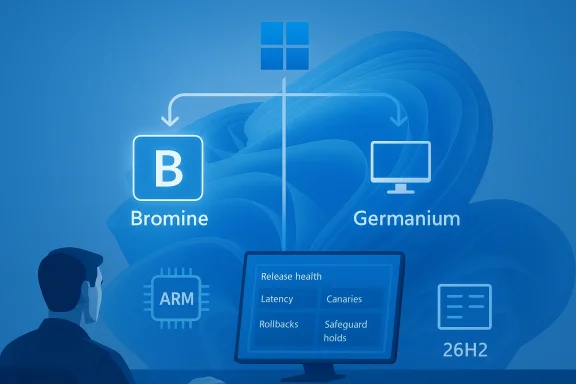
Two structural moves stand out in Microsoft’s approach for 2026: (1) a short‑term redirection of engineering effort — often described internally as “swarming” around the most frequent and disruptive issues — and (2) a platform split that will see a spring 26H1 release (codenamed Bromine) targeted at next‑generation Arm/Copilot+ devices and a broader 26H2 release (codenamed Germanium) slated for later in the year for the wider installed base. These are not just marketing names; they represent different underlying OS platform branches with different deployment rules.
Why this matters now: mainstream support for Windows 10 ended on October 14, 2025, and many organizations and consumers were counting on a smooth Windows 11 experience while they migrate. Microsoft’s pledge to prioritize reliability is therefore as much about technical correctness as it is about preserving trust during an active transition period.
Two independent reporting threads back this up: major trade press and Windows‑focused outlets are reporting the same two‑track plan, and Microsoft’s Insider channel activity (new build series being tested in Dev/Canary) confirms platform work is active and targeted. Those outside the company should treat “swarming” as an operational commitment rather than a guarantee — the results will show in fewer regressions, quicker out‑of‑band fixes, and demonstrable improvements to typical SLOs (service‑level objectives) like UI responsiveness.
Reasons to be cautiously optimistic:
For Windows users and administrators the sensible posture is pragmatic: validate updates in representative test rings, plan for mixed‑platform lifecycles, and demand measurable outcomes. If Microsoft pairs its “swarm” engineering with public SLOs, an expanded Release Health dashboard, and stronger OEM coordination, 2026 can be the year Windows 11 repairs its credibility. If it fails to deliver visible, verifiable progress, promises will be forgotten and the migration narrative will harden against Microsoft’s favor. The onus is now on Microsoft to not only fix the bugs, but to make the fixes visible and the process trustworthy — because in the age of continuous delivery, trust is the long‑term product.
Source: Windows Report https://windowsreport.com/microsoft-promises-to-save-windows-11-from-its-own-mess-this-year/
 Background / Overview
Windows 11 has been under sustained criticism from parts of Microsoft’s installed base: performance regressions in everyday shell operations, update‑induced failures, visual and dark‑mode inconsistencies, and some game‑related regressions have combined into a narrative that the OS is less dependable than it should be. Microsoft’s leadership has acknowledged the problem and promised a prioritized focus on performance, reliability, and “meaningful” fixes for everyday workflows. That messaging and the accompanying technical plan have been reported across major outlets and discussed widely in community forums. Two structural moves stand out in Microsoft’s approach for 2026: (1) a short‑term redirection of engineering effort — often described internally as “swarming” around the most frequent and disruptive issues — and (2) a platform split that will see a spring 26H1 release (codenamed Bromine) targeted at next‑generation Arm/Copilot+ devices and a broader 26H2 release (codenamed Germanium) slated for later in the year for the wider installed base. These are not just marketing names; they represent different underlying OS platform branches with different deployment rules.
Why this matters now: mainstream support for Windows 10 ended on October 14, 2025, and many organizations and consumers were counting on a smooth Windows 11 experience while they migrate. Microsoft’s pledge to prioritize reliability is therefore as much about technical correctness as it is about preserving trust during an active transition period.
What Microsoft said — the public commitments
Microsoft’s public framing is straightforward: listen to feedback, focus on high‑impact fixes, and reduce user friction. Executives have told press outlets and internal audiences that the company will shift engineering focus to address repeated pain points — particularly around platform performance, update reliability, and UX regressions that impair everyday productivity. The phrase “swarming” has been used internally to describe concentrated, cross‑team engineering effort on high‑priority bugs. This is a tactical, visible pivot away from pure new‑feature velocity toward stabilization and remediation.Two independent reporting threads back this up: major trade press and Windows‑focused outlets are reporting the same two‑track plan, and Microsoft’s Insider channel activity (new build series being tested in Dev/Canary) confirms platform work is active and targeted. Those outside the company should treat “swarming” as an operational commitment rather than a guarantee — the results will show in fewer regressions, quicker out‑of‑band fixes, and demonstrable improvements to typical SLOs (service‑level objectives) like UI responsiveness.
The technical roadmap: Bromine vs Germanium explained
What Bromine is (26H1)
- Bromine is the newer platform branch Microsoft is using to enable next‑generation Arm devices and Copilot+ hardware optimizations.
- It’s being validated in preview channels and will ship on qualifying new devices in spring 2026 as Windows 11 version 26H1, but Microsoft has stated it will not be a universal feature update for existing 25H2 PCs. In practice, Bromine is device‑gated and hardware‑specific.
What Germanium is (26H2)
- Germanium is the platform underpinning the mass‑market Windows 11 updates for most PCs. The broader consumer feature release 26H2 (expected in the second half of 2026) will use Germanium for the wider install base.
- Germanium builds are undergoing testing in the Dev channel now (26300 series), with the goal of delivering platform refinements that improve stability and security for the general population.
Why Microsoft split platforms
- New Arm silicon (e.g., Snapdragon X2 family) and device‑specific accelerators demand platform changes that would be risky to roll out immediately to millions of older Intel/AMD systems.
- Gating the Bromine branch to qualifying devices reduces the blast radius of low‑level firmware and scheduler changes while allowing OEMs and silicon partners to ship tuned firmware for those devices.
- The trade‑off: faster enablement for new hardware vs. fragmentation and additional complexity for IT — administrators will have to manage two different platform lifecycles for at least part of 2026.
The practical fixes Microsoft says it will prioritize
Microsoft has named several concrete categories it intends to focus on. These are the highest‑frequency, highest‑impact problems users reported:- Performance fundamentals — reduce perceived slowness in common shell operations: File Explorer, Start/Search, window switching, and context‑menu responsiveness. Expect targeted micro‑latency reductions calibrated against measurable SLOs.
- Update reliability and rollback — fewer update‑induced failures, better safegaurd holds, and faster out‑of‑band patches when regressions occur. Transparency around canary cohorts and clearer rollback instructions for IT are planned.
- Usability and polish — restore small but high‑impact UX elements (consistent dark mode, fixed context menus, Agenda view behaviors) that create everyday friction. These are low‑risk fixes with high perceived value.
- Gaming stability — reduce hitches related to shader compilation, session scheduling, and driver coordination; this includes a push for OS‑level session modes and precompiled shader delivery where possible.
- Copilot and telemetry controls — clearer opt‑outs and transparent telemetry governance so users can choose less intrusive AI behavior without residual artifacts after uninstall. Microsoft has signaled it will make AI features more optional and easier to disable.
What actually went wrong: a short timeline of notable regressions
- 24H2 rollout (October 2024–2025): a “full OS swap” under the hood introduced AI plumbing and platform changes that solved some problems but caused others — File Explorer regressions, update‑blocking bugs, cache corruption, and game stability issues were widely reported in community forums.
- Early 2026 cumulative updates: Microsoft’s January 2026 update cycle produced serious incidents — some Enterprise and IoT devices experienced shutdowns and boot failures, prompting emergency out‑of‑band patches and widespread administrator headaches. This high‑visibility failure was covered by mainstream outlets.
- Insider builds and platform previews: rapid platform iteration and Canary/Dev channel divergence (Bromine vs Germanium trace paths) made it harder for the community to interpret which fixes would reach general users and when. The device‑gating approach helped limit immediate risk but raised questions about longer‑term platform alignment.
Strengths Microsoft still has — assets to build on
It’s important to remember Microsoft is not starting from scratch. The company retains several durable advantages it can deploy to regain trust:- Security baseline on modern hardware — TPM, Secure Boot, VBS and hardware encryption raise the security bar when correctly configured.
- Enterprise management tooling — Intune, Windows Autopatch, Windows Update for Business and safeguard holds provide mechanisms to stage rollouts and protect critical fleets.
- Ecosystem scale — Microsoft’s OEM partnerships and cloud integration mean it can coordinate firmware/driver pushes at scale when necessary.
Risks, downsides and what to watch for
Microsoft’s plan is pragmatic, but it has clear risks:- Fragmentation and support complexity. Device‑gated releases mean administrators must manage mixed platform environments, with potential differences in behavior and feature availability between Copilot+ devices and the wider installed base. This complicates imaging, application testing, and policy enforcement.
- Telemetry and privacy friction. As AI features proliferate, so do questions about what data is sent to cloud services and how on‑device models are trained. Microsoft has promised clearer controls, but until those are both visible and enforceable by policy, privacy‑sensitive organizations will be cautious.
- Perception risk and trust deficit. Repeated high‑impact regressions erode goodwill. PR promises matter only if accompanied by measurable reductions in user‑facing issues and open reporting. Publishing SLOs and progress metrics would help restore trust.
- Vendor and driver coordination. Many regressions trace to third‑party drivers or firmware. Microsoft can encourage better pre‑release testing with OEMs and GPU vendors, but it cannot single‑handedly eliminate all surface area for regressions. Expect continued coordination headaches for complex scenarios like anti‑cheat systems and specialized peripherals.
Tactical guidance for IT teams and power users
If you’re responsible for running Windows in production or you’re a power user who relies on stability, here’s a practical checklist aligned to Microsoft’s roadmap:- Audit and segment your fleet now. Identify devices that can accept Bromine (Copilot+ / next‑gen Arm) vs those that will remain on Germanium. Plan image and driver validation workflows accordingly.
- Maintain a robust test ring. Use real‑world pilot cohorts that mirror production workloads (including VDI, non‑persistent sessions, and gaming setups if relevant). Don’t rely on “happy path” tests only.
- Use safeguard holds and staged rollouts aggressively. Windows Update for Business and in‑place safeguards are your friend — and keep rollback procedures validated and documented.
- Consider ESU as a bridge, not a solution. If you can’t migrate devices by October 14, 2025, consumer ESU options exist through October 13, 2026 — but they require Microsoft account linkage and are temporary. Plan migration timelines now.
- Lock down telemetry and AI defaults via Group Policy/MDM for privacy‑sensitive deployments until Microsoft publishes the detailed telemetry schema and retention policies.
How Microsoft should demonstrate progress (and what we’ll watch)
Promises are cheap; measurables matter. To restore confidence, Microsoft should commit to at least three visible, verifiable actions:- Publish measurable reliability targets. For example: reduce top‑10 customer‑reported regressions by X% in six months; achieve median UI action latency under Y ms on qualifying hardware. Public targets create accountability.
- Open release health dashboards. Expand the Release Health dashboard to show canary cohort behavior, the rate of out‑of‑band patching, and rollback frequencies. Consumers and admins should be able to see whether improvements are real.
- Tighter OEM/driver prerelease testing. Make driver signing and prerelease test matrices more stringent for features that touch low‑level components (e.g., DirectStorage, anti‑cheat hooks). Co‑testing windows with vendors will reduce last‑mile surprises.
Critical analysis — will this actually work?
There’s reason for cautious optimism and reason for skepticism.Reasons to be cautiously optimistic:
- The problems Microsoft aims to fix are concrete, measurable, and already well‑understood by the engineering teams that built the features. Fixes like reducing blocking I/O in File Explorer, curbing context‑menu bloat, and improving rollback behavior are engineering work — not philosophical shifts. Microsoft has the resources and ecosystem reach to pull this off.
- The two‑track approach is pragmatic: it enables new silicon without destabilizing the entire user base. Device gating is a reasonable risk‑reduction measure if communicated and managed properly.
- Splitting platforms produces operational complexity. Mixed fleets create support burdens, and unless Microsoft provides clear tooling and policies to manage mixed platform environments, enterprise friction will rise.
- The credibility gap is real. Users and IT administrators will want verifiable reductions in breakages. Microsoft must move beyond promises to public metrics and independent verification; otherwise, PR cycles won’t change adoption behavior.
- Some regressions are driven by third‑party firmware and drivers; Microsoft’s ability to eliminate these depends on vendor cooperation and extended test cycles — both of which add time and coordination cost.
Quick checklist for Windows users (summary)
- If you value absolute stability today: remain on the most recent Germanium builds that your organization validates, keep a tested rollback plan, and delay early adopter Insider rings on production machines.
- If you have Copilot+ hardware and want the latest device optimizations: expect Bromine on new devices in spring 2026 — but be prepared for early hardware‑specific quirks and limited feature parity with Germanium until 26H2.
- For everyone: keep your device drivers and firmware updated from OEMs, validate critical apps against preview builds in a sandbox, and consider ESU only as a short‑term bridge if migration deadlines are tight.
Conclusion
Microsoft’s pledge to “save” Windows 11 this year is a candid admission that the product’s delivery model needs a temporary course correction. The company is reallocating resources, gating certain platform changes to new hardware, and promising to prioritize the core, measurable annoyances that have undermined user trust. Those moves are sensible and technically achievable — but they come with operational trade‑offs: fragmentation, added complexity for IT, and a need for much greater transparency.For Windows users and administrators the sensible posture is pragmatic: validate updates in representative test rings, plan for mixed‑platform lifecycles, and demand measurable outcomes. If Microsoft pairs its “swarm” engineering with public SLOs, an expanded Release Health dashboard, and stronger OEM coordination, 2026 can be the year Windows 11 repairs its credibility. If it fails to deliver visible, verifiable progress, promises will be forgotten and the migration narrative will harden against Microsoft’s favor. The onus is now on Microsoft to not only fix the bugs, but to make the fixes visible and the process trustworthy — because in the age of continuous delivery, trust is the long‑term product.
Source: Windows Report https://windowsreport.com/microsoft-promises-to-save-windows-11-from-its-own-mess-this-year/
