

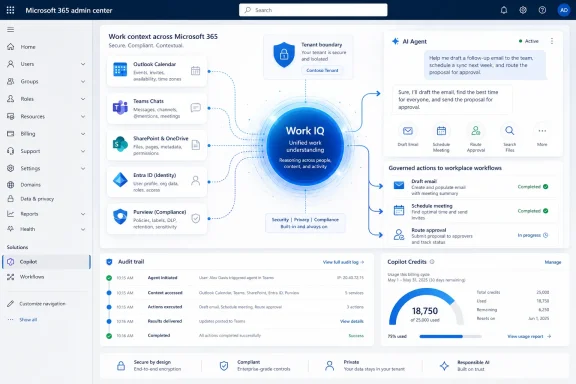
Microsoft announced on June 2, 2026 that its Work IQ APIs, a new agent-focused interface for Microsoft 365 data, context, tools, and Copilot intelligence, will become generally available on June 16, 2026 for developers building enterprise agents inside Microsoft 365. The announcement is not merely another API launch in the Microsoft 365 ecosystem. It is Microsoft’s clearest statement yet that the next productivity platform will be less about humans clicking through apps and more about agents operating inside a governed corporate nervous system. For IT leaders, that makes Work IQ both promising and uncomfortable: it packages organizational context as a product surface.
For years, Microsoft has described Microsoft 365 as more than Word, Excel, Outlook, Teams, SharePoint, and OneDrive stitched together by licensing. The company’s real asset has been the connective tissue: identity, permissions, files, calendars, meetings, chats, org charts, relationships, and the historical residue of how work actually gets done. Work IQ is the branding for that connective tissue when it is fed to Copilot and, now, to third-party or custom agents.
The important shift is that Microsoft is no longer treating enterprise data access as a retrieval problem alone. Traditional Microsoft Graph calls can fetch messages, files, users, events, and Teams artifacts if a developer knows what to ask for and has permission to ask for it. Work IQ is pitched as something higher up the stack: a semantic model that understands relevance, relationships, roles, collaboration patterns, and business context before an outside agent ever receives a response.
That is a big architectural bet. Microsoft is effectively saying that the raw material of workplace software is not the document, the email, or the meeting transcript. The raw material is the work context inferred from all of them. If Graph was the map of Microsoft 365 resources, Work IQ is Microsoft trying to sell the traffic layer, the likely destination, and the route planner in one package.
This is also why the announcement matters beyond Copilot enthusiasts. Agents that merely search documents are useful in demos and brittle in production. Agents that can reason over who owns a project, which meeting changed the decision, which file is authoritative, and which user has permission to approve a next step are much closer to the automation layer enterprises have wanted for years.
The Chat API gives developers programmatic access to the kind of answer Microsoft 365 Copilot would return to a user, including citations. That is the most obvious bridge for developers who want Copilot-like responses without forcing users into the Copilot UI. It also keeps Microsoft’s model orchestration and grounding machinery in the loop, which is convenient for developers and strategically useful for Microsoft.
The Context API is more interesting. Instead of asking Copilot to synthesize an answer, it returns the underlying context Copilot would use, packaged for an agent to consume. That distinction matters because many enterprise workflows do not want a polished paragraph; they want the relevant emails, files, meeting notes, people, and organizational signals assembled into a machine-usable bundle.
The Tools API is Microsoft’s answer to tool sprawl. Rather than making developers expose hundreds of narrow actions for mail, calendar, Teams, SharePoint, OneDrive, Word, Dataverse, and related services, Microsoft says Work IQ collapses operations into a small set of generic tools with progressive disclosure through the Model Context Protocol. The pitch is that agents can learn a stable action vocabulary while Work IQ handles the Microsoft 365-specific complexity underneath.
Workspaces completes the picture. Long-running agents need a place to store intermediate state, files, memory, partial outputs, and progress as they work through multi-step tasks. By keeping those digital workspaces inside the Microsoft 365 tenant boundary, Microsoft is trying to avoid the obvious governance problem of enterprise agents squirreling away sensitive intermediate data in an external orchestration layer.
That is a subtle but important escalation. Search returns candidates. Work IQ is being positioned as a system that helps decide what matters.
In the enterprise, that distinction is everything. A legal hold policy, a sensitivity label, a stale project plan, and a Teams message from the actual decision-maker may all coexist in the same tenant. The useful agent is not the one that retrieves the most text. It is the one that understands which artifact carries authority, which relationship explains the workflow, and which action is permissible for the user it represents.
Microsoft’s advantage is that it already sits where those signals live. Outlook knows communication patterns. Teams knows meetings and chats. SharePoint and OneDrive know files and collaboration. Entra ID knows identity and group structure. Purview knows classification and compliance. Work IQ’s promise is that an agent can draw on those signals without developers rebuilding the workplace model from scratch.
The risk is that “judgment” becomes an opaque platform function. If Work IQ ranks one file above another, packages one meeting as decisive, or infers that a colleague is the right approver, administrators and developers will want to know why. Microsoft says actions are auditable and discoverable, but auditability after the fact is not the same as explainability before the action is taken.
That matters because agent economics are ugly when every step becomes a pile of retrieved documents, metadata, IDs, and tool schemas shoved into a model context window. Tokens cost money, latency kills user trust, and brittle chains of calls fail in ways that are hard to debug. If Work IQ can hand an agent a compact, relevant, permission-aware context package, that is a real engineering advantage.
But the larger adoption question is not whether Microsoft can make agents faster. It is whether enterprises trust agents to act.
Microsoft’s answer is to keep data, context, insights, and agent workspaces inside the Microsoft 365 tenant trust boundary. That is the right answer for customers already standardized on Microsoft 365, and it will appeal to administrators who do not want yet another AI vendor replicating corporate data into another control plane. It also lets Microsoft argue that Work IQ inherits the governance posture customers already use across Microsoft 365.
Still, tenant-boundary comfort does not erase operational risk. An agent that sends an email, schedules a meeting, uploads a document, or moves work through a business process can create real-world consequences even when it stays inside the tenant. The system may be governed, but governed mistakes are still mistakes.
That dashboard may sound like back-office plumbing, but it is central to the product strategy. Microsoft knows that agent usage does not look like human usage. A person checks mail, opens a spreadsheet, attends meetings, and occasionally asks Copilot for help. An agent can run continuously, perform multi-step operations, inspect many resources, and repeat the process at machine speed.
That makes cost governance a first-order feature, not an afterthought. If hundreds of agents begin operating across a tenant, the question is not just “Can they do the work?” It is “Who pays when they do too much of it?”
The Copilot Credits model also gives Microsoft a way to unify billing across Work IQ, Copilot Studio, and future agentic services. For customers, that may simplify procurement. For administrators, it introduces a new capacity-planning discipline: tracking not only users and licenses, but also autonomous work performed by software on behalf of those users.
This is where some organizations will slow down. Consumption pricing is familiar in cloud infrastructure, but less familiar in productivity suites historically sold per seat. Microsoft is importing Azure-style metering into the Microsoft 365 admin experience. That may be inevitable for AI, but it changes the psychology of deploying workplace automation.
That shortcut could accelerate a wave of internal agents. A sales operations agent could reason over customer meetings, account plans, Teams discussions, and CRM-adjacent data. A project management agent could assemble status from documents, chats, calendars, and deliverables. A security or compliance assistant could work from governed context rather than exported data lakes and improvised retrieval systems.
But every shortcut is also a dependency. If Work IQ becomes the best way for agents to interact with Microsoft 365, developers building serious workplace agents will increasingly optimize for Microsoft’s semantics, permissions model, pricing units, and tool abstractions. That is good for consistency and bad for portability.
The Model Context Protocol angle softens this somewhat, because MCP has become a common way to expose tools and context to agents. But Microsoft’s implementation still places the richest organizational intelligence behind Microsoft’s own platform boundary. The more valuable Work IQ becomes, the more Microsoft 365 becomes not just a productivity suite but the operating substrate for enterprise agents.
That is the strategic play. Microsoft is not merely adding APIs to Copilot. It is trying to make Microsoft 365 the place where agents understand work well enough to act.
The modern Windows desktop is no longer just a local application launcher. It is a front end to Entra identity, Microsoft 365 files, Teams collaboration, Edge web apps, OneDrive sync, Windows 365 cloud PCs, Intune policy, Defender telemetry, and Copilot experiences. Work IQ strengthens the cloud intelligence layer that those client experiences will increasingly call into.
For administrators, that means endpoint management and productivity governance are converging. A user’s Windows session may become the place where agents are invoked, but the agent’s real authority will come from Microsoft 365 permissions, tenant policies, Copilot credits, and Work IQ context. The desktop remains important, but the control plane moves higher.
For power users, this may feel like a continuation of the long migration from local workflows to cloud-mediated workflows. The agent that helps you prepare for a meeting may surface inside Windows, Edge, Teams, Outlook, or Copilot, but its useful knowledge will come from Microsoft 365’s semantic model of your work. That is convenient, provided the model is accurate and the permissions are sane.
For skeptics, it reinforces a familiar concern: Microsoft’s most powerful features increasingly assume deep participation in its cloud ecosystem. Work IQ may be technically elegant, but it is not neutral infrastructure. It is Microsoft 365 intelligence exposed on Microsoft’s terms.
That is the right story, but it will be tested by edge cases. Enterprise permissions are often messy. SharePoint sites accumulate accidental access. Old Teams channels contain sensitive history. Distribution lists sprawl. Calendar metadata reveals more than users realize. If Work IQ continuously processes this material into a semantic model, organizations will need to revisit whether their existing permissions actually reflect their risk appetite.
This is not a new problem created by Work IQ. Copilot already forced many organizations to confront oversharing in Microsoft 365 because AI made forgotten access paths suddenly useful. Work IQ extends that concern from human-prompted answers to agentic action. The agent does not just discover context; it may use that context to do something.
That puts pressure on identity governance, data classification, lifecycle management, and audit review. The organizations most ready for Work IQ are not necessarily the ones most excited about AI. They are the ones that already know where their sensitive data lives, have cleaned up access, and can explain who is allowed to act on behalf of whom.
Microsoft can build strong platform controls, but it cannot magically fix a tenant whose permissions are already chaotic. Work IQ may make well-governed environments more powerful and poorly governed environments more visibly risky.
That is a signal to CIOs and sysadmins: agents are becoming a managed resource. They will need policy. They will need budgets. They will need observability. They will need lifecycle controls. They will need someone to answer when a department’s autonomous workflows burn through credits or produce unexpected output.
The admin center has long been where Microsoft turns product sprawl into operational reality. Licenses, devices, users, groups, domains, service health, security defaults, compliance settings, and now AI credits all become part of the same management ritual. Work IQ’s arrival there makes agent usage feel less experimental and more inevitable.
It also raises the burden on Microsoft to make the controls intelligible. A spending limit is easy to understand. A Copilot Credit consumed by a Context call, a Chat call, or a Tools operation is more abstract. Administrators will need reporting that maps technical consumption to business value, not just a meter that says the tenant is spending faster than expected.
The winners inside enterprises will be teams that can connect agent activity to measurable workflows: cases resolved, reports generated, meetings prepared, documents reviewed, tickets triaged, approvals routed. Without that line of sight, Work IQ risks becoming another AI bill whose value is asserted more than demonstrated.
This is the same tension that has defined the AI platform race since Copilot first arrived in Microsoft 365. Enterprises want models to understand their business, but they also want to control exactly what the models know, why they know it, and what they do with it. Work IQ is Microsoft’s attempt to resolve that tension by making the intelligence layer native to the tenant.
The strongest version of this future is compelling. Developers stop writing brittle retrieval glue. Users get agents that understand real workplace context. Admins govern action and spending from familiar Microsoft 365 controls. Security teams retain auditability and tenant boundaries. Microsoft turns its productivity suite into the platform on which business agents run.
The weaker version is familiar too. Costs become hard to predict. Agent behavior becomes hard to explain. Developers become more dependent on Microsoft’s abstractions. Tenants with messy permissions discover that semantic intelligence amplifies their governance debt. Users see another layer of automation they are asked to trust before it has earned that trust.
Both versions can be true at once, depending on the organization.
For teams evaluating the launch, the practical read is more sober than the marketing. Work IQ is not just another way to call Microsoft 365 data. It is a decision to let Microsoft’s semantic understanding of the workplace become part of your agent architecture.
 Microsoft Turns the Office Graph Into an Agent Platform
For years, Microsoft has described Microsoft 365 as more than Word, Excel, Outlook, Teams, SharePoint, and OneDrive stitched together by licensing. The company’s real asset has been the connective tissue: identity, permissions, files, calendars, meetings, chats, org charts, relationships, and the historical residue of how work actually gets done. Work IQ is the branding for that connective tissue when it is fed to Copilot and, now, to third-party or custom agents.The important shift is that Microsoft is no longer treating enterprise data access as a retrieval problem alone. Traditional Microsoft Graph calls can fetch messages, files, users, events, and Teams artifacts if a developer knows what to ask for and has permission to ask for it. Work IQ is pitched as something higher up the stack: a semantic model that understands relevance, relationships, roles, collaboration patterns, and business context before an outside agent ever receives a response.
That is a big architectural bet. Microsoft is effectively saying that the raw material of workplace software is not the document, the email, or the meeting transcript. The raw material is the work context inferred from all of them. If Graph was the map of Microsoft 365 resources, Work IQ is Microsoft trying to sell the traffic layer, the likely destination, and the route planner in one package.
This is also why the announcement matters beyond Copilot enthusiasts. Agents that merely search documents are useful in demos and brittle in production. Agents that can reason over who owns a project, which meeting changed the decision, which file is authoritative, and which user has permission to approve a next step are much closer to the automation layer enterprises have wanted for years.
The API Surface Is Smaller Because the Ambition Is Larger
Microsoft says the Work IQ APIs are organized around four domains: Chat, Context, Tools, and Workspaces. On paper, that looks tidy. In practice, it is an attempt to compress the mess of Microsoft 365 into a set of agent-native primitives.The Chat API gives developers programmatic access to the kind of answer Microsoft 365 Copilot would return to a user, including citations. That is the most obvious bridge for developers who want Copilot-like responses without forcing users into the Copilot UI. It also keeps Microsoft’s model orchestration and grounding machinery in the loop, which is convenient for developers and strategically useful for Microsoft.
The Context API is more interesting. Instead of asking Copilot to synthesize an answer, it returns the underlying context Copilot would use, packaged for an agent to consume. That distinction matters because many enterprise workflows do not want a polished paragraph; they want the relevant emails, files, meeting notes, people, and organizational signals assembled into a machine-usable bundle.
The Tools API is Microsoft’s answer to tool sprawl. Rather than making developers expose hundreds of narrow actions for mail, calendar, Teams, SharePoint, OneDrive, Word, Dataverse, and related services, Microsoft says Work IQ collapses operations into a small set of generic tools with progressive disclosure through the Model Context Protocol. The pitch is that agents can learn a stable action vocabulary while Work IQ handles the Microsoft 365-specific complexity underneath.
Workspaces completes the picture. Long-running agents need a place to store intermediate state, files, memory, partial outputs, and progress as they work through multi-step tasks. By keeping those digital workspaces inside the Microsoft 365 tenant boundary, Microsoft is trying to avoid the obvious governance problem of enterprise agents squirreling away sensitive intermediate data in an external orchestration layer.
The Real Product Is Not Retrieval, It Is Judgment
The language around Work IQ is deliberately different from ordinary search. Microsoft is not just promising that agents can find emails faster or summarize meetings more neatly. It is promising “intelligence” built from semantic indexing, personal memory, personal and organizational skills, structured schemas over files, and business-specific knowledge tuning.That is a subtle but important escalation. Search returns candidates. Work IQ is being positioned as a system that helps decide what matters.
In the enterprise, that distinction is everything. A legal hold policy, a sensitivity label, a stale project plan, and a Teams message from the actual decision-maker may all coexist in the same tenant. The useful agent is not the one that retrieves the most text. It is the one that understands which artifact carries authority, which relationship explains the workflow, and which action is permissible for the user it represents.
Microsoft’s advantage is that it already sits where those signals live. Outlook knows communication patterns. Teams knows meetings and chats. SharePoint and OneDrive know files and collaboration. Entra ID knows identity and group structure. Purview knows classification and compliance. Work IQ’s promise is that an agent can draw on those signals without developers rebuilding the workplace model from scratch.
The risk is that “judgment” becomes an opaque platform function. If Work IQ ranks one file above another, packages one meeting as decisive, or infers that a colleague is the right approver, administrators and developers will want to know why. Microsoft says actions are auditable and discoverable, but auditability after the fact is not the same as explainability before the action is taken.
Microsoft Is Selling Speed, But Governance Will Decide Adoption
The announcement leans heavily on speed and efficiency. Microsoft says Work IQ reduces round trips, lowers access latency, shrinks token usage, and moves more AI processing into the Work IQ runtime. It also claims that trimming identifiers and packaging context more intelligently can reduce the amount of text an external orchestration layer has to process.That matters because agent economics are ugly when every step becomes a pile of retrieved documents, metadata, IDs, and tool schemas shoved into a model context window. Tokens cost money, latency kills user trust, and brittle chains of calls fail in ways that are hard to debug. If Work IQ can hand an agent a compact, relevant, permission-aware context package, that is a real engineering advantage.
But the larger adoption question is not whether Microsoft can make agents faster. It is whether enterprises trust agents to act.
Microsoft’s answer is to keep data, context, insights, and agent workspaces inside the Microsoft 365 tenant trust boundary. That is the right answer for customers already standardized on Microsoft 365, and it will appeal to administrators who do not want yet another AI vendor replicating corporate data into another control plane. It also lets Microsoft argue that Work IQ inherits the governance posture customers already use across Microsoft 365.
Still, tenant-boundary comfort does not erase operational risk. An agent that sends an email, schedules a meeting, uploads a document, or moves work through a business process can create real-world consequences even when it stays inside the tenant. The system may be governed, but governed mistakes are still mistakes.
The Pricing Model Makes Agents a Metered Utility
Work IQ APIs will use consumption-based pricing denominated in Copilot Credits, with a fixed component for Tools and variable components for Chat and Context. Microsoft is also introducing a cost management dashboard in the Microsoft 365 admin center, giving administrators ways to review AI credit usage, configure prepaid or pay-as-you-go billing, set spending limits, and monitor credit requests.That dashboard may sound like back-office plumbing, but it is central to the product strategy. Microsoft knows that agent usage does not look like human usage. A person checks mail, opens a spreadsheet, attends meetings, and occasionally asks Copilot for help. An agent can run continuously, perform multi-step operations, inspect many resources, and repeat the process at machine speed.
That makes cost governance a first-order feature, not an afterthought. If hundreds of agents begin operating across a tenant, the question is not just “Can they do the work?” It is “Who pays when they do too much of it?”
The Copilot Credits model also gives Microsoft a way to unify billing across Work IQ, Copilot Studio, and future agentic services. For customers, that may simplify procurement. For administrators, it introduces a new capacity-planning discipline: tracking not only users and licenses, but also autonomous work performed by software on behalf of those users.
This is where some organizations will slow down. Consumption pricing is familiar in cloud infrastructure, but less familiar in productivity suites historically sold per seat. Microsoft is importing Azure-style metering into the Microsoft 365 admin experience. That may be inevitable for AI, but it changes the psychology of deploying workplace automation.
Developers Get a Shortcut, and a Dependency
For developers, the appeal is obvious. Building an enterprise agent that understands Microsoft 365 from the outside is hard. You need identity, permissions, Graph calls, retrieval, ranking, summarization, tool execution, state storage, audit trails, and a way to avoid drowning the model in irrelevant context. Work IQ offers to turn much of that into a managed platform capability.That shortcut could accelerate a wave of internal agents. A sales operations agent could reason over customer meetings, account plans, Teams discussions, and CRM-adjacent data. A project management agent could assemble status from documents, chats, calendars, and deliverables. A security or compliance assistant could work from governed context rather than exported data lakes and improvised retrieval systems.
But every shortcut is also a dependency. If Work IQ becomes the best way for agents to interact with Microsoft 365, developers building serious workplace agents will increasingly optimize for Microsoft’s semantics, permissions model, pricing units, and tool abstractions. That is good for consistency and bad for portability.
The Model Context Protocol angle softens this somewhat, because MCP has become a common way to expose tools and context to agents. But Microsoft’s implementation still places the richest organizational intelligence behind Microsoft’s own platform boundary. The more valuable Work IQ becomes, the more Microsoft 365 becomes not just a productivity suite but the operating substrate for enterprise agents.
That is the strategic play. Microsoft is not merely adding APIs to Copilot. It is trying to make Microsoft 365 the place where agents understand work well enough to act.
The Windows Angle Is Indirect but Real
At first glance, Work IQ is not a Windows story. It is a Microsoft 365, Copilot, and cloud API story. But for WindowsForum readers, the implications are hard to miss because Windows increasingly sits at the edge of Microsoft’s agent strategy.The modern Windows desktop is no longer just a local application launcher. It is a front end to Entra identity, Microsoft 365 files, Teams collaboration, Edge web apps, OneDrive sync, Windows 365 cloud PCs, Intune policy, Defender telemetry, and Copilot experiences. Work IQ strengthens the cloud intelligence layer that those client experiences will increasingly call into.
For administrators, that means endpoint management and productivity governance are converging. A user’s Windows session may become the place where agents are invoked, but the agent’s real authority will come from Microsoft 365 permissions, tenant policies, Copilot credits, and Work IQ context. The desktop remains important, but the control plane moves higher.
For power users, this may feel like a continuation of the long migration from local workflows to cloud-mediated workflows. The agent that helps you prepare for a meeting may surface inside Windows, Edge, Teams, Outlook, or Copilot, but its useful knowledge will come from Microsoft 365’s semantic model of your work. That is convenient, provided the model is accurate and the permissions are sane.
For skeptics, it reinforces a familiar concern: Microsoft’s most powerful features increasingly assume deep participation in its cloud ecosystem. Work IQ may be technically elegant, but it is not neutral infrastructure. It is Microsoft 365 intelligence exposed on Microsoft’s terms.
The Security Promise Has to Survive the First Bad Demo
Microsoft’s security framing is sensible. Keep data inside the tenant boundary. Preserve existing permissions. Make actions auditable and discoverable. Give administrators cost and usage controls. Do not force customers to bolt on a separate governance layer just to let agents use Microsoft 365.That is the right story, but it will be tested by edge cases. Enterprise permissions are often messy. SharePoint sites accumulate accidental access. Old Teams channels contain sensitive history. Distribution lists sprawl. Calendar metadata reveals more than users realize. If Work IQ continuously processes this material into a semantic model, organizations will need to revisit whether their existing permissions actually reflect their risk appetite.
This is not a new problem created by Work IQ. Copilot already forced many organizations to confront oversharing in Microsoft 365 because AI made forgotten access paths suddenly useful. Work IQ extends that concern from human-prompted answers to agentic action. The agent does not just discover context; it may use that context to do something.
That puts pressure on identity governance, data classification, lifecycle management, and audit review. The organizations most ready for Work IQ are not necessarily the ones most excited about AI. They are the ones that already know where their sensitive data lives, have cleaned up access, and can explain who is allowed to act on behalf of whom.
Microsoft can build strong platform controls, but it cannot magically fix a tenant whose permissions are already chaotic. Work IQ may make well-governed environments more powerful and poorly governed environments more visibly risky.
Microsoft’s Agent Future Runs Through the Admin Center
One underrated part of the announcement is the new cost management dashboard in the Microsoft 365 admin center. That placement matters. Microsoft is not treating Work IQ as a developer toy living off to the side in GitHub samples and API docs. It is putting agent consumption, billing mode, spending limits, and user credit requests into the same administrative orbit as the rest of Microsoft 365.That is a signal to CIOs and sysadmins: agents are becoming a managed resource. They will need policy. They will need budgets. They will need observability. They will need lifecycle controls. They will need someone to answer when a department’s autonomous workflows burn through credits or produce unexpected output.
The admin center has long been where Microsoft turns product sprawl into operational reality. Licenses, devices, users, groups, domains, service health, security defaults, compliance settings, and now AI credits all become part of the same management ritual. Work IQ’s arrival there makes agent usage feel less experimental and more inevitable.
It also raises the burden on Microsoft to make the controls intelligible. A spending limit is easy to understand. A Copilot Credit consumed by a Context call, a Chat call, or a Tools operation is more abstract. Administrators will need reporting that maps technical consumption to business value, not just a meter that says the tenant is spending faster than expected.
The winners inside enterprises will be teams that can connect agent activity to measurable workflows: cases resolved, reports generated, meetings prepared, documents reviewed, tickets triaged, approvals routed. Without that line of sight, Work IQ risks becoming another AI bill whose value is asserted more than demonstrated.
The Old API Contract Is Being Rewritten
The classic API contract was straightforward: a developer asks for data, a service returns data, and the application decides what to do next. Work IQ changes that contract by inserting an intelligence layer that shapes what the agent sees and how it acts. That is powerful because agents need abstraction. It is risky because abstraction hides details.This is the same tension that has defined the AI platform race since Copilot first arrived in Microsoft 365. Enterprises want models to understand their business, but they also want to control exactly what the models know, why they know it, and what they do with it. Work IQ is Microsoft’s attempt to resolve that tension by making the intelligence layer native to the tenant.
The strongest version of this future is compelling. Developers stop writing brittle retrieval glue. Users get agents that understand real workplace context. Admins govern action and spending from familiar Microsoft 365 controls. Security teams retain auditability and tenant boundaries. Microsoft turns its productivity suite into the platform on which business agents run.
The weaker version is familiar too. Costs become hard to predict. Agent behavior becomes hard to explain. Developers become more dependent on Microsoft’s abstractions. Tenants with messy permissions discover that semantic intelligence amplifies their governance debt. Users see another layer of automation they are asked to trust before it has earned that trust.
Both versions can be true at once, depending on the organization.
The June 16 Launch Is a Starting Gun, Not a Finish Line
The concrete facts are simple, but the implications are not. Work IQ APIs are moving to general availability on June 16, 2026. They expose Copilot-style chat, agent-ready context, Microsoft 365 tools, and tenant-contained workspaces. They are priced through Copilot Credits and managed through new cost controls in the Microsoft 365 admin center.For teams evaluating the launch, the practical read is more sober than the marketing. Work IQ is not just another way to call Microsoft 365 data. It is a decision to let Microsoft’s semantic understanding of the workplace become part of your agent architecture.
- Organizations should treat Work IQ pilots as governance tests, not just developer experiments.
- Administrators should review Microsoft 365 permissions and oversharing risks before allowing broad agent access.
- Developers should evaluate whether Work IQ’s reduced tool surface and packaged context justify the platform dependency.
- Finance and IT operations teams should model agent consumption because autonomous workflows can spend differently from human users.
- Security teams should demand clear audit trails for both retrieved context and actions taken by agents.
- Business teams should measure Work IQ agents against concrete workflows rather than generic productivity claims.
References
- Primary source: Microsoft
Published: 2026-06-02T17:42:06.442172

Announcing the new Work IQ APIs | Microsoft 365 Blog
Build enterprise agents with Work IQ APIs for Microsoft 365—bringing business context, tools, and secure, scalable intelligence into every workflow. www.microsoft.com
- Related coverage: techradar.com
- Official source: learn.microsoft.com

Work IQ overview
Learn how to extend agents with Work IQ, the intelligence layer that grounds Microsoft 365 Copilot in enterprise data, context, and execution capabilities.learn.microsoft.com - Official source: support.microsoft.com
Get started with Workflows in Microsoft 365 Copilot | Microsoft Support
Learn how you can automate tasks with Workflows--building, testing, monitoring, and managing your flows with Microsoft 365 Copilot. support.microsoft.com
- Official source: blogs.microsoft.com

Introducing the First Frontier Suite built on Intelligence + Trust - The Official Microsoft Blog
Today Microsoft is announcing: Wave 3 of Microsoft 365 Copilot Expanded model diversity with Claude and next-gen OpenAI models available today General availability of Agent 365 on May 1 for $15 per user General availability of the new Microsoft 365 E7: The Frontier Suite on May 1 for $99 per... blogs.microsoft.com
- Official source: news.microsoft.com

Microsoft kündigt neue agentische KI-Funktionen an - Source EMEA
 news.microsoft.com
- Official source: techcommunity.microsoft.com
A closer look at Work IQ | Microsoft Community Hub
Work IQ is the intelligence layer that personalizes Microsoft 365 Copilot to you and your organization. techcommunity.microsoft.com
- Related coverage: windowscentral.com
Only 3.3% of Microsoft 365 users pay for Copilot
Copilot adoption is lagging: only 3.3% of Microsoft 365 users pay for the service despite Microsoft’s billion-dollar investment. www.windowscentral.com
- Related coverage: pcgamer.com

Microsoft used Copilot chats to form data that basically says users think AI is good
There's dozens of us who don't!www.pcgamer.com
- Official source: adoption.microsoft.com
- Related coverage: assets-c4akfrf5b4d3f4b7.z01.azurefd.net
- Related coverage: its.fsu.edu
- Related coverage: reality-tech.com
