

Microsoft’s 2025 push to turn Azure into a purpose-built utility for the AI economy is no longer a marketing slogan — it’s a global infrastructure strategy that is reshaping how companies buy compute, how governments think about energy and sovereignty, and how investors value cloud platforms in an age defined by inference. The scale of Microsoft’s investments — from in‑house silicon and purpose‑built racks to dedicated power purchase agreements and nationwide “AI superfactory” campuses — has created a defensible moat, but it also exposes the company and the industry to new operational, regulatory, and geopolitical risks that are only now coming into focus.
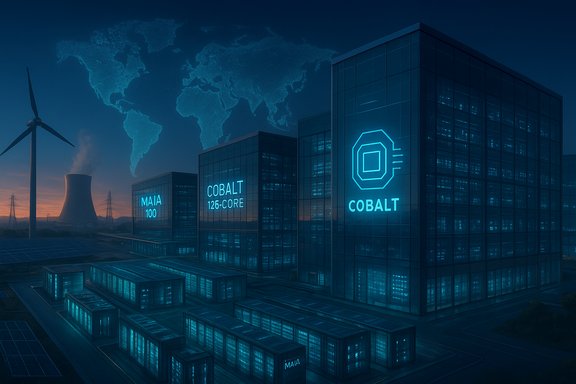
Microsoft publicly announced the first fruits of its in‑house silicon program with the Azure Maia accelerator and the Arm‑based Azure Cobalt CPU, positioning custom chips at the center of Azure’s AI strategy. These announcements framed a deliberate shift: cloud providers will no longer be passive purchasers of third‑party GPUs and CPUs — they will design and optimize silicon, racks, cooling, and power in a single systems play to win the era of “AI at scale.” The company’s investor communications in 2025 placed AI-driven revenue growth at the center of Azure’s story. During fiscal 2025 investor calls Microsoft reported that its AI business had reached an annualized revenue run rate milestone — a point auditors and market watchers use to measure momentum — and supplied headline figures to quantify that momentum. Microsoft’s statements in its FY2025 earnings commentary indicated an AI annual revenue run rate milestone that was materially lower than some later market estimates and media headlines; company disclosures from the quarter put the AI business run rate at approximately $13 billion at that time, while some post‑summer market analysis and industry writeups have extrapolated significantly higher numbers for later in 2025. At the product level, Microsoft’s Copilot family — spanning Microsoft 365 Copilot, GitHub Copilot, Edge/Bing Copilot experiences and consumer/endpoint Copilot integrations — passed a major usage threshold in 2025: executive commentary reported that the “first‑party family of Copilots” had exceeded roughly 150 million monthly active users, a metric Microsoft released in earnings remarks and investor presentations. This adoption figure is a central plank in the company’s argument that inference demand will sustain Azure’s growth. Alongside silicon and software, Microsoft’s energy strategy has become a public infrastructure program. Constellation Energy’s plan to restart the Three Mile Island Unit 1 reactor — to be rebadged as the Crane Clean Energy Center — was announced with a long‑term power purchase agreement tied to Microsoft’s data‑center expansion, putting nuclear back on the menu for hyperscalers seeking 24/7 carbon‑free baseload for dense AI facilities. That deal and subsequent government loan support have been widely reported and acknowledged by the parties involved. Finally, large cross‑industry consortiums aimed at national‑scale AI infrastructure also crystallized in 2025. SoftBank’s “Stargate” initiative publicly framed a multi‑hundred‑billion dollar deployment plan, naming OpenAI and several major technology players as partners or funders and setting an aggressive timetable for capital allocation to build sovereign‑level AI compute hubs. Microsoft is listed among the core technology partners in such initiatives, reflecting the industry’s emerging tendency toward consortium-based, capital‑intensive projects rather than single‑vendor rollouts.
Microsoft’s PPA with Constellation for the Three Mile Island restart is an emblematic response: securing 24/7 baseload from a nuclear facility removes a critical constraint for high‑density facilities, but it also places Microsoft at the center of complex regulatory and social debates. Nuclear restarts carry multi‑year licensing timelines, political controversy, and cost‑overrun risk — all factors that make energy deals a multi‑dimensional dependency rather than a simple procurement item.
Yet the same forces that make the strategy powerful — concentration of compute and energy, deep vendor integration, and massive up‑front capital commitments — also make it inherently risky. The next phase of cloud competition will be decided as much by energy deals, regulatory outcomes, and supply‑chain execution as by technical achievements. For enterprises and investors, the right stance is to treat year‑end extrapolations and bullish media headlines with caution, to parse Microsoft’s public financial disclosures for verified run‑rate numbers, and to monitor the company’s ability to translate massive CapEx into durable, predictable inference economics.
Microsoft is building a Silicon Fortress. Whether it becomes the unassailable backbone of the Industrial AI Era or a very expensive strategic high ground that competitors and regulators chip away at will depend on execution across a far wider set of domains than chips and cloud alone.
Source: FinancialContent https://markets.financialcontent.co...es-its-dominance-in-the-enterprise-cloud-war/
 Background
Microsoft publicly announced the first fruits of its in‑house silicon program with the Azure Maia accelerator and the Arm‑based Azure Cobalt CPU, positioning custom chips at the center of Azure’s AI strategy. These announcements framed a deliberate shift: cloud providers will no longer be passive purchasers of third‑party GPUs and CPUs — they will design and optimize silicon, racks, cooling, and power in a single systems play to win the era of “AI at scale.” The company’s investor communications in 2025 placed AI-driven revenue growth at the center of Azure’s story. During fiscal 2025 investor calls Microsoft reported that its AI business had reached an annualized revenue run rate milestone — a point auditors and market watchers use to measure momentum — and supplied headline figures to quantify that momentum. Microsoft’s statements in its FY2025 earnings commentary indicated an AI annual revenue run rate milestone that was materially lower than some later market estimates and media headlines; company disclosures from the quarter put the AI business run rate at approximately $13 billion at that time, while some post‑summer market analysis and industry writeups have extrapolated significantly higher numbers for later in 2025. At the product level, Microsoft’s Copilot family — spanning Microsoft 365 Copilot, GitHub Copilot, Edge/Bing Copilot experiences and consumer/endpoint Copilot integrations — passed a major usage threshold in 2025: executive commentary reported that the “first‑party family of Copilots” had exceeded roughly 150 million monthly active users, a metric Microsoft released in earnings remarks and investor presentations. This adoption figure is a central plank in the company’s argument that inference demand will sustain Azure’s growth. Alongside silicon and software, Microsoft’s energy strategy has become a public infrastructure program. Constellation Energy’s plan to restart the Three Mile Island Unit 1 reactor — to be rebadged as the Crane Clean Energy Center — was announced with a long‑term power purchase agreement tied to Microsoft’s data‑center expansion, putting nuclear back on the menu for hyperscalers seeking 24/7 carbon‑free baseload for dense AI facilities. That deal and subsequent government loan support have been widely reported and acknowledged by the parties involved. Finally, large cross‑industry consortiums aimed at national‑scale AI infrastructure also crystallized in 2025. SoftBank’s “Stargate” initiative publicly framed a multi‑hundred‑billion dollar deployment plan, naming OpenAI and several major technology players as partners or funders and setting an aggressive timetable for capital allocation to build sovereign‑level AI compute hubs. Microsoft is listed among the core technology partners in such initiatives, reflecting the industry’s emerging tendency toward consortium-based, capital‑intensive projects rather than single‑vendor rollouts. The Architecture of Dominance
Custom silicon and system co‑design
Microsoft’s bet is straightforward: custom silicon plus systems engineering buys sustained cost and performance advantages. The Azure Maia GPU‑class accelerators and Azure Cobalt Arm CPUs represent a vertical integration play. The company’s public materials show Maia 100 as a large, purpose‑built AI accelerator and Cobalt 100 as a 128‑core Arm‑based CPU tuned for Azure workloads, with Microsoft promoting up to a 40% performance improvement for Cobalt versus its prior generation of Arm‑based VMs. The company also disclosed that Maia required new rack form‑factors and liquid‑cooling “sidekick” solutions, underscoring that hardware changes force systems and facility changes. Why this matters: the economics of inference are primarily measured in performance‑per‑watt and price‑per‑token. By optimizing silicon, packaging, and racks together, Microsoft gains levers to reduce per‑inference energy and latency costs, enabling more attractive pricing for enterprise AI workloads and tighter integration with Microsoft‑branded software (Copilot, Fabric, Azure OpenAI). That integrated stack also becomes a sticky lock‑in vector: customers who optimize to Microsoft‑tuned models, runtimes, and VMs face migration friction.AI supercomputers and “AI Superfactories”
Microsoft’s public statements and partner consortiums framed a new typology of data centers: large campus campuses designed specifically as AI supercomputers rather than general cloud facilities. These sites co‑locate hundreds of thousands of accelerators, ultra‑dense power delivery, and bespoke cooling systems to maximize utilization for both training and inference workloads. The idea — to make one site perform with supercomputer‑like cohesion while still operating as part of a global Azure fabric — is technologically feasible and operationally seductive. The strategic implication is a two‑tiered cloud: general‑purpose availability zones for conventional workloads and high‑density AI “factories” for high‑velocity inference and training. Industry press coverage and Microsoft commentary in 2025 confirm the architecture and the intent to deploy such campuses, although exact capacity figures and GPU counts are often proprietary.The supply chain axis: NVIDIA, TSMC, and partners
Microsoft’s infrastructure is not built in isolation. The company remains a priority partner for GPU vendors and foundries: public communications in 2025 show deep collaborations with NVIDIA on Blackwell‑family GPUs and with TSMC and other foundries for packaging and Maia manufacturing. Cloud providers that design their own accelerators still rely on the broader silicon ecosystem for advanced nodes and packaging technologies, making Microsoft’s strategy simultaneously independent (in design) and interdependent (in supply). Azure’s early adoption of NVIDIA GB200/GB300 systems and the public rollouts of ND GB200‑v6 VM types demonstrate a hybrid approach — in‑house silicon where it makes sense, partner GPUs where performance per watt and software ecosystem matter.What’s Proven — and What’s Extrapolation
- Proven: Microsoft publicly announced and deployed the Azure Maia AI accelerator and Azure Cobalt Arm CPU lines, and described new rack and coolant designs to support them. These product disclosures and technical claims come from Microsoft’s Azure engineering blogs and press materials.
- Proven: Microsoft reported a meaningful AI revenue run‑rate milestone during fiscal 2025 investor briefings; the company specifically cited an AI business run rate in the low‑double‑digit billions in mid‑2025. The exact figure Microsoft publicly cited in mid‑2025 was around $13 billion annualized at that time; later market writeups extrapolated higher numbers as the year progressed, but those extrapolations are not a direct company disclosure. Readers should treat headline run‑rate figures in year‑end third‑party articles with caution unless corroborated by company filings.
- Proven: Microsoft’s Copilot family surpassed roughly 150 million monthly active users, according to company commentary in earnings materials and widely reported transcripts. That aggregate MAU figure is a central adoption metric Microsoft uses to benchmark enterprise and consumer traction.
- Proven: The Constellation Energy plan to restart Three Mile Island Unit 1 as the Crane Clean Energy Center and supply Microsoft via a long‑term PPA was publicly announced and widely reported; the restart plan and the Microsoft PPA have regulatory and financing milestones to complete.
- Extrapolation / Unverified: Some year‑end market articles and commentaries attribute much larger AI revenue run rates (e.g., $26B), specific GPU counts (claims of 100,000+ Blackwell Ultra GPUs deployed in Azure), or a near‑term CapEx plan that reaches $120 billion in 2026. These are market estimates, modeled extrapolations, or sourced to unnamed analysts; they are not uniformly verifiable in public company filings or vendor disclosures and should be treated as projections rather than settled facts. Where possible, investors and technical planners should rely on company 10‑Q / 10‑K disclosures, vendor press releases, and confirmed regulatory filings rather than single‑article extrapolations.
The Winners and the Supply‑Chain Effects
- Immediate hardware winners: NVIDIA remains the primary beneficiary of hyperscaler AI spend due to its dominant GPU ecosystem and software stack, and public roadmaps in 2025 reaffirmed Nvidia’s Blackwell family and coded follow‑ups that hyperscalers prioritized. Microsoft’s ND GB200/GB300 VM announcements show continued reliance on partner accelerators alongside its own Maia line.
- Facilities and systems winners: companies that supply liquid cooling, prefabricated modular data‑center infrastructure, and high‑efficiency power delivery — e.g., Vertiv and other infrastructure OEMs — saw surging backlog and order growth as hyperscalers redesigned racks for GB200/GB300 densities and for custom accelerator form factors. Public earnings and order‑book disclosures in 2025 reflect that momentum.
- Strategic winners: ecosystems that can bridge hardware and software — system integrators, PPA/energy partners, and national governments seeking sovereign AI capacity — stand to gain from the multiparty projects that weave compute, energy, and compliance together.
- At‑risk players: smaller cloud providers and many legacy hardware vendors face rising barriers. The capital intensity of custom silicon, bespoke racks, and dedicated low‑carbon baseload energy deals makes competing at scale increasingly difficult without major investment or partnerships. The market dynamics are shifting toward a winner‑takes‑most dynamic in high‑end, inference‑heavy enterprise AI.
Regulatory and Geopolitical Pressure
The consolidation of AI “intelligence layers” under a few hyperscalers raises several regulatory red flags:- Gatekeeper scrutiny: As Azure becomes the substrate for enterprise Agentic AI and national intelligence workloads, antitrust regulators in multiple jurisdictions will intensify their scrutiny. Concentration of compute, data, and distribution is a classic trigger for regulatory attention.
- Sovereignty and data residency: Governments are already discussing “Sovereign AI Clouds” — localized variants of hyperscale infrastructure built in partnership with national actors to ensure data remains on domestic soil and under local legal regimes. Microsoft and peers are responding with localized AI campuses and air‑gapped service offerings, but these raise tradeoffs in cost and operational complexity.
- Energy geopolitics: Contracts that tie hyperscalers to nuclear restarts or to large renewable PPAs create new intersections between energy policy and digital sovereignty. Public‑private deals to restart reactors or build modular nuclear plants are politically sensitive and often require federal or state approvals; they also redraw local power markets.
The Energy Wall: A New Constraint
The transition to inference‑dominated compute changes the energy math. Training remains cluster‑intensive but episodic, whereas inference is an enduring, globally distributed workload that scales linearly with user adoption. For Microsoft’s densely packed AI sites, the limiting resource increasingly looks like stable, high‑capacity, low‑carbon energy rather than raw server availability.Microsoft’s PPA with Constellation for the Three Mile Island restart is an emblematic response: securing 24/7 baseload from a nuclear facility removes a critical constraint for high‑density facilities, but it also places Microsoft at the center of complex regulatory and social debates. Nuclear restarts carry multi‑year licensing timelines, political controversy, and cost‑overrun risk — all factors that make energy deals a multi‑dimensional dependency rather than a simple procurement item.
The Financials: CapEx, ROI, and the Inference Inflection
Microsoft’s quarterly disclosures in 2025 show capital expenditures at an elevated run rate, with quarter‑by‑quarter CapEx in the tens of billions. Sum totals for the fiscal year placed Microsoft’s FY2025 capital spending near historically high levels for the company, and management commentary signaled continued heavy investment to keep throughput capacity on pace with demand. Those disclosed numbers align with a strategy of heavy near‑term CapEx to capture long‑term inference economics. At the same time, third‑party analyses that project CapEx approaching $120 billion in calendar 2026 are higher than company guidance and should be treated as scenariobased forecasts rather than confirmed commitments. Microsoft’s own cash‑flow and PP&E disclosures remain the primary source for verified CapEx figures. For investors and corporate planners, the critical metric will be how quickly the “AI attachment rate” (the share of Azure revenue attributable to AI workloads and services) converts into recurring gross profit that covers depreciation and financing costs for the new datacenter estate. The inference inflection — when daily inference compute demand eclipses training and becomes the dominant commercial spend — is already visible in usage patterns, but monetization depends on pricing, performance per watt, and enterprise willingness to embed vendor‑specific AI stacks.Strategic Risks and Operational Fragilities
- Concentration risk and vendor lock‑in: The vertical integration that gives Microsoft its efficiency gains also increases customer lock‑in. Enterprises that tightly integrate Copilot and Azure‑optimized models face migration costs and potential anti‑competitive backlash.
- Supply chain fragility: Custom silicon relies on cutting‑edge foundry capacity, advanced packaging, specialized memory (HBM3/HBM4), and long lead times. Bottlenecks at TSMC, packaging partners, or essential sub‑suppliers could delay deployments.
- Energy project execution risk: Nuclear restarts and modular nuclear projects carry multi‑year regulatory programs and capex uncertainty. Delays or overruns materially affect the timeline for regional AI hubs.
- Regulatory scrutiny: Market concentration invites antitrust examiners and potential remedial actions that could limit integration strategies or force operational concessions.
- Demand and pricing risk: If inference prices fall faster than expected — due to algorithmic efficiency gains, open‑source model improvements, or a competitor price war — Azure’s large CapEx could face margin pressure before utilization ramps.
- Geopolitical fragmentation: Export controls, sanctions, and national security policies could fragment the global AI stack, forcing regionally differentiated clouds and increasing cost.
What Microsoft Has Right — And Where the Calculus Is Thin
Microsoft’s strengths are substantial:- Systems-level engineering: designing chips, racks, cooling, and software together reduces token cost and latency in ways that third‑party procurement alone can’t achieve.
- Enterprise distribution and product depth: Microsoft’s seat‑based enterprise relationships (Office, Teams, Dynamics, Azure) are unrivaled and provide natural inroads for Copilot adoption at scale.
- Strategic partnerships: OpenAI, NVIDIA, and major energy partners give Microsoft leverage across the compute and software stack.
- Long‑term balance sheet power: Microsoft’s cash flow and investment capacity support large, patient CapEx programs.
- Assumptions about price elasticity: Microsoft is banking on enterprises accepting higher price tags for premium inference and agent services. If inference becomes commoditized faster than expected, the ROI of large AI campuses will lengthen.
- Political and social license for energy projects: Nuclear restarts and large PPAs sit in a political minefield. Community opposition, permitting delays, or shifts in political will could alter timelines.
- Comparability of usage metrics: Microsoft’s 150M Copilot MAU is an aggregate across many Copilot experiences and is not apples‑to‑apples with single‑product MAU figures used by some competitors. That makes comparative market sizing noisy for outsiders.
The Road Ahead: Scenarios and What to Watch
- Baseline scenario — “Capacity Catch‑Up”: Microsoft continues heavy CapEx, deploys Maia and partner GPUs across regional AI hubs, and maintains high utilization thanks to Copilot adoption. The company strengthens a durable moat around enterprise inference and wins the growth race against AWS and Google Cloud in AI‑centric workloads.
- Regulatory squeeze scenario — “Platform Breakup Pressure”: Antitrust scrutiny forces operational concessions (data portability, feature unbundling, or neutral access rules). Microsoft adapts but loses some leverage, slowing the pace of vertical integration.
- Energy or supply shock scenario — “Energy Wall”: Nuclear restarts, grid constraints, or supply chain delays stymie capacity growth. Price inflation for co‑located power or raw materials compresses margins and lengthens ROI.
- Open-source or commoditization shock — “The Algorithmic Equalizer”: Breakthroughs in model efficiency or a rapid shift to cheaper inference fabrics (e.g., new open silicon standards or alternative hardware) undercut premium pricing, making the hyperscaler advantage more ephemeral.
- Quarterly investor disclosures on AI revenue contribution and the definition Microsoft uses for “AI run rate.”
- Microsoft’s CapEx guidance and the breakdown between long‑lived asset investments vs. server (GPU/CPU) purchases.
- Rollout cadence of Maia units and any independent performance or price‑per‑token benchmarks.
- Execution milestones for energy projects such as the Crane Clean Energy Center and other long‑term PPAs.
- Regulatory moves in the U.S., EU, and key markets regarding platform competition and data sovereignty.
Conclusion
Microsoft’s 2025 infrastructure play is ambitious, purposeful, and — in many respects — already underway. By integrating custom silicon, building AI‑specific data centers, securing dedicated energy sources, and turning Copilot into a product family with tens of millions of active users, Microsoft has moved from software-first to systems‑first. The payoff could be a new utility‑grade foundation for an AI‑driven global economy.Yet the same forces that make the strategy powerful — concentration of compute and energy, deep vendor integration, and massive up‑front capital commitments — also make it inherently risky. The next phase of cloud competition will be decided as much by energy deals, regulatory outcomes, and supply‑chain execution as by technical achievements. For enterprises and investors, the right stance is to treat year‑end extrapolations and bullish media headlines with caution, to parse Microsoft’s public financial disclosures for verified run‑rate numbers, and to monitor the company’s ability to translate massive CapEx into durable, predictable inference economics.
Microsoft is building a Silicon Fortress. Whether it becomes the unassailable backbone of the Industrial AI Era or a very expensive strategic high ground that competitors and regulators chip away at will depend on execution across a far wider set of domains than chips and cloud alone.
Source: FinancialContent https://markets.financialcontent.co...es-its-dominance-in-the-enterprise-cloud-war/
