Microsoft’s public-facing concession — that Windows 11 faces a “trust problem” and that the company will prioritize reliability and user confidence through 2026 — has jolted an already uneasy Windows ecosystem and forced a rare moment of corporate accountability from Redmond. WebProNews reported the pledge and framed it as an explicit pivot from feature-driven experimentation back toward fundamentals.
Windows 11 launched in October 2021 with a clear design and security agenda: a modernized UI, tighter integration with Microsoft services, and a higher hardware baseline intended to raise the platform’s security floor. The transition period collided with real-world constraints: hundreds of millions of PCs still ran Windows 10, many enterprises had deferred migration plans, and the market reaction to stricter requirements was far from uniform.
Microsoft’s timeline for Windows 10 support made the migration even more consequential. The company set October 14, 2025 as the formal end of mainstream support for Windows 10, after which Microsoft no longer provides free technical assistance, feature updates or security updates for unmanaged systems — a hard deadline that forced organizations to crystallize long-running upgrade debates.
The combination of an aggressive new baseline, a looming Windows 10 cutoff, and a push to embed cloud and AI services into the OS created a high-stakes transition. Users and admins began to ask a simple question: did Microsoft prioritize new revenue streams and AI experimentation at the expense of the one thing an operating system must first deliver — predictable, work-safe reliability?
When the flashy track accelerates faster than the foundational track can absorb change, users notice. Bugs that interrupt everyday workflows, update regressions that disable peripherals, and telemetry decisions that feel opaque compound into a single, powerful narrative: the OS is being treated more like a distribution channel than as an engineerable platform for productivity.
The visible symptoms — update regressions, incompatibility safeguards, broken peripherals after major feature updates — are classic signs of underinvested end-to-end validation and the costs of rushing features into a mass market.
But two questions mattered more to users:
Examples from recent major rollouts document the dynamic:
The coming year will be a test. If Windows updates become more predictable, safeguard holds are replaced by clearer pre-upgrade guidance, and user-facing controls for telemetry and AI are more transparent, then the credibility reset will be real and evident in administrator dashboards and end-user sentiment alike. If the company reverts to rapid feature pushes without demonstrable investment in the platform’s reliability, the trust deficit will deepen and alternative platforms will continue to chip away at Windows’ historical advantages.
Microsoft has already begun some of this work through release-health communications, targeted OOB updates and improved tooling for managed environments. Turning those actions into a sustained and measurable credibility recovery will require discipline, transparency and — above all — a willingness to let stability lead product priorities for the next 12 months. Only then will the company convert a moment of vulnerability into a durable restoration of user confidence.
Source: WebProNews Microsoft’s Windows 11 Credibility Crisis: Inside the Company’s Pledge to Rebuild User Confidence
 Background / Overview
Windows 11 launched in October 2021 with a clear design and security agenda: a modernized UI, tighter integration with Microsoft services, and a higher hardware baseline intended to raise the platform’s security floor. The transition period collided with real-world constraints: hundreds of millions of PCs still ran Windows 10, many enterprises had deferred migration plans, and the market reaction to stricter requirements was far from uniform.Microsoft’s timeline for Windows 10 support made the migration even more consequential. The company set October 14, 2025 as the formal end of mainstream support for Windows 10, after which Microsoft no longer provides free technical assistance, feature updates or security updates for unmanaged systems — a hard deadline that forced organizations to crystallize long-running upgrade debates.
The combination of an aggressive new baseline, a looming Windows 10 cutoff, and a push to embed cloud and AI services into the OS created a high-stakes transition. Users and admins began to ask a simple question: did Microsoft prioritize new revenue streams and AI experimentation at the expense of the one thing an operating system must first deliver — predictable, work-safe reliability?
Why the headlines matter: the anatomy of a credibility problem
The perception gap: features vs. foundations
From the outside, Microsoft’s product strategy during the Windows 11 era often looked like two parallel tracks. On one track were visible innovations—Copilot integrations, AI-powered editing in first-party apps, and promotional placements for Microsoft services. On the other was the unglamorous, slow work of regression testing, driver ecosystems, and long-tail compatibility with decades of third-party software.When the flashy track accelerates faster than the foundational track can absorb change, users notice. Bugs that interrupt everyday workflows, update regressions that disable peripherals, and telemetry decisions that feel opaque compound into a single, powerful narrative: the OS is being treated more like a distribution channel than as an engineerable platform for productivity.
A short history of the grievances
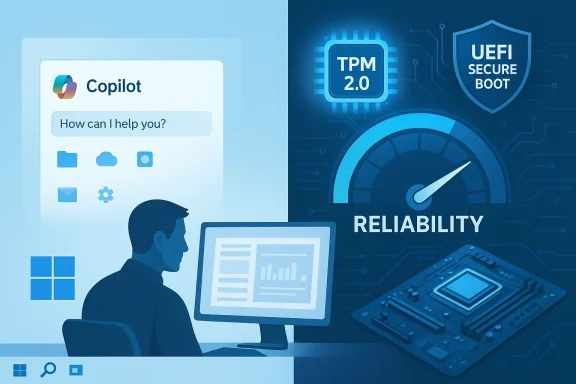
- Hardware gates: The mandatory presence of TPM 2.0, Secure Boot and specific CPU families became a lightning rod for criticism. Many users saw these checks as arbitrary barriers that retired otherwise functional hardware from mainstream support and upgrade entitlement. Security rationales were defensible, but the public communication and tooling around eligibility left wide room for resentment.
- Forced or brittle updates: The cadence of Windows feature and cumulative updates, and the occasional emergence of severe regressions, created distrust. When updates introduced compatibility problems with games, audio drivers, fingerprint readers or enterprise workloads, administrators had to scramble with safeguard holds, workarounds and emergency patches. Microsoft’s own release-health communications showed a string of compatibility blocks and subsequent fixes during the rollout of major 24H2/25H2 updates — a sign that the update pipeline still struggles with the complexity of modern PC hardware and ecosystems.
- Experience erosion: Changes to long-standing UI affordances (for example, taskbar behaviors) and more persistent native prompts for Microsoft services made everyday usage feel less like a clean upgrade and more like a forced reconfiguration of preferences users once controlled easily.
The technical debt that built the problem
The term “technical debt” gets tossed around casually, but Windows’ case is instructive: Microsoft seeks to do three difficult things at once.- Maintain maximal backward compatibility for a vast matrix of legacy applications.
- Modernize the UI and platform to host AI and cloud services that often require new security primitives.
- Ship new experiences on a commercially sensitive cadence that aligns with broader corporate product and subscription goals.
The visible symptoms — update regressions, incompatibility safeguards, broken peripherals after major feature updates — are classic signs of underinvested end-to-end validation and the costs of rushing features into a mass market.
The hardware-requirements controversy: security defensible, optics disastrous
Microsoft’s insistence on TPM 2.0, UEFI Secure Boot, and specific CPU microarchitecture features is technically defensible. Hardware-backed isolation (virt‑based security, HVCI, secure key storage) materially improves resistance to kernel-level exploits and firmware attacks.But two questions mattered more to users:
- Did the policy come with enough guidance, tooling and communication to make legitimate upgrades accessible?
- Did Microsoft underestimate the blowback of effectively excluding large swaths of otherwise-capable hardware from official upgrade paths?
Update reliability: safeguard holds, fixes, and the enterprise cost
Microsoft’s mechanism to protect customers — the “safeguard hold” — is designed to prevent problematic updates from being pushed to impacted devices automatically. In practice, safeguard holds are both a mitigation and a symptom: they show the company is willing to pause rollouts when issues emerge, yet they also reveal that significant compatibility work reached production.Examples from recent major rollouts document the dynamic:
- Microsoft applied, removed, and re-applied compatibility holds for Windows 11 24H2 due to issues affecting gaming titles, Auto HDR interactions, and camera-based face recognition. The company published guidance, issued out-of-band fixes and lifted holds when patches were validated. Administrators were left juggling hold IDs, staged rollouts and emergency mitigations.
- Cumulative monthly updates occasionally required OOB (out-of-band) fixes to resolve regressions that affected remote desktop sign-ins, audio subsystems or specialized enterprise configurations. Those events erode confidence: IT teams prefer predictable, testable releases over reactive triage.
User autonomy and the control paradox
Central to the credibility argument is perceived loss of control. The platform that once emphasized customization and choice has, at times, nudged or even constrained that autonomy for security, telemetry or monetization reasons.- Updates: Automatic update behaviors and the complexity of pausing or deferring feature rollouts frustrate power users and admins who historically managed patch timing precisely around business windows.
- Telemetry and diagnostics: Microsoft documents diagnostic data levels and the management controls available to organizations, but many users feel the defaults and the available consumer UI make it hard to fully opt out of “required” telemetry. For enterprise customers, Group Policy and MDM offer comprehensive controls; for typical consumers, the choices feel limited. Microsoft’s own guidance advises administrators to rely on managed policies to tune diagnostic collection — a capability unavailable to many home users.
- Copilot and background AI: Bundling AI helpers like Copilot directly into system surfaces improved discoverability but also raised concerns over background resource use, data flows and where inference runs (local vs. cloud). Users who are sensitive to privacy or constrained on compute budgets perceive Copilot as an intrusive system-level addition unless explicit controls are surfaced and easy to use.
Competitive pressures: why Microsoft cannot take loyalty for granted
The Windows franchise was built on a broad compatibility moat and decades of developer and enterprise lock-in. That moat is still deep, but it has cracks.- Desktop alternatives matured. Linux distros have made enormous strides in usability, packaging and driver support. ChromeOS expanded beyond education into lightweight productivity, and macOS remains an attractive, integrated alternative for certain professional workflows.
- Cloud-first application stacks and web apps reduce the OS dependency for many workloads. When the app surface becomes device-agnostic, switching costs fall.
The 2026 promise: ambiguous pledge, real work required
WebProNews framed Microsoft’s January 2026 acknowledgment as a commitment to prioritize fixes and rebuild confidence during 2026. That framing sits uneasily between corporate marketing and engineering reality. Microsoft’s public Windows release-health channels and support documentation show a continuing focus on patch quality, clearer communications around safeguards, and more responsive fix cadence — but a single, canonical corporate “credibility-pledge” memo using that exact language is not readily traceable in public Microsoft messaging. In short: the pledge as reported captures a broader change in tone, but some of the article’s stronger phrasings amount to interpretation rather than a verbatim corporate pledge available for independent verification. Readers should treat the “pledge” language as an editorial summation of Microsoft’s actions and tone rather than a found-and-quoted corporate edict.Strengths Microsoft can (and should) protect
It’s important to acknowledge what Windows 11 does well — and why Microsoft has earned the right to recover trust if it chooses the right path.- Security baseline on modern hardware: TPM, Secure Boot, virtualization-based protections and hardware-assisted encryption materially raise the bar against a subset of firmware and kernel attacks when the full stack is enabled.
- Ecosystem reach and management tooling: Intune, Windows Autopatch, Windows Update for Business and enterprise telemetry provide powerful controls to IT organizations when configured properly. These are assets Microsoft can use to show value for large customers.
- Performance and features on supported devices: On modern, compatible hardware, Windows 11 has demonstrated improvements in power management, gaming experiences (DirectStorage, Auto HDR refinements), and a more modern UI that benefits new hardware designs.
Practical steps Microsoft must take — a prioritized three-point plan
- Stabilize update pipelines and make rollback safe and predictable
- Expand early testing programs with OEMs and ISVs, and publish clearer pre-upgrade compatibility matrices.
- Improve the discoverability and ease of using safeguard holds and rollback tooling for SMBs and IT administrators.
- Rebuild user control and transparency
- Surface simple, consumer-facing controls to limit optional telemetry and AI background activity without forcing registry edits.
- Publish machine-readable retention and training policies for Copilot/AI features and make default behavior conservative (privacy-first) for non-enterprise installs.
- Reframe product messaging around reliability
- For the next major release cycle, announce a clear stability-first cadence: a set of dates and measurable reliability goals (e.g., reduce class-X regressions by Y%).
- Commit to independent, third-party benchmarking of update quality and device compatibility so progress is verifiable.
For administrators and power users: tactical guidance
- Audit your fleet now. Use the latest compatibility reports and Windows Update for Business telemetry to identify devices with potential safeguard holds.
- Keep a dev/test ring that mirrors production — perform staged rollouts and validate critical LOB applications before broad deployment.
- Treat the consumer ESU or paid ESU bridge as an escape hatch, not a strategy. Plan migrations with hardware lifecycles, procurement costs and compliance obligations in view.
- Harden telemetry and AI defaults via Group Policy/MDM where possible; for consumer devices, document simple steps users can follow to reduce optional diagnostic data and disable intrusive AI features.
Broader industry lessons
Microsoft’s credibility moment is not a Microsoft-only cautionary tale. It illustrates larger truths about software in the age of continuous delivery and AI:- Dominant players cannot indefinitely trade core product reliability for faster monetization experiments without incurring long-term erosion of trust.
- Building for the modern edge (AI, cloud) requires seriously investing in backward compatibility and automated testing across a broadly heterogeneous hardware base.
- Monetization strategies that blur the line between helpful and intrusive (ads in the OS, aggressive service nudges) will invite resistance and legal/regulatory scrutiny over time.
Conclusion: can Microsoft fix credibility? Yes — but only if it treats trust as a product requirement
Fixing reliability is not a marketing exercise; it is an organizational discipline that touches hiring, QA, telemetry, partner coordination and customer communication. Microsoft has the scale, the engineering muscle and the enterprise relationships to make measurable improvements. The company also has to acknowledge the political element: forgiveness is earned in public and measurable ways, not just in private engineering sprints.The coming year will be a test. If Windows updates become more predictable, safeguard holds are replaced by clearer pre-upgrade guidance, and user-facing controls for telemetry and AI are more transparent, then the credibility reset will be real and evident in administrator dashboards and end-user sentiment alike. If the company reverts to rapid feature pushes without demonstrable investment in the platform’s reliability, the trust deficit will deepen and alternative platforms will continue to chip away at Windows’ historical advantages.
Microsoft has already begun some of this work through release-health communications, targeted OOB updates and improved tooling for managed environments. Turning those actions into a sustained and measurable credibility recovery will require discipline, transparency and — above all — a willingness to let stability lead product priorities for the next 12 months. Only then will the company convert a moment of vulnerability into a durable restoration of user confidence.
Source: WebProNews Microsoft’s Windows 11 Credibility Crisis: Inside the Company’s Pledge to Rebuild User Confidence