

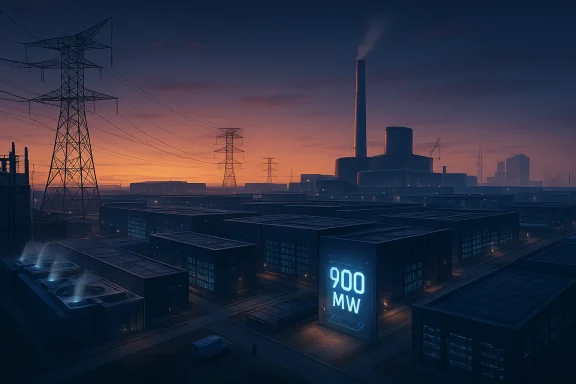
Microsoft’s rumored move into Crusoe’s latest Abilene expansion is a striking reminder that the AI infrastructure race has shifted from software bragging rights to pure industrial scale. If the report holds, Redmond is not just renting compute; it is staking a claim on one of the largest power-and-data-center buildouts now underway in the United States. The headline number — 900 megawatts — sounds almost absurd until you remember that the companies chasing frontier AI are now talking in the language of gigawatts, not racks.
The current frenzy around AI campuses did not emerge overnight. It is the result of a multi-year realization that training and serving frontier models no longer depends on clever software alone, but on vast quantities of power, land, cooling, and supply-chain discipline. Companies that once competed on cloud features are now competing on whether they can secure enough electrons to keep accelerators fed. That is why a single site in Texas can now carry strategic importance across multiple AI vendors.
Crusoe has become one of the most visible beneficiaries of that shift. The company began as an unconventional energy-and-infrastructure player and has evolved into a vertically integrated AI infrastructure provider, with Abilene at the center of its ambition. In March 2025, Crusoe said construction had begun on the next phase of its Abilene campus, expanding the site to 1.2 gigawatts and eight buildings, with the second phase expected in mid-2026.
The Abilene project is also tied to the broader Stargate push that OpenAI unveiled in January 2025 with partners including Oracle and SoftBank, describing a massive U.S. AI infrastructure program designed to reach 10 gigawatts over time. OpenAI later said it was moving ahead with additional Oracle capacity, taking Stargate development to more than 5 gigawatts, and in early 2026 it said the initiative was already well ahead of schedule.
Microsoft’s role in this story reflects a broader strategic realignment. It remains deeply tied to OpenAI’s ecosystem, but it is also building its own AI superfactory-style infrastructure and investing in distinct campuses of its own, including Wisconsin and Atlanta. Microsoft’s public messaging increasingly frames AI datacenters as interconnected industrial systems supporting OpenAI, Microsoft AI, Copilot, and other workloads, not as isolated buildings.
That context matters because the reported Crusoe expansion sits at the intersection of three powerful trends: the scarcity of power, the consolidation of AI infrastructure around a handful of hyperscale customers, and the emergence of behind-the-meter generation as a practical workaround for the grid bottleneck. In other words, this is not just about where Microsoft wants to place servers. It is about how the next era of compute will be physically built.
According to the report, Crusoe’s new campus would sit alongside the existing 1.2 GW Abilene buildout and add two more data halls, each capable of 336 MW of critical IT load. That distinction matters because headline campus capacity and usable IT load are not the same thing. The former includes power infrastructure and generation capacity, while the latter reflects what can actually be delivered to computing equipment.
Crusoe’s own March 2025 announcement said the Abilene campus would eventually consist of eight buildings totaling about 4 million square feet, but only the initial 200+ MW phase was expected to energize in the first half of 2025. That means the site’s physical footprint and its operational footprint are moving on different timelines. The result is a classic build-now, turn-on-later pattern that is becoming common in AI infrastructure.
That strategy is consistent with Microsoft’s recent physical investments. The company said in 2024 it would invest $3.3 billion in Wisconsin, and later said that its Mount Pleasant datacenter was on track to come online in early 2026. Microsoft also touted the opening of an AI Co-Innovation Lab in Wisconsin and described the campus as part of a broader local innovation push.
If Microsoft is indeed taking space in Crusoe’s Abilene expansion, the company may be diversifying the ways it secures frontier-scale compute. That could reduce dependence on a single owned campus schedule and offer more agility in an environment where GPU procurement, power delivery, and interconnect buildouts can all slip. In the AI race, optionality is a strategic asset.
Crusoe has positioned itself as vertically integrated, meaning it controls more of the stack than a traditional real-estate developer would. In practical terms, that can include land, construction, power planning, and increasingly the software and operational layer around AI datacenters. The more Crusoe can coordinate those pieces, the more attractive it becomes to customers that need speed and certainty.
The company’s Abilene site has also become a kind of proving ground for the next-generation AI factory model. Crusoe said in 2025 that the campus would eventually house up to 50,000 NVIDIA GB200 NVL72 systems per building, which shows how tightly the physical design is linked to high-density AI hardware. That kind of planning changes the economics of the building itself, because cooling, electrical distribution, and maintenance access all have to be engineered around the workload.
In a market where time-to-power is often the decisive constraint, on-site generation can be the difference between winning and losing a major tenant. It also allows builders to stage capacity more independently of transmission upgrades, which can take years. The tradeoff, of course, is that the economics, emissions profile, and permitting burden become more complicated.
OpenAI’s public announcements in 2025 and 2026 show how quickly the Stargate program expanded from a concept into multiple sites across the U.S. The company said it had moved ahead with Oracle for an additional 4.5 GW, and by January 2026 it was describing Stargate campuses in Texas, New Mexico, Michigan, Wisconsin, and elsewhere. That is a serious infrastructure footprint, not a pilot program.
If Oracle and OpenAI were previously expected to take the additional Abilene capacity but negotiations and financing fell through, as the report suggests, then Microsoft’s apparent entry would be a strong sign that the site’s value remains intact. It would also suggest that AI infrastructure demand is now so deep that one tenant’s retreat becomes another tenant’s opportunity. That is classic seller’s market behavior.
Abilene’s rise as a datacenter destination is a product of that tension. The site can host massive industrial loads, and developers can pursue on-site generation to reduce dependence on the grid. But every additional hundred megawatts raises questions about resilience, local environmental impact, and how much of the project is truly integrated with the broader energy system.
The report notes that Crusoe did not specify how the on-site power plants would generate electricity, though natural gas generators or fuel cells were suggested as likely candidates given the timeline. That is an important uncertainty because fuel choice affects emissions, operating cost, and permitting complexity. Until the exact design is public, the project’s environmental and regulatory profile remains partly speculative.
Consumers, by contrast, will probably feel this indirectly. They are unlikely to care whether a particular workload sits in Abilene or Wisconsin, but they will care if AI products become faster, more reliable, and more capable. The consumer-visible outcome of these giant campuses is often invisible until model quality jumps or outages become rarer.
This is why the infrastructure race matters even to users who never see a datacenter. The competition for power and land determines how quickly frontier models can improve, how aggressively companies can deploy them, and how much margin they have for services that feel “free” on the surface but are expensive to run underneath. The physical layer of AI increasingly shapes the user experience.
We should also watch whether Crusoe reveals more about the on-site generation design. If the company is indeed planning natural gas generation or fuel cells, that will tell us a lot about how aggressively AI builders are willing to trade emissions simplicity for deployment speed. It would also give local stakeholders a much clearer view of the project’s energy profile and political exposure.
Source: theregister.com Microsoft lays claim to Crusoe's new 900 MW DC campus
 Background
The current frenzy around AI campuses did not emerge overnight. It is the result of a multi-year realization that training and serving frontier models no longer depends on clever software alone, but on vast quantities of power, land, cooling, and supply-chain discipline. Companies that once competed on cloud features are now competing on whether they can secure enough electrons to keep accelerators fed. That is why a single site in Texas can now carry strategic importance across multiple AI vendors.Crusoe has become one of the most visible beneficiaries of that shift. The company began as an unconventional energy-and-infrastructure player and has evolved into a vertically integrated AI infrastructure provider, with Abilene at the center of its ambition. In March 2025, Crusoe said construction had begun on the next phase of its Abilene campus, expanding the site to 1.2 gigawatts and eight buildings, with the second phase expected in mid-2026.
The Abilene project is also tied to the broader Stargate push that OpenAI unveiled in January 2025 with partners including Oracle and SoftBank, describing a massive U.S. AI infrastructure program designed to reach 10 gigawatts over time. OpenAI later said it was moving ahead with additional Oracle capacity, taking Stargate development to more than 5 gigawatts, and in early 2026 it said the initiative was already well ahead of schedule.
Microsoft’s role in this story reflects a broader strategic realignment. It remains deeply tied to OpenAI’s ecosystem, but it is also building its own AI superfactory-style infrastructure and investing in distinct campuses of its own, including Wisconsin and Atlanta. Microsoft’s public messaging increasingly frames AI datacenters as interconnected industrial systems supporting OpenAI, Microsoft AI, Copilot, and other workloads, not as isolated buildings.
That context matters because the reported Crusoe expansion sits at the intersection of three powerful trends: the scarcity of power, the consolidation of AI infrastructure around a handful of hyperscale customers, and the emergence of behind-the-meter generation as a practical workaround for the grid bottleneck. In other words, this is not just about where Microsoft wants to place servers. It is about how the next era of compute will be physically built.
What Crusoe’s 900 MW expansion really means
A 900 MW addition is not a routine data-center upgrade. It is the kind of expansion normally associated with utility-scale planning, industrial zoning, and long-horizon transmission strategy. At this scale, the datacenter itself becomes a power project as much as a computing project, with the server halls only one part of the equation.According to the report, Crusoe’s new campus would sit alongside the existing 1.2 GW Abilene buildout and add two more data halls, each capable of 336 MW of critical IT load. That distinction matters because headline campus capacity and usable IT load are not the same thing. The former includes power infrastructure and generation capacity, while the latter reflects what can actually be delivered to computing equipment.
Crusoe’s own March 2025 announcement said the Abilene campus would eventually consist of eight buildings totaling about 4 million square feet, but only the initial 200+ MW phase was expected to energize in the first half of 2025. That means the site’s physical footprint and its operational footprint are moving on different timelines. The result is a classic build-now, turn-on-later pattern that is becoming common in AI infrastructure.
Why power figures can be misleading
The most important caveat in these projects is that capacity announcements often precede actual service by many months. Crusoe said in 2025 that the initial 200+ MW phase would be energized in the first half of 2025, and the rest of the 1.2 GW project would come online through 2026. The March 27 report suggests that only about 200 MW of the original project had actually been powered on so far. That is not unusual, but it is a reminder that announced megawatts and delivered megawatts are not the same thing.- Announced capacity signals ambition.
- Energized capacity signals real readiness.
- Critical IT load is the bottleneck that matters to tenants.
- Power generation and switchgear can be more limiting than floor space.
- The calendar is often more important than the brochure.
Microsoft’s infrastructure strategy
Microsoft has been busy turning AI infrastructure into a platform story rather than a single-campus story. Its official communications in 2026 describe networked AI datacenters working together as a “superfactory” to support OpenAI, Microsoft AI, Copilot, and other workloads. That framing is important because it suggests Microsoft wants flexible access to massive compute pools, whether owned directly or provisioned through partners.That strategy is consistent with Microsoft’s recent physical investments. The company said in 2024 it would invest $3.3 billion in Wisconsin, and later said that its Mount Pleasant datacenter was on track to come online in early 2026. Microsoft also touted the opening of an AI Co-Innovation Lab in Wisconsin and described the campus as part of a broader local innovation push.
If Microsoft is indeed taking space in Crusoe’s Abilene expansion, the company may be diversifying the ways it secures frontier-scale compute. That could reduce dependence on a single owned campus schedule and offer more agility in an environment where GPU procurement, power delivery, and interconnect buildouts can all slip. In the AI race, optionality is a strategic asset.
Why Microsoft would want this kind of site
There are at least three reasons Microsoft would find this attractive. First, the Abilene location is already part of the Stargate orbit, which means the physical ecosystem, permitting patterns, and industrial scale are already being assembled. Second, the campus is designed around very high-density AI workloads, which is what frontier models need. Third, behind-the-meter generation can sidestep some grid congestion and speed time to power.- Faster access to usable capacity.
- Alignment with AI-specific power densities.
- Less dependence on constrained utility timelines.
- Better fit for massive model training workloads.
- Potentially improved resilience through on-site generation.
Crusoe’s business model is changing
Crusoe’s evolution from a niche energy story into a core AI infrastructure builder is one of the more notable business transformations in the sector. The company’s public materials now emphasize renewable-powered AI infrastructure, but its latest expansion underscores a broader reality: customers care first about whether power can be delivered at scale and on time. The branding may say “clean,” but the business driver is unmistakably industrial.Crusoe has positioned itself as vertically integrated, meaning it controls more of the stack than a traditional real-estate developer would. In practical terms, that can include land, construction, power planning, and increasingly the software and operational layer around AI datacenters. The more Crusoe can coordinate those pieces, the more attractive it becomes to customers that need speed and certainty.
The company’s Abilene site has also become a kind of proving ground for the next-generation AI factory model. Crusoe said in 2025 that the campus would eventually house up to 50,000 NVIDIA GB200 NVL72 systems per building, which shows how tightly the physical design is linked to high-density AI hardware. That kind of planning changes the economics of the building itself, because cooling, electrical distribution, and maintenance access all have to be engineered around the workload.
Behind-the-meter power is the real story
The report’s most revealing detail may be Crusoe’s mention of an on-site power plant capable of delivering 900 MW behind the meter. Even without a detailed fuel disclosure, that points to a strategy increasingly used by AI infrastructure developers: generate power on-site so the datacenter is less exposed to grid interconnection delays. That does not eliminate complexity, but it can make the project more bankable and more controllable.In a market where time-to-power is often the decisive constraint, on-site generation can be the difference between winning and losing a major tenant. It also allows builders to stage capacity more independently of transmission upgrades, which can take years. The tradeoff, of course, is that the economics, emissions profile, and permitting burden become more complicated.
- The build becomes more capital intensive.
- Fuel sourcing becomes strategically important.
- Local permitting scrutiny increases.
- Emissions questions do not disappear.
- Operational flexibility improves if the plan works.
Why the OpenAI-Oracle-Microsoft triangle matters
The most interesting competitive wrinkle in this report is the shifting relationship between Microsoft and OpenAI. For years, the two companies were seen as tightly coupled in both technology and infrastructure. That relationship has changed as OpenAI broadened its commercial and infrastructure partnerships, especially through Stargate and Oracle. Microsoft, in turn, has not stood still; it has been building its own AI infrastructure identity.OpenAI’s public announcements in 2025 and 2026 show how quickly the Stargate program expanded from a concept into multiple sites across the U.S. The company said it had moved ahead with Oracle for an additional 4.5 GW, and by January 2026 it was describing Stargate campuses in Texas, New Mexico, Michigan, Wisconsin, and elsewhere. That is a serious infrastructure footprint, not a pilot program.
If Oracle and OpenAI were previously expected to take the additional Abilene capacity but negotiations and financing fell through, as the report suggests, then Microsoft’s apparent entry would be a strong sign that the site’s value remains intact. It would also suggest that AI infrastructure demand is now so deep that one tenant’s retreat becomes another tenant’s opportunity. That is classic seller’s market behavior.
The broader market signal
This is not just a story about one lease. It is a signal that the next phase of AI competition may revolve around the availability of ready-to-energize campuses. The companies with access to the most power and the fastest deployment timelines gain a huge advantage in training, inference, and product rollout. In that sense, Crusoe’s site may be as strategically important as any chip supply agreement.- Compute access can shape model development schedules.
- Power availability can shape product launch timing.
- Infrastructure partners can influence strategic alliances.
- Campus scale can determine how many models can be trained in parallel.
- Leasing decisions can affect competitive balance across the sector.
The Texas power question
Texas is both the ideal and the awkward place to build AI campuses. It offers land, industrial openness, and a historically pro-development posture, but it also comes with weather risk, grid volatility, and intense scrutiny around large power draws. For AI datacenters, Texas is attractive precisely because the state has embraced big infrastructure, yet that same scale creates friction when multiple industries compete for the same electrons.Abilene’s rise as a datacenter destination is a product of that tension. The site can host massive industrial loads, and developers can pursue on-site generation to reduce dependence on the grid. But every additional hundred megawatts raises questions about resilience, local environmental impact, and how much of the project is truly integrated with the broader energy system.
The report notes that Crusoe did not specify how the on-site power plants would generate electricity, though natural gas generators or fuel cells were suggested as likely candidates given the timeline. That is an important uncertainty because fuel choice affects emissions, operating cost, and permitting complexity. Until the exact design is public, the project’s environmental and regulatory profile remains partly speculative.
Energy infrastructure as a competitive moat
The ability to solve power is becoming a moat for AI infrastructure companies. Developers that can secure land, gas supply, switchgear, transmission rights, and permitting all at once can move faster than rivals waiting on utility interconnection. This is not just an engineering advantage; it is a business advantage that determines who lands the marquee tenants.- Fast power access shortens deployment cycles.
- On-site generation reduces reliance on crowded grids.
- Texas offers scale but also scrutiny.
- Environmental tradeoffs remain politically sensitive.
- Energy strategy increasingly equals market strategy.
Enterprise and consumer impact are diverging
For enterprises, the significance of this expansion is straightforward: more AI infrastructure means more capacity for large-scale training, inference, and hosted model services. It may also mean improved access to premium AI features as Microsoft distributes workloads across a bigger and more resilient compute base. Businesses that depend on Copilot, Azure AI, or Microsoft-backed model services are ultimately beneficiaries of any expansion that increases available headroom.Consumers, by contrast, will probably feel this indirectly. They are unlikely to care whether a particular workload sits in Abilene or Wisconsin, but they will care if AI products become faster, more reliable, and more capable. The consumer-visible outcome of these giant campuses is often invisible until model quality jumps or outages become rarer.
This is why the infrastructure race matters even to users who never see a datacenter. The competition for power and land determines how quickly frontier models can improve, how aggressively companies can deploy them, and how much margin they have for services that feel “free” on the surface but are expensive to run underneath. The physical layer of AI increasingly shapes the user experience.
Enterprise implications
Enterprises should read this as a sign that AI capacity planning is becoming a strategic procurement issue, not just an IT issue. Large customers may increasingly want to know where their workloads run, what power assumptions underlie service guarantees, and how resilient the underlying campus network really is. As AI becomes embedded in core workflows, infrastructure reliability becomes a board-level concern.- More capacity can mean better service availability.
- Campus diversity can reduce concentration risk.
- Dedicated AI sites can improve latency and throughput.
- Power-backed campuses may offer stronger resilience.
- Procurement teams may begin asking infrastructure questions more aggressively.
Strengths and Opportunities
The upside of this reported deal is that it shows the AI infrastructure market is still expanding rather than freezing up. Crusoe appears to have the scale, site control, and customer relevance to keep attracting the biggest names in the industry, while Microsoft gains another path to secured compute without waiting entirely on its own build schedule. That combination is powerful in a market where timing can matter as much as technical specification.- Access to massive, AI-specific power capacity.
- Faster route to operational compute than greenfield builds alone.
- Better resilience through geographic and customer diversification.
- Strong demand signal for Crusoe’s vertically integrated model.
- Potentially improved leverage in future infrastructure negotiations.
- Greater flexibility for Microsoft’s AI workload planning.
- Reinforcement of Texas as a strategic AI geography.
Risks and Concerns
The risks are equally real. Large AI campuses can become headline machines long before they become stable operating assets, and that creates a temptation to overread every capacity announcement as if it were live capacity. If the power plant design, fuel sourcing, or permitting path proves more difficult than expected, timelines can slip and the economics can worsen quickly.- Construction and energization may lag behind press releases.
- Fuel choice could trigger regulatory or environmental backlash.
- Behind-the-meter generation may increase operating complexity.
- Local grid and community impacts may become politically sensitive.
- Capital intensity may strain financing if utilization ramps slowly.
- Customer concentration can create dependence on a few large tenants.
- Public scrutiny could intensify if water, emissions, or reliability issues emerge.
Looking Ahead
The next few quarters will tell us whether this is a real lease-level commitment or a broader placeholder for Microsoft’s longer-term infrastructure strategy. The timing matters because Crusoe says the second campus is still in land-clearing and site-prep mode, and the company does not expect the facilities to be operational until the middle of next year. That means the story is still unfolding in construction time, not customer time.We should also watch whether Crusoe reveals more about the on-site generation design. If the company is indeed planning natural gas generation or fuel cells, that will tell us a lot about how aggressively AI builders are willing to trade emissions simplicity for deployment speed. It would also give local stakeholders a much clearer view of the project’s energy profile and political exposure.
- Whether Microsoft formally confirms the campus role.
- Whether Crusoe discloses the generation technology.
- How quickly the existing Abilene capacity is actually energized.
- Whether more tenants join the same site or nearby expansions.
- Whether regulatory scrutiny increases around large behind-the-meter generation.
- Whether this model spreads to other states and other hyperscalers.
Source: theregister.com Microsoft lays claim to Crusoe's new 900 MW DC campus
