

Microsoft’s reported move to lease abandoned AI data center capacity in Abilene, Texas is more than a simple real-estate transaction. It signals how quickly the generative AI infrastructure race is shifting from grand announcements to hard-nosed capacity arbitrage, with major cloud vendors chasing power, land, and cooling wherever they can find it. The site in question sits next to Oracle and OpenAI’s flagship Stargate campus, making the handoff especially symbolic: what was once framed as a marquee OpenAI-Oracle expansion is now reportedly being repackaged for Microsoft’s needs. In the broader market, the deal underscores a new reality for AI infrastructure: demand is still enormous, but tenant priorities, financing structures, and chip road maps are changing fast enough to redraw campus plans in months rather than years.
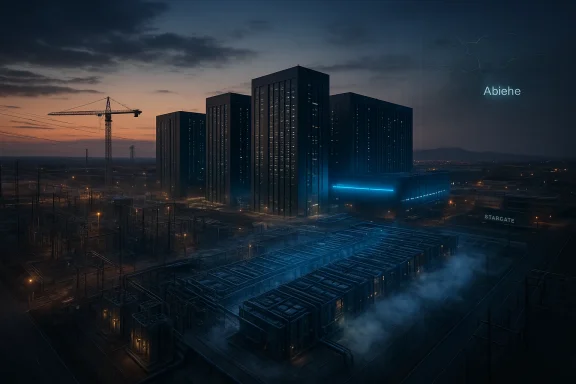
The Abilene campus has become one of the most closely watched pieces of AI infrastructure in the United States. Built by Crusoe on a large Texas site and tied to the broader Stargate branding, it was presented as part of the vast buildout needed to support next-generation model training and inference. Over the last year, the project evolved from a single-campus concept into a broader symbol of the capital intensity behind generative AI.
The original premise was straightforward enough: if companies like OpenAI, Oracle, and their financing partners wanted to stay competitive, they would need very large, utility-scale data centers with access to extraordinary power. That meant locking down megawatts, not just servers. It also meant building campuses far from traditional cloud hubs, where land is cheaper, grids can be expanded, and developers can design around the thermal and electrical needs of modern AI accelerators.
Yet the speed of AI infrastructure demand has made planning unusually difficult. A campus that looked undersized in one budget cycle can look excessive in the next. A chip generation that seemed dominant at launch may be overtaken by a new architecture before the concrete sets. And when financing conditions tighten, the cost of carrying half-committed capacity can become a major burden.
That is the context for the reported Microsoft lease. According to the reporting cited by News.Az, Oracle and OpenAI walked away from the expansion after financing challenges and shifting infrastructure needs, leaving developer Crusoe with capacity to re-market. Microsoft then reportedly stepped in as a tenant. Reuters is cited as the underlying source of the claim, which matters because Reuters has been one of the few outlets consistently tracking the capital markets and infrastructure side of the AI boom.
The irony is hard to miss. Microsoft has been one of OpenAI’s most important strategic partners, yet it has also been investing heavily in its own AI stack, including Microsoft Copilot and Azure-linked infrastructure. So the lease would not merely fill empty space; it would place Microsoft physically adjacent to a project originally associated with a rival’s broader ecosystem. That kind of proximity is typical in cloud infrastructure, but in the AI era it has become a strategic statement.
The reported reason Oracle and OpenAI stepped back was a combination of financing pressure and changing AI infrastructure requirements. That explanation is plausible in a market where compute planning has become more dynamic than ever. A company can no longer assume that a single campus layout, cooling method, or hardware mix will remain optimal for the life of the lease.
At the same time, the reporting should be read carefully. Oracle previously pushed back on some claims that parts of the Stargate buildout were stalled or off track, which suggests there is at least some tension between public messaging and the interpretations drawn by the press. That does not make the underlying story false, but it does mean the exact status of each expansion block may be more fluid than a clean “cancelled versus active” framing suggests.
What makes the report especially important is not simply whether Microsoft took one lease. It is the evidence that top-tier AI buyers are now treating capacity as a tradable commodity. In other words, data center footprints are no longer immutable company monuments; they are strategic inventory that can be swapped, repurposed, or re-leased as business priorities change.
It also highlights how the AI arms race has changed the meaning of “cloud capacity.” The old cloud narrative focused on elasticity and global distribution. The new one is increasingly about site-specific power availability and the ability to bring massive clusters online fast enough to matter.
Key implications include:
That is why any change in tenant mix matters. If one marquee customer steps back and another steps in, the meaning of the campus changes, even if the power draw stays the same. A site can remain operational while its strategic identity evolves.
The Stargate concept also reflects how the AI industry now thinks about infrastructure in blocks rather than sites. A campus is no longer just for one model family or one product line. It is a platform that can be aligned to different hardware road maps and different commercial needs over time.
That makes campuses like Abilene less like traditional corporate campuses and more like continuously reconfigurable industrial plants. The winning operator is not necessarily the one with the most optimistic press release. It is the one who can adapt the fastest when demand or financing shifts.
Leasing pre-built or partially completed capacity also makes strategic sense. In an environment where lead times for electrical equipment, transformers, and GPU-ready space can stretch for months or longer, buying time can be as valuable as buying land. The faster Microsoft can bring capacity online, the faster it can support customer demand and internal workloads.
There is also a portfolio effect. Microsoft has to balance its exposure across many regions and many partners. An additional large lease in Texas would fit a broader strategy of diversifying infrastructure while keeping enough proximity to major AI ecosystems to stay competitive.
It also gives Microsoft leverage in a market where being short on capacity can mean lost revenue or delayed product launches. In AI, idle demand is expensive. If customers want compute and you cannot deliver it, they will look elsewhere.
Possible advantages include:
OpenAI’s model road map has become more dynamic, with changing assumptions about capacity, timing, and deployment strategy. Oracle, meanwhile, has to manage infrastructure economics, lease obligations, and its role as a host for one of the most visible AI projects in the world. When those incentives diverge, a campus can quickly become a negotiation rather than a commitment.
The issue is not just size. It is fit. AI infrastructure is becoming more specialized, and what works for one customer’s training cycle may not be ideal for another’s inference-heavy workloads. That raises the value of repurposable capacity and lowers the tolerance for rigid, single-use designs.
This is one reason the abandoned or deferred capacity in Texas matters so much. It shows that even in a market full of AI enthusiasm, money still has to clear the gate. If a project’s economics wobble, the physical site may still exist — but the intended tenant may not.
That matters because infrastructure developers increasingly function like market makers. They absorb some of the uncertainty around demand, then try to match power and physical capacity with whichever major customer is willing to commit. In the old cloud era, this role was often hidden in the background. In the AI era, it is becoming strategic.
The reported Microsoft lease also demonstrates how developers can salvage value from a project that might otherwise look stranded. If one customer steps back, another can step in. That keeps the capital deployed, preserves grid commitments, and reduces the risk of a dead asset.
That means balancing several things at once:
That makes site leasing a competitive weapon. A company that can move into an existing mega-campus can accelerate deployment, reduce uncertainty, and conserve engineering bandwidth. In a fast-moving market, time saved is often more valuable than a theoretical cost advantage.
It also suggests a growing separation between AI product strategy and infrastructure strategy. The same company might train models in one place, run inference in another, and lease extra capacity somewhere else entirely. That distributed footprint makes the market harder to track, but it also makes it more resilient.
It also puts pressure on competitors to move faster. If one of the most important AI vendors can snap up abandoned capacity, others will want to do the same before the best sites are gone.
For enterprise customers, the implications are even more direct. Businesses buying cloud and AI services want capacity guarantees, predictable service levels, and confidence that the provider will not hit a compute ceiling at the wrong time. A larger footprint helps Microsoft meet those expectations and may support more aggressive enterprise AI sales.
There is also a broader pricing effect, though it is hard to quantify. The more infrastructure a provider has, the more freedom it may have in packaging services, managing margins, and smoothing demand spikes. That can influence the economics of AI adoption across sectors.
Potential consumer-side benefits include:
Potential enterprise-side benefits include:
A 700 MW site implies massive coordination with utilities and local infrastructure. It also implies a cooling strategy capable of handling dense rack configurations associated with modern accelerators. That is why companies building AI campuses are increasingly talking like energy companies and less like software vendors.
The cooling issue is particularly important. AI hardware generates intense heat loads, and the design choices around liquid cooling, airflow, and redundancy can determine whether a site is reliable or fragile. In this sense, the physical design of the campus can shape the economics of the software above it.
In practical terms, that means data center location and utility planning are now part of the product stack.
It also reveals how much of the AI boom is now mediated by developers and infrastructure platforms. These companies sit between the hype and the hardware, converting ambition into concrete, power, and operational capacity. When demand shifts, they are among the first to feel it.
In that sense, the Texas deal is a reminder that the AI race is no longer only about software breakthroughs. It is about who can secure the industrial base underneath them. That base is expensive, hard to build, and increasingly valuable to whichever customer can use it fastest.
Another concern is overbuilding. If multiple companies continue to race for AI capacity while model demand becomes more efficient than expected, some campuses could end up underused. The industry still appears capacity-hungry, but forecasting at this scale is difficult and mistakes are expensive.
More broadly, the AI infrastructure market is likely to keep rewarding firms that can move quickly on power and site availability. The winners will not just be those with the most ambitious model road maps, but those with the best physical backbone to support them. That is why a reported lease in Texas can matter far beyond Texas.
Source: Latest news from Azerbaijan Microsoft to rent Texas AI data center abandoned by Oracle | News.az
 Background
The Abilene campus has become one of the most closely watched pieces of AI infrastructure in the United States. Built by Crusoe on a large Texas site and tied to the broader Stargate branding, it was presented as part of the vast buildout needed to support next-generation model training and inference. Over the last year, the project evolved from a single-campus concept into a broader symbol of the capital intensity behind generative AI.The original premise was straightforward enough: if companies like OpenAI, Oracle, and their financing partners wanted to stay competitive, they would need very large, utility-scale data centers with access to extraordinary power. That meant locking down megawatts, not just servers. It also meant building campuses far from traditional cloud hubs, where land is cheaper, grids can be expanded, and developers can design around the thermal and electrical needs of modern AI accelerators.
Yet the speed of AI infrastructure demand has made planning unusually difficult. A campus that looked undersized in one budget cycle can look excessive in the next. A chip generation that seemed dominant at launch may be overtaken by a new architecture before the concrete sets. And when financing conditions tighten, the cost of carrying half-committed capacity can become a major burden.
That is the context for the reported Microsoft lease. According to the reporting cited by News.Az, Oracle and OpenAI walked away from the expansion after financing challenges and shifting infrastructure needs, leaving developer Crusoe with capacity to re-market. Microsoft then reportedly stepped in as a tenant. Reuters is cited as the underlying source of the claim, which matters because Reuters has been one of the few outlets consistently tracking the capital markets and infrastructure side of the AI boom.
The irony is hard to miss. Microsoft has been one of OpenAI’s most important strategic partners, yet it has also been investing heavily in its own AI stack, including Microsoft Copilot and Azure-linked infrastructure. So the lease would not merely fill empty space; it would place Microsoft physically adjacent to a project originally associated with a rival’s broader ecosystem. That kind of proximity is typical in cloud infrastructure, but in the AI era it has become a strategic statement.
What Reportedly Happened
The headline claim is that Microsoft agreed to lease a data center in Abilene, Texas, after the space had been left behind by Oracle and OpenAI. The capacity involved is said to be roughly 700 megawatts, which is enormous by conventional data center standards and meaningful even in the new generation of AI campuses. At that scale, the site is not just a building; it is a power asset, a grid commitment, and a long-term operational bet.The reported reason Oracle and OpenAI stepped back was a combination of financing pressure and changing AI infrastructure requirements. That explanation is plausible in a market where compute planning has become more dynamic than ever. A company can no longer assume that a single campus layout, cooling method, or hardware mix will remain optimal for the life of the lease.
At the same time, the reporting should be read carefully. Oracle previously pushed back on some claims that parts of the Stargate buildout were stalled or off track, which suggests there is at least some tension between public messaging and the interpretations drawn by the press. That does not make the underlying story false, but it does mean the exact status of each expansion block may be more fluid than a clean “cancelled versus active” framing suggests.
What makes the report especially important is not simply whether Microsoft took one lease. It is the evidence that top-tier AI buyers are now treating capacity as a tradable commodity. In other words, data center footprints are no longer immutable company monuments; they are strategic inventory that can be swapped, repurposed, or re-leased as business priorities change.
Why 700 MW Matters
Seven hundred megawatts is not a casual figure. For AI, it represents a campus designed around industrial-scale power delivery, not enterprise IT. In practical terms, this kind of capacity supports an ecosystem of transformers, substations, backup systems, liquid cooling, network fabric, and maintenance operations that resemble utility infrastructure as much as software infrastructure.It also highlights how the AI arms race has changed the meaning of “cloud capacity.” The old cloud narrative focused on elasticity and global distribution. The new one is increasingly about site-specific power availability and the ability to bring massive clusters online fast enough to matter.
Key implications include:
- Megawatts are the new bottleneck
- Speed to power can matter more than location prestige
- Leases are now strategic compute options
- Cooling design is as important as rack density
- Financing can determine whether a campus becomes real or remains planned
The Stargate Context
The Abilene project has been closely associated with the broader Stargate effort, which was introduced as a massive AI infrastructure buildout involving multiple heavyweight partners. In that framing, the Texas campus was supposed to help provide the muscle behind future AI model training and large-scale inference services. The symbolism was significant: this was not a niche colocation arrangement, but a flagship industrial project meant to show scale.That is why any change in tenant mix matters. If one marquee customer steps back and another steps in, the meaning of the campus changes, even if the power draw stays the same. A site can remain operational while its strategic identity evolves.
The Stargate concept also reflects how the AI industry now thinks about infrastructure in blocks rather than sites. A campus is no longer just for one model family or one product line. It is a platform that can be aligned to different hardware road maps and different commercial needs over time.
From Announcement to Adaptation
The transition from launch hype to operational flexibility has been one of the defining themes of the AI infrastructure boom. Initial announcements often assume stable demand curves and predictable chip rollouts. In reality, the industry is dealing with rapidly changing model requirements, supply-chain constraints, and competitive pressure to optimize every watt.That makes campuses like Abilene less like traditional corporate campuses and more like continuously reconfigurable industrial plants. The winning operator is not necessarily the one with the most optimistic press release. It is the one who can adapt the fastest when demand or financing shifts.
Microsoft’s Strategic Motive
If Microsoft is indeed the new tenant, the logic is easy to see. The company is simultaneously a major OpenAI backer and a cloud provider that must support its own generative AI products. It needs enormous compute access for Azure, Copilot, and the broader AI services stack that is increasingly central to its growth story.Leasing pre-built or partially completed capacity also makes strategic sense. In an environment where lead times for electrical equipment, transformers, and GPU-ready space can stretch for months or longer, buying time can be as valuable as buying land. The faster Microsoft can bring capacity online, the faster it can support customer demand and internal workloads.
There is also a portfolio effect. Microsoft has to balance its exposure across many regions and many partners. An additional large lease in Texas would fit a broader strategy of diversifying infrastructure while keeping enough proximity to major AI ecosystems to stay competitive.
Why Microsoft Would Want This Site
Microsoft has several reasons to prefer a site like Abilene over starting from scratch elsewhere. The campus is already designed for scale, the power planning is likely advanced, and the developer relationship may be mature. That means fewer unknowns and a faster path to operational use.It also gives Microsoft leverage in a market where being short on capacity can mean lost revenue or delayed product launches. In AI, idle demand is expensive. If customers want compute and you cannot deliver it, they will look elsewhere.
Possible advantages include:
- Faster deployment than greenfield construction
- Access to utility-scale power commitments
- Potential economies of scale in operations
- A location suited to large AI workloads
- Strategic flexibility across Azure and Copilot workloads
Oracle, OpenAI, and the Changing Plan
The most revealing part of the story may be what it says about Oracle and OpenAI, not Microsoft. Their reported decision to step away suggests that even the largest AI players are being forced to continuously recalibrate infrastructure plans. That is not a sign that demand vanished; it is a sign that demand changed shape.OpenAI’s model road map has become more dynamic, with changing assumptions about capacity, timing, and deployment strategy. Oracle, meanwhile, has to manage infrastructure economics, lease obligations, and its role as a host for one of the most visible AI projects in the world. When those incentives diverge, a campus can quickly become a negotiation rather than a commitment.
The issue is not just size. It is fit. AI infrastructure is becoming more specialized, and what works for one customer’s training cycle may not be ideal for another’s inference-heavy workloads. That raises the value of repurposable capacity and lowers the tolerance for rigid, single-use designs.
Financing as a Pressure Point
Large AI campuses depend on intricate financing structures. They often involve developers, landlords, infrastructure financiers, cloud operators, and software tenants, all trying to de-risk multi-billion-dollar commitments. When the capital stack gets complicated, the deal can slow down even if the technical demand is real.This is one reason the abandoned or deferred capacity in Texas matters so much. It shows that even in a market full of AI enthusiasm, money still has to clear the gate. If a project’s economics wobble, the physical site may still exist — but the intended tenant may not.
Crusoe’s Role as Developer
Crusoe sits at the center of the story because it is the developer that can pivot a campus from one anchor tenant to another. That kind of flexibility is now a highly valuable skill in AI infrastructure. The company is not merely constructing walls and power lines; it is managing an asset that can be re-leased if a planned customer changes course.That matters because infrastructure developers increasingly function like market makers. They absorb some of the uncertainty around demand, then try to match power and physical capacity with whichever major customer is willing to commit. In the old cloud era, this role was often hidden in the background. In the AI era, it is becoming strategic.
The reported Microsoft lease also demonstrates how developers can salvage value from a project that might otherwise look stranded. If one customer steps back, another can step in. That keeps the capital deployed, preserves grid commitments, and reduces the risk of a dead asset.
The Developer’s Balancing Act
For Crusoe, the challenge is not just construction. It is sequencing. A site with megawatt-scale capacity must be matched to tenants, hardware, and electrical milestones in the right order or the economics break down.That means balancing several things at once:
- Construction schedules
- Utility interconnections
- Tenant credit quality
- Cooling and power architecture
- Demand forecasts that keep changing
The Competitive Landscape
Microsoft’s alleged move should be read in the context of a wider race among tech giants. Meta, Google, Amazon, and others are all competing to secure enough power and server room to stay in the AI game. The competition is no longer just about model quality or product design; it is about who can secure the industrial backbone first.That makes site leasing a competitive weapon. A company that can move into an existing mega-campus can accelerate deployment, reduce uncertainty, and conserve engineering bandwidth. In a fast-moving market, time saved is often more valuable than a theoretical cost advantage.
It also suggests a growing separation between AI product strategy and infrastructure strategy. The same company might train models in one place, run inference in another, and lease extra capacity somewhere else entirely. That distributed footprint makes the market harder to track, but it also makes it more resilient.
What Rivals Are Likely Thinking
Rivals will likely see the reported deal as confirmation that AI capacity is still scarce, even if individual projects are reconfigured. If Microsoft is taking over space that OpenAI and Oracle no longer want, that means demand remains deep enough to keep the asset attractive. In effect, the market is re-pricing the same power in real time.It also puts pressure on competitors to move faster. If one of the most important AI vendors can snap up abandoned capacity, others will want to do the same before the best sites are gone.
Enterprise and Consumer Impact
The consumer impact of a lease like this may not be immediate, but it is real. More infrastructure generally means faster model access, better responsiveness, and the ability to launch more capable AI products. For consumers using Copilot, chat tools, image generation, or enterprise-facing AI features, the difference can show up in latency, availability, and feature rollout speed.For enterprise customers, the implications are even more direct. Businesses buying cloud and AI services want capacity guarantees, predictable service levels, and confidence that the provider will not hit a compute ceiling at the wrong time. A larger footprint helps Microsoft meet those expectations and may support more aggressive enterprise AI sales.
There is also a broader pricing effect, though it is hard to quantify. The more infrastructure a provider has, the more freedom it may have in packaging services, managing margins, and smoothing demand spikes. That can influence the economics of AI adoption across sectors.
Consumer Benefits
For everyday users, additional capacity can translate into better product performance. That includes quicker responses, less throttling during peak demand, and the possibility of richer models being exposed to more people.Potential consumer-side benefits include:
- Faster AI response times
- Improved service reliability
- Broader access to new features
- Less strain during high-demand periods
- Better multimodal product performance
Enterprise Benefits
For businesses, the bigger story is capacity assurance. Enterprises do not just want flashy demos; they want systems that can handle production workloads without interruption. A larger Microsoft infrastructure base can support that reliability.Potential enterprise-side benefits include:
- More predictable cloud capacity
- Better support for custom AI workloads
- Higher confidence in long-term roadmap execution
- Potentially faster rollout of enterprise AI features
- More flexibility for hybrid and regulated workloads
Energy, Cooling, and the Physical Reality of AI
The Texas location is a reminder that AI is ultimately constrained by physical systems. Servers need electricity, cooling, and network connectivity. At scale, these are not minor engineering details; they are the project.A 700 MW site implies massive coordination with utilities and local infrastructure. It also implies a cooling strategy capable of handling dense rack configurations associated with modern accelerators. That is why companies building AI campuses are increasingly talking like energy companies and less like software vendors.
The cooling issue is particularly important. AI hardware generates intense heat loads, and the design choices around liquid cooling, airflow, and redundancy can determine whether a site is reliable or fragile. In this sense, the physical design of the campus can shape the economics of the software above it.
Infrastructure as Competitive Advantage
The next wave of AI winners may be the companies that can align compute architecture with power and cooling reality faster than their rivals. Good enough infrastructure is no longer good enough when customers expect instant model access and providers are training on ever-larger datasets.In practical terms, that means data center location and utility planning are now part of the product stack.
Why This Story Matters Beyond Texas
The Abilene lease story is not just about one campus in one city. It is a window into how AI infrastructure is being reallocated across the market as companies revise forecasts and re-rank priorities. What looks like a local leasing decision may actually be a signal about how large language model economics are evolving.It also reveals how much of the AI boom is now mediated by developers and infrastructure platforms. These companies sit between the hype and the hardware, converting ambition into concrete, power, and operational capacity. When demand shifts, they are among the first to feel it.
In that sense, the Texas deal is a reminder that the AI race is no longer only about software breakthroughs. It is about who can secure the industrial base underneath them. That base is expensive, hard to build, and increasingly valuable to whichever customer can use it fastest.
The Bigger Pattern
This is becoming a repeating pattern in AI infrastructure:- Announce a giant campus.
- Lock in power and financing.
- Reassess model needs and hardware plans.
- Re-tenant or repurpose any unused capacity.
- Treat the physical footprint as a dynamic asset.
Strengths and Opportunities
The reported Microsoft lease, if accurate, has several clear strengths. It keeps valuable infrastructure in use, preserves the economic logic of a large-scale campus, and gives Microsoft a faster path to additional AI capacity. It also shows that even when one tenant steps back, the market can absorb the asset quickly.- Faster time to capacity than greenfield construction
- Reduced risk of stranded infrastructure
- Stronger positioning for Microsoft’s AI products
- Validation of Abilene as a strategic compute location
- Potentially better monetization for Crusoe
- Evidence of deep demand for AI power and space
- A practical example of infrastructure reuse in the AI era
Why the Opportunity Is Bigger Than One Lease
The bigger opportunity is structural. If this pattern repeats, developers and cloud providers will have a more flexible market for AI campuses, where large assets can be matched to changing demand rather than abandoned when the first tenant reshuffles its plans. That creates a more efficient ecosystem, even if it looks chaotic in the short term.Risks and Concerns
There are also real risks. The most immediate is execution: mega-campus leases can still run into interconnection delays, construction issues, or hardware mismatches. There is also reputational risk if public reports outpace finalized agreements or if different parties continue sending mixed messages about the site’s status.Another concern is overbuilding. If multiple companies continue to race for AI capacity while model demand becomes more efficient than expected, some campuses could end up underused. The industry still appears capacity-hungry, but forecasting at this scale is difficult and mistakes are expensive.
- Potential mismatch between capacity and actual demand
- Financing risk if leases depend on changing assumptions
- Utility and cooling execution challenges
- Mixed public messaging from major stakeholders
- Possible volatility in AI hardware road maps
- Risk of stranded power if tenants change again
- Concentration of infrastructure in a few mega-sites
The Hidden Risk: Forecast Error
The most important concern may be forecast error. AI infrastructure planning depends on assumptions about model growth, enterprise adoption, inference demand, and chip availability. If any of those variables shifts sharply, a giant campus can move from strategic advantage to costly excess.Looking Ahead
The next phase of this story will hinge on whether the lease is formally confirmed and how the site is integrated into Microsoft’s broader infrastructure strategy. If the deal is finalized, expect more attention on how quickly the Abilene campus can be adapted for Microsoft workloads and whether the company treats it as a regional anchor or part of a wider capacity portfolio. If the transaction remains only partially defined, the market will keep watching for more signs of tenant reshuffling.More broadly, the AI infrastructure market is likely to keep rewarding firms that can move quickly on power and site availability. The winners will not just be those with the most ambitious model road maps, but those with the best physical backbone to support them. That is why a reported lease in Texas can matter far beyond Texas.
- Formal confirmation of the lease terms
- Any clarification from Microsoft, Oracle, OpenAI, or Crusoe
- Whether the capacity is tied to Azure, Copilot, or broader cloud use
- Additional tenant reshuffling across other Stargate sites
- How utilities and local partners respond to the changing campus mix
Source: Latest news from Azerbaijan Microsoft to rent Texas AI data center abandoned by Oracle | News.az
Last edited:
