

Microsoft Did Not Cancel the AI Boom
The first mistake in the market reaction was treating a data center lease cancellation as a proxy for end-user demand. In ordinary cloud computing, that shorthand can work reasonably well. If a hyperscaler walks away from capacity, investors can infer that the provider sees lower utilization ahead, or at least wants to slow the pace at which it adds supply.
AI has made that inference much more dangerous. A data center is not merely a box of compute anymore. The relevant unit is a bundle of land, power, cooling, networking, accelerators, deployment timing, interconnect topology, and workload assumptions. Change the workload, and the value of the whole bundle changes with it.
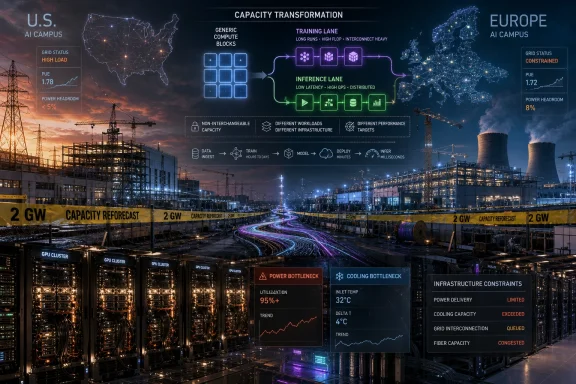
That is why the Microsoft story mattered. TD Cowen’s reported findings described not a symbolic trimming at the margin but a meaningful pullback from planned capacity, including leases, prospective leases, and projects in the U.S. and Europe. The number that grabbed attention was 2 gigawatts, a level of planned electrical capacity large enough to move public markets and embarrass anyone still pretending AI infrastructure is a normal corporate facilities budget.
But the public debate quickly compressed the story into a familiar binary. Either AI demand was exploding forever, or Microsoft had overbuilt and was quietly admitting the bubble. That framing is satisfying because it lets everyone reuse the same arguments they were already making about generative AI. It is also too blunt to describe what appears to have happened.
Microsoft’s own posture at the time did not look like a company abandoning AI. In January 2025, the company said it expected to spend roughly $80 billion in fiscal 2025 on AI-enabled data centers, with more than half of that spending in the United States. That was not the language of retreat. It was the language of an infrastructure arms race in which even the largest players were discovering that capital alone could not guarantee usable capacity.
The contradiction is the story. Microsoft could be spending at historic levels while also walking away from specific projects because the bottleneck had shifted. The company did not need less AI infrastructure in the abstract. It needed the right AI infrastructure, in the right places, with the right density, at the right time, attached to the right workload commitments.
OpenAI Changed the Shape of Microsoft’s Capacity Problem
The most important context is Microsoft’s evolving relationship with OpenAI. For years, Microsoft’s Azure relationship with OpenAI gave it a privileged role in one of the most compute-hungry partnerships in technology. That relationship shaped planning assumptions, including assumptions about frontier model training workloads that require enormous, concentrated clusters of accelerators.
Then the structure began to change. In January 2025, OpenAI announced Stargate, a new AI infrastructure venture involving SoftBank, Oracle, MGX, and OpenAI, with a stated ambition to invest up to $500 billion over four years in U.S. AI infrastructure. At the same time, Microsoft said its relationship with OpenAI would continue, including a large Azure commitment, but the old sense of Microsoft as OpenAI’s exclusive infrastructure path was gone.
That distinction matters because training capacity is not generic cloud capacity wearing a more expensive badge. Large-scale training runs are brutally specific. They need dense accelerator clusters, high-bandwidth networking, specialized cooling, resilient power delivery, and careful physical design to minimize performance-killing bottlenecks. A facility planned around that use case is not easily transformed into ordinary enterprise cloud capacity without leaving money, power, and design compromises on the floor.
If OpenAI’s incremental training demand moved partly toward infrastructure outside Microsoft’s direct Azure buildout, Microsoft would naturally be left reassessing commitments made under earlier assumptions. That is not the same as saying nobody wanted the compute. It is saying that the compute demand migrated to a different contractual and physical architecture.
This is the point many bearish interpretations missed. A hyperscaler can face weaker demand for a specific block of future capacity while the overall market faces stronger demand for AI compute. Both can be true at once. In fact, the AI infrastructure market is increasingly defined by exactly that kind of mismatch.
The Microsoft pullback therefore looks less like a confession that AI is fake and more like a forced correction after a partner’s workload roadmap changed. That is still painful. It still raises questions about forecasting discipline and capital allocation. But it is a different problem from a collapse in demand.
The Overbuild Is Real, Just Not Where the Bears Think It Is
The stronger version of the bearish argument should not be dismissed. Microsoft CEO Satya Nadella acknowledged in early 2025 that there would be an overbuild of AI infrastructure. Around the same period, Microsoft executives also emphasized that the company remained capacity constrained, particularly by power and space. To casual observers, those statements sound mutually exclusive. To anyone who has watched infrastructure cycles, they sound like the beginning of the next phase.
Markets often overbuild the last bottleneck. In 2022 and 2023, the obvious bottleneck was accelerator access. In 2024, it became data center capacity and power. By 2025, the question was no longer simply whether a company could secure enough megawatts. It was whether those megawatts could be converted into the right kind of usable AI service before the workload mix changed again.
This is where the vocabulary of “overcapacity” becomes misleading. There can be too much of one kind of capacity and too little of another. A region can have plenty of shell space but not enough power. A provider can have power but not enough high-density cooling. A cloud can have clusters suited for training but insufficient capacity for latency-sensitive inference close to enterprise customers. A developer can see GPU quotas on one service while the financial press talks about a glut somewhere else.
The AI buildout is not one market. It is a stack of overlapping markets that only look unified when viewed from a quarterly capital expenditure line. Training clusters, inference regions, sovereign cloud deployments, enterprise Copilot workloads, model-serving platforms, storage backends, and networking fabrics do not all stress the same parts of the system in the same way.
That is why Microsoft’s cancellations should worry optimists more than they reassure pessimists. The problem is not that the industry will simply run out of appetite for compute. The problem is that the industry may spend staggering sums building assets that are poorly matched to the next bottleneck.
The old hyperscale playbook rewarded scale, standardization, and long-term commitment. Secure the land, lock in the power, build huge, amortize over years, and let demand catch up. AI has compressed the planning cycle. A facility conceived for one workload generation can be overtaken by a different deployment model before it is finished.
Hyperscale Rigidity Has Become a Financial Risk
The hidden cost in this story is rigidity. Hyperscale data centers are marvels of operational discipline, but they are also enormous commitments made under imperfect information. Once a provider starts down the path of land acquisition, power interconnection, leasing, site preparation, equipment planning, and construction, the cost of changing direction rises quickly.
In the pre-AI cloud era, that rigidity was tolerable because workload growth was more predictable. Enterprise migration to cloud, SaaS expansion, storage growth, and web-scale services all produced demand curves that could be modeled with some confidence. The exact mix changed, but the direction was clear and the infrastructure was relatively fungible.
AI broke that comfort. Frontier training, retrieval-augmented applications, agentic workflows, batch inference, real-time inference, enterprise copilots, multimodal generation, and synthetic data pipelines all have different infrastructure profiles. The industry is still learning which of those workloads will dominate spending, where they will run, and how much performance users will actually pay for.
That uncertainty turns flexibility into a balance-sheet advantage. A company that can redirect capacity, reconfigure deployments, or stage construction in smaller increments has a better chance of avoiding stranded capital. A company locked into giant purpose-built commitments can be right about AI demand in general and still wrong about its own assets.
This is the core lesson of the 2 gigawatt figure. Two gigawatts is not just a number for energy analysts. It represents a chain of assumptions: about customer demand, accelerator availability, model training schedules, partner behavior, regional power access, and future utilization. When those assumptions move, the infrastructure does not move with them.
The industry likes to describe AI infrastructure as if it were a pure race for scale. Whoever builds the most wins. But the Microsoft episode suggests a more complicated contest. The winners will be the companies that build at scale without making every bet irreversible.
Training Was the First Gold Rush; Inference Is the Longer War
One reason the overcapacity debate became confused is that it treated “AI compute” as a single category. Training and inference are related, but they create different infrastructure businesses. Training is episodic, concentrated, and massively parallel. Inference is persistent, distributed, and tied more directly to product usage.
The first phase of the generative AI boom rewarded companies that could assemble vast training clusters. Bigger models needed more compute, and the prestige economy of AI revolved around frontier benchmarks. That phase made it easy to assume that the future of AI infrastructure would be defined by a small number of gigantic campuses feeding ever-larger training runs.
The next phase is messier. Enterprises do not buy benchmarks; they buy workflows. Consumer applications do not tolerate infinite latency. Developers want reliable APIs, predictable pricing, regional availability, and data governance. Those needs push infrastructure toward inference capacity that may need to sit closer to users, closer to data, or closer to regulated jurisdictions.
Microsoft is especially exposed to this shift because its AI story is not only about OpenAI’s next frontier model. It is about Copilot in Windows, Microsoft 365, GitHub, Dynamics, Azure AI services, security products, developer tooling, and enterprise automation. Those workloads require scale, but they do not all require the same scale in the same place.
A training-optimized site designed around OpenAI’s frontier ambitions may not be the ideal answer for millions of enterprise inference calls across regulated industries. It may still be useful. It may still be valuable. But it may not be valuable enough, soon enough, to justify the original commitment.
This is why the “AI demand is soft” narrative is too crude. The demand may be shifting from spectacular training events toward operational inference workloads. That transition does not reduce the need for infrastructure. It changes the infrastructure that captures the value.
Power Is the New Platform Constraint
For WindowsForum readers, the most familiar analogy may be the shift from CPU-bound computing to systems design. At some point, the important constraint stops being the headline chip and becomes the surrounding platform. Memory bandwidth, storage latency, thermal limits, interconnects, and software scheduling determine whether the expensive silicon actually delivers.
AI data centers are undergoing the same transition at planetary scale. The scarce resource is not just the GPU. It is the powered, cooled, connected, permitted, and operational environment in which the GPU can do useful work. A chip sitting in inventory is not capacity. A building without sufficient power is not capacity. A lease without the right workload is not capacity.
That is why Microsoft could simultaneously be power constrained and canceling capacity. The canceled projects may not have represented the right kind of powered environment for the workloads Microsoft now expects to serve. Or they may have been too late, too costly, too poorly located, too dependent on partner demand, or too mismatched to the company’s updated plan.
Power also changes the politics of the cloud. Data centers are no longer invisible warehouses at the edge of industrial parks. They are major electrical loads competing with factories, housing growth, grid modernization, and local climate commitments. A 2 gigawatt planning swing is not merely a private procurement adjustment; it is a signal to utilities, regulators, and communities.
That makes flexibility harder, not easier. Power interconnection queues are long. Transmission upgrades take years. Local opposition can delay or reshape projects. Once a hyperscaler secures a promising site, it has strong incentives to keep it, even if the workload picture changes. Yet holding the wrong site can become a different kind of trap.
Microsoft’s pullback is therefore a reminder that the AI race is not being fought only in model labs or chip fabs. It is being fought in substations, water systems, zoning boards, lease negotiations, and power purchase agreements. The technical architecture and the financial architecture are now inseparable.
The Modular Argument Gets Stronger When Forecasts Get Worse
The submitted argument frames modular, flexible, energy-first infrastructure as the architecture best suited to this environment. That claim deserves scrutiny, because “modular” can easily become another infrastructure buzzword. Not every modular deployment is efficient, and not every hyperscale campus is foolish. At sufficient scale, purpose-built facilities still have real advantages in cost, reliability, and operational control.
But the Microsoft episode strengthens the modular case in one important respect: it exposes the value of optionality. If workload requirements are changing every 12 to 18 months, the ability to stage capacity, relocate equipment, alter density, and avoid massive stranded commitments becomes more than a convenience. It becomes a way to preserve capital while the demand curve is still being discovered.
The old cloud model assumed that demand would eventually fill whatever well-designed capacity the hyperscaler built. AI makes that assumption riskier because capacity is becoming more specialized. A rack designed for high-density accelerator training is not the same economic object as a rack designed for ordinary virtualization. A campus planned around one anchor tenant or one partner roadmap is not equivalent to a region designed around diversified enterprise demand.
Modularity does not solve the hardest problems. It does not create power where the grid cannot provide it. It does not make GPUs cheap. It does not erase permitting delays or magically fix networking bottlenecks. But it can reduce the blast radius of a bad forecast.
That matters because the AI industry is full of bad forecasts, including sincere ones. Model efficiency is improving. Application patterns are changing. Enterprises are experimenting, canceling, restarting, and renegotiating. Open-source models are altering cost expectations. Frontier labs are making infrastructure commitments whose details can shift with funding, regulation, and competitive pressure.
In that world, the highest-return infrastructure may not be the biggest facility announced on a stage. It may be the facility that can change its mind.
Windows Users Will Feel This Through Copilot, Azure, and the Price of Latency
This may sound like a capital markets story, but it will eventually reach ordinary Windows users and IT departments. Microsoft’s AI infrastructure choices shape the availability, performance, and pricing of Copilot across Windows, Microsoft 365, GitHub, security products, and Azure services. If Microsoft builds the wrong kind of capacity, users will not experience that as a lease problem. They will experience it as slow features, uneven regional rollout, quota limits, or higher prices.
Enterprise administrators should pay particular attention to the distinction between training capacity and inference capacity. Training gets the headlines because it produces new models. Inference determines whether those models can be delivered reliably inside business workflows. A Copilot feature that works beautifully in a demo but becomes expensive or latency-sensitive at scale is an infrastructure problem wearing a software costume.
Azure customers should also expect Microsoft to keep managing capacity more aggressively. That may mean more regional differences, more specialized instance types, more reserved-capacity incentives, and more careful steering of customers toward services Microsoft can operate efficiently. Cloud abstraction is still useful, but AI is making the underlying physical constraints harder to hide.
Developers will feel the same pressure through API pricing and model availability. If inference becomes the long-term battleground, the cloud provider with the best mix of power, accelerators, networking, and utilization economics will be able to offer more attractive services. The provider that overcommits to the wrong architecture will be forced to recover those costs somewhere.
For security-minded readers, there is another wrinkle. AI workloads are increasingly tied to sensitive enterprise data, regulated environments, and sovereign cloud requirements. That pushes infrastructure decisions into compliance territory. A capacity mismatch is not merely a performance issue if the only available AI region is not the region where the workload is allowed to run.
This is why Microsoft’s 2 gigawatt reversal is not an isolated financial curiosity. It is part of the physical substrate beneath the next generation of Windows and Azure features. The user interface may say Copilot. The real question is whether the infrastructure behind it was built for the workload users are actually going to run.
The Market Punished a Pullback but Missed the Confession
Microsoft’s share-price reaction after the TD Cowen reports made sense in the narrow way markets often make sense. Investors saw a large AI infrastructure pullback and inferred uncertainty. Uncertainty is expensive when a company is valued partly on the promise that AI will drive future growth across its product lines.
But the more revealing confession was not that Microsoft might have too much capacity. It was that Microsoft, despite its scale and sophistication, could still be caught with the wrong capacity. That should unsettle anyone assuming the AI buildout will be efficiently allocated simply because the buyers are rich and technically competent.
The hyperscalers have advantages no startup can match. They have procurement muscle, engineering depth, customer relationships, balance sheets, and operational experience. Yet AI has introduced a planning problem that even hyperscalers cannot fully brute-force. The demand is real, but its shape is unstable.
This is the uncomfortable middle ground between bubble talk and techno-optimism. AI may transform software, productivity, search, coding, security, and enterprise automation. It may also produce a historic wave of misallocated infrastructure spending. Those outcomes are not mutually exclusive. The railroads changed the economy and still bankrupted investors who built the wrong lines.
Microsoft’s reported cancellations should be read in that tradition. The buildout can be necessary and wasteful at the same time. A company can be right about the destination and wrong about the route. The important question is not whether AI infrastructure spending continues. It is how much of that spending becomes durable productive capacity rather than a monument to last year’s assumptions.
The 2 Gigawatts Were a Warning Label, Not a Death Notice
The useful lesson from Microsoft’s reported pullback is narrow but powerful. It does not prove that AI demand is collapsing. It does not prove that Microsoft has lost the AI race. It does not prove that every hyperscale data center project is doomed. It proves that AI infrastructure has entered the phase where architecture, timing, and workload alignment matter as much as aggregate spending.
That lesson can be reduced to a few practical conclusions:
- Microsoft’s reported cancellations are better understood as a workload-alignment problem than as a simple collapse in AI demand.
- OpenAI’s Stargate shift changed the infrastructure assumptions around incremental training workloads that had previously supported Microsoft’s planning.
- The AI market can have overcapacity in one kind of data center while remaining constrained in power, high-density cooling, inference capacity, and regional availability.
- Hyperscale infrastructure is financially vulnerable when long construction cycles meet AI workload patterns that change in 12 to 18 months.
- Modular and staged deployments gain strategic value when the cost of being early to the wrong architecture exceeds the cost of building more cautiously.
- Windows, Microsoft 365, GitHub, and Azure customers will eventually experience these infrastructure decisions through pricing, latency, regional access, and feature availability.
Microsoft’s 2 gigawatt wake-up call should not be filed under “AI bust.” It belongs under a more consequential heading: the end of easy infrastructure assumptions. The companies that win the next phase will not simply be the ones that announce the largest numbers. They will be the ones that can turn power into usable AI capacity without locking themselves into yesterday’s workload map.