

Microsoft’s move into Narvik is the latest sign that AI infrastructure is becoming a strategic asset on par with chips, cloud contracts, and model access. The company has reportedly taken over a major Norwegian data center project that was initially positioned for OpenAI, turning a high-profile European buildout into a Microsoft-led capacity play. What makes this especially notable is not just the size of the campus, but the way it reflects the new economics of AI: the winners are increasingly the firms that can secure power, land, cooling, and long-term GPU supply before anyone else does. (prnewswire.com)
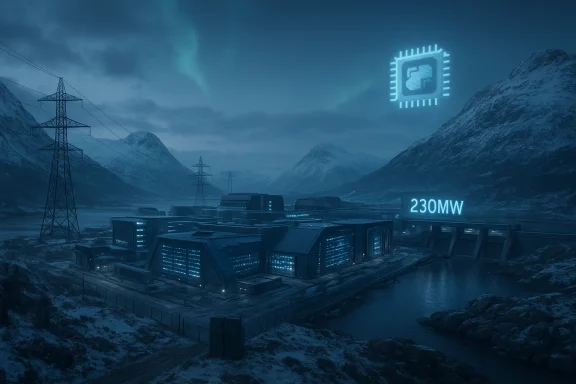
The original Stargate Norway announcement framed Narvik as one of Europe’s most ambitious AI infrastructure projects. OpenAI said the site would deliver 230MW of capacity, with ambitions to expand by another 290MW, and target 100,000 NVIDIA GPUs by the end of 2026. It also stressed the logic of the location: abundant hydropower, a cold climate, and a mature industrial base that could support large-scale compute with a lower carbon footprint. (openai.com)
That vision now appears to have been reorganized around Microsoft. Nscale’s April 14, 2026 announcement says the company expanded its agreement with Microsoft to add more than 30,000 NVIDIA Rubin GPUs to the Narvik campus, with deployment in 2027. The release also says the project will be solely managed by Nscale, even as it builds on the previously announced Aker-Nscale structure. (nscale.com)
The deeper story is that the Narvik site was never just about one customer. It sits at the intersection of sovereignty, energy security, cloud competition, and AI chip allocation. Microsoft’s earlier September 2025 agreement with Nscale and Aker was already valued at about $6.2 billion, with staged deployments beginning in 2026, and it described Narvik as a launchpad for Europe’s sovereign cloud ambitions. That means the latest change is less a surprise than a consolidation of an already shifting commercial reality. (prnewswire.com)
OpenAI, meanwhile, has been pulling back from the most capital-intensive version of its infrastructure ambitions. In July 2025, OpenAI still described Norway as its first AI data center initiative in Europe and an important part of its OpenAI for Countries program. But by April 2026, the company was reportedly taking a more disciplined view of its long-term infrastructure spend, with recent reporting pointing to a much lower compute target than the eye-watering figures that circulated earlier in the year. In other words, the Narvik pivot fits a broader reset, not a one-off retreat. (openai.com)
Those factors matter because the economics of AI infrastructure are changing. Training and serving frontier models now require not just chips, but entire ecosystems built around electricity availability, thermal management, and grid stability. A location like Narvik can reduce the burden on mechanical cooling, and in a world where every watt and every acre matter, that is a real competitive advantage. For hyperscalers, climate is no longer scenery; it is part of the cost model. (openai.com)
The environmental pitch is also strategic, not just ethical. When Microsoft or OpenAI can point to renewable electricity and lower cooling loads, they gain political cover in markets where energy consumption is under scrutiny. The result is a rare alignment of economics, regulation, and corporate messaging. That alignment may not last forever, but it is powerful while it holds. (prnewswire.com)
By mid-April 2026, the commercial center of gravity had changed. Nscale said the new Microsoft agreement expands the Narvik campus with additional Rubin GPUs, and that the deployment follows the earlier Aker-Nscale roll-up but will be managed solely by Nscale. That language suggests a clean reallocation of control rather than a simple side deal. OpenAI may still benefit indirectly, but the operational and contractual leverage has clearly moved elsewhere. (nscale.com)
This is significant because it shows how cloud and model companies are converging and separating at the same time. They still depend on each other, but the relationship is more modular than it looked two years ago. Microsoft can use Narvik to strengthen Azure and its AI services, while OpenAI can preserve flexibility and avoid locking itself into extra fixed infrastructure costs. (prnewswire.com)
That matters because GPU supply is now a strategic chokepoint. The AI industry is no longer only competing for model quality; it is competing for access to the latest accelerators, the power to run them, and the contract structures needed to keep them busy. A campus like Narvik becomes a kind of physical option on future AI demand, with each deployment phase locking in another layer of leverage. (prnewswire.com)
There is also a signaling effect. If Microsoft can secure advanced GPU capacity in Norway while others remain constrained, it reinforces the company’s image as one of the AI era’s default infrastructure providers. That does not guarantee market dominance, but it does make it harder for rivals to dismiss Microsoft as merely an application-layer player. The company is buying itself room to maneuver, one campus at a time. (prnewswire.com)
That shift tracks with a wider recalibration. Recent reporting has suggested OpenAI is aiming to keep long-term compute spend much lower than the largest figures previously discussed. Whether that reflects improved efficiency, investor pressure, or a more realistic revenue path, the direction is clear: growth remains the goal, but unchecked infrastructure expansion is no longer the headline strategy.
That does not mean OpenAI is backing away from infrastructure entirely. It still needs huge amounts of compute, and its partnership stack remains highly capital intensive. But the company is learning a lesson the cloud giants have known for years: owning demand is one thing, but owning every physical layer beneath it is a different kind of business. The fixed-cost burden can become a trap if growth does not arrive on schedule.
Microsoft also has every incentive to secure geographically diverse, renewable-powered compute. That helps with enterprise adoption, regulatory positioning, and resilience. It also gives the company more flexibility in serving customers across Europe, where data location, sovereignty, and energy politics are increasingly inseparable from AI procurement. (prnewswire.com)
That matters for public-sector sales, regulated industries, and multinational enterprises with privacy concerns. If Microsoft can combine advanced chips, renewable energy, and local hosting options, it improves Azure’s appeal against rivals that may have stronger raw scale but weaker regional positioning. The infrastructure story becomes a product story. (prnewswire.com)
Aker, as the industrial heavyweight in the mix, benefits from the continuing validation of Norway as a location for strategic digital infrastructure. Its earlier announcement with Microsoft already framed the deal as a way to convert clean hydropower into digital capacity, and that thesis is now being tested at larger scale. If Narvik works, it strengthens the case for Norway as a serious AI infrastructure hub rather than a niche energy play. (prnewswire.com)
But the challenge is execution. Large AI data centers are complex industrial assets, and the market is unforgiving when timelines slip or power assumptions change. The financial model only works if the campus can move from promise to staged delivery, without turning into an expensive monument to over-ambition. In this sector, a partial success can still look like a victory, but only if the machines keep turning. (prnewswire.com)
For rivals, the message is blunt. If Microsoft can keep layering capacity into strategic locations while preserving its core OpenAI relationship, then competitors face a moving target. Amazon, Google, and other infrastructure players must contend not only with software competition but also with an increasingly global contest for power-rich sites and advanced accelerators.
The result may be a new class of regional AI campuses that blur the line between public policy and commercial infrastructure. If that model succeeds in Norway, it could spread to other energy-rich regions where governments are eager to attract investment without sacrificing sovereignty. The geopolitical map of AI may turn out to be drawn by power grids as much as by politics. (openai.com)
The broader AI infrastructure race is unlikely to slow. If anything, the Narvik deal shows that the battlefield is widening, with cloud providers, model makers, chip vendors, and industrial partners all trying to secure the same scarce ingredients. The companies that win this phase will not just train better models; they will control the concrete, the copper, and the cooling behind them. (prnewswire.com)
Source: Bisinfotech Microsoft takes over Norway AI data center project
 Overview
The original Stargate Norway announcement framed Narvik as one of Europe’s most ambitious AI infrastructure projects. OpenAI said the site would deliver 230MW of capacity, with ambitions to expand by another 290MW, and target 100,000 NVIDIA GPUs by the end of 2026. It also stressed the logic of the location: abundant hydropower, a cold climate, and a mature industrial base that could support large-scale compute with a lower carbon footprint. (openai.com)That vision now appears to have been reorganized around Microsoft. Nscale’s April 14, 2026 announcement says the company expanded its agreement with Microsoft to add more than 30,000 NVIDIA Rubin GPUs to the Narvik campus, with deployment in 2027. The release also says the project will be solely managed by Nscale, even as it builds on the previously announced Aker-Nscale structure. (nscale.com)
The deeper story is that the Narvik site was never just about one customer. It sits at the intersection of sovereignty, energy security, cloud competition, and AI chip allocation. Microsoft’s earlier September 2025 agreement with Nscale and Aker was already valued at about $6.2 billion, with staged deployments beginning in 2026, and it described Narvik as a launchpad for Europe’s sovereign cloud ambitions. That means the latest change is less a surprise than a consolidation of an already shifting commercial reality. (prnewswire.com)
OpenAI, meanwhile, has been pulling back from the most capital-intensive version of its infrastructure ambitions. In July 2025, OpenAI still described Norway as its first AI data center initiative in Europe and an important part of its OpenAI for Countries program. But by April 2026, the company was reportedly taking a more disciplined view of its long-term infrastructure spend, with recent reporting pointing to a much lower compute target than the eye-watering figures that circulated earlier in the year. In other words, the Narvik pivot fits a broader reset, not a one-off retreat. (openai.com)
The Narvik Geography Advantage
Narvik is not a random pin on the map. It is a carefully chosen answer to one of AI’s hardest problems: how to run vast numbers of GPUs without making power, cooling, and sustainability the bottleneck. OpenAI’s original announcement highlighted hydropower, cool weather, and industrial readiness as the key ingredients that made northern Norway attractive for large-scale AI compute. (openai.com)Those factors matter because the economics of AI infrastructure are changing. Training and serving frontier models now require not just chips, but entire ecosystems built around electricity availability, thermal management, and grid stability. A location like Narvik can reduce the burden on mechanical cooling, and in a world where every watt and every acre matter, that is a real competitive advantage. For hyperscalers, climate is no longer scenery; it is part of the cost model. (openai.com)
Why Arctic infrastructure is suddenly hot
The logic behind Narvik mirrors a wider industry trend. AI firms are chasing sites with cheap renewable power, efficient cooling, and room to grow, because centralized data-center clusters can no longer be treated as generic real estate. In that sense, the Norwegian project looks like a European version of the same physical race playing out in Texas, the American Midwest, and the Gulf states. (prnewswire.com)The environmental pitch is also strategic, not just ethical. When Microsoft or OpenAI can point to renewable electricity and lower cooling loads, they gain political cover in markets where energy consumption is under scrutiny. The result is a rare alignment of economics, regulation, and corporate messaging. That alignment may not last forever, but it is powerful while it holds. (prnewswire.com)
- Hydropower lowers the carbon intensity of large-scale compute.
- Cold ambient temperatures can reduce cooling overhead.
- Remote industrial regions can offer faster project approvals than dense metros.
- Renewable branding helps with regulators, investors, and enterprise customers.
- Massive campuses favor firms that can pre-commit capital and demand.
From Stargate Norway to Microsoft Control
The name “Stargate Norway” carried a lot of symbolism when OpenAI introduced it in July 2025. It was presented as the company’s first European AI data center initiative, part of a global infrastructure strategy meant to bring more compute closer to users and governments. The site was expected to be owned by a 50/50 joint venture between Nscale and Aker, with OpenAI positioned as an initial offtaker that could scale over time. (openai.com)By mid-April 2026, the commercial center of gravity had changed. Nscale said the new Microsoft agreement expands the Narvik campus with additional Rubin GPUs, and that the deployment follows the earlier Aker-Nscale roll-up but will be managed solely by Nscale. That language suggests a clean reallocation of control rather than a simple side deal. OpenAI may still benefit indirectly, but the operational and contractual leverage has clearly moved elsewhere. (nscale.com)
What changed in the deal structure
The most important shift is probably not the chip count. It is the fact that Microsoft is now the customer anchoring the project in a more direct way, while OpenAI appears to be relying on its existing Azure relationship rather than taking a dedicated lease. Microsoft’s September 2025 agreement already secured access to the site for AI compute capacity, and the 2026 expansion simply deepens that commitment. (prnewswire.com)This is significant because it shows how cloud and model companies are converging and separating at the same time. They still depend on each other, but the relationship is more modular than it looked two years ago. Microsoft can use Narvik to strengthen Azure and its AI services, while OpenAI can preserve flexibility and avoid locking itself into extra fixed infrastructure costs. (prnewswire.com)
- Microsoft gains more direct control over scarce compute.
- Nscale keeps the campus commercially filled.
- OpenAI reduces upfront infrastructure exposure.
- The site becomes a shared node in a wider AI supply chain.
- The old one-partner narrative gives way to multi-party bargaining.
The GPU Arms Race Continues
The Narvik story is really a GPU story. OpenAI originally said Stargate Norway would target 100,000 NVIDIA GPUs by the end of 2026, which signals just how big these campuses have become. Nscale’s April 2026 release adds more than 30,000 Rubin GPUs to the picture, indicating that the project is not merely preserving its scale, but moving to newer hardware generations. (openai.com)That matters because GPU supply is now a strategic chokepoint. The AI industry is no longer only competing for model quality; it is competing for access to the latest accelerators, the power to run them, and the contract structures needed to keep them busy. A campus like Narvik becomes a kind of physical option on future AI demand, with each deployment phase locking in another layer of leverage. (prnewswire.com)
Why Rubin matters
Rubin is the next step in NVIDIA’s platform roadmap, and landing those chips in a single campus implies a serious long-term commitment. It also suggests Microsoft wants to stay close to the front edge of AI compute, not just in software but in physical capacity. That is important because model quality, inference cost, and enterprise latency are increasingly shaped by the hardware stack underneath the cloud. (nscale.com)There is also a signaling effect. If Microsoft can secure advanced GPU capacity in Norway while others remain constrained, it reinforces the company’s image as one of the AI era’s default infrastructure providers. That does not guarantee market dominance, but it does make it harder for rivals to dismiss Microsoft as merely an application-layer player. The company is buying itself room to maneuver, one campus at a time. (prnewswire.com)
- More advanced chips usually mean better performance per watt.
- Fresh chip generations can improve training and inference economics.
- Large deployments reduce the risk of capacity shortfalls.
- High-volume orders strengthen vendor relationships.
- GPU access increasingly shapes cloud competitiveness.
OpenAI’s Capital Discipline
OpenAI’s reported retrenchment is one of the most important subplots here. The company still wants compute, but it appears to want less capital risk attached to that compute. OpenAI’s own July 2025 description of Stargate Norway positioned the site as a cornerstone of its European expansion, yet its later behavior suggests a preference for tapping capacity through existing partnerships rather than adding another heavy lease commitment. (openai.com)That shift tracks with a wider recalibration. Recent reporting has suggested OpenAI is aiming to keep long-term compute spend much lower than the largest figures previously discussed. Whether that reflects improved efficiency, investor pressure, or a more realistic revenue path, the direction is clear: growth remains the goal, but unchecked infrastructure expansion is no longer the headline strategy.
Less capex, more optionality
For a company like OpenAI, optionality is valuable. By relying more on Microsoft Azure rather than directly underwriting every new campus, OpenAI can focus on models, products, and distribution. It also avoids tying itself too tightly to any single real-estate-heavy project if chip requirements, model architectures, or regulations change.That does not mean OpenAI is backing away from infrastructure entirely. It still needs huge amounts of compute, and its partnership stack remains highly capital intensive. But the company is learning a lesson the cloud giants have known for years: owning demand is one thing, but owning every physical layer beneath it is a different kind of business. The fixed-cost burden can become a trap if growth does not arrive on schedule.
- OpenAI can preserve balance-sheet flexibility.
- Microsoft absorbs more of the infrastructure complexity.
- The company can shift capacity as priorities change.
- A lighter asset posture can help investor messaging.
- The downside is less direct control over compute destiny.
Microsoft’s Infrastructure Strategy
For Microsoft, Narvik is a logical extension of a broader AI infrastructure campaign. The company has spent much of the last two years making one message impossible to miss: Azure needs more capacity, and the fastest way to build that capacity is through a combination of internal capex and partner-led campuses. The September 2025 Aker-Nscale agreement and the April 2026 expansion both fit that pattern. (prnewswire.com)Microsoft also has every incentive to secure geographically diverse, renewable-powered compute. That helps with enterprise adoption, regulatory positioning, and resilience. It also gives the company more flexibility in serving customers across Europe, where data location, sovereignty, and energy politics are increasingly inseparable from AI procurement. (prnewswire.com)
Azure, sovereignty, and customer trust
The phrase sovereign AI infrastructure shows up repeatedly in the deal language for a reason. European customers want AI services without forcing every workload into a purely U.S.-centric footprint, and governments want to see local economic and strategic value. Microsoft can use Narvik to argue that it is investing in European capacity rather than simply extracting demand from the region. (prnewswire.com)That matters for public-sector sales, regulated industries, and multinational enterprises with privacy concerns. If Microsoft can combine advanced chips, renewable energy, and local hosting options, it improves Azure’s appeal against rivals that may have stronger raw scale but weaker regional positioning. The infrastructure story becomes a product story. (prnewswire.com)
- Narvik strengthens Microsoft’s European cloud footprint.
- Renewable energy supports ESG and procurement requirements.
- Sovereign-cloud messaging helps win public-sector trust.
- Distributed campuses improve resilience.
- Partner-led builds can accelerate time to capacity.
What It Means for Nscale and Aker
For Nscale, the transition from an OpenAI-centered narrative to a Microsoft-anchored one is not a failure so much as a commercial pivot. The company still gets a marquee customer and keeps the campus densely utilized, which is exactly what a capital-intensive infrastructure builder wants. The fact that the project remains tied to Narvik’s 230MW plan shows that demand is still strong enough to sustain the original vision, even if the customer mix has changed. (nscale.com)Aker, as the industrial heavyweight in the mix, benefits from the continuing validation of Norway as a location for strategic digital infrastructure. Its earlier announcement with Microsoft already framed the deal as a way to convert clean hydropower into digital capacity, and that thesis is now being tested at larger scale. If Narvik works, it strengthens the case for Norway as a serious AI infrastructure hub rather than a niche energy play. (prnewswire.com)
A campus with more than one future
The big opportunity for Nscale and Aker is that the campus can serve multiple demand pools over time. That means not only hyperscalers like Microsoft, but potentially broader enterprise, public-sector, and regional AI demand if spare capacity comes online. The original OpenAI framing already hinted at that wider ecosystem play, and the Microsoft expansion reinforces it. (openai.com)But the challenge is execution. Large AI data centers are complex industrial assets, and the market is unforgiving when timelines slip or power assumptions change. The financial model only works if the campus can move from promise to staged delivery, without turning into an expensive monument to over-ambition. In this sector, a partial success can still look like a victory, but only if the machines keep turning. (prnewswire.com)
- Nscale keeps a major hyperscale customer.
- Aker deepens its role in industrial AI infrastructure.
- Narvik gains credibility as a data-center destination.
- The project can support regional economic spillovers.
- Execution risk remains high despite strong demand.
Competitive Fallout Across the AI Market
The Narvik shift is a reminder that the AI market is now competing on at least three fronts at once: models, distribution, and infrastructure. Microsoft gains an edge in the third category, OpenAI keeps flexibility in the second, and Nscale secures itself as a critical enabler rather than a sidelined subcontractor. That reshuffling could influence how other cloud and AI players structure their own deals. (prnewswire.com)For rivals, the message is blunt. If Microsoft can keep layering capacity into strategic locations while preserving its core OpenAI relationship, then competitors face a moving target. Amazon, Google, and other infrastructure players must contend not only with software competition but also with an increasingly global contest for power-rich sites and advanced accelerators.
Europe’s AI sovereignty angle
Europe’s AI policy environment makes the Narvik story even more interesting. Governments want local compute, local control, and local economic upside, while also depending on global vendors to deliver the hardware and software stack. That tension creates openings for firms like Microsoft and Nscale, which can package capacity as both strategic and compliant. (openai.com)The result may be a new class of regional AI campuses that blur the line between public policy and commercial infrastructure. If that model succeeds in Norway, it could spread to other energy-rich regions where governments are eager to attract investment without sacrificing sovereignty. The geopolitical map of AI may turn out to be drawn by power grids as much as by politics. (openai.com)
- More firms will seek renewable-heavy, low-temperature sites.
- Sovereign AI messaging will matter more in Europe.
- GPU supply contracts may become a competitive weapon.
- Cloud providers may rely more on partner campuses.
- Infrastructure location will increasingly influence market share.
Strengths and Opportunities
The Narvik arrangement has real strategic appeal because it combines scale, energy efficiency, and customer demand into one industrial package. Microsoft gets more compute, Nscale keeps its campus monetized, and Norway gains another flagship project that reinforces its clean-energy reputation. If the buildout stays on schedule, the site could become a reference model for how large-scale AI infrastructure is financed and deployed in Europe. (prnewswire.com)- Renewable power supports sustainability claims and lowers carbon intensity.
- Cold climate helps reduce cooling costs.
- Staged deployment can improve cash flow discipline.
- Microsoft demand increases the odds of full utilization.
- European positioning helps with sovereignty and regulation.
- Advanced GPU access keeps the site relevant to frontier workloads.
- Industrial partnerships spread risk across experienced operators.
Risks and Concerns
The same attributes that make the project attractive also create substantial execution risk. A campus this large depends on grid reliability, hardware availability, customer commitments, and regulatory stability, and any one of those can shift. The change in OpenAI’s role also underscores a broader concern: even the best-laid AI infrastructure plans can be re-traded when capital discipline tightens. (nscale.com)- Project complexity rises sharply at hyperscale.
- Customer concentration can make economics fragile.
- Chip supply remains vulnerable to global bottlenecks.
- Energy pricing could change the site’s advantage.
- Regulatory scrutiny may intensify around power and land use.
- Timelines can slip if construction or procurement falters.
- Narrative risk grows if the project is seen as a reshuffle rather than growth.
Looking Ahead
The next phase will be about delivery, not headlines. The market already knows the Narvik site is ambitious; what matters now is whether the first deployments land on time and whether Microsoft uses the campus to deepen Azure’s European position without dragging OpenAI back into a heavier capital commitment. Nscale’s claim that more than 30,000 Rubin GPUs are coming in 2027 suggests the buildout is still very much alive. (nscale.com)The broader AI infrastructure race is unlikely to slow. If anything, the Narvik deal shows that the battlefield is widening, with cloud providers, model makers, chip vendors, and industrial partners all trying to secure the same scarce ingredients. The companies that win this phase will not just train better models; they will control the concrete, the copper, and the cooling behind them. (prnewswire.com)
- First deployment milestones in Narvik.
- Further NVIDIA chip allocation and timing.
- Any change in OpenAI’s indirect use of the site.
- Microsoft’s broader 2026–2027 AI capex posture.
- Additional European sovereign-cloud deals.
Source: Bisinfotech Microsoft takes over Norway AI data center project
Last edited:
