

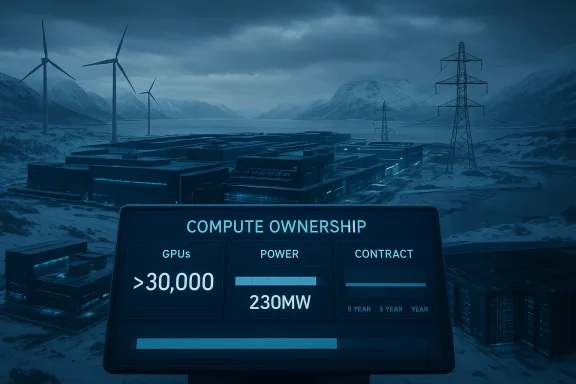
Microsoft is tightening its grip on the physical layer of AI at exactly the moment OpenAI is trying to loosen its dependence on any single infrastructure partner. The reported Norwegian deal in Narvik, built around a 230MW campus and more than 30,000 Nvidia Rubin GPUs, is not just another data center transaction; it is a signal that compute ownership, power access, and cloud leverage are becoming the decisive battleground in artificial intelligence. If the reporting is accurate, Microsoft is no longer merely financing the AI boom from the software side. It is increasingly acting as the essential operator of the hardware and energy stack that makes the boom possible.
The story begins with a simple but brutal reality: AI demand has outgrown the patience of the infrastructure market. Hyperscalers can write enormous checks, but they still have to secure land, grid access, cooling, permitting, and long-lead hardware before a single GPU starts generating revenue. In that environment, the winner is often not the company with the boldest model narrative, but the company that can actually bring power online on time. Microsoft learned that lesson the hard way when AI capacity constraints started appearing in its own earnings commentary, even as Azure demand kept surging.
That is why this Norwegian deal matters so much. Nscale’s own announcement says the Narvik campus will support more than 30,000 Nvidia Rubin GPUs under a five-year Microsoft contract beginning in 2026, while the facility remains tied to a 230MW footprint and a renewable-energy design. OpenAI’s earlier public description of Stargate Norway showed how ambitious the site originally was: a planned 230MW campus, with a path to expansion and aspirations for 100,000 GPUs by the end of 2026. The gap between those two narratives is important. It suggests that OpenAI wants access to compute, but not necessarily the burden of directly anchoring every large infrastructure commitment itself.
This shift also fits a broader pattern. OpenAI has publicly framed Stargate as an umbrella for AI infrastructure partnerships, and Microsoft has continued to provide cloud services even as OpenAI broadens its compute and distribution options. That means the relationship is not breaking down so much as changing shape. It is moving from an era of near-single-partner dependence into one where multi-cloud strategy and commercial flexibility matter more than symbolic exclusivity. In practice, that makes Microsoft more valuable as a buyer of capacity, even if it becomes less central as OpenAI’s sole home.
The timing matters too. Microsoft’s latest earnings release showed Azure and other cloud services revenue growth at 39% year over year in the fiscal second quarter of 2026, while commercial remaining performance obligations climbed to $625 billion, up 110% year over year. Those are not numbers from a company in retreat. They are the metrics of a business that still has enormous demand, but now has to translate that demand into delivered infrastructure faster and more efficiently. In that sense, the Narvik deal is not just opportunistic. It is a response to a structural bottleneck.
Yet the same breadth creates complexity. A company this large cannot simply “pivot” to AI infrastructure. It has to coordinate legal, commercial, security, and capital allocation decisions across multiple divisions and geographies. That is why the Narvik development should be read alongside the company’s other recent infrastructure moves. The Texas asset reportedly abandoned by OpenAI and Oracle, and the Norway campus now aligned with Microsoft, suggest a market in which strategic vacuums are being filled quickly by whichever buyer can absorb capacity and move fastest.
The market is also reassessing what Microsoft’s relationship with OpenAI really means. For years, investors treated the alliance like a kind of exclusive growth engine: OpenAI would expand, Microsoft would capture the cloud revenue, and Copilot would turn the whole arrangement into a sticky software annuity. But the current shape of the deal looks more complicated. OpenAI is clearly pursuing infrastructure flexibility, while Microsoft is building enough internal and partner capacity to remain indispensable regardless of where the models run. That is a more defensive posture, but also a more realistic one.
This also shows how much the AI supply chain has matured. A year ago, the dramatic story was model performance. Now the dramatic story is who can secure next-generation hardware before anyone else, and who can attach that hardware to enough electricity to make the economics work. Nvidia’s Rubin generation, which Nscale says will underpin the deployment, is a reminder that the market is already planning around chip cycles several steps ahead. Microsoft is not just buying capacity for today’s workloads. It is reserving a path into the next wave of frontier compute.
At the same time, the deal structure gives Microsoft strategic optionality. If OpenAI continues to diversify across clouds and infrastructure partners, Microsoft still benefits by being the buyer with the most reliable appetite for industrial-scale AI capacity. That is a very different form of power from exclusivity. It is more like being the company that keeps the market liquid, because every supplier knows Microsoft can absorb a massive footprint when others step back.
OpenAI’s public materials continue to emphasize Stargate as a major infrastructure platform. But the reality underneath those announcements is more nuanced. In the U.S., OpenAI’s infrastructure vision has already included partnerships with Oracle and others, while Microsoft itself has publicly said it will continue to provide cloud services for OpenAI. The result is a more modular AI ecosystem. Each participant still matters, but no one relationship looks as singular as it once did.
That shift has strategic consequences for Microsoft. If OpenAI is no longer trying to own every data center path directly, then Microsoft’s value rises as the company most willing to take on heavy, long-duration capacity commitments. Investors often talk about partnerships as if they were static. In AI, they are better understood as moving bargaining systems. The party that can tolerate more complexity usually ends up with more leverage.
That is strategically powerful because AI customers do not just want models. They want reliable access to those models, predictable latency, and the confidence that capacity will exist when usage spikes. Nscale’s AI infrastructure materials emphasize multi-megawatt power, engineered cooling, and dense GPU systems for enterprises and mission-critical workloads. Microsoft, by aligning with a supplier like that, is effectively outsourcing part of the physical complexity while keeping commercial control over the demand side.
This could become a major competitive differentiator. AWS, Google Cloud, Oracle, and others are all trying to capture AI workloads, but Microsoft has a special advantage because it can combine its own software ecosystem with third-party infrastructure that is purpose-built for frontier demand. That makes it harder for customers to disentangle Microsoft from the AI stack even if OpenAI itself becomes more cloud-agnostic. Microsoft is still the company that sits closest to the workflow, the wallet, and the workload.
Microsoft’s latest reported metrics support the constructive case. Azure and other cloud services grew 39% year over year in the last reported quarter, while commercial backlog reached $625 billion. That is an unusually strong foundation for a company facing both infrastructure pressure and competitive scrutiny. It suggests that Microsoft’s challenge is not demand weakness; it is execution under scarcity.
Still, investors should not confuse infrastructure wins with immediate margin expansion. Multi-year data center commitments are expensive, and the payoff arrives gradually. A campus can look like a strategic triumph on announcement day and a depreciation problem two years later if demand or pricing changes faster than expected. The key question is whether Microsoft can keep utilization high enough to justify the spend. That remains the central financial test.
Amazon is the clearest beneficiary of OpenAI’s diversification, but Microsoft is arguably the clearest beneficiary of OpenAI’s retreat from direct infrastructure ownership. If OpenAI becomes less interested in physically owning every large campus, Microsoft can step into the role of the dependable operator. That may not be as glamorous as being the sole strategic partner, but it is more durable.
Google, meanwhile, faces a different pressure point. It still has world-class AI capabilities, but it has to compete against Microsoft’s installed base and cloud integration story. The more Microsoft can turn Azure into an AI operations layer rather than just a cloud product, the harder it becomes for rivals to present a simpler, cleaner alternative. The battle is not over who has the best model. It is over who can reliably industrialize AI at scale.
Security risk matters more in AI than in ordinary cloud computing because AI systems are increasingly woven into identity, content creation, enterprise workflows, and data access. If Microsoft becomes the central operator of AI compute, then it also becomes the central target for attackers hoping to exploit vulnerabilities at scale. This is where the company’s security reputation becomes an asset, but also a burden. The more important Microsoft becomes, the more damaging any failure can be.
There is also the issue of operational complexity. A 230MW renewable-powered campus sounds elegant in a press release, but every large deployment introduces risk around cooling, supply chain coordination, software orchestration, and hardware refresh timing. When those systems are tied to next-generation Nvidia chips and multi-year contracts, a hiccup in one part of the chain can cascade into delayed capacity or reduced utilization. The infrastructure story is therefore also a reliability story.
What happens next will also tell us whether OpenAI’s infrastructure retreat is strategic maturity or a temporary pause. If OpenAI continues to lean on Microsoft and other partners while reserving flexibility, then the market will likely settle into a more pluralistic model. If, however, Microsoft continues to win the largest footprints whenever competitors step back, the company may end up controlling far more of the AI supply chain than its own branding currently suggests.
Source: AD HOC NEWS Microsoft's Norwegian Power Play Signals AI Infrastructure Shift
 Background
The story begins with a simple but brutal reality: AI demand has outgrown the patience of the infrastructure market. Hyperscalers can write enormous checks, but they still have to secure land, grid access, cooling, permitting, and long-lead hardware before a single GPU starts generating revenue. In that environment, the winner is often not the company with the boldest model narrative, but the company that can actually bring power online on time. Microsoft learned that lesson the hard way when AI capacity constraints started appearing in its own earnings commentary, even as Azure demand kept surging.That is why this Norwegian deal matters so much. Nscale’s own announcement says the Narvik campus will support more than 30,000 Nvidia Rubin GPUs under a five-year Microsoft contract beginning in 2026, while the facility remains tied to a 230MW footprint and a renewable-energy design. OpenAI’s earlier public description of Stargate Norway showed how ambitious the site originally was: a planned 230MW campus, with a path to expansion and aspirations for 100,000 GPUs by the end of 2026. The gap between those two narratives is important. It suggests that OpenAI wants access to compute, but not necessarily the burden of directly anchoring every large infrastructure commitment itself.
This shift also fits a broader pattern. OpenAI has publicly framed Stargate as an umbrella for AI infrastructure partnerships, and Microsoft has continued to provide cloud services even as OpenAI broadens its compute and distribution options. That means the relationship is not breaking down so much as changing shape. It is moving from an era of near-single-partner dependence into one where multi-cloud strategy and commercial flexibility matter more than symbolic exclusivity. In practice, that makes Microsoft more valuable as a buyer of capacity, even if it becomes less central as OpenAI’s sole home.
The timing matters too. Microsoft’s latest earnings release showed Azure and other cloud services revenue growth at 39% year over year in the fiscal second quarter of 2026, while commercial remaining performance obligations climbed to $625 billion, up 110% year over year. Those are not numbers from a company in retreat. They are the metrics of a business that still has enormous demand, but now has to translate that demand into delivered infrastructure faster and more efficiently. In that sense, the Narvik deal is not just opportunistic. It is a response to a structural bottleneck.
Overview
Microsoft’s advantage in AI is no longer just that it partnered early with OpenAI. It is that it can now operate at multiple layers of the stack at once: software, cloud, infrastructure, and financing. That makes it harder for rivals to dislodge, because a competitor has to beat Microsoft in more than one market at the same time. The company’s ability to support Azure, Copilot, and partner models gives it a broader monetization base than a pure model company or a pure cloud vendor.Yet the same breadth creates complexity. A company this large cannot simply “pivot” to AI infrastructure. It has to coordinate legal, commercial, security, and capital allocation decisions across multiple divisions and geographies. That is why the Narvik development should be read alongside the company’s other recent infrastructure moves. The Texas asset reportedly abandoned by OpenAI and Oracle, and the Norway campus now aligned with Microsoft, suggest a market in which strategic vacuums are being filled quickly by whichever buyer can absorb capacity and move fastest.
The market is also reassessing what Microsoft’s relationship with OpenAI really means. For years, investors treated the alliance like a kind of exclusive growth engine: OpenAI would expand, Microsoft would capture the cloud revenue, and Copilot would turn the whole arrangement into a sticky software annuity. But the current shape of the deal looks more complicated. OpenAI is clearly pursuing infrastructure flexibility, while Microsoft is building enough internal and partner capacity to remain indispensable regardless of where the models run. That is a more defensive posture, but also a more realistic one.
Why Narvik matters
Narvik is not just a pin on the map. It is a reminder that AI infrastructure is now being sited where energy economics make sense, not just where cloud incumbents are strongest. OpenAI originally highlighted Narvik’s hydropower, cool climate, and industrial base as reasons the location could support large-scale sustainable AI compute. That same logic makes the site attractive to Microsoft now: the physical inputs that matter most in AI are power, cooling, and expansion headroom.What changed from the original Stargate vision
The original Stargate framing was expansive and highly symbolic. OpenAI described a future of up to 100,000 GPUs and possible expansion beyond 230MW. Nscale’s newer announcement keeps the scale but changes the operator dynamic: the campus is now being managed solely by Nscale, with Microsoft as the major customer. That is a subtle but consequential difference. It means OpenAI is not being treated as the central anchor tenant in the same way, and it suggests Microsoft has become the steadier demand source.The Deal Structure
The most important detail in the reported Narvik arrangement is not merely the number of GPUs, but the nature of the relationship. Nscale says the campus will deliver more than 30,000 Nvidia Rubin GPUs for Microsoft under a five-year contract starting in 2026, with the broader campus built around renewable power and significant expansion potential. That makes Microsoft a long-duration customer, not a casual spot buyer. In infrastructure terms, that is the difference between renting a room and taking out a mortgage.This also shows how much the AI supply chain has matured. A year ago, the dramatic story was model performance. Now the dramatic story is who can secure next-generation hardware before anyone else, and who can attach that hardware to enough electricity to make the economics work. Nvidia’s Rubin generation, which Nscale says will underpin the deployment, is a reminder that the market is already planning around chip cycles several steps ahead. Microsoft is not just buying capacity for today’s workloads. It is reserving a path into the next wave of frontier compute.
At the same time, the deal structure gives Microsoft strategic optionality. If OpenAI continues to diversify across clouds and infrastructure partners, Microsoft still benefits by being the buyer with the most reliable appetite for industrial-scale AI capacity. That is a very different form of power from exclusivity. It is more like being the company that keeps the market liquid, because every supplier knows Microsoft can absorb a massive footprint when others step back.
Why a five-year contract matters
A long contract reduces uncertainty for both sides. Nscale gets predictable utilization, and Microsoft gets a committed path to capacity without having to own every physical asset outright. That matters in a market where hardware lead times, grid interconnects, and chip availability can all stretch for years. In other words, the contract is not just financial; it is a scheduling tool.The GPU angle
The 30,000+ Nvidia Rubin GPUs figure is particularly notable because it places Microsoft inside the next generation of AI infrastructure planning. Nscale’s own Rubin announcement says its deployment will support Microsoft and extend across sites in the UK, Norway, and beyond. That implies a broader European compute footprint is emerging around Microsoft demand, not just a single campus in Narvik.OpenAI’s Retreat and Repositioning
The clearest interpretation of OpenAI’s recent behavior is not that it is abandoning infrastructure, but that it is becoming more selective about which infrastructure it wants to own directly. The company still needs enormous compute, but it appears increasingly comfortable sourcing that capacity through partners rather than shouldering every development risk itself. That is a smarter position if capital preservation and optionality are rising priorities.OpenAI’s public materials continue to emphasize Stargate as a major infrastructure platform. But the reality underneath those announcements is more nuanced. In the U.S., OpenAI’s infrastructure vision has already included partnerships with Oracle and others, while Microsoft itself has publicly said it will continue to provide cloud services for OpenAI. The result is a more modular AI ecosystem. Each participant still matters, but no one relationship looks as singular as it once did.
That shift has strategic consequences for Microsoft. If OpenAI is no longer trying to own every data center path directly, then Microsoft’s value rises as the company most willing to take on heavy, long-duration capacity commitments. Investors often talk about partnerships as if they were static. In AI, they are better understood as moving bargaining systems. The party that can tolerate more complexity usually ends up with more leverage.
Capital discipline versus ambition
OpenAI’s retreat from some direct infrastructure commitments looks like a capital-preservation play. That may help if the company is preparing for a public listing or simply trying to avoid tying too much balance-sheet risk to physical infrastructure. It also preserves flexibility in a market where demand forecasts can be aggressive but still wrong in one direction or another. In that sense, caution is not weakness; it is survivability.A tactical rather than emotional reset
This is not a breakup in the romantic sense. It is a tactical reset. OpenAI appears to want more sources of compute, more bargaining power, and less dependence on any single operator. Microsoft, meanwhile, appears content to be the one that can always step in when the market needs a large, reliable buyer. That symmetry is what makes the current phase so interesting. Both companies are reducing risk, but they are doing it by moving in opposite directions.Microsoft as the Compute Operator
What Microsoft is building is not just a cloud franchise. It is a compute operating model. That means the company is increasingly responsible for the full chain from model training to inference throughput, from enterprise delivery to power procurement, and from software integration to physical siting. The Narvik deal reinforces the idea that Microsoft’s moat is no longer merely Azure’s scale. It is Azure’s ability to sit on top of a much larger infrastructure machine.That is strategically powerful because AI customers do not just want models. They want reliable access to those models, predictable latency, and the confidence that capacity will exist when usage spikes. Nscale’s AI infrastructure materials emphasize multi-megawatt power, engineered cooling, and dense GPU systems for enterprises and mission-critical workloads. Microsoft, by aligning with a supplier like that, is effectively outsourcing part of the physical complexity while keeping commercial control over the demand side.
This could become a major competitive differentiator. AWS, Google Cloud, Oracle, and others are all trying to capture AI workloads, but Microsoft has a special advantage because it can combine its own software ecosystem with third-party infrastructure that is purpose-built for frontier demand. That makes it harder for customers to disentangle Microsoft from the AI stack even if OpenAI itself becomes more cloud-agnostic. Microsoft is still the company that sits closest to the workflow, the wallet, and the workload.
Why physical scale matters
The scale of a campus like Narvik is not just impressive; it is economically meaningful. Once a customer is committed to a campus of that size, the infrastructure becomes part of the strategic planning cycle for years. That gives Microsoft more than just GPUs. It gives the company a longer runway to monetize AI demand before competitors can easily duplicate the same footprint.The new definition of control
In older cloud debates, control meant owning the server fleet. In the AI era, control increasingly means controlling the scheduling, the GPU reservation, the network path, and the economics of access. Microsoft seems to understand that distinction better than most. It does not need to own every blade in every data hall if it can control the demand and the integration layer above it.Investor Implications
For investors, the Narvik move is bullish in one sense and sobering in another. It is bullish because it shows Microsoft has the financial muscle and strategic urgency to secure the AI footprint it needs. It is sobering because the move also confirms that AI infrastructure remains capital-intensive, operationally messy, and constrained by physical realities that take time to solve. The stock may benefit from the narrative, but the business still has to convert that narrative into durable growth.Microsoft’s latest reported metrics support the constructive case. Azure and other cloud services grew 39% year over year in the last reported quarter, while commercial backlog reached $625 billion. That is an unusually strong foundation for a company facing both infrastructure pressure and competitive scrutiny. It suggests that Microsoft’s challenge is not demand weakness; it is execution under scarcity.
Still, investors should not confuse infrastructure wins with immediate margin expansion. Multi-year data center commitments are expensive, and the payoff arrives gradually. A campus can look like a strategic triumph on announcement day and a depreciation problem two years later if demand or pricing changes faster than expected. The key question is whether Microsoft can keep utilization high enough to justify the spend. That remains the central financial test.
What the market is likely pricing in
The stock market tends to reward certainty more than complexity. Right now, Microsoft is offering a more complicated but arguably stronger long-term story: it can still grow Azure, still monetize Copilot, still support OpenAI, and still command strategic data center assets. That is a lot to like, even if it comes with operational friction. The more skeptical interpretation is that the company is spending heavily just to hold its strategic position. Both readings can be true at once.Why April 29 matters
Microsoft’s next earnings report on April 29, 2026 is therefore a critical checkpoint. Investors will want to know whether the company can sustain Azure’s growth rate, whether infrastructure investment is easing or intensifying, and whether the demand picture still justifies the current capex posture. The Narvik deal raises the stakes because it implies Microsoft sees demand far enough out to commit major capacity in 2026 and beyond.Competitive Positioning
The broader market consequence of this deal is that Microsoft looks increasingly like the anchor tenant of the AI infrastructure economy. That puts pressure on rivals to explain where they will source future compute, who will own it, and how they will monetize it. In that sense, the competition is shifting from model bragging rights to operational credibility.Amazon is the clearest beneficiary of OpenAI’s diversification, but Microsoft is arguably the clearest beneficiary of OpenAI’s retreat from direct infrastructure ownership. If OpenAI becomes less interested in physically owning every large campus, Microsoft can step into the role of the dependable operator. That may not be as glamorous as being the sole strategic partner, but it is more durable.
Google, meanwhile, faces a different pressure point. It still has world-class AI capabilities, but it has to compete against Microsoft’s installed base and cloud integration story. The more Microsoft can turn Azure into an AI operations layer rather than just a cloud product, the harder it becomes for rivals to present a simpler, cleaner alternative. The battle is not over who has the best model. It is over who can reliably industrialize AI at scale.
Enterprise versus consumer dynamics
Enterprise buyers care about uptime, governance, and procurement. Consumers care about immediacy and delight. Microsoft is unusually strong on the first category and still uneven on the second. That matters because the company’s long-term AI economics depend on enterprise scale, not viral novelty. This is where Microsoft’s strengths are real, and where rivals may still overestimate how easy it is to catch up.A more modular AI market
The Narvik move also reinforces a broader industry truth: AI is becoming modular. Model providers can move across clouds, clouds can host multiple model families, and infrastructure providers can work with several buyers at once. That makes lock-in harder, but it also makes execution more important. Microsoft appears to be betting that the company with the broadest operational reach wins when the market stops caring about neat exclusivity stories.Security and Operational Risk
Microsoft’s infrastructure push is happening against a sharp security backdrop. The company’s latest Patch Tuesday cycle delivered 167 fixes, including critical zero-days, one of which involves SharePoint Server being actively exploited. That is a reminder that the more Microsoft expands its AI and cloud surface area, the more it must defend a sprawling attack surface that stretches far beyond a single data center campus.Security risk matters more in AI than in ordinary cloud computing because AI systems are increasingly woven into identity, content creation, enterprise workflows, and data access. If Microsoft becomes the central operator of AI compute, then it also becomes the central target for attackers hoping to exploit vulnerabilities at scale. This is where the company’s security reputation becomes an asset, but also a burden. The more important Microsoft becomes, the more damaging any failure can be.
There is also the issue of operational complexity. A 230MW renewable-powered campus sounds elegant in a press release, but every large deployment introduces risk around cooling, supply chain coordination, software orchestration, and hardware refresh timing. When those systems are tied to next-generation Nvidia chips and multi-year contracts, a hiccup in one part of the chain can cascade into delayed capacity or reduced utilization. The infrastructure story is therefore also a reliability story.
The hidden downside of scale
Big infrastructure projects can become so strategically important that they are difficult to simplify later. If Microsoft overcommits to a particular hardware cycle or geography, it may have less flexibility if demand shifts. That is especially true in AI, where chip generations and model architecture evolve faster than data centers do. A misread can be expensive.Cybersecurity is part of the compute story
The SharePoint zero-day situation underscores a broader point: Microsoft is not just building AI infrastructure, it is maintaining the trust environment that allows customers to use it. If security incidents intensify, they can erode confidence in exactly the moment Microsoft is asking enterprises to move more workload into its ecosystem. That makes patch cadence, incident response, and secure-by-default design part of the AI investment thesis, not a side issue.Strengths and Opportunities
Microsoft’s position is stronger than the market sometimes credits, especially when the company is seen through the lens of infrastructure rather than consumer hype. The Narvik deal suggests Microsoft is willing to commit long-term capital to secure the compute it needs, and that willingness is a competitive asset in a capital-hungry industry. The company also retains the rare ability to pair cloud infrastructure with everyday productivity software, giving it multiple paths to monetize AI.- Deep enterprise trust gives Microsoft an advantage when customers care about compliance, support, and procurement.
- Azure scale allows the company to absorb very large AI workloads.
- Copilot distribution can turn AI into a software upgrade path rather than a standalone purchase.
- Long-duration infrastructure contracts improve planning and reduce reliance on spot capacity.
- Partner flexibility helps Microsoft benefit even if OpenAI becomes more cloud-agnostic.
- Financial strength lets the company keep investing through volatile AI cycles.
- Renewable, high-density campuses can support both sustainability goals and performance goals.
The upside case in one sentence
If Microsoft can combine reliable compute, security, and distribution, it can become the default operating layer for enterprise AI even if no single model remains exclusive to Azure. That is a powerful position because it is based on utility, not hype.Risks and Concerns
The biggest risk is that Microsoft is now being asked to solve too many strategic problems at once. It has to supply AI capacity, defend Azure growth, sharpen Copilot, absorb OpenAI’s changing posture, and maintain strong security outcomes across a widening surface area. That is not impossible, but it is a lot to ask of even a company as large as Microsoft.- Capex pressure could weigh on margins if utilization lags.
- Execution complexity rises when the company is both platform operator and strategic partner.
- OpenAI diversification may dilute the neat narrative investors once used to value Microsoft’s AI exposure.
- Security incidents can distract management and erode trust.
- Capacity timing remains vulnerable to delays in power, permitting, or hardware delivery.
- Brand confusion around Copilot could keep consumer momentum uneven.
- Competitive responses from Amazon, Google, and others may reduce Microsoft’s relative advantage.
The valuation problem
The market tends to reward clean stories, and Microsoft’s story is becoming more layered. That is not bad, but it does make the investment case harder to summarize. When a company is simultaneously a software giant, a cloud giant, an infrastructure buyer, and a partner to multiple frontier model companies, the risk is not collapse. The risk is compression—multiple wins that do not translate into one neat valuation rerating.Looking Ahead
The next few quarters will determine whether Narvik is seen as a clever repositioning or an early sign of Microsoft becoming the de facto landlord of enterprise AI. The company’s earnings on April 29, 2026 will be especially important because they should reveal whether Azure is still growing fast enough to justify heavy infrastructure commitments, and whether the company’s current capacity strategy is catching up to demand or merely holding the line.What happens next will also tell us whether OpenAI’s infrastructure retreat is strategic maturity or a temporary pause. If OpenAI continues to lean on Microsoft and other partners while reserving flexibility, then the market will likely settle into a more pluralistic model. If, however, Microsoft continues to win the largest footprints whenever competitors step back, the company may end up controlling far more of the AI supply chain than its own branding currently suggests.
Key things to watch
- Whether Microsoft discloses more details on the Narvik timetable and utilization.
- Whether Azure growth remains near the high-30% range.
- Whether OpenAI adds more non-Microsoft infrastructure partners.
- Whether security updates and zero-day response affect enterprise confidence.
- Whether Copilot becomes more coherent across consumer and business surfaces.
Source: AD HOC NEWS Microsoft's Norwegian Power Play Signals AI Infrastructure Shift
