

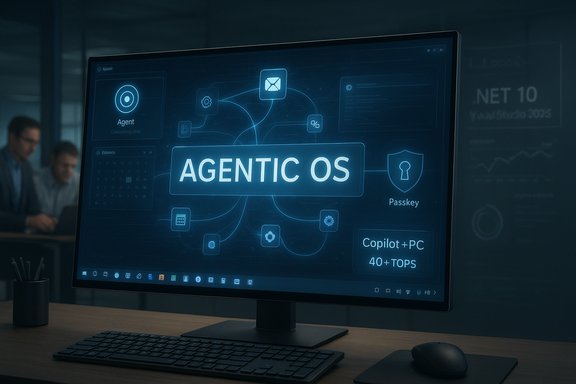
This week’s Microsoft story cycle delivered a rare mix of sharp public mockery, awkward marketing, incremental fixes, and bold product launches — a snapshot of a company simultaneously accelerating an AI-first vision and tripping over the basics that power its broad user base. From the viral roasting of Windows leadership for teasing an “agentic OS,” to a widely-mocked Copilot ad, to out‑of‑band fixes for Windows 10’s Extended Security Update (ESU) enrollment, the week underscored a growing trust gap between Microsoft’s roadmap and its customers’ expectations. The same seven days also produced important platform moves — improved passkey support for third‑party managers, a patched Media Creation Tool ISO, and major developer news with .NET 10 and Visual Studio 2026 — plus ecosystem headlines (FlyOOBE and tiny11 updates, Valve’s new hardware, Xbox Cloud Gaming arriving in India). Taken together, the coverage paints Microsoft as a company sprinting toward an agentic, AI-first Windows, while wrestling with optics, reliability, and the real-world complexity of shipping at scale.
Background / Overview
Microsoft’s recent messaging — especially the phrase that lit the fuse, “Windows is evolving into an agentic OS” — is shorthand for a strategic pivot: embed persistent, stateful AI agents across the operating system so Windows can proactively help complete multi‑step tasks, coordinate across apps, and use local NPUs for on‑device inference. The company couples that vision with a hardware tier, Copilot+ PCs, which Microsoft positions as devices with high‑performance NPUs (advertised as 40+ TOPS) required to deliver the smoothest, most private on‑device experiences. The technical plumbing includes support for the Model Context Protocol (MCP) and the Windows AI Foundry — plumbing that lets models and agents talk to apps and services with a standardized interface. That future is appealing on paper: less context switching, lower latency for AI features, and richer assistant experiences. But it’s not just a technical challenge. The shift collides with long‑running user concerns about telemetry, forced account nudges, in‑OS promotions, and regressed reliability. When Microsoft’s Windows leadership posted a short teaser using the word agentic, it ignited a wave of ridicule and distrust from power users and developer communities — a backlash that quickly became a major media moment. Microsoft then attempted to calm critics by saying it listens to feedback, but the communications gap is now as newsworthy as the technical roadmap.The “Agentic OS” Firestorm
What was said, and why it mattered
Pavan Davuluri, who leads Windows and Devices, posted a brief statement describing Windows as “evolving into an agentic OS, connecting devices, cloud, and AI to unlock intelligent productivity and secure work anywhere.” That sound bite — targeting Ignite and partner audiences — landed badly in public channels. Enthusiasts, longtime Windows power users, and many developers reacted with alarm: agentic implies initiative, and initiative in software is synonymous with autonomy — an attribute that raises immediate questions about control, privacy, and predictability. The social replies were ferocious enough that replies to the original post were subsequently restricted. The backlash was not purely emotional. It bundled several concrete grievances:- Perceived prioritization of AI-enabled novelty over reliability (taskbar regressions, update regressions).
- Fear of expanded telemetry and automated “memory” features that snapshot context.
- Concerns about gating the best experiences behind new, expensive hardware (Copilot+ and 40+ TOPS NPUs).
- Repeated in‑OS monetization nudges (ads, Copilot upsells, OneDrive pressure).
Engineering reality vs. marketing shorthand
Technically, an agentic OS is achievable: modern NPUs, local runtimes, and protocols like MCP make it feasible to run small models locally and orchestrate hybrid cloud+device workflows. Microsoft’s own pages and developer documentation outline the necessary components — local inference runtimes, permissioned sandboxes for agents, and platform APIs for integration. But marketing that vision with a single phrase — agentic — without explaining permission models, governance, audit logs, and safe defaults created a vacuum filled by distrust. The technical ambition is real; so is the implementation complexity and the need for rigorous security and governance.Why the community reacted so hard
This isn’t just sour grapes. Windows’ loyal communities are sensitive to changes that reduce control or add opaque automation. Over a decade of UI churn, subscription pushes, and occasional reliability lapses means even measured design experiments now get interpreted as part of a pattern. The net result: a technical vision that could be transformative is being debated primarily through the lens of trust — a gap Microsoft will have to close with transparency, enterprise‑grade controls, and clear, opt‑in flows.Marketing Misfires: The Copilot Ad Roast
Shortly after the “agentic OS” thread trended, Microsoft suffered a PR stumble: a Copilot ad that many users mocked as tone‑deaf and counterproductive. Critics argued the creative underscored Copilot’s limitations rather than its promise — an awkward outcome for a product Microsoft is trying to mainstream. The ad backlash amplified the earlier reaction, making the company’s messaging appear tone‑deaf at a sensitive moment. The combined effect: a week where marketing and engineering narratives collided in public, and users won the loudest megaphone.Patch Tuesday, ESU and Emergency Fixes: Reliability Work
Windows 10 ESU: KB5071959 and enrollment fixes
October 14, 2025 marked the end of free support for Windows 10 for most consumers. For organizations and users who opted to continue receiving security updates, Microsoft’s ESU program provides a paid pathway. This week Microsoft issued an out‑of‑band patch — KB5071959 — to fix a problem that prevented some users from enrolling in the ESU program; the enrollment wizard in certain regions was failing with generic errors, blocking access. Microsoft’s quick patching closed that enrollment gap for affected devices. Multiple outlets confirmed the emergency nature of the update and the narrow scope: it remedies enrollment failures rather than broadly re‑opening free updates. Administrators and users should verify enrollment status in the Volume Licensing / Microsoft 365 admin portals. What to keep in mind:- KB5071959 is an out‑of‑band fix to the ESU sign‑up workflow; if you were blocked from enrolling you should install it and retry enrollment.
- Receiving the patch does not mean Windows 10 mainstream updates resumed for all devices; only enrolled ESU systems will receive subsequent security updates.
Other reliability notes
Microsoft also shipped small fixes in preview channel builds that addressed File Explorer slowdowns and Group Policy issues, a reminder that stability work continues even as Microsoft ships new features. The company also updated the Media Creation Tool with a newer ISO image that reduces the number of post‑install updates and addresses several issues in the toolchain. If you manage deployment media, download the refreshed ISO or use the updated Media Creation Tool to avoid extra update churn after setup.Passkeys and Authentication: Real Progress for Windows 11 Security
One of the week’s least‑squishy wins was tangible: improved passkey integration that lets third‑party credential managers — notably 1Password and Bitwarden — plug into Windows 11’s native passkey API. Microsoft published an explicit developer and platform story for third‑party passkey providers, and both 1Password and Bitwarden began deploying MSIX builds that register as system passkey providers on Windows. This is a pragmatic, security‑forward step: passkeys bring phishing resistance and a stronger authentication posture to users who want to avoid the Microsoft account / Microsoft password ecosystem. Why this matters:- Passkeys reduce phishing risk by eliminating shared secrets transmitted to servers.
- System‑level integrations let password managers offer a consistent sign‑in surface across browsers and apps.
- The move is enterprise‑friendly: admins can configure and audit passkey behavior in corporate deployments.
- Some third‑party integrations require MSIX packaging and the latest Windows 11 platforms (25H2 build variants); older systems or non‑MSIX installs may not see the option immediately.
- As with any security feature, confirm compatibility with SSO, conditional access, and your identity provider before broad rollout.
FlyOOBE, tiny11, and the Legacy Upgrade Question
Microsoft’s hardware gatekeeping and Windows 11’s minimum requirements continue to push a healthy ecosystem of third‑party tools and stripped‑down Windows builds.- FlyOOBE, the popular setup/customization tool that helps modify the OOBE and bypass certain hardware checks, released a redesigned v2.0 and maintains a preview channel; its maintainers also warned users about malicious clones hosted on unofficial sites. Users should only download FlyOOBE from the official project pages or verified GitHub repos and exercise caution — tampered installers are a real risk.
- tiny11 and related projects (Nano11, Tiny11 Builder) continue to provide lightweight, debloated Windows builds for unsupported hardware. These projects have evolved to support recent Windows 11 releases, but they remain community projects intended for advanced users and testing rather than corporate production. Expect tradeoffs: smaller footprint and performance gains often come at the cost of removed components (e.g., telemetry, drivers) that may be needed in certain scenarios.
Developer News: .NET 10 and Visual Studio 2026
For developers the week offered a more conventional win: .NET 10 shipped as an LTS release with a major focus on AI integration, performance improvements, and a new set of tooling primitives for agents and models. Microsoft’s .NET team announced AI‑first features — a Microsoft Agent Framework and tighter integrations for model hosting — along with broad runtime speedups and extended LTS commitments through November 2028. Visual Studio 2026 — released in tandem — includes deeper Copilot integration, performance profilers that make code recommendations, and language updates for C# 14. For developers planning long‑term platform upgrades, .NET 10 is the natural migration target and ships with practical benefits in performance and AI tooling. What IT teams should do now:- Test your application stack against .NET 10 in a staging environment.
- Validate third‑party libraries for compatibility with C# 14 and runtime changes.
- Measure performance improvements on representative workloads before adopting widely.
Gaming and Hardware: Valve’s Big Reveal and Xbox Cloud in India
Two sizable hardware/service announcements framed the week’s gaming coverage.- Valve announced a new family of hardware — a living‑room Steam Machine (a console/PC hybrid), a next‑gen Steam Controller, and the Steam Frame VR headset — positioning itself to move beyond handhelds and deeper into console and VR markets. The Steam Machine promises 4K/60 gameplay, richer I/O and expanded SteamOS support; the Steam Frame blends VR and non‑VR streaming. The reveal signals Valve’s renewed hardware ambition and will be measured for price, regional availability, and developer support. Early coverage flags launch timing in early 2026, though pricing remains TBD. These announcements were covered across multiple outlets and carry clear implications for competition in console and hybrid PC markets.
- Xbox Cloud Gaming launched in India, with local Azure stacks to reduce latency and three Game Pass tiers priced for the Indian market. This expands Microsoft’s reach in one of the world’s fastest‑growing gaming markets and highlights how cloud streaming reduces the console barrier for entry. The rollout includes local optimizations and tailored pricing that make cloud gaming a plausible option for mainstream Indian audiences.
What Worked — And What Didn’t
Wins
- Passkey integration with third‑party providers is practical, security‑forward, and widely useful for consumers and enterprises alike. The implementation is precise: a new API model plus MSIX support for vendors like 1Password and Bitwarden.
- .NET 10 and Visual Studio 2026 are material upgrades for developers, with clear performance and tooling gains that enterprises can act on now.
- Quick patching (KB5071959) to unblock ESU enrollments is the right operational move: Microsoft fixed an enrollment flow regression that could have stranded paying customers. Timely fixes like this still matter to admins.
Missteps and risks
- Tone-deaf messaging and marketing: The agentic OS sound bite and a poorly received Copilot ad combined to amplify user distrust. When long-term architectural changes require opt‑in, transparent governance, and enterprise controls, marketing that centers novelty over clarity is risky.
- Perception of gating via hardware: Messaging around Copilot+ and 40+ TOPS NPUs risks creating a two‑tier Windows experience. If the most compelling features require expensive hardware, Microsoft must manage expectations and interoperability carefully. The 40+ TOPS guidance is real on Microsoft product pages, but the practical performance envelope will vary by vendor and workload. Treat hardware claims as vendor‑dependent until independent benchmarks emerge.
- Security hazard from third‑party tool clones: The FlyOOBE ecosystem illustrates an ongoing risk: popular upgrade and bypass tools attract malicious clones. Security‑conscious readers should only use official project pages and verify checksums.
How Enterprises and Power Users Should Respond
- Prioritize reliability over hype. Apply tested Windows updates in controlled rings; don’t rush to enable large‑scale agentic features without governance.
- Treat passkeys as a high‑value security improvement: pilot 1Password/Bitwarden integration with identity teams and SSO flows. Third‑party passkeys are now feasible at scale.
- For Windows 10 systems that must remain online, validate ESU enrollment and apply KB5071959 if you were blocked from enrolling. Confirm billing/enrollment status in admin portals.
- If you run custom or unsupported installations (tiny11, FlyOOBE), maintain strict update and image verification processes; these tools have benefits but also elevate operational and security complexity.
- For developers, begin planning .NET 10 migrations now: it’s an LTS release with significant runtime and AI tooling improvements that will materially affect performance and developer productivity.
Where Claims Need Caution and Further Verification
- Performance promises tied to NPU TOPS: TOPS numbers are a vendor‑provided shorthand that depends heavily on model type, quantization, and workload. The 40+ TOPS marketing figure signals capability, but independent benchmarking will be necessary to validate real‑world performance for specific Copilot features. Treat TOPS as an indicative, not absolute, performance metric.
- Agentic autonomy boundaries: Microsoft has published primitives like MCP and Foundry, but how agents will be permissioned, logged, and audited in enterprise contexts remains an implementation detail that will vary across corporate deployments. Enterprises should require clear SLAs and audit capabilities before adopting agentic workflows at scale.
- Third‑party tool safety: Community tools (FlyOOBE, tiny11) are valuable but unregulated. Download only from official sources and treat modified images as non‑supported for enterprise workloads. Verified checksums and isolated testing are mandatory.
Final Assessment
This week was defining not because of a single product reveal but because it exposed how strategy, marketing, and engineering must align for sweeping changes to stick. Microsoft’s AI ambition for Windows — agents, MCP, Copilot+ — is technically credible and potentially transformative. The company has shipped real developer and security wins (passkey APIs, .NET 10, fixes to ESU enrollment), which should be acknowledged.But the twin problems of perception and governance are urgent. Marketing that compresses complex architectural change into a provocative phrase like “agentic OS” without clear user controls produces backlash. Aggressive in‑OS nudges and misfired advertising risk eroding goodwill just as Microsoft asks users to trust automated, autonomous software running at the system level.
The way forward is clear: combine technical safeguards (permissioned agents, audit logs, enterprise governance), transparent communications (what agents can and cannot do), and pragmatic deployment guidance (graceful degradation on older hardware, robust fallback paths). If Microsoft can pair its engineering roadmap with disciplined product governance and clearer, less sensational messaging, the agentic future could be a real productivity win. If not, users will continue to push back — loudly.
Quick Reference: Actionable Items This Week
- Install KB5071959 if you were blocked from ESU enrollment and confirm ESU status.
- For security, pilot third‑party passkey integration (1Password/Bitwarden) on Windows 11 25H2 test devices.
- Developers: begin .NET 10 compatibility testing; consider Visual Studio 2026 pilots.
- If using FlyOOBE or tiny11, validate downloads against official repos and run images in isolated test environments first.
Source: Neowin Microsoft Weekly: People roast Microsoft executives and lame Copilot ads
