

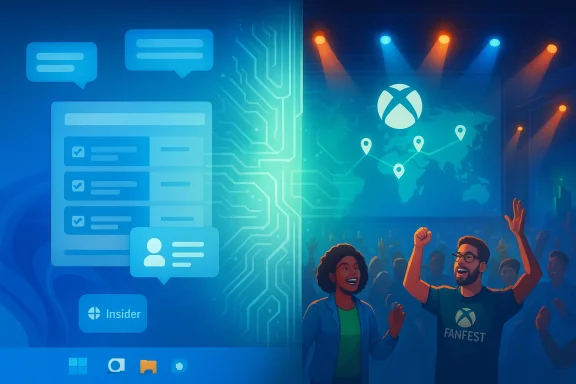
Microsoft’s sudden rediscovery of user feedback is not just a charming course correction; it looks like a strategic reset. After years of treating Windows 11 and Xbox like side quests while the company bet the farm on AI, Microsoft is suddenly talking again about product quality, community access, and long-requested features. That shift is showing up in public: Windows Insider meetups are back, taskbar customization is returning, and Xbox FanFest is going global for the first time in years.
For much of the last decade, Microsoft’s consumer story has come in waves. The company spent years trying to rehabilitate Windows after the Windows 8 backlash, then made a genuine effort to look and feel more consumer-friendly through Surface hardware, Xbox investments, and a more open posture toward developers and enthusiasts. That era did not make Microsoft beloved, but it did make the company feel like it was at least trying to earn goodwill rather than simply extract it.
Then the AI era arrived and the company’s priorities visibly changed. Microsoft became the most important strategic backer of OpenAI, poured huge amounts of capital into cloud infrastructure, and began framing almost every product category through the lens of Copilot and generative AI. The result was an enormous corporate bet that made sense on a balance sheet and in investor presentations, but often felt disconnected from what Windows and Xbox users actually wanted.
That disconnect mattered because Microsoft’s core brands are still emotional products. Windows is not just an operating system; for many people it is the default interface to work, school, gaming, and creativity. Xbox is not just a console business; it is a community brand built on identity, tradition, and fan rituals. When those products feel ignored, people do not merely become dissatisfied — they become actively distrustful.
The backlash to Windows 11 in particular has been cumulative. Users bristled at intrusive AI branding, complained about reduced control, and watched familiar features disappear or remain half-baked. The removal of longstanding customization options such as taskbar repositioning became symbolic: a product once known for flexibility increasingly looked like it was being simplified around a corporate vision that had little to do with power users.
Xbox told a similar story, though through a different lens. The platform spent years in a strange limbo where Microsoft still invested in studios and services, yet the brand often seemed unsure of its own value proposition. Community-facing efforts thinned out, some marketing messaging felt self-defeating, and exclusivity increasingly gave way to a broad multiplatform strategy that left many loyal fans wondering what exactly was special about being an Xbox customer.
But a strategy can be technically rational and still become politically toxic. The more Microsoft leaned into AI branding, the more its consumer products started to look like vehicles for a larger ambition rather than destinations in their own right. Windows users noticed. Xbox users noticed. And the broader public noticed too.
That is why the OpenAI relationship matters so much. Even if the partnership remains strategically useful, it can also create a dependency that distorts product priorities across the company. If one external relationship becomes too central, every other product starts feeling like it has to justify itself against the needs of that relationship.
It signals that Microsoft is willing to concede that some past decisions were mistakes. That matters because Windows users have spent years hearing a version of the same message: this is the future, adapt to it. Now the tone is more like: we heard you, and we should have listened sooner.
That is why the reaction to Microsoft’s renewed focus is mixed. Some users are genuinely encouraged. Others assume the company is trying to repair trust with a few highly visible concessions while the larger product strategy remains unchanged. That skepticism is well-earned.
That is especially true because Windows 11 has accumulated reputation damage from multiple directions. Privacy concerns, inconsistent UX, forced recommendations, and awkward AI integration have created the impression that Microsoft is more interested in steering behavior than supporting productivity. Reversing that takes time, not just announcements.
By expanding FanFest across multiple locations, Microsoft is acknowledging that Xbox is not just a platform; it is a club. The company appears to understand that brand loyalty in gaming is emotional, local, and experiential. People want to feel seen.
That is the tension Microsoft still has not fully resolved. A more open content strategy can expand revenue and audience reach, but it can also make the hardware and platform layer feel less special. Xbox needs to prove that it can be both broadly distributed and still distinctly Xbox.
That makes Microsoft’s broader portfolio more important, not less. Windows, Xbox, Surface, and other consumer-facing lines are not as glamorous as frontier AI, but they are durable. They also provide opportunities to rebuild trust in ways that a cloud capacity report never can.
That does not mean Microsoft is “giving up” on AI. It means the company may be rediscovering that long-term resilience comes from balanced portfolios, not from worshipping the newest category in the room. In that sense, the pivot feels less like a retreat than a hedge.
In other words, a more customer-focused Windows and Xbox strategy is not charity. It is risk management.
That is why the consumer pivot matters. If the AI partnership becomes noisier, costlier, or harder to defend, Microsoft needs alternative sources of confidence. Windows and Xbox are not substitutes for AI, but they are proof that the company can still improve products people touch every day.
That is a very large if, of course. But large companies often survive by preparing for multiple outcomes simultaneously. Microsoft looks like it is finally acting that way again.
That last point matters more than Microsoft may realize. Many users do not hate AI in the abstract; they hate being told that they must care about it on the company’s schedule. A product that listens will always outperform one that lectures.
That does not mean Xbox has to return to old exclusivity models. But it does mean Microsoft needs to articulate why being part of Xbox still matters when the same games increasingly show up elsewhere.
That is why a cleaner Windows message helps Microsoft even in corporate conversations. A product that feels respected is easier to standardize around than one that feels like it is constantly changing for reasons no one asked for.
Just as important, Microsoft must resist the temptation to frame every win as an AI win. The best possible version of this story is not that AI saved Windows and Xbox. It is that Microsoft remembered those products mattered in their own right. That may sound modest, but for a company as large and as visibly overextended as Microsoft, modesty could be the smartest strategic move it has made in years.
Source: Windows Central Windows and Xbox rediscover user feedback and fans are wondering what took so long
 Background
For much of the last decade, Microsoft’s consumer story has come in waves. The company spent years trying to rehabilitate Windows after the Windows 8 backlash, then made a genuine effort to look and feel more consumer-friendly through Surface hardware, Xbox investments, and a more open posture toward developers and enthusiasts. That era did not make Microsoft beloved, but it did make the company feel like it was at least trying to earn goodwill rather than simply extract it.Then the AI era arrived and the company’s priorities visibly changed. Microsoft became the most important strategic backer of OpenAI, poured huge amounts of capital into cloud infrastructure, and began framing almost every product category through the lens of Copilot and generative AI. The result was an enormous corporate bet that made sense on a balance sheet and in investor presentations, but often felt disconnected from what Windows and Xbox users actually wanted.
That disconnect mattered because Microsoft’s core brands are still emotional products. Windows is not just an operating system; for many people it is the default interface to work, school, gaming, and creativity. Xbox is not just a console business; it is a community brand built on identity, tradition, and fan rituals. When those products feel ignored, people do not merely become dissatisfied — they become actively distrustful.
The backlash to Windows 11 in particular has been cumulative. Users bristled at intrusive AI branding, complained about reduced control, and watched familiar features disappear or remain half-baked. The removal of longstanding customization options such as taskbar repositioning became symbolic: a product once known for flexibility increasingly looked like it was being simplified around a corporate vision that had little to do with power users.
Xbox told a similar story, though through a different lens. The platform spent years in a strange limbo where Microsoft still invested in studios and services, yet the brand often seemed unsure of its own value proposition. Community-facing efforts thinned out, some marketing messaging felt self-defeating, and exclusivity increasingly gave way to a broad multiplatform strategy that left many loyal fans wondering what exactly was special about being an Xbox customer.
The AI Bet That Changed Microsoft
The easiest way to understand the present pivot is to start with the AI gamble. Microsoft chose to align itself with OpenAI earlier and more aggressively than most rivals, and that bet transformed the company’s narrative from a mature software giant into the apparent front-runner of the generative AI boom. In theory, the logic was obvious: own the infrastructure, own the enterprise distribution, and capture the next platform shift.Why the Bet Looked Brilliant
On paper, this was classic Microsoft. It had cloud scale, enterprise relationships, and enough cash to subsidize the future long before the future turned profitable. The company could plausibly argue that its role was not only to build products but to provide the compute, tooling, and integration layer that would make AI broadly usable. That is a very Microsoft-shaped strategy.But a strategy can be technically rational and still become politically toxic. The more Microsoft leaned into AI branding, the more its consumer products started to look like vehicles for a larger ambition rather than destinations in their own right. Windows users noticed. Xbox users noticed. And the broader public noticed too.
- AI became the headline
- Windows and Xbox became supporting acts
- User feedback felt secondary
- Every product launch was filtered through Copilot
- The brand image shifted from practical to preachy
The Cost of Being First
Early leadership in a new category is valuable, but it comes with operational drag. AI workloads are expensive, infrastructure-hungry, and unforgiving when demand spikes. They also create a tension between serving mass-market users and meeting enterprise expectations for reliability and cost control. Microsoft has had to absorb that tension while still defending Azure margins and reassuring investors that the money is not simply being burned for prestige.That is why the OpenAI relationship matters so much. Even if the partnership remains strategically useful, it can also create a dependency that distorts product priorities across the company. If one external relationship becomes too central, every other product starts feeling like it has to justify itself against the needs of that relationship.
What Changed This Year
What changed in 2026 is not necessarily that Microsoft stopped caring about AI. It is that the company appears to have remembered that it also sells operating systems, consoles, devices, and services to real people who expect those products to improve. The Windows Insider team is again emphasizing direct feedback, while Xbox is re-centering community events and fan engagement. That is not a full reversal, but it is a meaningful recalibration.Windows Learns to Listen Again
Microsoft’s Windows messaging has been noticeably different in recent weeks. The company has publicly committed to Windows quality, emphasized feedback from Insiders, and previewed features many users have requested for years, including more taskbar customization and better channel clarity in the Insider Program. That kind of language sounds basic, but for Windows fans it lands like a small miracle.The Return of Familiar Ideas
The most important part of the Windows shift is not the novelty of any single feature. It is the fact that Microsoft is reviving the idea that Windows should be a configurable, user-directed desktop rather than a fixed experience with occasional AI garnish. Returning the ability to move the taskbar, for example, is less about pixels and more about philosophy.It signals that Microsoft is willing to concede that some past decisions were mistakes. That matters because Windows users have spent years hearing a version of the same message: this is the future, adapt to it. Now the tone is more like: we heard you, and we should have listened sooner.
Why Power Users Care
For enthusiasts, taskbar placement is not a gimmick. It affects workflow, ergonomics, and how people use ultrawide monitors, portrait displays, and multi-screen setups. Windows has always had a deep practical appeal because it could be bent to the user’s needs. When that flexibility narrows, the operating system loses part of its identity.That is why the reaction to Microsoft’s renewed focus is mixed. Some users are genuinely encouraged. Others assume the company is trying to repair trust with a few highly visible concessions while the larger product strategy remains unchanged. That skepticism is well-earned.
- Taskbar flexibility is back on the agenda
- Windows quality is being framed as a first-class priority
- Insider feedback is being treated more seriously
- Community events are returning
- Users want fixes, not slogans
The Trust Problem
Microsoft’s biggest Windows problem is not simply feature parity. It is trust. Users have seen enough dramatic branding cycles and half-implemented ideas to wonder whether each new promise will actually survive the next wave of strategic enthusiasm. If Windows is finally being treated as a core product again, the company will need more than a few polished blog posts to prove it.That is especially true because Windows 11 has accumulated reputation damage from multiple directions. Privacy concerns, inconsistent UX, forced recommendations, and awkward AI integration have created the impression that Microsoft is more interested in steering behavior than supporting productivity. Reversing that takes time, not just announcements.
Xbox Finally Remembers Its Community
Xbox’s recent moves suggest a similar correction. Microsoft has brought back Xbox FanFest and is taking it global in celebration of the brand’s 25th anniversary, with events planned across multiple cities and regions. That is a deliberate return to a kind of brand-building Microsoft had largely allowed to fade.FanFest as a Signal
FanFest is not merely an event calendar item. It is a statement that Xbox still believes it has a community worth gathering in person. That sounds obvious, but in recent years the brand often seemed to behave as if community could be maintained through content drops and social posts alone. Fans know the difference between marketing and actual presence.By expanding FanFest across multiple locations, Microsoft is acknowledging that Xbox is not just a platform; it is a club. The company appears to understand that brand loyalty in gaming is emotional, local, and experiential. People want to feel seen.
The Multiplatform Tension
At the same time, Xbox’s identity problem is not solved by one event series. The company has spent the last few years pushing broader availability for its games, including on rival platforms, which may make business sense but can also weaken the perception that Xbox itself is indispensable. If your best content lives everywhere, then your console has to offer something beyond access.That is the tension Microsoft still has not fully resolved. A more open content strategy can expand revenue and audience reach, but it can also make the hardware and platform layer feel less special. Xbox needs to prove that it can be both broadly distributed and still distinctly Xbox.
Why the Community Still Matters
Community events, in-person demos, developer access, and fan celebrations are one way to restore that distinctiveness. They create memories that cannot be replicated by a digital storefront. They also give Microsoft a way to hear criticism directly rather than through filtered social sentiment.- FanFest returns as a brand ritual
- Global events signal renewed seriousness
- Local community building matters in gaming
- Hardware must still justify itself
- Xbox identity needs emotional texture
The Business Reality Behind the Pivot
A softer public image does not happen in a vacuum. Microsoft is a public company, and it reacts to incentives. If Wall Street is uneasy, if infrastructure costs are climbing, or if the AI story becomes harder to sell at current margins, then management has every reason to redistribute attention toward businesses that are stable, profitable, and still capable of producing goodwill.Azure, AI, and Margin Pressure
The company’s AI infrastructure push has created real costs. Compute is expensive, capacity is finite, and the economics of large-scale model serving can be ugly in the short term. Even if demand stays high, it is still possible for the cost structure to become a problem if the revenue does not keep pace or if expectations outrun the current economics.That makes Microsoft’s broader portfolio more important, not less. Windows, Xbox, Surface, and other consumer-facing lines are not as glamorous as frontier AI, but they are durable. They also provide opportunities to rebuild trust in ways that a cloud capacity report never can.
The Value of Stable Products
There is a strategic logic here that is easy to miss. If one part of the business is volatile, management often leans harder on the parts that are predictable. Windows and Xbox are imperfect, but they are familiar. They have established audiences, recurring touchpoints, and a rich base of user feedback that can be turned into product improvements relatively quickly.That does not mean Microsoft is “giving up” on AI. It means the company may be rediscovering that long-term resilience comes from balanced portfolios, not from worshipping the newest category in the room. In that sense, the pivot feels less like a retreat than a hedge.
The Market Likes Balance
Investors tend to reward narratives that combine growth with stability. A company that can sell AI infrastructure while also making users happier on Windows and Xbox is easier to believe in than one that seems to be neglecting its most visible consumer products. That is particularly true when the AI market itself is still uncertain and heavily subsidized.In other words, a more customer-focused Windows and Xbox strategy is not charity. It is risk management.
The OpenAI Relationship Looks Less Like a Partnership and More Like a Pressure Point
It would be a mistake to treat Microsoft’s renewed focus on feedback as purely internal soul-searching. The company’s relationship with OpenAI is still the central pressure point in the background. Even without endorsing every rumor about legal disputes or contractual conflict, the strategic reality is obvious: when one partner becomes too important, the relationship stops being a partnership and starts becoming leverage.Why Dependency Creates Anxiety
Microsoft built a large part of its AI story around OpenAI models and infrastructure. That made sense when the alliance looked clean, exclusive, and mutually beneficial. But the moment exclusivity becomes contested or economics become strained, the arrangement turns complicated fast. In that scenario, every additional dollar spent on AI can start to look like a sunk bet.That is why the consumer pivot matters. If the AI partnership becomes noisier, costlier, or harder to defend, Microsoft needs alternative sources of confidence. Windows and Xbox are not substitutes for AI, but they are proof that the company can still improve products people touch every day.
The Strategic Insurance Policy
A more grounded Windows and Xbox strategy functions like insurance. If AI growth is uneven, Microsoft can still point to product quality, ecosystem value, and consumer engagement. If AI eventually pays off, even better — the company will have avoided letting the rest of the portfolio atrophy in the meantime.That is a very large if, of course. But large companies often survive by preparing for multiple outcomes simultaneously. Microsoft looks like it is finally acting that way again.
The Risk of Overcorrection
There is, however, a danger in swinging too far the other direction. If Microsoft starts treating Windows and Xbox as reputational repair projects rather than core businesses, it could end up with polished messaging and shallow execution. Fans are not fooled by sudden enthusiasm if the underlying product cadence remains timid.- Dependency creates leverage
- Leverage creates strategic anxiety
- Insurance requires real investment
- Overcorrection can become performative
- Goodwill has to be earned repeatedly
Consumer Impact: What Windows Users and Xbox Fans Actually Want
For consumers, the reset is refreshingly simple. They want products that work well, respect their choices, and improve in obvious ways. They do not want every patch to be a referendum on artificial intelligence, nor do they want the company’s internal strategic drama to leak into their daily workflows or gaming sessions.Windows Users Want Control
Windows users have a remarkably consistent wishlist. They want customization restored where it was removed, privacy protections to be clearer, performance to be better, and system changes to be less intrusive. They also want Microsoft to stop acting as if every improvement has to be framed as a Copilot victory.That last point matters more than Microsoft may realize. Many users do not hate AI in the abstract; they hate being told that they must care about it on the company’s schedule. A product that listens will always outperform one that lectures.
Xbox Fans Want Identity
Xbox fans want the opposite of ambiguity. They want a platform that feels like it has a point of view, a calendar, and a soul. They want exclusive or distinctive content, genuine community engagement, and hardware that feels part of a larger ecosystem rather than an afterthought in a business report.That does not mean Xbox has to return to old exclusivity models. But it does mean Microsoft needs to articulate why being part of Xbox still matters when the same games increasingly show up elsewhere.
The Social Contract
At the consumer level, the social contract is straightforward: users tolerate change when they believe the company is listening and the product is getting better. They revolt when they feel like they are being experimented on. Microsoft has been pushing that boundary for years, and it is only now starting to repair the damage.Enterprise Impact: Why the Corporate Side Still Cares About the Consumer Side
It is tempting to separate consumer products from enterprise strategy, but Microsoft never really can. Windows remains the default workplace operating system for a huge share of the world, and Xbox’s brand halo still influences how people feel about the company broadly. That means consumer sentiment feeds into enterprise credibility more than some executives like to admit.Trust Travels
When users associate Microsoft with clutter, coercion, or sloppy product decisions, that perception does not stay at home. It affects how companies think about deployment risk, training burden, and user satisfaction. Even in enterprise settings, employees are people first. They notice when the tools imposed on them are getting worse.That is why a cleaner Windows message helps Microsoft even in corporate conversations. A product that feels respected is easier to standardize around than one that feels like it is constantly changing for reasons no one asked for.
The Ecosystem Argument
Enterprise buyers also care about ecosystems. A healthier Windows desktop story, a more credible device strategy, and a more trusted consumer brand all reinforce the notion that Microsoft’s platform is stable. That stability is part of what makes Microsoft’s cloud and software stack feel safe to adopt.- Consumer trust supports enterprise confidence
- Windows quality affects deployment morale
- Brand reputation influences procurement perception
- Platform coherence matters across segments
- User satisfaction is not just a consumer metric
Strengths and Opportunities
Microsoft’s pivot comes with real upside if the company follows through. The biggest opportunity is not a flashy new feature; it is the chance to rebuild product trust by improving things people already care about. If the company sustains the shift, it can make Windows and Xbox feel relevant again while still pursuing AI at scale.- Restoring lost trust through visible product improvements
- Winning back enthusiasts with real customization
- Strengthening Windows as a platform for power users
- Rebuilding Xbox community energy through live events
- Creating a more balanced corporate narrative
- Reducing dependence on a single hype cycle
- Improving perception across both consumer and enterprise audiences
Risks and Concerns
The danger is that this moment becomes another Microsoft mood swing rather than a lasting change. The company has a long history of introducing promising initiatives and then drifting once attention moves elsewhere. Users have reason to worry that the current friendliness is tactical, not structural.- Trust may not return quickly, even with good updates
- A few features cannot erase years of frustration
- AI priorities could crowd out consumer fixes again
- Xbox community efforts could feel cosmetic if hardware and content strategy remain unclear
- Windows feedback loops may still be too slow
- Public skepticism could blunt even genuinely good changes
- The company could overpromise and underdeliver once more
Looking Ahead
The next several months will tell us whether Microsoft is merely polishing its messaging or actually rebalancing the company. The answer will come not from slogans, but from release notes, event cadence, product consistency, and whether feedback becomes a durable part of how Windows and Xbox are built. If the company keeps showing up in public and keeps shipping useful changes, the narrative will begin to shift.Just as important, Microsoft must resist the temptation to frame every win as an AI win. The best possible version of this story is not that AI saved Windows and Xbox. It is that Microsoft remembered those products mattered in their own right. That may sound modest, but for a company as large and as visibly overextended as Microsoft, modesty could be the smartest strategic move it has made in years.
- Watch for more taskbar and desktop customization
- Watch for whether Insider feedback changes build quality
- Watch for how global FanFest events are executed
- Watch for whether Xbox clarifies its hardware identity
- Watch for whether Microsoft keeps Windows quality above AI marketing
- Watch for any signs of a broader org-level reset
- Watch for evidence that this is more than a temporary apology tour
Source: Windows Central Windows and Xbox rediscover user feedback and fans are wondering what took so long
