

Microsoft’s AI moment is no longer a single‑actor drama: the company’s OpenAI tie remains strategically important, but the bigger story for investors and IT leaders is Microsoft converting that partnership into a broader, multichannel AI platform built across Azure, Copilot, developer tooling and a growing roster of model partners.
Microsoft’s formal relationship with OpenAI began as a high‑risk, high‑reward play: an early 2019 investment that gave the Redmond giant preferential technical and commercial access to frontier models while providing OpenAI the compute, distribution and funding muscle needed to scale. Since then Microsoft’s exposure to OpenAI and the broader model economy has been described in the tens of billions — a cumulative commitment frequently reported as roughly $13 billion. Two parallel shifts changed the narrative during 2024–2025. First, Microsoft dramatically expanded spending to build AI‑capable infrastructure — public reporting and company statements pegged FY2025 AI‑related infrastructure spending in the broad neighborhood of $80 billion. Second, OpenAI’s corporate evolution in late 2025 — a recapitalization that created a for‑profit public benefit corporation and gave Microsoft a material equity stake (reported as about 27%) in the newly structured entity — made headlines and sharpened the economics of the partnership. Those moves are the immediate backdrop for the bullish Wall Street takes — from forecasts about multi‑trillion‑dollar upside to analyst notes highlighting Microsoft’s unique combination of distribution, cloud capacity and productization. But the headlines obscure important subtleties about what Microsoft actually owns, what it can monetize today, and where the strategic risks remain.
Yet the bull case rests on measurable execution: converting Copilot adoption into predictable recurring revenue, keeping data‑center utilization high, and ensuring model economics don’t erode margins. The largest headline numbers (multi‑hundred‑billion purchase commitments or multi‑trillion market‑cap forecasts) are directional signals of scale — not guaranteed outcomes — and deserve careful scrutiny in any valuation model. For enterprises, the vendor story is clear: Microsoft offers an unusually integrated route to adopt AI at scale, but CIOs should validate workload fit, cost assumptions and governance before making multiyear commitments. For investors, Microsoft’s combination of distribution, balance‑sheet optionality and multi‑model platform gives it a realistic path to significant upside — provided the company controls capex discipline, defends margins, and navigates regulatory scrutiny prudently.
Note on sourcing and verifiability: this analysis cross‑checked major public claims against multiple independent reports — including Reuters and CNBC on Microsoft’s FY2025 AI infrastructure commitments, Fortune and The Guardian on OpenAI’s restructuring and Microsoft’s stake, and broad reporting on the Anthropic/Microsoft/Nvidia arrangement. Headline multi‑year commitment figures are often structured and conditional; where contract mechanics were not publicly available, those figures are reported as company or press claims and should be treated as directional until definitive filings or contract texts are released.
Source: AOL.com Microsoft's AI advantage isn't all about OpenAI — and Wall Street loves it
 Background / Overview
Microsoft’s formal relationship with OpenAI began as a high‑risk, high‑reward play: an early 2019 investment that gave the Redmond giant preferential technical and commercial access to frontier models while providing OpenAI the compute, distribution and funding muscle needed to scale. Since then Microsoft’s exposure to OpenAI and the broader model economy has been described in the tens of billions — a cumulative commitment frequently reported as roughly $13 billion. Two parallel shifts changed the narrative during 2024–2025. First, Microsoft dramatically expanded spending to build AI‑capable infrastructure — public reporting and company statements pegged FY2025 AI‑related infrastructure spending in the broad neighborhood of $80 billion. Second, OpenAI’s corporate evolution in late 2025 — a recapitalization that created a for‑profit public benefit corporation and gave Microsoft a material equity stake (reported as about 27%) in the newly structured entity — made headlines and sharpened the economics of the partnership. Those moves are the immediate backdrop for the bullish Wall Street takes — from forecasts about multi‑trillion‑dollar upside to analyst notes highlighting Microsoft’s unique combination of distribution, cloud capacity and productization. But the headlines obscure important subtleties about what Microsoft actually owns, what it can monetize today, and where the strategic risks remain. Microsoft’s multi‑layer AI strategy: what it looks like today
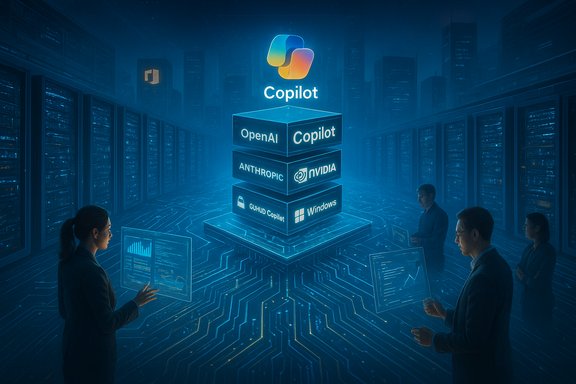
Microsoft hasn’t bet on a single model; it’s building a platform that can host, call and productize multiple models while embedding AI across every customer surface.Key architectural layers
- Compute and data centers (Azure): hyperscale regions, GPU farms and AI‑optimized facilities that provide training and inference capacity. The company’s public capex disclosures and reporting describe an outsized allocation to AI infrastructure in FY2025.
- Model partnerships and multi‑model distribution: continuing OpenAI collaboration plus strategic investments and distribution deals with other model providers (notably Anthropic), enabling model choice for enterprise customers.
- Productization via Copilot: seat‑based Copilot products embedded in Microsoft 365, GitHub Copilot for developers, and Windows‑level assistants that convert model access into recurring revenue.
- Developer and ISV tooling: Azure AI Foundry, Copilot Studio and SDKs that let partners and enterprises build, secure and scale agentic workflows.
Product examples that matter right now
- Microsoft 365 Copilot: positioned as the “front door” for office‑workflow AI monetization, where seat pricing and upsell are the direct monetization handles.
- Azure OpenAI Service / Azure AI Foundry: enterprise‑grade runtimes and compliance wrappers for hosting third‑party models and private instances.
- GitHub Copilot: developer productivity monetization and a natural channel for enterprise code‑automation agents.
Financial claims and verified figures — what’s solid, what’s reported
When discussing Microsoft and its AI economics, several load‑bearing figures recur. These have been verified across multiple independent outlets where possible.- Microsoft’s cumulative commitments to OpenAI are widely reported in the low‑to‑mid double‑digit billions, commonly cited as ~$13 billion; company executives and major business outlets have repeated that figure.
- Microsoft publicly disclosed plans and reports placed large AI‑focused capital expenditures around $80 billion for fiscal 2025, a number covered by Reuters and CNBC and echoed in industry reporting. That figure describes an aggressive expansion of AI data‑center capacity and related investments.
- The OpenAI recapitalization reported in October 2025 placed the firm’s valuation near $500 billion and Microsoft’s stake at approximately 27%, as reported by major outlets covering the restructuring. Those reports also described extended IP and cloud arrangements lasting into the early 2030s under negotiated terms.
- The Anthropic strategic agreement announced in November 2025 involved Microsoft and NVIDIA investment commitments (reported as up to $5 billion and $10 billion respectively) and Anthropic’s commitment to purchase about $30 billion of Azure compute — a deal framed as part of Microsoft’s multi‑model strategy. Multiple independent reports corroborate those headline terms.
Why Wall Street likes Microsoft’s position
- Distribution leverage: Microsoft can push Copilot‑style AI into hundreds of millions of productivity seats and tens of millions of enterprise endpoints — a distribution moated by Office, Windows, LinkedIn and GitHub. Analysts repeatedly call this the decisive advantage.
- Multi‑model, multi‑channel revenue: by combining cloud consumption (Azure AI), seat subscription (Copilot), and enterprise services (Foundry, managed deployments), Microsoft reduces dependence on a single revenue source. The Anthropic partnership is a concrete example of this diversification.
- Capital and supply chain optionality: Microsoft’s balance sheet allows it to underwrite enormous infrastructure builds and secure long‑run GPU supply, which is a strategic advantage in a capital‑intensive arena.
Critical analysis — strengths, execution traps and systemic risks
Microsoft’s strategy contains powerful strengths, but execution reality and macro risks deserve tight scrutiny.Strengths
- Integrated distribution and productization: embedding AI into Office, Windows and developer tools creates frequent usage patterns that make seat upgrades and upsells easier. This is the “software as a shock absorber” thesis — software margins cushion heavy compute capex.
- Platform optionality: by supporting multiple frontier models (OpenAI, Anthropic, others), Microsoft can sell model choice to enterprises that demand compliance, sovereignty and vendor diversification.
- Scale economics and chip leverage: as a hyperscaler, Microsoft negotiates preferential terms for GPU and hardware and designs facilities optimized for AI workloads — an operational edge.
Execution traps and financial risks
- Overbuilding risk: the company’s multi‑year capex play (the reported $80B FY2025 program and other multi‑party projects) creates utilization risk. If enterprise adoption or pricing trends soften, Microsoft could carry oversized, underused capacity for years. Multiple analysts have warned of the “bought a Ferrari when a Prius would’ve done” outcome if demand decelerates.
- Circular economics and margin pressure: large investments into partner models that commit compute back to Azure (for example, investment + purchase commitments with Anthropic) can create circular revenue flows that are profitable in aggregate but opaque in margins when assessed at unit economics. Analysts caution this can inflate top‑line headlines without delivering clean, high‑margin free cash flow.
- Competitive model risk: frontier model leadership can shift; breakthroughs from rivals (Google, AWS partner models, open‑source breakthroughs) could materially change cost‑performance tradeoffs and displace value‑capture assumptions embedded in current analyst forecasts.
- Regulatory and antitrust scrutiny: bundling Copilot across productivity suites, preferential commercial terms tied to platform access, and concentrated access to frontier compute may attract scrutiny in major jurisdictions. Regulators have already examined related packaging and disclosure concerns in multiple markets.
Technical and operational considerations for CIOs
- Workload placement: enterprises must evaluate which workloads benefit from frontier models vs. small, task‑specialized in‑house models. Microsoft’s hybrid orchestration approach (route the task to the most efficient model) reduces cost but increases operational complexity.
- Sovereignty and compliance: as Microsoft expands sovereign cloud options (example: India investments and sovereign public cloud offerings), customers should verify in‑region processing and contractual data protections. Microsoft’s India investment pledge is a notable example of region‑specific infrastructure strategy.
- Agent governance: as “agentic AI” (multistep agent workflows) becomes a core enterprise use case, governance, observability and rollback tools will be decisive for production readiness. Microsoft’s Copilot Studio and Foundry attempt to address this, but maturity varies by industry.
The OpenAI relationship — headline vs. reality
OpenAI gave Microsoft a head start and privileged access; the October 2025 restructuring complicated, clarified and commercialized that relationship.- Microsoft’s reported 27% stake in the reconstituted OpenAI Group PBC (and the company valuation reported near $500 billion) is transformative in headline terms, but the day‑to‑day commercial benefit for Microsoft flows through long‑term IP rights, Azure purchase commitments by OpenAI, and preferred API economics — not immediate profit recognition on Microsoft’s income statement. Companies frequently do not book equity gains from private investments until realized events occur (IPO, sale), so the market value of that stake is contingent.
- The new arrangement intentionally loosened exclusivity and allowed OpenAI to diversify compute partners, while preserving Microsoft’s access and multi‑year IP protections. That shift reduces single‑counterparty risk while allowing both firms to pursue additional partnerships. For Microsoft, the practical value is in Azure consumption (platform revenue), product integration and distribution — not simply in the rising paper value of an equity stake.
Competitive landscape and why the multi‑model approach matters
AI is increasingly an ecosystem game. Frontier models, chips, datacenters and platforms are interdependent.- Google and AWS pursue their own model and cloud plays; Google closes gaps via TPU and proprietary models, AWS via broad customer reach and hosting options. Microsoft’s advantage is product reach and enterprise compliance rather than exclusive model ownership.
- Anthropic’s partnership with Microsoft (and Nvidia) reflects how major hyperscalers now hedge on multiple model sources to de‑risk any single frontier model dependency. Anthropic’s reported commitment to purchase large volumes of Azure compute and Microsoft’s investment create both revenue lock‑in and a more competitive model choice for customers.
- Open ecosystems and open‑source models can change dynamics quickly — lower‑cost, well‑engineered open models reduce incremental inference cost and could pressure pricing dynamics for high‑volume enterprise use cases.
Practical guidance for buyers and IT leaders
- Prioritize workloads where AI can demonstrably improve KPIs (time‑to‑decision, lead conversion, developer throughput). Start with seat‑based Copilot pilots that have clear adoption and ROI wiring.
- Measure end‑to‑end unit economics: include model inference costs, data pipeline, observability and incident risk when estimating margins. Overlooking inference cost is the most common financial error.
- Insist on contractual clarity for data residency, IP ownership of fine‑tuned models and exit mechanics if a model provider changes pricing or availability. These clauses will matter as enterprises bake models into core workflows.
Conclusion — a calibrated bullishness
Microsoft’s AI story is bigger than OpenAI, but not separate from it. The company’s strategic playbook blends privileged early access to frontier models with a disciplined — if capital‑intensive — buildout of infrastructure, productization and multi‑model distribution. That architecture is precisely what many investors value: a set of durable monetization levers backed by unmatched enterprise distribution.Yet the bull case rests on measurable execution: converting Copilot adoption into predictable recurring revenue, keeping data‑center utilization high, and ensuring model economics don’t erode margins. The largest headline numbers (multi‑hundred‑billion purchase commitments or multi‑trillion market‑cap forecasts) are directional signals of scale — not guaranteed outcomes — and deserve careful scrutiny in any valuation model. For enterprises, the vendor story is clear: Microsoft offers an unusually integrated route to adopt AI at scale, but CIOs should validate workload fit, cost assumptions and governance before making multiyear commitments. For investors, Microsoft’s combination of distribution, balance‑sheet optionality and multi‑model platform gives it a realistic path to significant upside — provided the company controls capex discipline, defends margins, and navigates regulatory scrutiny prudently.
Note on sourcing and verifiability: this analysis cross‑checked major public claims against multiple independent reports — including Reuters and CNBC on Microsoft’s FY2025 AI infrastructure commitments, Fortune and The Guardian on OpenAI’s restructuring and Microsoft’s stake, and broad reporting on the Anthropic/Microsoft/Nvidia arrangement. Headline multi‑year commitment figures are often structured and conditional; where contract mechanics were not publicly available, those figures are reported as company or press claims and should be treated as directional until definitive filings or contract texts are released.
Source: AOL.com Microsoft's AI advantage isn't all about OpenAI — and Wall Street loves it
