

Microsoft’s latest AI hiring spree is widening into something bigger than a talent grab: it looks like a deliberate attempt to build a frontier-model organization inside the company, with Mustafa Suleyman now closer to the research core and further from the day-to-day Copilot product grind. The headline move is the arrival of former Ai2 CEO Ali Farhadi plus three other high-profile researchers from the Allen Institute for AI and the University of Washington, a package that gives Microsoft not just names but an established research constellation. For Ai2, the loss is more than symbolic; it is a reminder that the economics of extreme-scale AI are increasingly pulling the best people toward Big Tech’s compute-rich orbit.
Microsoft’s current AI strategy did not appear overnight. The company spent much of 2023 and 2024 building its consumer and enterprise AI story around OpenAI’s foundation models, then formalized its internal AI ambition by bringing Mustafa Suleyman in to lead Microsoft AI and the Copilot effort in March 2024. That original move was about product integration and velocity: get AI into the hands of users, fast, and keep the platform advantage intact. Microsoft said at the time that the new organization would advance Copilot and other consumer AI products while continuing the OpenAI partnership.
By 2025, however, Microsoft’s internal language had begun to shift. The company introduced CoreAI – Platform and Tools in January 2025, signaling that it wanted deeper control over the infrastructure and developer layers beneath its applications. That mattered because it suggested Microsoft did not want to be merely a great distributor of external models; it wanted the stack, the tooling, and eventually more of the model-layer leverage too. In other words, the company was no longer satisfied with being an exceptional integrator.
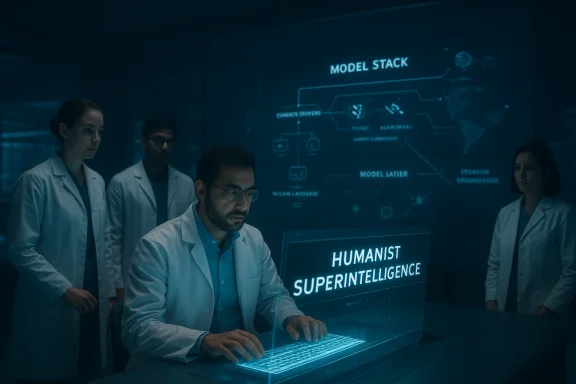
The next major pivot came in November 2025, when Microsoft publicly framed Suleyman’s unit around Humanist Superintelligence. That initiative, described as a special superintelligence effort under Microsoft AI, was the clearest evidence yet that the company intended to compete at the frontier rather than only wrap frontier models in products. The concept itself was carefully chosen: “humanist” was meant to imply controllability, usefulness, and safety, not raw capability for its own sake.
Then, in March 2026, Microsoft reorganized its Copilot leadership again, freeing Suleyman to focus more directly on building the company’s own models. Microsoft’s own messaging emphasized that “the model layer” had become more critical than ever, and that the company was “doubling down” on the superintelligence mission with the talent and compute to make it real. That is the strategic backdrop for the Ai2 hires: this is not an isolated acquisition, but part of a broader model-sovereignty push.
The Ai2 story sits on the other side of that same divide. The Allen Institute for AI was founded by Paul Allen in 2014 with an explicit nonprofit mission, and it built a reputation for open research, open models, and a public-interest framing that stood apart from the profit-maximizing race among frontier labs. Yet even the most principled research organizations now face a brutal reality: frontier AI has become capital intensive in a way that nonprofit budgets struggle to absorb. That tension is what makes the current departures feel like more than a personnel shuffle.
Farhadi is especially significant because he is not a peripheral hire; he was the public face and operational leader of Ai2. He had also co-founded Xnor.ai, which Apple acquired in 2020, and later worked on machine learning at Apple before returning to Ai2. In practical terms, he offers Microsoft a combination of research credibility, product awareness, and executive discipline that is rare even among elite AI leaders. That combination is exactly what a new internal model organization needs if it wants to move quickly without drifting into research theater.
The broader market should read this as a move toward resilience through redundancy. Microsoft still benefits from OpenAI, but it is acting as if that relationship cannot be the only pillar supporting its long-term AI ambitions. That is a sober, almost insurance-like strategy, and it reflects the reality that AI leadership can change quickly when companies depend too heavily on a single external supplier.
This also helps explain why the hires are clustered around a single institution. Microsoft seems to be choosing speed over breadth, preferring to import a coherent group rather than spend a year piecing together a team from the open market. That kind of cluster hiring is usually a clue that the company is racing a deadline, whether that deadline is technical, competitive, or both.
That makes the Ai2 hires strategically coherent. Farhadi, Hajishirzi, and Krishna bring expertise in open models, multimodal systems, and scalable research operations. Those are exactly the ingredients a company needs if it wants to create its own internal family of frontier models rather than merely fine-tune or wrap outside systems. Microsoft is effectively building the human infrastructure for a model program that can stand on its own.
That matters because not all AI leadership roles are equal. Running a product portfolio requires customer empathy, execution discipline, and go-to-market instincts. Running a model lab requires different muscles: research taste, technical hiring, compute allocation, publication judgment, and the ability to make hard calls about architectural tradeoffs. Suleyman now appears to be operating closer to the second category.
Still, the framing should not obscure the underlying reality. If Microsoft is recruiting this aggressively and reorganizing its leadership around model development, it is because it believes the model layer will define competitive advantage for the next decade. The branding is soft; the strategy is hard-nosed.
That mix matters because the next generation of AI systems will not be defined by language alone. The market is moving toward multimodal, agentic, and tool-using systems that can interpret text, images, audio, and structured data together. Microsoft has already made serious products around Copilot, but productizing a category is not the same as owning the research backbone behind it. These hires help close that gap.
Her role in a large NSF- and Nvidia-backed initiative also matters because it shows she understands how to navigate the intersection of academic ambition, funding structure, and industrial-grade compute. That is a rare skill set. Many researchers can publish. Far fewer can help build a sustainable model program.
Multimodal capability is also a key enterprise differentiator. Business users do not live inside pure text prompts; they work with dashboards, spreadsheets, presentations, camera feeds, and workflows. A team with real multimodal experience can help Microsoft build AI that is more useful in those environments and less dependent on outside model vendors.
Microsoft is not just hiring coders and scientists; it is hiring the operating logic of a research organization. That is often what separates a fast-moving AI group from a talent-heavy but chaotic one.
Bill Hilf’s observation that extreme-scale model work is very hard to do inside a nonprofit captures the issue neatly. The statement is not a critique of Ai2’s vision; it is a recognition of economic reality. You can build remarkable research institutions outside Big Tech, but once the work moves into frontier-scale training runs, the capital requirements become punishing.
That is an awkward position for a lab whose identity has been bound up with open foundation models. If the funder wants nearer-term application value, then the lab’s most ambitious research program may need to be rebalanced. That could be healthy discipline, or it could be mission drift. The difference will depend on execution.
To Ai2’s credit, the institute has been here before. But repeated transitions can create a subtle drag on long-term momentum. If researchers begin to see the nonprofit as a stepping-stone to Big Tech rather than a durable destination, the talent pipeline itself changes.
The hires from Ai2 fit into a broader pattern. Microsoft has been widely reported to have attracted talent from Google DeepMind, Meta, Anthropic, and OpenAI as it grows its internal AI bench. It also launched internal models such as MAI-Voice-1 and MAI-1-preview in 2025, which signaled that it wanted to be taken seriously as a model producer, not just a model consumer.
Microsoft’s model push also aligns with its platform business. The company has always done best when it can turn technical depth into broad enterprise distribution. Owning more of the model stack makes that easier because it gives Microsoft more latitude in pricing, packaging, and feature design.
The most likely outcome is not a clean break but a layered strategy: Microsoft will use external frontier models where it makes sense, while building its own internal family of models for differentiated product, safety, and long-term platform control. That is a classic large-company move, and it is hard to argue with from a strategic standpoint.
For consumers, the payoff is less direct but still meaningful. Better models can improve the quality of the Copilot experience, whether in search, chat, reasoning, or multimodal interaction. But consumer AI is a crowded field, and Microsoft’s ability to stand out will depend on whether these research hires produce systems that feel materially better rather than merely more expensive to run.
It may also help Microsoft differentiate Copilot from competitors by giving it a more recognizable technical identity. If the company can pair frontier capability with enterprise controls, it could build a more defensible business than simple chatbot parity.
That is where the risk lies. A great research team does not automatically create a loved consumer product. Microsoft has known this for years, and Copilot’s mixed reception is evidence enough.
The biggest opportunity is that Microsoft now has a path to becoming a true frontier-model owner rather than only a frontier-model partner. That would be valuable even if OpenAI remains central, because redundancy is a strategic asset in a market this volatile.
Another concern is cultural. Microsoft is a massive corporation, while Ai2 and similar institutions are research-driven environments with different incentives. Bringing in leading researchers is one thing; preserving the intellectual freedom that made them effective is another. If the new team feels too constrained by product expectations, it could lose the creative edge Microsoft is trying to buy.
The more interesting test is whether the company can build a distinctive model family that complements OpenAI rather than merely trailing it. That would be the strongest proof that Suleyman’s repositioning and the new hires have real substance. It would also suggest Microsoft believes the AI market is entering a phase where owning multiple model paths is not luxury but necessity.
Source: WinBuzzer Microsoft Hires Former Ai2 CEO Farhadi for Suleyman AI Team
 Background
Microsoft’s current AI strategy did not appear overnight. The company spent much of 2023 and 2024 building its consumer and enterprise AI story around OpenAI’s foundation models, then formalized its internal AI ambition by bringing Mustafa Suleyman in to lead Microsoft AI and the Copilot effort in March 2024. That original move was about product integration and velocity: get AI into the hands of users, fast, and keep the platform advantage intact. Microsoft said at the time that the new organization would advance Copilot and other consumer AI products while continuing the OpenAI partnership.By 2025, however, Microsoft’s internal language had begun to shift. The company introduced CoreAI – Platform and Tools in January 2025, signaling that it wanted deeper control over the infrastructure and developer layers beneath its applications. That mattered because it suggested Microsoft did not want to be merely a great distributor of external models; it wanted the stack, the tooling, and eventually more of the model-layer leverage too. In other words, the company was no longer satisfied with being an exceptional integrator.
The next major pivot came in November 2025, when Microsoft publicly framed Suleyman’s unit around Humanist Superintelligence. That initiative, described as a special superintelligence effort under Microsoft AI, was the clearest evidence yet that the company intended to compete at the frontier rather than only wrap frontier models in products. The concept itself was carefully chosen: “humanist” was meant to imply controllability, usefulness, and safety, not raw capability for its own sake.
Then, in March 2026, Microsoft reorganized its Copilot leadership again, freeing Suleyman to focus more directly on building the company’s own models. Microsoft’s own messaging emphasized that “the model layer” had become more critical than ever, and that the company was “doubling down” on the superintelligence mission with the talent and compute to make it real. That is the strategic backdrop for the Ai2 hires: this is not an isolated acquisition, but part of a broader model-sovereignty push.
The Ai2 story sits on the other side of that same divide. The Allen Institute for AI was founded by Paul Allen in 2014 with an explicit nonprofit mission, and it built a reputation for open research, open models, and a public-interest framing that stood apart from the profit-maximizing race among frontier labs. Yet even the most principled research organizations now face a brutal reality: frontier AI has become capital intensive in a way that nonprofit budgets struggle to absorb. That tension is what makes the current departures feel like more than a personnel shuffle.
Why These Hires Matter
The most important detail in this story is not just that Microsoft hired Ali Farhadi, Hanna Hajishirzi, Ranjay Krishna, and Sophie Lebrecht. It is that Microsoft appears to have acquired an entire leadership layer from one ecosystem, which is often more valuable than recruiting scattered individuals. When researchers have already worked together, they bring shared assumptions, trust, and a common technical language. That can shave months—or even years—off the time needed to build an effective internal lab.Farhadi is especially significant because he is not a peripheral hire; he was the public face and operational leader of Ai2. He had also co-founded Xnor.ai, which Apple acquired in 2020, and later worked on machine learning at Apple before returning to Ai2. In practical terms, he offers Microsoft a combination of research credibility, product awareness, and executive discipline that is rare even among elite AI leaders. That combination is exactly what a new internal model organization needs if it wants to move quickly without drifting into research theater.
The signal to the market
Microsoft’s move also sends a message to the rest of the AI sector: the company is no longer relying solely on partnerships or external ecosystem leverage to define its future. It is building its own internal bench, and it is willing to recruit from places that traditionally sat outside the commercial talent magnet. That is an important competitive signal because it implies Microsoft wants optionality if its OpenAI relationship weakens, diversifies, or simply becomes strategically insufficient.The broader market should read this as a move toward resilience through redundancy. Microsoft still benefits from OpenAI, but it is acting as if that relationship cannot be the only pillar supporting its long-term AI ambitions. That is a sober, almost insurance-like strategy, and it reflects the reality that AI leadership can change quickly when companies depend too heavily on a single external supplier.
- Microsoft gains research depth and not just individual hires.
- The company strengthens its frontier-model independence.
- The move reduces reliance on a single external AI partner.
- It gives Suleyman a team with proven open-model experience.
- It raises the competitive pressure on smaller labs with limited compute.
Why the timing is sharp
The timing matters because Microsoft’s March 2026 leadership change around Copilot effectively created room for Suleyman to focus on the model layer. That meant the company could pair organizational latitude with a meaningful hiring push. When leadership and hiring move in tandem, the result is often a real strategic shift rather than a cosmetic reorg.This also helps explain why the hires are clustered around a single institution. Microsoft seems to be choosing speed over breadth, preferring to import a coherent group rather than spend a year piecing together a team from the open market. That kind of cluster hiring is usually a clue that the company is racing a deadline, whether that deadline is technical, competitive, or both.
Suleyman’s Superintelligence Ambition
Suleyman’s mission has been unusually explicit for a large-company AI executive. Microsoft framed his superintelligence work as a long-term effort to build systems that are more capable, more controllable, and more aligned with human use cases. This is not the language of an organization trying to optimize only short-term product metrics. It is the language of a team trying to build a platform-defining capability over several years.That makes the Ai2 hires strategically coherent. Farhadi, Hajishirzi, and Krishna bring expertise in open models, multimodal systems, and scalable research operations. Those are exactly the ingredients a company needs if it wants to create its own internal family of frontier models rather than merely fine-tune or wrap outside systems. Microsoft is effectively building the human infrastructure for a model program that can stand on its own.
From product leader to model-builder
Suleyman’s repositioning also marks a subtle but important identity shift. When he first joined Microsoft in 2024, the big assignment was Copilot leadership: connect AI to products, customers, and enterprise workflows. That is a product-management heavy mission, even if it has profound technical implications. Now, with Copilot oversight partially reassigned, he is being pushed toward what he seems to have wanted all along: direct involvement in the frontier of model development.That matters because not all AI leadership roles are equal. Running a product portfolio requires customer empathy, execution discipline, and go-to-market instincts. Running a model lab requires different muscles: research taste, technical hiring, compute allocation, publication judgment, and the ability to make hard calls about architectural tradeoffs. Suleyman now appears to be operating closer to the second category.
- The role is shifting from product orchestration to research leadership.
- Microsoft is betting on in-house model capability.
- The company is prioritizing technical autonomy.
- Suleyman’s team will likely influence product roadmaps indirectly, not just directly.
- The move could reshape internal power balances across Microsoft AI.
Humanist superintelligence as branding and strategy
The phrase Humanist Superintelligence is more than branding. It is a political and cultural framing device that lets Microsoft talk about extreme capability without sounding reckless. In a market where “AGI” and “superintelligence” can trigger anxiety, the word “humanist” signals restraint, safety, and social benefit. That does not make the research easier, but it does make the narrative more acceptable to enterprise customers and regulators.Still, the framing should not obscure the underlying reality. If Microsoft is recruiting this aggressively and reorganizing its leadership around model development, it is because it believes the model layer will define competitive advantage for the next decade. The branding is soft; the strategy is hard-nosed.
What Microsoft Is Actually Buying
The Ai2 hires are interesting because Microsoft is not simply buying experience. It is buying complementary capability. Hajishirzi brings strength in natural language processing and open language-model research. Krishna adds multimodal and vision-language expertise. Lebrecht adds operational experience from the nonprofit-research side. Farhadi ties the package together with executive authority and technical breadth.That mix matters because the next generation of AI systems will not be defined by language alone. The market is moving toward multimodal, agentic, and tool-using systems that can interpret text, images, audio, and structured data together. Microsoft has already made serious products around Copilot, but productizing a category is not the same as owning the research backbone behind it. These hires help close that gap.
Hajishirzi’s value
Hanna Hajishirzi is especially notable because she is one of the most visible figures in open language modeling and scientific AI research. Her work co-leading OLMo at Ai2 helped define what an open alternative to proprietary language models can look like. That is valuable to Microsoft for two reasons: first, it provides deep expertise in building and training open-weight systems; second, it offers a philosophical template for doing model development with more transparency and reproducibility than typical frontier labs.Her role in a large NSF- and Nvidia-backed initiative also matters because it shows she understands how to navigate the intersection of academic ambition, funding structure, and industrial-grade compute. That is a rare skill set. Many researchers can publish. Far fewer can help build a sustainable model program.
Krishna and multimodal systems
Ranjay Krishna brings another crucial piece: multimodal AI. His work on Ai2’s Molmo models showed that open vision-language systems can be competitive without requiring the same level of secrecy or cost intensity as proprietary stacks. That is strategically useful for Microsoft because its own AI ambitions increasingly involve not only chat interfaces but also assistants that can reason across documents, screens, images, and tasks.Multimodal capability is also a key enterprise differentiator. Business users do not live inside pure text prompts; they work with dashboards, spreadsheets, presentations, camera feeds, and workflows. A team with real multimodal experience can help Microsoft build AI that is more useful in those environments and less dependent on outside model vendors.
- Open language-model expertise.
- Multimodal and vision-language depth.
- Research operations know-how.
- Nonprofit-to-enterprise translation skills.
- A collaborative team that already knows how to work together.
Lebrecht’s often-overlooked importance
Sophie Lebrecht may be the least publicly visible of the four, but that does not make her less important. AI organizations fail not only because of weak models, but because of weak operating systems around hiring, research planning, publication, and internal coordination. A COO who understands research institutions can be invaluable when a company is trying to scale a lab without suffocating it in bureaucracy.Microsoft is not just hiring coders and scientists; it is hiring the operating logic of a research organization. That is often what separates a fast-moving AI group from a talent-heavy but chaotic one.
The Ai2 Challenge
Ai2 now faces a problem that many nonprofit labs will recognize: the mission is bigger than the budget. The institute was built to champion open AI research for the common good, but frontier AI increasingly requires compute and staffing levels that look more like the province of hyperscalers than nonprofits. That creates a structural mismatch between ambition and financing, and the current departures bring that tension into sharp relief.Bill Hilf’s observation that extreme-scale model work is very hard to do inside a nonprofit captures the issue neatly. The statement is not a critique of Ai2’s vision; it is a recognition of economic reality. You can build remarkable research institutions outside Big Tech, but once the work moves into frontier-scale training runs, the capital requirements become punishing.
Funding pressure
Ai2’s funding situation makes the challenge even more concrete. The Fund for Science and Technology, the foundation tied to Paul Allen’s legacy, is reportedly moving toward a proposal-based funding model that favors applied uses of AI over frontier-model building. That does not mean Ai2 is in crisis today, but it does suggest a future in which the institute may need to justify open-model research against competing priorities more aggressively.That is an awkward position for a lab whose identity has been bound up with open foundation models. If the funder wants nearer-term application value, then the lab’s most ambitious research program may need to be rebalanced. That could be healthy discipline, or it could be mission drift. The difference will depend on execution.
Leadership continuity versus institutional momentum
Ai2 interim CEO Peter Clark is not a newcomer, and that matters. Institutions can survive leadership turnover if the bench is deep and the mission is clear. The concern is not simply that one CEO left; it is that a whole layer of expertise appears to be moving out together. When that happens, the organization can lose not just decision-makers but a shared sense of research direction.To Ai2’s credit, the institute has been here before. But repeated transitions can create a subtle drag on long-term momentum. If researchers begin to see the nonprofit as a stepping-stone to Big Tech rather than a durable destination, the talent pipeline itself changes.
Microsoft’s Competitive Posture
Microsoft is not the only company trying to deepen its AI independence, but it may be the most disciplined about building both partnership leverage and internal redundancy at the same time. The company continues to benefit from its OpenAI relationship, yet its own moves suggest it is preparing for a future in which the partnership is only one component of a broader model strategy. That is smart corporate risk management.The hires from Ai2 fit into a broader pattern. Microsoft has been widely reported to have attracted talent from Google DeepMind, Meta, Anthropic, and OpenAI as it grows its internal AI bench. It also launched internal models such as MAI-Voice-1 and MAI-1-preview in 2025, which signaled that it wanted to be taken seriously as a model producer, not just a model consumer.
Why internal models matter
Internal models matter for three reasons. First, they give Microsoft bargaining power. Second, they allow tighter integration with products and infrastructure. Third, they reduce dependency on the roadmap of a single external lab. That last point is especially important because AI markets can change quickly, and strategic control tends to favor companies that can shape their own technical destiny.Microsoft’s model push also aligns with its platform business. The company has always done best when it can turn technical depth into broad enterprise distribution. Owning more of the model stack makes that easier because it gives Microsoft more latitude in pricing, packaging, and feature design.
The OpenAI question
The OpenAI relationship is still central, but it is no longer the whole story. That distinction is critical. Microsoft does not need to abandon OpenAI to invest aggressively in its own models; it only needs to ensure that it is not strategically trapped by the limits of one external source of innovation. The Ai2 hires are part of that hedge.The most likely outcome is not a clean break but a layered strategy: Microsoft will use external frontier models where it makes sense, while building its own internal family of models for differentiated product, safety, and long-term platform control. That is a classic large-company move, and it is hard to argue with from a strategic standpoint.
- Greater internal leverage over AI roadmaps.
- Better alignment with Microsoft’s product stack.
- More negotiating power with external partners.
- Reduced strategic dependency on outside labs.
- A stronger position in the next phase of AI competition.
Enterprise Versus Consumer Impact
The most immediate consumer-facing effect of this move may be invisible, but the enterprise implications are substantial. Microsoft’s biggest AI monetization engine remains enterprise distribution: Microsoft 365, Azure, security, and workflow automation. If Suleyman’s team succeeds, the models it develops will likely show up first in enterprise-tuned lineages, internal tooling, and Copilot capabilities that support productivity, governance, and knowledge work.For consumers, the payoff is less direct but still meaningful. Better models can improve the quality of the Copilot experience, whether in search, chat, reasoning, or multimodal interaction. But consumer AI is a crowded field, and Microsoft’s ability to stand out will depend on whether these research hires produce systems that feel materially better rather than merely more expensive to run.
Enterprise upside
Microsoft’s enterprise customers care about trust, cost control, integration, and predictable governance. A stronger in-house model team can help the company optimize around those concerns instead of waiting for third-party model updates. That could improve latency, tuning, data residency options, and sector-specific behavior over time.It may also help Microsoft differentiate Copilot from competitors by giving it a more recognizable technical identity. If the company can pair frontier capability with enterprise controls, it could build a more defensible business than simple chatbot parity.
Consumer limitations
The consumer side is harder. People rarely buy “model architecture”; they buy outcomes. That means Microsoft must translate internal research gains into visible product quality, which is often harder than it sounds. The company will need better answers, more useful multimodal behavior, and a noticeably better assistant experience if it wants consumer users to care.That is where the risk lies. A great research team does not automatically create a loved consumer product. Microsoft has known this for years, and Copilot’s mixed reception is evidence enough.
Strengths and Opportunities
Microsoft’s move has several advantages, and they are worth separating from the hype. The company is not merely buying celebrity researchers; it is building a capacity stack that could pay off across research, product, and platform layers. If the execution is strong, this could become one of the more consequential AI staffing decisions of 2026.The biggest opportunity is that Microsoft now has a path to becoming a true frontier-model owner rather than only a frontier-model partner. That would be valuable even if OpenAI remains central, because redundancy is a strategic asset in a market this volatile.
- Deep research credibility from Ai2 and UW talent.
- Stronger multimodal expertise for next-generation Copilot experiences.
- Better internal model sovereignty and reduced dependency.
- Operational know-how from leaders who have scaled a research nonprofit.
- A coherent team dynamic rather than a patchwork of individual hires.
- Improved bargaining power in the broader AI ecosystem.
- Long-term strategic flexibility if partner relationships shift.
Risks and Concerns
There are also real risks, and they should not be minimized. The biggest is that Microsoft may be overestimating how quickly elite research teams can translate into durable product advantage. AI labs are notoriously hard to run, and talent concentration does not guarantee breakthrough output. The very fact that the company is hiring so aggressively can be read as a sign of urgency rather than confidence.Another concern is cultural. Microsoft is a massive corporation, while Ai2 and similar institutions are research-driven environments with different incentives. Bringing in leading researchers is one thing; preserving the intellectual freedom that made them effective is another. If the new team feels too constrained by product expectations, it could lose the creative edge Microsoft is trying to buy.
- Integration risk between research culture and corporate process.
- Compute cost escalation if frontier ambitions outrun budgets.
- Talent churn if more researchers follow leaders out the door.
- Productization delay if the lab moves faster than the product org.
- Open-model mission drift if commercial incentives dominate.
- Dependence on a few key leaders rather than a broad bench.
- Competitive retaliation from rival labs and platforms.
Looking Ahead
The next few quarters should tell us whether Microsoft’s superintelligence team is a genuine research engine or simply the latest high-end restructuring of the company’s AI ambitions. Watch for whether the group publishes, trains, or ships anything that clearly reflects the influence of these hires. If the team remains mostly invisible for too long, skeptics will argue that Microsoft is collecting talent without creating enough output.The more interesting test is whether the company can build a distinctive model family that complements OpenAI rather than merely trailing it. That would be the strongest proof that Suleyman’s repositioning and the new hires have real substance. It would also suggest Microsoft believes the AI market is entering a phase where owning multiple model paths is not luxury but necessity.
Indicators to watch
- New Microsoft model announcements tied to Suleyman’s team.
- Publication output or research disclosures from the new hires.
- Whether Copilot begins reflecting more internally developed model behavior.
- Additional hiring from academia or rival labs.
- Funding shifts at Ai2 and related open-model institutions.
Source: WinBuzzer Microsoft Hires Former Ai2 CEO Farhadi for Suleyman AI Team
