

Microsoft’s decision to flip the switch on a second Fairwater AI datacenter in Atlanta — and to explicitly link it with the Wisconsin Fairwater campus into what the company calls a planet‑scale “AI superfactory” — is the most tangible demonstration yet that hyperscalers are converting cloud capacity into purpose‑built supercomputing infrastructure for frontier AI workloads.
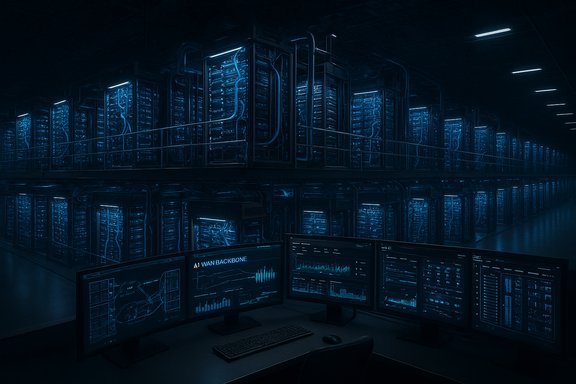
Microsoft’s new Atlanta Fairwater site is the second installment in a repeatable datacenter design the company has been rolling out to host extremely dense NVIDIA Blackwell (GB‑family) racks, custom liquid cooling, and a dedicated, low‑latency AI wide‑area network (AI WAN) intended to make multiple geographic sites behave like a single, unified supercomputer. The company’s engineering post describes two‑story server halls, a closed‑loop facility cooling system designed to minimize makeup water, and rack‑scale NVL72 configurations that treat an entire rack as a single accelerator. Why this matters: traditional cloud datacenters are optimized for multi‑tenant elasticity and general workloads. The Fairwater design flips that premise by optimizing the physical building, the networking fabric and storage stack around synchronized, high‑throughput training and inference jobs that require deterministic bisection bandwidth and minimal cross‑device latency. That topology change is why Microsoft calls the network of linked Fairwater sites an “AI superfactory.”
Source: Blockchain News Microsoft MSFT unveils Fairwater datacenter in Atlanta, linking Wisconsin site to build the world's first AI superfactory – Azure expansion update Nov 12, 2025 | Flash News Detail
 Background / Overview
Microsoft’s new Atlanta Fairwater site is the second installment in a repeatable datacenter design the company has been rolling out to host extremely dense NVIDIA Blackwell (GB‑family) racks, custom liquid cooling, and a dedicated, low‑latency AI wide‑area network (AI WAN) intended to make multiple geographic sites behave like a single, unified supercomputer. The company’s engineering post describes two‑story server halls, a closed‑loop facility cooling system designed to minimize makeup water, and rack‑scale NVL72 configurations that treat an entire rack as a single accelerator. Why this matters: traditional cloud datacenters are optimized for multi‑tenant elasticity and general workloads. The Fairwater design flips that premise by optimizing the physical building, the networking fabric and storage stack around synchronized, high‑throughput training and inference jobs that require deterministic bisection bandwidth and minimal cross‑device latency. That topology change is why Microsoft calls the network of linked Fairwater sites an “AI superfactory.” What Microsoft actually built — verified technical snapshot
Rack and chip architecture: NVL72, GB200 / GB300 and the rack‑as‑accelerator
- Microsoft’s public materials and vendor documentation confirm that Fairwater deployments are based on NVIDIA’s GB‑family rack designs: NVL72‑style racks that integrate up to 72 Blackwell GPUs and a matched set of Grace‑class host CPUs into a single NVLink domain. NVIDIA’s datasheets describe the GB200/GB300 NVL72 family as a 72‑GPU, rack‑scale unit that provides extremely high intra‑rack NVLink bandwidth and a pooled fast‑memory envelope intended to present the rack as one accelerator to the scheduler.
- Microsoft’s architectural descriptions, and independent datacenter reporting, align with that vendor messaging: Fairwater racks are being treated as the practical unit of compute, and pods of these racks are stitched into larger clusters via 800Gbps‑class fabrics and optimized RDMA protocols so that gradient exchanges and model checkpointing can proceed without the usual cloud‑scale interference.
Cooling, power and the building as a system
- Fairwater uses closed‑loop liquid cooling to move heat from cold plates directly off servers and return chilled fluid via external heat exchangers, a design Microsoft says minimizes evaporative water use after an initial fill and allows rack power densities substantially higher than air‑cooled halls. Microsoft’s technical article and site tours confirm the two‑story hall approach (racks placed vertically to reduce cable path lengths) and a chilled‑loop heat rejection system sized to match the density. Independent datacenter reports corroborate the two‑story build and the closed‑loop approach.
- Microsoft also reports site‑level measures to stabilize local grids — a mix of renewables procurement, energy storage and software/hardware power management — to avoid creating sudden demand spikes that could destabilize local utilities. These claims are operationally plausible but important to interrogate in context (see the risks section).
Networking: AI WAN and inter‑site Fabric
- The defining systems claim is the AI WAN — dedicated fiber and a tailored protocol stack that reduces cross‑site congestion and aims to let multi‑site synchronous training jobs perform as if running inside one data hall. Microsoft’s Source feature and the company blog describe fiber investments and optimized interconnect protocols designed to reduce bottlenecks for AllReduce and other collective operations. That architecture is the mechanism that turns physically separate sites into a “superfactory.”
Cross‑checking Microsoft’s headline claims
Microsoft’s public statements include a few high‑impact, headline figures: “hundreds of thousands” of GPUs, two‑story, liquid‑cooled halls, and a marketing line that Fairwater delivers roughly “10× the performance of today’s fastest supercomputers” for AI training/inference workloads. Each of these requires precise context; independent verification yields the following:- GPU counts: Microsoft has used non‑specific, capacity‑oriented language (e.g., “hundreds of thousands”) as a program target rather than a precise inventory snapshot. Company materials tie Fairwater to large‑scale GB200/GB300 purchases, and vendor specs confirm the per‑rack 72‑GPU NVL72 unit, but public documents do not disclose an exact current fleet count by model and date. Treat aggregate GPU totals as a program objective rather than a confirmed installed payload unless Microsoft releases the audit figures.
- The “10×” performance claim: Microsoft frames this as AI training throughput on purpose‑built GB‑class racks relative to prior public supercomputers on AI workloads, not as a blanket statement that Fairwater would beat every HPC system on every LINPACK or general compute benchmark. NVIDIA’s GB200/GB300 materials do show large per‑rack throughput gains vs prior generations for targeted LLM workloads, which makes the directional claim plausible — but it is workload‑dependent and needs independent, reproducible benchmarking to be dispositive. In short: plausible, but metric dependent.
- Cooling and water claims: Microsoft’s closed‑loop approach reduces evaporative water consumption compared with cooling‑tower designs; independent reporting supports this. However, “zero water use” is a marketing simplification in many such systems; closed‑loop minimizes makeup decisions but does not eliminate embodied water in component manufacture or the energy expenditure of the chillers and fans. The net environmental footprint depends on grid mix and firming capacity.
Market reaction: what to believe and what to correct
The user’s summary linked the November 12 announcement to near‑term moves in MSFT and several AI‑focused cryptocurrencies. A careful check against market data and price records shows important discrepancies and some verifiable patterns:- Microsoft stock price: the user’s note that MSFT “closed at around $420” with 20M volume on the sessions around the announcement does not match public market records for early November 2025. Multiple market feeds show Microsoft trading in the $490–$550 range in late October/early November, with documented closes at ~$508 on Nov 11, 2025 (and intraday highs in the $540s in late October). Recent daily volumes ranged roughly 18–35 million shares across the period — so the claim of a $420 close is not supported by major exchanges’ historical data.
- Analysts and sentiment: industry coverage and recent analyst commentary frame Microsoft’s Fairwater build as a durable strategic advantage for Azure in frontier AI, and analysts have in many cases raised price targets or reiterated Buy stances in response to accelerating AI demand. That narrative helps explain why Microsoft’s stock tends to react positively to visible, capacity‑related announcements, but individual session moves are also driven by earnings, macro headlines and broader market liquidity. Expect a positive sentiment overlay, not an assured linear uptick.
- Cryptocurrency moves: the user cites past patterns where Microsoft AI news led to 5–10% gains in AI tokens like SingularityNET (AGIX). Historical token volatility varies widely by date and liquidity; a cross‑check of major token price feeds around November 2025 shows:
- Fetch.ai (FET) was trading in the low‑dollar‑cent range (roughly $0.23–$0.36 in the early November window), not the $1.20–$1.50 range cited in the original text. That earlier $1+ price would reflect a very different market environment or a much earlier time. Coin market trackers show FET at ~\$0.33 on mid‑November snapshots.
- Render (RNDR) showed multi‑dollar prices in November 2025 (variously in the $6–$7+ band on some aggregator snapshots), and short‑term volume spikes have occurred around platform or cloud announcements historically, but the magnitude and persistence of any pump vary by market and often revert quickly.
- SingularityNET (AGIX), Ocean Protocol (OCEAN) and others do experience episodic spikes on AI industry news, but the historical averages and volatility differ widely across tokens and across venues. Always verify token snapshots on primary exchanges (CoinGecko/CoinMarketCap/Binance) for timestamped claims.
Trading and portfolio implications (framework, not instructions)
This section outlines scenarios and risk‑aware frameworks readers use to interpret the announcement, not personalized financial advice.How big tech infrastructure news typically transmits to markets
- Sentiment shock: Visible, credible infrastructure investments reduce perceived supply constraints for model training capacity and can lift investor expectations of AI revenue capture — this tends to be bullish for cloud providers’ equity valuations in the short run.
- Flow transmission to crypto: Traders seeking leverage to an AI narrative sometimes move into small‑cap AI tokens that are perceived as direct beneficiaries (e.g., compute‑aligned or AI‑middleware tokens), causing temporary correlations between large‑cap tech moves and certain altcoins. Correlations are noisy and often transient.
- Mean reversion and liquidity: Smaller tokens may show exaggerated percentage moves on modest dollar flows because of thinner order books; these spikes can be profitable but also risk rapid reversals and slippage.
Practical scenarios traders and portfolio managers should consider
- Scenario A — Risk‑on spillover: A widely positive investor reaction to Fairwater (broader AI optimism) lifts MSFT and major tech peers; BTC/ETH rally as risk assets, and some small AI tokens see 10–40% short‑term rallies. Tactical play for sophisticated traders: consider small, time‑boxed exposure to high‑liquidity AI tokens while keeping strict position sizing and stop levels. Verify token liquidity on primary order books first.
- Scenario B — Sector rotation with profit‑taking: MSFT rises intra‑day on the announcement but broader markets rotate profit out of equities into bonds or take gains off the table; AI token pumps fade quickly. Risk management: avoid one‑sided bets that depend on correlated moves across markets and avoid assuming correlation — hedge via options or reduce exposure size.
- Scenario C — Infrastructure spend priced in: If the market already anticipated Microsoft’s investment, actual news may produce only minimal re‑rating and speculative crypto moves could be muted. Execution matters: the market rewards demonstrable capacity coming online and measurable revenue capture, not just announcements.
Tactical checks before placing a trade (short checklist)
- Confirm MSFT’s latest trade and technical levels on two reputable data providers (e.g., exchange feed + major aggregator).
- Verify token price and real liquidity across the exchange(s) you plan to use; check spread, depth and 24‑hour volume.
- Define stop‑loss and position size (risk per trade) before entry. Example rule: risk no more than 1–2% of portfolio on speculative token positions. (This is a risk management guideline, not financial advice.
- Time‑box the trade: earnings and macro events can erase narrative moves quickly. Use intraday exit triggers if correlation fails.
Strategic and systemic implications beyond trading
Competitive moat for Azure AI
Microsoft’s investment creates a tangible capability argument: by owning large clusters of the latest GB‑family racks and providing them as carved capacity within Azure, Microsoft lowers the barrier for enterprises and research teams that need frontier compute without building their own farms. That is a defensible commercial position because high‑density datacenter builds are capital‑intensive, require supply‑chain relationships (notably with NVIDIA), and benefit from deep software and operations integration. The OpenAI/Azure co‑optimization story compounds that advantage.Supply‑chain concentration and geopolitical risk
The industry now depends heavily on a narrow set of accelerator vendors. NVIDIA’s GB200/GB300 families are central to the Fairwater design; that makes hyperscalers’ compute roadmaps tightly coupled to a single vendor’s product cadence and supply constraints. That concentration creates a systemic risk should supply lines, export controls, or manufacturing slowdowns emerge. Prepare for cyclical procurement shocks as a real risk factor.Environmental, regulatory and local‑political pressure
Large AI datacenters have real impacts on local grids, water systems, and land use. Microsoft’s engineering choices reduce freshwater use via closed‑loop cooling, and the company says it coordinates renewables procurement and grid upgrades, but environmental NGOs, local utilities, or regulators may push for stricter transparency on lifecycle emissions and water accounting. Companies building such sites will face recurring scrutiny that can affect approvals, timelines and operating constraints.Strengths and risks — critical appraisal
Notable strengths
- Purpose‑built engineering reduces communication bottlenecks for synchronized training: treating a rack as an accelerator and minimizing cable/run distances via two‑story halls are practical, measurable advances that improve scaling efficiency.
- Tight hardware–software co‑design (Microsoft + NVIDIA + networking vendors) speeds real‑world deployments and gives Azure a differentiated product offering for large model training customers (including OpenAI).
- Productization: by packaging this capacity inside Azure and exposing it via managed SKUs, Microsoft turns a capital‑intensive asset into a scalable revenue stream for enterprises that cannot build their own facilities.
Material risks and open questions
- Benchmark ambiguity: the “10×” claim is workload‑specific and not a universal performance multiplier. Demand independent, reproducible third‑party benchmarking across representative workloads before treating this as a universal hardware victory.
- Supply‑chain concentration: heavy reliance on NVIDIA GB‑family accelerators increases exposure to supplier bottlenecks and geopolitical risk. Diversification or in‑house silicon could be costly and slow.
- Grid and environmental limits: while closed‑loop cooling reduces evaporative water use, the electrical demand and embodied carbon of such builds are non‑trivial. Microsoft’s renewable procurement and storage plans matter, but so does the reliability and timing of firming resources — a risk if demand spikes outpace contracted capacity.
What to watch next (operational and market signals)
- Confirmed, timestamped capacity figures from Microsoft (actual installed GB200/GB300 GPU counts per site) — this moves the narrative from promise to supply reality. If Microsoft publishes audited counts, that would materially change capacity‑supply calculations.
- Independent benchmarking results from neutral third parties (academic groups, cloud benchmarkers) comparing Fairwater jobs vs. other public supercomputers on specific LLM training/inference workloads. The presence or absence of reproducible gains will determine long‑term competitive advantage.
- Local energy procurement filings and renewable firming contracts — these documents reveal whether the site’s grid impacts and carbon claims are credible or if the site will rely on firming gas/diesel generation during peak loads.
- On‑chain and exchange data for AI tokens: real volume and active address growth on a token (e.g., FET, RNDR, AGIX, OCEAN) in the 48–72 hours after major cloud provider announcements, verified across at least two exchanges/aggregators, can help quantify speculative spillover vs. durable adoption signals.
Conclusion
Microsoft’s Atlanta Fairwater and the linked Wisconsin campus are a decisive engineering answer to one of generative AI’s core bottlenecks: how to provide coherent, synchronized, high‑throughput compute at scale without the latency and I/O constraints of general‑purpose cloud racks. The Fairwater approach — rack‑as‑accelerator, NVL72 Blackwell/GB‑family racks, closed‑loop liquid cooling, and an AI WAN — is verifiable in public vendor and company materials, and the architecture is directionally aligned with what frontier AI workloads require. For markets and traders, the announcement strengthens the narrative that Microsoft and Azure are central to the physical infrastructure underpinning next‑generation AI, and that narrative can support positive equity sentiment for MSFT. However, specific price claims and token moves must be independently verified: some widely circulated numbers (for example, the $420 close for MSFT cited in one summary and certain token price ranges) do not match public exchange records and aggregate feeds for the relevant dates. Use at least two reputable data sources for price confirmations and treat single‑source assertions with caution. Finally, the Fairwater program crystallizes a broader truth: the AI era will be built as much of steel, fiber and cooling systems as it is of code and models. That combination of physical scale, vendor dependence and local environmental impact creates both opportunity and responsibility — and investors, operators and regulators will watch execution and transparency closely.Source: Blockchain News Microsoft MSFT unveils Fairwater datacenter in Atlanta, linking Wisconsin site to build the world's first AI superfactory – Azure expansion update Nov 12, 2025 | Flash News Detail
