

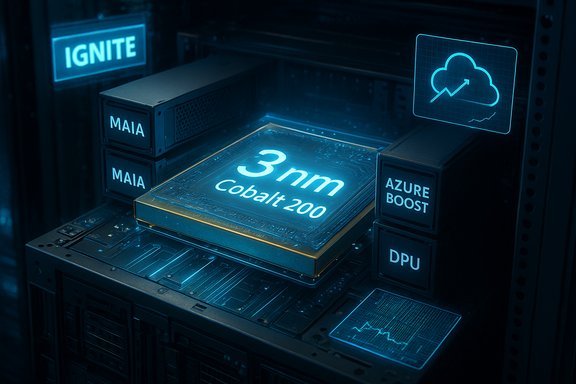
Microsoft’s Ignite preview of the Azure Cobalt 200 marks another clear step in the company’s long game: owning more of the cloud stack from silicon to services. The Cobalt 200 is presented as the next-generation Azure CPU — built on a 3 nm process and claimed to deliver roughly up to 50% higher performance than the earlier Cobalt 100 while also lowering energy consumption for cloud workloads. This shift is emblematic of Microsoft’s continued push into custom silicon (Cobalt for CPUs, Maia for accelerators, and complementary DPUs), a strategy designed to cut operating costs, tune hardware to Microsoft’s software patterns, and differentiate Azure at scale.
Microsoft’s Cobalt 200 preview is a clear statement: Azure is doubling down on silicon to improve performance, efficiency, and competitive differentiation. For cloud customers, the announcement is an invitation to test and to think in terms of cost‑per‑result rather than raw clock speed. For the industry, it is another data point in a broader hyperscaler transition — the era when cloud providers become hardware innovators as well as software operators. The technical and commercial potential is real, but the prudent path for IT teams is to validate, measure, and pilot before committing at scale; independent verification and supply realities will determine how fast Cobalt 200 moves from preview promise to operational advantage.
Source: The Verge This is Microsoft’s next-gen Cobalt CPU.
 Background
Why Microsoft is building its own CPUs
The hyperscalers have moved from being pure software and services companies to systems companies that co-design hardware and software. Microsoft’s silicon program aims to optimize energy, latency, and cost at hyperscale by tailoring chips to the specific needs of Azure workloads — from virtual machines and database services to model inference. The Cobalt line is Azure’s ARM-class CPU family that sits alongside other Microsoft silicon efforts and third‑party custom parts used in Azure’s HPC fleets.A short history of Cobalt
Cobalt began as Azure’s in‑house ARM CPU effort intended to broaden Microsoft’s instance portfolio and reduce dependency on off‑the‑shelf x86 designs. The Cobalt 100 established the baseline; now the Cobalt 200 is offered as a generational improvement focused on higher single‑thread and throughput performance while trimming energy per operation — an important metric for cloud economics. Reporting and internal coverage around the first Cobalt launch showed early deployments and growing AZURE region presence for ARM‑based instances, and the new preview continues that trajectory.What we know about Cobalt 200
Public claims at a glance
- Built on a 3 nm process (TSMC is the commonly reported partner for Microsoft’s most advanced nodes).
- Marketed as delivering up to 50% higher performance versus Cobalt 100.
- Designed to reduce energy consumption for typical cloud apps running on Azure.
- Previewed at Microsoft Ignite (availability details described as “preview” with broader rollout to follow).
Architecture and process node
Microsoft’s messaging emphasizes the move to a 3 nm node for Cobalt 200. Shrinking to 3 nm typically enables higher transistor density, improved performance, and lower energy per transistor when compared to older nodes — advantages that hyperscalers tune aggressively to reduce operating costs at scale. Historically, Microsoft has worked with leading foundries and packaging partners for advanced nodes; industry coverage around Microsoft’s Maia accelerators and other custom silicon points at TSMC as a key supplier for advanced process work. However, specific foundry agreements, exact die sizes, voltage/frequency curves, and microarchitectural details for Cobalt 200 have not been fully published in a vendor datasheet at preview time.Technical analysis — what the claims imply
Performance uplift: measurement and meaning
A claim of “up to 50% higher performance” is significant but requires context. Typical caveats apply:- “Up to” often refers to specific benchmarks or workload classes (e.g., single‑thread throughput, SPECint, or a cloud‑service microbenchmark) rather than a universal uplift across all workloads.
- The real benefit for customers depends on workload profile: integer vs. floating point, memory‑bound vs. compute‑bound, container density, and virtualization overhead all affect realized gains.
- Cloud‑scale improvements are often quoted as time‑to‑solution or cost‑per‑transaction rather than raw clock‑for‑clock comparisons.
Energy efficiency: process wins, system design matters
Moving to 3 nm can reduce active and idle power at a given performance target, which matters hugely for cloud providers who pay the electricity bill. But energy efficiency is not just about transistor density — system‑level design (power delivery, packaging, memory topology, firmware, and datacenter cooling) also drives effective power. Microsoft’s Cobalt program is part of a larger effort to co‑design chips and systems (including DPUs and data‑center level fabrics) — a coordinated approach that increases the chances the company will harvest meaningful efficiency benefits beyond simple process shrink advantages.Software stack and ecosystem
Cobalt sits in an ARM ecosystem, which means software compatibility and tooling are critical. Microsoft has already invested in Arm support in cloud images and tooling, and its software teams have been pushing Arm64 optimization across Azure services. Still, customers with legacy binaries and closed third‑party software must validate compatibility. Microsoft’s preview posture suggests a phased roll‑out where early adopters and cloud‑native applications can test and validate before broad production adoption.How Cobalt 200 fits into Microsoft’s silicon strategy
A portfolio approach
Microsoft’s chip efforts are not one-off experiments; they are a coherent portfolio:- Cobalt — ARM‑based cloud CPUs for general purpose and cloud‑native workloads.
- Maia — accelerators for model inference/training workloads (rack‑scale designs and specialty accelerators).
- Azure Boost (DPU) — offload for networking and storage tasks to improve host CPU availability and efficiency.
Competitive positioning
Custom CPUs give Microsoft a direct lever to compete with:- AWS (with its Graviton ARM family and Nitro ecosystem).
- Google Cloud (with its custom TPU and accelerator fabric).
- Traditional x86 incumbents (Intel/AMD), where cloud providers must show cost or performance advantages to persuade customers to migrate.
Practical implications for customers and IT teams
Who benefits most
- Cloud‑native applications (microservices, web servers, containerized services) that can be recompiled or already run on Arm64 stacks.
- Batch compute and scale‑out services with many parallel tasks where instance price‑to‑performance matters.
- Energy‑sensitive deployments where power cost and sustainability targets are material.
Who should be cautious
- Enterprises reliant on vendor‑locked binaries that are only distributed for x86.
- Latency‑sensitive single‑thread workloads where raw single‑core IPC and instruction set tradeoffs may not favor an ARM design.
- Teams with strict procurement rules that require identical hardware across clouds or on‑prem. Cobalt is a differentiating, Azure‑centric part — portability and exact parity with on‑prem boxes are not guaranteed.
A short adoption checklist
- Identify representative workloads and measure baseline performance.
- Validate binary compatibility and runtime behavior under Arm64 and Azure images.
- Run pilot tests on preview instances (when available) and measure time‑to‑solution and cost‑per‑job, not just throughput.
- Revisit monitoring, observability, and incident playbooks — different CPU behavior can change failure modes.
- Engage vendor ISVs to confirm support and request Arm64 releases where needed.
Verification, benchmarks, and the need for independent tests
Microsoft’s preview is a product announcement and performance claim. For the industry to fully trust the 50% uplift claim, independent testing must show:- A reproducible benchmark suite that includes representative cloud workloads.
- Clear configuration details (CPU microcode, frequency/voltage settings, turbo behavior, instance sizes, VM hypervisor configurations).
- Power measurements under identical, real‑world load patterns to evaluate energy per operation.
Risks and open questions
- Supply and foundry constraints: Advanced-node parts (3 nm) are expensive to produce and depend on foundry capacity. Large hyperscaler demand can pressure supply or require Microsoft to prioritize certain SKU families. This influences availability timelines and preview rollouts.
- Software ecosystem maturity: Arm64 support in enterprise tooling has improved, but gaps remain for legacy ISVs and specialized middleware. Porting and validation costs can blunt the economic appeal for some customers.
- Measurement nuance: “Up to 50%” may mask narrower windows of advantage. Real‑world benefit is workload dependent and may require tuning (NUMA, kernel parameters, memory allocators, JIT configurations).
- Lock‑in and procurement: Bespoke cloud CPU families create a stronger tie between a customer’s workload and one cloud provider’s hardware. That can be positive (optimized performance) or a risk (portability, pricing leverage). Teams must weigh cost‑per‑job vs. lock‑in risk.
- Transparency of specs: Full die‑level specs, power profiles, and microarchitectural details are not always released at preview time. Verify critical numbers independently before major migrations.
The bigger picture: why this matters for cloud computing
Microsoft’s Cobalt 200 preview is another sign that hyperscalers will continue to vertically integrate across hardware and software. This trend reshapes the cloud market in three ways:- Performance‑per‑dollar competitions will increasingly revolve around custom designs and co‑design, not just price cuts. Hyperscalers that control silicon can tune for their most common workloads and pass savings to customers or capture margin.
- Operational efficiency and sustainability: energy savings at hyperscale are non‑trivial. Even small efficiency gains multiply into large cost and carbon reductions across millions of servers. Microsoft pitches Cobalt 200 as part of that sustainability and cost story.
- Fragmentation vs. specialization tradeoff: as clouds ship bespoke hardware, customers must decide whether to optimize for the best‑performing cloud SKU or maintain homogeneous portability across providers. The answer depends on workload criticality and migration cost.
Final assessment — strengths and caveats
Strengths
- Targeted optimization: Cobalt 200 promises strong gains for cloud workloads Microsoft runs at scale; when hardware and software are co‑designed, real operational wins are possible.
- Energy & cost potential: a 3 nm process plus system co‑design can reduce energy per operation, lowering both bills and carbon footprint when scaled.
- Part of a broader, coherent silicon roadmap: Cobalt 200 complements Maia accelerators and Azure Boost DPUs, giving Microsoft flexibility in matching hardware to workload.
Caveats & risks
- Claims need independent validation: the headline “up to 50%” uplift must be corroborated by third‑party benchmarks across representative workloads.
- Ecosystem friction: enterprise customers with legacy binaries or strict vendor requirements must budget for validation and possible porting.
- Supply & availability: 3 nm parts are expensive and dependent on foundry capacity; preview availability does not equal immediate GA capacity for broad customers.
What to watch next (timeline and signals)
- Availability of preview instances and public pricing guidance from Microsoft.
- Early independent benchmarks from reputable labs and media outlets that test representative cloud and enterprise workloads.
- Microsoft’s release of technical documentation (datasheets, power/perf curves, virtualization features) that enable procurement and architecture teams to validate claims.
- ISV announcements confirming Arm64 support and Azure marketplace images optimized for Cobalt 200.
Microsoft’s Cobalt 200 preview is a clear statement: Azure is doubling down on silicon to improve performance, efficiency, and competitive differentiation. For cloud customers, the announcement is an invitation to test and to think in terms of cost‑per‑result rather than raw clock speed. For the industry, it is another data point in a broader hyperscaler transition — the era when cloud providers become hardware innovators as well as software operators. The technical and commercial potential is real, but the prudent path for IT teams is to validate, measure, and pilot before committing at scale; independent verification and supply realities will determine how fast Cobalt 200 moves from preview promise to operational advantage.
Source: The Verge This is Microsoft’s next-gen Cobalt CPU.
