• Thread Author
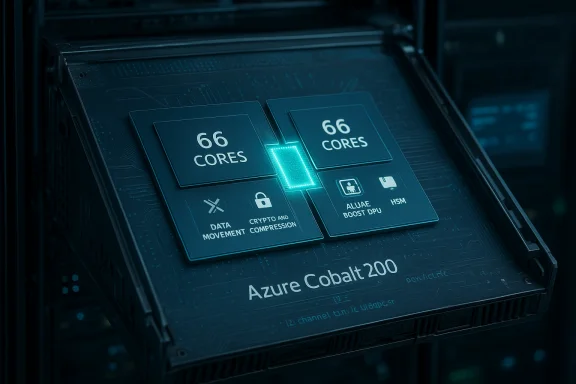
Azure Cobalt 200 server blade with dual 66-core modules.
Microsoft’s Azure Cobalt 200 arrives as a radical second act in its custom‑silicon playbook: a chipletized Arm-based server SoC that packs 132 Arm Neoverse V3 cores, a 12‑channel DDR5 memory interface, built on TSMC’s 3 nm process, and a set of on‑SoC accelerators and per‑core power controls aimed squarely at cloud‑native scale‑out workloads.

Background / Overview​

Microsoft’s Cobalt program began as a strategic bet to own more of the hardware stack and tune compute for Azure’s scale, following the same hyperscaler playbook used by other cloud vendors that build custom Arm silicon. The Cobalt 200 continues that trajectory by adopting Arm’s newest server subsystem (CSS V3), pushing transistor density with TSMC 3 nm, and combining a high core count with a wide memory fabric and integrated accelerators to reduce host software overhead. Microsoft positions Cobalt 200 as a performance‑and‑efficiency uplift over the previous generation, claiming up to 50% higher performance vs Cobalt 100 and describing the first production servers as already running in Microsoft datacenters, with broader customer availability scheduled for 2026. Those are company claims that require independent validation when public instance types appear.

Architecture deep dive​

Chiplet topology and core count​

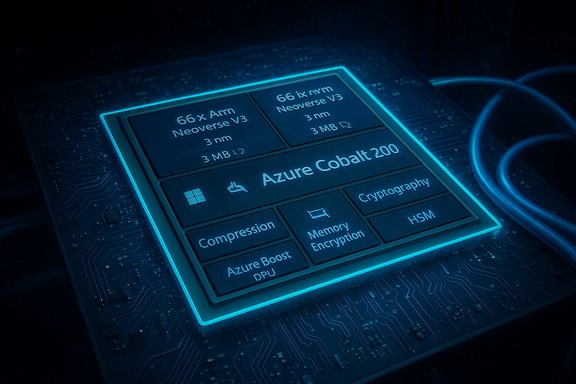
At the package level Cobalt 200 is a two‑chiplet SoC with a high‑bandwidth die‑to‑die link tying the two compute tiles into a single socket. Microsoft reports 132 active cores per SoC; industry coverage and Microsoft imagery show this implemented as 66 cores per chiplet (66 + 66). That layout lets Microsoft scale core count while managing yield and thermal density with chiplets rather than a single monolithic die. Important note on an apparent specification edge case: Arm’s Neoverse CSS V3 is formally specified as supporting up to 64 cores per die in its published per‑die spec, while Microsoft’s design shows 66 active cores per tile. That difference may reflect licensee flexibility in CSS V3 implementations, the use of spare/yield cores, or a vendor‑level customization of the subsystem; it’s a detail worth flagging for verification because it speaks to how closely vendors map Arm’s reference subsystem to their production parts.

Core microarchitecture and cache hierarchy​

Cobalt 200 is built on the Arm Neoverse V3 family via Arm’s CSS V3 blueprint, giving Microsoft a modern, high‑IPC core design and a fabric tuned for confidential compute and high throughput. Microsoft lists 3 MB of L2 cache per core (a very large private L2 allocation) and 192 MB of shared L3 system cache for the entire SoC. That L2/L3 balance signals an architecture optimized for on‑core locality and scaling of many lightweight threads rather than purely boosting single‑thread peak frequency. Arm’s public material says CSS V3 delivers a flexible memory and cache topology and is expressly designed to let partners tune cache sizes for workload targets; Cobalt 200’s unusually large private L2 per core is therefore feasible in a CSS‑based design but is a deliberate tradeoff that favors the kinds of containerized, thread‑dense services Azure runs.

Memory and I/O fabric​

Each chiplet exposes six memory channels, yielding 12 memory channels per socket when both chiplets are considered together. The result is a very wide DDR5 memory subsystem intended to feed the 132 cores and reduce memory bandwidth contention under heavy multi‑threaded loads. The package also carries high‑speed I/O (PCIe Gen5/CXL lanes are possible via CSS V3) and die‑to‑die links compatible with UCIe or custom PHYs.

On‑SoC accelerators and stack integration​

Microsoft integrates several specialized engine blocks on the SoC:
  • Data Movement Accelerator — to speed DMA‑style transfers and reduce CPU overhead on streaming I/O.
  • Crypto and Compression Accelerators — to offload common cloud tasks (TLS, disk encryption, network compression).
  • Other Azure‑specific IP — tight integration points for the Azure Boost DPU and an Azure‑integrated HSM are called out in Microsoft’s materials to reduce host CPU cycles and shorten secure key paths.
These accelerators mirror an industry trend: modern server CPUs are becoming heterogeneous substrates where fixed‑function engines relieve general‑purpose cores of repetitive, power‑heavy tasks (a direction Intel has pursued with QuickAssist, DSA/QAT and accelerator engines on Xeon). Microsoft’s design follows that same system‑level playbook to lower price‑per‑workload at hyperscale.

Per‑core DVFS and power management​

A headline feature for Cobalt 200 is per‑core Dynamic Voltage and Frequency Scaling (DVFS) — the ability to set different performance points on each core independently. In theory this enables fine‑grained energy proportionality: idle or background threads can sit at low power while latency‑sensitive cores run faster, saving energy across the rack.
In practice per‑core DVFS increases complexity:
  • Power delivery networks must support many operating points across a socket.
  • Thermal behavior and neighbor‑core interference must be modeled carefully.
  • OS scheduler, hypervisor, and firmware must expose and use the per‑core controls effectively.
The potential efficiency gains are real, but their realization depends heavily on software integration and telemetry to avoid pathological scheduling/power interactions. Microsoft cites per‑core DVFS as a differentiator; customers should watch how Azure exposes this capability to VMs and containers.

What Microsoft claims — and what needs verification​

Microsoft’s public statement and the Ignite Book of News list a set of bold promises:
  • 132 active Arm Neoverse V3 cores per SoC with a chiplet 66+66 layout.
  • 3 MB L2 per core and 192 MB L3 system cache.
  • Fabrication on TSMC 3 nm for improved energy per operation.
  • Integration with Azure Boost (DPU) and an on‑package HSM for tightened security and offload.
  • A marketing figure of “up to 50%” performance improvement over Cobalt 100.
Cross‑checking key points: Microsoft’s technical blog and the Ignite Book of News are the authoritative primary sources for these claims; independent reporting from Phoronix and Arm’s own press materials confirm the core building blocks (CSS V3, V3 microarchitecture, and the high‑level design choices). That gives multiple independent touch points for the headline facts. Caveats and unverifiable elements:
  • The “up to 50%” improvement is a vendor figure. Microsoft’s slide set and blog indicate the gains are measured against targeted cloud‑native workloads and reflect simulation and internal measurements; they should be treated as guidance rather than as a universal uplift across all workloads until independent benchmarks appear.
  • Yield and production behavior on TSMC 3 nm: Microsoft says first production servers are live, but large‑scale availability depends on foundry capacity, yield, and supply chain scheduling. Public availability is slated for 2026; exact timeline and pricing will determine commercial impact.
  • The 66 cores per tile vs Arm CSS V3’s published up to 64 cores per die raises a specification question that Microsoft and Arm have not publicly walked through in fine detail; this needs clarifying to fully reconcile the design with Arm’s per‑die spec.

Packaging, thermal design and server integration​

Microsoft showed a test system photo that pairs two Cobalt 200 chips with its NICs and E1.S NVMe devices in a dual‑chiplet, dual‑socket arrangement. The cooling approach looks familiar to Microsoft’s prior server designs: larger heatsink with a thick perimeter around the socket, tuned for the company’s airflow and high‑ambient temperature deployment targets. Observers noted an unusually thick fin perimeter and eight retention screws around the socket area, suggesting custom mechanical engineering to manage the higher power density at the socket plane.
From an operations standpoint, the chiplet approach reduces monolithic die risk but introduces packaging complexity (die‑to‑die link integrity, interposer or UCIe implementation, NUMA visibility across chiplets). Microsoft’s internal telemetry and firmware will decide how transparent those topologies are to guest OSes and hypervisors.

Competitive context: where Cobalt 200 fits​

  • Against AWS Graviton: AWS’s Graviton family is a mature, deployed Arm ecosystem with many public instance types and broad software support. Microsoft’s Cobalt effort targets the same market of cost‑sensitive scale‑out workloads but differentiates with tighter Azure stack integration (DPUs, HSM) and a particular focus on per‑core power control and chiplet scaling. Customers will choose by total cost, available instance shapes, and software compatibility.
  • Against NVIDIA Grace (and Grace‑based systems): NVIDIA’s Grace CPU efforts targeted HPC and AI memory‑bound workloads and use Arm‑based cores tuned for large memory bandwidth. Cobalt 200 emphasizes consolidation, energy proportionality, and integrated offloads for cloud services rather than serving primarily as an AI training CPU. Feature sets overlap in being Arm‑based, but target profiles differ.
  • Against Intel Xeon 4th Gen: Intel has been embedding accelerators (AMX, QAT, DSA) directly in Xeons to accelerate AI, crypto, and data movement. Microsoft’s inclusion of crypto/compression and dedicated data movement hardware in Cobalt 200 mirrors that trend. The difference is Microsoft’s co‑design with Arm CSS V3 and cloud‑native integration, while Intel’s approach is x86‑centric with a long software stack pedigree. Real competitiveness will hinge on price‑performance, availability and software maturity.

Practical implications for Azure customers and IT teams​

Cobalt 200 will matter most for workloads where consolidation, throughput per rack, and energy per operation drive economics:
  • Web front ends, microservices, proxies, distributed caches, smaller‑model CPU inference, and many containerized services will likely benefit from increased core density and on‑chip accelerators.
  • Memory‑heavy or I/O‑bound workloads will need to be validated; the wide memory interface is encouraging but real‑world NUMA behavior, interrupt routing and DPU offload interactions are the practical tests.
Recommended validation checklist (for IT/DevOps teams preparing pilots):
  1. Measure end‑to‑end time‑to‑solution and cost‑per‑job on a representative workload rather than relying on single microbenchmarks.
  2. Include power and telemetry in pilot runs — energy per operation is a core part of Microsoft’s pitch.
  3. Validate binary compatibility and behavior for any x86‑only enterprise software; identify replacement or recompilation needs for Arm64.
  4. Test network, storage and cryptographic workloads with and without Azure Boost/DPU offload to quantify host CPU savings.
  5. Publish and compare methodologies so that results can be reproduced across teams and vendors.

Risks, supply constraints and operational unknowns​

  • Foundry capacity and yield: Fabrication on TSMC 3 nm is a strategic advantage but also a capacity risk. Hyperscalers compete aggressively for advanced node allotments; early deployment and internal use are plausible, but broad availability can be staggered.
  • Software and ecosystem friction: Although Arm‑on‑server support has matured rapidly, enterprise ecosystems still contain x86 artefacts. Migration costs and testing for legacy middleware and third‑party drivers remain real.
  • Vendor marketing vs. reproducible outcomes: Microsoft’s “up to 50%” claim is presented as a generational uplift for cloud‑native workloads; independent, reproducible third‑party benchmarks will be necessary to translate that into procurement decisions. Customers should insist on representative tests performed under real‑world conditions.
  • Operational complexity of per‑core DVFS: Fine‑grained DVFS requires sophisticated scheduler and telemetry integration. Poorly coordinated power/performance policies could harm tail latency or create noisy neighbor effects in multi‑tenancy environments.

Verification, benchmarking and what to watch next​

Given Microsoft’s claims and the architectural shifts in Cobalt 200, the following are the highest‑value items the community and IT teams should watch for in the coming months:
  • Publication of public Cobalt 200 VM SKUs, pricing, and regional availability timelines (Microsoft’s announcement points to 2026 availability).
  • Independent benchmarks across a matrix of workloads: scale‑out web services, container density, Redis/Postgres, CPU inference (small LLMs), and I/O/crypto throughput — with power‑aware metrics (watts per request).
  • Deep technical write‑ups showing how the 66+66 chiplet split maps to Arm’s CSS V3 specifications, and whether the extra cores are spares/yield‑related or an explicit CSS configuration that exceeds the public per‑die baseline.
  • Documentation or whitepapers detailing how Azure exposes per‑core DVFS to guests or whether it remains a Microsoft‑managed platform feature; details here will determine how much customers can tune energy/performance at the VM level.

Final analysis — strengths, strategic rationale, and potential downsides​

Strengths and strategic wins
  • System‑level optimization: Microsoft is designing silicon to work with Azure’s DPU, HSM and service fabric — a powerful co‑design that can materially lower cost‑per‑workload at hyperscale.
  • Modern building blocks: Using Arm CSS V3 gives Microsoft a faster path to production silicon with proven die‑to‑die interconnect and a tested ecosystem.
  • Aggressive efficiency targets: Per‑core DVFS plus TSMC 3 nm process promises improved energy proportionality if software stacks leverage those controls effectively.
  • Heterogeneous on‑SoC offloads: Integrated crypto, compression and data movement engines will reduce host CPU cycles for common cloud services — a pragmatic, revenue‑neutral efficiency play.
Risks and downsides
  • Vendor‑claimed performance needs independent validation. The “up to 50%” metric will vary by workload; customers should require representative benchmarks.
  • Supply and cost sensitivity around 3 nm. Advanced node runs are expensive and capacity constrained; that will affect instance availability and pricing early in the lifecycle.
  • Operational complexity of per‑core DVFS and chiplet NUMA. Those features are powerful but raise scheduler, telemetry and firmware engineering demands; immature integrations can negate intended gains.
  • Ecosystem migration costs. Organizations with x86‑only stacks may face nontrivial porting and validation burdens.

Conclusion​

Azure Cobalt 200 is a consequential product for cloud infrastructure: it demonstrates Microsoft’s continued commitment to vertically integrating hardware and software to optimize TCO and efficiency for Azure services. Built on Arm’s Neoverse CSS V3 foundation and leveraging TSMC’s 3 nm process, the SoC bundles high core counts, large per‑core caches, a very wide memory interface, per‑core DVFS, and a set of on‑chip accelerators that reflect modern cloud economics.
The architecture is plausible and strategically coherent — and multiple independent outlets and Arm’s own materials corroborate the key components of the design. That said, headline performance claims, real‑world efficiency, and platform ergonomics remain vendor‑provided assertions until independent, reproducible benchmarks and deployment data become available once public instance types arrive in 2026. Organizations planning pilots should prioritize representative, power‑aware testing, validate software compatibility, and model the operational implications of per‑core power control and chiplet topology before committing at scale.
Source: ServeTheHome Microsoft Azure Cobalt 200 Launched with 132 Arm Neoverse V3 Cores
 

Microsoft’s Azure Cobalt 200 marks a striking escalation in the company’s in‑house silicon strategy: a chipletized, Arm‑based server SoC that packs 132 active Arm Neoverse V3 cores, each reportedly paired with 3 MB of private L2 cache, a 192 MB shared L3 system cache, a 12‑channel DDR5 memory fabric, and per‑core dynamic voltage and frequency scaling — all built on TSMC’s 3 nm node and described by Microsoft as delivering “up to 50%” performance improvement over the prior Cobalt 100 generation.

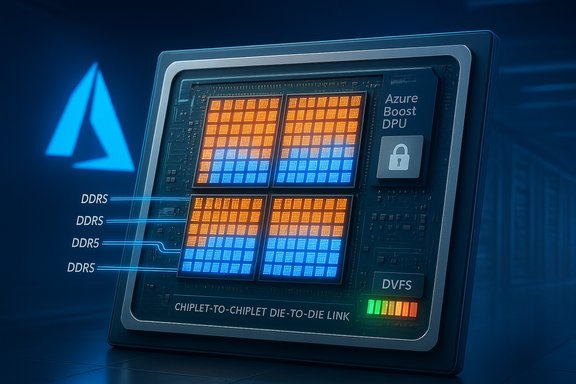
A futuristic chip diagram labeled 'Azure Boost DPU' with glowing die tiles and DDRS connections.Background​

Why hyperscalers build custom CPUs​

Over the past decade hyperscalers have shifted from pure software stacks to vertically integrated systems engineering: custom CPUs, DPUs (data processing units), and accelerators are now co‑designed with software and orchestration layers to squeeze cost, latency, and energy out of data‑center workloads. Microsoft’s Cobalt family is an explicit expression of that trend: the first Cobalt generation established Microsoft’s ability to deploy Arm‑based instances at scale, and Cobalt 200 is the follow‑on designed for denser consolidation, improved energy proportionality, and tighter integration with Azure’s networking and security offloads.

Where Cobalt 200 sits in Microsoft’s stack​

Microsoft positions Cobalt 200 as a cloud‑native server CPU optimized for scale‑out workloads (microservices, caches, containerized web tiers, and some CPU‑centric model inference tasks) and as part of a broader Azure silicon portfolio that includes DPUs and accelerators. The aim is to reduce the price‑per‑workload and energy per operation across millions of server‑hours while providing tighter security primitives such as on‑package HSM integration.

Architecture and Design​

Chiplet topology and core microarchitecture​

Cobalt 200 is implemented as a two‑chiplet package — effectively 66 cores per tile, combined as 66 + 66 = 132 active cores per SoC. Each core is built on Arm’s Neoverse Compute Subsystem V3 (CSS V3) building blocks, which emphasize higher IPC and scalability for server workloads compared with earlier Neoverse families. The chiplet approach allows Microsoft to scale core count while better managing manufacturing yield and thermal density than a single monolithic die. Microsoft claims unusually large private L2 allocations — 3 MB per core — paired with a 192 MB L3 system cache for the full SoC. Those cache figures signal a deliberate trade‑off toward on‑core locality and scaled multithread performance rather than narrowly pursuing single‑thread frequency wins. Industry reporting echoes this layout and emphasizes the cache and memory fabric as central to the SoC’s performance model.

Memory and I/O fabric​

Each compute chiplet reportedly exposes six DDR5 memory channels, yielding a 12‑channel DDR5 interface per socket when both chiplets are combined. That is a very wide memory fabric intended to reduce contention feeding 132 cores, especially for throughput‑bound cloud services. The package also includes high‑speed I/O lanes (PCIe Gen5/CXL capability is expected in CSS V3‑based designs) and a high bandwidth die‑to‑die link between chiplets.

Process node, power, and per‑core DVFS​

Microsoft says Cobalt 200 is manufactured on TSMC’s 3 nm (N3) process. Moving to 3 nm typically offers improvements in transistor density and energy efficiency per operation but also increases manufacturing complexity and dependency on foundry capacity. A headline hardware innovation Microsoft highlights is per‑core dynamic voltage and frequency scaling (DVFS), allowing independent power/performance points on each core to improve energy proportionality for mixed workloads. The feature promises concrete benefits in cloud contexts but introduces complexity for power delivery, thermal modeling, and scheduler integration.

On‑SoC accelerators and Azure integration​

The Cobalt 200 SoC integrates fixed‑function engines — for compression, cryptography, and data movement — to offload common, repetitive tasks and reduce host CPU overhead. Microsoft also emphasizes tight integration with Azure Boost (its DPU) and an on‑package hardware security module (HSM) to shorten cryptographic paths and reduce software overhead for secure services. These moves follow an industry trend of heterogenous system substrates where special‑purpose engines relieve general cores of expensive tasks.

What Microsoft Claims — and What Is Verified​

The headline claims​

Key claims Microsoft has publicly made:
  • 132 active Arm Neoverse V3 cores per SoC (66 + 66 chiplets).
  • 3 MB L2 per core and 192 MB L3 system cache.
  • 12 DDR5 memory channels per socket (6 per chiplet).
  • Built on TSMC 3 nm process.
  • Per‑core DVFS and on‑SoC accelerators for compression/crypto.
  • “Up to 50%” performance uplift over Cobalt 100 (marketing figure conditioned on workload).
These are the primary, load‑bearing facts of the announcement and are present in Microsoft’s official technical blog post and Azure materials. For independent confirmation, reputable outlets including ComputerBase and Arm’s own newsroom note and contextualize the same hardware building blocks and claims.

Verified vs. vendor claims​

While the structural facts (core count, chiplet layout, cache sizes, and process node) are corroborated by Microsoft’s blog and independent reporting, performance uplift figures — “up to 50%” — should be treated as a vendor‑side preview figure. Those marketing numbers are typically measured on specific benchmark classes or workload slices chosen to highlight strengths; they require independent benchmarking across representative cloud stacks to confirm real‑world, generalizable gains. The community and press coverage uniformly advise caution until third‑party, reproducible measurements and pricing details appear.

Deep‑dive analysis: Strengths and Opportunities​

1) Density and consolidation​

A 132‑core SoC with wide memory bandwidth and substantial per‑core cache is explicitly optimized for scale‑out services where many lightweight threads and containerized workloads run concurrently. For many web backends, caching layers, distributed databases, and CPU‑bound inference tasks that do not require GPUs, higher consolidation can significantly lower cost‑per‑request and rack‑level power consumption. That is the clearest economic leverage for Cobalt 200.

2) Energy proportionality using per‑core DVFS​

Per‑core DVFS is a powerful lever for cloud operators. By allowing idle or background cores to run at lower voltage/frequency while latency‑sensitive cores run faster, Cobalt 200 can reduce datacenter energy bills and heat density — provided that the OS scheduler, hypervisor, and firmware are designed to exploit those capabilities effectively. This approach maps cleanly to Azure’s telemetry and orchestration expertise and can yield material operational savings at hyperscale.

3) Heterogeneous offloads reduce host CPU overhead​

On‑SoC compression and crypto units, together with Azure Boost DPUs and on‑package HSMs, mean fewer cycles spent on I/O and encryption. For cloud workloads dominated by TLS termination, network stack work, or heavy compression, offloads translate directly into increased effective throughput and lower power per transaction. Such system‑level co‑engineering is where vertically integrated hyperscalers extract disproportionate benefit.

4) Alignment with Arm ecosystem and roadmaps​

Microsoft’s adoption of Arm’s CSS V3 gives it both a high‑IPC blueprint and compatibility with the expanding Arm server ecosystem. Arm’s public support and collaboration statements underscore the strategic fit between Microsoft and Arm, reducing technical risk for broad software support and enabling future roadmap alignment.

Risks, Unknowns, and Critical Caveats​

1) Benchmarks and the meaning of “up to 50%”​

Vendor claims of “up to” improvements commonly reflect carefully chosen benchmarks. Until Azure publishes Cobalt‑based instance SKUs and independent reviewers run standardized, reproducible workloads (including power‑aware tests), the 50% figure must be treated as aspirational. Customers should plan migration pilots with real workload traces rather than rely on vendor slide decks.

2) Supply, yield, and cost at 3 nm​

TSMC’s 3 nm node offers clear physical advantages, but early N3 production also brings yield risk and capacity pressure. Microsoft’s ability to ramp Cobalt 200 to broad availability depends on long‑lead foundry scheduling and packaging partners. Microsoft indicates initial production servers are already running in Azure datacenters and that broader customer availability is slated for 2026, but the pace of external availability will hinge on manufacturing realities.

3) Software maturity and compatibility​

Although Arm64 support in Linux, container runtimes, and many cloud images has matured significantly, enterprise dependence on x86‑only binaries, proprietary middleware, or narrow microarchitecture optimizations can complicate migrations. Vendors must provide Arm‑native images, validated stacks, and clear guidance to reduce friction. The per‑core DVFS and chiplet NUMA topologies also require tuned VM placement, hypervisor scheduling, and NUMA‑aware libraries to avoid counterproductive performance interactions.

4) Thermal and power delivery complexity​

Per‑core DVFS and 132‑core density increase demands on power delivery networks, thermal management, and neighbor‑core interference modeling. Misconfigured scheduler interactions could create pathological cases (e.g., livelock where power states oscillate) that reduce efficiency. Robust firmware, power management, and observability are necessary to fully harvest the theoretical energy gains.

5) The CSS V3 per‑tile core count nuance​

Arm’s published CSS V3 materials describe certain per‑die scaling limits; Microsoft’s implementation shows 66 cores per chiplet whereas some references note 64‑core logical limits in reference materials. This discrepancy could reflect licensee customization, spare/yield cores, or packaging choices — a detail worth flagging and verifying because it speaks to how far vendors can push Arm’s reference subsystems in production silicon. Until full datasheets are public, treat this as an observed specification nuance, not necessarily a contradiction.

Practical guidance for Azure customers and architects​

  • Start migration pilots focused on time‑to‑solution and cost‑per‑job rather than raw clock‑for‑clock throughput. Measure energy and billing impact as first‑class metrics.
  • Prioritize scale‑out, containerized services and stateless web layers for early trials; these workloads most closely align with Cobalt 200’s density and memory fabric.
  • Validate third‑party vendor support for Arm64 or plan for container/multi‑arch re‑packaging strategies where possible.
  • Observe NUMA topology and scheduler behavior on preview instances; tune hypervisor affinity and VM placement to reflect chiplet boundaries and memory channel allocation.
  • Require reproducible, independent benchmarks for your representative workloads before committing large migrations; treat vendor “up to” numbers as planning guidance only.

How to verify Microsoft’s claims when Cobalt instances arrive​

When Azure publishes Cobalt‑backed SKUs, the community should run a consistent verification suite that includes:
  • Scale‑out HTTP request throughput and latency under multitenant contention.
  • Memory‑bandwidth and cache‑sensitivity tests (STREAM, cache microbenchmarks) to validate the L2/L3 balance claims.
  • Power‑aware workloads measuring energy per operation at fixed throughput targets.
  • Real‑world server workloads (JVM/CLR microservices, Redis/Memcached, database OLTP) to assess consolidation gains and tail latency.
  • Regression tests for crypto/compression offloads to confirm offload benefit and HSM path semantics.
Publishing results with full configuration details (kernel, hypervisor, CPU governor settings, NUMA layout) will be essential for reproducibility. Independent sites and community labs should also measure long‑running reliability under heavy I/O and thermal stress to validate production readiness.

Market and competitive implications​

Against Graviton and x86 incumbents​

Microsoft’s Cobalt 200 is a direct addition to the growing field of hyperscaler‑class Arm silicon (for example, AWS Graviton and other licensee designs). The competitive pitch differs slightly: where Graviton has aggressively focused on price‑performance for public instances, Microsoft’s differentiation centers on stack integration — DPU offloads, HSM integration, per‑core DVFS, and a design tuned to Azure’s orchestration and telemetry. For many customers the decision will come down to price, availability, and migration friction. Against x86 incumbents, custom Arm silicon continues to shift the calculus for scale‑out workloads where total cost of ownership and energy efficiency trump peak single‑thread throughput.

Vendor lock‑in and portability​

A system‑level advantage is also a lock‑in lever: deep integration with Azure Boost, HSMs, and Azure‑specific offloads can deliver real value, but it can also increase switching friction. Enterprises must weigh potential TCO improvements against vendor reliance and design their architectures for workload portability where that matters.

Security and compliance considerations​

On‑package HSMs and integrated crypto accelerate secure key operations and reduce attack surface for certain threat models. However, customers with strict compliance needs should audit HSM capabilities, key custody semantics, attestation flows, and auditability features. When hardware offloads modify TLS termination or encryption paths, ensure that logging, forensics, and compliance evidence are preserved in a way consistent with regulatory obligations. Azure documentation and compliance whitepapers will need to detail these aspects before high‑value workloads are migrated.

Open questions and items to watch​

  • Exact SKU availability, pricing, and region rollout cadence for Cobalt 200‑based Azure instances. Microsoft has said broader customer availability will follow in 2026; the calendar and SKU pricing will determine the commercial impact.
  • Full technical datasheets: die sizes, per‑core frequency bands, thermal design power (TDP) ranges, and packaging details (UCIe vs custom die‑to‑die PHY).
  • Independent benchmark suites and power‑per‑operation measurements on representative workloads. The community should prioritize publishing reproducible results.
  • The practical behavior and maturity of per‑core DVFS: whether Azure exposes per‑core power controls to VMs, or whether it remains an operator‑level optimization.

Conclusion​

Azure Cobalt 200 is a significant incremental step in Microsoft’s silicon ambitions: chipletized, 132‑core Arm hardware, a wide memory fabric, large per‑core L2 caches, built on TSMC 3 nm, and featuring per‑core DVFS and integrated offloads — all designed to push price‑performance and energy efficiency for cloud‑native workloads. These are meaningful technical investments that, if realized at scale, will reshape instance economics for many throughput‑oriented services. At the same time, several practical caveats remain. Performance uplift claims must be validated by independent benchmarks; per‑core power features and chiplet topologies complicate scheduler and hypervisor design; and N3 manufacturing introduces supply and yield dependencies that can affect timing and availability. For architects and operators, the prudent path is structured pilots, rigorous measurement of cost‑per‑job and energy‑per‑operation, and careful attention to software porting and NUMA/scheduling details before large migrations.
If Microsoft’s preview metrics hold up under independent verification, Cobalt 200 will be another clear sign that hyperscalers’ control of both hardware and software stacks is entering a new, more vertically integrated phase — one in which raw core counts alone matter less than how silicon, accelerators, networking, and orchestration work together to deliver lower cost, lower latency, and lower energy per unit of useful cloud work.
Source: TechPowerUp Microsoft Rolls Out Cobalt 200 CPU with 132 Arm Cores
 

Microsoft’s Azure Cobalt 200 is a clear signal that the next phase of cloud evolution is being driven as much by custom silicon as by software — a chipletized, Arm‑based server SoC Microsoft says will deliver substantial performance and energy‑efficiency gains for Azure workloads and is already running in production test racks while public availability is expected in 2026.

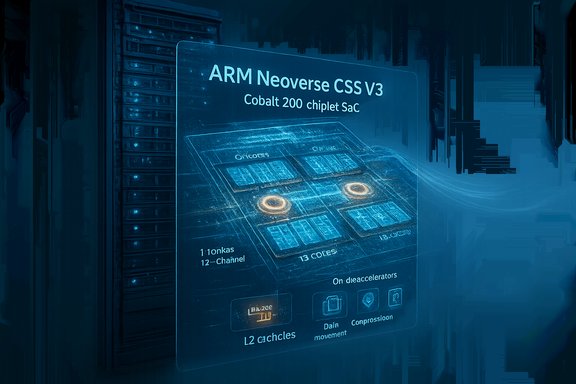
Blue holographic sign displaying ARM Neoverse CSS V3 chipset on a server panel.Background / Overview​

Microsoft announced the Azure Cobalt 200 during its Ignite slate of infrastructure updates, positioning the new CPU as the successor to the Cobalt 100 family and a cornerstone of a broader, vertically integrated Azure hardware strategy that includes DPUs (Azure Boost), integrated HSMs, and AI accelerators. The company frames Cobalt 200 as a cloud‑native CPU tuned for scale‑out, multi‑tenant workloads with a focus on energy efficiency and tighter hardware‑software co‑design. At its core, Microsoft describes Cobalt 200 as:
  • An Arm‑based SoC built from the Arm Neoverse Compute Subsystem V3 (CSS V3).
  • A chiplet design with two compute tiles (66 cores each) totaling 132 active cores per SoC.
  • Fabricated on TSMC’s 3 nm process node.
  • Featuring large per‑core private L2 caches (reported as ~3 MB per core), a large shared L3 (reported ~192 MB), and a 12‑channel DDR5 memory fabric per socket.
  • Including on‑SoC accelerators for data movement, compression and cryptography, plus per‑core DVFS (dynamic voltage and frequency scaling).
These claims form the technical backbone of Microsoft’s narrative that Cobalt 200 will yield “up to 50%” higher performance versus the Cobalt 100 generation. That headline number is notable but should be read as a vendor claim until independent benchmarks across a representative workload set are available.

Why Cobalt 200 matters: the strategic context​

Custom cloud silicon is no longer experimental​

Hyperscalers have moved beyond experimenting with custom chips and into repeated, production investments in silicon to control price‑performance, latency, power consumption, and supply chain exposure. Microsoft’s Cobalt program — now on generation two — joins similar moves by other major clouds that are optimizing stack‑level performance through bespoke chips, DPUs and accelerators. Cobalt 200 is Microsoft’s attempt to own more of the compute substrate for general‑purpose and cloud‑native workloads while integrating offloads that reduce host CPU overhead.

What Microsoft is optimizing for​

Microsoft emphasizes three linked goals for Cobalt 200:
  • Core density and consolidation: more cores per socket to run more containers/VMs per rack.
  • Energy proportionality: finer power control per core to reduce wasted energy in variable cloud workloads.
  • Stack integration: on‑SoC accelerators and tighter DPU/HSM integration to offload routine tasks (TLS, compression, DMA) and reduce host CPU cycles.
These goals matter because, at hyperscale, incremental gains in watts per request or percent improvements in consolidation can translate into major operating‑cost advantages or margin improvements.

Technical deep dive: architecture and claimed specs​

Core microarchitecture and chiplet design​

Microsoft states Cobalt 200 is built on Arm’s Neoverse CSS V3 framework and implements a two‑chiplet package with 66 cores per chiplet for a total of 132 active Neoverse‑V3 cores. The chiplet approach is a deliberate yield and thermal‑density choice: it lets Microsoft scale core counts while managing manufacturing risk compared with larger monolithic dies. Important verification note: Arm’s published CSS V3 materials typically reference design targets and partner flexibility; some public observers flagged a potential mismatch between a 64‑core per‑die expectation in generic CSS guidance and Microsoft’s use of 66 cores per tile. That is a technical nuance worth tracking because it touches on licensee customization, spare/yield cores, or a specific mapping of Arm’s subsystem blueprint to a production implementation. Treat the exact per‑tile core count as vendor‑declared and wait for silicon‑level datasheets or independent package‑level teardowns for full confirmation.

Cache, memory and I/O fabric​

Microsoft reports ~3 MB L2 per core and an ~192 MB L3 system cache, along with a 12‑channel DDR5 memory interface per socket (6 channels per chiplet). A wide memory fabric is necessary to feed 132 cores and reduce memory contention for throughput‑oriented cloud workloads. Microsoft also lists PCIe Gen5/CXL‑capable I/O and die‑to‑die high‑bandwidth links (UCIe or custom PHYs are plausible implementation choices).

On‑SoC accelerators and Azure integration​

Cobalt 200 is described as including fixed‑function accelerators for:
  • Data movement (to reduce CPU cycles on streaming I/O),
  • Compression and cryptography (offloading TLS, disk encryption, and network compression),
  • Tight integration points for Azure Boost (the DPU) and an integrated HSM for security and key management.
This pattern — adding domain‑specific accelerators to a general‑purpose CPU — mirrors industry trends toward heterogeneous server SoCs that reduce host overhead for frequently repeated operations.

Power and process: TSMC 3 nm and per‑core DVFS​

Microsoft states the Cobalt 200 is manufactured on TSMC’s 3 nm process, which typically affords higher transistor density and improved energy efficiency versus older nodes. Equally important is the announced per‑core DVFS, which allows different cores to run at independent voltage/frequency points — a capability that can materially improve energy proportionality in mixed workloads if the hypervisor/OS scheduler, firmware and telemetry are designed to make correct decisions about core power states. This feature raises implementation complexity (power‑delivery network design, neighbor thermal interactions), so realizing the promised efficiency will be as much a software and systems exercise as a silicon one.

Performance claims and how to read them​

Microsoft’s public messaging asserts “up to 50%” performance improvement versus Cobalt 100. That phrasing is industry‑standard marketing language and typically describes a best‑case or targeted improvement on specific workload classes rather than an across‑the‑board doubling. Independent outlets and Microsoft’s own materials caution that real‑world gains will vary significantly by workload type (scale‑out throughput vs single‑thread latency‑sensitive tasks, memory‑bound vs compute‑bound workloads). External validation with reproducible benchmarks is essential to translate vendor claims into procurement decisions. What the 50% claim likely implies:
  • The greatest benefits will probably show up in throughput‑oriented, containerized, multi‑threaded workloads where consolidation and cache topology improvements reduce per‑request CPU time.
  • Single‑thread peak performance or workloads dominated by memory latency or I/O contention may see smaller improvements, depending on clocking trades Microsoft made for energy savings.
  • Offloads (crypto/compression/DPU) can further improve system throughput by shifting routine work off general‑purpose cores.

Strengths: where Cobalt 200 could deliver real value​

  • Hardware‑software co‑design at scale: Microsoft can tune firmware, hypervisor scheduler and Azure services to exploit Cobalt 200’s per‑core power controls and accelerators across millions of server hours — a scale advantage commodity vendors cannot easily replicate.
  • Core density for consolidation: 132 cores per SoC plus wide memory channels promise higher VM/container density and improved price‑performance for scale‑out workloads.
  • Power efficiency potential: TSMC 3 nm plus per‑core DVFS can reduce energy per operation, an operational and sustainability win if realized in production.
  • Integrated offloads: Built‑in cryptography, compression and data‑movement engines — used alongside Azure Boost and an on‑package HSM — may reduce host CPU cycles, lower latency for certain services, and simplify secure key flows for enterprise customers.
  • Platform differentiation: Custom silicon tightens Azure’s vertical integration, enabling unique VM SKUs and service features only available on Azure’s hardware stack.

Risks, unknowns and what to watch​

1) Vendor claims vs independent validation​

The headline “up to 50%” figure is a vendor claim. Independent third‑party benchmarks that measure time‑to‑solution, cost‑per‑job, and watts‑per‑request across realistic cloud stacks (web front ends, caches, databases, small‑model inference) are needed to validate Microsoft’s claims. Early in‑house tests can be optimized to favorable cases; purchasers must insist on reproducible test methodologies.

2) Availability and supply chain risk​

Cutting‑edge nodes like TSMC 3 nm involve foundry capacity constraints and yield challenges. Microsoft says first production Cobalt 200 servers are running internally, with broader customer availability expected in 2026, but broad GA timing and regional SKU availability depend on foundry allocations and packaging logistics. Expect staged rollouts and premium pricing for early SKUs.

3) Software and ecosystem maturity​

Although Arm on server has matured quickly, many enterprise binaries and third‑party drivers still assume x86. Migration cost, recompilation, testing for edge cases, and vendor support for Arm64 will remain friction points for enterprise adoption. Microsoft must provide robust migration guidance and optimized images to lower these barriers.

4) Operational complexity of per‑core DVFS​

Per‑core DVFS raises scheduler and firmware complexity. Poorly coordinated power/performance policies can harm tail latency or enable noisy‑neighbor issues in multi‑tenant environments. Azure’s telemetry, firmware and orchestration need to be highly polished before customers can exploit per‑core DVFS safely at scale.

5) Unverified micro‑spec details​

Some architecture details (e.g., 66 cores per tile vs Arm’s typical 64‑core reference) deserve scrutiny from hardware analysts and teardowns to fully reconcile Microsoft’s implementation with Arm’s public subsystem specs. These nuances can matter for low‑level performance and NUMA behavior.

Practical guidance: how enterprise IT and cloud architects should respond​

Quick takeaways​

  • Treat Cobalt 200 as an Azure‑centric option that could materially reduce cost‑per‑workload for scale‑out services — but validate with measurable tests before committing migrations.
  • Focus early pilots on containerized, stateless, or easily recompiled workloads that already run well on Arm64.
  • Include energy and telemetry in procurement metrics; don’t rely solely on throughput numbers.

Suggested pilot and validation checklist​

  • Identify representative workloads (web front ends, microservices, Redis/Postgres, small LLM CPU inference).
  • Measure baseline metrics on current Azure VMs: time‑to‑solution, cost‑per‑job, P50/P95/P99 latency, and power telemetry if available.
  • Run matched tests on Cobalt 200 preview instances when available; capture identical metrics and compare cost/energy curves.
  • Test offload benefits (TLS, compression, remote storage) to quantify host CPU savings with Azure Boost and on‑SoC accelerators.
  • Validate binary compatibility for any closed x86 dependencies; engage ISVs to secure Arm64 builds as required.
  • Publish methodology and results internally to ensure reproducibility and support procurement negotiation.

Competitive landscape: where Cobalt 200 sits​

  • AWS Graviton: AWS’s Graviton family is a mature, widely adopted Arm option with many instance types and extensive third‑party support; Microsoft must win developer mindshare and show clear cost/feature advantages to convert Graviton users.
  • Intel/AMD x86: For workloads that still need x86 specifics or single‑thread peak performance, x86 remains advantaged. Cobalt 200 competes where consolidation and energy efficiency matter more than absolute single‑thread throughput.
  • NVIDIA/Other AI CPUs: Microsoft’s contemporaneous work on Maia accelerators and partnerships with GPU vendors means Cobalt 200 is not a replacement for GPU‑centric training or large model inference; it is a complementary platform optimized for throughput‑oriented CPU tasks and certain inference classes. Notably, any delays in custom AI accelerators increase the near‑term importance of CPU performance improvements.

Regional and industry impacts (including India)​

  • For regions with fast Azure adoption, including India, Cobalt 200 could improve VM price‑performance for AI enabling use cases like model inference, analytics, and large‑scale microservice deployments — assuming region‑level SKU availability. Improved energy efficiency also helps customers bound operational costs in markets with high power prices.
  • Enterprises in regulated industries that require clear hardware security assurances may benefit from Microsoft’s integrated HSM story — but must confirm compliance artifacts, auditability and key‑management flows before production adoption.

Verification status and how to interpret available evidence​

Multiple independent outlets and Microsoft’s own infrastructure blog corroborate the core elements of the announcement: Arm Neoverse CSS V3 base, 132 cores per SoC, per‑core DVFS, 3 nm process, chipletized 66+66 layout, and the performance/efficiency positioning. The most load‑bearing claims — core count, process node, and the “up to 50%” uplift — are reported by Microsoft and independently summarized by industry press, but the magnitude of real‑world benefit remains to be proven by third‑party tests and vendor‑neutral benchmarks. Where claims remain unverifiable today:
  • The exact real‑world percentage improvement across a customer’s specific workload mix.
  • Yield, per‑region availability, and final GA pricing for Cobalt 200 VMs.
  • Microarchitectural details that only a silicon teardown or full datasheet would fully confirm (e.g., the precise cache topology and how chiplet NUMA is exposed to guests). These should be treated as vendor statements until independent validation appears.

Final assessment and recommendations​

Microsoft’s Azure Cobalt 200 is an important and credible move in the continued hyperscaler shift toward owning more of the hardware stack. The combination of a high core count, a wide memory fabric, on‑SoC accelerators, per‑core DVFS and TSMC 3 nm manufacturing represents a sophisticated, systems‑level approach to lowering cost‑per‑workload and improving energy efficiency for cloud‑native services. If Microsoft’s performance and energy claims hold up in independent testing, Cobalt 200 could materially change economics for scale‑out cloud workloads and increase Azure’s differentiation in the compute market. Pragmatic next steps for enterprise decision‑makers:
  • Treat early performance numbers as promising but provisional; require representative, reproducible benchmarking before large migrations.
  • Plan pilots on stateless/containerized services and batch jobs that are easiest to recompile and validate on Arm64.
  • Include energy and telemetry metrics in procurement comparisons; the real value of Cobalt 200 is as much about watts‑per‑work as raw peak throughput.
  • Engage ISVs about Arm64 support timelines and ask Azure for clear region and SKU availability dates to align migration timelines.
Cobalt 200 is not a single product — it’s a strategic lever in Microsoft’s infrastructure playbook. Its true impact will depend on Microsoft’s ability to operationalize per‑core power management, deliver robust software and migration tooling, and scale foundry and packaging supply — the engineering and procurement work that separates promising silicon demos from cloud‑changing infrastructure.
The Azure Cobalt 200 announcement makes one thing clear: the cloud is becoming a vertically engineered platform in which software, networking, security and silicon are designed together. For customers and cloud architects, the practical task is to translate vendor claims into verified outcomes — measurable improvements in price‑performance, latency, and energy per operation — before re‑architecting production fleets around a new class of Azure‑only compute.
Source: Lapaas Voice Microsoft unveil in-house cloud chip Azure ‘Cobalt 200'
 

Microsoft’s Azure Cobalt 200 is the clearest statement yet that hyperscale cloud operators are taking the silicon stack into their own hands — a chipletized, Arm‑based server SoC that Microsoft says packs 132 Neoverse‑V3 cores, rides TSMC’s 3 nm node, and will deliver “up to 50%” more performance than the original Cobalt 100 while adding hardware offloads and tighter platform security.

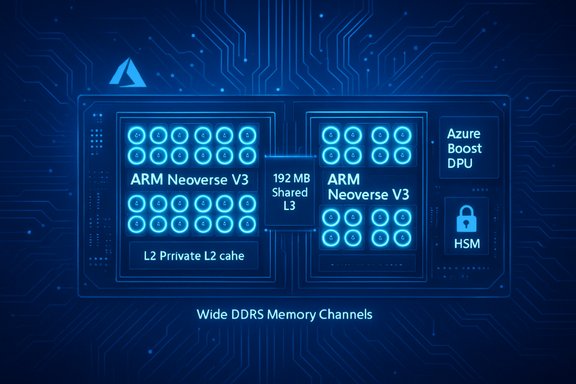
Blue neon diagram of wide DDR memory channels with ARM Neoverse V3 cores.Background​

Microsoft introduced the Cobalt family as its in‑house Arm server CPU program with Cobalt 100; that effort moved Azure beyond off‑the‑shelf x86 parts and into vertically integrated hardware tuned to the company’s workload telemetry. Cobalt 200 is the second generation in that program, previewed at Microsoft Ignite in November 2025 and documented in Microsoft’s Azure Infrastructure blog, which describes the chip as designed to optimize throughput, consolidation, and energy proportionality across Azure’s general‑purpose instance footprint. Why this matters: at hyperscale, marginal improvements in watts per request, consolidation ratio, or cryptographic throughput scale into substantial cost and sustainability impacts over millions of server‑hours. Cobalt 200 is explicitly framed as a systems play — silicon plus DPU (Azure Boost), hardware security module (HSM) integration, and software‑driven power controls — rather than a standalone CPU launch.

What Microsoft says Cobalt 200 is — the headline specs​

Microsoft’s announcement and subsequent industry reporting present a consistent high‑level spec set for the Cobalt 200 platform:
  • 132 active Arm Neoverse‑V3 cores per SoC, implemented as two chiplets with 66 active cores each.
  • 3 MB of private L2 cache per core, yielding a very large L2 footprint, and 192 MB of shared L3 system cache for the SoC.
  • 12 DDR5 memory channels per socket (six channels per chiplet).
  • Fabrication on TSMC’s 3 nm (N3) process node.
  • Per‑core DVFS (dynamic voltage and frequency scaling) to tune power/performance at the individual core level.
  • Integrated fixed‑function accelerators for compression and cryptography, plus platform integration with Azure Boost (DPU) and an Azure‑integrated HSM.
  • Microsoft states “up to 50%” higher performance versus Cobalt 100 based on an extensive internal modeling and benchmark suite; the company says first production servers are live internally and broader customer availability is planned in 2026.
These are the load‑bearing claims from Microsoft’s public materials and corroborating press coverage; they form the basis for evaluating how Cobalt 200 may change instance economics and architecture choices for Azure customers.

Architecture deep dive: chiplets, cores, cache and memory​

Chiplet topology and core microarchitecture​

Cobalt 200 uses a two‑chiplet package — effectively 66 cores per chiplet for 132 active cores total — a design choice that balances core count scaling with die yield and thermal constraints. The cores are reported to be based on Arm’s Neoverse Compute Subsystem V3 (CSS V3), which delivers higher IPC potential than prior Neoverse families and is aimed at cloud/server workloads. The chiplet model serves multiple purposes:
  • It reduces the manufacturing risk of very large monolithic dies by splitting the compute array into smaller, more yield‑friendly tiles.
  • It makes thermal and power delivery more tractable in dense server topologies.
  • It permits Microsoft to mix‑and‑match or iterate on compute tiles without redesigning a single huge die.
Industry observers have noted a nuance worth tracking: some Arm CSS V3 reference materials have commonly discussed partner tile sizes around 64 cores, while Microsoft’s implementation shows 66 active cores per tile. That discrepancy could reflect licensee customization, spare/yield cores, or specific subsystem choices and should be verified with die‑level teardowns or vendor datasheets. Treat the exact tile mapping as vendor‑declared for now.

Cache hierarchy: more L2 than you typically see​

Microsoft’s decision to allocate ~3 MB of private L2 per core is notable. That’s a very L2‑heavy topology compared with many server parts and signals an architectural emphasis on on‑core locality — favoring many thread‑dense, latency‑sensitive cloud services where per‑thread working sets benefit from large private caches. The large per‑core L2 combined with a 192 MB shared L3 is designed to reduce memory traffic and NUMA sensitivity in tightly consolidated VM/container workloads.

Memory, fabric and I/O​

With 12 DDR5 channels per socket (six per chiplet), the platform exposes an unusually wide memory fabric intended to keep 132 cores fed under throughput‑oriented loads. Microsoft also customized the memory controller to enable always‑on memory encryption and to support Arm’s Confidential Compute Architecture (CCA), aiming to provide stronger tenant isolation with low overhead compared to purely software‑enabled encrypted‑memory approaches. The SoC is also expected to support modern I/O standards (PCIe Gen5/CXL) and uses high‑bandwidth die‑to‑die links to tie chiplets together.

Performance claims: what “up to 50%” means — and what it doesn’t​

Microsoft’s headline claim — a performance uplift of “up to 50%” versus Cobalt 100 — is anchored in the company’s modeling and internal benchmarks. Microsoft reports evaluating hundreds of thousands of simulated configuration candidates and running more than 140 benchmark variants to choose the final design point. That level of internal modeling is credible as a design tool, but the phrase “up to” is intentionally context‑sensitive. Key caveats and interpretation guidance:
  • “Up to 50%” is almost certainly not a universal uplift for all workloads; in practice it will apply to selected, favorable workload classes (memory‑sensitive, scale‑out throughput, or cases where larger per‑core caches reduce stalls).
  • The shift from Neoverse N2‑class cores to Neoverse V3‑class cores targets per‑core IPC gains, but realized gains depend on frequency targets, thermal headroom, and scheduler behavior across the OS/hypervisor stack.
  • Independent third‑party benchmarks across representative enterprise and cloud workloads (databases, web tiers, containerized microservices, CPU‑bound inference) will be required to validate how Cobalt 200 performs in customer scenarios versus Cobalt 100, AWS Graviton, and x86 Epyc/Xeon offerings. Multiple outlets have highlighted that the 50% figure should be considered a vendor claim pending reproducible testing.
In short: the claim is plausible given the architectural changes (faster cores, more cache, 3 nm process), but it must be validated with independent measurements that report time‑to‑solution, cost‑per‑workload, and watts‑per‑request, not just single synthetic metrics.

Security and Confidential Compute​

Security is a central theme of the Cobalt 200 narrative. Microsoft emphasizes hardware‑level features intended to strengthen tenant isolation and key management without the overheads of software‑only techniques:
  • Always‑on memory encryption and integration with Arm’s Confidential Compute Architecture (CCA) are presented as first‑class features, designed to protect memory regions of concurrently running instances and reduce the trust surface exposed to privileged software.
  • An integrated HSM on the platform (tightly coupled to the SoC and Azure’s broader key‑management systems) is intended to shorten cryptographic keypaths and improve performance for TLS, disk encryption, and attestation flows.
These hardware primitives align with broader industry trends (AMD SEV‑SNP, Intel TDX), but their effectiveness depends on audited attestation flows, key custody semantics, and how Azure exposes attestation/measurement APIs to customers. Enterprises with stringent compliance needs should plan pilots that validate these control surfaces under their threat models before migrating sensitive workloads.

Software, ecosystem and migration considerations​

Arm64 server software has matured rapidly over the last several years, and Microsoft has invested heavily in tooling, container images, and service support for Arm since the launch of Cobalt 100. That work reduces the friction of migrating many cloud‑native workloads, but there remain practical considerations:
  • Legacy enterprise binaries, vendor drivers, or specialized middleware may still assume x86 semantics or microarchitecture specifics; those components require validation or recompilation.
  • Hypervisor and OS schedulers must be updated to exploit per‑core DVFS and the chiplet cache/NUMA topology to unlock energy‑efficiency gains; absent scheduler support, per‑core DVFS benefits may be limited.
  • NUMA-aware application tuning and thorough performance testing will be essential for customer migrations to avoid surprises in latency‑sensitive services.
Microsoft’s own services (Office, Teams, Azure SQL) are reported to be migrating internal workloads to Cobalt platforms, which is a pragmatic proving ground, but customers should run representative benchmarks for their own stacks.

Operational realities: supply, availability and cost​

Adopting a 3 nm foundry ramp for a cloud CPU is a major operational commitment. Leading‑edge nodes like TSMC N3 typically come with constrained capacity, early yield risk, and cost pressure. Microsoft reports first production servers are running in its datacenters and that public availability for customers is planned across 2026, but the exact SKU rollout, region cadence, and pricing remain to be published. Customers should expect staged rollouts and region‑by‑region availability as supply ramps. From an economic perspective, the hypothesis is straightforward: higher consolidation (more cores per rack) plus offloads (DPU, crypto, compression) reduce price‑per‑workload and energy costs. But organizations should require proof in the form of reproducible cost‑per‑transaction and energy‑per‑operation benchmarks before committing to large migrations. Microsoft’s internal modeling is useful, but real TCO decisions must be based on customer‑visible SLAs and measurable operational telemetry.

Competitive landscape — where Cobalt 200 sits​

Cobalt 200 joins a field of hyperscaler and vendor‑designed server silicon:
  • AWS Graviton series remains the market’s most‑deployed hyperscaler Arm family and a direct competitor for price‑performance on scale‑out workloads.
  • Google’s Axion and other custom Arm initiatives target similar workload classes with their own microarchitecture and integration choices.
  • NVIDIA Grace family uses Arm cores paired with large AI accelerators in “superchip” configurations for model training/inference; those are complementary rather than direct competitors.
  • x86 incumbents (Intel, AMD) are responding with denser core designs (compact E‑cores, Zen‑c variants) and larger socket‑level memory fabrics — so the landscape remains multi‑architecture and workload dependent.
Cobalt 200’s differentiators are Azure stack integration (Azure Boost DPU, integrated HSM), per‑core DVFS, and a cache/memory topology tuned to Microsoft’s workload telemetry — features that may make it especially appealing for customers heavily invested in Azure‑native services. But the typical tradeoff applies: deeper integration can increase switching friction and vendor lock‑in risks.

Strengths and opportunities​

  • Systems integration: Cobalt 200 is more than a CPU; it’s positioned as a tightly coupled compute + DPU + HSM platform that offloads common data‑center tasks and reduces host CPU overhead.
  • Energy and consolidation: Per‑core DVFS and a 3 nm node give Microsoft levers to improve energy proportionality and rack‑level consolidation, which can reduce operating costs and carbon intensity.
  • Security primitives: On‑SoC memory encryption and CCA support broaden Azure’s confidential computing story for Arm‑native instances.
  • Workload fit: The chip’s cache and memory topology favor the scale‑out, containerized workloads that dominate cloud economics: web front ends, transactional databases, streaming ingestion, and CPU‑bound model inference.

Risks, unknowns and verification items​

  • Benchmarks and workload fidelity: Microsoft’s “up to 50%” figure is vendor‑declared and requires reproducible third‑party validation across representative stacks. Treat the number as directional.
  • Foundry and yield risk: TSMC N3 capacity constraints and early yield curves could affect availability and regional SKU timing.
  • Scheduler and platform maturity: Per‑core DVFS and chiplet NUMA behavior require sophisticated OS/hypervisor hooks to realize the promised efficiency. Without software maturity, hardware capability may underdeliver.
  • Portability and lock‑in: Deep Azure platform integration (DPU/HSM offloads) improves efficiency but can increase vendor dependence; enterprises must weigh TCO gains against portability requirements.
  • Verification of microdetails: Certain technical specifics (e.g., exact per‑tile core mapping, die size, frequencies, TDP bands) are vendor‑declared and will need independent confirmation from datasheets or silicon teardowns. Flag any such microdetail as provisional until verified.

Practical checklist for Windows‑centric and Azure‑first organizations​

  • Identify candidate workloads: pick scale‑out services where per‑core locality, memory bandwidth, and offloaded crypto/compression matter most.
  • Conduct pilots: measure time‑to‑solution, cost‑per‑transaction and watts‑per‑request on production‑like datasets.
  • Validate security flows: test attestation, key custody and HSM integration against compliance needs.
  • Confirm vendor SLAs: require clear deployment timelines, capacity commitments, and exit terms before committing large workloads.
  • Track independent benchmarks: wait for third‑party reproducible tests from independent labs to confirm Microsoft’s performance and efficiency claims.

Conclusion​

Azure Cobalt 200 is a decisive step in Microsoft’s vertical integration of cloud infrastructure: a two‑chiplet, 132‑core Arm server SoC built on Arm’s CSS V3 and TSMC’s 3 nm node, with large per‑core caches, wide memory channels, per‑core DVFS and on‑SoC offloads for crypto and compression. Microsoft positions it as a platform‑level lever to improve throughput, consolidation and energy efficiency across Azure, with first production servers already in Microsoft datacenters and broader customer availability slated for 2026. The technical approach — increase per‑core performance by moving to Neoverse V3, expand cache, widen memory, and shift routine data‑center tasks into silicon — is sound and mirrors what other hyperscalers have done to control price‑performance. However, the headline “up to 50%” performance figure should be read as a vendor‑side claim until independent, reproducible benchmarks quantify its impact across real‑world workloads. Likewise, some microarchitectural specifics (tile core counts per die, precise TDP/frequency envelopes) remain vendor‑declared and merit verification by datasheets or teardowns.
For architects and operators, the right posture is pragmatic: evaluate Cobalt 200 with structured pilots that measure cost and energy impacts under representative loads, insist on clear SLA and capacity commitments, and verify confidential computing and attestation flows before moving regulated workloads. If Microsoft’s internal modeling and early production tests hold up in independent assessments, Cobalt 200 will be a meaningful new lever for Azure customers seeking lower cost, higher consolidation, and stronger built‑in security across a wide range of cloud‑native workloads.
Source: heise online Azure Cobalt 200: Microsoft's Second In-House ARM CPU for Cloud Servers
 

Microsoft’s Azure Cobalt 200 is a bold second-generation cloud CPU that moves the company’s in‑house silicon program onto TSMC’s 3 nm node, delivering a chipletized Arm Neoverse‑V3 design with 132 active cores, an unusually large per‑core cache strategy, and a wide 12‑channel DDR5 memory fabric—features Microsoft says will translate to “up to 50%” higher performance versus Cobalt 100 as the chips enter staged production and customer availability in 2026.

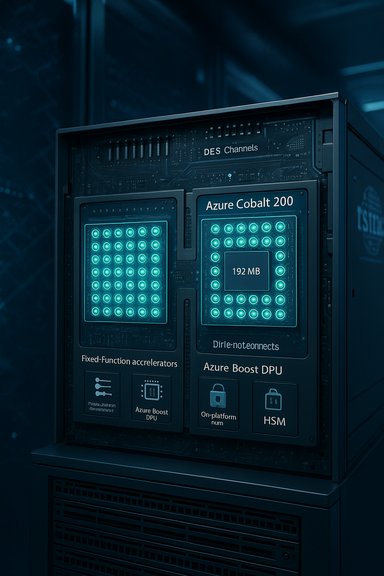
Azure Cobalt 200 server module with teal LED arrays.Background / Overview​

Microsoft’s Cobalt program started as an exercise in vertical integration: owning more of the hardware stack to tune performance, efficiency, and security for Azure workloads. Cobalt 100 proved Microsoft could field Arm‑based instances at scale; Cobalt 200 scales that premise aggressively by combining a chipletized implementation of Arm’s Neoverse Compute Subsystem V3 (CSS V3) with process‑node improvements, on‑SoC accelerators, and fine‑grained power controls designed for hyperscale economics. At a glance, the platform’s headline specifications are:
  • 132 active Arm Neoverse‑V3 cores per SoC (two chiplets with 66 active cores each in Microsoft’s public block diagram).
  • ~3 MB private L2 cache per core and ~192 MB shared L3 system cache for the SoC.
  • 12 DDR5 memory channels per socket (six channels per chiplet) and a memory controller customized for always‑on memory encryption and Arm Confidential Compute Architecture (CCA) support.
  • Fabrication on TSMC 3 nm (N3) process and per‑core dynamic voltage and frequency scaling (DVFS).
  • Integrated fixed‑function accelerators for compression and cryptography, and packaging integrated to work with Microsoft’s DPU (Azure Boost) and on‑platform HSM.
Those claims are repeated across vendor materials and press coverage, but they carry technical caveats and verification points that matter to architects and procurement teams. Multiple industry outlets note that Microsoft’s “up to 50%” performance figure is a vendor claim pending independent benchmarking; the practical uplift will vary widely by workload class.

Architecture deep dive​

Chiplet layout, core microarchitecture and cache topology​

Cobalt 200 is implemented as a two‑chiplet package — Microsoft’s illustrations show 66 active cores per tile for a total of 132 active cores. That tile count balances die yield and thermal management while allowing the company to push core density without a monolithic‑die yield hit. The cores are described as Arm Neoverse‑V3 class and implemented using the CSS V3 subsystem, giving Microsoft a modern server‑class CPU base with high IPC potential. Two cache details stand out:
  • Approximately 3 MB of private L2 per core — a large per‑core L2 compared with many server parts, indicating Microsoft prioritized on‑core locality for thread‑dense cloud services.
  • About 192 MB of shared L3 for the entire SoC — a large system cache intended to reduce off‑chip memory traffic and tail‑latency variance in consolidated workloads.
Important verification note: public CSS V3 reference materials and partner guidance sometimes discuss typical tile sizes around 64 cores. Microsoft’s use of 66 active cores per tile is explicitly flagged in technical writeups as a licensee‑level implementation detail (possible spare/yield cores or subsystem mapping choices) that should be validated by datasheets or die‑level teardowns. Treat the 66‑per‑tile number as Microsoft‑declared until independent verification is available.

Memory, I/O and fabric​

Each compute tile exposes six DDR5 channels, for a total of 12 channels per socket — an unusually wide memory fabric aimed at feeding 132 cores with reduced contention under throughput‑oriented loads. Microsoft also signals PCIe Gen5/CXL capability and high‑bandwidth die‑to‑die links (the public block diagram shows a wide inter‑chiplet interconnect). In addition, Microsoft customized the memory controller to support always‑on memory encryption and CCA, reinforcing tenant isolation claims for multitenant Azure instances. On the I/O side, the platform is clearly designed for Azure’s stack-level integration: each server pairs the Cobalt SoC with Azure Boost (DPU) and an integrated HSM, aiming to move packet processing and secure key paths out of general‑purpose cores and shorten latency associated with networking and cryptographic operations. These architectural choices mirror hyperscaler trends toward system‑level co‑design.

On‑SoC accelerators and power controls​

Cobalt 200 integrates fixed‑function accelerators for compression and cryptography, directly addressing per‑host CPU cycles consumed by TLS, disk encryption and network compression. Combined with DPU offload, this reduces CPU cycles spent on I/O processing and improves watts‑per‑request for many cloud services.
Equally noteworthy is per‑core DVFS — Microsoft’s claim that each core can independently scale voltage and frequency. If exposed and utilized properly by firmware, hypervisors and schedulers, per‑core DVFS can yield meaningful energy proportionality benefits in mixed cloud workloads. However, it increases complexity in power‑delivery design and scheduler intelligence; realizing the potential requires concerted firmware and OS-level integration.

What the performance claim actually means​

Microsoft states Cobalt 200 delivers “up to 50%” higher performance versus Cobalt 100. That phrasing is common marketing shorthand: “up to” typically denotes a best‑case scenario on selected, favorable workloads rather than a uniform uplift across all classes. Independent outlets and Microsoft materials emphasize the need for third‑party benchmarks to translate vendor claims into procurement reality. Where the real gains are most likely:
  • Throughput‑oriented, containerized microservices and web tiers that benefit from core density, cache locality and wide memory bandwidth.
  • I/O‑heavy database and analytics tasks where on‑SoC compression/crypto and DPU offloads reduce host CPU work (Microsoft highlights SQL Server as an early beneficiary).
  • Consolidation scenarios where more VMs/containers per rack lower price‑per‑workload and reduce watts per request.
Where gains may be smaller:
  • Single‑thread latency‑sensitive workloads that depend on peak per‑core frequency if Microsoft traded frequency for energy efficiency.
  • Legacy binary stacks or workloads tightly coupled to x86 microarchitecture optimizations; migration and validation effort will vary.
Operational metrics that matter beyond raw throughput include cost‑per‑transaction, watts‑per‑request, and tail‑latency under consolidation — metrics Azure customers should demand in reproducible benchmarks before making workload migration decisions.

Supply‑chain, manufacturing and availability considerations​

Cobalt 200 uses TSMC’s 3 nm (N3) process — a leading‑edge node that can deliver transistor density and energy advantages, but also introduces dependency on high‑demand foundry capacity and early‑node yield challenges. Microsoft says the first production servers are live internally and general customer availability is targeted for 2026, implying a staged rollout and likely regional SKU variances during supply ramp.
Key operational risks:
  • Early 3 nm parts can be capacity constrained; hyperscalers typically plan multi‑year foundry engagements to secure supply, but customers may see phased availability.
  • Packaging and thermal engineering matter: high core counts in dense chiplets raise power density; Microsoft’s rack photos show conservative thermal solutions, but customers should request thermal and TDP guidance for rack planning.

Software, compatibility and ecosystem impact​

Cobalt 200 is firmly in the Arm64 ecosystem. Microsoft has invested heavily in Arm support across Azure and its own services, easing adoption for many modern cloud stacks. Nevertheless, enterprise migration considerations remain:
  • Binary compatibility: closed third‑party binaries and some legacy middleware expecting x86 require porting or emulation, which may introduce performance penalties or additional validation costs.
  • Scheduler/hypervisor hooks: to exploit per‑core DVFS and on‑SoC offloads, hypervisors, container schedulers and telemetry frameworks must be updated. This is an opportunity for Azure to expose differentiated instance types with scheduler‑aware configurations, but it also creates a migration surface for customers.
  • Tooling and observability: teams should validate observability stacks (profilers, performance counters) on Cobalt‑backed instances before large migrations.
Microsoft’s strategic play is clear: pair custom silicon with DPU and HSM integration to deliver a stack that operating teams can consume as higher‑density, lower‑cost instances. For Azure‑first organizations, that integration can simplify procurement and operations — provided the vendor delivers transparent performance and pricing metrics.

How Cobalt 200 compares to the competition (high level)​

Cobalt 200 joins a now‑familiar hyperscaler pattern: Amazon’s Graviton family, Google’s custom accelerators and other providers’ vertical integrations. The difference for Microsoft is the combination of very high core density, a heavy L2‑centric cache topology, on‑SoC offloads and per‑core DVFS, all on 3 nm silicon. That mix is tuned for consolidation economics rather than raw floating‑point throughput aimed at large‑model training. Important caveat: without independent, workload‑representative benchmarks, cross‑vendor comparisons remain tentative. For many customers, the meaningful comparison will be cost‑and‑performance on their exact workload on published Azure SKUs versus available x86 or Arm offerings elsewhere. Require reproducible per‑workload benchmarks and explicit price and capacity SLAs.

Practical guidance for IT and procurement teams​

  • Classify workloads by workload type:
  • Throughput‑oriented, cache‑friendly services
  • I/O and encryption‑heavy services
  • Single‑thread latency‑sensitive or legacy x86‑bound applications
    Use the classification to prioritize migration pilots for candidate workloads that are most likely to benefit from Cobalt 200’s strengths (1 and 2).
  • Require vendor‑grade, reproducible benchmarks:
  • Request time‑to‑solution, cost‑per‑transaction, and watts‑per‑request for representative tests that mimic production scale and concurrency. Don’t accept “up to X%” as a procurement guarantee.
  • Pilot with observability and rollback plans:
  • Include monitoring, profiling, and rollback criteria in any pilot. Validate per‑core DVFS behavior under real scheduler load and confirm that on‑SoC offloads are triggered and exposed to telemetry.
  • Ask for explicit operational commitments:
  • Instance pricing, regional availability timelines, capacity commitments, and exit terms (to avoid lock‑in risk if workloads are re‑architected). These commercial terms matter as much as raw silicon specs.
  • Evaluate security and confidential compute needs:
  • If tenant isolation and always‑on encryption are important, request measured overhead figures and operational controls for HSM usage and key lifecycle. Microsoft’s memory‑encryption and CCA claims are meaningful but must be auditable in your context.

Strengths and strategic implications​

  • Density and consolidation: 132 cores plus wide memory channels enable higher consolidation ratios for containerized and microservice workloads, which can reduce rack count and operating costs at scale.
  • System‑level co‑design: On‑SoC crypto/compression and DPU/HSM integration reduce host CPU overhead for common cloud tasks — a practical lever hyperscalers use to lower price‑per‑request.
  • Energy and sustainability focus: Per‑core DVFS and 3 nm silicon support Microsoft’s energy‑efficiency narrative; if realized at scale, the platform can improve Azure’s watts‑per‑workload and sustainability metrics.

Risks, unknowns and open verification points​

  • Vendor‑declared numbers need independent validation. The “up to 50%” figure is directional; customers should demand representative, repeatable tests.
  • Tile core counts vs public CSS guidance. The 66 cores per tile detail departs from typical 64‑core tile references in some Arm materials; this is a licensee implementation detail that should be confirmed by silicon documentation or teardown.
  • Foundry and yield risk on N3. Early N3 production carries manufacturing risk and regional availability effects; expect staged rollouts.
  • Operational complexity of per‑core DVFS. Power‑delivery and scheduling complexity could delay the realization of theoretical efficiency gains if software stacks are not ready.
Where claims are currently unverifiable, treat them as vendor targets and insist on independent, workload‑specific tests before committing production workloads. Microsoft’s public materials and the press coverage provide a consistent technical narrative, but the true operational impact will be revealed only after third‑party benchmarking and scaled availability.

Conclusion​

Azure Cobalt 200 is Microsoft’s most aggressive execution yet of the hyperscaler silicon playbook: a chipletized Arm Neoverse‑V3 SoC on TSMC 3 nm with 132 active cores, large per‑core L2, a wide memory fabric, integrated accelerators and per‑core DVFS that together promise substantial efficiency and consolidation gains for cloud‑native workloads. Those architectural choices reflect a system‑level optimization for throughput, energy proportionality and tighter DPU/HSM co‑engineering. For IT teams and procurement officers, the practical takeaway is calibrated optimism: the design is promising and aligned with hyperscale cost and sustainability drivers, but the purchase decisions should be grounded in reproducible benchmarks, clear pricing and availability commitments, and careful pilots that validate both performance and operational integration (power, telemetry, scheduler behavior). Until independent labs and cloud customers publish real‑world results on representative workloads, Microsoft’s headline claims should be used as a planning input rather than a procurement guarantee.

Microsoft’s Cobalt 200 is positioned as a practical, systems‑level lever to lower price‑per‑workload at hyperscale; the promise is real, the engineering choices are thoughtful, and the verification task now shifts to the industry: publish reproducible benchmarks, measure energy‑per‑operation at scale, and evaluate whether the theoretical advantages survive the complexity of real enterprise deployments.
Source: ServeTheHome Microsoft Azure Cobalt 200 On Table - ServeTheHome
 

Microsoft’s new Arm-based Azure Cobalt 200 marks a deliberate shift from generic benchmark chasing to workload-driven silicon, delivering a purpose-built platform that accelerates encryption, compression, and analytics inside Azure while promising up to 50% higher performance over its Cobalt 100 predecessor.

A neon-lit Azure Cobalt 200 chip on a circuit board with security features.Background​

Microsoft first introduced the Cobalt family as part of a multi-year push to design in-house cloud silicon that tightly integrates with Azure’s networking, storage, and security stacks. Cobalt 200 is presented as the follow‑on to Cobalt 100 and is the first Cobalt generation implemented on a 3 nm process node and built around Arm’s latest Neoverse Compute Subsystem V3 (CSS V3). The company says Cobalt 200 is optimized not for synthetic benchmarks but for real-world telemetry and workload profiles collected across Azure services. This release is framed as a systems play: silicon plus dedicated accelerators, a customized memory controller with always‑on encryption, integration with a hardware security module (HSM), and partnership with Azure Boost — Microsoft’s DPU/network offload — to move packet and remote storage work off the CPU. Those pieces together aim to reduce operational costs and energy use across hyperscale deployments.

Overview: what Cobalt 200 is — and what it isn’t​

Cobalt 200 is a cloud‑native System-on-Chip (SoC) explicitly targeted at Azure general‑purpose compute and data‑intensive services such as databases, analytics, web services, and network‑heavy workloads. It is not a standalone product for sale as a chip to the broader market; instead, it is a vertically integrated component of Microsoft’s Azure hardware fleet and ecosystem. Microsoft reports first production servers are already live internally with broader customer availability planned for 2026. Key headline specs Microsoft and industry outlets report:
  • 132 active Arm Neoverse‑V3 cores (implemented as two 66‑core chiplets).
  • 3 MB L2 cache per core and 192 MB shared L3 system cache.
  • 12 memory channels per socket (six channels per chiplet) with a custom memory controller that enables always‑on memory encryption.
  • TSMC 3 nm (N3) process for the SoC.
  • Per‑core Dynamic Voltage and Frequency Scaling (DVFS) across all 132 cores to tune power to workload.
  • Integrated fixed‑function accelerators for compression and cryptography, and platform integration with Azure Boost and an Azure‑integrated HSM.
These specifications form the backbone of Microsoft’s claim that Cobalt 200 delivers substantial real‑world throughput and energy‑efficiency gains for Azure customers. Where possible below, claims are cross‑checked against multiple independent reports and Microsoft’s own engineering blog.

Architecture deep dive​

Chiplet strategy, core architecture, and caches​

Cobalt 200 uses a chiplet approach: two chiplets, each containing 66 active Arm Neoverse‑V3 cores, for a total of 132 active cores. This layout lets Microsoft scale core counts while managing yield and thermal constraints. Each core is reported to have a 3 MB L2 private cache, an unusually large per‑core L2 allocation that benefits latency‑sensitive server workloads. A 192 MB shared L3 provides system‑level cache capacity for large working sets. This large L2 and L3 budget is purposeful: database, analytics, and telemetry workloads benefit from abundant cache to reduce DRAM trips, improving effective throughput and lowering power per request. The Neoverse V3 lineage brings modern Arm v9 features such as enhanced speculative execution controls and SVE2 vector extensions, which Microsoft cites as important for accelerating data‑plane and analytic kernels.

Memory subsystem and encryption​

The SoC includes a custom memory controller exposed as a platform differentiator. Microsoft emphasizes two capabilities: always‑on memory encryption and native support for Arm’s Confidential Compute Architecture (CCA), allowing tenant memory to be hardware‑isolated from the host and hypervisor with minimal overhead. For multi‑tenant cloud environments, always‑on memory encryption removes a class of attack surface while preserving performance, according to Microsoft’s design rationale. A 12‑channel memory fabric provides ample DRAM bandwidth for the 132‑core chip, which is critical to avoid memory bottlenecks in streaming and analytics jobs. The combination of wide memory channels and large caches aims to reduce effective memory latency and increase consolidation ratios in virtualized environments.

Per‑core DVFS: energy proportionality at scale​

One of the most technically interesting features is per‑core DVFS: each of the 132 cores can independently vary voltage and frequency to match instantaneous workload demand. This enables fine‑grained energy proportionality — the idea that power consumption should scale closely with utilization — across a heterogeneous mix of workloads running on the same socket. Microsoft argues this lowers wasted energy when only a subset of cores is doing heavy work and reduces the need to run all cores at a higher, less efficient frequency. Independent DVFS can be powerful in cloud contexts where VMs and containers with dissimilar performance profiles are colocated. However, the practical benefits depend on the OS and hypervisor’s ability to expose core‑level telemetry and enforce scheduling policies that exploit DVFS without creating performance jitter for latency‑sensitive tenants. This is a crucial software/hardware co‑design challenge.

Fixed‑function accelerators: compression and crypto​

Microsoft has moved common data‑center primitives — compression, encryption, and decompression — into silicon accelerators on the Cobalt 200 SoC. Internal telemetry reportedly showed that over 30% of workloads relied heavily on these operations; moving them to fixed‑function blocks frees CPU cycles and reduces the compute costs of services such as Azure SQL. These accelerators sit alongside the CPU cores and operate on I/O and memory paths, handling cryptographic transforms and compression without invoking general‑purpose cores. Offloading these primitives is a well‑established design choice in hyperscale silicon: it reduces per‑request CPU overhead, lowers tail latency for storage and network paths, and improves overall throughput per watt. The trade‑off is fixed‑function hardware’s reduced flexibility compared to software implementations; Microsoft has to be confident in its telemetry to justify allocating silicon area to these functions.

Platform integration: security, networking, and storage offload​

Cobalt 200 ships as more than a CPU — Microsoft positions it within a platform that includes a DPU (Azure Boost), an integrated HSM for encrypted key management, and software services such as Key Vault and Azure Boost offload for network and remote storage tasks. This holistic approach lets Azure shift packet processing and I/O scheduling out of the main CPU to improve latency and throughput for tenant workloads.

Confidential Compute and hardware security​

Cobalt 200 integrates with Arm’s Confidential Compute Architecture to isolate VMs’ memory from the host. This is combined with an Azure HSM for encrypted key management and Key Vault for availability and scaling of keys. For customers with compliance or confidentiality requirements, these hardware-backed protections are tangible value propositions when comparing cloud instance options. Microsoft claims the memory encryption and CCA features come with only marginal performance impact, but independent measurements will be necessary to validate those numbers at scale.

Azure Boost and DPU offload​

Azure Boost — Microsoft’s data processing unit — offloads networking and remote storage functions from the CPU. In Cobalt 200 deployments, Azure Boost handles packet processing and RDMA‑style remote storage operations, letting CPU cores focus on application logic and analytics. This hybrid approach combines the benefits of many contemporary hyperscaler architectures where DPUs and accelerators partner with CPUs to improve overall system efficiency.

Performance claims: what Microsoft says and how to interpret it​

Microsoft claims up to 50% higher performance versus Cobalt 100 across a blended set of real‑world workloads. That number is central to the marketing message and reflects a workload‑specific evaluation rather than standard industry benchmarks. The company also emphasizes power efficiency and operating cost reductions as primary goals, rather than raw clock‑for‑clock comparisons. Cross‑referenced industry coverage supports the core claim that Cobalt 200 materially improves throughput for targeted Azure workloads, but it’s important to read “up to 50%” as a workload‑dependent peak rather than a universal uplift. The gains are plausible given the move to a 3 nm process node, increased core counts, large per‑core caches, and the inclusion of hardware accelerators that remove software overheads for common tasks. Independent benchmarking against other cloud CPUs (for example, AMD, Intel, or AWS Graviton instances) will be the real test when customer access expands in 2026.

Where the performance wins are most likely​

  • Database and storage I/O paths — fixed‑function encryption and compression accelerators reduce CPU cycles spent on I/O processing.
  • Network‑heavy services — pairing the SoC with a DPU offload reduces per‑packet CPU overhead and improves throughput.
  • Analytics and telemetry — wide memory channels, abundant L2/L3 cache, and SVE2 vector support favor streaming and SIMD‑friendly workloads.

What remains unverified​

  • Latency behavior under mixed tenant loads when per‑core DVFS and aggressive consolidation are in play. Microsoft claims minimal penalty for memory encryption and isolation; however, independent latency and tail‑latency tests are needed to confirm multitenant behavior. Flag: requires third‑party validation.

Energy, cost, and sustainability considerations​

Energy consumption is a major operational cost for hyperscale clouds. Microsoft positions Cobalt 200 explicitly as part of a strategy to reduce energy-per-request and optimize total cost of ownership for Azure regions. The move to TSMC’s 3 nm node, combined with per‑core DVFS and workload‑specific accelerators, helps lower energy use when compared with previous generations. There are two primary mechanisms at work:
  • Hardware specialization: moving common, compute‑heavy primitives to fixed function blocks reduces cycles spent on those tasks, lowering energy per operation.
  • Fine‑grained power control: per‑core DVFS prevents idle or lightly loaded cores from drawing unnecessary power when only a subset of cores is active.
The environmental impact at global scale can be meaningful: even single‑digit percentage improvements in watts‑per‑request compound across millions of server‑hours. That said, the exact operational savings Microsoft will realize depend on workload mix, consolidation policies, and how quickly customers migrate to Cobalt‑backed instance types.

Security and compliance: hardware‑backed assurances​

Cobalt 200’s always‑on memory encryption and support for Arm CCA are designed to strengthen Azure’s confidential computing and compliance posture. Integrating an Azure HSM and key‑management services such as Key Vault ensures that cryptographic keys are handled with separation and scale in mind. For regulated industries (finance, healthcare, government), these silicon‑level protections can simplify compliance and reduce the attack surface relative to software‑only protections. However, hardware features do not eliminate the need for robust operational practices. Key management, secure provisioning, firmware integrity, and supply‑chain controls remain essential to ensuring the promised guarantees are realized in production. Independent audits and disclosure of threat models will be important for enterprise customers evaluating Cobalt‑based instances for high‑sensitivity workloads. Flag: customers should request attestation details and compliance documentation.

What Cobalt 200 means for the cloud CPU landscape​

Cobalt 200 continues a trend toward hyperscalers designing domain‑specific or workload‑aware silicon tailored to their internal telemetry. Amazon’s Graviton family, Google’s custom designs, and now Microsoft’s Cobalt family represent an industry movement away from one‑size‑fits‑all x86 dominance for many cloud use cases. The strategy here is vertical integration: control silicon, platforms, and orchestration to optimize cost, power, and performance.
  • For Microsoft, Cobalt 200 strengthens control over cost curves, enabling tighter economics for Azure compute tiers and more predictable performance for core internal services.
  • For enterprise customers, Cobalt‑backed instances may offer compelling price‑performance and stronger confidentiality features for regulated workloads.
  • For competitors, Cobalt 200 increases pressure to match domain‑specific features (accelerators, DPUs, memory encryption) and to demonstrate real‑world TCO advantages.

Deployment timeline and availability​

Microsoft reports Cobalt 200 production servers are already operating in selected data centers, with expanded customer availability slated for 2026. That phased rollout mirrors how hyperscalers often bake new silicon into non‑customer‑facing services first, then migrate internal workloads, and finally open instances to paying customers after validation and scale testing. Until customers can run independent benchmarks or see clear pricing for Cobalt‑backed instance families, definitive comparisons with rival cloud CPUs will remain partly speculative.

Risks, caveats, and the verification checklist​

Cobalt 200 is an ambitious, engineering‑heavy initiative with material upside, but it carries technical and commercial risk that customers and architects should weigh carefully.
Key risks and points to validate:
  • Independent performance validation: Microsoft’s “up to 50%” claim is workload‑specific. Customers should demand independent benchmarks across their representative workloads before committing to migrations. Requires third‑party benchmarking.
  • Multitenant latency behavior: per‑core DVFS and aggressive consolidation can cause scheduling complexity; measure tail latency under realistic noisy‑neighbor scenarios. Flag: verify with latency/p99 tests.
  • Accelerator inflexibility: fixed‑function compression/crypto blocks improve efficiency but are less adaptable than software libraries. Confirm supported algorithms and future upgrade paths. Flag: request accelerator feature lists and firmware/update policies.
  • Ecosystem and tooling: OS, hypervisor, and orchestration tooling must be optimized to exploit per‑core DVFS and hardware offloads. Confirm Microsoft’s guidance and tooling availability for tenant VMs and containers. Check: OS scheduler patches, telemetry interfaces.
  • Supply chain and firmware: new silicon requires robust firmware supply‑chain assurances and firmware update mechanisms to prevent vulnerabilities. Request attestation and firmware management details. Security due diligence advised.

Practical guidance for architects and CIOs​

If your organization consumes cloud compute at scale or runs compliance‑sensitive services, consider the following approach as Cobalt‑powered instances become available:
  • Inventory: identify workloads that are heavy on encryption, compression, or network I/O. These are the highest‑probability beneficiaries.
  • Pilot: plan a limited pilot using Cobalt instances (when available) to measure real‑user latency, throughput, and cost per request.
  • Measure: run p50/p95/p99 latency tests and end‑to‑end application benchmarks, not only CPU utilization.
  • Validate: check tooling and OS/hypervisor support for DVFS and accelerator use; ensure visibility into per‑core power/perf telemetry.
  • Negotiate: treat early access as an opportunity to negotiate pricing and instance types that reflect measured TCO benefits versus incumbent instance families.
This staged, evidence‑driven approach reduces migration risk and helps quantify the operational savings that Microsoft promises.

The strategic takeaway​

Cobalt 200 is more than a CPU refresh: it exemplifies the next phase of hyperscale cloud engineering where silicon, networking, security, and platform services are co‑designed around customer workload telemetry. By moving compression and encryption into hardware, deploying per‑core DVFS, and integrating with a DPU and HSM, Microsoft seeks to lower cost-per‑operation and strengthen Azure’s confidential computing story. The approach is sensible and aligns with industry trends toward workload‑aware engineering. Yet the ultimate judgment will come from independent, customer‑facing evaluations. The most important facts to verify are performance under real tenant mixes, tail latency in consolidated environments, and the practical cost benefits at scale. Until those independent data points are widely available, Cobalt 200 should be viewed as a promising, well‑architected platform that requires empirical validation for specific customer workloads.

Final thoughts​

Cobalt 200 demonstrates the maturity of Microsoft’s silicon program and its willingness to invest in vertical integration to control cost, power, and feature sets for Azure. For enterprises, especially those with encryption‑heavy or network‑saturated workloads, the platform promises tangible benefits in raw throughput and operational efficiency. For the cloud industry, the launch reinforces that the future of hyperscale infrastructure will be defined by closer coupling of hardware and software — and by silicon that targets real workloads rather than synthetic benchmarks. Independent validation will be the decisive factor, but Microsoft’s architecture choices on Cobalt 200 represent a meaningful step forward in cloud‑native CPU design and deployment.
Source: TechRadar New Cobalt 200 design accelerates encryption, compression, and analytics
 

Back
Top