• Thread Author
Microsoft’s Maia 200 is not a subtle step — it’s a direct, public escalation in the hyperscaler silicon arms race: an inference‑first AI accelerator Microsoft says is built on TSMC’s 3 nm process, packed with massive on‑package HBM3e memory, and deployed in Azure with the explicit aim of lowering per‑token cost for production AI services. ia is Microsoft’s second‑generation in‑house accelerator program, following the experimental Maia 100. The company positions Maia 200 as a purpose‑built inference SoC that trades training versatility for inference density, predictable latency, and improved performance‑per‑dollar in production serving. Microsoft announced Maia 200 on January 26, 2026 and said it is already running in Azure’s US Central region with US West 3 slated next. These are vendor statements that multiple outlets quickly reproduced; independent, workload‑level verification remains pending.
Why an inference‑first chip? Training GPUs are optimized for mixed‑precision dense compute and wide flexibility, but the recurring cost of AI comes from inference: every user query and API call. By optimizing silicon, memory hierarchy, and datacenter fabric specifically for low‑precision, memory‑heavy inference patterns, hyperscalers can meaningfully lower the dollars‑per‑token for services like Microsoft 365 Copilot and hosted OpenAI models. Maia 200 is marketed as Microsoft’s engineering answer to that economic pressure.

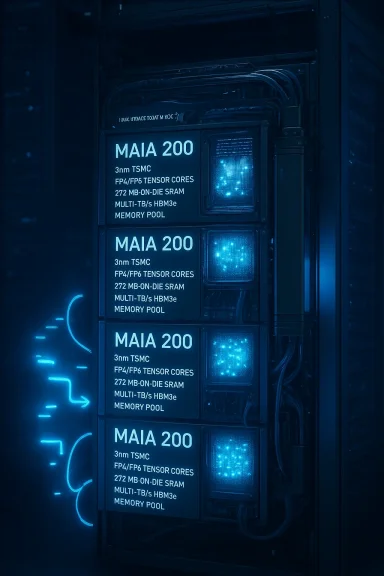
A glowing blue computer chip labeled MAIA 200 sits on a circuitry-filled motherboard.What Microsoft says Maia 200 is (headline claims)​

Microsoft’s public materials and press coverage present a concise set of headline figures. Taken together they form the company’s value proposition for the chip:
  • Process and transistor budget: Built on TSMC’s 3‑nanometer class process; Microsoft cites a transistor budget “over 140 billion” in multiple communications.
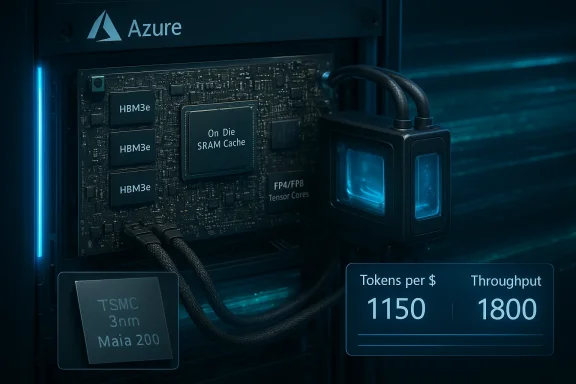
  • Precision and compute: Native tensor hardware optimized for narrow‑precision inference (FP4 and FP8) and vendor‑stated peak throughput of >10 petaFLOPS (FP4) and >5 petaFLOPS (FP8) per accelerator.
  • Memory subsystem: 216 GB of HBM3e on‑package with roughly 7 TB/s aggregate bandwidth, plus about 272 MB of on‑die SRAM for fast staging and caching.
  • Thermals and power: A SoC thermal envelope in the neighborhood of ~750 W (Microsoft describes rack cooling and liquid/closed‑loop arrangements).
  • Interconnect and fabric: A two‑tier, Ethernet‑based scale‑up fabric with a Microsoft‑designed Maia transport layer exposing ~2.8 TB/s bidirectional dedicated scale‑up bandwidth per accelerator and the ability to form collectives across thousands of accelerators (Microsoft cites clusters up to 6,144 accelerators).
  • Software and tooling: A preview Maia SDK with PyTorch integration, a Triton compiler, optimized kernel libraries, and a low‑level programming language (NPL) plus simulators and cost‑calculator tools to ease model porting.
  • Business claim: Microsoft states the Maia 200 is “the most efficient inference system Microsoft has ever deployed,” offering about 30% better performance‑per‑dollar for inference than the latest generation of hardware in its fleet.
These are the load‑bearing vendor claims. Independent outlets have reported the same numbers and contextualized them against competitors, but most numbers so far are manufacturer‑provided and should be treated as vendor claims until independent benchmarks and workload‑level studies appear.

Overview of architecture: where Maia 200 aims to win​

Memory‑first design​

At the heart of Microsoft’s argument is memory locality — that inference for large language models is bound more by moving bytes than by raw FLOPS. Maia 200’s package emphasizes a large, high‑bandwidth memory pool plus substantial SRAM to stage hot weights and KV caches, reducing trips to slower storage or cross‑device fetches.
  • Why it matters: In autoregressive generation, the model repeatedly accesses weights and large KV caches; keeping as much of that state near the compute fabric reduces tail latency and device fan‑out per token. Maia’s 216 GB HBM3e + 272 MB SRAM is explicitly engineered for that pattern.

Low‑precision native compute (FP4 / FP8)​

Maia 200 targets aggressive quantization in hardware: native FP4 and FP8 tensor units dramatically increase math density compared with wider formats. That yields greater tokens‑per‑watt and tokens‑per‑dollar for models that tolerate lower precision.
  • Tradeoffs: Aggressive quantization increases software complexity. Not all models maintain identical quality under 4‑bit quantization; robust quantization flows, fallback paths, and per‑model validation are required to preserve accuracy and safety. Microsoft’s SDK and simulation pipeline are designed to help with that transition.

Ethernet‑based scale‑up fabric​

Instead of relying on proprietary fabrics like InfiniBand/NVLink, Microsoft built a two‑tier scale‑up network over commodity Ethernet with a custom Maia transport and integrated NICs.
  • Claimed benefits: Economics (Ethernet at massive scale is very cost‑effective), standardization, and the ability to program consistent collectives across trays and racks.
  • Key risk: Collective operations at hyperscaler scale are sensitive to congestion, tail behavior, and failure modes; delivering InfiniBand‑like determinism on Ethernet will require careful engineering and operational validation.

Cross‑checking the reporting: verification and caveats​

I verified Microsoft’s primary claims against the company’s official blog post and multiple independent trade outlets.
  • Microsoft blog (official technical announcement) documents the core specs: TSMC 3 nm, 216 GB HBM3e, 272 MB SRAM, >10 PFLOPS FP4, >5 PFLOPS FP8, 750 W SoC envelope, Ethernet scale‑up design, and the SDK preview. These core claims are repeated in the official blog.
  • Independent coverage from outlets such as The Verge and DataCenterDynamics (DCD) reprints the headline figures and focuses assessment on what matters in practice: memory bandwidth, interconnect, and quantization strategy. These outlets largely corroborate the vendor narrative while noting the need for workload measurements.
  • Industry commentary emphasizes the economics: if Maia 200 truly delivers ~30% perf/$ improvements on production inference workloads, that advantage compounds rapidly at hyperscale and reshapes cost dynamics. Analysts also caution that transistor counts and peak PFLOPS are vendor‑reported marketing metrics and that real performance depends on end‑to‑end system behavior.
Caveats and unverifiable points:
  • Transistor count and peak FLOPS: These are vendor‑provided specs; independent measurement of transistor count or effective token throughput requires teardown or benchmark studies that are not yet public. Treat the numbers as credible design intentions but vendor statements, not neutral measurements.
  • 30% performance‑per‑dollar: Microsoft’s perf/$ claims are central to the business case, but they are sensitive to workload mix, scheduling, and Azure pricing models. Independent workload evaluations are needed to confirm this advantage across a representative set of production models.
  • Deployment scale: Microsoft says Maia 200 is deployed in US Central and will expand. Roll‑out cadence, global availability, and region‑by‑region capacity are operational decisions that will determine how meaningful the advantage is for external customers.

Strengths: where Maia 200 could truly move the market​

  • Purposeful systems engineering: Microsoft built Maia 200 as a joint play of silicon, memory, rack mechanics, network, and runtime. That systems perspective matters; performance at hyperscale is a platform problem, not just a die problem.
  • Memory and bandwidth focus: By prioritizing on‑package HBM3e and on‑die SRAM, Maia 200 addresses the principal bottleneck for inference: data movement. For large models, that can reduce device fan‑out and latency spikes.
  • Cost economics: A persistent, demonstrable ~20–30% improvement in inference perf/$ at cloud scale would translate into meaningful margin expansion for MS products and potentially lower prices for customers — a lever that hyperscalers can and do apply strategically.
  • Software stack and openness: Early SDK access, PyTorch integration and Triton support signal Microsoft’s intent to reduce friction for model porting — a necessary move if customers are to adopt Maia‑native hosting.
  • Operational control and supply diversification: Owning a first‑party accelerator reduces Microsoft’s dependence on any single vendor for inference capacity and gives it ng and price volatility in GPU markets.

Risks and open questions​

  • Quality vs. quantization: Aggressive FP4 adoption requires mature quantization tooling and extensive per‑model validation. Some models will adapt easily; others (safety‑critical or high‑precision generative systems) may degrade without careful work. This is a non‑trivial migration for many enterprise models.
  • Fabric and scale challenges: Delivering deterministic collectives across thousands of accelerators using Ethernet and a custom transport is ambitious. Production behavior under partial failures, noisy neighbors, and mixed workloads will be the acid test.
  • Supply chain and ramp: Manufacturing on TSMC’s 3 nm node enables density but comes with yield and capacity constraints that can affect ramp speed and geographic expansion. Microsoft will need to manage fab allocations and yield curves if it hopes to scale beyond pilot regions quickly.
  • Ecosystem inertia: Nvidia’s GPUs, CUDA ecosystem, and marketplace momentum are significant. Even with better perf/$ on narrow cases, persuading broad swathes of customers to port models and workflows — or to switch hosting choices — takes time. Microsoft will have to match or exceed developer ergonomics to make headway.
  • Vendor‑reported metrics: Peak PFLOPS and transistor counts are useful design signals but not proof of system performance. Independent benchmarks and head‑to‑head workload comparisons will be required to validate Microsoft’s claims across representative inference workloads.

What this means for IT leaders, developers, and WindowsForum readers​

If you manage AI infrastructure or rely on Azure for model hosting, Maia 200 introduces both opportunity and a short action checklist.
  • For cloud architects: Start planning how you would evaluate Maia‑backed instances once they’re available in your preferred regions. Prioritize realistic inference workloads and measure end‑to‑end latency, tail percentiles, and cost per token — not just peak FLOPS.
  • For ML engineers and devs: Begin assessing model quantizability. Run controlled experiments porting models to FP8/FP4 simulation backends, and validate output fidelity, calibration, and safety metrics. Use the Maia SDK simulator (preview) where available to measure performance and catch correctness issues early.
  • For procurement and finance teams: Watch Azure region rollouts and pricing closely. A 20–30% reduction in inference TCO can change hosting decisions — but only if the performance and availability match your needs. Consider staged migrations for high‑volume endpoints.
  • For operations and SREs: Prepare for different failure and observability modes. Maia’s Ethernet scale‑up fabric and dense trays will require new runbooks for network congestion, device restart policies, and thermal/cooling maintenance. Invest in telemetry that tracks per‑token cost and quality metrics.
Practical immediate steps (numbered):
  • Request access to the Maia SDK preview if your models are latency‑sensitive or run at scale.
  • Run a quantization fidelity study (FP8 and FP4) on a representative sample of models.
  • Build a workload comparison framework that measures tokens/second, tail latency (95th/99th percentile), and tokens‑per‑dollar.
  • Simulate network collectives and isolate failure patterns to evaluate how model sharding behaves in production.
  • Keep a close eye on Azure regional availability and on Microsoft’s public benchmark papers or third‑party tests.

Competitive and market implications​

Maia 200 is another clear signal that major cloud providers are moving to verticalize key parts of the inference stack. Amazon, Google, and others have been pursuing similar first‑party silicon strategies; Microsoft’s contribution is notable because it publicly commits a full systems approach — chip, package, network, racks, cooling and SDK.
  • For Nvidia: Maia 200 does not obviate Nvidia’s role in training or many inference scenarios, but it raises competitive pressure on inference economics and regional capacity allocation. Wall Street and markets have already signaled that Nvidia will remain central to the sector’s growth, but hyperscalers controlling part of the inference stack changes negotiation dynamics.
  • For enterprise customers: More choices at the infrastructure layer can mean better pricing, but it also increases complexity in procurement and portability decisions. Enterprises must balance performance gains against engineering and validation cost of migration.
  • For the broader ecosystem: If Maia’s Ethernet scale‑up fabric works at scale, it could shift how datacenter interconnects are engineered for AI workloads — making commodity networking more central to high‑performance clusters and reducing reliance on specialized, proprietary fabrics.

Verdict and final assessment​

Maia 200 is a consequential, well‑engineered gamble by Microsoft: a systems‑level solution that targets the economics of inference where hyperscalers feel the most pain. The chip’s memory heavy architecture, narrow‑precision compute, and novel Ethernet scale‑up fabric are logical choices for inference density — and Microsoft’s integration of SDKs and runtime tooling reduces friction for adoption.
That said, the most important caveats are operational and empirical: vendor‑reported peak metrics and perf/$ statements must be validated with independent, workload‑level benchmarks. The risk profile centers on quantization fidelity, the real‑world behavior of the Ethernet scale‑up fabric at cluster scale, and the operational realities of ramping a 3 nm product in volume.
For WindowsForum readers: treat Maia 200 as an early, high‑potential platform for inference hosting. Start the technical work now — quantify model readiness for FP8/FP4, build reliable benchmarks, and prepare operational playbooks — because if Microsoft’s perf/$ claims hold across your workloads, Maia 200 will change how Azure pricing and AI hosting choices are evaluated.
Maia 200 is not the end of Nvidia’s era, but it is a meaningful, practical counterweight. The next months of independent benchmarks, Azure region rollouts, and developer adoption will decide whether Maia 200 becomes a defining infrastructure play or a strategically valuable step in a longer first‑party silicon journey.


Source: Tbreak Media Microsoft Maia 200: AI chip to cut Azure costs | tbreak
Source: Technetbook Microsoft Azure Maia 200 AI Accelerator Unveiled Using TSMC 3nm Process for Inference
 

Microsoft has announced Maia 200, a purpose-built AI inference accelerator that the company says will give Azure a material cost and performance edge for running large language models and other production inference workloads, promising multi-petaFLOPS low-precision throughput, a high-bandwidth memory subsystem, and cloud-native systems engineering designed for rapid datacenter deployment.

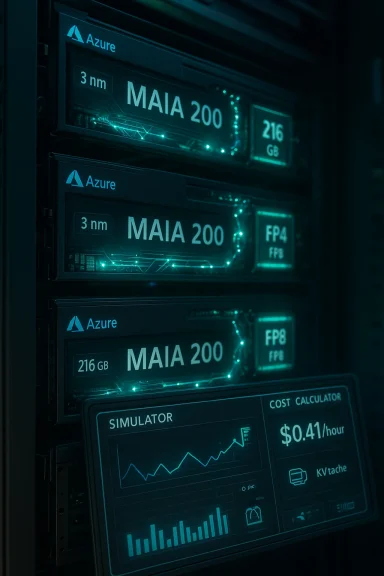
Blue-lit sci‑fi server rack labeled MAIA 200 with glowing circuitry.Background​

Microsoft’s Maia program began as an in‑house effort to reduce reliance on third‑party accelerators and to optimize the economics of large‑scale AI services. The new Maia 200 is positioned as a second‑generation design focused specifically on inference: token‑generation, low‑latency serving, and cost‑efficient delivery of large models in production. Microsoft frames Maia 200 as part of a heterogeneous Azure fabric that mixes its own accelerators with third‑party GPUs and other silicon for maximum flexibility.
The timing is strategic. Cloud hyperscalers are racing to own more of the stack—from chips to software—to control costs, differentiate services, and tune hardware for internal and customer workloads. Microsoft’s public announcement follows in the footsteps of Amazon’s Trainium and Google’s TPU lines, and it arrives at a point when inference economics (tokens per dollar, sustained latency under load) matter as much as raw training throughput.

What Microsoft is claiming: the headline specs​

Microsoft’s official technical description emphasizes three classes of capability: compute, memory/movement, and system integration.
  • Compute: Maia 200 ships with native FP4 and FP8 tensor compute, delivering over 10 petaFLOPS at FP4 and more than 5 petaFLOPS at FP8 per chip, targeted at dense inference workloads within a roughly 750 W SoC thermal envelope.
  • Memory & bandwidth: The chip pairs on‑die SRAM (Microsoft cites 272 MB) with a high‑bandwidth memory pool; Microsoft reports a memory subsystem that includes HBM3e with aggregate bandwidth in the terabytes‑per‑second class (7 TB/s is cited for the HBM interface) to keep low‑precision tensor pipelines fed.
  • Process node and transistor budget: Maia 200 is fabricated on TSMC’s 3‑nanometer node, and Microsoft states the die contains well over 100 billion transistors (the blog places the figure around 140 billion).
  • System throughput & networking: Microsoft describes a two‑tier scale‑up network on standard Ethernet with a custom transport layer and tight NIC integration, claiming per‑chip scale‑up bandwidth figures (for local and collective operations) and the ability to scale predictable collectives across large clusters of accelerators. The architecture uses local, direct links among accelerators within a tray and standard Ethernet for rack and cluster scaling.
These numbers are Microsoft’s published claims and form the foundation of its argument that Maia 200 is an inference‑first accelerator tuned for token‑generation cost and throughput. Independent third‑party benchmarks are not yet available publicly; Microsoft’s own performance claims are corroborated in contemporary reporting from multiple outlets but should be treated as vendor statements until independent tests emerge.

Deep dive: architecture and why Microsoft built Maia 200 this way​

Compute for inference: FP4 and FP8 focus​

Modern inference workloads increasingly use low‑precision datatypes—FP8 for larger models and FP4 for extremely dense throughput—because quantized compute reduces memory movement, power draw, and token cost without dramatically impacting quality when models and pipelines are designed for it. Microsoft explicitly targeted both datatypes in Maia 200’s tensor core design, claiming the chip is natively wired for FP4/FP8 to maximize throughput per watt for production serving. This reflects a broader industry shift toward aggressive quantization as the dominant cost lever for inference.

Feeding the compute: memory, DMA and on‑chip SRAM​

Microsoft emphasizes that FLOPS alone don’t win in production—data movement does. Maia 200’s standout architectural choices include a two‑tier memory strategy:
  • Large external pool (HBM3e) with multi‑TB/s aggregate bandwidth to sustain model weights and activation streaming.
  • Substantial on‑chip SRAM (272 MB) to stage activations, key/value caches, and reduce round trips to HBM for latency‑sensitive operations.
  • Specialized DMA engines and a NoC fabric to move narrow‑precision tensors efficiently.
These elements are intended to collapse token generation latency and increase utilization of the tensor cores, a pragmatic approach for inference clusters aimed at high tokens‑per‑second operation. Microsoft’s disclosure of specific SRAM numbers and TB/s bandwidth aligns with the direction many cloud vendors have taken: more on‑die scratchpad memory plus high‑bandwidth off‑die pools.

System‑level engineering: Ethernet, trays, and cooling​

Rather than relying on proprietary fabrics like InfiniBand, Microsoft designed Maia 200’s scale‑up transport to ride on standard Ethernet with a custom transport layer. The claimed advantages are cost predictability, simpler datacenter integration, and interoperability with Azure’s existing networking stack. Within a tray, accelerators are directly connected for low‑hop local collectives; beyond that, the Maia transport runs across racks and clusters with predictable collectives at scale.
Microsoft also called out systems engineering elements: a second‑generation liquid Heat Exchanger Unit for cooling high‑density racks, and native Azure control‑plane hooks for telemetry, diagnostics, and management. This turns Maia 200 from a standalone chip into a serviceable cloud appliance—important for reliability at hyperscale.

Performance claims, competition, and independent context​

Microsoft directly compared Maia 200 to rivals in its public messaging, claiming 3× FP4 performance vs. Amazon’s Trainium Gen 3 and FP8 performance above Google’s TPU v7. Those comparative statements are part of Microsoft’s positioning and were repeated by multiple outlets in their coverage. However, there are important caveats:
  • Vendor comparisons that cite raw FP4/FP8 FLOPS are useful but not decisive; real‑world inference performance depends heavily on memory subsystems, interconnects, software stacks, and model compatibility. Microsoft’s architecture choices (large on‑chip SRAM, custom DMA engines, Ethernet‑based transport) aim to turn FLOPS into delivered throughput, but independent workload benchmarks are necessary to validate the claim at scale.
  • Market watchers noted the announcement did not immediately unseat NVIDIA’s central role in both training and inference ecosystems; analysts and investors still expect heavy NVDA demand for a long time. Early market reaction, as reported, showed Nvidia’s stock broadly resilient despite Microsoft’s announcement. That underscores how difficult it is for a single hyperscaler to displace incumbents for many customers, even when it owns compelling first‑party silicon.
In short: Microsoft’s comparative claims are bold and repeated in major outlets, but the community should prioritize independent benchmarks and latency/cost measurements on representative inference workloads before treating raw FLOPS comparisons as definitive.

Practical implications for Azure customers and Microsoft services​

Where Microsoft will use Maia 200 first​

Microsoft says Maia 200 will be deployed initially to internal teams and Microsoft‑run services: the Superintelligence team for synthetic data generation and model iteration, Microsoft Foundry (their integrated platform for building AI apps), and Microsoft 365 Copilot. Microsoft also confirmed deployment in at least two U.S. datacenter regions (US Central near Des Moines, Iowa; US West 3 near Phoenix), with a gradual rollout across Azure regions thereafter.
For Azure customers, the important early questions will be:
  • Which instance families or SKU names will expose Maia 200 accelerators?
  • What are the pricing and tokens‑per‑dollar economics vs. existing GPU and TPU options?
  • How straightforward will it be to port existing PyTorch/Triton models to Maia 200, and what quality/perf tradeoffs will quantization require?
Microsoft has previewed a Maia SDK with PyTorch and Triton integration plus a low‑level programming language and optimized kernels, signaling that the company expects customers to port and tune models rather than rely on opaque, locked stacks. That is a pragmatic route to broader adoption if the tooling is well executed.

Token economics and latency considerations​

If Maia 200’s performance‑per‑dollar claims hold up in production, customers running high token volumes (chatbots, copilots, search, recommendation systems) could see meaningful cost reductions or capacity increases without raising budgets. At the same time, inference quality tradeoffs introduced by lower‑precision arithmetic (FP8/FP4) will necessitate model validation, recalibration, and potential re‑training or quantization‑aware fine‑tuning—work that Microsoft aims to make easier through its SDK and tooling.

Competitive landscape: how Maia 200 fits into the hyperscaler chip race​

Microsoft joins Google and Amazon in building first‑party silicon for inference. The strategic rationale mirrors their peers: control costs, optimize for internal models and services, and present differentiated cloud offerings to customers.
  • Google TPUs: Google’s TPU family has been refined over many generations for both training and inference with tight hardware/software co‑design. Microsoft’s claim that Maia 200 outperforms TPU v7 on FP8 should be evaluated in light of application‑specific benchmarks and the fact that Google has a mature compiler and software ecosystem targeted at its internal services and cloud customers.
  • Amazon Trainium: AWS has iterated on Trainium for both training and inference and ties the silicon tightly into EC2, SageMaker, and Neuron software. Microsoft’s FP4‑focused performance claim (3× Trainium Gen 3 at FP4) highlights a different design point—optimized throughput for very low‑precision inference. The value to customers will depend on porting effort and per‑token cost on representative workloads.
  • NVIDIA: Despite first‑party efforts by hyperscalers, NVIDIA remains the dominant supplier for many customers thanks to an extensive software ecosystem (CUDA, cuDNN, Triton), broad third‑party hardware availability, and market momentum in both training and inference. Microsoft’s Maia 200 is unlikely to immediately displace NVIDIA in all workloads, but it can reshape the economics of very large token volumes within Azure and give Microsoft leverage in procurement and product differentiation. Early market reaction suggested investors believe NVIDIA will remain central to AI infrastructure demand.

Risks, unknowns, and practical caveats​

Vendor claims vs. independent verification​

Microsoft’s performance and efficiency claims are compelling, but they are still claims. Until independent third‑party benchmarks appear—covering latency, tail latency under load, quantized model accuracy, and tokens‑per‑dollar on real workloads—enterprises and researchers should treat the specs as vendor‑issued targets rather than definitive proof. Microsoft’s published figures should be verified by the community as Maia 200 becomes accessible to external testers.

Supply chain and process node risks​

Maia 200 is built on TSMC’s 3 nm process. Advanced nodes can deliver density and power advantages, but they also introduce yield, sourcing, and cost dynamics that can complicate large‑scale rollouts. Historically, cutting‑edge processes constrain initial supply and raise unit cost until yields improve—factors Microsoft will need to manage carefully to realize the promised 30% cost‑performance improvement at scale. Earlier reporting showed Microsoft experienced delays on prior Maia silicon iterations; those programmatic risks can reappear with complex custom chips.

Software portability and developer friction​

Maia 200’s value to customers depends as much on software as silicon. Microsoft’s SDK promises PyTorch and Triton integration, but porting large, quantized models and getting acceptable accuracy at FP4/FP8 often requires engineering effort. Enterprises will weigh porting cost against token savings. If the tooling is robust and migration paths are simple, the adoption curve could be fast; if not, many customers will prefer the lower‑risk path of running on established GPU instances.

Operational and thermal realities​

A 750 W SoC TDP and dense racks carrying many accelerators require serious datacenter engineering. Microsoft has designed liquid cooling sidecars and claims broad deployability in both air and liquid environments, but customers and operators should expect practical constraints: energy costs, site power limits, and field serviceability considerations could influence where and how aggressively Maia 200 is deployed.

What to watch next: validation, availability, and pricing​

  • Independent benchmarks: Expect early tests from cloud researchers and industry analysts that will measure latency, throughput, quantized model accuracy, and real tokens‑per‑dollar economics. These will be decisive in validating Microsoft’s claims.
  • Commercial availability and SKUs: Microsoft needs to publish instance types, pricing, and migration guidance. The business case for customers hinges on tokens‑per‑dollar comparisons against GPU/TPU offerings in Azure and other clouds.
  • Software maturity and ecosystem adoption: The quality of the Maia SDK, PyTorch/Triton integrations, and community tooling will determine developer uptake. Microsoft must demonstrate that moving large models to FP8/FP4 on Maia 200 is predictable and preserves model quality.
  • Broader rollout and TSMC supply: How quickly Microsoft can expand Maia 200 beyond initial regions and replenish capacity will affect customer access and the competitive landscape. Watch for announcements on regional availability and enterprise previews.

Verdict: a pragmatic, high‑stakes play​

Maia 200 is a significant strategic move for Microsoft—an attempt to translate first‑party silicon into production cost advantages, tighter integration with Azure, and differentiated AI services. Its architecture is thoughtfully aligned to the economics of inference: low‑precision compute, abundant on‑chip memory, high aggregate bandwidth, and cloud‑native systems engineering. Microsoft’s claims about multi‑petaFLOPS low‑precision throughput, 272 MB of on‑die SRAM, and a 30% performance‑per‑dollar advantage make a compelling story, and they are supported by Microsoft’s published technical notes and broad contemporary reporting.
At the same time, important questions remain. The industry needs independent, transparent benchmarks on realistic workloads; the software migration story must be simple and well‑documented; and Microsoft must manage supply, cooling, and datacenter operational constraints to make the promise real for customers. Strategic announcements of this scale often shift buying conversations and procurement strategies, but market outcomes depend on execution in production contexts—not just on lab FLOPS.
For Azure customers, the prudent approach is to follow Microsoft’s rollout closely, test representative workloads on Maia instances as they become available, and quantify token economics and model quality tradeoffs before committing large production workloads. For developers and operators, Maia 200 is an invitation to engage early with Microsoft’s SDK and to help shape a new era of inference‑optimized cloud infrastructure—provided the promised tooling and transparency arrive in time.

Microsoft’s Maia 200 is not just another chip announcement; it’s an operational and economic bet on a future where hyperscalers co‑design silicon, systems, and software to bend the cost curve of AI. If the company can deliver sustained, verifiable token‑level cost advantages while keeping developer friction low, Maia 200 could meaningfully alter the calculus of cloud AI services. If not, it will still have value as an in‑house engine for Microsoft’s own AI products—but the broader market impact will be smaller and slower to materialize.

Source: National Technology News Microsoft launches chip to speed up inference workloads in Azure
 

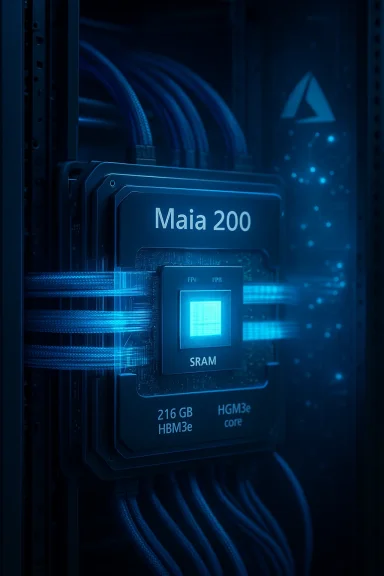
Azure MAIA 200 storage modules glow in a teal-lit server rack.
Microsoft’s Maia 200 lands as a purpose‑built inference accelerator that Microsoft says will become the silicon workhorse behind Azure’s next generation of deployed AI — promising massive low‑precision throughput, a memory‑centric design, and a software stack to make it practical for production models at cloud scale. m]

Background / Overview​

Microsoft unveiled Maia 200 as the successor to its in‑house Maia program, positioning it squarely as an inference‑first SoC optimized for running large language models and other high‑throughput AI services in production. The company frames the launch as a systems play: not just a chip, but an integrated combination of silicon, on‑pater networking, and a developer SDK intended to sit inside Azure’s fleet.
Why inference‑first? The economics of large‑scale AI have shifted: training is episodic, but inference is continuous and dominates the day‑to‑day cost of running commercial AI services. Microsoft argues that optimizing the stack for low‑precision token generation can materially reduce per‑ predictable capacity for products such as Microsoft 365 Copilot, Foundry services, and models hosted via Azure. Independent reporting echoes that strategic rationale.

What Microsoft announced — the headline claims​

Microsoft’s public materials and blog set out a concise set of headline specs and claims for Maia 200:
  • Fabrication on TSMC’s 3‑nanometer process and a transistor budget in the hundreds of billions.
  • Native low‑precision tensor hardware for FP4 (4‑bit) and FP8 (8‑bit) inference math.
  • Massive on‑package HBM3e capacity and bandwidth: 216 GB HBM3e with roughly 7 TB/s aggregate bandwidth, plus approximately 272 MB of on‑disoft.com]
  • Peak per‑chip low‑precision math: >10 petaFLOPS at FP4 and ~5 petaFLOPS at FP8 (vendor‑quoted).
  • A rack‑scale, Ethernet‑based scale‑up fabric and a Maia transport protocol intended to support low‑latency collective operations across many accelerators.
  • A previewed Maia SDK: PyTorch support, a Triton compiler, an NPL low‑level layer, a simulator, and a cost‑calculator to help teams port and cost‑model inference workloads.
Microsoft also states Maia 200 is already being deployed inside Azure’s US Central region and will expand to additional US regions, with early usage for Microsoft’s Superintelligence and Copilot operations. Independent outlets corroborate early Iowa deployment and imminent expansion.

Verifying the most load‑bearing technical claims​

The five claims that will determine Maia 200’s real impact are (1) process and transistor scale, (2) memory capacity and sustained bandwidth, (3) low‑precision throughput (FP4/FP8), (4) system‑level scale‑up/interconnect, and (5) claimed performance‑per‑dollar improvements. Each is vendor‑stated and needs cross‑checks.

1. Process node and transistor count​

Microsoft’s announcement places Maia 200 on TSMC’s 3 nm family and reports a transistor count in the 100+ billion range — figures that are consistent with the company’s blog and were repeated across press coverage. Modern hyperscaler silicon does use 3 nm to reach this transistor scale, but transistor counts and effective die area are vendor‑reported metrics and typically require independent analysis (die photos, process node verification, or foundry confirmation) before the community treats them as independently verified.

2. HBM3e capacity and memory bandwidth​

Microsoft’s specification — 216 GB HBM3e at ~7 TB/s — is explicit and was picked up by outlets that compared Maia 200 to AWS Trainium 3 and Google TPU v7. Independent writeups that reproduced Microsoft’s numbers make the same comparison, but system‑level sustained bandwidth (what matters to models) depends on runtime behavior, DMA paths, and how much of the HBM bandwidth is usable for steady inference pipelines. Treat the 7 TB/s figure as a manufacturer’s peak/aggregate figure; sustained throughput on real workloads can be lower.

3. FP4 / FP8 peak throughput​

Microsoft quotes >10 PFLOPS (FP4) and ~5 PFLOPS (FP8). Independent outlets have repeated these peaks and placed them in competitive context (e.g., claims of 3× Trainium Gen‑3 in FP4). Peak FLOPS are useful for rough comparisons, but they are idealized arithmetic measures — actual token throughput for LLM inference is constrained by memory access patterns, KV cache behavior, quantization overhead (converting higher‑precision weights or activations), and orchestration across devices. Multiple news outlets note these are vendor‑provided peaks requiring workload‑level validation.

4. Scale‑up fabric and the Ethernet choice​

Microsoft stresses a rack‑scale Ethernet‑based approach with a custom Maia transport, direct tray links among accelerators, and collective operations optimized for deterministic inference. Choosing Ethernet — rather than a classic HPC choice like InfiniBand — is a deliberate tradeoff favoring integration with datacenter switching, lower cost per port, and Microsoft’s experience operating Ethernet at hyperscale. Independent coverage confirms the two‑tier scale‑up fabric and stresses that the deterministic behavior of the transport will be critical to meet tail‑latency SLAs for interactive services.

5. Performance‑per‑dollar and “30%” claims​

Microsoft’s most commercially meaningful number is the claim of ~30% better performance‑per‑dollar versus the latest generation hardware in its fleet. That’s a fleet‑level economic claim that folds in procurement, power, datacenter density, and utilization assumptions. It’s plausible — given Maia 200’s memory‑centric design and low‑precision optimizations — but it’s also the most context‑dependent metric and one that enterprise customers should treat as a vendor hypothesis to validate using their own workloads. Independent reporting repeats the number and frames it as Microsoft’s economic pitch rather than an independently audited TCO study.

How Maia 200 compares with the alternatives​

Microsoft explicitly compares Maia 200 to AWS Trainium Gen‑3 and Google TPU v7 on certain precision metrics. Several independent articles reproduced those comparisons, usually acknowledging the vendor‑provided nature of the numbers.
  • On FP4 math, Microsoft claims Maia 200 offers roughly the throughput of Trainium Gen‑3.
  • On FP8, Microsoft positions Maia 200 above Google’s TPU v7 on peak FP8 throughput while pointing to roughly similar high‑bandwidth memory numbers versus TPU v7. Independent writeups repeat the claim but stress that TPU v7’s real‑world strengths vary by workload and precision mix.
Important context: those comparisons are published as single‑metric head‑to‑head numbers (FP4/FP8 throughput, HBM capacity/bandwidth). GPUs from NVIDIA still offer broader software and mixed‑precision maturity, and training workloads — which often require BF16/FP16 or FP32 — remain an area where general‑purpose GPUs excel. Maia 200 is explicitly a specialization: it may beat competitors on low‑precision inference economics, but that doesn’t automatically displace GPUs for training or every inferencing use case.

Architecture and software: the practical uplift​

Microsoft designed Maia 200 as more than a raw compute device. The architecture’s three co‑designed pivots are:
  • Memory locality: large HBM3e plus substantial on‑die SRAM to keep model weights and KV caches close to compute and reduce cross‑device choreography.
  • Narrow‑precision tensor math: native FP4/FP8 cores to shrink memory and arithmetic cost per token.
  • Deterministic datacenter transport: Ethernet‑based scale‑up topology with a Maia transport to support predictable collectives and tail‑latency control.
On the software side Microsoft is previewing the Maia SDK to ease migration: PyTorch integration, a Triton compiler, optimized kernel libraries, a low‑level NPL programming interface, a simulator, and a cost calculator. That toolset is critical because model owners must quantize carefully to FP8/FP4 and validate that quality, latency, and safety properties hold under narrower datatypes. Microsoft’s SDK is the company’s first line of defense against developer friction and porting costs.

Strengths — where Maia 200 could make a real difference​

  • Inference economics at scale. If Maia 200 delivers even a fraction of the promised 30% performance‑per‑dollar gain, the cumulative savings for token‑heavy services would be substantial and could reshape pricing for enterprise AI.
  • Memory‑centric architecture reduces system complexity. Large HBM3e and on‑die SRAM may allow bigger models to be served from fewer devices, reducing the orchestration overhead and cross‑device synchronization that inflates latency.
  • Product and risk diversification. For Microsoft, owning first‑party silicon reduces vendor lock‑in risk and provides procurement leverage when third‑party GPUs are constrained or expensive. Industry observers see this as a strategic hedge.
  • Operational alignment. The Ethernet‑first approach and tight Azure integration make it easier for Microsoft to deploy, manage, and instrument Maia‑backed racks at scale without reworking datacenter networking radically.

Risks and caveats — what to watch out for​

  • Vendor‑provided peaks aren’t the same as workload throughput. The quoted PFLOPS are peak numbers under idealized conditions. Real models will be constrained by memory access patterns, KV cache behavior, quantization overhead, and network collectives. Enterprises should require model‑level benchmarks on representative workloads before committing.
  • FP4 quantization risk. Moving production models into FP4 (4‑bit) is attractive for cost, but quantization can introduce subtle degradation in model behavior, hallucination rates, or instruction‑following fidelity. Extensive QA and fallbacks are required. Microsoft’s SDK will help, but customers must still validate.
  • Ecosystem and tooling lock‑in. Maia’s NPL and specialized kernel stack speed adoption inside Azure but create migration friction if customers want to run identical inference stacks across other clouds. Hybrid customers will need multi‑target tooling strategies.
  • Power, cooling and integration. A high‑density inference rack using multiple Maia devices will impose real demands on power delivery and cooling; different outlets estimate package TDPs in the high hundreds of watts (reports vary). Datacenter operators must plan for these systems holistically.
  • Supply and foundry risk. Maia 200 is built on TSMC’s 3 nm family — a scarce, high‑demand process node. While Microsoft has the scale and supply relationships to obtain capacity, foundry constraints are an industry risk that can blunt rollout speed or margin assumptions.

What this means for enterprises and WindowsForum readers​

For teams that run production LLMs or token‑heavy services, Maia 200 matters because it changes the inference options available inside Azure. But moving to Maia should not be a leap of faith — it should follow a structured validation plan:
  1. Benchmark representative inference workloads (token‑generation, streaming latency) on Maia‑backed instances in Azure when available.
  2. Measure quantization impact: run both FP8 and FP4 variants with validation suites that test instruction fidelity, safety filters, and hallucination metrics.
  3. Profile tail latency and concurrency: deterministic collectives and transport performance will be the difference between a happy user experience and a system that stalls under bursty load.
  4. Model performance per dollar: compute token TCO including power, rack density, and expected utilization — don’t rely solely on vendor fleet‑level percentages.
  5. Plan for hybrid portability: keep an abstraction layer in your inference layer so you can fall back to GPUs or alternative accelerators if you need portability across clouds.
These steps are practical and intended to protect production SLAs while giving teams the chance to capture any cost benefits Maia 200 delivers.

Strategic implications for the cloud market​

Maia 200 is more than a product release — it’s a signal. Hyperscalers are investing in vertical integration of silicon, racks, and software to control cost and capacity. Microsoft is following Google and Amazon down this path, and each vendor uses different tradeoffs: Google’s TPUs target mixed training/inference needs and integrate tightly with Google Cloud software; AWS places emphasis on Trainium/Vaniium for different workloads. Microsoft’s bet is that inference specialization — especially at low precision — will unlock the largest near‑term economic returns for cloud AI services. Analysts and reporters agree that this intensifies competition rather than ends NVIDIA’s leadership: the market will be more heterogeneous, and GPUs will remain central for many training tasks and certain inference scenarios.

Final assessment — cautious optimism​

Maia 200 is a substantive engineering achievement: a 3 nm inference SoC with massive on‑package memory, native FP4/FP8 compute, and datacenter‑oriented networking and software. If Microsoft’s claims about memory locality and performance‑per‑dollar hold in independent workload tests, Maia 200 could become a foundational part of Azure’s inference fabric and materially lower the cost of deployed AI services. Early independent reporting corroborates the core specifications, while also reminding customers that vendor‑provided peaks and comparative claims require validation on real workloads.
For WindowsForum readers — system administrators, cloud architects, and enterprise AI engineers — the practical takeaway is clear: Maia 200 is worth testing as soon as preview instances are available, but don’t replace a production inference stack without thorough model‑level validation, quantization QA, and a clear rollback plan. The future of inference hardware will be heterogeneous; Maia 200 is Microsoft's powerful, well‑integrated bid to be a central pillar of that future.

Conclusion: Maia 200 advances the inference‑first argument in cloud AI infrastructure by pairing low‑precision math with a memory and network architecture designed to keep large models local to compute. That makes it one of the most consequential hyperscaler silicon launches to date — promising tangible economic upside for Microsoft and its customers while leaving verification, interoperability, and long‑term ecosystem effects as the next critical battlegrounds.

Source: CXOToday.com Microsoft Launches New Chip Maia 200 for Enhancing AI Inference
 

Microsoft has quietly moved from experiment to production: the company’s Maia 200 inference accelerator is now live in Azure and — by Microsoft’s own account — represents a major step toward lowering the token cost of large-model AI by optimizing silicon, memory, and networking specifically for inference workloads.

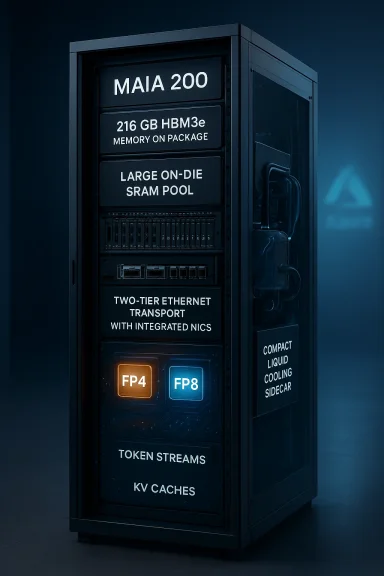
Blue-lit data center rack featuring Maia 200 SRAM module with HBM3e core.Background / Overview​

Maia started as an internal Microsoft program to explore first-party silicon and systems for AI; Maia 200 is the second-generation, inference‑first product intended for broad deployment across Azure to support Microsoft 365 Copilot, Microsoft Foundry, hosted OpenAI models, and internal model-development pipelines. The public announcement frames Maia 200 as a systems play — not just a chip — combining a TSMC 3 nm SoC, large on‑package HBM3e, on‑die SRAM, an Ethernetc, and a Maia SDK for model portability.
That positioning is purposeful. The cloud economics of AI have shifted: training dominates headlines and one‑time costs, but inference — every prompt, every token returned to users — creates the recurring bill that scales directly with product usage. Microsoft’s thesis is simple: re around low‑precision inference math and data‑movement, you can materially reduce tokens‑per‑dollar and ensure predictable capacity at hyperscaler scale.

Maia 200 at a glance: the headline specs Microsoft publishes​

  • Fabrication: TSMC 3 nm process (N3).
  • Transistor budget: vendor‑reported “over 140 billion” transistors.
  • Native low‑precision compute: hardware FP4 and FP8 tensor cores.
  • Peak (vendor) throughput: >10 petaFLOPS at FP4 and >5 petaFLOPS at FP8 per chip.
  • Memory: 216 GB HBM3e on‑package with ~7 TB/s aggregate HBM bandwidth.
  • On‑die SRAM: ~272 MB to act as large low‑latency scratch.
  • Thermal envelope: ~750 W SoC TDP per accelerator package.
  • Scale‑up network: integrated Ethernet‑based transport with ~2.8 TB/s bidirectional dedicated scale‑up bandwidth and the ability to scale collof accelerators.
  • Deployment: announced initial rollout in Azure US Central (Iowa), expanding to additional U.S. regions.
These are Microsoft’s public numbers. Independent outlets and Microsoft community posts have reiterated the same claims but — as with any hyperscaler silicon announcement — many of the most consequential metrics remain vendor‑stated pending independent benchmarks.

Why Microsoft built Maia 200: inference economics and system tradeoffs​

Inference-first, not training-first​

Microsoft explicitly designed Maia 200 for inference — especially reasoning models where throughput at low precision matters more than high‑precision FP32/bfloat training performance. That constraint yields a different optimization surface: prioritize memory proximity, deterministic collectives, predictable latency tails, and the ability to serve more tokens per watt and per dollar.

Memory and data movement dominate token throughput​

Transformers and long‑context models are frequently memory‑bound during generation: the model needs timely access to weights and KV caches, and memory fetches (or cross‑device sharding) kill latency and utilization. Maia 200’s big bet is that adding a two‑tier memory hierarchy — large HBM3e on package plus substantial on‑die SRAM — reduces off‑die trips and the number of devices needed to serve a single token, improving effective tokens/sec in production.

Low‑precision math as an efficiency lever​

FP8 and FP4 are now practical for many inference use cases. Microsoft places native hardware emphasis on both, claiming much higher FP4/FP8 throughput versus competitor silicon on like‑for‑like narrow‑precision metrics. This enables dense throughput at lower memory and arithmetic cost — but it shifts risk to quantization tooling and model‑quality evaluation.

Architecture deep dive: what makes Maia 200 different​

Tens of billions of transistors, but the story is memory and fabric​

The Maia 200 die (vendor‑reported) pushes into the 100–150B transistor range on TSMC’s N3 node, which allows dense arrays of narrow‑precision tensor units and large on‑die SRAM regions. That transistor budget matters because Maia isn’t chasing raw mixed‑precision training FLOPS; it is placing silicon where inference stalls occur — caches, DMA units, and NoC buffers — to reduce off‑chip traffic.

On‑package HBM3e + big on‑die SRAM​

216 GB of HBM3e with ~7 TB/s aggregate bandwidth is the marquee memory stat Microsoft uses to argue Maia can keep big models local and reduce sharding. The ~272 MB of on‑die SRAM is unusually large for an accelerator and functions as a hot‑weight/activation cache and as a buffer for collective primitives, lowering the need for frequent HBM accesses and network hops during inference. Those combined choices are what Microsoft says enable better latency and utilization for token generation.

Native FP4 / FP8 tensor cores​

Narrow‑precision tensor cores are first‑class citizens on Maia 200. Microsoft publishes peak FP4 and FP8 petaFLlative compute density for quantized inference; those numbers are not directly comparable to mixed‑precision BF16/FP16 training metrics used for GPU comparisons, but they are meaningful within the narrow‑precision inference domain.

Ethernet‑based scale‑up fabric and Maia relying exclusively on specialized fabrics like proprietary InfiniBand variants, Microsoft built a two‑tier scale‑up design over commodity Ethernet with a bespoke Maia transport. The design ties tight NIC integration and deterministic collective protocols to reduce the penalty of packetized fabrics at scale while keeping cost and procurement advantages of industry standard networking. Microsoft says this supports collections across thousands of accelerators while keeping communication local inside trays where possible.​


Cross‑checks and corroboration: what independent coverage confirms​

Multiple industry outlets and Microsoft community posts echo the announcerocess, the focus on FP4/FP8, the large HBM3e footprint, the on‑die SRAM, the 750 W envelope, and the initial Azure region rollout. Publications that reviewed the announcement emphasize the same vendor numbers while correctly noting they are vendor statements pending independent testing.
Analysts have also framed thestrategic expansion of hyperscaler‑owned silicon to control inference costs and supply constraints, similar to earlier efforts by Amazon (Trainium) and Google (TPU families). Those outlets underline the industry pattern: hyperscalers now build vertical pipelines (silicon + racks + runtime) to optimize economics for production AI.

Strengths: where Maia 200 looks compellingference optimization.** Maia 200’s explicit tradeoffs for inference — memory proximity, narrow‑precision math, predictable collectives — align with the real cost drivers for cloud token generation. That targeted approach can yield genuine tokens‑per‑dollar and tokens‑per‑watt advantages when models and pipelines are quantization‑aware.​

  • Memory-first architecture. The HBM3e + on‑die SRAM combination directly addresses model sharding and tail‑latency problems that plague long‑context serving. Keeping more of the working set local reduces device count per request and simplifies orchestration.
  • Ecosystem pragmatism. Microsoft ships a Maia SDK with PyTorch integration, a Triton compiler path, optimized kernels and a low‑level NPL language to ease porting. That software focus improves adoption odds compared to silicon that arrives without a robust runtime story.
  • Operational leverage. Rolling Maia into Azure gives Microsoft control over unit economics on high‑volume services like Copilot and hosted OpenAI models — areas wheage gains in cost efficiency compound into large dollar savings.

Risks, tradeoffs, and open questions​

  • Vendor‑stated performance figures need independent validation. Peak FP4/FP8 PFLOPS and the headline “30% better performance‑per‑dollar” claim are Microsoft metrics that depend heavily on workload shape, quantization strategy, and orchestration. Expect variability when third‑party benchmarks and customer workloads are measured. Treat these numbers as hypotheses to validate.
  • Quantization and model fidelity. Aggressive FP4/FP8 usage requires robust quantization tooling, post‑training quantization strategies, and fallbacks for quality‑sensitive tasks. Some models — particularly safety‑critical or highly precise instruction‑following agents — may suffer without careful adaptation. Model owners must benchmark accuracy vs cost tradeoffs thoroughly.
  • Software maturity and portability. Despite an SDK preview, migrating existing production setups to a specialized inference fabric introduces integration and operational complexity. Differences in numerical behavior, kernel maturity, and debugging tooling can slow adoption. Expect an initial period of experimentation and selective traffic shifting.
  • Ecosystem and market implications. Maia 200 increases hyperscaler diversity, but it is not a full replacement for general‑purpose training GPUs. Organizations that need training elasticity will still rely on general‑purpose accelerators. Maia’s largest impact will be on where and how inference is run at hyperscale.
  • Thermal and power operations. A 750 W TDP per accelerator implies significant cooling and power provisioning considerations at rack scale. Microsoft is deploying Maia with specialized trays and rack integrations; third‑party customers must assess regional availability and operational readiness.
  • Supply and strategic dependence. Although Maia reduces Microsoft’s relative dependence on third‑party accelerators, it also increases dependence on TSMC foundry capacity and the company’s own hardware roadmap. Hyperscaler chip programs themselves become strategic choke points in supply chains.

Practical guidance for IT teams and WindowsForum readers​

If you run models or are planning to migrate inference workloads to Maia‑backed Azure instances, follow a disciplined evaluation plan:
  • Run accuracy and fidelity tests against representative prompt distributions.
  • Evaluate full‑stack outputs post‑quantization; test instruction following, hallucination rates, and safety filters.
  • Measure latency a50, P95, P99) under real request mixes.
  • Tail behavior often hides cross‑device and network stalls that synthetic microbenchmarks miss.
  • Compute token cost and TCO.
  • Use real‑world traffic and retention patterns to estimate per‑token pricing vs current GPUs (include power, networking and orchestration overheads).
  • Test scale behavior with realistic batch sizes and multi‑session workloads.
  • Validate Microsoft’s collective primitives and the Maia transport under suidate fallback strategies and hybrid deployments.
  • Consider a hybrid fleet that uses Maia for high‑volume, low‑precision paths and GPUs for high‑precision or training tasks.
  • Engage with the Maia SDK/preview early.
  • Use the Triton compiler, PyTorch tooling, and the simulator to pre‑test quantization and performance tradeoffs before moving production traffic.
These steps will help determine whether Maia’s vendor‑stated advantages materialize for your specific models and business constraints.

Competitive and market implications​

Maia 200 amplifies a clear industry trend: hyperscalers are vertically integrating silicon to control inference economics. Microsoft joins Amazon (Trainium) and Google (TPU family) in fielding first‑party silicon tailored to cloud services, but each provider chooses different design tradeoffs: Microsoft emphasizes memory locality and Ethernet‑scale fabrics; AWS and Google favor different mixes of training/inference balance and interconnect choices. The net effect is more choice for enterprises and more pressure on general‑po justify premium pricing for inference.
Street and analyst reaction is nuanced: Maia is strategically important for Microsoft’s margins and capacity control, but it is unlikely to displace the broader GPU ecosystem overnight. Capital spending on AI infrastructure remains large industry‑wide, leaving room for continued Nvidia relevance even as hyperscalers diversify. Recent market commentary highlights that Maia’s launch is a competitive shot across the bow — important, but not a categorical market realignment.

What to watch next​

  • Independent benchmarks from reputable labs measuring end‑to‑end token throughput, latency tails, and per‑token cost versus current GPU fleets. Until these appear, treat the vendor figures as preliminary.
  • Wider region rollouts and availability of Maia‑backed instance SKUs in Azure and whether Microsoft exposes price/performance publicly for customers.
  • SDK maturity and open‑source tooling: how quickly model compilers, quantization toolchains, and community frameworks support Maia’s FP4/FP8 paths.
  • Real customer case studies showing net TCO benefits for production Copilot‑like services or hosted model vendors moving to Maia infrastructure.

Verdict: important, plausible, but not yet definitive​

Maia 200 is a consequential announcement that makes strategic sense for Microsoft: optimize infrastructure for the recurring cost center (inference), reduce dependence on third‑party accelerators, and co‑engineer silicon, memory, network, and software to win at tokens‑per‑dollar. The architecture choices — large HBM3e, big on‑die SRAM, native FP4/FP8 support, and an Ethernet‑based scale‑up fabric — target well‑understood bottlenecks in production LLM serving.
But important caveats remain. The most load‑bearing numbers (PFLOPS, 216 GB HBM3e, 272 MB SRAM, 30% performance‑per‑dollar) are vendor‑provided. Real validation requires independent benchmarks on practical models, careful quantization studies, and transparent cost comparisons under sustained production traffic. Until then, Maia 200 should be viewed as a promising, plausible step toward cheaper inference — one that organizations should evaluate pragmatically with their own workloads rather than assume universal gains.
For WindowsForum readers and enterprise architects, the pragmatic takeaway is clear: begin testing, plan hybrid deployments, and require workload‑level benchmarks before committing critical production traffic to any new accelerator. Maia 200 raises the bar for inference infrastructure; the hard work now shifts to proving the promise in real deployments.

Source: Computerworld Microsoft launches its second generation AI inference chip, Maia 200
 

Microsoft’s cloud team has unveiled Maia 200, a second‑generation, in‑house AI inference accelerator designed to cut the cost and power of large‑scale model serving while giving Azure a native alternative to third‑party GPUs. The chip, manufactured on TSMC’s 3‑nanometer node and built around low‑precision FP4/FP8 tensor engines, is being billed by Microsoft as their most efficient inference system to date — promising roughly 30% better performance per dollar than the company’s prior fleet while targeting orders of magnitude gains in inference throughput for generative AI services such as Microsoft 365 Copilot, Microsoft Foundry, and internal Superintelligence workloads.

Microsoft Azure server rack featuring a 3nm SoC and sea on-chip SRAM pool in blue glow.Background​

Cloud providers have been racing to tame the runaway costs of running large language models (LLMs) in production. Training these models still consumes huge pools of GPU cycles, but costs for inference — the continual, pay‑as‑you‑use stage where models respond to user prompts — now dominate operational budgets for many enterprises. Hyperscalers respond in two ways: buy more of the market’s fastest commercial accelerators (principally from Nvidia) or design custom silicon tuned to inference economics.
Microsoft’s Maia program began publicly in 2023 with the Maia 100 family and the Cobalt Arm server CPUs, signaling a long‑term bet on custom silicon, system integration, and new rack and cooling designs. Maia 200 is the next big step in that strategy: a purpose‑built inference SoC combined with system‑level networking and cooling innovations intended to maximize tokens‑per‑dollar and tokens‑per‑joule.

What Maia 200 is: a technical overview​

Maia 200 is positioned as a cloud‑scale inference accelerator, not a general‑purpose GPU for both training and inference. Its design choices emphasize memory bandwidth, precision‑optimized tensor compute, and rack‑scale networking for dense inference clusters.

Silicon and fabrication​

  • Maia 200 is fabricated on Taiwan Semiconductor Manufacturing Company’s (TSMC) 3‑nanometer process and contains well over 100 billion transistors (Microsoft’s public commentary cites a figure north of 140 billion).
  • The chip is a purpose‑built SoC aimed at inference, with a stated thermal design power (TDP) in the ~750 W range for the packaged accelerator — a number that places it in the high‑density, liquid‑cooled class of data center silicon rather than traditional air‑cooled server components.

Memory and data movement​

  • The Maia 200 design centers on a broad memory subsystem: Microsoft describes ~216 GB of HBM3e high‑bandwidth memory with aggregate bandwidth on the order of 7 TB/s, complemented by a large ~272 MB pool of on‑chip SRAM.
  • Microsoft emphasizes that throughput for token generation is limited as much by memory and data movement as by raw FLOPS, and Maia 200’s architecture uses a specialized DMA, on‑die SRAM, and a network‑on‑chip to keep tensors fed.

Compute formats and peak performance​

  • Maia 200 is optimized for low‑precision inference formats that dominate modern LLM serving: FP4 (4‑bit) and FP8 (8‑bit). Microsoft advertises peak figures such as >10 petaFLOPS FP4 and >5 petaFLOPS FP8 per chip.
  • The company also publicly compares Maia 200 to competitor silicon, citing 3× FP4 throughput vs. Amazon’s Trainium v3 and higher FP8 throughput than Google’s TPU v7 in Microsoft’s internal comparisons.
  • Microsoft frames the value not just as raw compute but as performance per dollar and tokens per joule, claiming the Maia 200 delivers ~30% better perf/$ than its current Azure hardware baseline.

Systems‑level innovations​

  • Maia 200 isn’t just a die; Microsoft couples the accelerator with a two‑tier scale‑up network and a custom transport layer that runs over standard Ethernet, enabling deterministic communication across clusters of accelerators (Microsoft cites scaling to clusters of up to 6,144 accelerators).
  • To handle dissipating heat at scale, Microsoft uses a second‑generation closed‑loop liquid cooling heat‑exchanger unit (a “sidecar” HXU) integrated with rack design to deliver production‑grade operation.
  • The company is shipping a Maia SDK (preview) with PyTorch integration, a Triton compiler, optimized kernels, and a Maia native programming language and simulator to help developers port and optimize models.

Why Microsoft built Maia 200​

Microsoft’s public answers revolve around three economic and strategic priorities:
  • Reduce dependence on third‑party accelerators. Large cloud providers pay premium rental rates for Nvidia hardware to run inference; owning tuned silicon reduces per‑token costs and gives Microsoft more control over capacity planning and pricing.
  • Optimize inference economics. Microsoft argues that improvements in inference efficiency — the cost to generate tokens in production — are where profit margins for cloud AI services are made or lost. Maia 200 targets exactly that operating point.
  • Differentiate Azure’s offering. Having first‑party silicon allows Microsoft to tune the end‑to‑end stack — from chip to cooling to Azure control plane — and sell a distinct value proposition to enterprise customers focused on predictable, cost‑optimized inference.
Beyond cost and differentiation, Microsoft also highlights ecosystem and supply‑chain partnerships — including long‑standing collaboration with Arm in server‑class CPU design, and foundry relationships with TSMC — to speed development and shorten time from prototype to fleet deployment.

Rollout and service integration​

Microsoft reports that Maia 200 is already in operation in the Azure US Central region (near Des Moines, Iowa), with additional US West deployments planned. The company says Maia 200 will be used to accelerate models running in Microsoft Foundry, Microsoft 365 Copilot, and internal Superintelligence projects, and that early internal validation allowed racks to be populated within days of first packaged silicon arrival.
Developer access will begin via the Maia SDK preview; integration with PyTorch and Triton is intended to make porting straightforward for teams that already build around those toolchains. Microsoft is pitching the combination of accelerator plus orchestration as a cloud‑native building block that can be scheduled and managed by Azure operators in the same way as other compute offerings.

Independent verification: what’s confirmed and what still needs testers​

Multiple independent publications and data‑center outlets reported on Microsoft’s announcement and corroborated the headline technical points: TSMC 3nm fabrication, the large HBM3e pool and bandwidth figures, the on‑chip SRAM magnitude, and the general FP4/FP8 orientation. Media reporting also confirms the initial US Central deployment and Microsoft’s claims that Maia 200 is aimed primarily at inference workloads.
That said, a few items deserve caution:
  • Vendor performance comparisons are inherently selective. Microsoft compares FP4 and FP8 throughput measurements against Amazon and Google silicon, but those claims reflect vendor‑provided metrics and internal validation. Independent third‑party benchmarks run across the same model families, thermal constraints, and real‑world serving stacks will be needed to validate the 3× and “better than” assertions under equivalent conditions.
  • The 30% performance‑per‑dollar improvement is a meaningful metric for customers, but its impact depends heavily on workload mix (batch vs. real‑time inference), model size, context window use, and the extent of additional model pre‑ and post‑processing. It’s plausible and supported by public statements, but only real customer billing and neutral benchmarks will prove the bottom‑line savings.
  • Microsoft’s claim that Maia 200 will serve OpenAI’s GPT‑5.2 in production is consistent with Microsoft’s close ties to OpenAI. However, public confirmation of breadth and depth of OpenAI’s usage of Maia 200 across live traffic — and whether OpenAI will continue to use alternative accelerators in parallel — has not been independently verified beyond Microsoft’s announcement.

Strengths: where Maia 200 could move the needle​

  • Inference‑centric design: Maia 200 is tuned for the economics of serving large models — low‑precision compute, massive memory bandwidth, and specialized data movement all address real bottlenecks in token generation.
  • Integrated systems approach: Microsoft’s advantage is vertical integration: co‑design of silicon, servers, racks, networking, cooling, and orchestration minimizes the gaps that inhibit raw compute-to-cost efficiency.
  • Developer tooling and portability: Early SDK support with PyTorch and Triton lowers the friction for model teams to test Maia 200, increasing the odds of adoption among Azure customers and internal teams.
  • Potential cost savings at scale: If the perf/$ and perf/watt claims hold in realistic workloads, enterprises that operate large inference workloads via Azure could see meaningful cost reductions or higher service quality for the same spend.
  • Competitive pressure on the market: Microsoft’s public comparisons and aggressive messaging increase pressure on other hyperscalers and chip vendors to improve inference efficiency — a net positive for customers over time.

Risks and unknowns: where to be cautious​

  • Benchmark selection and real‑world variability. Vendor claims often use narrow microbenchmarks or optimal payloads; real multi‑tenant cloud workloads, mixed precision fallbacks, and extra model logic (retrieval, reranking, hallucination checks) can reduce the headline advantage.
  • Power and cooling complexity. A 750 W TDP per chip implies significant rack‑level engineering and reliance on liquid cooling. Migration to Maia 200 at customer scale could be constrained by data center cooling limits and retrofitting costs, even if Microsoft manages that internally for Azure regions.
  • TSMC supply and geopolitics. Advanced nodes like 3 nm are capacity‑constrained and subject to geopolitical risk. Heavy hyperscaler ordering can create supply tension and schedule risk; dependence on one foundry also concentrates risk.
  • Software and tooling maturity. While Microsoft ships a preview SDK, robust production adoption requires mature compilers, optimized kernels, and wide community support — all of which take time to build compared with the mature CUDA/TensorRT ecosystem entrenched around GPUs.
  • Customer lock‑in and portability tradeoffs. Deep integration into Azure’s control plane is a double‑edged sword: it improves performance inside Azure but increases migration friction for customers who prefer multi‑cloud or on‑prem options.
  • Market dynamics for training vs. inference. Maia 200 targets inference; Nvidia and other vendors remain dominant for training workloads. Customers that require both training and inference efficiency may still run hybrid fleets — complicating procurement and operations.
  • Potential regulatory and export control impacts. Advanced AI accelerators and the ecosystems around them face evolving export control regimes and regional policy scrutiny; these external factors could affect availability.

What this means for customers, partners, and the cloud market​

  • For enterprises with heavy inference workloads (customer service bots, Copilot‑style assistants, real‑time analytics), Maia 200 promises a new option to reduce per‑token costs if they commit to Azure‑hosted deployment and can validate performance on their own workloads.
  • Independent software vendors and AI startups should view Maia 200 as an opportunity and a test: early adopters will get privileged access to cost/perf advantages but must invest in portability and benchmarking to avoid lock‑in.
  • For competitors, Microsoft’s move further tightens the race among hyperscalers to own hardware for the economics of AI — Google and Amazon continue to iterate on TPUs and Trainium, and Nvidia still dominates many training and mixed workloads.
  • For the chip ecosystem, Maia 200 signals that hyperscale first‑party silicon is no longer experimental. Expect a continued expansion of Arm‑centric server IP, broader packaging and chiplet strategies, and more foundry partnerships as the industry seeks efficiency gains.

Practical guidance for IT and cloud architects​

  • Benchmark first: Before committing workloads, run controlled benchmarks that replicate production inference pipelines (including retrieval, safety checks, and any secondary passes).
  • Evaluate the full stack: Measure not just raw latency and throughput but end‑to‑end cost per completed user session and the impact on downstream systems like telemetry and logging.
  • Plan for cooling and density: If you operate private data centers, assess your facility’s ability to host high‑density, liquid‑cooled racks; if you plan to rely on Azure, include questions about regional availability and SLAs.
  • Preserve portability: Use model abstractions that enable switching backends (e.g., ONNX, standardized Triton pipelines) to hedge against lock‑in risk and vendor discontinuities.
  • Watch software maturity: Tooling, kernel libraries, and compiler optimizations will mature over months; consider a staged approach that validates Maia 200 in non‑critical paths first.
  • Negotiate cloud economics: If you expect Maia 200 to materially lower your inference bills, use that potential as leverage when structuring long‑term Azure commitments.

Strategic implications for Nvidia, Arm, and the broader supply chain​

  • Nvidia remains firmly entrenched across many workloads; Maia 200 is an alternative for specific inference workloads rather than an outright replacement. The most likely near‑term outcome is heterogeneity: clouds will use a mix of first‑party chips and commercial GPUs depending on training vs. inference, latency, model size, and customer demand.
  • Arm’s Neoverse ecosystem and the Arm Total Design initiative are accelerating custom server CPU and accelerator integrations. Microsoft’s prior Cobalt designs and continued emphasis on Arm relationships indicate a strategic pivot away from single‑vendor dependency in server CPU and control planes.
  • Foundry partnerships are crucial; reliance on TSMC’s bleeding‑edge nodes can yield performance advantages but also forces hyperscalers into a tight queue for capacity and exposes them to single‑source supply risk.

Final analysis and what to watch next​

Maia 200 matters because it crystallizes a broader transition: cloud providers are now designing silicon intentionally for the economics of inference, not merely to chase peak FLOPS. Microsoft’s combination of a 3 nm SoC, massive on‑package memory, low‑precision FP4/FP8 compute, and rack‑scale networking shows a clear awareness of the practical constraints that determine AI’s total cost of ownership.
That said, headline claims — 3× FP4 vs. Trainium 3, FP8 above TPU v7, and 30% perf/$ — should be treated as vendor assertions until neutral third‑party benchmarks and broad customer billing data confirm them under production conditions. The most meaningful proof will arrive slowly: real customer usage patterns, independent lab tests, and Microsoft’s ability to scale Maia 200 across regions without running into cooling, supply, or software adoption bottlenecks.
For IT professionals and decision‑makers, the takeaway is pragmatic: Maia 200 is a compelling option for inference‑heavy workloads on Azure, but the rollout is a technology transition, not an instant wholesale replacement for existing fleets. Start testing, preserve portability, and demand transparent, workload‑specific cost projections from your cloud vendor before committing critical services.
Maia 200 is not just a chip: it’s a systems play. Its success will depend as much on software, racks, networking, and supply chains as on transistor counts. If Microsoft can translate the architecture into consistent, measurable savings for customers at scale, Maia 200 will be an important milestone in cloud AI economics — and a clear signal that hyperscalers intend to fight for every token‑dollar through silicon innovation.

Source: MEXC Microsoft introduces Maia 200 to reduce AI cloud costs and power use | MEXC News
 

Microsoft’s Maia 200 is the clearest signal yet that hyperscalers are moving from buying commodity GPUs to building inference-optimized silicon and systems — a tightly integrated hardware + software play aimed at driving down the marginal cost of serving large language models and other reasoning workloads. m])

A futuristic server rack labeled with specs and glowing FP4/FP8 chips.Background / Overview​

Microsoft announced Maia 200 as an inference-first accelerator that the company says is already running in production inside Azure’s US Central region and will power services such as Microsoft Foundry and Microsoft 365 Copilot, as well as hosted OpenAI models. The public pitch centers on three themes: aggressive low‑precision compute (FP4/FP8), a memory‑centric architecture (216 GB SRAM), and a systems-level scale‑up fabric built on standard Ethernet.
The Maia 200 story is not just a new chip spec release — Microsoft frames it as a fully integrated stack: silicon, racks, cooling, an Ethernet-backed transport layer, and an SDK (PyTorch + Triton + tooling) to help migrate inferure. This systems approach underpins Microsoft’s claim of roughly 30% better performance‑per‑dollar for inference workloads compared with its prior fleet hardware.
Two important editorial notes up front:
  • The most consequential numeric claims (PFLOPS, HBM capacity and bandwidth, transistor counts, perf-per-dollar) are uire independent, workload‑level validation before they should be treated as settled fact. Several reports and community posts repeat Microsoft’s numbers, but real-world throughput and cost depend heavily on software, model quantization, utilization and pricing.
  • Microsoft’s narrative explicitly positions Maia 200 as an inference accelerator rather than a training GPU — a deliberate trade that favors memory locality, deterministic collectives, and token cost over broad mixed-precision training FLOPS.
t is claiming: headline specs and system features
Microsoft’s own announcement lists a compact set of headline metrics; multiple independent outlets have repeated these claims. Taken together, the principal public assertions include:
  • Fabrication: TSMC 3‑nanometre (N3) process; vendor‑reported transistor budget north of 140 billion transistors.
  • Native low‑precision tensor cores: FP4 (4‑bit) and FP8 (8‑bit) are first‑class compute formats.
  • Peak compute (vendor‑stated): >10 petaFLOPS at FP4 and >5 petaFLOPS at FP8 per chip.
  • Memory subsystem: 216 GB HBM3e on package, with Microsoft citing roughly 7 TB/s of aggregate HBM bandwidth, plus ~272 MB of on‑die SRAM to act as fast staging/cache.
  • Power envelope: a packaged ~750 W SoC thermal design point (liquid‑cooled server-clgs.micro
  • Scale‑up networking: a two‑tier Ethernet-based transport with an integrated NIC and 2.8 TB/s bidirectional scale‑up bandwidth per accelerator and an architecture Microsoft says can scale collectives across up to 6,144 accelerators.
  • Software and portability: early SDK previews with PyTorch integration, a Triton compiler, optimized kernel library and a Maia low‑level programming language (NPL) to help port and optimize models on the new hardware.
These are the vendor’s engineering numbers and the architecture bullets that matter for real‑world inference. Independent press outlets confirm the early coverage, but they also signal the need to validate real workloads.

Deep dive: compute, memory and data movement (why Maia 200 is inference‑first)​

Native FP4/FP8 and the arithmetic density argument​

Maia 200 makes narrow‑precision arithmetic the primary lever for throughput: by making FP4 and FP8 native, Microsoft can increase arithmetic throughput per watt and reduce memory footprint per weight. In practice this means more weights and key/value (KV) cache can be kept closer to the compute units, improving token throughput for autoregressive generation.
The consequence: for workloads that tolerate quantization, FP4/FP8 pipelines can dramatically raise tokens‑per‑second and tokens‑per‑dollar. But this is conditional — careful quantization strategies, evaluation, and worst‑case fallbacks remain essential to maintain model quality. Independent coverage emphasizes that peak FLOPS reported by vendors are an upper bound; real token throughput depends on memory/IO, quantization overhead, and software maturity.

Massive HBM3e and on‑die SRAM: reducing the memory wall​

Where Maia 200 diverges from traditional GPU-first designs is its memory hierarchy: 216 GB of HBM3e with ~7 TB/s bandwidth and a large on‑die SRAM pool thae partitioned to serve cluster‑local and tile‑local needs. This redesign aims to collapse typical inference memory stalls by keeping working sets local and reducing cross‑device sharding for long‑context models.
Practically, this means:
  • Fewer devices per served model (less sharding) when a larger fraction of the weight/KV state fits on a single accelerator.
  • Reduced latency tails and higher utilization because small, hot data can stay in SRAM and not traverse HBM or network links.
  • Opportunities for software to explicitly pin and stage tensors into SRAM to produce deterministic latency behavior — an essential quality-of-service metric for production services.

Ethernet-based scale-up fabric: an operational tradeoff​

Instead of a proprietary fabric, Microsoft o custom Maia transport** and integrated NICs to scale collective operations. The pitch: commodity Ethernet reduces cost and operational friction while a software-defined transport delivers the deterministic collectives needed for inference. Microsoft claims scale-up bandwidth of 2.8 TB/s and scaling to thousands of accelerators for large-model serving.
This choice matters for datacenter operations: Ethernet is broadly deployable and staff‑friendly compared with specialized fabrics, but achieving GPU‑class latency and collective performance on Ethernet requires tight co‑design between NIC, transport, and runtime. The effectiveness of that co‑dal axis of third‑party validation.

System thinking: Maia as a platform, not just a die​

Microsoft repeatedly frames Maia 200 as a system-level product: silicon, trays, liquid cooling heat exchangers, control plane integration, and the SDK. That systems-first narrative is core to the company’s argument that Maia yields better TCO for inference at scale. Key system-level elements include:
  • Tray/rack designs (four Maia accelerators per tray with direct local links).
  • Second‑generation closed‑loop liquid cooling “sidecar” heat exchangers to manage the 750 W class TDP and rack density.
  • Deep integration with Azure’s telemetry, security and scheduling stacks so Maia racks can be treated as another accelerator class in the fleet.
That integration is Microsoft’s competitive strength: the company controls the hardware, the runtime, the deployment plane, and a massive in‑house demand signal (Copilot, OpenAI model hosting, Foundry). For enterprises already committed to Azure, Maia’s integration promises frictioficiency upside it delivers.

How Maia 200 stacks up against rival cloud accelerators (early comparative claims)​

Microsoft compares Maia 200 directly to other hyperscaler silicon in narrow-precision metrics:
  • Microsoft claims 3× FP4 throughput vs. Amazon’s Trainium Gen‑3 and **F Google’s TPU v7 on vendor-provided comparisons.
  • Tom’s Hardware and CRN echo the same comparative headlines while noting differences in memory capacity and bandwidth between Maia, Trainiumrd
Important caveats:
  • Comparisons are typically on narrow-precision metrics (FP4/FP8) and do not capture broader training workloads, mixed‑precision use cases, or real-world perf/$ with actual customer pricing and utilization.
  • Competing accelerators expose different tradeoffs: some designs favor broader BF16/FP16 training performance, or different memory/interconnect topologies. Which chip wins depends on the workload profile and the cloud operator’s pricing/availability.

Developer and enterprise implications: portability, tooling and migration path​

Microsoft is previewing an SDK intended to address one of the hardest parts of hyperscaler silicon: **softwrent SDK features announced:
  • PyTorch integration and a Maia runtime path.
  • Triton compiler support to ease kernel portability and optimization.
  • A Maia simulator and cost calculator for early workload validation and TCO modeling.
For enterprises and ML teams considering Maia, practical steps look like:
  • Identify inference workloads that are memory‑bound and tolerate quantization (e.g., many LLM serving workloads).
  • Use the simulator/cost calculator to estimate token cost and latency changes relative to current infra.
  • Run end‑to‑end tests: port model, evaluate FP8/FP4 quantization impact on accuracy and throughput, and measure tail latency under production-like load.
  • Validate failback/shanghai paths for operators that need higher-precision modes.
The upshot: developers will need to invest time in quantization validation and possibly model tuning. Microsoft’s SDK can ease this, but real migration value hinges on maintained model quality when moving to FP8/FP4 modes and on the pricing Azure offers relative to Nvidia-backed instances.

Strengths: what Maia 200 gets right​

  • Inference-first optimization: Focusing on token‑generation economics addresses the real recurring cost for production AI deployments. Maia’s architectural tradeoffs — memory proximity, narrow-precision arithmetic, and deterministic collectives — are aligned to that problem.
  • Large on‑package memory + SRAM: The combined HBM3e + on‑die SRAM approach directly targets the classic “memory wall” for large models, enabling larger working sets per accelerator ans-device traffic.
  • **Systems ining chip, cooling, network, and cloud control plane reduces integration friction and can accelerate time‑to‑value for Azure customers.
  • Operational pragmatism: Building the scale fabric on Ethernet lowers datacenter operapotential vendor lock‑in compared with proprietary fabrics — if Microsoft’s transport delivers on latency and collectives.

Risks, tradeoffs and unanswered questions​

  • Quantization quality risk: FP4 and aggressive FP8 use cases need careful quantization-aware training or post‑training calibration. For instruction‑following models and safety‑sensitive outputs, small numeric shifts can have outsized user impact. Enterprises must validate model fidelity under Maia’s numeric regimes.
  • Vendor‑reported metrics vs. workload reality: Peak FLOPS and memory numbers are useful engineering signals, but the most important yardstick is tokens per dollar under realistic SLOs. Independent, third‑party benchmarks and customer case studies will be the soft’s 30% perf/$ claim is promising but needs context on pricing, utilization and model mix.
  • Power and cooling at scale: A 750 W class SoC requires liquid cooling and rack redesign. While Microsoft is prepared for that, enterprises evaluating Maia-backed Azure offerings should account for any cost or regional availability constraints driven by cooling and deployment choices.
  • Ecosystem and portability: Maia’s SDK (PyTorch/Triton) eases migration, but porting complex model graphs and custom ops will still require engineering work. Some workloads may be better left on general-purpose GPUs that support a wider precision mix.
  • Competitive dynamics vs. Nvidia and other hyperscalers: Maia 200 is a strategic move to reduce reliance on third‑party accelerators. But Nvidia’s entrenched software ecosystem, broad training performance, and continued roadmap make immediate displacement unlikely. The real effect will be on marginal inference pricing and how cloud providers differentiate their AI offerings.
  • Security, multi‑tenancy and auditability: Running multiple tenants or third‑party models on new accelerators raises questions around isolation, telemetry and auditability. Microsoft’s integration into Azure’s control plane suggests they’re addressing these concerns, but independent audits will reassure enterprise customers.

Practical guidance for WindowsForum readers and IT leaders​

as hypotheses to be validated. Run production‑like experiments with your models before switching traffic.
  • Prioritize migration candidates: memory‑bound LLM serving, long‑context inference, and synthetic data generation pipelines are the most likely to benefit early.
  • Build a quantization validation checklist: accuracy delta by task, adversarial/regression tests, latency and tail SLOs, and emergency fallbacks to higher‑precision execution.
  • Use Microsoft’s Maia simulator and cost calculator in preview to model perf/$ and capacity planning; but always confirm with live trials.
A simple migration checklist:
  • Identify candidate models and workloads.
  • Simulate costs and expected token throughput with Microsoft’s tooling.
  • Port model and quantize in a test environment; run fidelity and stress tests.
  • Measure tail latency and SLO compliance under production‑like load.
  • Validate cost per token and make pricing comparisons with GPU-based clouds.
  • Stage traffic with progressive rollouts and monitor for quality regressions.

What to watch next (short to medium term)​

  • Independent benchmarks: Look for mixed‑workload third‑party tests that evaluate token cost, latency tails, and accuracy under FP4/FP8 on real models. Those will be the decisive datapoints for enterprise adoption.
  • Pricing and availability: Maia’s business impact depends on Microsoft’s Azure pricing for Maia‑backed instances and the geographic rollout cadence. Expect early access to be limited and priced to capture internal and strategic customer demand.
  • Ecosystem adoption: How quickly PyTorch/Triton workflows, third‑party frameworks and model vendors certify and optimize for Maia will influence how broadly it is used outside Microsoft’s internal workloads.
  • Competitor responses: AWS, Google, and other cloud providers will push their own accelerators and pricing adjustments — watch for reciprocal product announcements and pricing moves.

Conclusion​

Maia 200 is a consequential milestone in the cloud AI infrastructure arms race: a purpose‑built inference accelerator wrapped in a system stack that Microsoft controls end‑to‑end. The architecture’s emphasis on low‑precision compute (FP4/FP8), unusually large on‑package memory, and Ethernet‑based scale‑up networking directly targets the economics of token generation — the recurring cost that now dominates deployed LLM services.
If Microsoft’s vendor claims hold up in third‑party and customer benchmarks, Maia 200 could materially shift inference pricing and capacity dynamics in Azure — and by extension force competitors to sharpen their own infrastructure strategies. But the decisive questions remain practical: how well do models retain accuracy under FP4/FP8 at scale, what will the actual tokens‑per‑dollar be for real workloads, and how broadly available will Maia‑backed instances be for enterprise customers? Those are testable questions that IT leaders should evaluate with measured experiments and realistic SLOs.
For WindowsForum readers and infrastructure teams, Maia 200 is not an immediate one‑click replacement for existing GPU fleets. It is, however, a powerful signal: the hyperscalers are investing aggressively in inference‑optimized silicon and system design, and the next 12–24 months will determine whether that strategy becomes the dominant cost lever for production generative AI.


Source: HardwareZone Microsoft’s Maia 200 signals a new phase of AI infrastructure built for reasoning
 

Microsoft has quietly moved from experiment to production with Maia 200, a purpose‑built AI inference accelerator that Microsoft says will deliver faster responses, improved reliability, and materially better energy and cost efficiency for Azure‑hosted AI services — and it’s already running in select U.S. data centers powering workloads such as Microsoft 365 Copilot and internal model pipelines.

Azure server blade with HBM3e memory, on-die SRAM cache, FP4/FP8 tensor cores, and a 3nm TSMC chip.Background​

Microsoft’s Maia program began as an internal initiative to co‑design silicon, racks, cooling, and runtime specifically for large‑scale AI inference. Maia 200 is presented as the second‑generation, productionized accelerator in that lineage: an inference‑first SoC optimized for the narrow precision math and memory patterns that dominate modern large language model (LLM) serving.
The unveiling is strategically timed. Hyperscalers are under pressure to reduce per‑token inference costs and reduce dependence on third‑party GPUs. Microsoft frames Maia 200 as a lever to improve performance‑per‑dollar for production workloads, secure capacity during constrained GPU supply, and differentiate Azure’s cloud AI stack through vertical integration.

What Microsoft says Maia 200 is — the headline claims​

Microsoft’s public materials and the early press coverage present a clear set of technical and system claims. Below are the most consequential ones, cross‑referenced against multiple reports and the company briefings embedded in the files we reviewed.
  • Fabrication: TSMC 3 nm process (N3) and a very large transistor budget (Microsoft’s materials and several outlets cite figures in the 100–140+ billion range).
  • Precision & peak compute: native FP4 (4‑bit) and FP8 (8‑bit) tensor hardware, with vendor‑stated peaks of >10 petaFLOPS (FP4) and >5 petaFLOPS (FP8) per accelerator.
  • Memory: ~216 GB of HBM3e on‑package and an aggregate HBM bandwidth in the multi‑TB/s range (Microsoft cites ~7 TB/s), along with a sizeable ~272 MB on‑die SRAM used as a hot cache.
  • Power & cooling: a server‑class thermal envelope in the high hundreds of watts (Microsoft materials reference ~750 W TDP) and rack integration with closed‑loop liquid cooling units.
  • Interconnect and scale: an Ethernet‑based two‑tier scale‑up fabric with a Microsoft “Maia transport” layer, exposing roughly 2.8 TB/s bidirectional scale‑up bandwidth per accelerator and an architecture Microsoft claims can scale collective operations to thousands of devices.
  • Efficiency and economics: Microsoft asserts ~30% better performance‑per‑dollar for inference versus its prior generation fleet, and publishes vendor comparisons claiming multiples of FP4 throughput vs. some competitor accelerators. These are vendor‑provided figures that require independent verification.
  • Software & developer access: a Maia SDK (preview) with PyTorch integration, Triton compiler support, an optimized kernel library, a simulator and cost calculator, and a low‑level programming layer (NPL) to help teams port and optimize models.
These specifications, taken together, highlight Microsoft’s explicit trade: tune silicon and system design for inference economics (latency, throughput, energy, and tokens‑per‑dollar) rather than a general‑purpose training device.

Technical deep dive: architecture and what it means for inference​

Inference‑first compute: FP4 and FP8 at scale​

Maia 200 is purpose‑built around aggressive low‑precision tensor math. FP8 and FP4 reduce memory footprints and arithmetic cost dramatically compared with higher precisions, enabling higher throughput and lower energy per token when models are quantized appropriately. Microsoft’s design places native tensor units for those precisions at the center of the chip, yielding the quoted multi‑petaFLOPS peak numbers for narrow‑precision workloads.
Why that matters: inference cost at hyperscale is dominated not by raw arithmetic but by the cost of moving weights, activations, and Key/Value cache data. Narrow‑precision compute reduces those transfers, letting Maia 200 trade precision headroom for real per‑token savings.

Memory hierarchy: HBM3e + on‑die SRAM​

Microsoft’s emphasis on memory locality is obvious in Maia 200’s package: hundreds of gigabytes of HBM3e plus a large on‑die SRAM scratch space. That two‑tier memory strategy targets the primary bottleneck for large context LLMs — fetching weights and activations fast enough to keep tensor units fed without incurring latency or energy penalties from remote memory.
Practical effect: fewer model shards per inference, lower cross‑device traffic, and better tail‑latency behavior for interactive services — provided the model and runtime exploit the SRAM cache effectively.

Scale‑up fabric: Ethernet with a custom transport​

Rather than using proprietary fabrics like InfiniBand, Microsoft chose an Ethernet‑based scale‑up network with a custom transport layer optimized for collective operations at hyperscale. This is a pragmatic trade: operational familiarity and cost predictability of Ethernet against the latency/throughput characteristics of specialized fabrics. Microsoft’s materials claim deterministic collectives and support for very large clusters when using its Maia transport.
Implication: Microsoft can more easily integrate Maia racks into existing Azure network infrastructure, but performance and determinism at very large scale will hinge on both software stack maturity and real‑world network provisioning.

System integration: racks, cooling, and telemetry​

Maia 200 is sold to Azure as a rack‑level resource rather than a retail chip. Microsoft couples the accelerator with trays that connect multiple Maia devices via direct links, a “sidecar” liquid heat‑exchanger for thermal control, and deep integration with Azure telemetry, diagnostics, and orchestration. That system‑level view is what allows Microsoft to claim improved utilization and performance‑per‑dollar across services such as Microsoft 365 Copilot.

Deployment, availability, and integration with Microsoft products​

Microsoft reports that Maia 200 is already deployed in select Azure U.S. regions (initially U.S. Central; U.S. West regions were named as near‑term follow‑ups), and that the chip is being used in production for internal teams and Azure services, including Microsoft 365 Copilot, Microsoft Foundry, and hosted model pipelines. Developer access begins with the SDK preview aimed at academics, researchers, and early adopters.
Important operational nuance: Maia 200 is presented as an Azure‑native resource. Enterprises are expected to benefit through Azure‑hosted services and Maia‑backed compute reservations rather than by buying Maia silicon for on‑premises servers. That shapes the vendor/customer relationship: access to Maia acceleration is mediated by Azure’s scheduling and heterogeneous orchestration systems.

Strengths: where Maia 200 could move the needle​

  • Inference economics are the right target. Microsoft focuses on the recurring cost drivers (tokens, latency, utilization) rather than raw training horsepower, which is where the majority of production costs accrue. Maia 200’s hardware choices directly attack those levers.
  • Memory‑centric design reduces real bottlenecks. High HBM bandwidth combined with on‑die SRAM and DMA/NoC optimizations could materially reduce stalls and improve tokens‑per‑second for quantized models.
  • Systems approach shortens go‑from‑chip‑to‑service time. By shipping Maia as a rack‑level, liquid‑cooled, telemetry‑integrated resource and pairing it with an SDK, Microsoft minimizes integration friction for its own services and for Azure customers willing to adopt its toolchain.
  • Supply and capacity control. First‑party silicon reduces Microsoft’s reliance on external accelerator supply chains and gives Azure leverage over capacity planning and pricing — a clear strategic advantage in tight hardware markets.

Risks, unknowns, and practical caveats​

While the Maia 200 announcement is technically bold and strategically coherent, there are multiple practical and competitive caveats every enterprise should weigh.
  • Most performance figures are vendor‑provided and not yet independently benchmarked. Microsoft’s peaks (FP4/FP8 FLOPS, 216 GB HBM3e, ~7 TB/s bandwidth, ~30% perf/$) are compelling, but neutral, third‑party validations and real‑world application benchmarks remain limited at present. Treat the vendor numbers as hypotheses until independent tests appear.
  • Porting and software ecosystem maturity. Running production models at the claimed efficiency requires robust quantization toolchains, compiler support, and kernel libraries. Microsoft’s SDK preview and Triton/PyTorch integrations are promising, but enterprise porting costs and the time required to debug tail‑latency and accuracy implications can be significant.
  • Quantization tradeoffs and model fidelity. Aggressive FP4 quantization can reduce inference costs substantially, but the effect on model accuracy is model‑dependent. Enterprises must validate quality‑of‑service for their specific workloads, particularly for tasks that rely on high numeric fidelity.
  • Thermal, power, and data‑center operational impact. Maia 200’s high TDP and liquid cooling requirements impose rack‑level constraints. Customers should expect Microsoft to manage those constraints inside Azure, but organizations running hybrid clouds or on‑prem systems cannot adopt Maia 200 directly; this limits deployment patterns.
  • Heterogeneous fleet complexity and vendor lock‑in risk. Azure will run Maia alongside GPUs from other vendors. That heterogeneity improves flexibility but increases the risk of software fragmentation and potential lock‑in if enterprise features are optimized preferentially for Maia‑backed services. Plan for portability and vendor‑agnostic fallbacks.
  • Comparative context is nuanced. Microsoft’s public comparisons to other hyperscaler silicon (e.g., Trainium, TPU) are framed around specific precisions or workloads. Apples‑to‑apples comparisons across vendors are notoriously difficult due to differences in precision support, memory hierarchies, interconnects, and software stacks. Independent benchmarks will be essential to assess real competitive advantage.

Recommendations for organizations evaluating Maia 200 on Azure​

If you’re responsible for AI infrastructure, product strategy, or cloud procurement, treat Maia 200 as a significant development — but validate before you migrate:
  • Run a pilot: test representative production workloads on Maia‑backed Azure instances as soon as preview capacity is available. Measure throughput, tail latency, and model quality under realistic traffic patterns.
  • Quantization validation: quantify accuracy tradeoffs for FP8/FP4 on your models, and test fallback strategies (e.g., mixed precision or selective higher precision for sensitive subgraphs).
  • TCO analysis: use Microsoft’s cost simulator (and independent costing models) to measure tokens‑per‑dollar across projected traffic volumes, accounting for tooling and porting costs.
  • Portability plan: keep a hardware‑agnostic runtime layer where possible or maintain multiple deployment targets to avoid one‑vendor dependency. Prioritize standard frameworks (PyTorch/Triton) for greater portability.
  • Ask for neutral benchmarks: request independent third‑party tests or run your own standardized benchmarks that reflect your models’ memory and precision profiles. Vendor numbers are a starting point — you need apples‑to‑apples data.
  • Evaluate observability and reliability needs: check Azure telemetry and SLO guarantees for Maia‑backed instances — particularly how Azure handles failure isolation, firmware updates, and security patches at rack and chip levels.

Business and market implications​

Maia 200 is more than a chip — it’s a statement of Microsoft’s strategy to vertically integrate the inference stack. That has multiple downstream implications:
  • Cost pressure on hyperscalers and cloud customers. If Microsoft’s perf‑per‑dollar claims hold in neutral tests, other cloud providers will feel pressure to accelerate their first‑party silicon timelines or broaden discounts for inference workloads.
  • Ecosystem bifurcation. We will likely see stronger divergence between runtimes and toolchains optimized for first‑party clouds. Demand for portable quantization toolchains, neutral benchmarking suites, and universal runtimes will rise.
  • Acceleration of domain‑specific hardware. Maia 200 is part of a broader industry shift: specialized inference silicon optimized for particular workload profiles (e.g., large context LLMs) will proliferate, forcing enterprises to make strategic choices about where and how to run production AI.

What to watch next​

  • Independent benchmarks and neutral third‑party tests that compare Maia 200, current Azure GPU fleets, Amazon Trainium, and Google TPU families across representative enterprise workloads. Microsoft’s claims are strong, but validation is essential.
  • SDK maturity and porting stories from early customers and academia: how straightforward is the migration path for complex models, and how well do the PyTorch/Triton toolchains minimize engineering overhead?
  • Global rollout cadence: Microsoft’s materials focus on initial U.S. deployments (U.S. Central and selected West regions). Broader regional availability and capacity commitments will determine how quickly enterprises can rely on Maia‑backed instances for production.
  • Model accuracy and quality signals for aggressive quantization: independent evaluations that assess real‑world impact on task performance and hallucination rates will be highly instructive.

Final assessment​

Maia 200 is a calculated, systems‑level bet by Microsoft: optimize the hardware and the operational stack around what matters most for cloud AI economics — inference throughput, tail latency, and tokens‑per‑dollar. The architecture choices (FP4/FP8 tensor units, large HBM3e, on‑die SRAM, an Ethernet‑based scale‑up fabric, and a production rack integration with liquid cooling) reflect a coherent response to those needs.
At the same time, Microsoft’s numerical claims remain vendor‑provided and should be treated cautiously until independent, apples‑to‑apples benchmarks and more extensive third‑party reporting appear. Enterprises should plan pilots, validate quantization impacts on their specific workloads, and insist on neutral performance data before committing large portions of production traffic to any new accelerator type.
For WindowsForum readers and IT decision‑makers, Maia 200 is a major development worth watching closely: it could lower the cost curve for production generative AI if Microsoft’s claims hold, but the practical value will be decided in the messy realities of porting, observability, operational integration, and neutral benchmarking.

In short: Maia 200 is a strong strategic move by Microsoft that aligns hardware design with the economics of large‑scale inference; it promises tangible efficiency gains but requires careful empirical validation and thoughtful migration planning before enterprises should place heavy bets on it.

Source: Microsoft Source Microsoft Introduces Maia 200, Its Next‑Gen AI AcceleratorSocial Description
 

Back
Top