• Thread Author
Microsoft’s newest public commitment — a pledge to ensure its AI datacenters do not drive up local electricity bills — marks a turning point in how hyperscale cloud providers are answering political, regulatory, and community pressure over the environmental and economic footprint of AI infrastructure.

Neon shield reading COMMUNITY FIRST hovers over a glowing city map guiding sustainable infrastructure.Background​

Microsoft unveiled its “Community‑First AI Infrastructure” plan and said it will adopt a five‑point framework to reduce the local impacts of its datacenters: paying its way so datacenters don’t raise household electricity rates, minimizing and replenishing water use, creating local jobs, contributing to local tax bases, and investing in AI training and nonprofits in host communities. This initiative was published by Microsoft in a detailed company blog post and rolled out publicly in Washington, D.C., on January 13, 2026. The announcement followed explicit public pressure from the White House, with President Donald Trump saying his administration had been in talks with Microsoft and that tech companies must “pay their own way” so Americans don’t “pick up the tab” for runaway utility bills tied to AI datacenter growth. Major outlets covering the rollout frame Microsoft’s plan as a direct response to both grassroots pushback from communities and an explicit political nudge. This is not a simple marketing gesture; it’s a multi‑pronged corporate policy statement that touches on utility economics, public‑policy design, environmental engineering, and municipal finance. The pledge carries practical targets — including new reporting on water use, site‑level water‑replenishment commitments, and an explicit promise to work with utilities and regulators to ensure costs are borne by the company and not shifted to residents.

What Microsoft has promised — the five commitments​

Microsoft’s plan is explicit in scope and language. The five headline commitments are:
  • We’ll pay our way to ensure our datacenters don’t increase your electricity prices.
  • We’ll minimize our water use and replenish more of your water than we use.
  • We’ll create jobs for your residents.
  • We’ll add to the tax base for your local hospitals, schools, parks, and libraries.
  • We’ll strengthen your community by investing in local AI training and nonprofits.
Microsoft’s own write‑up includes operational detail: the company says it will ask utilities and regulators to design rates and interconnection plans that treat hyperscale customers in a way that does not cause residential bill increases, will fund grid and water‑system upgrades where needed, and will publish site‑by‑site water‑use and replenishment reporting. Microsoft also highlights previous local investments — for example, funding more than $25 million in water and sewer improvements in one community to prevent local ratepayers from bearing costs.

Why this matters now: political and local context​

AI workloads require significant electrical power and — depending on cooling technology — can also stress local water systems. As datacenter GPU clusters scale to support generative AI, the power profile of a single new datacenter can approach the consumption of a small town during peak hours, putting pressure on local distribution networks and sometimes increasing local rates or accelerating capacity upgrades. That dynamic has already sparked opposition to proposed datacenter projects in several U.S. states and produced at least one high‑profile cancellation. News coverage over the last year documented community pushback and raised questions about transparency in utility deals. U.S. political leaders have taken notice. The Trump administration signaled that it would work with technology firms to ensure consumers don’t shoulder higher utility costs, and used the Microsoft announcement to underscore that message. That public political engagement both reflects and amplifies citizen concerns and changes the incentives for major cloud operators.

Technical and policy mechanics: how could “no increased household rates” actually work?​

The commitment is straightforward in principle but technically and regulatorily complex in practice. There are several mechanisms Microsoft (and utilities) can employ to prevent residential bill impacts:
  • Direct rate design for large industrial/very large customers. Utilities and state public utility commissions can create rate schedules that allocate interconnection and distribution costs to the large customer, including demand charges, facility upgrades, and interconnection costs, rather than averaging those costs across all ratepayers.
  • Capacity and transmission upgrades funded by the company. Microsoft can pay for substation, line, or transformer upgrades required to serve its datacenter, sometimes under “make‑ready” arrangements where the developer funds the upgrades. Those costs can be absorbed by the company rather than rolled into general rates.
  • Long‑term power purchase agreements (PPAs) and on‑site/adjacent generation. By contracting for new generation capacity (renewables, storage, or even nuclear in policy discussions) Microsoft can bring additional supply online, reducing upward pressure on local wholesale prices.
  • Demand‑side management and on‑site storage. Batteries, load shaping, and flexible scheduling of compute workloads can smooth demand peaks, lowering the need for distribution upgrades.
  • Regulatory commitments and watchdog reporting. Clear reporting, third‑party auditing, and explicit commitments filed with state commissions can provide enforceable public record to prevent cost shifting.
Each of these tools is viable, and Microsoft’s public plan notes intent to use many of them — including funding upgrades (Microsoft called out a multi‑million‑dollar water and sewer investment example), working with utilities on rate design, and investing in grid planning and capacity. But the devil is in the execution and regulatory detail: state commissions ultimately approve rate structures, and “paying your way” can take many contractual forms.

Verifiable commitments and concrete targets​

Microsoft’s public blog provides measurable items that can be tracked over time:
  • Water‑use reporting and targets. Microsoft commits to publish water‑use data for each datacenter region and says it will pursue a 40% improvement in datacenter water‑use intensity across its owned fleet by 2030, along with a corporate goal of being water‑positive by replenishing more water than it consumes in the basins where it operates. The company has already documented substantial historic reductions in water intensity and has previously reported innovations in zero‑evaporative cooling designs.
  • No property tax breaks or electricity rate discounts. Microsoft explicitly states it will not seek tax abatements or special discounts in jurisdictions where it builds datacenters and will instead pay its full share into local tax rolls. That promise directly addresses a major local complaint: developers frequently negotiate tax incentives that reduce municipal revenue even as public services face new demand.
  • Local investments and reporting. Microsoft says it will fund infrastructure where necessary (citing a $25M+ water and sewer investment example) and create local reporting and liaisons to ensure transparency. It also promises to invest in AI training hubs and non‑profits.
These are concrete commitments that permit public verification — if Microsoft follows its stated path of publishing site‑level water and power data, local stakeholders and regulators will have the information necessary to hold the company to account.

Strengths of the plan: why the pledge matters​

  • Directly addresses the immediate political and community problem. By acknowledging the link between datacenter growth and local electricity and water pressures, Microsoft removes the pretense that these impacts are negligible. That shift in tone matters to communities and regulators who previously felt excluded from decision‑making.
  • Operational transparency and data commitments create accountability pathways. The promise of region‑level water reporting and public targets gives community leaders metrics they can track, which is essential for credible corporate stewardship.
  • A model for other cloud providers. Microsoft’s high profile and scale mean its approach could set industry norms. Several outlets and commentators already expect other hyperscalers to respond in kind or risk heightened political scrutiny.
  • Potential to accelerate grid and water infrastructure investment. If large customers are willing to fund immediate make‑ready work and new generation, the local grid could see upgrades sooner than through public funding cycles alone — an argument Microsoft emphasizes in its blog. That can yield long‑term benefits for communities if managed transparently.

Risks, loopholes, and oversight challenges​

The headline promise—“datacenters won’t increase your electricity prices”—sounds simple, but several real risks could blunt the public benefit:
  • Cost shifting via indirect channels. Even if Microsoft funds distribution upgrades and pays higher contractual rates, the broader wholesale market dynamics could still push energy prices upward regionally. Wholesale price changes are driven by supply and demand across broader balancing areas, and they won’t necessarily be isolated to a single customer’s payments. Public statements that focus on retail bills can obscure wholesale and market dynamics unless backed by structured solutions (e.g., new supply, storage, long‑duration contracts).
  • Regulatory capture and negotiated exceptions. Utilities and local governments sometimes grant incentives, rate deals, or confidentiality clauses that make true cost allocation opaque. Microsoft’s pledge to avoid discounts or tax breaks is meaningful, but local approvals, negotiated confidential contracts with utilities, or off‑book infrastructure costs can produce outcomes that still raise concerns. Transparent filings with state commissions and third‑party audits are essential to closing this loophole.
  • Verification and enforcement. A company pledge is not the same as enforceable regulatory commitments. The plan’s success depends on regular, verifiable reporting and, ideally, enforceable commitments in public filings. Without those, companies can default to optimistic language without operational change. Microsoft’s pledge to publish data is a positive sign, but external auditors and regulatory knobs will be necessary to give the public confidence.
  • Local economic tradeoffs. Microsoft promises to contribute to local tax bases rather than seek abatements, but local governments may still negotiate infrastructure concessions to secure jobs and investment. The net municipal benefit depends on the size and permanence of local jobs, tax flows, and the timing of infrastructure costs. Past datacenter projects generated considerable construction employment but relatively modest ongoing operational jobs; communities need realistic models of long‑term fiscal impacts.

How communities and regulators should respond​

To turn corporate pledges into durable outcomes, local stakeholders should pursue a 3‑part strategy:
  • Demand public, enforceable filings. Require Microsoft (and other cloud operators) to place commitments and site‑level data in public regulatory filings or binding memoranda of understanding that are accessible to the public and regulators. This ensures commitments cannot be quietly reversed.
  • Insist on third‑party audits and transparent metrics. Local governments should require independent verification of electricity and water reporting, including baseline measurements, units of measure, and consistent reporting intervals.
  • Design rate and grid solutions that allocate costs fairly. State commissions should design tariffs that allow large industrial customers to pay for the marginal costs their projects impose, while incentivizing load flexibility, on‑site storage, and incremental supply that benefits the whole system.
Those steps will convert headline pledges into measurable, enforceable outcomes that protect local ratepayers and ensure investment actually benefits host communities.

What this means for the industry​

Microsoft’s public move changes the market calculus. Hyperscalers have long sought maximum operational efficiency and lowest possible rates through negotiated utility deals; now the political economy has shifted. Companies expanding AI infrastructure will face three new pressures:
  • Public expectations of community investment and transparency. Datacenter vendors must now anticipate demands for local reporting, water stewardship, tax contributions, and job guarantees as part of approval processes.
  • Regulatory scrutiny over utility deals. State commissions and consumer advocates will scrutinize negotiated contracts and make “confidential” clauses harder to defend.
  • Competitive pressure to design more efficient datacenters. Corporate incentives to develop low‑water cooling, chip‑level liquid cooling, and other efficiency gains will increase — because tech companies now have a public commitment to reduce water intensity and energy impacts. Microsoft has already highlighted next‑generation designs that use zero water for cooling in some configurations and a plan to improve fleet water‑use intensity.
If other hyperscalers follow Microsoft’s lead, the result could be an industry‑wide elevation of standards: more corporate funding of local infrastructure, new rate designs, and faster deployment of low‑water cooling technologies.

Accountability checklist — what to watch for in the next 6–12 months​

  • Site‑level disclosures. Has Microsoft published datacenter‑by‑datacenter water‑use and replenishment data as promised? This is one of the clearest near‑term tests of follow‑through.
  • Rate filings and regulatory decisions. Are state utility commissions approving rate schedules that place interconnection and capacity upgrade costs on Microsoft rather than general ratepayers? Watch for public docket filings.
  • Infrastructure funding and make‑ready projects. Will Microsoft fund or co‑fund specific grid or water projects (like the cited $25M water/sewer improvement) and will those projects be documented in local budgets or filings?
  • Third‑party auditing and community oversight. Will independent auditors validate Microsoft’s water‑replenishment claims and energy accounting? Public involvement in oversight will be essential.
  • Policy and legislative responses. Expect legislative interest in model policies that govern hyperscaler utility deals; some states may move to standardize how data centers are treated in rate design and tax policy.

Final analysis — promise versus practice​

Microsoft’s “Community‑First AI Infrastructure” is an important, potentially industry‑shaping announcement. It concedes the fundamental problem communities have been raising for months: datacenters consume large amounts of electricity and (in some designs) water, and without careful planning those costs and burdens can fall on local residents.
The plan’s strengths are that it is public, measurable in parts, and tied to explicit corporate actions — not just abstract environmental claims. If Microsoft publishes the promised site‑level data, funds the infrastructure required to serve its datacenters without forcing that cost onto ratepayers, and accepts independent audits and regulatory oversight, the announcement will be a genuine blueprint for balancing AI infrastructure growth with community resilience. However, the plan also faces significant practical and political tests. Wholesale market dynamics, the fine print of negotiated utility agreements, state‑level regulatory variability, and political incentives at the local level can all blunt the public benefit of corporate pledges. The most plausible risk is that the company satisfies the letter of its commitments while allowing indirect or longer‑term cost pressures — such as regional wholesale price effects or deferred municipal maintenance — to persist. For communities and regulators, the imperative is to convert Microsoft’s promises into public, enforceable records and to require independent verification.

Conclusion​

Microsoft’s commitment to ensure its AI datacenters “don’t increase your electricity prices” is a consequential corporate response to a national conversation that blends local community activism, utility economics, and federal political pressure. The announcement is a welcome pivot toward transparency and accountability, but the public benefit will hinge on the granular details: rate‑design filings, infrastructure contracts, independent audits, and visible, verifiable reporting.
If Microsoft follows through and other hyperscalers adopt similar principles, the industry could move from secret‑negotiated deals to a new model in which large AI customers accept explicit responsibility for the grid and water infrastructure their workloads require. That outcome would make room for AI growth without forcing local residents to pay the unintended costs — but it will take sustained oversight, robust regulation, and community engagement to ensure the promise becomes reality.
Source: Shacknews Microsoft (MSFT) commits to not raising energy costs near AI data centers

 

Microsoft’s new “Community‑First AI Infrastructure” pledge is a strategic pivot: the company promises to ensure its U.S. AI data‑center expansion won’t raise household electricity bills, will sharply cut and replenish local water use, will deliver local jobs and training, and will pay property taxes and invest in civic institutions — a five‑point commitment designed to defuse community opposition and reset the rules for hyperscale infrastructure growth.

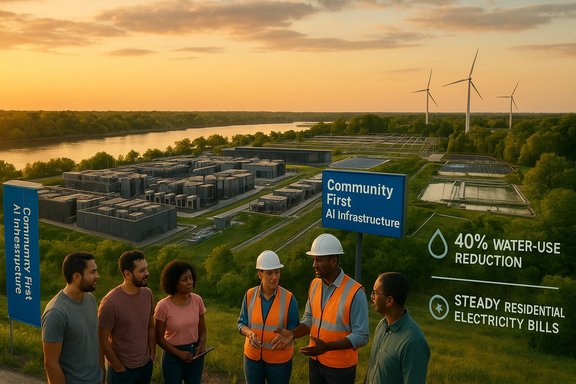
Diverse team in safety vests discuss Community First AI Infrastructure at a wind farm site.Background / Overview​

The scale and speed of today’s AI build‑out have made data‑center campuses a new form of heavy infrastructure, with localized impacts on electricity grids, water systems, land use and municipal finances. Microsoft’s announcement frames that reality bluntly: building AI‑grade capacity requires new generation, transmission work and denser thermal management, and these burdens have been the focal point of community concerns and political scrutiny. In response, Microsoft published a structured, five‑commitment plan — called Community‑First AI Infrastructure — and launched it publicly in Washington, D.C. on January 13, 2026. This is both a corporate sustainability narrative and a policy play. Microsoft positions the pledge as operational (funding grid upgrades, deploying low‑water cooling designs), fiscal (no tax abatements, full property‑tax payments) and social (workforce training, nonprofit support). The company explicitly ties technical design choices — closed‑loop, chip‑level liquid cooling, on‑site and contracted generation, and improved energy management — to community outcomes such as stable residential rates and water stewardship. Independent coverage places the move in a broader political moment where communities, state regulators and federal actors are pushing hyperscalers to “pay their way.”

What Microsoft Promised: The Five Commitments (brief)​

Microsoft’s plan centers on five publicly stated commitments:
  • “We’ll pay our way” — ensure datacenters do not increase household electricity prices.
  • Water stewardship — reduce water‑use intensity by 40% across the fleet by 2030, adopt near‑zero evaporative cooling designs, and replenish more water than withdrawn in host basins.
  • Local jobs and training — scale Datacenter Academy programs, expand partnerships with trade unions and community colleges, and fund apprenticeships and certification pathways.
  • Fiscal contribution — pay full property taxes and avoid seeking tax abatements that shift costs to other taxpayers.
  • Community investment — grants and AI literacy programs for K‑12, libraries and small businesses; employee volunteer and donation matching amplified in local markets.
These are headline promises with measurable anchors — rate design negotiations, a 2030 water‑intensity target, site‑level reporting and explicit local investments. The detail matters: the commitments are not just aspirational language but include specific operational levers Microsoft says it will use.

Electricity: The mechanics of “don’t raise your bill”​

The problem in one line​

Modern AI racks consume very large, sustained power; when clustered, a single campus can require distribution and substation upgrades and, in worst cases, put upward pressure on local retail rates if utilities spread upgrade costs across all customers.

Microsoft’s approach​

Microsoft says it will:
  • contract early and transparently with utilities on projected load and timing;
  • finance transmission, substation and “make‑ready” upgrades when necessary rather than seeking to roll those costs into general rate bases;
  • pursue additional generation to expand supply — citing a 7.9 GW contracted addition to the MISO (Midcontinent Independent System Operator) footprint — and explore innovations such as AI for grid planning and long‑duration firming.
Those actions translate into three technical levers regulators and utilities can use to protect ratepayers: targeted rate schedules for large industrial customers, direct capital funding by the customer for distribution assets, and new generation (and storage) that increases available supply in a region.

What to watch — realities and limits​

  • Long‑term wholesale dynamics matter. Even when a single company pays for interconnection or upgrades, wholesale prices in the larger balancing area can move with demand and supply shifts, potentially affecting retail prices through more complex channels than simple cost passthrough. Microsoft’s pledge reduces one common pathway for cost shifting, but it does not mechanically eliminate all market‑level price effects.
  • Regulatory control is essential. Utilities and state public utility commissions (PUCs) set rates and approve interconnection cost allocation; corporate pledges must be memorialized in public filings or tariffs to be enforceable.
  • The 7.9 GW figure comes from Microsoft’s own announcement and is an important declaration of intent, but independent documentation of the contracts behind that number is limited in public filings at the time of writing; it should be treated as a company disclosure that warrants follow‑up in utility dockets and MISO records.

Water: Tradeoffs, innovations and the 40% target​

The challenge​

Traditional evaporative cooling for large campuses uses municipal water and can stress local water supplies in drought‑prone regions. That has been a flashpoint in permitting debates and public opposition.

Microsoft’s technical responses​

  • Closed‑loop, chip‑level liquid cooling: Microsoft is rolling out next‑generation designs intended to eliminate evaporative system use for server cooling on new sites, dramatically lowering potable‑water withdrawals. The company says these designs are already deployed in pilot and production sites.
  • Fleet target: a 40% reduction in water‑use intensity across its owned data‑center fleet by 2030, plus site‑level water‑use reporting and commitments to replenish more water than facilities withdraw in their basins.
  • Local projects: Microsoft funded a dedicated Quincy Water Reuse Utility to treat and return cooling water at its Quincy, Washington, campus — a closed‑loop industrial solution that avoids discharging mineral‑rich “blowdown” to the municipal wastewater system. The U.S. EPA documents the Quincy reuse system as operational and effective at decoupling data‑center cooling flows from municipal treatment constraints.

Tradeoffs and watchdog points​

  • Closed‑loop systems reduce potable water evaporation but still require initial fills, occasional makeup due to leakage and additional pumping energy. In some climates, replacing evaporative cooling with electric chillers can increase electricity demand and potentially emissions if the grid is carbon‑intensive. Microsoft acknowledges those tradeoffs in its engineering discussion and frames the switch as a holistic design trade that must be matched with low‑carbon electricity.
  • “Water‑positive” and “replenish” claims require transparent, place‑specific definitions and independent audits: does replenishment mean local aquifer recharge, regional offsets, or remote basin projects? The practical community benefit hinges on local hydrology and the proximity of replenishment projects to the stressed watershed. Require third‑party verification.

Jobs, training and community benefits: real gains or transient boosts?​

Microsoft’s workforce strategy​

Microsoft doubles down on workforce pipelines through two channels:
  • a formal partnership with North America’s Building Trades Unions (NABTU) to strengthen apprenticeships and supply local skilled tradespeople for construction and infrastructure projects; and
  • expansion of Datacenter Academy programs in partnership with local community colleges and vocational schools (the company points to success in Boydton, Virginia, and the new Critical Environment Training Lab at Southside Virginia Community College as concrete examples). Microsoft has also committed flexible grants for chambers of commerce and AI literacy programs for K‑12 and libraries.

Local case studies​

  • Boydton / Southern Virginia: Microsoft’s Datacenter Academy, the Critical Environment Training Lab (opened 2024), and circulation of decommissioned equipment for hands‑on teaching have already produced certifications and placements for local residents. Local reporting and Microsoft program pages confirm the lab’s opening and the role it plays in training operational staff.
  • Quincy, Washington: beyond water reuse, Microsoft’s long presence is associated with sharp local fiscal improvements (dramatic increases in property tax revenues, new medical facilities, and declines in measured poverty rates reported by the company). These outcomes illustrate how multi‑decade campus growth can transform a local economy — but they also show that impacts are uneven and depend on local policy and reinvestment choices.

Skeptical lens​

  • Construction brings many jobs but they are temporary; operational headcounts for mature data centers are far smaller. Communities need enforceable local hiring targets, apprenticeship quotas, and placement metrics (not just training outputs) to convert short‑term spikes into durable career pathways.
  • The company cited LinkedIn job‑growth statistics in some press accounts; however, specific claims such as “23% global growth and 13.5% US growth year‑over‑year in 2025” require direct verification from LinkedIn’s published reports. At present, national job‑data sources confirm strong growth in data‑center‑related employment over the last several years but do not uniformly reproduce those precise percentages — treat them as illustrative rather than definitive until LinkedIn raw data or a published report is cited.

Tax and fiscal commitments: paying into the tax base​

Microsoft says it will pay full property taxes in host communities and will not pursue tax abatements that shift fiscal burdens to other taxpayers. That promise is meaningful in places where municipalities compete fiercely for campus investments through tax incentives. Public verification requires that tax and PILOT (payment in lieu of taxes) deals be published and that municipal revenues and contract terms be transparent. Microsoft’s public pledge reduces the political pressure municipalities feel to compete with tax breaks, but the practical test will be whether local governments still negotiate other forms of concessions (e.g., infrastructure discounts, utility easements, below‑market land leases).

Case Study Deep‑Dive: Quincy, Washington — what worked​

Quincy is the clearest empirical example Microsoft highlights: a multi‑decade presence (more than 20 facilities) that Microsoft credits with measurable fiscal and social outcomes — declining poverty rates, tripled property tax revenues and new civic capital such as a medical center and high‑school renovations. Microsoft also invested directly in a dedicated Quincy Water Reuse Utility to treat and recycle cooling water, avoiding burdens on the municipal wastewater plant and reducing local freshwater consumption. The EPA documents the QWRU model and affirms that the utility is a functioning industrial‑scale reuse system that decouples data‑center blowdown from municipal treatment constraints. Quincy is not a universal template, but it does show how company funding plus municipal coordination can produce durable local gains — and why independent, place‑based auditing of outcomes matters.

Strengths of Microsoft’s plan​

  • Operational specificity: the plan gives measurable targets (40% water‑intensity reduction by 2030), technical direction (closed‑loop liquid cooling) and concrete actions (fund grid and sewer upgrades). Specificity creates accountability pathways if matched to public filings.
  • Alignment of engineering and policy: pairing water‑saving designs with commitments to buy or fund generation and to pay for make‑ready grid upgrades addresses both demand and supply sides of the equation.
  • Community investments: Datacenter Academy programs, apprenticeship partnerships with NABTU, and local AI literacy investments are scalable, replicable actions that produce visible community benefits if implemented with local hiring requirements and placement tracking.
  • Political resonance: by publicly committing to “not raising household bills” Microsoft attenuates a major political argument that has fueled opposition and regulatory pushback. Independent outlets and federal actors have taken notice, which increases scrutiny but also political cover for the company’s investments.

Risks, loopholes and the “devil in the details”​

  • Enforceability: a corporate pledge is not the same as a tariff, permit condition or binding contract. Without regulatory filings, community benefit agreements, and third‑party audits, promises are fragile. Local governments and PUCs must demand enforceable terms.
  • Cost shifting via wholesale markets: Microsoft can pay for local upgrades but broader wholesale price dynamics can still raise regional energy costs or lead to fuel‑switching at marginal hours. The pledge addresses retail cost allocation, not all systemic market effects.
  • Greenwashing and accounting choices: water‑positive and carbon‑match claims can be achieved through remote offsets or creative accounting that does not reduce local stress. Communities should insist on place‑based metrics and independent audits.
  • Transient employment impacts: construction jobs are plentiful but temporary; the long‑term operational workforce is smaller. Training programs must be tethered to placement rates and living‑wage hiring commitments to be meaningful.

Accountability checklist: how to turn pledges into enforceable outcomes​

For communities, regulators and journalists tracking Microsoft (and other hyperscalers), insist on the following concrete items before green‑lighting new projects:
  • Public, enforceable Community Benefit Agreements (CBAs) that include:
  • local apprenticeship targets and operational hiring quotas;
  • clear, non‑revocable tax payment language and schedules;
  • escrowed remediation funds in case facilities idle or close.
  • Utility and PUC filings that document rate schedules, interconnection cost allocation, and the company’s make‑ready financing arrangements; require a robust distribution‑level impact study showing projected effects on residential bills.
  • Site‑level, monthly published metrics for: PUE (Power Usage Effectiveness), WUE (Water Usage Effectiveness), volumetric potable and non‑potable water draws, and peak hourly electricity draws (for the first 24 months). Require third‑party audits of these reports.
  • Water replenishment definitions and verification: insist that “replenish” measures be local (within the impacted watershed) or meaningfully tied to local aquifer recharge projects, and audited by independent hydrology firms.
  • Transparency around energy contracting: publish PPA terms (where permissible), the timing and type of generation to be added to the local grid, and whether any fossil firming is planned during buildout.

What will determine success in the next 6–12 months​

  • Publication of site‑level water and power data as Microsoft pledged; this is the clearest near‑term test.
  • Public utility docket activity showing tariff designs that place interconnection and distribution upgrade costs on Microsoft rather than general ratepayers; look for rate case filings and impact statements.
  • Evidence of enforceable, local CBAs with measurable hiring and training commitments, and documentation that NABTU partnerships produce local contractor selection and apprenticeship placements.
  • Independent audits of water‑replenishment claims and verification of the 7.9 GW MISO addition Microsoft cites. If those generation contracts are firm and visible in grid filings, that materially bolsters Microsoft’s “don’t raise your bill” pledge. If they remain company assertions without public contracts, communities should require further scrutiny.

How regulators and communities should respond now​

  • Treat the pledge as the opening of a negotiation, not the closing. Require Microsoft to place commitments in public dockets, planning documents and municipal resolutions.
  • Use permit conditions to mandate monthly operational metrics, independent audits and clear remediation funds. Tie any local approvals to verifiable, place‑based outcomes.
  • Prioritize siting near low‑carbon firm power and industrial heat reuse opportunities to reduce both carbon and local footprint; where feasible, prefer projects that enable district energy or municipal benefit rather than isolated campuses.

Final assessment — opportunity and skepticism in equal measure​

Microsoft’s Community‑First pledge is consequential because it reframes what communities should demand from hyperscalers: not just promises about sustainability, but measurable, enforceable commitments that protect local taxpayers, preserve water resources, and deliver durable local economic benefits. The company has matched rhetoric with engineering choices—closed‑loop liquid cooling, grid contracts, training labs—and has a track record of long‑term investments in select towns, notably Quincy and Boydton, that demonstrate the potential upside of a well‑managed campus. At the same time, the plan exposes the essential next phase of public policy in the AI era: converting corporate promises into regulatory frameworks, public filings, and independent verification. The two most important questions are simple and civic: (1) Will Microsoft and utilities put the promised terms into public, enforceable records in utility dockets and municipal agreements? (2) Will independent auditors and local stakeholders have timely access to site‑level data so the public can see whether outcomes match promises? Until the answers are “yes,” the plan will remain a welcome but incomplete template.
If implemented with regulatory teeth and community oversight, Microsoft’s initiative could set an industry standard — forcing hyperscalers to internalize local infrastructure costs, to design lower‑water cooling systems, and to finance the grid and water projects their operation requires. If not, these pledges risk becoming expensive public relations that shift problems across geographies or through opaque market channels. The promise is real; the work of verification has just begun.
Conclusion
Microsoft’s Community‑First AI Infrastructure plan is a timely and concrete attempt to reframe the social contract between hyperscalers and host communities. It pairs engineering innovation with fiscal and civic commitments, and it recognizes the political reality that communities will not tolerate large builds without measurable returns. The ultimate test will be whether these commitments are codified in public, enforceable instruments, paired with independent monitoring and transparent energy and water contracts. The next 12 months will show whether the plan becomes a new industry standard or another high‑profile promise that fades without public enforcement.
Source: Techzine Global Microsoft plan aims to protect energy and water in data center rollout
 

Microsoft’s new Community‑First AI Infrastructure Plan signals a deliberate shift: the company is attempting to convert the political and civic friction around hyperscale AI datacenters into a public, measurable set of commitments designed to protect local resources and communities.

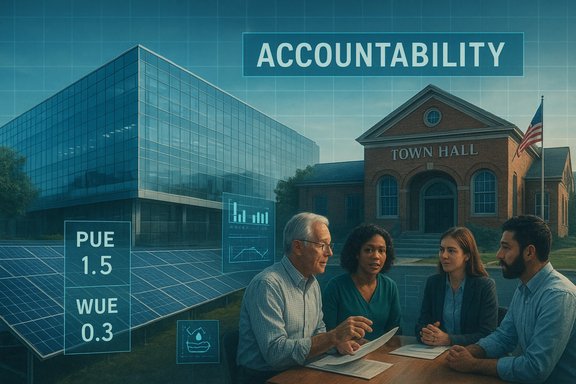
Diverse professionals discuss plans near town hall, with solar panels and the word ACCOUNTABILITY.Background / Overview​

Microsoft unveiled a five‑point framework it calls the Community‑First AI Infrastructure plan in a public rollout in Washington, D.C., on January 13, 2026. The pledge, authored and promoted by Microsoft vice chair and president Brad Smith, is explicitly targeted at the localized impacts of modern AI datacenters: electricity demand, water consumption, employment and fiscal effects, and community investments.
At its core the plan says Microsoft will:
  • “Pay our way” so new datacenters do not raise household electricity prices.
  • Minimize and replenish water withdrawn for cooling, with site‑level transparency.
  • Create local jobs and workforce pipelines.
  • Contribute to local tax bases and avoid shifting communal costs.
  • Invest in AI training and community nonprofits.
These are not vague sustainability platitudes: Microsoft’s public materials include operational levers, numeric targets and examples of past infrastructure investments the company says demonstrate intent. But the announcement raises immediate questions about enforceability, measurement, and the practical limits of corporate pledges in regulated utility and water systems.

Why communities pushed hyperscalers to make this promise​

The technical pressure points​

Modern generative AI workloads place unique demands on datacenters. GPU‑dense racks draw sustained, high power and produce dense heat that often requires far more aggressive cooling than typical cloud workloads. The combined effect is materially different infrastructure needs:
  • Large, sustained peak electric demand that can require new substations, transformed distribution assets, and sometimes upgrades to transmission capacity.
  • Cooling approaches that, depending on design, can pull significant volumes of water if evaporative systems are used.
When utilities or regional grid operators allocate the costs of upgrades across ratepayers, local residential customers can see upward pressure on bills or accelerated rate cases to fund upgrades. That dynamic has driven sharp opposition in communities that were not expecting infrastructure projects of this scale. Microsoft’s plan is a reaction to that political and civic context.

Political and regulatory inflection​

The rollout took place against an intensified public debate. Federal and state actors have begun to press hyperscalers to internalize the costs of grid and water impacts rather than allow those costs to be socialized across households. Microsoft framed its plan as both a civic responsibility and a business strategy intended to reduce friction for future campus builds. That political moment significantly shaped the language and commitments in the plan.

The five commitments — what Microsoft actually promised​

Each of the five headline commitments contains operational language and specific levers that matter for verification.

1) “We’ll pay our way” — electricity and grid impacts​

Microsoft pledges to work with utilities and regulators to ensure that datacenter interconnection and distribution costs aren’t pushed onto residential ratepayers. Practically, the company lists three main tactics:
  • Negotiate rate designs and tariffs that allocate upgrade costs and demand‑related charges to the datacenter rather than spreading them across all customers.
  • Directly fund “make‑ready” distribution and substation upgrades when required.
  • Contract for and add new generation capacity (PPAs, storage, or on‑site/adjacent generation) so that additional supply reduces market pressure. Microsoft cites large generation additions in its disclosures as evidence of intent.
Critical technical caveat: paying for distribution upgrades is necessary but not always sufficient. Wholesale electricity markets and regional price dynamics can still change retail rates indirectly. A company can fund local upgrades, yet broader supply and demand shifts across a balancing area can nudge wholesale prices upward — a dynamic Microsoft’s pledge does not instantly neutralize. Regulators control tariff rules and interconnection cost allocation; the pledge’s protective effect therefore depends on formal filings and enforceable regulatory decisions.

2) Water stewardship — reduce, report, and replenish​

Microsoft promises to reduce data‑center water intensity and to replenish more water than it withdraws at specific sites, coupled with public, site‑level reporting on water use. Public materials indicate a fleet‑level water‑intensity target and reference closed‑loop, chip‑level liquid cooling and near‑zero evaporative designs as engineering routes to reduce potable water consumption.
That replenishment promise is the most consequential local commitment. The company describes funding local water‑ and sewer‑system improvements in prior projects and intends to replicate that model. But the definition of “replenish” — whether by local aquifer recharge, watershed projects, or offset investments elsewhere — will determine whether the pledge delivers real, place‑based water security. Without tight, auditable definitions, replenishment risks becoming an accounting exercise.

3) Jobs and workforce development​

Microsoft pledges to expand local hiring during construction and operations and to scale training pipelines such as Datacenter Academy‑style programs, apprenticeships, and partnerships with community colleges and unions. The company positions these investments as ways to ensure proximate economic benefits accrue to host communities.
However, the historical pattern of datacenters is instructive: construction phases generate many jobs but are temporary, while steady‑state operations employ relatively few people. That makes measurable placement targets and living‑wage hiring commitments essential to avoid a transient boost followed by long‑term structural changes (e.g., housing pressure) with few permanent jobs.

4) Fiscal contributions — add to the tax base​

The company promises to contribute property and other taxes rather than seek abatements that shift fiscal burdens to other taxpayers. Microsoft frames this as adding revenue for schools, hospitals and local services. In practice, local governments deciding whether to grant concessions will be a negotiation between projected fiscal flows and perceived economic benefits. The pledge matters most when tied into enforceable Community Benefit Agreements (CBAs) or municipal permit conditions.

5) Community investment in AI training and nonprofits​

Microsoft commits to invest in local AI training, nonprofit grants and community programs (libraries, K‑12 AI literacy, and small business support). These are attractive and visible benefits, but their real value depends on sustained funding, measured outcomes (placements, incomes), and alignment with local needs.

Strengths of the plan — what Microsoft gets right​

  • Operational specificity over general greenwashing. The plan provides concrete levers (funding make‑ready upgrades, site reporting, cooling technology choices) rather than only aspirational language. That specificity can be converted into enforceable permit conditions or tariff filings if communities and regulators insist.
  • Recognition of local impacts. Microsoft acknowledges the true local pain points — electricity and water — and places them at the center of the policy response. That candid framing is necessary to rebuild trust.
  • Capital willingness. The company signals a readiness to fund infrastructure and generation, which can accelerate grid and water upgrades faster than municipal budgets alone. If executed transparently, this can be a net positive for capacity and resilience.
  • Engineering trajectory toward low‑water cooling. The plan endorses closed‑loop and chip‑level cooling designs that materially reduce potable water use and can align with broader sustainability goals. Those designs also improve thermal efficiency at high rack densities.

Major risks and the “devil in the details”​

Enforceability vs. PR​

A corporate pledge is not a binding regulatory order. The plan’s protective effects hinge on putting commitments into public filings, tariffs, municipal permit conditions, or legally enforceable CBAs. Without those instruments, promises risk being quietly softened or reinterpreted over time. Local stakeholders must insist on binding documentation.

Cost shifting via wholesale markets​

Even if Microsoft pays for distribution upgrades, regional wholesale prices can rise as balancing areas absorb increased demand. Microsoft’s pledge addresses the common retail‑level pathway for cost pass‑through, but regional electricity market dynamics — supply scarcity hours, seasonal spikes, or fuel price shocks — can still affect consumer bills indirectly. Communities must demand transparent documentation of PPAs and firming commitments to assess systemic impacts.

Water‑replenishment ambiguity​

“Replenish more water than we withdraw” is a strong headline commitment, but its civic value depends on definitions:
  • Is replenishment local to the watershed or simply measured globally?
  • Does replenishment include indirect offsets, such as funding wastewater projects in unrelated basins?
  • Who audits the replenishment claims and on what schedule?
Absent site‑level, third‑party‑verified hydrology reports, replenishment can become a headline that masks place‑based scarcity. Regulators and communities must spell out measurable replenishment criteria that are auditable.

Transient job effects and economic displacement​

Construction employment is short‑lived; operations hire a smaller, more specialized workforce. Without enforceable hiring targets, preferential local procurement, and tracked placement rates, the economic uplift may be overstated. Communities should require placement guarantees and living‑wage commitments tied to local tax benefits.

Greenwashing and accounting choices​

Corporate claims about water‑positive and carbon‑matched outcomes can rely on distant offsets, creative accounting, or time‑shifted PPA claims. Place‑based outcomes (local aquifer health, local air quality, and local electricity reliability) require local measurement rather than global offsets. Insistence on independent audits is essential.

Accountability checklist — turning the pledge into enforceable outcomes​

Local governments, utilities, and civic groups should require the following before granting approvals or permits:
  • Public, enforceable Community Benefit Agreements (CBAs) that include:
  • Binding local apprenticeship quotas and living‑wage hiring targets.
  • Clear, irrevocable tax payment schedules and penalties for non‑compliance.
  • Escrowed remediation funds for site closure or idling scenarios.
  • Utility and public‑utility‑commission (PUC) filings that document:
  • Tariff language allocating make‑ready and interconnection costs to the datacenter.
  • The company’s capital commitments for distribution and substation work.
  • Any demand‑charge or capacity schedule design to avoid cross‑subsidies.
  • Site‑level, monthly published metrics (first 24 months at minimum):
  • PUE (Power Usage Effectiveness), WUE (Water Usage Effectiveness), volumetric potable and non‑potable water draws, and peak hourly electricity draw.
  • Independent third‑party audits of those metrics.
  • Water replenishment rules and verification:
  • Require replenishment to be watershed‑based or tied to the impacted aquifer.
  • Independent hydrological verification and annual public reporting.
  • Energy contracting transparency:
  • Disclosure of PPA terms where permissible, timing and type of new generation, and any fossil firming strategies planned during buildout.

How to evaluate progress over the next 6–12 months​

  • Confirm Microsoft publishes site‑level water and power data as promised. This is the single clearest near‑term test of follow‑through.
  • Watch for utility docket filings showing tariff designs and interconnection cost allocations that place costs on the company rather than general ratepayers.
  • Look for publicly recorded CBAs or municipal resolutions that convert commitments into enforceable language.
  • Demand third‑party audits of water‑replenishment outcomes and verification of generation contracts Microsoft cites as supporting its “don’t raise your bill” promise. If those generation contracts are visible in grid filings, they materially strengthen the claim; if they remain company assertions, require more scrutiny.

Broader industry and policy implications​

Microsoft’s announcement can become a template for other hyperscalers, raising baseline expectations for community transparency and investment. If other cloud providers adopt similar public commitments — and, crucially, if regulators insist on enforceable filings — the industry standard could shift toward more accountable datacenter development.
However, policy responses are essential to solidify gains:
  • State and federal regulators should craft model tariff language that allocates marginal upgrade costs fairly and incentivizes load flexibility.
  • Municipalities should standardize CBA templates for datacenter projects that include water stewardship obligations and enforceable workforce commitments.
  • Federal infrastructure funds could be targeted to upgrade regional grids to better absorb localized AI demand spikes while retaining protections for residential customers.

Final assessment — cautious optimism with strict conditions​

Microsoft’s Community‑First AI Infrastructure Plan is an important moment: the company publicly acknowledges and enumerates the local risks posed by AI datacenters and offers a concrete framework to manage them. The plan’s strengths are its operational language, willingness to fund infrastructure, and emphasis on transparency. Those ingredients are what civic actors have been asking for.
But the plan’s value will be judged in execution. The most meaningful tests will be:
  • Whether commitments are recorded in public regulatory filings and enforceable local agreements.
  • Whether site‑level water and power metrics are published and audited.
  • Whether replenishment promises are grounded in local hydrology rather than distant offsets.
  • Whether workforce and fiscal promises translate into durable local benefits beyond construction spikes.
If Microsoft and regulators convert the pledge into enforceable, auditable terms, the Community‑First plan could become an industry benchmark and materially reduce friction for future AI infrastructure builds. If not, the announcement will remain a defensive, public‑relations oriented document that defers the hard work of verification to later — and communities should treat it accordingly.

The stakes are real: AI datacenters are a form of critical infrastructure that can bring jobs and tax revenue, but also create stress on electricity grids, water systems and local services. Microsoft’s plan is a promising start; its civic legitimacy will depend on transparent filings, measurable outcomes, third‑party audits, and community oversight. Until those elements are in place, communities and regulators should treat the pledge as the opening of a negotiation, not its conclusion.

Source: ExtremeTech Microsoft Develops 'Community-First AI Infrastructure Plan'
 

Microsoft’s new “Community‑First AI Infrastructure” pledge lands as a strategic pivot in the company’s datacenter strategy, a public-facing bid to reframe hyperscale AI buildouts as accountable, locally beneficial investments rather than hidden local burdens.

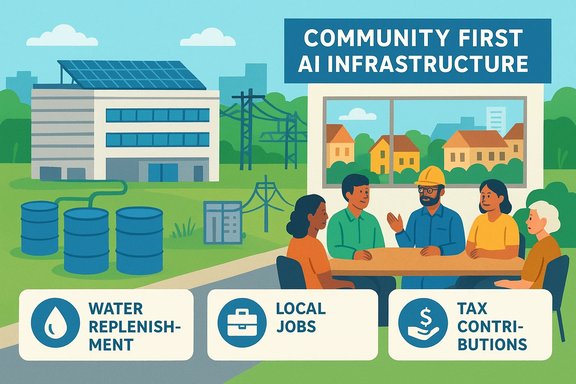
A community meeting on AI infrastructure, highlighting water replenishment, local jobs, and tax contributions.Background​

Microsoft launched the Community‑First AI Infrastructure plan publicly on January 13, 2026, positioning it as a five‑point framework designed to address the acute local impacts of AI‑grade datacenters: electricity grid strain, water consumption for cooling, local jobs and training, fiscal contributions to host communities, and community investment in AI literacy and nonprofits. The plan ties engineering choices — from closed‑loop and near‑zero evaporative cooling to on‑site generation and contractually funded grid upgrades — directly to commitments intended to prevent residential rate impacts and to replenish local water resources.
This announcement comes amid heightened public scrutiny of hyperscale datacenter expansion in the United States. Industry reporting and local activism over the past year have highlighted conflicts at the intersection of rapid capacity growth and constrained local utility and water infrastructures — a context Microsoft acknowledges in its public write‑up and policy framing. Observers note the plan is both a corporate sustainability narrative and a political play intended to reduce community resistance to new AI campuses.

What Microsoft Promised: The Five Commitments​

Microsoft’s public statement lays out five headline commitments that form the backbone of the Community‑First approach. Each is framed with operational intent and, in some cases, measurable targets:
  • “We’ll pay our way” — Microsoft pledges that its datacenters will not increase household electricity bills, committing to work with utilities and regulators on rate design and to fund necessary grid upgrades rather than shift costs to residents.
  • Water stewardship — The company commits to reduce water‑use intensity across its fleet by 40% by 2030, adopt near‑zero evaporative cooling options where feasible, and replenish more water than specific facilities withdraw from local basins.
  • Local jobs and training — Microsoft intends to scale Datacenter Academy‑style programs, expand partnerships with community colleges and unions, and create apprenticeship and certification pathways for construction and operations jobs.
  • Fiscal contribution — The pledge includes a commitment to pay full property taxes and to avoid tax abatements that shift public costs to other taxpayers, explicitly promising fiscal support for local services.
  • Community investment — Microsoft will invest in AI literacy programs, grants for K‑12 and local nonprofits, and broaden employee volunteer and philanthropic matching to amplify local benefits.
These commitments are not limited to rhetoric: Microsoft cites operational levers such as funding substation and “make‑ready” distribution work, pursuing additional generation and storage, and deploying low‑water cooling designs — all technical choices tied to measurable local outcomes.

Why This Matters: Power, Water, and the New Infrastructure Politics​

Modern generative AI workloads are electricity‑and‑cooling intensive. A single AI campus, when built to train and host large transformer models at scale, can approach the peak consumption of a small municipality. That concentration of demand introduces three interlocking policy problems:
  • Utilities and regulators must approve interconnection and cost allocation, often through rate cases that historically socialize infrastructure costs across all customers.
  • Cooling approaches that use evaporative systems can impose significant local water withdrawals or compete with municipal needs in water‑sensitive basins.
  • Rapid construction booms transform land use, municipal services demand, and local fiscal dynamics, producing winners and losers within host communities.
Microsoft’s plan acknowledges these tensions and attempts to reshape them through contractual and operational commitments: targeted funding for grid upgrades, explicit water‑reduction metrics, and proclamations to pay full taxes and invest locally. The company frames the approach as a replicable model other hyperscalers could adopt to defuse community opposition while preserving growth.

Technical Measures: Cooling, Grid Strategy, and On‑Site Generation​

Microsoft highlights several technical and engineering levers it intends to use to meet its commitments. These are important because technical choices determine the scale and permanence of local impacts.

Closed‑loop and low‑water cooling​

Microsoft is emphasizing closed‑loop, chip‑level liquid cooling and near‑zero evaporative systems that drastically reduce potable water use compared with standard evaporative cooling towers. The 40% water‑use intensity improvement target for 2030 is anchored to fleet‑wide design shifts and site‑level replenishment policies. On paper, chip‑level liquid cooling can reduce water demand by eliminating evaporative losses and enabling heat rejection into air‑cooled or closed‑loop heat‑exchange systems — but costs, retrofitting complexity, and supply chain requirements vary by site.

Grid and interconnection funding​

Microsoft says it will contract early and transparently with utilities, finance “make‑ready” work like substations and distribution upgrades, and pursue new generation and storage to increase regional supply. The company cites a contracted addition figure of roughly 7.9 GW into the MISO footprint as part of its power strategy, underlining the scale of its electricity commitments. Those actions, if executed and memorialized in public utility filings and tariffs, can reduce the typical pathway through which local ratepayers absorb interconnection and distribution costs.

On‑site and contracted generation​

Microsoft’s approach also includes procuring or building generation — including low‑carbon and firming capacity — that can expand effective supply in regions with constrained grids. The firm positions such investments as a way to ensure increased demand doesn’t translate into higher wholesale or retail prices for residents, though the relationship between localized investments and broader wholesale price dynamics is complex.

Accountability and Verification: What Microsoft Must Deliver to Make This Real​

Promises are only as good as the mechanisms that make them enforceable. The Community‑First plan contains measurable anchors, but converting commitments into enforceable public outcomes requires several additional steps:
  • Public, site‑level disclosures of water use, replenishment amounts, and electricity load projections so local stakeholders can validate claims.
  • Formal rate and tariff filings with state public utility commissions (PUCs) that explicitly allocate the capital and operational costs Microsoft pledges to fund. Voluntary corporate promises without tariff changes or docketed agreements are hard to enforce.
  • Independent third‑party audits and community oversight structures to verify water‑replenishment claims and energy accounting. Microsoft’s plan points to publishing data and working with local entities, but independent validation is the gold standard.
  • Binding commitments on tax and fiscal obligations recorded in local agreements rather than aspirational statements; municipal budgets and tax records must reflect promised payments to be meaningful.
If these mechanisms are not implemented, the risk is Microsoft fulfills the letter but not the spirit of the Community‑First pledge — satisfying minimal obligations while leaving indirect or systemic costs unaddressed.

Strengths of the Plan​

Microsoft’s announcement is notable in several constructive ways.
  • Clarity and measurability: The plan specifies measurable targets (e.g., 40% water‑use intensity reduction by 2030) and lists operational levers. That beats generic sustainability language and sets specific outcomes to track.
  • Direct engagement with local policy mechanics: Committing to fund grid and distribution upgrades addresses the core nexus where corporate promises interact with regulatory realities. Funding make‑ready work and negotiating rate design can directly reduce the likelihood of cost pass‑through to residents if executed via regulator‑approved mechanisms.
  • Broad community focus: The plan bundles economic (jobs, taxes), environmental (water, energy), and social (AI literacy, nonprofit grants) elements. This multifaceted approach recognizes that community acceptance depends on multiple benefit streams, not a single promise.
  • Potential industry ripple effect: If Microsoft makes these commitments binding and documents their outcomes, other hyperscalers may face pressure to match or exceed the standard — potentially raising the industry baseline for responsible datacenter development.

Key Risks, Gaps, and Unverifiable Claims​

The plan also carries important risks and leaves several critical questions open.

1. Market and wholesale price dynamics remain outside corporate control​

Even if Microsoft pays for local interconnection and distribution upgrades, regional wholesale market dynamics can still shift, producing indirect effects on retail prices through mechanisms that are not straightforwardly traced to a single customer. Microsoft’s pledge reduces a common but not exclusive pathway for cost shifting; it does not mechanically eliminate market‑level price effects. This is a technical and economic caveat regulators and communities must factor into oversight.

2. Verification of the 7.9 GW and $80B figures​

The files reference a Microsoft‑stated figure of roughly 7.9 GW contracted into a regional grid and an $80 billion AI data‑center spending commitment reported across Microsoft disclosures. These numbers are significant but derive from company disclosures and secondary reporting; they require verification in public filings (utility dockets, SEC filings, or procurement contracts) to be treated as fully vetted public facts. Until those independent confirmations appear, treat such numerical claims with caution.

3. Water replenishment: measurement, hydrology, and timing​

Promising to “replenish more water than withdrawn” is conceptually straightforward but technically complex. Replenishment requires hydrological expertise, agreed baseline withdrawals, measurement protocols, and sustained funding. Questions include: which basins are included? Over what timeframe are replenishment flows measured? Are replenishment credits banked or distributed over seasons? Microsoft’s plan references site‑level replenishment reporting but independent verification and detailed hydrological plans are essential before communities can consider the claim robust.

4. Local political dynamics and tax negotiations​

Committing not to seek tax abatements is politically powerful, but local incentives are often negotiated in private, and municipal governments vary in bargaining posture. The firm’s willingness to commit broadly will be tested in jurisdictions where counties or cities expect incentives to secure large projects. Binding those commitments into local budgets and development agreements will be the acid test.

5. Implementation timelines and retrospective audits​

Promising targets through 2030 (e.g., water‑use reduction) requires tracking systems and interim milestones. Yearly reporting, third‑party audits, and transparent dashboards are necessary so communities and regulators can assess progress in real time rather than at a distant deadline. The plan references reporting but the schedule and audit frameworks remain to be clarified.

How Regulators and Communities Can Convert Promises into Policy​

To ensure the Community‑First plan produces tangible, enforceable benefits, local governments, utilities, and community stakeholders should demand:
  • Public docket filings for rate and interconnection cost allocation that record Microsoft’s proposed financial commitments and any avoided cost claims.
  • Legally binding community benefit agreements that specify tax payments, job targets, and local procurement commitments with clear enforcement clauses.
  • Independent hydrological audits and basin‑specific replenishment plans with measurable timelines.
  • Annual, third‑party‑audited site‑level disclosures for energy use, water withdrawals, replenishment volumes, and workforce outcomes.
  • A formal dispute resolution mechanism and an escalation path to state regulators should local benefits diverge from commitments.
These steps transform corporate pledges into accountable, enduring public assets rather than one‑off PR promises.

Broader Industry Implications​

Microsoft’s Community‑First policy arrives during an industry pivot: hyperscalers are increasingly aware that the physical footprint of AI matters politically and economically. If Microsoft turns its plan into a durable template — complete with regulatory filings, audited reporting, and binding local agreements — it could set a new industry standard that constrains incentive racing and raises design expectations for water and energy efficiency.
At the same time, the technical arms race continues. Investments in chip‑level liquid cooling, rack‑level power delivery innovations, and distributed “AI superfactory” fabrics are reshaping how large models are trained and where capacity gets sited. That means technology choices and corporate policy must align or the plan risks becoming a patchwork of local mitigations without systemic reform.

Practical Takeaways for IT and Community Leaders​

  • IT leaders evaluating Azure AI workloads should track Microsoft’s site‑level disclosures and ask procurement and cloud teams for evidence of any promises that affect local electricity or water risk profiles for their operations. Integrations and SLAs that reference sustainability or community commitments should be scrutinized for auditability.
  • Municipal leaders should require Microsoft to file commitments in public dockets and community benefit agreements before final approvals are issued. Oral commitments and press statements are insufficient for long‑term municipal finance planning.
  • Environmental and community groups should push for independent verification, not just corporate reporting, and insist on basin‑level hydrological analysis for any water replenishment claims.

Final Assessment: Promise, Risk, and the Path Forward​

Microsoft’s Community‑First AI Infrastructure plan is a consequential corporate response to a real public problem: datacenter‑scale AI expansion is changing local infrastructure footprints, and communities have legitimate claims to transparency, fair fiscal treatment, and environmental stewardship. The plan’s strengths lie in its clarity, measurable targets, and the attempt to integrate engineering choices with community benefits.
However, the ultimate public value of the pledge depends on follow‑through. The most important near‑term checks are: whether Microsoft archives site‑level disclosures publicly, whether utility and regulatory filings document the company’s financing of upgrades, whether hydrological replenishment claims are auditable, and whether tax/fiscal commitments appear in municipal records. Absent these concrete, enforceable steps, the initiative risks becoming a useful public relations frame rather than a durable policy shift.
The Community‑First plan could become a blueprint for aligning hyperscale AI expansion with local resilience — but only if communities, regulators, and independent auditors insist on binding, transparent, and verifiable execution rather than optimistic headlines.

Microsoft’s move reframes a technical infrastructure problem as a civic governance challenge. The next chapters will be written in utility dockets, municipal budgets, hydrological reports, and independent audit statements; those are the documents that will determine whether Community‑First becomes a meaningful standard or another corporate promise awaiting verification.

Source: extremetech.com https://www.extremetech.com/computing/microsoft-develops-community-first-ai-infrastructure-plan]
 

Back
Top