

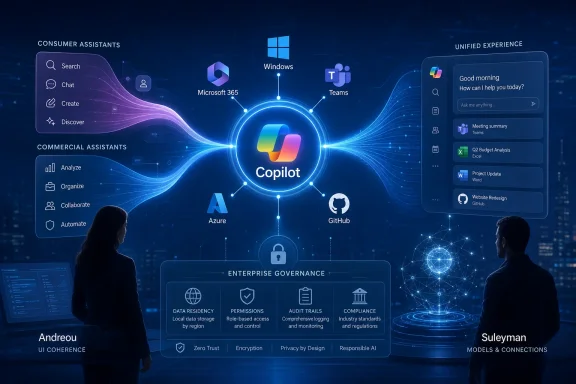
On March 17, 2026, Microsoft CEO Satya Nadella reorganized the company’s Copilot operation, putting consumer and commercial AI assistant work under Jacob Andreou, a newly elevated executive vice president who reports to Nadella, while Mustafa Suleyman shifted toward frontier models and superintelligence research. The move is less a routine management shuffle than an admission that Microsoft’s most important AI product has been too fragmented for the moment it is trying to define. Copilot has been everywhere in Microsoft’s stack, but not always obviously one thing. Nadella is now betting that coherence, not ubiquity alone, is what turns AI hype into durable platform power.
For the last several years, “Copilot” has functioned as both product name and corporate aspiration. It has meant a chat pane in Windows, a paid assistant inside Microsoft 365, a coding partner in developer tools, a consumer chatbot, a search companion, and increasingly a substrate for agents. That strategy gave Microsoft speed: every division could attach itself to the AI wave without waiting for a single centralized product doctrine.
But speed has a cost. Users encountered Copilot as a family resemblance rather than a unified experience, with different rules, prices, memories, capabilities, and workplace boundaries depending on which Microsoft surface they happened to be using. For IT administrators, that meant policy and governance questions often arrived faster than product clarity. For consumers, it meant the Copilot button or sidebar could feel less like a trusted assistant and more like another Microsoft experiment looking for daily relevance.
The March reorganization is Microsoft’s attempt to fix that problem at the level where it starts: authority. Jacob Andreou now sits above the divide between personal and workplace Copilot experiences, with responsibility for the thing users actually touch. Suleyman, meanwhile, is being pulled away from the daily product grind to focus on models, frontier research, and Microsoft’s longer-term superintelligence ambitions.
That split matters because it separates two jobs Microsoft had been trying to hold together. One job is making a chatbot, assistant, and agent system useful enough that people return to it every day. The other is making sure Microsoft has access to the model capability it needs as the OpenAI partnership becomes more complicated and competitors push their own AI stacks deeper into productivity software.
Copilot’s biggest problem is not merely technical. Microsoft has enormous distribution, a dominant productivity suite, Windows, Edge, Bing, Teams, GitHub, Azure, and one of the deepest enterprise sales channels in technology. Yet distribution does not automatically create habit. The history of Windows is littered with features that were placed in front of hundreds of millions of users and still failed to become essential.
Andreou’s task is to turn Copilot from a branded layer into a coherent behavior. In consumer software, the question is whether users voluntarily return. In enterprise software, the question is whether workflows measurably improve enough for companies to renew, expand, and tolerate the governance burden. Copilot has to win both tests, which is exactly why splitting consumer and commercial AI into parallel universes was becoming untenable.
A unified Copilot organization suggests Microsoft no longer wants separate assistants for “work you” and “home you” that merely share typography. It wants a system that can move across contexts without collapsing the boundaries between them. That is a far more difficult product challenge than adding another chat box to another app.
The technical infrastructure has to respect identity, data residency, permissions, compliance labels, retention rules, and tenant boundaries. The user experience has to make those constraints understandable without forcing everyone to become an administrator. If Andreou succeeds, Copilot becomes the invisible tissue connecting Microsoft’s ecosystem. If he fails, it remains a set of ambitious demos scattered across the company’s product map.
That concern has become more visible as OpenAI builds a stronger direct consumer relationship and expands into productivity-adjacent tools. Microsoft invested early, provided cloud infrastructure, and integrated OpenAI models across its products. But platform companies eventually worry about dependency, especially when the partner also wants to own the user interface.
Suleyman’s focus on models gives Microsoft a hedge. The company needs AI systems tuned for enterprise cost structures, compliance expectations, latency requirements, and product integration. It also needs negotiating leverage. If the future of software is increasingly shaped by model capability, then Microsoft cannot rely indefinitely on contractual access to outside models, no matter how productive the partnership has been.
The superintelligence language is grandiose, but the near-term enterprise logic is pragmatic. Microsoft wants models that can reduce business process costs, fit into regulated environments, and operate across the messy data estates that define real companies. In that sense, Suleyman’s five-year horizon is not just about science fiction-level AI. It is about whether Microsoft can own enough of the technical stack to control its margins, roadmap, and destiny.
There is also a cultural shift here. Microsoft once looked comfortable treating models as a layer it could source, orchestrate, and wrap in enterprise software. The new structure implies a more sober view: the model layer may be too important to leave mostly outside the house.
That distinction matters because AI assistants are supposed to accumulate context and trust. A user may forgive a disconnected set of conventional apps; they expect different apps to behave differently. But an assistant implies continuity. If the thing called Copilot appears in five places and seems to have five different memories, five different skill sets, and five different security assumptions, the brand starts working against itself.
This is especially acute in Windows. Microsoft has pushed Copilot into the operating system at a time when many users are already wary of cloud-connected features, telemetry, advertising surfaces, and unwanted prompts. An assistant inside Windows has to justify its presence more carefully than a feature inside a subscription productivity suite. It sits close to the user’s files, settings, habits, and sense of control.
In Microsoft 365, the value proposition is clearer but the bar is higher. If Copilot can produce a useful meeting recap, extract action items, draft a proposal from internal documents, or analyze a spreadsheet without hallucinating important details, enterprises will listen. If it adds another layer of review, licensing complexity, and administrative overhead, adoption will slow.
The reorganization is therefore a product quality bet masquerading as an org chart. Nadella is saying that the next phase of Copilot requires fewer seams, fewer competing priorities, and a single executive accountable for making the experience feel intentional.
That is why unifying consumer and commercial Copilot may be more important than it first appears. Consumer AI products teach users what to expect. ChatGPT’s success was not built through procurement departments; it came from individuals developing habits and then dragging those expectations into work. Google is trying to use Gemini across Android, Search, and Workspace in a similar loop. Microsoft cannot assume that owning Office is enough if workers prefer another assistant before they arrive at the office.
The consumer product becomes Microsoft’s training ground for the enterprise product. If Copilot is pleasant, fast, and useful in everyday life, employees are more likely to trust it in Word, Excel, Outlook, Teams, and Windows. If the consumer experience feels second-rate, the enterprise sale has to overcome not only budget scrutiny but user skepticism.
This is where Andreou’s growth background becomes relevant. Microsoft does not just need Copilot to exist in high-value software; it needs Copilot to develop daily gravity. It must become the first place a user thinks to ask, not the icon they notice after they have already opened a browser tab and gone elsewhere.
For IT leaders, that means the Copilot roadmap should be judged less by splashy launch moments and more by signs of sustained use. Are employees returning after the pilot? Are they using it for real workflows rather than novelty prompts? Are support tickets manageable? Are administrators getting clearer controls? A unified organization should make those questions easier for Microsoft to answer, but it does not answer them by itself.
That puts Microsoft in a strange position. OpenAI is both partner and pressure. Google is both old rival and mirror image. The result is that Microsoft cannot win simply by being early or by having the best enterprise bundle. It has to make Copilot feel like the natural AI layer for people who live inside Microsoft software, while ensuring the underlying intelligence remains competitive with models users encounter elsewhere.
The reorganization acknowledges that a disconnected Copilot portfolio would be vulnerable on both fronts. Against Google, fragmentation weakens Microsoft’s answer to ecosystem integration. Against OpenAI, it weakens Microsoft’s claim to own the user relationship. If Copilot is merely a Microsoft-branded endpoint for intelligence users associate with someone else, Microsoft risks ceding the most valuable layer of the next software era.
This is why Nadella’s move should be read as defensive as well as ambitious. Microsoft is protecting its installed base from AI-native competitors while trying to make that same base the launchpad for a broader assistant platform. The company knows the Office file, the Teams meeting, the Outlook inbox, the SharePoint library, the GitHub repository, and the Windows desktop are not just applications. They are context reservoirs.
The strategic prize is to turn that context into advantage. But context is sensitive, regulated, and messy. Microsoft’s advantage is also its burden.
Windows users are unusually sensitive to friction because the PC remains a general-purpose machine. People use it for gaming, administration, coding, media production, finance, school, and work. A one-size-fits-all AI assistant can easily feel intrusive if it does not respect that diversity. The same feature that delights a casual user can irritate a power user who wants fewer prompts, not more.
A unified Copilot strategy could help if it produces consistent controls and clearer boundaries. Users should not have to decode which Copilot is active, what data it can see, whether it is operating under a work identity or personal account, and how to disable or limit it. For sysadmins, those questions become deployment blockers. For home users, they become trust blockers.
Microsoft has already shown signs that it understands the risk of overexposure. The company has reportedly moved to reduce unnecessary Copilot entry points in some Windows 11 apps and refocus on experiences that are genuinely useful. That is the right instinct. The assistant that appears everywhere before it is indispensable teaches users to dismiss it.
The best Windows version of Copilot may not be the loudest one. It may be the one that helps when summoned, explains itself when acting, and disappears when irrelevant. That is harder to market than a button, but it is closer to how people want their operating system to behave.
Andreou now owns the experience. That includes design, product direction, growth, and the difficult work of making Copilot legible across user types. Suleyman owns the deeper model ambition. Other Microsoft leaders continue to shape Microsoft 365 apps, the platform layer, and the infrastructure that makes AI features possible. But the top-level message is that Copilot needs an operator, not just evangelists.
This matters because Microsoft’s AI rollout has sometimes felt like a company-wide land rush. Teams moved quickly to attach Copilot to their products, which created momentum but also unevenness. Some features were compelling. Others felt premature, duplicative, or unclear about their intended user. A unified leader should be able to say no more often.
That may be the most important hidden consequence of the reorganization. The next phase of Copilot probably requires subtraction as much as expansion. Microsoft needs fewer confusing surfaces, fewer inconsistent behaviors, and fewer demos that look impressive only under controlled conditions. It needs a product philosophy.
A sharper Copilot may disappoint some internal teams that want their feature in the AI spotlight. But Microsoft’s customers would benefit from restraint. In enterprise software, trust is built not only by what a product can do, but by what it declines to do until it can do it reliably.
But investors have learned to ask harder questions about AI monetization. User counts sound impressive, but not all users are equal. A casual monthly user of a free assistant is not the same as a paid Microsoft 365 Copilot seat inside a large enterprise. A pilot deployment is not the same as a company-wide rollout. A meeting summary is not the same as a measurable productivity gain.
Microsoft’s challenge is to bridge those categories. The company needs free and consumer Copilot usage to feed habit formation. It needs Microsoft 365 Copilot to justify premium pricing. It needs Azure AI infrastructure to absorb demand profitably. And it needs its own model work to reduce strategic dependency and improve cost control.
The March reorganization suggests Microsoft believes the revenue story depends on product unity. A fragmented Copilot may generate many announcements, but it struggles to generate a single flywheel. A coherent Copilot could move users from casual chat to work assistance to agentic workflows to enterprise automation. That is the platform story investors want to hear.
The risk is that enterprises remain cautious. Security reviews, data governance, legal exposure, hallucination risk, and change management all slow AI adoption. Microsoft can sell licenses faster than customers can redesign work. Over time, that gap becomes visible.
It tells employees, partners, and investors that Microsoft does not intend to remain dependent on external frontier progress. It also tells enterprise customers that Microsoft sees model development as part of its product responsibility, not a detached research exercise. If AI assistants are going to act on business data, automate workflows, and make recommendations in sensitive contexts, the model cannot be treated as interchangeable plumbing.
Still, Microsoft should be careful with the rhetoric. Enterprise buyers do not need superintelligence to approve expense reports, summarize meetings, draft contracts, or reconcile spreadsheets. They need reliability, auditability, permissions awareness, and predictable cost. The distance between boardroom AI language and administrator reality can be large.
The five-year framing attributed to Suleyman is useful because it gives the ambition a horizon. It implies Microsoft is not merely chasing the next benchmark cycle. It wants model families that can serve its own ecosystem and business requirements over time. That is a serious strategic project, but it should not obscure the immediate test.
The immediate test is whether Copilot becomes better next quarter, not whether superintelligence arrives this decade. Users will judge the product in Outlook before they judge the research agenda.
Defaults are not just placement. They are trust, memory, permissions, integrations, and billing relationships. A default assistant that users ignore is not a default in any meaningful sense. A chosen assistant that users keep open all day can become the real platform even without owning the operating system.
This is the threat OpenAI poses to Microsoft. ChatGPT became a destination, not merely a capability. Users formed a direct relationship with it, learned its quirks, and built workflows around it. Microsoft can embed Copilot throughout Office and Windows, but if users reflexively open ChatGPT for serious work, Microsoft’s distribution advantage is diluted.
Google’s threat is different. Gemini’s strength is not only chatbot popularity but ecosystem reach. Android, Search, Gmail, Docs, Drive, Chrome, and cloud services create a context web that resembles Microsoft’s own. If Google can make Gemini feel natural across personal and professional life, Microsoft’s unified Copilot story becomes less distinctive.
That is why unifying consumer and enterprise Copilot is strategically necessary. The assistant that wins may not respect the old boundary between home and work. It will follow the user’s intent while enforcing the user’s rules. Microsoft has the identity systems, productivity data, and enterprise controls to attempt that. Now it needs the product to match.
The cautious answer is that reorgs do not automatically simplify tenant reality. Enterprises still have to classify data, manage permissions, educate users, monitor output quality, and decide where AI-generated work fits into approval processes. Copilot can surface information a user already has access to, but that is not always comforting if existing permissions are messy. AI often reveals governance debt rather than creating it.
This is one reason Microsoft’s enterprise advantage is double-edged. The company sits close to the systems of record, which makes Copilot potentially powerful. It also means mistakes are consequential. A consumer chatbot hallucinating a travel suggestion is annoying; an enterprise assistant mishandling confidential context is a legal and operational problem.
Andreou’s product organization will need to make governance feel like part of the experience, not an afterthought buried in admin portals. Users need visible signals about what data Copilot used. Admins need controls that are granular without becoming unusable. Compliance teams need audit trails and policy hooks they can defend.
The winning enterprise assistant will not be the one that talks the most confidently. It will be the one organizations can trust at scale.
The most concrete implications are already visible:
That ambition is both plausible and fragile. Microsoft has the distribution, enterprise relationships, infrastructure, and productivity context to make Copilot matter more than almost any rival assistant. But it also has a long history of letting internal complexity leak into products users are expected to love. Nadella’s new structure gives Copilot a better chance to become coherent; it does not guarantee that people will want it. The next phase will be decided not by how often Microsoft says “AI,” but by whether Copilot becomes the assistant users trust enough to invite into the work they cannot afford to get wrong.
 Microsoft Stops Pretending One Brand Means One Product
For the last several years, “Copilot” has functioned as both product name and corporate aspiration. It has meant a chat pane in Windows, a paid assistant inside Microsoft 365, a coding partner in developer tools, a consumer chatbot, a search companion, and increasingly a substrate for agents. That strategy gave Microsoft speed: every division could attach itself to the AI wave without waiting for a single centralized product doctrine.But speed has a cost. Users encountered Copilot as a family resemblance rather than a unified experience, with different rules, prices, memories, capabilities, and workplace boundaries depending on which Microsoft surface they happened to be using. For IT administrators, that meant policy and governance questions often arrived faster than product clarity. For consumers, it meant the Copilot button or sidebar could feel less like a trusted assistant and more like another Microsoft experiment looking for daily relevance.
The March reorganization is Microsoft’s attempt to fix that problem at the level where it starts: authority. Jacob Andreou now sits above the divide between personal and workplace Copilot experiences, with responsibility for the thing users actually touch. Suleyman, meanwhile, is being pulled away from the daily product grind to focus on models, frontier research, and Microsoft’s longer-term superintelligence ambitions.
That split matters because it separates two jobs Microsoft had been trying to hold together. One job is making a chatbot, assistant, and agent system useful enough that people return to it every day. The other is making sure Microsoft has access to the model capability it needs as the OpenAI partnership becomes more complicated and competitors push their own AI stacks deeper into productivity software.
Andreou Inherits the Hard Part: Making Copilot Feel Inevitable
Jacob Andreou’s résumé is telling. Before Microsoft, he held senior product and growth roles at Snap, a company that knows what it means to compete for attention in consumer software. At Microsoft AI, he worked on product and growth before being promoted to executive vice president of Copilot. That is not the profile of a traditional enterprise software lifer, and that is the point.Copilot’s biggest problem is not merely technical. Microsoft has enormous distribution, a dominant productivity suite, Windows, Edge, Bing, Teams, GitHub, Azure, and one of the deepest enterprise sales channels in technology. Yet distribution does not automatically create habit. The history of Windows is littered with features that were placed in front of hundreds of millions of users and still failed to become essential.
Andreou’s task is to turn Copilot from a branded layer into a coherent behavior. In consumer software, the question is whether users voluntarily return. In enterprise software, the question is whether workflows measurably improve enough for companies to renew, expand, and tolerate the governance burden. Copilot has to win both tests, which is exactly why splitting consumer and commercial AI into parallel universes was becoming untenable.
A unified Copilot organization suggests Microsoft no longer wants separate assistants for “work you” and “home you” that merely share typography. It wants a system that can move across contexts without collapsing the boundaries between them. That is a far more difficult product challenge than adding another chat box to another app.
The technical infrastructure has to respect identity, data residency, permissions, compliance labels, retention rules, and tenant boundaries. The user experience has to make those constraints understandable without forcing everyone to become an administrator. If Andreou succeeds, Copilot becomes the invisible tissue connecting Microsoft’s ecosystem. If he fails, it remains a set of ambitious demos scattered across the company’s product map.
Suleyman’s New Mandate Reveals Microsoft’s OpenAI Anxiety
Mustafa Suleyman’s shift toward frontier models and superintelligence is easy to frame as promotion or specialization, depending on one’s angle. Either way, it exposes the strategic tension at the center of Microsoft’s AI era. Microsoft has benefited enormously from its partnership with OpenAI, but it cannot afford to be merely the world’s most successful reseller of someone else’s intelligence layer.That concern has become more visible as OpenAI builds a stronger direct consumer relationship and expands into productivity-adjacent tools. Microsoft invested early, provided cloud infrastructure, and integrated OpenAI models across its products. But platform companies eventually worry about dependency, especially when the partner also wants to own the user interface.
Suleyman’s focus on models gives Microsoft a hedge. The company needs AI systems tuned for enterprise cost structures, compliance expectations, latency requirements, and product integration. It also needs negotiating leverage. If the future of software is increasingly shaped by model capability, then Microsoft cannot rely indefinitely on contractual access to outside models, no matter how productive the partnership has been.
The superintelligence language is grandiose, but the near-term enterprise logic is pragmatic. Microsoft wants models that can reduce business process costs, fit into regulated environments, and operate across the messy data estates that define real companies. In that sense, Suleyman’s five-year horizon is not just about science fiction-level AI. It is about whether Microsoft can own enough of the technical stack to control its margins, roadmap, and destiny.
There is also a cultural shift here. Microsoft once looked comfortable treating models as a layer it could source, orchestrate, and wrap in enterprise software. The new structure implies a more sober view: the model layer may be too important to leave mostly outside the house.
The Copilot Problem Was Never Just Branding
Microsoft’s challenge is not that users are confused by a name. They are confused by behavior. A Copilot that summarizes a Teams meeting, a Copilot that answers a Windows question, a Copilot that drafts a Word document, and a Copilot that chats in a browser may all be useful, but they do not automatically add up to one assistant.That distinction matters because AI assistants are supposed to accumulate context and trust. A user may forgive a disconnected set of conventional apps; they expect different apps to behave differently. But an assistant implies continuity. If the thing called Copilot appears in five places and seems to have five different memories, five different skill sets, and five different security assumptions, the brand starts working against itself.
This is especially acute in Windows. Microsoft has pushed Copilot into the operating system at a time when many users are already wary of cloud-connected features, telemetry, advertising surfaces, and unwanted prompts. An assistant inside Windows has to justify its presence more carefully than a feature inside a subscription productivity suite. It sits close to the user’s files, settings, habits, and sense of control.
In Microsoft 365, the value proposition is clearer but the bar is higher. If Copilot can produce a useful meeting recap, extract action items, draft a proposal from internal documents, or analyze a spreadsheet without hallucinating important details, enterprises will listen. If it adds another layer of review, licensing complexity, and administrative overhead, adoption will slow.
The reorganization is therefore a product quality bet masquerading as an org chart. Nadella is saying that the next phase of Copilot requires fewer seams, fewer competing priorities, and a single executive accountable for making the experience feel intentional.
The Enterprise Sale Now Depends on Consumer-Grade Trust
Microsoft has always known how to sell to enterprises. The question is whether enterprises can convince employees to use Copilot often enough to justify the bill. AI licensing is not like adding another background service to an E5 agreement. Its value is visible only when workers change habits, managers redesign workflows, and administrators establish rules that make experimentation safe.That is why unifying consumer and commercial Copilot may be more important than it first appears. Consumer AI products teach users what to expect. ChatGPT’s success was not built through procurement departments; it came from individuals developing habits and then dragging those expectations into work. Google is trying to use Gemini across Android, Search, and Workspace in a similar loop. Microsoft cannot assume that owning Office is enough if workers prefer another assistant before they arrive at the office.
The consumer product becomes Microsoft’s training ground for the enterprise product. If Copilot is pleasant, fast, and useful in everyday life, employees are more likely to trust it in Word, Excel, Outlook, Teams, and Windows. If the consumer experience feels second-rate, the enterprise sale has to overcome not only budget scrutiny but user skepticism.
This is where Andreou’s growth background becomes relevant. Microsoft does not just need Copilot to exist in high-value software; it needs Copilot to develop daily gravity. It must become the first place a user thinks to ask, not the icon they notice after they have already opened a browser tab and gone elsewhere.
For IT leaders, that means the Copilot roadmap should be judged less by splashy launch moments and more by signs of sustained use. Are employees returning after the pilot? Are they using it for real workflows rather than novelty prompts? Are support tickets manageable? Are administrators getting clearer controls? A unified organization should make those questions easier for Microsoft to answer, but it does not answer them by itself.
Google and OpenAI Are Forcing Microsoft to Pick a Lane
Microsoft’s AI strategy is now caught between two kinds of competitors. Google is the integrated platform rival, embedding Gemini across search, productivity, cloud, mobile, and developer tools. OpenAI is the product rival with cultural momentum, an enormous direct user base, and increasing interest in the same productivity territory Microsoft wants Copilot to occupy.That puts Microsoft in a strange position. OpenAI is both partner and pressure. Google is both old rival and mirror image. The result is that Microsoft cannot win simply by being early or by having the best enterprise bundle. It has to make Copilot feel like the natural AI layer for people who live inside Microsoft software, while ensuring the underlying intelligence remains competitive with models users encounter elsewhere.
The reorganization acknowledges that a disconnected Copilot portfolio would be vulnerable on both fronts. Against Google, fragmentation weakens Microsoft’s answer to ecosystem integration. Against OpenAI, it weakens Microsoft’s claim to own the user relationship. If Copilot is merely a Microsoft-branded endpoint for intelligence users associate with someone else, Microsoft risks ceding the most valuable layer of the next software era.
This is why Nadella’s move should be read as defensive as well as ambitious. Microsoft is protecting its installed base from AI-native competitors while trying to make that same base the launchpad for a broader assistant platform. The company knows the Office file, the Teams meeting, the Outlook inbox, the SharePoint library, the GitHub repository, and the Windows desktop are not just applications. They are context reservoirs.
The strategic prize is to turn that context into advantage. But context is sensitive, regulated, and messy. Microsoft’s advantage is also its burden.
Windows Users Are the Test Audience Microsoft Cannot Ignore
For Windows enthusiasts, Copilot has been a mixed signal from the beginning. On one hand, an operating-system-level assistant could finally make Windows settings, troubleshooting, accessibility, search, automation, and file management less arcane. On the other hand, Microsoft has not always earned trust when inserting cloud services into the desktop experience.Windows users are unusually sensitive to friction because the PC remains a general-purpose machine. People use it for gaming, administration, coding, media production, finance, school, and work. A one-size-fits-all AI assistant can easily feel intrusive if it does not respect that diversity. The same feature that delights a casual user can irritate a power user who wants fewer prompts, not more.
A unified Copilot strategy could help if it produces consistent controls and clearer boundaries. Users should not have to decode which Copilot is active, what data it can see, whether it is operating under a work identity or personal account, and how to disable or limit it. For sysadmins, those questions become deployment blockers. For home users, they become trust blockers.
Microsoft has already shown signs that it understands the risk of overexposure. The company has reportedly moved to reduce unnecessary Copilot entry points in some Windows 11 apps and refocus on experiences that are genuinely useful. That is the right instinct. The assistant that appears everywhere before it is indispensable teaches users to dismiss it.
The best Windows version of Copilot may not be the loudest one. It may be the one that helps when summoned, explains itself when acting, and disappears when irrelevant. That is harder to market than a button, but it is closer to how people want their operating system to behave.
The New Org Chart Makes One Person Easier to Blame
Big technology reorganizations often promise clarity while preserving ambiguity. This one has the advantage of making accountability more visible. If Copilot remains fragmented six months or a year from now, Microsoft can no longer say the problem is that consumer and enterprise efforts naturally evolved in different directions.Andreou now owns the experience. That includes design, product direction, growth, and the difficult work of making Copilot legible across user types. Suleyman owns the deeper model ambition. Other Microsoft leaders continue to shape Microsoft 365 apps, the platform layer, and the infrastructure that makes AI features possible. But the top-level message is that Copilot needs an operator, not just evangelists.
This matters because Microsoft’s AI rollout has sometimes felt like a company-wide land rush. Teams moved quickly to attach Copilot to their products, which created momentum but also unevenness. Some features were compelling. Others felt premature, duplicative, or unclear about their intended user. A unified leader should be able to say no more often.
That may be the most important hidden consequence of the reorganization. The next phase of Copilot probably requires subtraction as much as expansion. Microsoft needs fewer confusing surfaces, fewer inconsistent behaviors, and fewer demos that look impressive only under controlled conditions. It needs a product philosophy.
A sharper Copilot may disappoint some internal teams that want their feature in the AI spotlight. But Microsoft’s customers would benefit from restraint. In enterprise software, trust is built not only by what a product can do, but by what it declines to do until it can do it reliably.
Investors Are Watching Conversion, Not Press Releases
The investment case for Copilot is simple in outline and difficult in execution. Microsoft has a massive base of users already paying for productivity software. If it can attach AI value to that base through premium licenses, usage-based services, Azure consumption, and workflow automation, Copilot becomes one of the most important revenue expansions in the company’s history.But investors have learned to ask harder questions about AI monetization. User counts sound impressive, but not all users are equal. A casual monthly user of a free assistant is not the same as a paid Microsoft 365 Copilot seat inside a large enterprise. A pilot deployment is not the same as a company-wide rollout. A meeting summary is not the same as a measurable productivity gain.
Microsoft’s challenge is to bridge those categories. The company needs free and consumer Copilot usage to feed habit formation. It needs Microsoft 365 Copilot to justify premium pricing. It needs Azure AI infrastructure to absorb demand profitably. And it needs its own model work to reduce strategic dependency and improve cost control.
The March reorganization suggests Microsoft believes the revenue story depends on product unity. A fragmented Copilot may generate many announcements, but it struggles to generate a single flywheel. A coherent Copilot could move users from casual chat to work assistance to agentic workflows to enterprise automation. That is the platform story investors want to hear.
The risk is that enterprises remain cautious. Security reviews, data governance, legal exposure, hallucination risk, and change management all slow AI adoption. Microsoft can sell licenses faster than customers can redesign work. Over time, that gap becomes visible.
The Superintelligence Rhetoric Is a Distraction and a Signal
Suleyman’s move toward superintelligence will attract the most dramatic interpretations, because the word itself invites them. It conjures speculative systems that outperform humans across domains, a destination both technologically uncertain and socially fraught. But in the context of Microsoft’s reorganization, the term does more practical work.It tells employees, partners, and investors that Microsoft does not intend to remain dependent on external frontier progress. It also tells enterprise customers that Microsoft sees model development as part of its product responsibility, not a detached research exercise. If AI assistants are going to act on business data, automate workflows, and make recommendations in sensitive contexts, the model cannot be treated as interchangeable plumbing.
Still, Microsoft should be careful with the rhetoric. Enterprise buyers do not need superintelligence to approve expense reports, summarize meetings, draft contracts, or reconcile spreadsheets. They need reliability, auditability, permissions awareness, and predictable cost. The distance between boardroom AI language and administrator reality can be large.
The five-year framing attributed to Suleyman is useful because it gives the ambition a horizon. It implies Microsoft is not merely chasing the next benchmark cycle. It wants model families that can serve its own ecosystem and business requirements over time. That is a serious strategic project, but it should not obscure the immediate test.
The immediate test is whether Copilot becomes better next quarter, not whether superintelligence arrives this decade. Users will judge the product in Outlook before they judge the research agenda.
The Real Battle Is Over the Default Assistant
Every major platform company wants to own the default AI assistant because defaults shape habits. Microsoft wants Copilot to be the assistant for work and Windows. Google wants Gemini to be the assistant for search, Android, and Workspace. OpenAI wants ChatGPT to be the assistant people choose before any platform can intercept them.Defaults are not just placement. They are trust, memory, permissions, integrations, and billing relationships. A default assistant that users ignore is not a default in any meaningful sense. A chosen assistant that users keep open all day can become the real platform even without owning the operating system.
This is the threat OpenAI poses to Microsoft. ChatGPT became a destination, not merely a capability. Users formed a direct relationship with it, learned its quirks, and built workflows around it. Microsoft can embed Copilot throughout Office and Windows, but if users reflexively open ChatGPT for serious work, Microsoft’s distribution advantage is diluted.
Google’s threat is different. Gemini’s strength is not only chatbot popularity but ecosystem reach. Android, Search, Gmail, Docs, Drive, Chrome, and cloud services create a context web that resembles Microsoft’s own. If Google can make Gemini feel natural across personal and professional life, Microsoft’s unified Copilot story becomes less distinctive.
That is why unifying consumer and enterprise Copilot is strategically necessary. The assistant that wins may not respect the old boundary between home and work. It will follow the user’s intent while enforcing the user’s rules. Microsoft has the identity systems, productivity data, and enterprise controls to attempt that. Now it needs the product to match.
Admins Need Governance Before Magic
For WindowsForum’s sysadmin audience, the Copilot reorg raises a practical question: will central leadership make deployment easier? The optimistic answer is yes, eventually. A unified Copilot should produce more consistent admin controls, clearer documentation, and a more predictable roadmap across Microsoft 365, Windows, Edge, and related services.The cautious answer is that reorgs do not automatically simplify tenant reality. Enterprises still have to classify data, manage permissions, educate users, monitor output quality, and decide where AI-generated work fits into approval processes. Copilot can surface information a user already has access to, but that is not always comforting if existing permissions are messy. AI often reveals governance debt rather than creating it.
This is one reason Microsoft’s enterprise advantage is double-edged. The company sits close to the systems of record, which makes Copilot potentially powerful. It also means mistakes are consequential. A consumer chatbot hallucinating a travel suggestion is annoying; an enterprise assistant mishandling confidential context is a legal and operational problem.
Andreou’s product organization will need to make governance feel like part of the experience, not an afterthought buried in admin portals. Users need visible signals about what data Copilot used. Admins need controls that are granular without becoming unusable. Compliance teams need audit trails and policy hooks they can defend.
The winning enterprise assistant will not be the one that talks the most confidently. It will be the one organizations can trust at scale.
Microsoft’s Copilot Reset Narrows the Room for Excuses
The March 17 reorganization gives Microsoft a cleaner story, but it also removes some convenient ambiguity. Copilot can no longer be defended as a thousand experiments growing organically across the company. It is now a unified strategic product under a named executive, backed by a separate model effort aimed at long-term capability.The most concrete implications are already visible:
- Microsoft has acknowledged that consumer and commercial Copilot experiences must be designed as one system rather than parallel products sharing a brand.
- Jacob Andreou’s promotion makes Copilot’s user experience, growth, and coherence a CEO-level priority.
- Mustafa Suleyman’s shift toward frontier models and superintelligence signals Microsoft’s desire for more control over the AI stack beneath its products.
- Enterprise adoption will depend less on novelty and more on governance, measurable workflow value, and user habit formation.
- Windows users should expect Microsoft to keep testing where Copilot belongs in the operating system, but the company will need to be more disciplined about intrusive or redundant entry points.
- The competitive frame is no longer simply Microsoft versus Google; it is Microsoft versus Google’s integrated ecosystem and OpenAI’s direct relationship with users.
That ambition is both plausible and fragile. Microsoft has the distribution, enterprise relationships, infrastructure, and productivity context to make Copilot matter more than almost any rival assistant. But it also has a long history of letting internal complexity leak into products users are expected to love. Nadella’s new structure gives Copilot a better chance to become coherent; it does not guarantee that people will want it. The next phase will be decided not by how often Microsoft says “AI,” but by whether Copilot becomes the assistant users trust enough to invite into the work they cannot afford to get wrong.
References
- Primary source: Crypto Briefing
Published: 2026-07-02T19:12:10.806667
Microsoft merges enterprise and consumer AI chatbots under one roof
Microsoft unifies its consumer and enterprise Copilot teams under new EVP Jacob Andreou as Satya Nadella bets on integrated AI to compete with OpenAI andcryptobriefing.com - Related coverage: geekwire.com
Microsoft revamps Copilot structure, elevating former Snap exec as Suleyman shifts to AI models – GeekWire
Microsoft is reorganizing its Copilot organization, unifying its consumer and commercial AI efforts under former Snap executive Jacob Andreou while narrowing the role of Microsoft AI leader Mustafa Suleyman to focus on superintelligence and frontier models.www.geekwire.com - Related coverage: crn.com
Microsoft Reorganizes Copilot Team, Names Jacob Andreou EVP Reporting To CEO Nadella
Microsoft names Jacob Andreou Copilot EVP and reorganizes Copilot across four pillars spanning experience, platform and apps.www.crn.com - Related coverage: m.investing.com
Microsoft rejigs Copilot teams, freeing up AI chief for superintelligence push By Reuters
Microsoft rejigs Copilot teams, freeing up AI chief for superintelligence pushm.investing.com - Related coverage: goml.io
Announcing Copilot leadership update | Gen AI Live
Microsoft unified Copilot leadership, appointing Jacob Andreou to lead a single consumer and commercial AI system, while Mustafa Suleyman shifted focus to building advanced AI models and long-term superintelligence. www.goml.io
- Related coverage: mlq.ai
Microsoft Restructures Copilot Teams Under New Leader Jacob Andreou | MLQ News
Microsoft announced a major reorganization of its Copilot AI division, merging consumer and commercial product teams under Jacob Andreou, newly promoted to EVP…mlq.ai
- Related coverage: windowscentral.com
Microsoft Copilot Changes: Moving Away From OpenAI? | Windows Central
Ex-SnapChat exec takes over Copilot AI experiences as Microsoft AI CEO doubles down on in-house modelswww.windowscentral.com - Related coverage: bighatgroup.com
Microsoft's Copilot Leadership Shakeup: What Actually Changed and Why It Matters | Big Hat Group Inc.
Microsoft restructured its entire Copilot organization in March 2026 — retiring a 35-year EVP, promoting four leaders to report directly to Nadella, and unifying consumer and commercial Copilot under one executive. Here's what changed, who's in charge now, and what it signals for enterprise...www.bighatgroup.com - Related coverage: the-decoder.com
Microsoft restructures AI division to chase superintelligence after Nadella once called AI models a commodity
Microsoft is restructuring its AI division to double down on its own AI models, all the way up to superintelligence. That's a notable shift from what the company used to say.the-decoder.com - Related coverage: greyjournal.net
- Related coverage: bloomberg.com
- Related coverage: computerworld.com
Microsoft shuffles more of its senior AI leadership – Computerworld
Andreou is appointed to oversee the new AI division, with Suleyman’s main focus now on the firm’s superintelligence efforts. www.computerworld.com
- Related coverage: linkedin.com
Microsoft reshuffles Copilot leadership in AI push | LinkedIn
The tech giant has tapped Jacob Andreou to serve as executive vice president and oversee Copilot's design, product, growth and engineering.www.linkedin.com
- Related coverage: samexpert.com
Inside Microsoft's March 2026 Copilot Reorg | SAMexpert Blog
SAMexpert on Microsoft's Copilot reorg: consumer and commercial Copilot unified, Suleyman pivots to in-house AI models, Jha retires after 35 years.samexpert.com - Related coverage: techradar.com
Microsoft is mixing up its Copilot AI leadership, so Suleyman can 'build enterprise tuned lineages' | TechRadar
Microsoft brings consumer and enterprise Copilot into closer alignmentwww.techradar.com - Related coverage: axios.com
Microsoft Copilot Checkout launches with Shopify, PayPal, Etsy, Stripe
Microsoft is pushing shopping — and checkout — directly into its Copilot assistant, the company announced Thursday.www.axios.com
- Related coverage: copilot.summitna.com
