

Microsoft briefly published and then removed Windows 11 gaming guidance in early May 2026 that described 16GB of RAM as the practical baseline and 32GB as the “no worries” configuration for PC gamers using modern titles and background apps. The deletion did not erase the real message, because Microsoft’s accidental candor landed exactly where Windows users already felt the bruise. The fight is not really about whether 32GB is useful; it is about whether Microsoft has normalized solving software sprawl with the customer’s credit card.
The now-vanished guidance was framed around gaming, which gives Microsoft a defensible technical escape hatch. Modern games are huge, launchers are always awake, browsers are swollen, Discord and streaming tools are fixtures, and nobody wants their system to start paging to disk in the middle of a match. In that narrow sense, 32GB is not absurd.
But the reason the line detonated is that Windows users did not hear it as a gaming tip. They heard it as a diagnosis of Windows 11 itself. For years, the operating system has been sold as modern, secure, AI-ready, fluid, and efficient; now the practical advice seems to be that the comfortable version of the experience begins where mainstream PCs only recently started to arrive.
Microsoft’s official minimum for Windows 11 remains far below this debate. The company still lists 4GB of RAM as the minimum requirement to install or upgrade to Windows 11, a figure that belongs more to compatibility paperwork than lived experience. The gap between “can boot” and “won’t make you resent your laptop” has become the central credibility problem.
That gap matters because Windows is not a boutique operating system for workstation hobbyists. It is the default platform for schools, offices, call centers, small businesses, gaming rigs, family laptops, and industrial machines. When Microsoft shifts the comfort line upward, even informally, it is not merely giving advice to enthusiasts; it is moving the economic floor beneath the PC market.
If you play current AAA games while keeping a browser, chat client, RGB utility, capture software, game launcher, antivirus suite, and hardware monitor alive, 16GB can become cramped quickly. If you edit video, run virtual machines, compile large projects, process photos, or work with sprawling datasets, 32GB is not luxury. It is breathing room.
The problem is that Microsoft’s phrasing flattened a high-end comfort recommendation into something that felt like a new norm. “No worries” is not a benchmark category; it is a psychological promise. It says the buyer can stop thinking about memory only after buying twice what many mainstream machines still ship with.
That promise lands differently in 2026 than it would have five years ago. Memory prices have been volatile, AI hardware demand has distorted component planning, and PC buyers are being squeezed between Windows 10’s end-of-support afterlife and Windows 11’s stricter hardware posture. A recommendation that might be technically sound can still be politically tone-deaf.
The modern Windows desktop is no longer just an operating system in the old sense. It is a marketplace, identity broker, app runtime, gaming substrate, enterprise policy endpoint, AI client, cloud sync agent, security boundary, notification router, and promotional surface. That many jobs will always consume resources.
Yet users are not wrong to ask why all of that must feel so heavy. The PC industry has delivered faster CPUs, NVMe storage, high-bandwidth DDR5, more efficient display engines, and increasingly capable integrated graphics. The baseline machine of 2026 is dramatically more powerful than the baseline machine of 2016, but the subjective experience often feels less improved than the silicon curve suggests it should.
This is where Microsoft’s problem becomes reputational rather than technical. Users can forgive heavy software when it feels valuable. They are less forgiving when the weight appears to come from features they did not ask for, cannot fully remove, or suspect exist mainly to advance Microsoft’s platform agenda.
That nuance is real, but it does not get Microsoft off the hook. Users do not experience memory as a Task Manager lecture; they experience it as fan noise, lag, stutter, battery drain, app reloads, and the creeping sense that a machine bought only a few years ago is aging faster than it should. The number becomes a symbol because the feeling came first.
Windows enthusiasts know the difference between cached memory and a genuine leak. They also know when a fresh boot already feels crowded. The complaint is not merely that Windows uses RAM; it is that Windows has become an environment where the user must constantly adjudicate what is essential, what is merely resident, and what is quietly there because Microsoft or an OEM found a business reason to put it there.
That is why the 32GB line resonated beyond gaming. It seemed to validate the folk wisdom that Windows is no longer disciplined enough to thrive on hardware that should still be perfectly serviceable. Whether that is always fair is almost beside the point. Once an operating system loses the benefit of the doubt, every background process looks guilty.
This is not happening because developers are lazy in the cartoon sense. Cross-platform frameworks reduce cost, speed deployment, unify codebases, and let companies ship updates quickly across Windows, macOS, and Linux. The business logic is obvious.
The user experience cost is also obvious. A handful of web-wrapped apps can make a clean machine feel crowded before the user has done anything demanding. Each app may be rational in isolation, but together they create the modern desktop equivalent of urban sprawl: everything works, nothing is close, and the infrastructure bill keeps rising.
Microsoft is both victim and participant here. Windows must support the software world as it exists, not as native-app purists wish it existed. But Microsoft has also embraced WebView2, web-backed shells, cloud-connected surfaces, and service-driven interface elements. When the platform owner joins the same pattern users blame third-party apps for, it cannot credibly pretend this is someone else’s mess.
That said, Apple’s advantage is not merely that it has a smaller target. It is that it has made integration a product feature. Unified memory, aggressive power management, native app incentives, and tight hardware-software coordination let Macs feel more graceful under loads that would expose a messier platform.
The uncomfortable comparison for Microsoft is not that an 8GB Mac is always better than a 16GB Windows PC. That claim collapses under many real workloads. The more damaging comparison is that Apple has trained users to expect the system to manage constraints elegantly, while Windows has trained many users to expect that constraints will become their problem.
Linux and gaming-focused distributions add a different kind of pressure. SteamOS, Bazzite, and similar projects show that a leaner environment can produce a good gaming or desktop experience without carrying the full Windows inheritance. They do not replace Windows for everyone, especially not in enterprise or anti-cheat-constrained gaming, but they make Windows’ bulk more visible by contrast.
A current gaming PC with 32GB of RAM is not an exotic machine. In enthusiast circles, it is increasingly the sensible middle. If someone is buying a new gaming desktop in 2026 and can afford the upgrade, recommending 32GB is often good advice.
But Microsoft’s role in gaming is unusual. It is not merely advising buyers; it owns Windows, Xbox, Game Pass, DirectX, the Microsoft Store, Game Bar, and a major chunk of the PC gaming distribution conversation. When it tells gamers to provision more memory, it is speaking as both platform steward and ecosystem beneficiary.
That dual role demands restraint. Microsoft should be able to say that 32GB is comfortable for demanding gaming without implying that the way to handle software sprawl is to surrender to it. The message should have been: here is what today’s multitasking gaming reality looks like, and here is what we are doing to make Windows less wasteful. Instead, the pulled document left users to supply the second half themselves.
There is nothing inherently wrong with that. Local AI features may eventually become useful, especially for accessibility, search, workflow automation, and privacy-preserving inference. The issue is sequencing. Microsoft has asked users to accept AI integration before many of them believe the existing desktop has been cleaned up.
That creates a trust deficit. If Windows Search still feels inconsistent, Settings still has Control Panel ghosts, updates still occasionally disrupt work, ads still appear where users expect system surfaces, and background components still feel opaque, then AI features look less like progress and more like another layer. The user hears “intelligence” and suspects “more resident services.”
Microsoft has reportedly recognized some of this backlash internally and publicly, with leadership talking about fundamentals, quality, performance, and serving core users better. That is the right vocabulary. But vocabulary is not performance. The test will be whether Windows becomes tangibly quieter, faster, and more respectful on machines people already own.
If K2 is real in the way users need it to be real, it should not be measured by keynote demos. It should be measured by cold boots, resume times, memory pressure, update predictability, driver stability, battery drain, UI latency, and how many things a user must turn off before the PC feels like theirs. The boring metrics are the product.
There is precedent for Microsoft getting this right. Windows 7 succeeded partly because it felt like an act of cleanup after Vista’s overreach. Windows 10, at its best, restored a sense of desktop pragmatism after Windows 8’s tablet-first detour. Windows 11 has never enjoyed that same broad emotional contract, partly because its visual polish arrived with stricter requirements and a more assertive services layer.
K2 has to be more than “Windows, but with fewer complaints.” It has to represent a change in incentives. If every team inside Microsoft can still win by adding another surface, another background integration, another growth funnel, or another AI hook, the platform will keep getting heavier no matter how many performance teams are assigned to sand it down later.
Many enterprises are still digesting Windows 10’s retirement timeline, extended security options, Windows 11 hardware eligibility, and the realities of hybrid work. If 16GB becomes the de facto floor for business machines and 32GB becomes the safer tier for developers, analysts, engineers, and heavy multitaskers, that changes procurement math at scale. It also changes how long existing devices can be kept in service without frustrating users.
The irony is that enterprise IT has historically valued Windows because it runs everywhere and supports nearly everything. That breadth remains powerful. But breadth without discipline becomes expensive. If the answer to every performance concern is “buy more RAM,” Windows begins to look less like a universal platform and more like a tax on general-purpose computing.
This is where Microsoft should be especially cautious. Corporate buyers can absorb higher specifications more easily than consumers, but they also measure friction more ruthlessly. A few seconds of latency multiplied across thousands of workers is not vibes; it is productivity loss dressed in small increments.
Sometimes that normalization is healthy. The 4GB-to-8GB transition was necessary. The 8GB-to-16GB transition made mainstream PCs much better. A 16GB-to-32GB transition will also make many machines age more gracefully, especially as browsers, games, AI features, and creative tools continue to expand.
But there is a difference between raising the baseline because workloads have changed and raising it because software has become careless. The industry tends to blur those categories because both end in a sale. Users, understandably, are less charitable.
A better Microsoft would use its influence to separate the two. It could say plainly that 32GB is a strong recommendation for new gaming PCs and heavy multitasking, while also committing to measurable reductions in system overhead. It could publish performance targets, not just hardware shopping advice. It could treat efficiency as a competitive feature rather than an engineering chore.
Minimum requirements have always been a strange genre of corporate speech. They are designed to define eligibility, not happiness. They protect compatibility claims and OEM planning, but they do not tell a buyer whether the device will feel good after updates, security software, browser tabs, cloud sync, and daily life arrive.
The problem is that Microsoft’s public messaging often lets these categories collide. Windows 11 can officially require 4GB, Copilot+ PCs can normalize 16GB, gaming guidance can float 32GB as comfort, and the user is left to decode which number applies to reality. That confusion benefits nobody except the salesperson steering a nervous buyer toward the more expensive SKU.
Microsoft should retire the fiction that one RAM number can describe Windows. It needs a more honest ladder: installable, usable, comfortable, and recommended for specific workloads. The company already thinks this way internally. The controversy erupted because, for a moment, users saw the unvarnished version.
Windows became dominant because it abstracted hardware complexity without making users feel trapped by the abstraction. It let cheap PCs become useful, expensive PCs become powerful, and businesses standardize without surrendering every choice. The platform’s moral bargain was flexibility.
When Windows feels bloated, that bargain weakens. Users begin to ask why the operating system gets to consume more of the machine before they do. They ask why the default install feels like a negotiation. They ask why removing unwanted pieces is harder than adding new ones.
This is why “that sounds like a you problem” resonates. It is not a technical rebuttal; it is a boundary. Users are saying that Microsoft does not automatically get to convert its product complexity into their hardware expense.
A Windows 11 machine should not feel like it is auditioning for ten Microsoft businesses at once. The operating system can support AI without making AI feel compulsory. It can promote cloud services without turning system surfaces into billboards. It can support web apps without making the desktop feel like a stack of browsers in a trench coat.
Microsoft should also resist the temptation to dismiss the backlash as enthusiast theatrics. Enthusiasts are often noisy, but they are also early indicators of broader fatigue. The same people complaining about RAM today are the people relatives ask for buying advice, the admins who shape fleet standards, and the gamers who decide whether Windows remains the default PC gaming platform or merely the legacy one.
The company has a chance to convert this into a useful reset. Admit that 32GB is wise for many new gaming PCs. Admit that 16GB is the practical mainstream floor for a modern Windows experience. Then do the harder thing: prove that Windows 11 and its successors can become lighter without becoming less capable.
Source: Digital Trends 32GB RAM for Windows 11? Hey Microsoft, that sounds like a you problem!
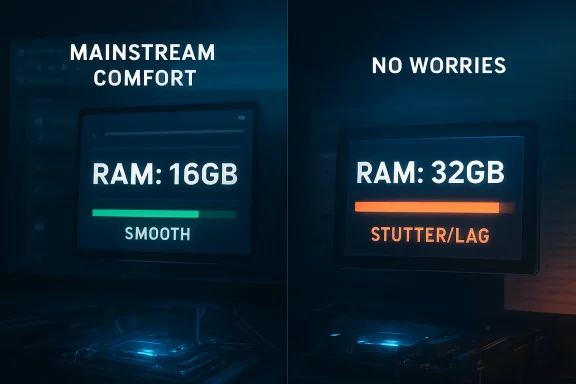 Microsoft Accidentally Said the Quiet Part Out Loud
The now-vanished guidance was framed around gaming, which gives Microsoft a defensible technical escape hatch. Modern games are huge, launchers are always awake, browsers are swollen, Discord and streaming tools are fixtures, and nobody wants their system to start paging to disk in the middle of a match. In that narrow sense, 32GB is not absurd.But the reason the line detonated is that Windows users did not hear it as a gaming tip. They heard it as a diagnosis of Windows 11 itself. For years, the operating system has been sold as modern, secure, AI-ready, fluid, and efficient; now the practical advice seems to be that the comfortable version of the experience begins where mainstream PCs only recently started to arrive.
Microsoft’s official minimum for Windows 11 remains far below this debate. The company still lists 4GB of RAM as the minimum requirement to install or upgrade to Windows 11, a figure that belongs more to compatibility paperwork than lived experience. The gap between “can boot” and “won’t make you resent your laptop” has become the central credibility problem.
That gap matters because Windows is not a boutique operating system for workstation hobbyists. It is the default platform for schools, offices, call centers, small businesses, gaming rigs, family laptops, and industrial machines. When Microsoft shifts the comfort line upward, even informally, it is not merely giving advice to enthusiasts; it is moving the economic floor beneath the PC market.
The 32GB Recommendation Is Reasonable, Which Is Why It Hurts
The easiest version of this argument is also the weakest: Microsoft says 32GB, therefore Microsoft is wrong. That is too tidy. Plenty of users should buy 32GB today, and many already have.If you play current AAA games while keeping a browser, chat client, RGB utility, capture software, game launcher, antivirus suite, and hardware monitor alive, 16GB can become cramped quickly. If you edit video, run virtual machines, compile large projects, process photos, or work with sprawling datasets, 32GB is not luxury. It is breathing room.
The problem is that Microsoft’s phrasing flattened a high-end comfort recommendation into something that felt like a new norm. “No worries” is not a benchmark category; it is a psychological promise. It says the buyer can stop thinking about memory only after buying twice what many mainstream machines still ship with.
That promise lands differently in 2026 than it would have five years ago. Memory prices have been volatile, AI hardware demand has distorted component planning, and PC buyers are being squeezed between Windows 10’s end-of-support afterlife and Windows 11’s stricter hardware posture. A recommendation that might be technically sound can still be politically tone-deaf.
Windows Has Become the Place Where Every Convenience Comes to Live
The resentment around RAM is really resentment around accumulation. Windows has become the place where every Microsoft strategy eventually takes up residence: cloud accounts, advertising surfaces, widgets, search integrations, Edge hooks, Teams remnants, Copilot entry points, Game Bar services, OneDrive prompts, Store plumbing, security layers, telemetry, compatibility shims, and update orchestration. Some of this is useful. Some of it is defensible. The totality is exhausting.The modern Windows desktop is no longer just an operating system in the old sense. It is a marketplace, identity broker, app runtime, gaming substrate, enterprise policy endpoint, AI client, cloud sync agent, security boundary, notification router, and promotional surface. That many jobs will always consume resources.
Yet users are not wrong to ask why all of that must feel so heavy. The PC industry has delivered faster CPUs, NVMe storage, high-bandwidth DDR5, more efficient display engines, and increasingly capable integrated graphics. The baseline machine of 2026 is dramatically more powerful than the baseline machine of 2016, but the subjective experience often feels less improved than the silicon curve suggests it should.
This is where Microsoft’s problem becomes reputational rather than technical. Users can forgive heavy software when it feels valuable. They are less forgiving when the weight appears to come from features they did not ask for, cannot fully remove, or suspect exist mainly to advance Microsoft’s platform agenda.
Idle RAM Is a Terrible Metric and a Great Symbol
Technically, high idle memory use is not automatically bad. Modern operating systems cache aggressively because unused RAM is wasted RAM. Windows can preload, cache, compress, and reclaim memory dynamically, and a system that appears to be “using” several gigabytes may still behave well under pressure.That nuance is real, but it does not get Microsoft off the hook. Users do not experience memory as a Task Manager lecture; they experience it as fan noise, lag, stutter, battery drain, app reloads, and the creeping sense that a machine bought only a few years ago is aging faster than it should. The number becomes a symbol because the feeling came first.
Windows enthusiasts know the difference between cached memory and a genuine leak. They also know when a fresh boot already feels crowded. The complaint is not merely that Windows uses RAM; it is that Windows has become an environment where the user must constantly adjudicate what is essential, what is merely resident, and what is quietly there because Microsoft or an OEM found a business reason to put it there.
That is why the 32GB line resonated beyond gaming. It seemed to validate the folk wisdom that Windows is no longer disciplined enough to thrive on hardware that should still be perfectly serviceable. Whether that is always fair is almost beside the point. Once an operating system loses the benefit of the doubt, every background process looks guilty.
Electron Did Not Break Windows, but It Gave Bloat a Uniform
No serious discussion of memory can ignore the app ecosystem. A Windows desktop in 2026 is often a colony of embedded browsers wearing different outfits. Chat clients, collaboration tools, password managers, note apps, launchers, hardware dashboards, and productivity utilities increasingly rely on web technologies, Chromium components, or cross-platform frameworks.This is not happening because developers are lazy in the cartoon sense. Cross-platform frameworks reduce cost, speed deployment, unify codebases, and let companies ship updates quickly across Windows, macOS, and Linux. The business logic is obvious.
The user experience cost is also obvious. A handful of web-wrapped apps can make a clean machine feel crowded before the user has done anything demanding. Each app may be rational in isolation, but together they create the modern desktop equivalent of urban sprawl: everything works, nothing is close, and the infrastructure bill keeps rising.
Microsoft is both victim and participant here. Windows must support the software world as it exists, not as native-app purists wish it existed. But Microsoft has also embraced WebView2, web-backed shells, cloud-connected surfaces, and service-driven interface elements. When the platform owner joins the same pattern users blame third-party apps for, it cannot credibly pretend this is someone else’s mess.
Apple’s Optimization Story Is Real, but Not Magic
Comparisons with macOS are inevitable and often overstated. Apple controls the hardware, operating system, many core apps, silicon roadmap, memory architecture, and retail configurations. Microsoft supports a sprawling hardware universe with decades of compatibility expectations, OEM customizations, enterprise management layers, and a software catalog that includes everything from Win32 fossils to bleeding-edge games.That said, Apple’s advantage is not merely that it has a smaller target. It is that it has made integration a product feature. Unified memory, aggressive power management, native app incentives, and tight hardware-software coordination let Macs feel more graceful under loads that would expose a messier platform.
The uncomfortable comparison for Microsoft is not that an 8GB Mac is always better than a 16GB Windows PC. That claim collapses under many real workloads. The more damaging comparison is that Apple has trained users to expect the system to manage constraints elegantly, while Windows has trained many users to expect that constraints will become their problem.
Linux and gaming-focused distributions add a different kind of pressure. SteamOS, Bazzite, and similar projects show that a leaner environment can produce a good gaming or desktop experience without carrying the full Windows inheritance. They do not replace Windows for everyone, especially not in enterprise or anti-cheat-constrained gaming, but they make Windows’ bulk more visible by contrast.
Gaming Is the Wrong Battlefield for a Purity Test
Microsoft’s deleted guidance was about gaming, and gaming is where the anti-bloat argument gets complicated. PC gaming has never been a minimalist activity. Players routinely accept giant installs, shader compilation, launchers, overlays, kernel anti-cheat, peripheral suites, capture tools, mod managers, and browser tabs full of guides.A current gaming PC with 32GB of RAM is not an exotic machine. In enthusiast circles, it is increasingly the sensible middle. If someone is buying a new gaming desktop in 2026 and can afford the upgrade, recommending 32GB is often good advice.
But Microsoft’s role in gaming is unusual. It is not merely advising buyers; it owns Windows, Xbox, Game Pass, DirectX, the Microsoft Store, Game Bar, and a major chunk of the PC gaming distribution conversation. When it tells gamers to provision more memory, it is speaking as both platform steward and ecosystem beneficiary.
That dual role demands restraint. Microsoft should be able to say that 32GB is comfortable for demanding gaming without implying that the way to handle software sprawl is to surrender to it. The message should have been: here is what today’s multitasking gaming reality looks like, and here is what we are doing to make Windows less wasteful. Instead, the pulled document left users to supply the second half themselves.
The Copilot Era Raises the Cost of Trust
The RAM fight also arrives in the middle of Microsoft’s AI push, which is why users are primed to be suspicious. Copilot+ PCs raised the hardware conversation around NPUs, memory, and local AI features. Windows has been steadily repositioned as an AI endpoint, not just a desktop OS.There is nothing inherently wrong with that. Local AI features may eventually become useful, especially for accessibility, search, workflow automation, and privacy-preserving inference. The issue is sequencing. Microsoft has asked users to accept AI integration before many of them believe the existing desktop has been cleaned up.
That creates a trust deficit. If Windows Search still feels inconsistent, Settings still has Control Panel ghosts, updates still occasionally disrupt work, ads still appear where users expect system surfaces, and background components still feel opaque, then AI features look less like progress and more like another layer. The user hears “intelligence” and suspects “more resident services.”
Microsoft has reportedly recognized some of this backlash internally and publicly, with leadership talking about fundamentals, quality, performance, and serving core users better. That is the right vocabulary. But vocabulary is not performance. The test will be whether Windows becomes tangibly quieter, faster, and more respectful on machines people already own.
Windows K2 Sounds Like an Apology in Roadmap Form
The reported “K2” effort, described as a push to improve Windows quality and regain user trust, is intriguing because it acknowledges what product marketing usually avoids. Windows does not need another grand reinvention so much as a visible campaign of restraint. Users want fewer irritations, fewer duplicative surfaces, fewer surprise prompts, and a system that feels like it is on their side.If K2 is real in the way users need it to be real, it should not be measured by keynote demos. It should be measured by cold boots, resume times, memory pressure, update predictability, driver stability, battery drain, UI latency, and how many things a user must turn off before the PC feels like theirs. The boring metrics are the product.
There is precedent for Microsoft getting this right. Windows 7 succeeded partly because it felt like an act of cleanup after Vista’s overreach. Windows 10, at its best, restored a sense of desktop pragmatism after Windows 8’s tablet-first detour. Windows 11 has never enjoyed that same broad emotional contract, partly because its visual polish arrived with stricter requirements and a more assertive services layer.
K2 has to be more than “Windows, but with fewer complaints.” It has to represent a change in incentives. If every team inside Microsoft can still win by adding another surface, another background integration, another growth funnel, or another AI hook, the platform will keep getting heavier no matter how many performance teams are assigned to sand it down later.
Enterprises Hear a Budget Alarm, Not a Gamer Debate
For home users, the 32GB argument is annoying. For IT departments, it is a planning signal. Fleet refreshes are built around lifecycles, images, procurement contracts, app compatibility, security baselines, and support windows. A casual shift in what counts as “comfortable” can ripple through budgets.Many enterprises are still digesting Windows 10’s retirement timeline, extended security options, Windows 11 hardware eligibility, and the realities of hybrid work. If 16GB becomes the de facto floor for business machines and 32GB becomes the safer tier for developers, analysts, engineers, and heavy multitaskers, that changes procurement math at scale. It also changes how long existing devices can be kept in service without frustrating users.
The irony is that enterprise IT has historically valued Windows because it runs everywhere and supports nearly everything. That breadth remains powerful. But breadth without discipline becomes expensive. If the answer to every performance concern is “buy more RAM,” Windows begins to look less like a universal platform and more like a tax on general-purpose computing.
This is where Microsoft should be especially cautious. Corporate buyers can absorb higher specifications more easily than consumers, but they also measure friction more ruthlessly. A few seconds of latency multiplied across thousands of workers is not vibes; it is productivity loss dressed in small increments.
The PC Industry Will Happily Sell the Cure
Microsoft is not alone in benefiting from higher baselines. OEMs like higher average selling prices. Memory vendors like richer configurations. Retailers like upsells. Reviewers like recommending the SKU that avoids regret. The entire industry has incentives to make 32GB feel normal.Sometimes that normalization is healthy. The 4GB-to-8GB transition was necessary. The 8GB-to-16GB transition made mainstream PCs much better. A 16GB-to-32GB transition will also make many machines age more gracefully, especially as browsers, games, AI features, and creative tools continue to expand.
But there is a difference between raising the baseline because workloads have changed and raising it because software has become careless. The industry tends to blur those categories because both end in a sale. Users, understandably, are less charitable.
A better Microsoft would use its influence to separate the two. It could say plainly that 32GB is a strong recommendation for new gaming PCs and heavy multitasking, while also committing to measurable reductions in system overhead. It could publish performance targets, not just hardware shopping advice. It could treat efficiency as a competitive feature rather than an engineering chore.
Minimum Requirements Have Become a Legal Fiction
The Windows 11 minimum requirement of 4GB of RAM is not wrong in the narrow certification sense. A machine can run the operating system with that amount. But nobody who cares about user experience should pretend that “runs” and “runs well” are adjacent concepts.Minimum requirements have always been a strange genre of corporate speech. They are designed to define eligibility, not happiness. They protect compatibility claims and OEM planning, but they do not tell a buyer whether the device will feel good after updates, security software, browser tabs, cloud sync, and daily life arrive.
The problem is that Microsoft’s public messaging often lets these categories collide. Windows 11 can officially require 4GB, Copilot+ PCs can normalize 16GB, gaming guidance can float 32GB as comfort, and the user is left to decode which number applies to reality. That confusion benefits nobody except the salesperson steering a nervous buyer toward the more expensive SKU.
Microsoft should retire the fiction that one RAM number can describe Windows. It needs a more honest ladder: installable, usable, comfortable, and recommended for specific workloads. The company already thinks this way internally. The controversy erupted because, for a moment, users saw the unvarnished version.
Microsoft’s Real Problem Is Not RAM, but Permission
The deepest complaint in the Digital Trends broadside is not that 32GB exists or that games are demanding. It is that Microsoft appears to believe it has permission to keep adding weight because hardware will catch up. That assumption is the old enemy of good platform stewardship.Windows became dominant because it abstracted hardware complexity without making users feel trapped by the abstraction. It let cheap PCs become useful, expensive PCs become powerful, and businesses standardize without surrendering every choice. The platform’s moral bargain was flexibility.
When Windows feels bloated, that bargain weakens. Users begin to ask why the operating system gets to consume more of the machine before they do. They ask why the default install feels like a negotiation. They ask why removing unwanted pieces is harder than adding new ones.
This is why “that sounds like a you problem” resonates. It is not a technical rebuttal; it is a boundary. Users are saying that Microsoft does not automatically get to convert its product complexity into their hardware expense.
The Backlash Is a Roadmap If Microsoft Can Read It
The useful thing about this controversy is that the anger is specific. Users are not asking for Windows to become Haiku or a bare Arch install. They are asking for Microsoft to stop confusing strategic ambition with user value.A Windows 11 machine should not feel like it is auditioning for ten Microsoft businesses at once. The operating system can support AI without making AI feel compulsory. It can promote cloud services without turning system surfaces into billboards. It can support web apps without making the desktop feel like a stack of browsers in a trench coat.
Microsoft should also resist the temptation to dismiss the backlash as enthusiast theatrics. Enthusiasts are often noisy, but they are also early indicators of broader fatigue. The same people complaining about RAM today are the people relatives ask for buying advice, the admins who shape fleet standards, and the gamers who decide whether Windows remains the default PC gaming platform or merely the legacy one.
The company has a chance to convert this into a useful reset. Admit that 32GB is wise for many new gaming PCs. Admit that 16GB is the practical mainstream floor for a modern Windows experience. Then do the harder thing: prove that Windows 11 and its successors can become lighter without becoming less capable.
The “No Worries” PC Should Not Require No Standards
The most concrete lesson from Microsoft’s deleted guidance is that users want honesty, but they want accountability with it. A higher hardware recommendation is acceptable when it comes with evidence, workload clarity, and a visible commitment to optimization.- Microsoft’s pulled guidance was aimed at gaming PCs, but the backlash spread because Windows users already feel the operating system has become too heavy.
- The official 4GB Windows 11 minimum is best understood as an install threshold, not a promise of a good everyday experience.
- A 32GB gaming recommendation is technically defensible for demanding titles, streaming, browsers, chat apps, and multitasking.
- The controversy becomes damaging when higher RAM is presented as the cure for software sprawl rather than one tool for specific workloads.
- Microsoft’s reported focus on Windows fundamentals will matter only if users can feel measurable improvements on existing hardware.
Source: Digital Trends 32GB RAM for Windows 11? Hey Microsoft, that sounds like a you problem!
