

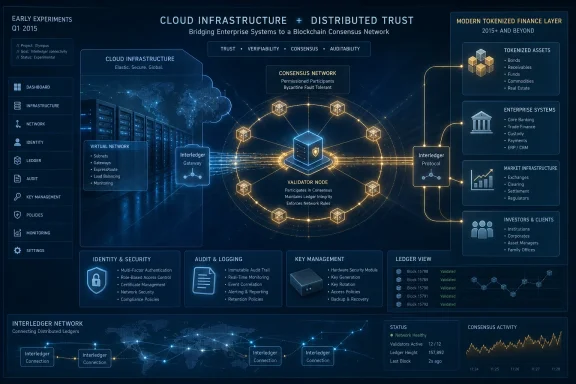
Microsoft disclosed on December 7, 2015, that Azure Blockchain as a Service was operating a Ripple validating node for Ripple’s bank users, placing Microsoft’s cloud infrastructure inside a live consensus network during the early enterprise-blockchain boom rather than merely hosting a laboratory demo on Azure. The detail matters less as crypto trivia than as a reminder of how early the cloud giants understood the institutional value of distributed ledgers. Microsoft was not betting the company on XRP, nor was it quietly becoming a bank. It was testing whether Azure could become the neutral compute layer beneath financial networks that did not want to be owned by any single bank, vendor, or protocol.
The 2015 Azure Blockchain as a Service update reads today like a time capsule from a more experimental Microsoft. Ethereum was the headline act, ConsenSys was the glamorous partner, and the pitch was classic Azure: let enterprises “fail fast and cheap” with emerging infrastructure instead of spending months assembling fragile test environments by hand.
The Ripple validator line was easy to miss because it was buried in a broader ecosystem update. But it was not an incidental marketplace listing. Microsoft said Azure BaaS was “currently operating” a Ripple validating node for the benefit of Ripple’s bank users, and described that node as a valuable stakeholder in the consensus network.
That is a very specific kind of participation. A cloud marketplace image lets customers deploy software. A validator node participates in the health and operation of a network. Microsoft’s move therefore sat somewhere between product exploration, ecosystem development, and infrastructure signaling.
This is where the story becomes more interesting than the revived 2026 social-media framing around it. The important point is not that Microsoft secretly endorsed every future claim made by Ripple advocates. The important point is that Microsoft understood, very early, that enterprise blockchain would be sold not as ideology but as plumbing.
That distinction mattered to banks. Mining-based systems carried political, environmental, and governance baggage even before those debates became mainstream. Ripple’s pitch to financial institutions was that distributed settlement could be fast, controlled enough to feel enterprise-safe, and interoperable with existing banking workflows.
By running a validator, Azure was not taking control of Ripple’s network. It was adding a recognizable enterprise infrastructure provider to the mix. For a banking customer evaluating whether this new settlement fabric could be trusted, a Microsoft-operated node had reputational value.
That reputational value was the real product. Microsoft was offering more than compute cycles; it was lending Azure’s enterprise credibility to a young category that desperately needed adults in the room. In 2015, that was a useful signal to banks still trying to distinguish serious distributed-ledger projects from speculative noise.
Microsoft’s emerging blockchain language in 2016 emphasized openness, modularity, identity, security, and interoperability. Project Bletchley, its enterprise blockchain architecture, framed Azure not as a chain but as a fabric around chains. That was a very Microsoft move: abstract the messy layer below, integrate the identity and developer tooling above, and make the platform indispensable in the middle.
The Ripple connection also included Microsoft’s interest in the Interledger Protocol, which was designed to route value across different payment networks. That is a critical distinction. Interledger was not another blockchain competing to be the single global ledger. It was an attempt to connect ledgers, payment systems, and financial networks that would never fully standardize on one stack.
That idea has aged better than many 2015 blockchain slogans. Enterprises did not converge on one universal chain. Banks did not rip out their core systems and replace them with public ledgers. Instead, the market moved toward bridges, custodians, tokenized deposits, stablecoins, permissioned environments, settlement APIs, and compliance-heavy middleware.
Azure’s quiet Ripple validator belongs to that lineage. It showed Microsoft exploring not just blockchain deployment, but the possibility that cloud platforms could host the connective tissue between financial networks.
Microsoft itself eventually retired Azure Blockchain Service in September 2021, after telling customers to migrate elsewhere. That retirement is an important corrective to any overexcited claim that Azure’s Ripple validator represented a straight line from 2015 to a Microsoft-led blockchain future. It did not.
But product retirement does not mean the underlying thesis vanished. Microsoft’s blockchain strategy narrowed and shifted toward more specific services, partner offerings, confidential computing, identity, and tamper-evident ledgers. The company became less interested in selling a broad managed blockchain service under its own banner and more interested in letting Azure remain the substrate for specialized providers.
That is how enterprise infrastructure often evolves. The first product wrapper fails, but the architectural pattern survives. Early cloud mobile back ends, IoT platforms, and big-data services followed similar paths: too broad at first, then absorbed into sharper managed services and partner ecosystems.
Tokenized assets, stablecoin settlement, always-on liquidity, and digital collateral are no longer fringe concepts confined to white papers. Large financial institutions now discuss tokenization in the language of operational efficiency, collateral mobility, settlement risk, and market access. The vocabulary has changed because the buyer has changed.
That does not mean every Ripple-adjacent claim deserves credulous treatment. The crypto industry remains unusually skilled at turning old vendor experiments into new narratives. A decade-old Azure update does not prove Microsoft has a current strategic alliance with Ripple, nor does it validate any particular token-price thesis.
What it does prove is narrower and more useful. Microsoft saw enough institutional demand in late 2015 to put Azure infrastructure into a live Ripple consensus role and to explore Interledger as part of its blockchain platform thinking. That is a real historical signal, and it helps explain why cloud providers keep orbiting digital-asset infrastructure even when they avoid the loudest parts of crypto culture.
A validator is not just an executable on a virtual machine. It has uptime expectations, patching requirements, network exposure, key-management implications, logging needs, and governance questions. If it participates in a real financial network, its failure modes matter beyond the subscription owner’s monthly bill.
That is why Microsoft’s early role is more consequential than a simple “Azure supported Ripple” headline. Azure was testing whether cloud-native operations could be made acceptable to institutions that care about auditability, resilience, and trust boundaries. Those are familiar concerns to any administrator who has had to explain where a workload runs, who can access it, and how it fails.
The same issues now show up across Web3 infrastructure, confidential ledgers, tokenization platforms, and digital-identity systems. The branding changes; the operational burden does not. Enterprises still need identity controls, separation of duties, recovery plans, telemetry, incident response, and vendor exit strategies.
That is why Azure can step back from a first-party blockchain service while still remaining relevant to blockchain-adjacent workloads. Managed Kubernetes, confidential computing, hardware-backed key protection, identity services, observability, and private networking are all more durable than any one ledger product. They are also easier to sell to risk committees.
This is the less glamorous but more profitable side of the blockchain story. The protocol captures the headlines, but the enterprise deal often depends on boring infrastructure. Banks do not buy decentralization in the abstract; they buy controlled participation in networks that might reduce settlement friction without blowing up governance.
Microsoft has always been comfortable in that middle layer. It does not need to own the ledger to own the enterprise relationship around the ledger. Azure’s old Ripple validator was an early glimpse of that strategy.
That timeline should cool the promotional reading. It should also sharpen the historical one. Microsoft’s experiment happened before the 2017 token mania, before the 2020–2021 institutional crypto wave, and before the current tokenization race became a boardroom-friendly topic.
In other words, Azure was early not because it predicted a single winner, but because it correctly identified a category of enterprise demand. Financial institutions wanted to test shared infrastructure without surrendering control. Developers wanted one-click environments. Vendors wanted credibility. Cloud platforms were the obvious meeting place.
That is the quiet infrastructure play. Not a secret alliance, not a hidden endorsement, and not a buried master plan. Just a cloud provider recognizing that if value networks were going to become programmable, somebody would have to run the boring parts.
Source: Coinpaper Microsoft Azure Was Running a Ripple Validator Years Ago — Inside the Quiet Blockchain Infrastructure Play
 Azure Was Selling Optionality Before Blockchain Had a Uniform
The 2015 Azure Blockchain as a Service update reads today like a time capsule from a more experimental Microsoft. Ethereum was the headline act, ConsenSys was the glamorous partner, and the pitch was classic Azure: let enterprises “fail fast and cheap” with emerging infrastructure instead of spending months assembling fragile test environments by hand.The Ripple validator line was easy to miss because it was buried in a broader ecosystem update. But it was not an incidental marketplace listing. Microsoft said Azure BaaS was “currently operating” a Ripple validating node for the benefit of Ripple’s bank users, and described that node as a valuable stakeholder in the consensus network.
That is a very specific kind of participation. A cloud marketplace image lets customers deploy software. A validator node participates in the health and operation of a network. Microsoft’s move therefore sat somewhere between product exploration, ecosystem development, and infrastructure signaling.
This is where the story becomes more interesting than the revived 2026 social-media framing around it. The important point is not that Microsoft secretly endorsed every future claim made by Ripple advocates. The important point is that Microsoft understood, very early, that enterprise blockchain would be sold not as ideology but as plumbing.
The Validator Was a Small Node With a Large Message
Ripple’s design made the Azure experiment especially revealing. Unlike Bitcoin’s proof-of-work model, the XRP Ledger does not depend on miners racing to solve computational puzzles. It relies on validators and trust lists to help the network agree on transaction ordering and ledger state.That distinction mattered to banks. Mining-based systems carried political, environmental, and governance baggage even before those debates became mainstream. Ripple’s pitch to financial institutions was that distributed settlement could be fast, controlled enough to feel enterprise-safe, and interoperable with existing banking workflows.
By running a validator, Azure was not taking control of Ripple’s network. It was adding a recognizable enterprise infrastructure provider to the mix. For a banking customer evaluating whether this new settlement fabric could be trusted, a Microsoft-operated node had reputational value.
That reputational value was the real product. Microsoft was offering more than compute cycles; it was lending Azure’s enterprise credibility to a young category that desperately needed adults in the room. In 2015, that was a useful signal to banks still trying to distinguish serious distributed-ledger projects from speculative noise.
Microsoft’s Real Bet Was the Cloud as Financial Middleware
The Ripple node sits neatly inside Microsoft’s broader enterprise-blockchain strategy at the time. Azure BaaS was designed as a sandbox where organizations could test multiple chains, deployment models, and consensus approaches without marrying one architecture too early. That flexibility was the sales pitch.Microsoft’s emerging blockchain language in 2016 emphasized openness, modularity, identity, security, and interoperability. Project Bletchley, its enterprise blockchain architecture, framed Azure not as a chain but as a fabric around chains. That was a very Microsoft move: abstract the messy layer below, integrate the identity and developer tooling above, and make the platform indispensable in the middle.
The Ripple connection also included Microsoft’s interest in the Interledger Protocol, which was designed to route value across different payment networks. That is a critical distinction. Interledger was not another blockchain competing to be the single global ledger. It was an attempt to connect ledgers, payment systems, and financial networks that would never fully standardize on one stack.
That idea has aged better than many 2015 blockchain slogans. Enterprises did not converge on one universal chain. Banks did not rip out their core systems and replace them with public ledgers. Instead, the market moved toward bridges, custodians, tokenized deposits, stablecoins, permissioned environments, settlement APIs, and compliance-heavy middleware.
Azure’s quiet Ripple validator belongs to that lineage. It showed Microsoft exploring not just blockchain deployment, but the possibility that cloud platforms could host the connective tissue between financial networks.
The Hype Cycle Hid a More Durable Infrastructure Story
It is tempting to read every old blockchain experiment through the boom-and-bust cycles that followed. Initial coin offerings exploded, collapsed, and left regulators sweeping up debris. Enterprise blockchain pilots multiplied, produced glossy press releases, and often disappeared before reaching production scale.Microsoft itself eventually retired Azure Blockchain Service in September 2021, after telling customers to migrate elsewhere. That retirement is an important corrective to any overexcited claim that Azure’s Ripple validator represented a straight line from 2015 to a Microsoft-led blockchain future. It did not.
But product retirement does not mean the underlying thesis vanished. Microsoft’s blockchain strategy narrowed and shifted toward more specific services, partner offerings, confidential computing, identity, and tamper-evident ledgers. The company became less interested in selling a broad managed blockchain service under its own banner and more interested in letting Azure remain the substrate for specialized providers.
That is how enterprise infrastructure often evolves. The first product wrapper fails, but the architectural pattern survives. Early cloud mobile back ends, IoT platforms, and big-data services followed similar paths: too broad at first, then absorbed into sharper managed services and partner ecosystems.
The Enterprise Blockchain Dream Became Less Romantic and More Useful
The best argument for revisiting Microsoft’s Ripple validator is not nostalgia. It is that the market in 2026 looks closer to the sober version of the 2015 thesis than to either the maximalist crypto dream or the enterprise-blockchain backlash.Tokenized assets, stablecoin settlement, always-on liquidity, and digital collateral are no longer fringe concepts confined to white papers. Large financial institutions now discuss tokenization in the language of operational efficiency, collateral mobility, settlement risk, and market access. The vocabulary has changed because the buyer has changed.
That does not mean every Ripple-adjacent claim deserves credulous treatment. The crypto industry remains unusually skilled at turning old vendor experiments into new narratives. A decade-old Azure update does not prove Microsoft has a current strategic alliance with Ripple, nor does it validate any particular token-price thesis.
What it does prove is narrower and more useful. Microsoft saw enough institutional demand in late 2015 to put Azure infrastructure into a live Ripple consensus role and to explore Interledger as part of its blockchain platform thinking. That is a real historical signal, and it helps explain why cloud providers keep orbiting digital-asset infrastructure even when they avoid the loudest parts of crypto culture.
Windows Shops Should Read This as a Cloud Governance Story
For WindowsForum readers, the practical angle is not whether to run out and deploy a validator. It is how quickly experimental infrastructure becomes somebody’s compliance, identity, monitoring, and operational problem. Once a cloud platform participates in financial rails, the conversation leaves the lab.A validator is not just an executable on a virtual machine. It has uptime expectations, patching requirements, network exposure, key-management implications, logging needs, and governance questions. If it participates in a real financial network, its failure modes matter beyond the subscription owner’s monthly bill.
That is why Microsoft’s early role is more consequential than a simple “Azure supported Ripple” headline. Azure was testing whether cloud-native operations could be made acceptable to institutions that care about auditability, resilience, and trust boundaries. Those are familiar concerns to any administrator who has had to explain where a workload runs, who can access it, and how it fails.
The same issues now show up across Web3 infrastructure, confidential ledgers, tokenization platforms, and digital-identity systems. The branding changes; the operational burden does not. Enterprises still need identity controls, separation of duties, recovery plans, telemetry, incident response, and vendor exit strategies.
The Cloud Giants Prefer the Picks and Shovels
Microsoft’s posture also reflects a broader pattern among hyperscalers. The safest cloud business is rarely to bet on a single financial protocol. It is to sell the compute, storage, security, key management, analytics, and compliance scaffolding that many protocols need.That is why Azure can step back from a first-party blockchain service while still remaining relevant to blockchain-adjacent workloads. Managed Kubernetes, confidential computing, hardware-backed key protection, identity services, observability, and private networking are all more durable than any one ledger product. They are also easier to sell to risk committees.
This is the less glamorous but more profitable side of the blockchain story. The protocol captures the headlines, but the enterprise deal often depends on boring infrastructure. Banks do not buy decentralization in the abstract; they buy controlled participation in networks that might reduce settlement friction without blowing up governance.
Microsoft has always been comfortable in that middle layer. It does not need to own the ledger to own the enterprise relationship around the ledger. Azure’s old Ripple validator was an early glimpse of that strategy.
The 2015 Experiment Looks Smaller and Smarter in Hindsight
The revived attention around Coinpaper’s report risks overstating the present-day implications. Microsoft has not suddenly re-entered the Ripple ecosystem because someone rediscovered an old Azure blog post. The relevant chronology is plain: Azure BaaS launched in late 2015, Microsoft said it was operating a Ripple validating node in December 2015, the company expanded its enterprise blockchain experiments in 2016, and Azure Blockchain Service was later retired in 2021.That timeline should cool the promotional reading. It should also sharpen the historical one. Microsoft’s experiment happened before the 2017 token mania, before the 2020–2021 institutional crypto wave, and before the current tokenization race became a boardroom-friendly topic.
In other words, Azure was early not because it predicted a single winner, but because it correctly identified a category of enterprise demand. Financial institutions wanted to test shared infrastructure without surrendering control. Developers wanted one-click environments. Vendors wanted credibility. Cloud platforms were the obvious meeting place.
That is the quiet infrastructure play. Not a secret alliance, not a hidden endorsement, and not a buried master plan. Just a cloud provider recognizing that if value networks were going to become programmable, somebody would have to run the boring parts.
The Signal From Azure’s Ripple Node Is Still Worth Separating From the Noise
The useful lesson is compact, but it cuts through a decade of overstatement. Microsoft’s Ripple validator was real, early, and institutionally meaningful, but it was also part of a broader experimentation phase rather than proof of a current strategic commitment.- Microsoft publicly said in December 2015 that Azure Blockchain as a Service was operating a Ripple validating node for Ripple’s bank users.
- The validator mattered because it placed Azure infrastructure in a live consensus role, not merely behind a sample application.
- Microsoft’s simultaneous interest in Interledger showed that interoperability, rather than chain maximalism, was already central to its enterprise thinking.
- Azure Blockchain Service’s 2021 retirement limits any claim that Microsoft maintained a continuous first-party blockchain platform strategy from that era.
- The durable story is that cloud platforms remain natural hosts for digital-asset infrastructure, especially where identity, compliance, uptime, and governance matter.
Source: Coinpaper Microsoft Azure Was Running a Ripple Validator Years Ago — Inside the Quiet Blockchain Infrastructure Play
