

Microsoft’s weekend hotpatch for Windows 11 and the company’s massive AI infrastructure push together create a picture of a firm that is simultaneously firefighting near‑term technical problems and betting the house on long‑term platform dominance — a duality that matters for investors weighing near‑term technical signals against multi‑year growth narratives.
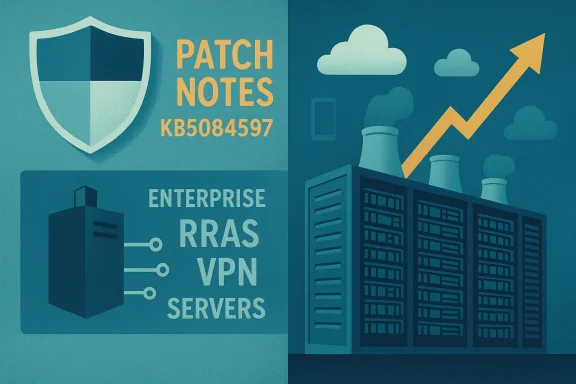
Microsoft’s security team deployed an out‑of‑band hotpatch for Windows 11 in mid‑March to close a set of Remote Code Execution (RCE) flaws that emerged from the March Patch Tuesday cycle. The emergency update, identified as KB5084597, was rolled out on March 13–15 for Windows 11 Enterprise customers enrolled in hotpatching and targeted Windows 11 versions 25H2 and 24H2, plus the Windows 11 Enterprise LTSC 2024 stream. The update closed three RRAS‑related vulnerabilities tracked as CVE‑2026‑25172, CVE‑2026‑25173, and CVE‑2026‑26111, all of which allow remote code execution under certain attacker conditions.
At roughly the same time, Microsoft and Samsung investigated reports of some Samsung OEM systems showing an “Access denied” state for the C: system volume following recent updates. That investigation traced the symptoms to a Samsung application — broadly reported as the Samsung Galaxy Connect / Samsung storage share family of software — rather than a change in Windows itself. Samsung temporarily pulled a problematic distribution from affected app channels while a stable build was republished.
Those two events — an unplanned hotpatch and a high‑profile OEM software failure — make for an instructive one‑two punch: Microsoft is publicly reinforcing its commitment to security and fast mitigation, yet the ecosystem complexity of Windows devices (manufacturers, drivers, OEM utilities) continues to expose customers — and by extension Microsoft’s brand and operations — to reliability incidents.
Key takeaways from the Samsung incident:
Industry research firms and market commentators have converged on the idea that hyperscalers and large cloud providers will pour hundreds of billions into AI and data center infrastructure over the next several years. Leading infrastructure and real‑estate analysts forecast that the data center sector alone could require multiple trillions in investment through the end of the decade, with a major tranche of that spend front‑loaded into 2026 and immediately adjacent years.
Why the spending matters:
Concrete market snapshots give context:
For investors, the tension is real: near‑term technical and operational events can create volatility and headline risk, while the multi‑year AI/cloud capex cycle argues for a patient, strategic view. The prudent approach is to treat the two realities together — respect technical signals and manage near‑term risk, while weighting portfolio exposure to Microsoft according to conviction in the company’s ability to convert its infrastructure investments into durable, high‑margin revenue streams over the coming years.
Source: AD HOC NEWS Microsoft's Dual Focus: Security Patches and AI Ambitions Shape Investor Outlook
 Background
Microsoft’s security team deployed an out‑of‑band hotpatch for Windows 11 in mid‑March to close a set of Remote Code Execution (RCE) flaws that emerged from the March Patch Tuesday cycle. The emergency update, identified as KB5084597, was rolled out on March 13–15 for Windows 11 Enterprise customers enrolled in hotpatching and targeted Windows 11 versions 25H2 and 24H2, plus the Windows 11 Enterprise LTSC 2024 stream. The update closed three RRAS‑related vulnerabilities tracked as CVE‑2026‑25172, CVE‑2026‑25173, and CVE‑2026‑26111, all of which allow remote code execution under certain attacker conditions.At roughly the same time, Microsoft and Samsung investigated reports of some Samsung OEM systems showing an “Access denied” state for the C: system volume following recent updates. That investigation traced the symptoms to a Samsung application — broadly reported as the Samsung Galaxy Connect / Samsung storage share family of software — rather than a change in Windows itself. Samsung temporarily pulled a problematic distribution from affected app channels while a stable build was republished.
Those two events — an unplanned hotpatch and a high‑profile OEM software failure — make for an instructive one‑two punch: Microsoft is publicly reinforcing its commitment to security and fast mitigation, yet the ecosystem complexity of Windows devices (manufacturers, drivers, OEM utilities) continues to expose customers — and by extension Microsoft’s brand and operations — to reliability incidents.
What Microsoft patched: technical overview
The nature of the vulnerabilities
- The trio of fixes patched in the hotpatch targeted weaknesses in the Routing and Remote Access Service (RRAS), a Windows component used in enterprise environments to handle VPNs, routing, and remote access functions.
- The reported weaknesses are classed as remote code execution vectors: under certain conditions an attacker could coerce a domain‑joined or otherwise authenticated user into interacting with a malicious RRAS endpoint, with the possibility of executing code or disrupting service.
- CVSS scores for these RRAS issues were reported as in the high‑sevens to 8.8 range by multiple vulnerability trackers; that places them in the important/critical tier for enterprise patch prioritization.
Why Microsoft used a hotpatch
- Microsoft opted for a hotpatch — an in‑memory, out‑of‑band remedial update — to protect high‑availability systems without forcing reboots. Hotpatching is commonly used for urgent, high‑impact vulnerabilities in environments where reboots would cause unacceptable downtime.
- The KB designation (KB5084597) and the targeted OS build numbers (hotpatch builds reported in vendor and community updates) indicate this was a focused enterprise fix rather than a broad cumulative release.
What admins should do now
- Prioritize enterprise RRAS endpoints (VPN gateways, remote access servers) for verification and testing.
- Confirm hotpatchs have been staged/applied to hotpatch‑enabled devices; where devices are not enrolled, apply the March cumulative updates and schedule controlled reboots if needed.
- Audit third‑party OEM utilities on managed devices — particularly vendors that ship system‑level integrations (e.g., Samsung, Lenovo, HP) — to reduce exposure to non‑OS software that can change ACLs, drivers, or filesystem permissions.
The Samsung C: drive incident — lessons about ecosystem complexity
When multiple machines from a single OEM begin reporting inaccessible system volumes immediately after updates, the reflex is often to blame the OS. The finer reality is usually more complex: the interaction between OEM drivers, preinstalled services, and OS hardening can surface latent bugs in non‑Microsoft software.Key takeaways from the Samsung incident:
- OEM utilities — even those marketed as convenience features for phone‑linking, device management, or SSD management — run with privileges and can modify critical system structures.
- Microsoft and Samsung’s joint investigation concluded that a faulty Samsung component triggered permission corruption on certain Galaxy Book and desktop SKUs. Samsung pulled the offending package and reinstated a stable build.
- For IT teams: auditing factory images and disabling or uninstalling nonessential OEM utilities on enterprise fleet images reduces blast radius from such incidents.
The macro picture: hyperscalers, AI and a spending supercycle
While the security headlines underline the operational realities of maintaining a widely deployed OS, Microsoft’s corporate strategy is dominated by an even larger, multi‑year capital allocation decision: building the compute infrastructure that will power generative AI and cloud services.Industry research firms and market commentators have converged on the idea that hyperscalers and large cloud providers will pour hundreds of billions into AI and data center infrastructure over the next several years. Leading infrastructure and real‑estate analysts forecast that the data center sector alone could require multiple trillions in investment through the end of the decade, with a major tranche of that spend front‑loaded into 2026 and immediately adjacent years.
- Commercial data center outlooks from major real‑estate and credit agencies show a gigantic buildout requirement to add tens of gigawatts of capacity and to outfit that capacity with GPUs, networking, and specialized power and cooling.
- Multiple market writeups and analyst roundups have put the collective hyperscaler‑driven AI spending figure in the ballpark of $600–$650 billion by 2026 across chips, servers, data center real‑estate, and related capital equipment — a convenient shorthand for the scale of the industry wave even if individual company numbers vary.
Why the spending matters:
- AI models — especially large generative models — require specialized accelerators (GPUs, custom ASICs), dense racks, and substantial power and cooling investment. That is capital intensive and cannot be scaled overnight.
- Hyperscaler investment creates long lead times for equipment (HBM memory, switches, optical fabric) and for site power provisioning — factors that increase the importance of scale and preferred supplier relationships.
- For Microsoft, heavy capex is a strategic choice: secure the compute capacity, own the cloud services surface, and monetize AI through platform, productivity, and enterprise channels.
Stock performance and technical picture — hard data matters
While Microsoft’s strategy centers on AI and cloud, investors often react to near‑term price action and technical indicators. The juxtaposition here is stark: a company with a long‑term growth story that, in the near term, is trading notably below the levels it reached at the start of the year.Concrete market snapshots give context:
- Microsoft’s shares were trading in the mid‑to‑high‑$300s in mid‑March 2026, versus closing levels in the low‑to‑high‑$400s at the start of the year. For example, an early‑January close was roughly in the $470–$475 range while mid‑March trading put the stock near $395–$400 — a decline on the order of ~15–16% since the year began.
- Technical indicators tracked across providers show the stock beneath several moving averages that technical traders watch. The 200‑day moving average is widely referenced by market participants as a long‑term trend filter. Different data providers report somewhat different 200‑day figures (reflecting data source nuance and timing), but the consensus zone for the 200‑day line has been in the low‑to‑mid‑$400s, which places mid‑March prices below that important long‑term average in many feeds.
- Some European commentators expressed the 200‑day average in euros (a quoted level near 415 EUR), which underscores an important point: currency, the venue used for quoting (U.S. listing vs. European ADR/ETFs), and which data vendor you consult all change the headline technical level.
- Trading below the 200‑day moving average is a technical signal interpreted by many as a switch from long‑term bullish momentum to consolidation or risk of further downside until confirmation of recovery.
- But technicals are one input among many. Microsoft’s revenue and cash‑flow trajectory, Azure growth, and AI monetization plans are fundamental anchors that may justify holding through short‑term technical weakness.
- For traders, the gap between the short‑term sentiment (price weakness) and long‑term story (AI/cloud investment, durable enterprise franchise) creates volatility — and opportunities for both disciplined long‑term buyers and tactical short‑term traders.
Strengths in Microsoft’s position
- Scale and embedded enterprise presence. Microsoft’s suite — Office, Windows, Azure, Dynamics, GitHub, Teams — gives it a broad reach into corporate IT and productivity workflows. That built‑in distribution is a competitive advantage when Microsoft layers AI into productivity and cloud offerings.
- Integrated cloud + software strategy. Microsoft’s approach to offering AI capabilities inside Azure and across Microsoft 365 gives it multiple monetization vectors: infrastructure as a service (AI compute), platform services (APIs, model hosting), and end‑user productivity uplift (Copilot‑style features).
- Financial firepower. Even after elevated capex, Microsoft’s balance sheet and cash flow generation enable sustained investment in data centers, partnerships, and strategic M&A if needed.
- Operational response to security. The hotpatch demonstrates a mature incident response capability — detecting, prioritizing, and delivering targeted updates to enterprise systems without forcing reboots is nontrivial and valuable to critical customers.
Risks and downside scenarios
- Capital intensity and ROI timing. Heavy investment in datacenter real estate and AI infrastructure pushes capital expenditures up front while the revenue and margin payback is realized over years. If AI monetization is slower or more competitive than expected, margins and return on invested capital could compress.
- Supply chain and energy constraints. GPUs, HBM, and specialized networking gear have limited production capacity. Meanwhile, siting large data centers is constrained by power availability and permitting — delays or cost overruns are real.
- Ecosystem fragility and reliability incidents. The Samsung C: drive episode is a cautionary micro‑example: complex device images and OEM utilities can generate reputational and operational headaches that distract customers and IT teams.
- Market sentiment and multiple compression. Even with strong fundamental prospects, macro risk or de‑risking in the technology sector can produce share price declines. Near‑term technical weakness (trading below moving averages) can be self‑reinforcing as certain quant funds and trend strategies reduce exposure.
- Regulatory and geopolitical risk. AI is increasingly in the regulatory eye. Changes to data‑localization rules, export controls on advanced chips, or liability regimes for AI outputs would materially affect costs and go‑to‑market strategies.
What investors should watch next
- Corporate capex disclosures and commentary: watch Microsoft’s capex cadence and any margins commentary tied to AI offerings. Quarterly commentary on Azure AI monetization will be particularly informative.
- Patch adoption and reliability metrics: how broadly the hotpatch and March cumulative updates are applied, and whether the Samsung OEM incident spawns broader vendor or OEM guidance on factory images.
- Supply chain signals: GPU allocations, HBM availability, and lead‑times from GPU vendors will shape hyperscalers’ ability to scale model training and inference.
- Technical confirmation levels for traders: price reclaim of the 200‑day moving average (as reported by major data providers) would be a psychological and technical milestone; failure to reclaim it could signal further consolidation.
- Broader market sentiment on AI: while long‑term AI adoption supports Microsoft’s thesis, the market will price expected returns against the enormous up‑front capital spending. Evidence that AI workloads are being monetized at scale (i.e., cloud customers paying higher bills for AI services or adoption of Microsoft’s paid Copilot features) will be a positive signal.
Practical investor takeaways
- If you are a long‑term investor focused on the secular AI/cloud transformation, Microsoft remains fundamentally positioned to benefit. The company’s scale, diversified revenue mix, and platform positions are durable advantages.
- If you are a short‑term or tactical trader, respect technicals. Trading below the 200‑day moving average and the recent year‑to‑date decline argue for caution: consider position sizing discipline, protective stops, or waiting for clear technical recovery signals.
- For risk‑management, diversify entry: dollar‑cost averaging into a core position reduces timing risk while exposing you to the long‑term secular tailwinds.
- Monitor capital allocation signals: if Microsoft shows disciplined capex that translates into demonstrable product monetization (higher revenue/ARPU for AI services), that will materially change the near‑term risk/reward balance.
- Pay attention to operational reliability issues at scale. Patches and OEM incidents do not threaten Microsoft’s business model directly, but repeated high‑visibility reliability problems can slow enterprise adoption and add friction.
Conclusion
Microsoft’s mid‑March hotpatch and the related OEM reliability story are a reminder that running one of the world’s most widely deployed operating systems still requires constant vigilance. Simultaneously, Microsoft is doubling down on a long game — massive, multi‑year investments in AI compute and cloud infrastructure that could reshape its revenue mix and competitive landscape.For investors, the tension is real: near‑term technical and operational events can create volatility and headline risk, while the multi‑year AI/cloud capex cycle argues for a patient, strategic view. The prudent approach is to treat the two realities together — respect technical signals and manage near‑term risk, while weighting portfolio exposure to Microsoft according to conviction in the company’s ability to convert its infrastructure investments into durable, high‑margin revenue streams over the coming years.
Source: AD HOC NEWS Microsoft's Dual Focus: Security Patches and AI Ambitions Shape Investor Outlook
