

Players worldwide were abruptly cut off from Minecraft Bedrock Realms when Microsoft-backed authentication and routing systems failed, leaving Realms inaccessible for hours and igniting an intense backlash from the game's massive community. The outage was not a game-engine crash; it was a cloud‑edge control‑plane failure tied to Azure Front Door (AFD) that broke authentication, storefront and matchmaking flows, producing widespread launcher errors and Realm disconnects across consoles and PCs.
On October 29, 2025, telemetry and external monitors detected significant DNS, TLS and gateway errors affecting services fronted by Azure Front Door. Microsoft acknowledged an inadvertent configuration change in AFD as the proximate trigger, froze further AFD changes, and rolled back to a “last known good” configuration while failing management portals away from AFD to restore access. Those containment steps began recovery, but global DNS convergence and per‑tenant edge state extended the outage window for many users.
This event is critically relevant to Minecraft Bedrock players because modern multiplayer and cloud features (Realms, authentication, cloud saves and cross‑platform matchmaking) depend on Microsoft Entra ID and the company’s global edge fabric. When those fronting layers misroute or drop traffic, the client cannot validate entitlements or obtain tokens, and the result is an authentication failure or a Realm that appears entirely unreachable.
Microsoft’s containment steps — freezing AFD changes and rolling back to a validated configuration — were appropriate and restored most services within hours, but the episode exposed residual fragility that deserves rigorous post‑incident scrutiny. The practical takeaways are immediate: back up worlds, verify entitlements, prepare offline contingencies for community events, and for enterprises, audit and mitigate dependency on single control‑plane surfaces. The cloud has transformed how games like Minecraft are experienced and monetized; the next challenge is ensuring that convenience does not become a brittle single point of failure.
Source: Windows Report https://windowsreport.com/update-mi...rldwide-and-players-are-understandly-furious/
 Background / Overview
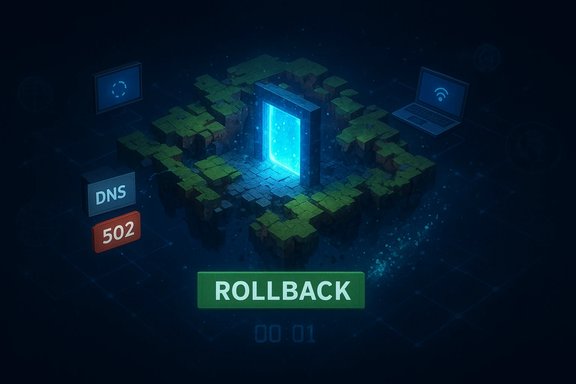
On October 29, 2025, telemetry and external monitors detected significant DNS, TLS and gateway errors affecting services fronted by Azure Front Door. Microsoft acknowledged an inadvertent configuration change in AFD as the proximate trigger, froze further AFD changes, and rolled back to a “last known good” configuration while failing management portals away from AFD to restore access. Those containment steps began recovery, but global DNS convergence and per‑tenant edge state extended the outage window for many users.This event is critically relevant to Minecraft Bedrock players because modern multiplayer and cloud features (Realms, authentication, cloud saves and cross‑platform matchmaking) depend on Microsoft Entra ID and the company’s global edge fabric. When those fronting layers misroute or drop traffic, the client cannot validate entitlements or obtain tokens, and the result is an authentication failure or a Realm that appears entirely unreachable.
What technically went wrong
Azure Front Door: the chokepoint
Azure Front Door (AFD) is a globally distributed, Layer‑7 edge and application delivery service that performs TLS termination, DNS‑level routing, Web Application Firewall (WAF) enforcement and global traffic steering. Because AFD sits at the ingress for thousands of Microsoft endpoints — including identity services (Microsoft Entra), the Microsoft Store, Xbox storefronts and game entitlement endpoints — a control‑plane misconfiguration propagating through AFD can make healthy backends look dead.The configuration change and its effects
Microsoft’s post‑incident narrative attributes the outage to an inadvertent configuration change in the AFD control plane. That change produced inconsistent DNS responses and routing anomalies across Points‑of‑Presence (PoPs), causing TLS handshake failures, gateway errors (502/504), token‑issuance timeouts and blank or partially rendered admin blades in the Azure Portal. The practical impact: login attempts failed, Realms could not be authorized, downloads and store purchases were delayed, and some consoles required restarts to re-establish connectivity.Why edge control‑plane failures are uniquely dangerous
Edge control planes are powerful because they accelerate and secure traffic at scale — but that same global reach creates a large blast radius when an error slips through validation and propagates. A misapplied host binding, route rule, DNS mapping or TLS configuration distributed across hundreds of PoPs can instantly render thousands of domains unreachable. Fixing such failures requires halting roll‑forwards, rolling back configurations, rebalancing traffic and waiting for DNS caches and ISPs to converge — a process that can take hours.The immediate player impact
What gamers saw
- Repeated launcher errors: many players saw messages that authentication servers could not be reached or that they needed to “authenticate to Microsoft services.”
- Realm disconnects: active Realms sessions dropped or refused new connections, preventing collaborative play.
- Store and download problems: Xbox storefront and Microsoft Store operations (purchases, downloads, Game Pass entitlements) stalled or failed.
- Single‑player difference: games that did not require re‑authorization or that were playable entirely offline continued to work for some users, but cross‑play and cloud‑backed features were blocked.
The community reaction
Outrage was swift and visible on social platforms and outage aggregators. Threads exploded with frustrated players demanding explanations, refunds, or offline modes that truly let them play without cloud checks. Sentiment ranged from practical troubleshooting (reboot consoles, sign out/in) to principled complaints about digital ownership and the fragility of cloud‑dependent experiences. The public anger was amplified because Minecraft is a deeply social game; being unable to join a Realm can instantly disrupt group events, servers, educational lessons and long‑running worlds.Microsoft’s response and timeline
- Detection: elevated latencies, DNS anomalies and gateway errors were detected in the mid‑afternoon UTC on October 29.
- Initial action: Microsoft posted incident notices pointing at Azure Front Door and suspected an inadvertent configuration change.
- Containment: engineers blocked further AFD configuration changes to prevent re‑propagation.
- Remediation: a rollback to the last‑known‑good configuration was deployed; critical management surfaces were failed away from AFD where feasible.
- Recovery: progressive restoration of PoPs and traffic rebalancing followed, with Microsoft reporting availability above 98% as recovery progressed; some users still experienced tenant‑specific residual issues due to caching and routing convergence.
Broader business and operational fallout
Not just Minecraft: collateral damage
Because AFD fronts many first‑party Microsoft properties and a large set of customer workloads, the outage’s visible surface included Microsoft 365 admin portals, Azure Portal blades, Xbox storefronts and thousands of third‑party websites that use AFD for ingress. Public reports and outage trackers recorded high peaks of incident reports for Azure and Microsoft 365 concurrent with gaming complaints. While outage tracker figures are useful directional indicators, exact tenant‑level impact and business losses require vendor and corporate confirmations.Real‑world consequences
Enterprises and public services that relied on Azure‑fronted endpoints reported customer‑facing disruptions during the window. Airlines, retail chains and even airports experienced degraded functionality in some reports — a reminder that cloud edge failures can spill into physical world operations. Those downstream impacts translate to delayed transactions, manual workarounds, dissatisfied customers and IT teams scrambling without full portal access in some cases.Why players are understandably furious — and where that fury points
Ownership and access
Many players feel a loss of ownership when a paid game or long‑running world becomes inaccessible because a remote identity check fails. The incident reinforced a broader unease: digital purchases and cloud‑backed services confer convenience, but they also concentrate control and risk in remote systems. When the sign‑in plane is down, paid content can become temporarily locked behind corporate infrastructure.Expectations vs reality
Gamers expect online features to be reliable; they also expect reasonable fallbacks. The intensity of the reaction is driven by contrast: Minecraft is often played across time zones with friends and communities, and losing access in the middle of an event is highly disruptive. Where trust breaks down is not only in the outage happening but in the sense that the dependency could have been prevented or better mitigated.Practical grievances, valid demands
Community anger often crystallizes into operational demands that are technically sensible:- Better offline fallbacks for features that do not strictly require live verification.
- Greater transparency and faster status updates during outages.
- Clear guidance for refunds, compensations or refunds for subscription‑based entitlements interrupted by provider downtime.
Technical analysis: root causes, safeguards and failures
Where validation and deployment controls likely failed
A global control‑plane change that escaped sufficient validation suggests a weakness in pre‑deployment gating, canarying or automated rollback triggers. Robust change‑control pipelines typically include staged rollouts, small canaries (geographically and tenant‑wise isolated), automated anomaly detection that halts propagation, and immediate automated rollback when control‑plane metrics diverge from expected norms. The incident indicates at least one of those protective layers failed or was bypassed.The tension between agility and safety
Hyperscale providers deploy frequent configuration changes to deliver features and security fixes. The engineering challenge is balancing the need for rapid change with the imperative of preventing global blast radius. More conservative global change windows, stronger automated validation of configuration semantics, and multi‑stage canarying can reduce the chance that an inadvertent change causes company‑wide disruption.Suggested provider and operator mitigations
- Harden control‑plane validation: schema checks, semantic validators and simulated propagation tests before global rollout.
- Canary at the edge: route a tiny, representative portion of traffic to a new config and validate behavior under real traffic.
- Automated rollback triggers: define clear, measurable thresholds that immediately revert changes on anomalies.
- Edge isolation: partition critical identity endpoints so that a single configuration domain cannot take down all authentication surfaces simultaneously.
Practical guidance for players, parents and server operators
Short‑term troubleshooting steps gamers should try
- Sign out and sign back in to the Microsoft Store / Xbox app; sometimes token refreshes resolve transient auth issues after partial recovery.
- Restart the launcher or the console/PC; DNS cache and local network state can interfere with recovery.
- For Windows players, verify system Date & Time is set to automatic — incorrect clocks can invalidate authentication tokens and masquerade as server errors.
- If access issues persist, check official Microsoft/Xbox status channels and avoid repeated purchases or account work while the service is unstable.
For Realm owners and server admins
- Maintain local backups of worlds and export periodic copies to a secondary location; offline copies are the most reliable recovery tool when cloud features fail.
- Consider alternative invitation methods or local LAN sessions during wide outages to keep community events running.
- Communicate proactively with players: transparency about backups and contingency plans reduces confusion and panic.
For IT teams and enterprise operators
- Map dependencies: identify which critical flows (authentication, checkout, admin portal) depend on AFD and edge control planes.
- Prepare programmatic fallbacks: when GUI admin portals fail, have PowerShell/CLI runbooks and pre-authorized service principals ready.
- Reassess SLAs: ensure contractual language covers control‑plane incidents and seek clarity on compensation and support obligations.
Wider industry implications
Concentration risk in the hyperscaler era
This outage followed a significant AWS incident earlier in the same month, highlighting a pattern: the internet relies on a handful of hyperscale platforms for critical routing, identity and edge services. When those platforms falter, effects cascade widely. The practical remedy is not to abandon cloud, but to design architectures that assume control‑plane failures are possible and build multi‑path redundancy for the most critical user journeys.Regulatory and contractual pressure
High‑visibility outages create pressure on providers to publish detailed post‑incident reports and strengthen change controls. Customers and regulators may demand clearer explanations of why safeguards failed and what actions will prevent recurrence. Enterprises should use these moments to renegotiate visibility, runbook obligations and SLA terms that explicitly address control‑plane failures.Limitations and cautionary notes
- Public outage‑aggregator numbers are useful but not authoritative. Peaks reported by services like Downdetector indicate user reports, not exact tenant counts; treat reported figures as directional unless multiple independent telemetry sources corroborate them.
- The deep causal chain — why the configuration passed validation — remains under Microsoft’s internal review. Any speculation beyond Microsoft’s acknowledged “inadvertent configuration change” should be labelled provisional until a formal post‑mortem is published.
Conclusion
The Minecraft Bedrock Realms outage was a vivid, public illustration of a broader cloud architecture reality: centralized edge control planes accelerate modern services but concentrate systemic risk. For Minecraft players, the incident was a painful interruption of social play and raised fresh questions about digital ownership and resilience. For platform operators and cloud architects, the outage is a call to action — strengthen control‑plane validation, adopt conservative canarying and rollback policies, and design multi‑path identity and routing fallbacks for critical user journeys.Microsoft’s containment steps — freezing AFD changes and rolling back to a validated configuration — were appropriate and restored most services within hours, but the episode exposed residual fragility that deserves rigorous post‑incident scrutiny. The practical takeaways are immediate: back up worlds, verify entitlements, prepare offline contingencies for community events, and for enterprises, audit and mitigate dependency on single control‑plane surfaces. The cloud has transformed how games like Minecraft are experienced and monetized; the next challenge is ensuring that convenience does not become a brittle single point of failure.
Source: Windows Report https://windowsreport.com/update-mi...rldwide-and-players-are-understandly-furious/
